Automatic recognition
by gait: progress and
prospects
Mark S. Nixon
John N. Carter
Michael G. Grant
Layla Gordon and
James B. Hayfron-Acquah
The authors
Mark S. Nixon, John N. Carter, Michael G. Grant, Layla GordonandJames B. Hayfron-Acquahare based at the Department of Electronics and Computer Science, University of Southampton, UK.
Keywords
Human physiology, Pattern recognition
Abstract
Recognising people by their gait is a biometric of increasing interest. Recently, analysis has progressed from evaluation by few techniques on small databases with encouraging results to large databases and still with encouraging results. The potential of gait as a biometric was encouraged by the considerable amount of evidence available, especially in biomechanics and literature. This potential motivated the development of new databases, new technique and more rigorous evaluation procedures. We adumbrate some of the new techniques we have developed and their evaluation to gain insight into the potential for gait as a biometric. In particular, we consider implications for the future. Our work, as with others, continues to provide encouraging results for gait as a biometric, let alone as a human identier, with a special regard for recognition at a distance.
Electronic access
The Emerald Research Register for this journal is available at
http://www.emeraldinsight.com/researchregister
The current issue and full text archive of this journal is available at
http://www.emeraldinsight.com/0260-2288.htm
1.1 Gait as a biometric
A unique advantage of gait as a biometric is that it offers potential for recognition at a distance or at low resolution, when other biometrics might not be perceivable (Nixonet al., 1999). Further, it is dif® cult to disguise gait without hampering progress, which is of particular interest in scene of crime analysis. Recognition can be based on the (static) human shape as well as on movement, suggesting a richer recognition cue. Further, gait can be used when other biometrics are obscured ± criminal intent might motivate concealment of the face, but it is dif® cult to conceal and/or disguise motion as this generally impedes movement.
There is much evidence to support the notion of using gait to recognise people. Shakespeare made several references to the individuality of gait, e.g.:
For that John Mortimer. . .in face, in gait in speech he doth resemble (Henry IV/II).
Further, the biomechanics literature makes similar observations:
A given person will perform his or her walking pattern in a fairly repeatable and characteristic way, suf® ciently unique that it is possible to recognize a person at a distance by their gait (Winter, 1991).
Similar observations can be found elsewhere, even in contemporary literature. Early medical studies (Murrayet al., 1964) established many of the basic tenets of gait analysis. These studies again suggested that gait appeared unique to subjects. Studies in psychology have progressed from establishing how humans can recognise subjects’ motion (Johannson, 1973), to recognising friends. Early approaches used marker-based
technology, but a later one used video imagery (Stevenageet al., 1999), also showing discrimination ability in poor illumination
Sensor Review
Volume 23 · Number 4 · 2003 · pp. 323–331
qMCB UP Limited · ISSN 0260-2288 DOI 10.1108/02602280310496845
conditions. As such there is much support for the notion of gait as a biometric.
1.2 Recognising people by their gait
Early approaches were limited to using more standard techniques processing silhouettes. These included analysing subjects’
trajectories (Niyogi and Adelson, 1994), principal components analysis (PCA)
(Murase and Sakai, 1996), moments (of ¯ ow) (Little and Boyd, 1998) and a combination of PCA with canonical analysis (CA) (Huang
et al., 1999). Only one approach used a model to analyse leg movement (Cunadoet al., 2003). This pattern is re¯ ected in the current approaches, all but one are based on analysis of silhouettes, including: the University of Maryland’s (UM’s) deployment of hidden Markov models (Kaleet al., 2002) and eigenanalysis (Abdelkaderet al., 2001); the National Institute for Standards in Technology/University of South Florida’s (NIST/USF’s) baseline approach matching silhouettes (Phillipset al., 2002a); Georgia Institute of Technology’s (GT’s) data derivation of stride pattern (Johnson and Bobick, 2001); Carnegie Mellon University’s (CMU’s) use of key frame analysis for sequence matching (Collinset al., 2002); Massachusetts Institute of Technology’s (MIT’s) ellipsoidal ® ts (Lee and Grimson, 2002); Curtin’s use of Point Distribution Models (Tassoneet al., 2002) and the Chinese Academy of Science’s eigenspace
transformation of an unwrapped human silhouette (Wanget al., 2002). These show promise for approaches that impose low computational and storage cost, together with deployment and development of new computer vision techniques for
sequence-based analysis. These factors have also motivated our newer approaches that range from a baseline-type approach by measuring area (Fosteret al., 2003) to extension of technique for object description including symmetry (Hayfron-Acquahet al., 2003) and statistical moments (Shutler and Nixon, 2001). Further, we have extended our model-based technique to include full limb movement (Yamet al., 2002a) and show how a model-based approach can facilitate greater application capabilities.
1.3 Database development
Early approaches used relatively small databases. This was largely enforced by
limited computational and storage
requirements at that time. It has been very encouraging to note that similar levels of discrimination can be achieved on the much larger datasets available. Naturally, the success and evolution of a new application relies largely on the dataset used for
evaluation. Accordingly, it is encouraging to note the rich variety of data that have been developed. These approaches include: UM’s surveillance data (Kaleet al., 2002); NIST/USF’s outdoor data, imaging subjects at a distance (Phillipset al., 2002b); GT’s data combines marker-based motion analysis with video imagery (Johnson and Bobick, 2001); CMU’s multi-view indoor data (Gross and Shi, 2001); and University of Southampton’s data (Shutleret al., 2002) which combines ground truth indoor data (processed by broadcast techniques) with video of the same subjects walking in an outdoor scenario (for computer vision analysis).
As gait is a behavioural biometric there is much potential for within-subject variation. This includes footwear, clothing and apparel. Application factors concern deployment via computer vision though none of the early databases allowed facility for such
consideration, save for striped trousers in an early Southampton database (aiming to allow for assessment of validity of a model-based approach). Our new databases sought to include more subjects so as to allow for an estimate of inter-subject variation, together with a limited estimate of intra-subject variation thus allowing for better assessment of the potential for gait as a biometric.
2. Advances in gait description and
analysis
2.1 New recognition approaches 2.1.1 Holistic/silhouette approaches
Essentially, we seek to process video images (Figure 1(a)) to derive silhouettes of the moving subject (Figure 1(b)) from which we derive numbers that re¯ ect the identity of the subject (Figure 1(c)). This then describes a subject, not just by shape but also by motion. As with earlier holistic approach (Huanget al., 1999), this is achieved (Shutler and Nixon, 2001) by reformulating a traditional
three such measures. The clustering re¯ ects that recognition can indeed be achieved.
Similarly, inclusion of time within a symmetry calculation can include
(Hayfron-Acquahet al., 2003) contributions of spatial and temporal symmetry. A modi® ed distance functional changes and the other functionals (phase and intensity) remain unchanged. In application, the temporal symmetry is derived for a sequence of images ® rst by edge detection. In common with other baseline approaches, we also sought to develop a fast technique with speci® city to gait (Fosteret al., 2003). This is achieved by using masking functions that are convolved to give a time variant signal describing gait. As it is a measure of area, not only it is fast in implementation, but it also allows for
speci® city to gait by choice of the masks used.
2.1.2 Model-based approaches
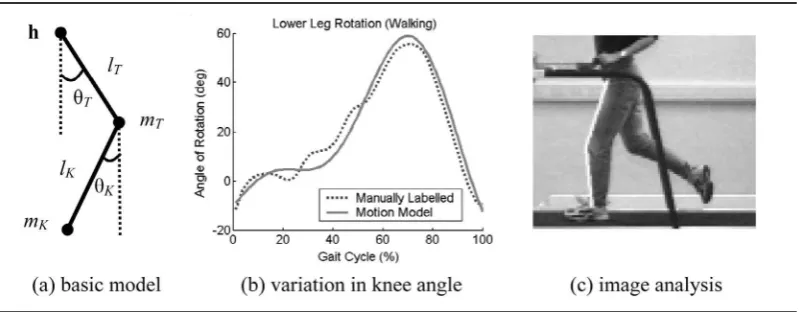
The earliest model-based approach relied on the use of frequency components of a thigh’s motion (Cunadoet al., 2003). Naturally, this should also offer facility to model running as well as walking. Accordingly, we extended the model to include both running and walking and to include the motion of the lower leg. This uses the concept of bilateral symmetry of the motion of the two legs, and phase coupling between the constituent sections. The new model provides a uni® ed model for walking and running, without the need for parameter selection (Yamet al., 2002a). The model is shown in Figure 2(a), the change in the knee angleyKwith time is shown in Figure 2(b)
superimposed on the analysis achieved by manual labelling. This can model successfully the motion of the thigh and the lower leg, for precise extraction of the thigh angle, and the lower leg angle, shown in Figure 2(c). This was achieved by considering the thigh as a free pendulum, forcing the motion of the lower leg, This model has been shown to have good effect on a separately developed database of
subjects who were ® lmed walking and running. This showed greater variation in the styles of running, consistent with the forced motion within a running gait. Further, the measures describing the transformation between walking and running were shown (Yamet al., 2002b) to have better
discriminatory capability than the individual measures (for walking and running alone), which appears to be since the transformation subsumes both running and walking.
In order to investigate the basic nature of gait, and the link between silhouette-based descriptions and the human skeleton, we have been developing an anatomically driven approach that employs new cyclic
descriptions for recognition. This model has been demonstrated to have a good effect on small laboratory databases (Yooet al., 2002), its target application is our laboratory data to acquire better understanding of the nature, and description, of gait. The motion of the skeleton derived from a silhouette sequence is shown in Figure 3(a) and the cyclogram derived from these new measures is shown in Figure 3(b).
3. Analysing recognition by gait
3.1 The Southampton database 3.1.1 Technological considerations
We sought to acquire two main databases: one of over 100 subjects to examine inter-subject distance (the difference between individuals), the other is of ten subjects and assesses intra-subject variance (the change within an individual subject). Given that digital video (DV) is now an established technology at reasonable cost and since our evaluation of quality suggested that it could be equal to that of conventional CCIR with A/D, and to reduce data volume, we chose DV (Shutler
[image:3.568.93.495.69.193.2]et al., 2002). We chose to acquire imagery via good quality progressive scan and interlaced
DV camcorders. The database construction software was Python (and XML for labelling); recognition implementations use standard languages, primarily for reasons of speed.
3.1.2 Database design
In order to provide an approximation to ground truth and acquire imagery for application analysis, we chose to ® lm subjects indoors and outdoors, respectively. Indoors, treadmills are most convenient for acquisition as long gait sequences can be acquired by their use though there is some debate as to how they can affect gait. Some studies hold that kinetics are affected rather than kinematics, but our experience with using untrained subjects and limitations on footwear and clothing motivated us to consider the track as the most suited for full analysis. The track was of the shape of a ª dog’s boneº , shown in Figure 4(a), so that subjects walked constantly and passed in front of the camera in both directions. The track was prepared with chromakey cloth (bright green, as this is an
[image:4.568.90.490.70.226.2]unusual clothes’ colour) and the background was illuminated by photo¯ ood lamps, seen from either end in Figure 4(b) and (c), viewed by cameras frontally, normally and at an oblique angle (an additional surveillance view is not shown). The arrangement enables chromakeyed subject separation from background, as in broadcast technology. On the treadmill, subjects were highlighted with diffuse spotlights and the treadmill was set at constant speed and inclination, aimed to support a conventional walk pattern. Psychology suggested that all personnel should be outside the laboratory during recording, to avoid any embarrassment and movement of the head during conversation. Further, a talk-only radio was used to ease familiarity with the laboratory. Placing a mirror in front of the treadmill aided balance and stopped the subject from looking at their feet and/or the treadmill control panel. Example images from the indoor data are shown in Figure 5. A similar track layout was used outdoors (Figure 1(a)), where the
Figure 3Anatomically-driven extraction and description (Yooet al., 2002)
[image:4.568.85.487.263.447.2]background contained a selection of objects such as foliage, pedestrian and vehicular traf® c, buildings (also for calibration) as well as occlusion by bicycles, cars and other subjects.
The imagery for the large database was completed with a high resolution still image of each subject in frontal and pro® le views, allowing for comparison with face recognition and for good estimates of body shape and size. Further, ten subjects were ® lmed on the track wearing a variety of footwear and clothing, carrying a variety of objects and at different times, to allow for estimation of intra-subject variability. The initial track data was
segmented into background and walking sequences and further labels were introduced for each heel strike and direction of walking. This information is associated with the data as XML; these labels include subject ingress, egress, direction of walk and heel-strikes, together with laboratory and camera set-up information recorded for each recording session. This allowed for basic analysis including manually imposed gait cycle labels. The treadmill and outside data were
segmented into background and walk (including direction) data only.
3.2 Recognition by gait 3.2.1 Overview
Our approaches process a sequence of images to provide a gait signature. Ideally, the
sequence of images is taken from heel-strike to the next heel strike of the same foot.
The holistic approaches require a silhouette to be derived, or optical ¯ ow (which describes motion), resulting in a set of connected points in each analysed image. These are then classi® ed. Here we use thek-nearest
neighbour approach to allow comparison with other approaches, whilst noting that more sophisticated classi® ers can offer better performance, often in respect of
generalization capability. The Euclidean distance metric is used to provide ranking lists describing the difference between signatures. Again, more sophisticated measures are available. In accordance with current practice, we used training, probe and gallery sets to develop sets of ranked lists and cumulative match scores.
3.2.2 Analysis of Southampton database ± recognition capability
To date, different recognition approaches, all holistic, have been applied to our new data, all with encouraging results. This analysis of the database suggests that it has indeed met its design objectives. First, high gait recognition performances have been
[image:5.568.85.493.71.198.2]achieved on the largest yet number of subjects for gait, an overview of these results via analysis by symmetry can be seen in Figure 6. The progression of these results re¯ ects the gradual construction of the databases. It is of note that symmetry has the most potent
[image:5.568.86.498.229.337.2]Figure 5Example data from Southampton’s gait databases (Shutleret al., 2002)
performance, moments have the greatest invariance properties whereas the area moments are formulated more for speed. These results show a recognition rate that is perhaps higher than originally anticipated. Other techniques equal this discriminatory capability (Johnson and Bobick, 2001; Kale
et al., 2002, 2003; Phillipset al., 2002a). Further outdoor investigation has been reported elsewhere (Nixonet al., 2002).
The distance analysis and the cumulative match score (CMS) are shown in Figure 7(a) and (b), respectively. The distance measures show that most subjects are clearly
distinguished by their gait and most classes are highly disparate (black represents similarity and white represents difference), but there is some potential for class confusion. This is re¯ ected by the CMS curve starting at over 80 per cent but note that 98 per cent correct of the probes are within nearly the ® rst 10 per cent of the gallery.
4. A future for gait?
The future for gait is unlikely to be just for biometric purposes. There are medical implications (for markerless gait), forensic implications (scene of crime analysis), and
potential links to animation and the ® lm industry. In terms of biometric deployment, it is not unlikely that subject extraction in complex scenarios will require full 3D extraction. In this respect, we sought to use our model-based approach to aid 3D subject extraction from multi-view image sequences. In this, we have developed a new
representation where reconstruction ® delity is dependent on view direction as well as on distance (Sharmanet al., 2002). One of the viewed images is shown in Figure 8(a), where a subject walked outside our gait laboratory and under conventional ª domesticº
illumination. The moving subject was extracted from the background, and
reconstructed with our new representation, as shown in Figure 8(b). A model of ambulatory human motion is then used to determine those points of the object with motion similar to that of the human thigh. The points so labelled are shown in Figure 8(c)
superimposed in 3D in white on one of the original images.
[image:6.568.85.489.72.139.2]One of the main motivations for 3D analysis concerns the non-linearity associated with gait. With change in viewing angle, the perceived motion of the leg will not be as shown in Figure 2(b). This motivates analysis
[image:6.568.82.488.570.774.2]Figure 7Data analysis descriptions
for viewpoint correction or generation of analysis that makes gait signatures invariant to view direction. We have shown (Spencer and Carter, 2002), in a laboratory scenario with images replicating human motion, that we can indeed correct for viewpoint using just the information present in the scene, rather than prede® ned geometrical analysis. Further, not all of the gait cycle depicted in Figure 2(b) is actually required for recognition purposes (Laxmiet al., 2002). By analysing motion captured joint data, we have shown on smaller databases that high recognition capability can be achieved by using only a fraction of the gait cycle, as opposed to the complete one.
There are many covariate factors in gait. In this respect, it is encouraging that gait’s progress has been helped, not only in database construction but also by early concentration on covariate factors. Though speed would appear to be a covariate, it has been studied as integral to the basic nature of gait
(Tanawongsuwan and Bobick, 2003). Further factors including carrying load and wearing different clothing have to be studied in one of the Southampton databases. Interestingly, increase in resolution can be performed in time as well as in space (Prismallet al., 2003). Figure 9 shows the ability to predict new frames from within a sequence of images, a new form of in-betweening speci® c to gait. Here, a missing frame (no. 10) is estimated from the one’s either side and the motion of
the leg is predicted well. This will allow for synchronising of multiple views.
The future also concerns other
applications. Essentially, we have ability to detect and describe gait without subject contact (Yamet al., 2002c). This lends itself to deeper analysis (for its use is now more convenient) as well as a richer application domain. We hope to deploy our analysis for medical use: we already have better ability to process larger databases automatically and look forward to new insight that this might bring. It could also lead to better animation, for our procedures, describe motion with accuracy and allow for analysis of ª averageº motion as well as individual motion. Since these differ from biometric use, we anticipate that there might be accompanying re® nement to our gait description techniques.
5. Conclusions
We ® rmly believe that by our new technique and results, gait continues to show
[image:7.568.83.495.65.190.2]encouraging potential as a biometric. We have constructed one of the largest gait databases, speci® cally designed to investigate the potential of gait as a biometric. The database allows for investigation of the inter- and intra-class subject variance. The techniques have speci® cally been designed to provide silhouette-based analysis with speci® city to gait, by generic formulation tailored to
[image:7.568.95.495.681.783.2]Figure 83D human extraction, reconstruction and analysis (Sharmanet al., 2002)
the target application and/or analysis. These techniques describe not only the shape, but also how it moves. We have also extended and demonstrated how a model-based approach can be used to recognise people by the way they walk and run. These studies continue to con® rm that gait is a richer study than it originally appeared. There are many avenues by which the already encouraging potential for gait as a biometric can be improved, and deployed.
References
Abdelkader, C.B., Cutler, R., Nanda, H. and Davis, L. (2001), “Eigengait: motion-based recognition using image self-similarity”,Proc. 3rd Audio- and Video-Based Biometric Person Authentication, pp. 289-94.
Collins, R., Gross, R. and Shi, J. (2002), “Silhouette-based human identication from body shape and gait”,
Proc. IEEE Conf. Face and Gesture Recognition ’02, pp. 366-71.
Cunado, D., Nixon, M.S. and Carter, J.N. (2003), “Automatic extraction and description of human gait models for recognition purposes”,Computer Vision and Image Understanding, Vol. 90 No. 1, pp. 1-41. Foster, J.P., Nixon, M.S. and Prugel-Bennet, A. (2003),
“Recognising movement and gait by masking functions”,Pattern Recog. Letters, June 2003. Gross, R. and Shi, J. (2001),The CMU Motion of Body
(MoBo) Database, CMU-RI-TR-01-18.
Hayfron-Acquah, J.B., Nixon, M.S. and Carter, J.N. (2003), “Automatic gait recognition by symmetry analysis”,
Pattern Recognition Letters, Vol. 24 No. 13, pp. 2175-83.
Huang, P.S., Harris, C.J. and Nixon, M.S. (1999), “Recognizing humans by gait via parametric canonical space”,Articial Intelligence in Engineering, Vol. 13 No. 4, pp. 359-66.
Johannson, G. (1973), “Visual perception of biological motion and a model for its analysis”,Perception and Psychophysics, Vol. 14, pp. 201-11.
Johnson, A.Y. and Bobick, A.F. (2001), “A multi-view method for gait recognition using static body parameters”,Proc. 3rd Audio- and Video-Based Biometric Person Authentication, pp. 301-11. Kale, A., Cuntoor, N., Yegnanarayana, B., Rajagopalan, A.
and Chellappa, R. (2003), “Gait analysis for human identication”,Proc. 4th Int. Conf. AVBPA 2003, pp. 706-14.
Kale, A., Rajagopalan, A.N., Cuntoor, N. and Kruger, V. (2002), “Gait-based recognition of humans using continuous HMMs”,IEEE Conf. Face and Gesture Recognition, pp. 336-41.
Laxmi, V.J., Carter, J.N. and Damper, R.I (2002), “Support vector machines and human gait classication”,
Proc. AutoID 2002, pp. 17-22.
Lee, L. and Grimson, W.E.L. (2002), “Gait analysis for recognition and classication”,Proc. IEEE Conf. Face and Gesture Recognition ’02, pp. 155-62.
Little, J. and Boyd, J. (1998), “Recognising people by their gait: the shape of motion”,Videre, International
Journal of Computer Vision, Vol. 14 No. 6, pp. 83-105.
Murase, H. and Sakai, R. (1996), “Moving object recognition in eigenspace representation: gait analysis and lip reading”,Pattern Recog. Letters, Vol. 17, pp. 155-62.
Murray, M.P., Drought, A.B. and Kory, R.C. (1964), “Walking patterns of normal men”,Journal of Bone and Joint Surgery, Vol. 46-A No. 2, pp. 335-60. Nixon, M.S., Carter, J.N., Shutler, J.D. and Grant, M.G.
(2002), “New advances in automatic gait recognition”,Elsevier Infn. Security Tech. Report, Vol. 7 No. 4, pp. 23-35.
Nixon, M.S., Carter, J.N., Cunado, D., Huang, P.S. and Stevenage, S.V. (1999), “Automatic gait
recognition”, in Jain, A.K., Bolle, R. and Pankanti, S. (Eds),Biometrics: Personal Identication in Networked Society, Kluwer Academic Publishing, Dordrecht, pp. 231-50.
Niyogi, S.A. and Adelson, E.H. (1994), “Analyzing and recognizing walking gures in XYT”,Proc. Conf. Comp. Vis. and Pattern Recog. 1994, pp. 469-74. Phillips, P.J., Sarkar, S., Robledo, I., Grother, P. and
Bowyer, K. (2002a), “Baseline results for the challenge problem of human ID using gait analysis”, Proc. IEEE Conf. Face and Gesture Recognition ’02, pp. 137-43.
Phillips, P.J., Sarkar, S., Robledo, I., Grother, P. and Bowyer, K. (2002b), “The gait identication challenge problem: data sets and baseline algorithm”,16th Int. Conf. Pattern Recog., pp. 385-9.
Prismall, S.P., Nixon, M.S. and Carter, J.N. (2003), “Novel temporal views of moving objects for gait biometrics”,Proc. 4th Int. Conf. AVBPA 2003, pp. 725-33.
Sharman, K.J., Nixon, M.S. and Carter, J.N. (2002), “Extraction and description of 3D (articulated) moving objects”,Proc. 3D Data Processing Visualisation Transmission, pp. 664-7.
Shutler, J.D. and Nixon, M.S. (2001), “Zernike velocity moments for description and recognition of moving shapes”,Proc. British Machine Vision Conference 2001, pp. 705-14.
Shutler, J.D., Grant, M.G., Nixon, M.S. and Carter, J.N. (2002), “On a large sequence-based human gait database”,Proc. 4th International Conf. on Recent Advances in Soft Computing, Nottingham, UK. Spencer, N. and Carter, J.N. (2002), “Viewpoint invariance
in automatic gait recognition”,Proc. AutoID 2002, pp. 1-6.
Stevenage, S.V., Nixon, M.S. and Vince, K. (1999), “Visual analysis of gait as a cue to identity”,Applied Cognitive Psychology, Vol. 13 No. 6, pp. 513-26.
Tanawongsuwan, R. and Bobick, A.F. (2003), “Performance analysis of time-distance gait parameters under different speeds”,Proc. 4th Int. Conf. AVBPA 2003, pp. 715-24.
Tassone, E., West, G. and Venkatesh, S. (2002), “Temporal PDMs for gait classication”,16th Int. Conf. Pattern Recog., pp. 1065-9.
Wang, L., Hu, W. and Tan, T. (2002), “A new attempt to gait-based human identication”,16th Int. Conf. Pattern Recog., pp. 115-19.
Yam, C-Y., Nixon, M.S. and Carter, J.N. (2002a), “Gait recognition by walking and running: a model-based approach”,Proc. Asian Conf. Computer Vision ACCV 2002, pp. 1-6.
Yam, C-Y., Nixon, M.S. and Carter, J.N. (2002b), “On the relationship of human walking and running: automatic person identication by gait”,16th Int. Conf. Pattern Recog., pp. 287-90.
Yam, C-Y., Nixon, M.S. and Carter, J.N. (2002c), “Automated markerless analysis of human walking and running by computer vision”,Proc. World Congress on Biomechanics.