Proceedings of the Workshop on Methods for Optimizing and Evaluating Neural Language Generation (NeuralGen), pages 1–10
1
An Adversarial Learning Framework For A Persona-Based Multi-Turn
Dialogue Model
Oluwatobi Olabiyi
Capital One Conversation Research Vienna VA
Anish Khazane
Capital One Conversation Research San Fransisco CA
Alan Salimov
Capital One Conversation Research San Fransisco CA
Erik T. Mueller
Capital One Conversation Research Vienna VA
Abstract
In this paper, we extend the persona-based sequence-to-sequence (Seq2Seq) neural net-work conversation model to a multi-turn di-alogue scenario by modifying the state-of-the-art hredGAN architecture to simultane-ously capture utterance attributes such as speaker identity, dialogue topic, speaker sen-timents and so on. The proposed system, phredGAN has a persona-based HRED gen-erator (PHRED) and a conditional discrimi-nator. We also explore two approaches to accomplish the conditional discriminator: (1)
phredGANa, a system that passes the
at-tribute representation as an additional input into a traditional adversarial discriminator, and (2)phredGANd, a dual discriminator system
which in addition to the adversarial discrimi-nator, collaboratively predicts the attribute(s) that generated the input utterance. To demon-strate the superior performance of phredGAN over the persona Seq2Seq model, we exper-iment with two conversational datasets, the Ubuntu Dialogue Corpus (UDC) and TV se-ries transcripts from the Big Bang Theory and Friends. Performance comparison is made with respect to a variety of quantitative mea-sures as well as crowd-sourced human evalu-ation. We also explore the trade-offs from us-ing either variant ofphredGAN on datasets with many but weak attribute modalities (such as with Big Bang Theory and Friends) and ones with few but strong attribute modali-ties (customer-agent interactions in Ubuntu dataset).
1 Introduction
Recent advances in machine learning especially with deep neural networks has lead to tremendous progress in natural language processing and dia-logue modeling research (Sutskever et al., 2014;
Vinyals and Le,2015;Serban et al.,2016). Nev-ertheless, developing a good conversation model
capable of fluent interaction between a human and a machine is still in its infancy stage. Most exist-ing work relies on limited dialogue history to pro-duce response with the assumption that the model parameters will capture all the modalities within a dataset. However, this is not true as dialogue cor-pora tend to be strongly multi-modal and practical neural network models find it difficult to disam-biguate characteristics such as speaker personality, location and sub-topic in the data.
Most work in this domain has primarily fo-cused on optimizing dialogue consistency. For example, Serban et al. (2016,2017b,a) andXing et al. (2017) introduced a Hierarchical Recurrent Encoder-Decoder (HRED) network architecture that combines a series of recurrent neural networks to capture long-term context state within a dia-logue. However, the HRED system suffers from lack of diversity and does not have any guaran-tee on the generator output since the output condi-tional probability is not calibrated. Olabiyi et al.
(2018) tackles these problems by training a modi-fied HRED generator alongside an adversarial dis-criminator in order to increase diversity and pro-vide a strong and calibrated guarantee to the gen-erator’s output. While the hredGAN system im-proves upon response quality, it does not cap-ture speaker and other attributes modality within a dataset and fails to generate persona specific re-sponses in datasets with multiple modalities.
speaker identity and interactions. Nguyen et al.
(2018) continue along the same line of thought by considering a Seq2Seq dialogue model with Responder-only representation. In both of these cases, the attribute representation is learned dur-ing the system traindur-ing. Zhang et al.(2018) pro-posed a slightly different approach. Here, the at-tributes are a set of sentences describing the profile of the speaker. In this case, the attributes represen-tation is not learned. The system however learns how to attend to different parts of the attributes during training. Still, the above persona-based models have limited dialogue history (single turn); suffer from exposure bias worsening the trade-off between personalization and conversation quality and cannot generate multiple responses given a di-alogue context. This is evident in the relatively short and generic responses produced by these sys-tems, even though they generally capture the per-sona of the speaker.
In order to overcome these limitations, we propose two variants of an adversarially trained persona conversational generative sys-tem, phredGAN, namely phredGANa and
phredGANd. Both systems aim to maintain the
response quality of hredGAN and still capture speaker and other attribute modalities within the conversation. In fact, both systems use the same generator architecture (PHRED generator), i.e., an hredGAN generator (Olabiyi et al., 2018) with additional utterance attribute representation at its encoder and decoder inputs as depicted in Figure 1. Conditioning on external attributes can be seen as another input modality as is the utterance into the underlying system. The attribute representation is an embedding that is learned together with the rest of model parameters similar to Li et al. (2016b). Injecting attributes into a multi-turn dialogue system allows the model to generate responses conditioned on particular attribute(s) across conversation turns. Since the attributes are discrete, it also allows for exploring different what-if scenarios of model responses. The difference between the two systems is in the discriminator architecture based on how the attribute is treated.
We train and sample both variants of
phredGAN similar to the procedure for
hredGAN (Olabiyi et al., 2018). To demon-strate model capability, we train on a customer service related data such as the Ubuntu Dialogue
Corpus (UDC) that is strongly bimodal between question poser and answerer, and transcripts from a multi-modal TV series The Big Bang Theory
and Friends with quantitative and qualitative analysis. We examine the trade-offs between using either system in bi-modal or multi-modal datasets, and demonstrate system superiority over state-of-the-art persona conversational models in terms of human evaluation of dialogue response quality as well as automatic evaluations with perplexity, BLEU, ROUGE and distinct n-gram scores.
2 Model Architecture
In this section, we briefly introduce the state-of-the-arthredGAN model and subsequently show how we derive the two persona versions by com-bining it with the distributed representation of the dialogue speaker and utterance attributes, or with an attribute discrimination layer at the end of the model pipeline.
2.1 hredGAN: Adversarial Learning Framework
Problem Formulation: ThehredGAN (Olabiyi et al., 2018) formulates multi-turn dialogue re-sponse generation as: given a dialogue history of sequence of utterances, xi = x1, x2,· · · , xi
, where each utterance xi = x1i, x2i,· · · , x
Mi
i
contains a variable-length sequence of Mi word tokens such that xij ∈ V for vocabulary V, the dialogue model produces an output yi =
yi1, yi2,· · · , yTi
i
, whereTiis the number of gen-erated tokens. The framework uses conditional GAN structure to learn a mapping from an ob-served dialogue history to a sequence of output tokens. The generator, G, is trained to produce sequences that cannot be distinguished from the ground truth by an adversarially trained discrimi-nator,Dakin to a two-player min-max optimiza-tion problem. The generator is also trained to min-imize the cross-entropy loss LM LE(G) between
the ground truthxi+1, and the generator outputyi. The following objective summarizes both goals:
G∗, D∗ =arg min
G maxD λGLcGAN(G, D)+ λMLM LE(G)
.
(1)
whereλGandλM are training hyperparamters and
Figure 1: The PHRED generator with local attention - The attributesc, allows the generator to condition its response on the utterance attributes such as speaker identity, subtopics and so on.
(5) and (7) of Olabiyi et al. (2018) respectively. Please note that the generatorGand discriminator
Dshare the same encoder and embedding repre-sentation of the word tokens.
2.2 phredGAN: Persona Adversarial Learning Framework
The proposed architecture ofphredGAN is very similar to that ofhredGAN(Olabiyi et al.,2018). The only difference is that the dialogue history is nowxi = (x1, c1),(x2, c2),· · ·,(xi, ci)
where
ci is additional input that represents the speaker
and/or utterance attributes. Please note thatci can either be a sequence of tokens or single token such that cij ∈ V c for vocabulary V c. Also, at the ithturn,ciandci+1 are the source/input attribute and target/output attribute to the generator respec-tively. The embedding for attribute tokens is also learned similar to that of word tokens.
Both versions of phredGAN shares the same generator architecture (PHRED) but different dis-criminators. Below is the highlight of how they are derived from thehredGANarchitecture.
Encoder: The context RNN,cRN N takes the source attributeci as an additional input by
con-catenating its representation with the output of
eRN N as in Figure1. If the attribute ci is a se-quence of tokens, then an attention (using the out-put ofeRN N) over the source attribute represen-tations is concatenated with the output ofeRN N. This output is used by the generator to create a context state for a turni.
Generator: The generator decoder RNN,
dRN N takes the target attribute ci+1 as an ad-ditional input as in Fig. 1. If the attribute ci+1 is a sequence of tokens, then an attention (using the output ofdRN N) over the attribute represen-tations is concatenated with the rest of the decoder inputs. This forces the generator to draw a con-nection between the generated responses and the utterance attributes such as speaker identity.
Noise Injection: As inOlabiyi et al.(2018), we also explore different noise injection methods.
Objective: For phredGAN, the optimization objective in eq. (1) can be updated as:
G∗, D∗adv, Datt∗ =arg min G max
Dadv
λGadvL
adv
cGAN(G, Dadv)
+min
Datt
λGattL
att
c (G, Datt)
+λMLM LE(G)
. (2)
whereLadv
cGAN(G, Dadv)andLattc (G, Datt)are the
traditional adversarial and attribute prediction loss respectively and dependent on the architectural variation. It is worth to point out that while the former is adversarial, the later is collaborative in nature. The MLE loss is common and can be ex-pressed as:
LM LE(G) =Exi+1[−log PG xi+1|xi, ci+1, zi
].
(3) where zi the noise sample and depends on the
2.3 phredGANa: Attributes as a
Discriminator Input
phredGANashares the same discriminator archi-tecture as the hredGAN but with additional in-put,ci+1. Since it does not use attribute prediction,
λGatt = 0.
The adversarial loss,Ladv
cGAN(G, D)can then be
expressed as:
LadvcGAN(G, Dadv) =
Exi,ci+1,xi+1[logDadv(xi, ci+1, xi+1)]+
Exi,ci+1,zi[1−logDadv(xi, ci+1, G(xi, ci+1, zi))]
(4)
The addition of speaker or utterance attributes al-lows the dialogue model to exhibit personality traits given consistent responses across style, gen-der, location, and so on.
2.4 phredGANd: Attributes as a
Discriminator Target
phredGANddoes not take the attribute
represen-tation at its input but rather uses the attributes as the target of an additional discriminatorDatt. The
adversarial and the attribute prediction losses can be respectively expressed as:
LadvcGAN(G, Dadv) =Exi,xi+1[logDadv(xi, xi+1)]
+Exi,zi[1−logDadv(xi, G(xi, ci+1, zi))]
(5)
Latt
c (G, Datt) =Eci+1[−logDatt(ci+1|xi, xi+1)]
+Eci+1[−logDatt(ci+1|xi, G(xi, ci+1, zi))]
(6)
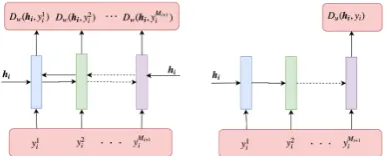
Attribute Discriminator: In addition to the ex-isting word-level adversarial discriminator Dadv
fromhredGAN, we add an attribute discrimina-tor,Datt, that discriminates on an utterance level
to capture attribute modalities since attributes are assigned at utterance level. The discriminator uses a unidirectional RNN (DattRN N) that maps the
in-put utterance to the particular attribute(s) that gen-erated it. The attributes can be seen as hidden states that inform or shape the generator outputs. The attribute discriminator can be expressed as:
Datt(ci+1|xi, χ) =DattRN N(hi, E(χ)) (7)
[image:4.595.309.503.64.142.2]where E(.) is the word embedding lookup (Olabiyi et al., 2018),χ = xi+1 for groundtruth andχ=yifor the generator output.
Figure 2: The phredGANd dual discriminator
-Left:Dadvis a word-level discriminator used by both
phredGANa andphredGANd to judge normal
dia-logue coherency as in hredGAN. Right: Datt, an
utterance-level attribute discriminator is used only in
phredGANdto predict the likelihood a given utterance
was generated from a particular attribute.
3 Model Training and Inference
3.1 Model Training
We train both the generator and the discrimi-nator (with shared encoder) of both variants of
phredGAN using the training procedure in Al-gorithm 1 (Olabiyi et al., 2018). For both vari-ants,λGadv =λM = 1, and forphredGANaand
phredGANd, λGatt = 0 andλGatt = 1
respec-tively. Since the encoder, word embedding and at-tribute embedding are shared, we are able to train the system end-to-end with back-propagation.
Encoder: The encoder RNN, eRN N, is bidi-rectional whilecRRN is unidirectional. All RNN units are 3-layer GRU cell with hidden state size of 512. We use word vocabulary size,V = 50,000
with word embedding size of 512. The number of attributes,V c is dataset dependent but we use an attribute embedding size of 512. In this study, we only use one attribute per utterance so there is no need to use an attention mechanism to combine the attribute embeddings.
Generator: The generator decoder RNN,
dRN N is also a 3-layer GRU cell with hidden state size of 512. The aRN N outputs are con-nected to the dRN N input using an additive at-tention mechanism (Bahdanau et al.,2015).
embed-Algorithm 1 Adversarial Learning of phredGAN
Require: A generatorGwith parametersθG.
Require: An adversarial discriminatorDadvwith parametersθDadv. Require: An attribute discriminatorDattwith parametersθDatt. Require: Training hyperparameters,isT arget,λGatt,λGadv, andλM.
fornumber of training iterationsdo
InitializecRN Nto zero state,h0
Sample a mini-batch of conversations,x = {xi, ci}Ni=1,xi =
(x1, c1),(x2, c2),· · ·,(xi, ci)withNutterances. Each
utter-ance mini batchicontainsMiword tokens. fori= 1toN−1do
Update the context state.
hi=cRN N(eRN N(E(xi)),hi−1, ci)
Compute the generator output similar to Eq. (11) in (Olabiyi et al., 2018).
PθG yi|, zi,xi, ci+1 =
PθG yji|xi+11:j−1, zji,xi, ci+1 Mi+1j=1
Sample a corresponding mini batch of utteranceyi. yi∼PθG yi|, zi,xi, ci+1
end for
Compute the adversarial discriminator accuracyDaccadvoverN−1 ut-terances{yi}Ni=1−1and{xi+1}Ni=1−1
ifDacc
adv< accDthadvthen ifisT argetthen
UpdatephredGANd’sθDadvandθDatt. P
i [∇θD
advlogDadv(hi, xi+1) +∇θDadvlog 1 − Dadv(hi, yi)+∇θDatt−logDatt(ci+1|hi, xi+1)]
else
UpdatephredGANa’sθDadvwith gradient of the
discrimi-nator loss.
P
i [∇θD
advlogDadv(hi, ci+1, xi+1) +
∇θD
advlog 1−Dadv(hi, ci+1, yi)
] end if
end if
ifDadvacc< accGththen
UpdateθGwith the generator’s MLE loss only. P
i
[∇θG−logPθG yi|, zi,xi, ci+1] else
UpdateθGwith attribute, adversarial and MLE losses. P
i
[λGatt∇θG−logDatt(ci+1|hi, yi) + λGadv∇θGlogDadv(hi, ci+1, yi) + λM∇θG−logPθG yi|, zi,xi, ci+1]
end if end for
ding.
Attribute Discriminator: The attribute dis-criminator RNN, DattRN N is a unidirectional
RNN with a 3-layer GRU cell, each of hidden state size 512. A softmax layer is then applied to project the final hidden state to a prespecified number of attributes,Vc. The output is the probability distri-bution over the attributes.
Others: All parameters are initialized with Xavier uniform random initialization (Glorot and Bengio,2010). Due to the large word vocabulary size, we use sampled softmax loss (Jean et al.,
2015) for MLE loss to expedite the training pro-cess. However, we use full softmax for model evaluation. For both systems, parameters updates are conditioned on the word-level discriminator accuracy performance as in Olabiyi et al. (2018) with accDth
adv = 0.99 and accGth = 0.75. The
model is trained end-to-end using the stochastic
gradient descent algorithm. Finally, the model is implemented, trained, and evaluated using the TensorFlow deep learning framework.
3.2 Model Inference
We use an inference strategy similar to the ap-proach inOlabiyi et al.(2018).
For the modified noise sample, we perform a linear search for α with sample size L = 1
based on the average word-level discriminator loss,−logDadv(G(.))(Olabiyi et al.,2018) using trained models run in autoregressive mode to re-flect performance in actual deployment. The op-timumαvalue is then used for all inferences and evaluations. During inference, we condition the dialogue response generation on the encoder out-puts, noise samples, word embedding and the at-tribute embedding of the intended responder. With multiple noise samples, L = 64, we rank the generator outputs by the discriminator which is also conditioned on encoder outputs, and the in-tended responder’s attribute embedding. The final response is the response ranked highest by the dis-criminator. ForphredGANd, we average the
con-fidences produced byDadvandDatt.
4 Experiments and Results
In this section, we explore the performance of PHRED, phredGANa and phredGANd on two
conversational datasets and compare their perfor-mances to non-adversarial persona Seq2seq mod-els (Li et al.,2016b) as well as to the adversarial
hredGAN (Olabiyi et al.,2018) with no explicit persona.
4.1 Datasets
TV Series Transcripts dataset (Serban et al.,
2016). We train all models on transcripts from two popular TV drama series, Big Bang Theory and Friends. Following a similar preprocessing setup inLi et al.(2016b), we collect utterances from the top 12 speakers from both series to construct a cor-pus of 5,008 lines of multi-turn dialogue. We split the corpus into training, development, and test set with a 94%, 3%, and 3% proportions, respectively, and pair each set with a corresponding attribute file that maps speaker IDs to utterances in the com-bined dataset.
(2012) which consists of 240,000 dialogue triples. We pre-train the models on this dataset to initial-ize the model parameters to avoid overfitting on a relatively small persona TV series dataset. After pre-training on MTC, we reinitialize the attribute embeddings in the generator from a uniform dis-tribution following a Xavier initialization (Glorot and Bengio, 2010) for training on the combined person TV series dataset.
Ubuntu Dialogue Corpus(UDC) dataset ( Ser-ban et al., 2017b). We train the models on 1.85 million conversations of multi-turn dialogue from the Ubuntu community hub, with an average of 5 utterances per conversation. We assign two types of speaker IDs to utterances in this dataset: ques-tioner and helper. We follow a similar training, development, and test split as the UDC dataset in
Olabiyi et al.(2018), with 90%, 5%, and 5% pro-portions, respectively, and pair each set with a cor-responding attribute file that maps speaker IDs to utterances in the combined dataset
While the overwhelming majority of utterances in UDC follow two speaker types, the dataset does include utterances that do not classify under either a questioner or helper speaker type. In order to remain consistent, we assume that there are only two speaker types within this dataset and that the first utterance of every dialogue is from a ques-tioner. This simplifying assumption does intro-duce a degree of noise into each persona model’s ability to construct attribute embeddings. How-ever, our experiment results demonstrate that both
phredGANa and phredGANd are still able to differentiate between the larger two speaker types in the dataset.
4.2 Evaluation Metrics
We use similar evaluation metrics as in Olabiyi et al.(2018) including perplexity, BLEU (Papineni et al.,2002), ROUGE (Lin,2014), distinct n-gram (Li et al.,2016a) and normalized average sequence length (NASL) scores. For human evaluation, we follow a similar setup as Li et al. (2016a), em-ploying crowd-sourced judges to evaluate a ran-dom selection of 200 samples. We present both the multi-turn context and the generated responses from the models to 3 judges and asked them to rank the general response quality in terms of rele-vance, informativeness, and persona. ForN mod-els, the model with the lowest quality is assigned a score 0 and the highest is assigned a score
N-1. Ties are not allowed. The scores are normal-ized between 0 and 1 and averaged over the total number of samples and judges. For each model, we also estimate the per sample score variance be-tween judges and then average over the number of samples, i.e., sum of variances divided by the square of number of samples (assuming sample in-dependence). The square root of result is reported as the standard error of the human judgement for the model.
4.3 Baseline
We compare the non-adversarial persona HRED model, PHRED with the adversarially trained
ones, i.e. hredGAN, phredGANa and
phredGANd, to demonstrate the impact of
adver-sarial training. Please note that no noise was added to the PHRED model.
We also compare the persona models to Li et al.’s work (Li et al., 2016b) which uses a Seq2Seq framework in conjunction with learnable persona embeddings. Their work explores two persona models in order to incorporate vector rep-resentations of speaker interaction and speaker at-tributes into the decoder of their Seq2Seq models i.e., Speaker model (SM) and Speaker-Addressee model (SAM). All reported results are based on our implementation of their models in Li et al.
(2016b).
4.4 Hyperparameter Search
For both phredGANa and phredGANd, we de-termine the noise injection method and the op-timum noise variance α that allows for the best performance on both datasets. We find that
phredGANdperforms optimally with word-level
noise injection on both Ubuntu and TV tran-scripts, while phredGANa performs the best
with utterance-level noise injection on TV tran-scripts and word-level injection on UDC. For all
phredGAN models, we perform a linear search for optimal noise variance values between 1 and 30 at an increment of 1, with a sample size of
L = 1. For phredGANd, we obtain an optimal αof 4 and 6 for the UDC and TV Transcripts re-spectively. ForphredGANa, we obtain an
opti-mal value of 2 and 5 for the combined TV series dataset and the much larger UDC respectively.
4.5 Results
Table 1:phredGANvs.Li et al.(2016b) on BBT Friends TV Transcripts.
Model Teacher Forcing Autoregression Human
Perplexity BLEU ROUGE-2 DISTINCT-1/2 NASL Evaluation
TV Series
SM 22.13 1.76 % 22.4 % 2.50%/18.95% 0.786 0.5566±0.0328
SAM 23.06 1.86 % 20.52 % 2.56%/18.91% 0.689 0.5375±0.0464
hredGAN 28.15 2.14 % 6.81 % 1.85 %/6.93 % 1.135 0.5078±0.0382
phred 30.94 2.41 % 14.03 % 0.66 %/2.54 % 1.216 0.3663±0.0883
phredGANa 25.10 3.07 % 30.47 % 2.19 %/19.02 % 1.218 0.6127±0.0498
phredGANd 28.19 2.76 % 14.68 % 0.70 %/4.76 % 1.163 0.4284±0.0337
Table 2:phredGAN vs.Li et al.(2016b) on UDC.
Model Teacher Forcing Autoregression Human
Perplexity BLEU-2/4 ROUGE-2 DISTINCT-1/2 NASL Evaluation
UDC
SM 28.32 0.437%/∼0% 9.19 % 1.61%/5.79% 0.506 0.4170±0.0396 SAM 26.12 0.490%/∼0% 10.23 % 1.85%/6.85% 0.512 0.4629±0.0171
hredGAN 48.18 2.16%/∼0% 11.68 % 5.16%/18.21% 1.098 0.5876±0.0532
phred 34.67 0.16%/∼0% 7.41% 0.56%/1.44% 0.397 0.4399±0.0445
phredGANa 31.25 1.94%/∼0% 19.15% 1.05%/5.28% 1.520 0.4920±0.0167
phredGANd 28.74 2.02%/0.10% 16.82% 1.38%/5.77% 1.387 0.5817±0.0615
baselines, PHRED,hredGANand Li et al.’s per-sona Seq2Seq models.
4.6 Quantitative Analysis
We first report the performance on TV series tran-scripts in table 1. The performance of both SM and SAM models in Li et al. (2016b) compared to the hredGAN shows a strong baseline and in-dicates that the effect of persona is more impor-tant than that of multi-turn and adversarial training for datasets with weak multiple persona. How-ever, once the persona information is added to the hredGAN, the resulting phredGAN shows a significant improvement over the SM and SAM baselines withphredGANaperforming best. We also observe that PHRED performs worse than the baseline S(A)M models on a number of metrics but we attribute this to the effect of persona on a limited dataset that results into less informative responses. This behavior was also reported inLi et al.(2016b) where the persona models produce less informative responses than the non-personal Seq2seq models but it seems to be even worse in multi-turn context. However, unlike the Speaker-Addressee and PHRED models that suffer from lower response quality due to persona condition-ing, we note that conditioning the generator and discriminator of phredGAN on speaker embed-dings does not compromise the systems ability to
produce diverse responses. This problem might have been alleviated by the adversarial training that encourages the generator model to produce longer, more informative, and diverse responses that have high persona relevance even with a lim-ited dataset.
We also compare the models performances on the UDC. The evaluation result is summarized in table 2. While the deleterious effect of per-sona conditioning on response diversity is still worse with PHRED than with S(A)M models, we note that hredGAN performs much better than the S(A)M models. This is because, the exter-nal persona only provides just a little more infor-mation than is already available from the UDC utterances. Therefore, performance on UDC is mostly driven by longer dialogue context and ad-versarial training. We also note an improvement ofphredGAN variants over the hredGAN in a variety of evaluation metrics including perplexity, ROUGE with the exception of distinct n-grams. This is expected asphredGAN should be gener-ally less diverse than hredGAN since each per-sona attribute of phredGAN covers only a lim-ited region of the data distribution. This, how-ever, leads to better response quality with persona, something not achievable withhredGAN. Also, the much better ROUGE(F1) score indicates that
be-tween diversity and precision while still capturing the characteristics of the speaker attribute modal-ity in the UDC dataset. Within the phredGAN
variants, phredGANd seems to perform better.
This is not surprising as speaker classification is much easier on UDC than on TV series. The at-tribute discriminator,Dattis able to provide more
informative feedback on UDC than on TV series where it is more difficult to accurately predict the speaker. Therefore, we recommendphredGANa
for datasets with weak attribute distinction and
phredGANdfor strong attribute distinction.
4.7 Qualitative Analysis1
In addition to the quantitative analysis above, we report the results of the human evaluation in the last column of Tables1and2for the TV Series and UDC datasets respectively. The human evaluation scores largely agrees with the automatic evalua-tions on the TV Series withphredGANa clearly giving the best performance. However, on the UDC, bothhredGANandphredGANdperforms
similarly which indicates that there is a trade off between diversity and persona by each model. We believe this is due to the strong persona informa-tion that already exists in the UDC utterances.
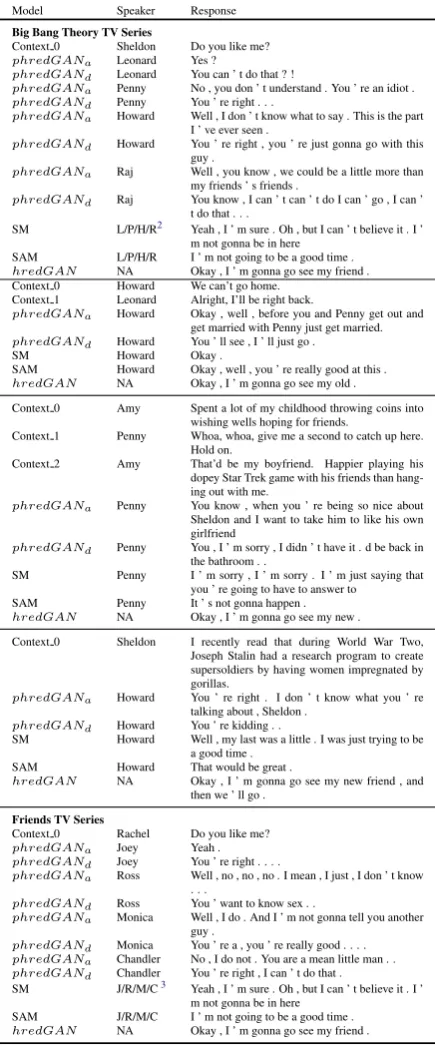
An additional qualitative assessment of these re-sults are in Table 3 with responses from several characters in the TV series dataset and the two characters in UDC.
We see that for TV drama series, phredGAN
responses are comparatively more informative than that of the Speaker-Addressee model of Li et al.(2016b). For example, all the characters in the TV series respond the same to the dialogue context. Similar behavior is reported in Li et al.
(2016b) where for the Speaker-Addressee model, nearly all the characters in the TV series respond with “Of course I love you.” to the dialogue con-text, “Do you love me?” despite the fact that some of the responders sometimes have unfriendly rela-tionship with the addressee. Many of the novel sit-uations explored byphredGAN are unachievable with the Speaker-Addressee model due to lack of informative responses. For example, by condition-ing as Sheldon from The Big Bang Theory and asking “Do you like me?”, our model responds with annoyance if conditioned as Penny (“No, you don’t understand. You’re an idiot”), brevity with
1Tables 3, 4 and 5 referenced in this section are in the
appendix.
Leonard (“Yes?”) and sarcasm with Raj (“Well , you know , we could be a little more than my friend’s friends.”) The wide range of responses in-dicate our model’s ability to construct distinct at-tribute embeddings for each character even from a limited dataset. The other interesting responses in Table3indicatephredGAN’s ability to infer not only the context of the conversation but important character information about the addressee.
We also see similar results with our model’s out-put on UDC in Table4. We demonstrate that by conditioning as either a helper or questioner from the UDC dataset,phredGAN models are able to respond differently to input utterances as well as stay close to the context of the conversation. For the purpose of completeness, we also show some samples from PHRED generator on both UDC and TV series dataset in Table5.
5 Conclusion and Future Work
In this paper, we improve upon state-of-the-art persona-based response generation models by exploring two persona conversational models:
phredGANawhich passes the attribute represen-tation as an additional input into a traditional ad-versarial discriminator, and phredGANd a dual
discriminator system which in addition to the ad-versarial discriminator from hredGAN, collab-oratively predicts the attribute(s) that are intrin-sic to the input utterance. Both systems demon-strate quantitative improvements upon state-of-the-art persona conversational systems such as the work fromLi et al. (2016b) with respect to both quantitative automatic and qualitative human mea-sures.
Our analysis also demonstrates how both variants of phredGAN perform differently on datasets with weak and strong modality. One of our future direction is to take advantage of
phredGANd’s ability to predict utterance
References
D. Bahdanau, K. Cho, and Y. Bengio. 2015. Neural machine translation by jointly learning to align and translate. In Proceedings of International Confer-ence of Learning Representation (ICLR 2015).
R. E. Banchs. 2012. Movie-dic: A movie dialogue cor-pus for research and development. InProceedings of the 50th Annual Meeting of the Association for Computational Linguistics, pages 203–207.
X. Glorot and Y. Bengio. 2010. Understanding the dif-ficulty of training deep feedforward neural networks. InInternational conference on artificial intelligence and statistics.
S. Jean, K. Cho, R. Memisevic, and Y. Bengio. 2015. On using very large target vocabulary for neural machine translation. In arXiv preprint arXiv:1412.2007.
J. Li, M. Galley, C. Brockett, J. Gao, and B. Dolan. 2016a. A diversity-promoting objective function for neural conversation models. In Proceedings of NAACL-HLT.
J. Li, M. Galley, C. Brockett, G. Spithourakis, J. Gao, and B. Dolan. 2016b. A persona-based neural con-versation model. InProceedings of the 54th Annual Meeting of the Association for Computational Lin-guistics, pages 994–1003.
C. Y. Lin. 2014. Rouge: a package for automatic evalu-ation of summaries. InProceedings of the Workshop on Text Summarization Branches Out.
H. Nguyen, D. Morales, and T. Chin. 2018. A neural chatbot with personality. InStanford NLP Course website: https://web.stanford.edu/class/cs224n/ re-ports/2761115.pdf.
O. Olabiyi, A. Salimov, A. Khazane, and E. Mueller. 2018. Multi-turn dialogue response generation in an adversarial learning framework. In arXiv preprint arXiv:1805.11752.
K. Papineni, S. Roukos, T. Ward, and W. Zhu. 2002. Bleu: A method for automatic evalution of machine translation. InProceedings of the 40th Annual Meet-ing of the Association for Computational LMeet-inguis- Linguis-tics, pages 311–318.
I. Serban, A. Sordoni, Y. Bengio, A. Courville, and J. Pineau. 2016. Building end-to-end dialogue sys-tems using generative hierarchical neural network models. InProceedings of The Thirtieth AAAI Con-ference on Artificial Intelligence (AAAI 2016), pages 3776–3784.
I. V. Serban, T. Klinger, G. Tesauro, K. Talamadupula, B. Zhou, Y. Bengio, and A. Courville. 2017a. Mul-tiresolution recurrent neural networks: An applica-tion to dialogue response generaapplica-tion. In Proceed-ings of The Thirty-first AAAI Conference on Artifi-cial Intelligence (AAAI 2017).
I. V. Serban, A. Sordoni, R. Lowe, L. Charlin, J. Pineau, A. Courville, and Y. Bengio. 2017b. A hierarchical latent variable encoder-decoder model for generating dialogue. In Proceedings of The Thirty-first AAAI Conference on Artificial Intelli-gence (AAAI 2017).
I. Sutskever, O. Vinyals, and Q. Le. 2014. Sequence to sequence learning with neural networks. In ceedings of Advances in Neural Information Pro-cessing Systems (NIPS), pages 3104–3112.
O. Vinyals and Q. Le. 2015. A neural conversational model. In Proceedings of ICML Deep Learning Workshop.
C. Xing, W. Wu, Y. Wu, M. Zhou, Y. Huang, and W. Ma. 2017. Hierarchical recurrent attention net-work for response generation. In arXiv preprint arXiv:1701.07149.
A Appendix
Table 3:hredGANvsphredGANvsLi et al.(2016b) on TV Transcripts
Model Speaker Response
Big Bang Theory TV Series
Context 0 Sheldon Do you like me?
phredGANa Leonard Yes ?
phredGANd Leonard You can ’ t do that ? !
phredGANa Penny No , you don ’ t understand . You ’ re an idiot . phredGANd Penny You ’ re right . . .
phredGANa Howard Well , I don ’ t know what to say . This is the part
I ’ ve ever seen .
phredGANd Howard You ’ re right , you ’ re just gonna go with this
guy .
phredGANa Raj Well , you know , we could be a little more than
my friends ’ s friends .
phredGANd Raj You know , I can ’ t can ’ t do I can ’ go , I can ’
t do that . . .
SM L/P/H/R2 Yeah , I ’ m sure . Oh , but I can ’ t believe it . I ’ m not gonna be in here
SAM L/P/H/R I ’ m not going to be a good time .
hredGAN NA Okay , I ’ m gonna go see my friend . Context 0 Howard We can’t go home.
Context 1 Leonard Alright, I’ll be right back.
phredGANa Howard Okay , well , before you and Penny get out and get married with Penny just get married.
phredGANd Howard You ’ ll see , I ’ ll just go .
SM Howard Okay .
SAM Howard Okay , well , you ’ re really good at this .
hredGAN NA Okay , I ’ m gonna go see my old .
Context 0 Amy Spent a lot of my childhood throwing coins into wishing wells hoping for friends.
Context 1 Penny Whoa, whoa, give me a second to catch up here. Hold on.
Context 2 Amy That’d be my boyfriend. Happier playing his dopey Star Trek game with his friends than hang-ing out with me.
phredGANa Penny You know , when you ’ re being so nice about
Sheldon and I want to take him to like his own girlfriend
phredGANd Penny You , I ’ m sorry , I didn ’ t have it . d be back in the bathroom . .
SM Penny I ’ m sorry , I ’ m sorry . I ’ m just saying that you ’ re going to have to answer to SAM Penny It ’ s not gonna happen .
hredGAN NA Okay , I ’ m gonna go see my new .
Context 0 Sheldon I recently read that during World War Two, Joseph Stalin had a research program to create supersoldiers by having women impregnated by gorillas.
phredGANa Howard You ’ re right . I don ’ t know what you ’ re
talking about , Sheldon .
phredGANd Howard You ’ re kidding . .
SM Howard Well , my last was a little . I was just trying to be a good time .
SAM Howard That would be great .
hredGAN NA Okay , I ’ m gonna go see my new friend , and then we ’ ll go .
Friends TV Series
Context 0 Rachel Do you like me?
phredGANa Joey Yeah . phredGANd Joey You ’ re right . . . .
phredGANa Ross Well , no , no , no . I mean , I just , I don ’ t know . . .
phredGANd Ross You ’ want to know sex . .
phredGANa Monica Well , I do . And I ’ m not gonna tell you another
guy .
phredGANd Monica You ’ re a , you ’ re really good . . . . phredGANa Chandler No , I do not . You are a mean little man . .
phredGANd Chandler You ’ re right , I can ’ t do that .
SM J/R/M/C3 Yeah , I ’ m sure . Oh , but I can ’ t believe it . I ’
m not gonna be in here SAM J/R/M/C I ’ m not going to be a good time .
hredGAN NA Okay , I ’ m gonna go see my friend .
2
Actors: Leonard/Penny/Howard/Raj
[image:10.595.307.526.168.437.2]3Actors: Joey/Ross/Monica/Chandler
Table 4:hredGANvsphredGANvsLi et al.(2016b) on UDC
Model Speaker Response
UDC
Context 0 asker all i need some quick amarok help. i cant hear my music
Context 1 helper is amarok muted? Context 2 asker no
phredGANa helper use the UNK drivers , and then run the UNK com-mand to get the UNK
phredGANd helper ok , so you re not using the right driver for the network card , you re using the UNK ?
phred helper you can try to install the UNK package SM helper ok , thanks
SAM helper ok , thanks
hredGAN helper I have no idea why it would be a bit of a bit.
Context 0 asker anyone had problems with the kernel update from today? giving me a kernel panic
Context 1 helper you can select previous kernels at the bootloader (grub) menu on booth.
phredGANa asker it says that it is not installed . . .
phredGANd asker ok , so i ll have to reinstall the new kernel , i ll try
that.
phred asker you can try to install the drivers from the live cd SM asker I ’ m not sure what you mean . . .
SAM asker I ’ m not sure how to do that . . .
hredGAN asker I ’ m not sure how to do that , but I can ’ t boot from a CD . . .
Context 0 asker how do I install Ubuntu?
phredGANa helper use the alternate cd , it should be in the repos , its a good place to get the source of the kernel
phredGANd helper ok , so you have to reinstall the kernel from the CD
, and you can t install the iso to the CD
phred helper yes
SM helper you can use the command line SAM helper what is your question ?
hredGAN helper you can use the UNK to install the UNK
Table 5: Sample of PHRED outputs on UDC and TV Series
Source Speaker Utterance
Big Bang Theory and Friends TV Series
Context 0 Howard Okay, you have to understand something, we’re in a hospital right now.
Response 0 Penny Oh , I ’ m sorry . I was just trying to be a girl .
Context 0 Sheldon Did I? Well, that can’t be right. No one’s ever done that before. Except me, because I just did it. Sheldon and his brain, yeah Response 0 Leonard I ’ m sorry . I just don ’ t want to be a man who ’ s going to be my
girlfriend .
Context 0 Leonard She’s gotten really hooked on Age of Conan, she’s playing non-stop.
Response 0 Raj Oh , I ’ m sorry . I ’ m sorry . I ’ m sorry . I ’ m sorry . I ’ m
UDC
Context 0 asker all i need some quick amarok help. i cant hear my music Context 1 helper is amarok muted?
Context 2 asker no
Response 0 helper you can try to install the UNK package
Context 0 asker anyone had problems with the kernel update from today? giving me a kernel panic
Context 1 helper you can select previous kernels at the bootloader (grub) menu on booth.
Response 0 asker you can try to install the drivers from the live cd
[image:10.595.307.525.495.701.2]