Ensembling Factored Neural Machine Translation Models for Automatic
Post-Editing and Quality Estimation
Chris Hokamp ADAPT Centre Dublin City University [email protected]
Abstract
This work presents a novel approach to Automatic Post-Editing (APE) and Word-Level Quality Estimation (QE) using en-sembles of specialized Neural Machine Translation (NMT) systems. Word-level features that have proven effective for QE are included as input factors, expanding the representation of the original source and the machine translation hypothesis, which are used to generate an automati-cally post-edited hypothesis. We train a suite of NMT models that use different input representations, but share the same output space. These models are then en-sembled together, and tuned for both the APE and the QE task. We thus attempt to connect the state-of-the-art approaches to APE and QE within a single framework. Our models achieve state-of-the-art results in both tasks, with the only difference in the tuning step which learns weights for each component of the ensemble.
1 Introduction
Translation destined for human consumption of-ten must pass through multiple editing stages. In one common scenario, human translators correct machine translation (MT) output, correcting errors and omissions until a perfect translation has been produced. Several studies has shown that this pro-cess, referred to as "post-editing", is faster than translation from scratch (Specia, 2011), or inter-active machine translation (Green et al.,2013).
A relatively recent line of research has tried to build models which correct errors in MT auto-matically (Simard et al.,2007;Bojar et al.,2015;
Junczys-Dowmunt and Grundkiewicz,2016). Au-tomatic Post-Editing (APE) typically views the
system that produced the original translation as a black box, which cannot be modified or inspected. An APE system has access to the same data that a human translator would see: a source sentence and a translation hypothesis. The job of the sys-tem is to output a corrected hypothesis, atsys-tempt- attempt-ing to fix errors made by the original translation system. This can be viewed as a sequence-to-sequence task (Sutskever et al.,2014), and is also similar to multi-source machine translation (Zoph and Knight, 2016; Firat et al., 2016). However, APE intuitively tries to make the minimum num-ber of edits required to transform the hypothesis into a satisfactory translation, because we would like our system to mimic human translators in at-tempting to minimize the time spent correcting each MT output. This additional constraint on APE models differentiates the task from multi-source MT.
The Word Level QE task is ostensibly a simpler version of APE, where a system must only decide whether or not each word in an MT hypothesis be-longs in the post-edited version – it is not neces-sary to propose a fix for errors. Most recent work has considered word-level QE to be a sequence la-beling task, and employed the standard tools of structured prediction to solve it, i.e. structured pre-dictors such as CRFs or structured SVMs, which take advantage of sparse representations and very large feature sets, as well as dependencies between labels in the output sequence (Logacheva et al.,
2016; Martins et al., 2016). However, Martins et al. (2017) recently proposed a new method of word-level QE using APE, which simply uses an APE system to produce a "pseudo-post-edit" given a source sentence and an MT hypothesis. Their ap-proach, which we callAPE-QE, is the basis of the work presented here. In APE-QE, the original MT hypothesis is then aligned with the pseudo-post-edit from the APE system using word level pseudo-post-
distance, and words which correspond toInsertor
Delete operations are labeled as incorrect. Note that this also corresponds exactly to the way QE datasets are currently created, with the only dif-ference being that human post-edits are typically used to create gold-standard data (Bojar et al.,
2015).
A key similarity between the QE and APE tasks is that both use information from two sequences: (1) the original source input, and (2) an MT hy-pothesis. Martins et al. (2017), showed that APE systems with no knowledge about the QE task al-ready provide a very strong baseline for QE. Be-cause the essential training data for the APE and QE tasks is identical, consisting of parallel triples of(SRC, M T, P E), it is also natural to consider
these tasks as two subtasks that make use of a sin-gle underlying model.
In this work, we explicitly design ensembles of NMT models for both word-level QE, and APE. This approach builds upon the approach presented in Martins et al. (2017), by incorporating features which have proven effective for Word Level QE as "factors" in the input to Neural Machine Transla-tion (NMT) systems. We achieve state-of-the-art results in both Automatic Post-Editing and Word-Level Quality Estimation, matching the perfor-mance of much more complex QE systems, and significantly outperforming the current state-of-the-art in APE.
The main contributions of this work are:
• Novel Input Representations for Neural APE
models
• New tuned ensembles for APE-QE
• An open-source decoder supporting
ensem-bles of models with different inputs1
The following sections discuss our approach to creating hybrid models for APE-QE, which should be able to solve both tasks with minimal modifica-tion.
2 Related Work
Two important lines of research have recently made breakthroughs in QE and APE.
1code avaiable at https://github.com/ chrishokamp/constrained_decoding
2.1 Automatic Post-Editing
APE and QE training datasets consist of
(SRC, M T, P E) triples, where the post-edited
reference is created by a human translator in the workflow described above. However, publicly available APE datasets are relatively small in comparison to parallel datasets used to train machine translation systems. Junczys-Dowmunt and Grundkiewicz (2016) introduce a method for generating a large synthetic training dataset from a parallel corpus of (SRC, REF) by first
translating the reference to the source language, and then translating this "pseudo-source" back into the target language, resulting in a “pseudo-hypothesis" which is likely to be more similar to the reference than a direct translation from source to target. The release of this synthetic training data was a major contribution towards improving APE.
Junczys-Dowmunt and Grundkiewicz (2016) also present a framework for ensembling SRC→
PE and SRC → PE NMT models together, and
tuning for APE performance. Our work extends this idea with several new input representations, which are inspired by the goal of solving both QE and APE with the same model.
2.2 Quality Estimation
Martins et al. (2016) introduced a stacked archi-tecture, using a very large feature set within a structured prediction framework to achieve a large jump in the state of the art for Word-Level QE. Some features are actually the outputs of stan-dalone feedforward and recurrent neural network models, which are then stacked into the final sys-tem. Although their approach creates a very good final model, the training and feature extraction steps are quite complicated. An additional disad-vantage of this approach is that it requires "jack-knifing" the training data for the standalone mod-els that provide features to the stacked model, in order to avoid overfitting in the stacked ensemble. This requires training k versions of each model type, wherekis the number of jackknife splits.
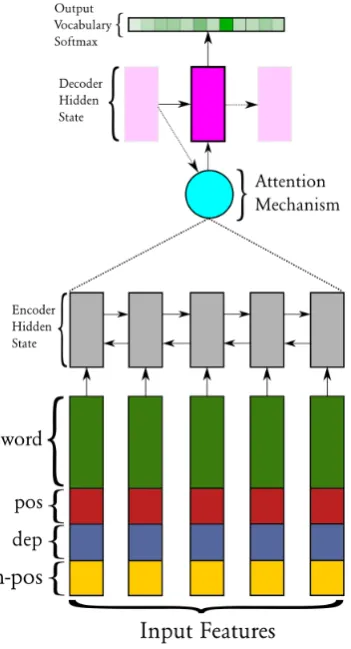
Figure 1: Schematic of the architecture of our fac-tored NMT systems
2.3 Factored Inputs
Alexandrescu and Kirchoff (2006) introduced lin-guistic factors for neural language models. The core idea is to learn embeddings for linguistic fea-tures such as part-of-speech (POS) tags and depen-dency labels, augmenting the word embeddings of the input with additional features. Recent work has shown that NMT performance can also be improved by concatenating embeddings for addi-tional word-level "factors" to source-word input embeddings (Sennrich and Haddow, 2016). The input representation ej for each source input xj with factorsF thus becomes Eq.1:
ej =
|F|
n
k=1
Ekxjk (1)
wheref
indicates vector concatenation,Ekis the embedding matrix of factork, andxjkis a one hot vector for thek-th input factor.
3 Models
In this section we describe the five model types used for APE-QE, as well as the ensembles of these models which turn out to be the best-performing overall. We design several features to be included as inputs to APE. The operating hy-pothesis is that that features which haven proven useful for Quality Estimation should also have a positive impact upon APE performance.
Our baseline models are the same models used in Junczys-Dowmunt (2016)2. The authors pro-vide trainedSRC → P EandM T → P E mod-els, which correspond to the last four checkpoints from fine-tuning the models on the500K training data concatenated with the task internal APE data upsampled 20 times. These models are referred to asSRCandMT.
3.1 Word Alignments
Previous work has shown that alignment informa-tion between source and target is a critical compo-nent of current state-of-the-art word level QE sys-tems (Kreutzer et al.,2015;Martins et al.,2016). The sequential inputs for structured prediction, as well as the feedforward and recurrent models in existing work obtain the source-side features for each target word using the word-alignments pro-vided by the WMT task organizers. However, this information is not likely to be available in many real-world usecases for Quality Estimation, and the use of this information also means that the MT system used to produce the hypotheses is not actu-ally a "black box", which is part of the definition of the QE task. Clearly, access to the word-alignment information of an SMT system provides a lot of in-sight into the underlying model.
Because our models rely upon synthetic training data, and because we wish to view the MT system as a true black-box, we instead use theSRCNMT system to obtain these alignments. The attention model for NMT produces a normalized vector of weights at each timestep, where the weights can be viewed as the "alignment probabilities" for each source word (Bahdanau et al.,2014). In order to obtain the input representation shown in table 3, we use the source word with the highest weight from the attention model as an additional factor in the input to another MT-aligned→PE system.
2These models have been made available by the
WMT 2016 Dev
Model Input BLEU TER↓ F1-Mult Accuracy
WMT 16 Best 68.94 .215 .493 –
Martins et al (2017) – – .568 –
SRC 55.47 .315 .506 .803
MT 66.66 .232 .328 .834
MT-aligned 68.32 .215 .437 .852
SRC+MT 69.17 .211 .477 .857
SRC+MT-factor 69.75 .209 .484 .859
Avg-All Baseline 71.02 .199 .476 .862
Avg-All APE-Tune 71.22 .197 .510 .866
Avg-All QE-Tune 66.92 .228 .554 .857
4-SRC+Avg-All QE-Tune 67.16 .225 .567 .860
WMT 2016 Test
Model Input BLEU TER↓ F1-Mult Accuracy
WMT Baseline 62.11 .248 .324 –
WMT 16 Best 67.65 .215 .493 –
Martins et al (2017) 67.62 .211 .575 –
SRC 55.58 .304 .519 .809
MT 65.85 .234 .347 .837
MT-aligned 67.69 .216 .447 .854
SRC+MT 68.03 .212 .477 .857
SRC+MT-factor 68.28 .211 .473 .857
Avg-All Baseline 70.05 .198 .492 .865
Avg-All APE-Tuned 70.04 .196 .516 .868
Avg-All QE-Tuned 66.93 .219 .573 .864
[image:4.595.76.533.274.454.2]4-SRC+Avg-All QE-Tune 66.94 .219 .575 .865
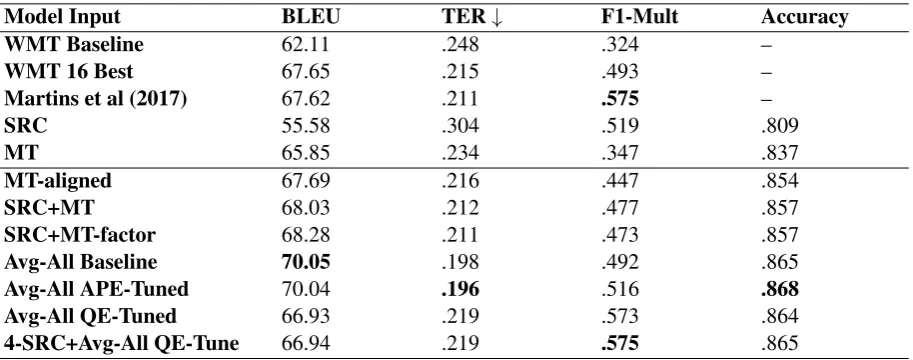
Table 1: Results for all models and ensembles on WMT 16 development and test datasets
TheMT-aligned→PE system thus depends upon theSRC→ PE system to produce the additional
alignment factor.
3.2 Inputting Both Source and Target
Following Crego et al. (2016), we train a model which takes the concatenated source and MT as input. The two sequences are separated by a spe-cial BREAK token. We refer to this system as
SRC+MT.
3.3 Part-of-Speech and Dependency Labels
Sennrich and Haddow (2016) showed that infor-mation such as POS tags, NER labels, and syntac-tic roles can be included in the input to NMT mod-els, generally improving performance. Inspired by this idea, we select some of the top perform-ing features from Martins et al. (Martins et al.,
2016), and include them as input factors to the
SRC+MT-factormodel. The base representation is the concatenated SRC+MT (again with a spe-cialBREAKtoken). For each word in the English source and the German hypothesis, we obtain the part-of-speech tag, the dependency relation, and the part-of-speech of the head word, and include these as input factors. For both English and Ger-man, we use spaCy3to extract these features for all training, development, and test data. The resulting model is illustrated in figure1.
3.4 Extending Factors to Subword Encoding
Our NMT models use subword encoding ( Sen-nrich et al., 2016), but the additional factors are computed at the word level. Therefore, the factors must also be segmented to match the BPE segmen-tation. We use the {BILOU}- prefixes common in sequence-labeling tasks such as NER to extend
factor vocabularies and map each word-level fac-tor to the subword segmentation of the source or target text.
Table3shows the input representations for each of the model types using an example from the WMT 2016 test data.
3.5 Ensembling NMT Models
We average the parameters of the four best check-points of each model type, and create an ensemble of the resulting five models, calledAvg-All Base-line. We then tune this ensemble for TER (APE) and F1-Mult (QE), using MERT (Och,2003). The tuned models are calledAvg-All APE-Tunedand
Avg-All QE-Tuned, respectively. After observ-ing that source-only models have the best sobserv-ingle- single-model QE performance (see section 5), we cre-ated a final F1-Mult tuned ensemble, consisting of the four individualSRCmodels, and the averaged models from each other type (an ensemble of eight models total), called4-SRC+Avg-All QE-Tune.
3.6 Tuning
Table2shows the final weights for each ensemble type after tuning. In line with the two-model en-semble presented in Martins et al. (2017), tuning models for F1-Mult results in much more weight being allocated to the SRC model, while TER tun-ing favors models with access to the MT hypothe-sis.
APE (TER) QE (F1-Mult)
SRC .162 .228
MT .003 -.183
MT-aligned .203 .229
SRC+MT .222 .231
SRC+MT-factor .410 .129
Table 2: Final weights for each model type after 10 iterations of MERT for tuning objectives TER and F1-Mult.
4 Experiments
All of our models are trained using Nematus ( Sen-nrich et al., 2017). At inference time we use our own decoder, which supports weighted log-linear ensembles of Nematus models4. Following Junczys-Dowmunt and Grundkiewicz (2016), we
4https://github.com/chrishokamp/ constrained_decoding
first train each model type on the large (4M) syn-thetic training data, then fine tune using the 500K dataset, concatenated with the task-internal train-ing data upsampled 20x. Finally, for SRC+MT
and SRC+MT-factor we continued fine-tuning each model for a small number of iterations us-ing the min-risk trainus-ing implementation available in Nematus (Shen et al.,2016). Table4shows the best dev result after each stage of training.
For both APE and QE, we use only the task-specific training data provided for the WMT 2017 APE task, including the extra synthetic training data5. However, note that the SpaCy models used to extract features for the factored models are trained with external data – we only use the off-the-shelf models provided by the SpaCy develop-ers.
To convert the output sequence from an APE system intoOK, BAD labels for QE, we use the APE hypothesis as a "pseudo-reference", which is then aligned with the original MT hypothesis us-ing TER (Snover et al.,2006).
5 Results
Table1 shows the results of our experiments us-ing the WMT 16 development and test sets. For each system, we measure performance on BLEU and TER, which are the metrics used in APE task, and also on F1-Mult, which is the primary metric used for the Word Level QE task. Overall tagging accuracy is included as a secondary metric for QE. All systems with input factors significantly im-prove APE performance over the baselines. For QE, the trends are less clear, but point to a key difference between optimizing for TER vs. F1_product: F1_product optimization probably lowers the threshold for "changing" a word, as opposed to copying it from the MT hypothesis. This hypothesis is supported by the observation that the source-only APE system outperforms all other single models on the QE metrics. Because the source-only systems cannot resort to copying words from the input, they are forced to make the best guess about the final output, and words which are more likely to be wrong are less likely to be present in the output. If input factors were used with a source-only APE system, the perfor-mance on word-level QE could likely be further improved. However, this hypothesis needs more
SRC auto vector masks apply predefined patterns as vector masks to bitmap and vector objects .
MT automatische Vektor- masken vordefinierten Mustern wie Vektor- masken , Bitmaps und Vektor- objekte anwenden .
MT-aligned automatische|auto |vector masken|masks vordefinierten|apply Mustern|patterns wie|as Vektor-|vector masken|masks ,|to Bitmaps|to und|and Vektor-Vektor-|vector objekte|objects anwenden|apply .|. SRC+MT auto vector masks apply predefined patterns as vector masks to bitmap and vector objects . BREAK
automatische Vektor- masken vordefinierten Mustern wie Vektor- masken , Bitmaps und Vektor- objekte anwenden .
SRC+MT Factored Auto|JJ|amod|NNS vector|NN|compound|NNS masks|NNS|nsubj|VBP apply|VBP|ROOT|VBP predefined|VBN|amod|NNS patterns|NNS|dobj|VBP as|IN|prep|NNS vector|NN|compound|NNS masks|NNS|pobj|IN to|TO|aux|VB bitmap|VB|relcl|NNS and|CC|cc|VB vector|NN|compound|NNS ob-jects|NNS|conj|VB .|.|punct|VBP BREAK|BREAK|BREAK|BREAK Automatische|ADJA|nk|NN Vektor-|B-NN|B-sb|B-VVINF masken|I-NN|I-sb|I-VVINF vordefinierten|ADJA|nk|NN Mustern|NN|pd|NN wie|KOKOM|cd|NN Vektor-|B-NN|B-cj|B-KOKOM masken|I-NN|I-cj|I-KOKOM ,|$,|punct|NN Bitmaps|NN|cj|NN und|KON|cd|NN Vektor-|B-NN|B-cj|B-KON objekte|I-NN|I-cj|I-KON anwenden|VVINF|ROOT|VVINF .|$.|punct|VVINF
PE (Reference) Automatische Vektormasken wenden vordefinierte Mustern als Vektormasken auf Bitmap- und Vek-torobjekte an .
Gold Tags OK OK BAD OK BAD OK BAD BAD OK OK BAD OK
Table 3: Examples of the input for the five model types used in the APE and QE ensembles. The pipe symbol ‘|’ separates each factor. ‘-’ followed by whitespace indicates segmentation according to the subword encoding.
Model General Fine-tune Min-Risk
MT-aligned 60.31 67.54 –
SRC+MT 59.52 68.68 69.44
SRC+MT-factor 57.59 68.26 69.76
Table 4: Best BLEU score on dev set after each of the training stages.Generalis training with 4M instances, Fine-tune is training with 500K + up-sampled in-domain data,Min-Risk uses the same dataset asFine-tune, but uses a minimum-risk loss with BLEU score as the target metric.
analysis and experimentation to confirm.
6 Conclusion
This work has presented APE-QE, unifying mod-els for APE and word-level QE by leveraging the flexibility of NMT to take advantage of informa-tive features from QE. Models with different input representations are ensembled together and tuned for either APE or QE, achieving state of the art performance in both tasks. The complementary nature of these tasks points to future avenues of exploration, such as joint training using both QE labels and reference translations, as well as the in-corporation of other features as input factors.
Acknowledgments
This project has received funding from Science Foundation Ireland in the ADAPT Centre for
Dig-ital Content Technology (www.adaptcentre.ie) at Dublin City University funded under the SFI Re-search Centres Programme (Grant 13/RC/2106) co-funded under the European Regional Devel-opment Fund and the European Union Horizon 2020 research and innovation programme under grant agreement 645452 (QT21). Marcin Junczys-Dowmunt provided essential guidance on the tun-ing implementation for APE and QE ensembles.
References
Andrei Alexandrescu and Katrin Kirchhoff. 2006.
Factored neural language models. InProceedings of the Human Language Technology Conference of the NAACL, Companion Volume: Short Papers. Association for Computational Linguistics, Strouds-burg, PA, USA, NAACL-Short ’06, pages 1–4.
http://dl.acm.org/citation.cfm?id=1614049.1614050. Dzmitry Bahdanau, Kyunghyun Cho, and Yoshua
Ben-gio. 2014. Neural machine translation by jointly learning to align and translate. arXiv preprint arXiv:1409.0473.
Ondˇrej Bojar, Rajen Chatterjee, Christian Federmann, Barry Haddow, Matthias Huck, Chris Hokamp, Philipp Koehn, Varvara Logacheva, Christof Monz, Matteo Negri, Matt Post, Carolina Scarton, Lucia Specia, and Marco Turchi. 2015. Findings of the 2015 workshop on statistical machine translation. In Proceedings of the Tenth Workshop on Statisti-cal Machine Translation. Association for Compu-tational Linguistics, Lisbon, Portugal, pages 1–46.
Josep Crego, Jungi Kim, Guillaume Klein, An-abel Rebollo, Kathy Yang, Jean Senellart, Egor Akhanov, Patrice Brunelle, Aurelien Coquard, Yongchao Deng, et al. 2016. Systran’s pure neu-ral machine translation systems. arXiv preprint arXiv:1610.05540.
Orhan Firat, Kyunghyun Cho, and Yoshua Bengio. 2016. Multi-way, multilingual neural machine translation with a shared attention mechanism. In Kevin Knight, Ani Nenkova, and Owen Rambow, editors, HLT-NAACL. The Association for Compu-tational Linguistics, pages 866–875.
Spence Green, Jeffrey Heer, and Christopher D. Manning. 2013. The efficacy of human post-editing for language translation. In Proceed-ings of the SIGCHI Conference on Human
Factors in Computing Systems. ACM, New
York, NY, USA, CHI ’13, pages 439–448.
https://doi.org/10.1145/2470654.2470718.
Marcin Junczys-Dowmunt and Roman Grundkiewicz. 2016. Log-linear combinations of monolingual and bilingual neural machine translation models for au-tomatic post-editing. In Proceedings of the First Conference on Machine Translation. Association for Computational Linguistics, Berlin, Germany, pages 751–758. http://www.aclweb.org/anthology/W16-2378.
Julia Kreutzer, Shigehiko Schamoni, and Stefan Riezler. 2015. Quality estimation from scratch (quetch): Deep learning for word-level trans-lation quality estimation. In Proceedings of the Tenth Workshop on Statistical Machine Translation. Association for Computational Linguistics, Lisbon, Portugal, pages 316–322.
http://aclweb.org/anthology/W15-3037.
Varvara Logacheva, Chris Hokamp, and Lucia Specia. 2016. MARMOT: A toolkit for translation quality estimation at the word level. In Proceedings of the Tenth International Conference on Language Resources and Evaluation LREC 2016, Portorož, Slovenia, May 23-28, 2016.. http://www.lrec-conf.org/proceedings/lrec2016/summaries/1054.html.
André F. T. Martins, Ramón Astudillo, Chris Hokamp, and Fabio Kepler. 2016. Unbabel’s participation in the wmt16 word-level translation quality estimation shared task. InProceedings of the First Conference on Machine Translation. Association for Computa-tional Linguistics, Berlin, Germany, pages 806–811.
http://www.aclweb.org/anthology/W/W16/W16-2387.
André FT Martins, Marcin Junczys-Dowmunt, Fabio N Kepler, Ramón Astudillo, and Chris Hokamp. 2017. Pushing the limits of translation quality estimation .
Franz Josef Och. 2003. Minimum error rate training in statistical machine translation. InProc. of the An-nual Meeting on Association for Computational Lin-guistics. pages 160–167.
Rico Sennrich, Orhan Firat, Kyunghyun Cho, Alexan-dra Birch, Barry Haddow, Julian Hitschler, Marcin Junczys-Dowmunt, Samuel Läubli, Antonio Vale-rio Miceli Barone, Jozef Mokry, and Maria Nade-jde. 2017. Nematus: a toolkit for neural ma-chine translation. In Proceedings of the Soft-ware Demonstrations of the 15th Conference of the European Chapter of the Association for Com-putational Linguistics. Association for Computa-tional Linguistics, Valencia, Spain, pages 65–68.
http://aclweb.org/anthology/E17-3017.
Rico Sennrich and Barry Haddow. 2016. Linguis-tic input features improve neural machine trans-lation. In Proceedings of the First Conference on Machine Translation, WMT 2016, colocated with ACL 2016, August 11-12, Berlin, Germany. The Association for Computer Linguistics, pages 83–91. http://aclweb.org/anthology/W/W16/W16-2209.pdf.
Rico Sennrich, Barry Haddow, and Alexandra Birch. 2016. Neural machine translation of rare words with subword units. In Proceedings of the 54th Annual Meeting of the Association for Com-putational Linguistics, ACL 2016, August 7-12, 2016, Berlin, Germany, Volume 1: Long Papers.
http://aclweb.org/anthology/P/P16/P16-1162.pdf.
Shiqi Shen, Yong Cheng, Zhongjun He, Wei He, Hua Wu, Maosong Sun, and Yang Liu. 2016. Minimum risk training for neural machine translation. In Pro-ceedings of the 54th Annual Meeting of the Associ-ation for ComputAssoci-ational Linguistics, ACL 2016, Au-gust 7-12, 2016, Berlin, Germany, Volume 1: Long Papers.
Michel Simard, Nicola Ueffing, Pierre Isabelle, and Roland Kuhn. 2007. Rule-based translation with statistical phrase-based post-editing. In Proceed-ings of the Second Workshop on Statistical Machine Translation. pages 203–206.
Matthew Snover, Bonnie Dorr, Richard Schwartz, Lin-nea Micciulla, and John Makhoul. 2006. A study of translation edit rate with targeted human annota-tion. InIn Proceedings of Association for Machine Translation in the Americas. pages 223–231.
Lucia Specia. 2011. Exploiting objective annotations for measuring translation post-editing effort. In Pro-ceedings of the 15th Conference of the European As-sociation for Machine Translation. pages 73–80.
Ilya Sutskever, Oriol Vinyals, and Quoc V. Le. 2014. Sequence to sequence learning with neural networks. In Proceedings of the 27th International Conference on Neural Informa-tion Processing Systems. MIT Press, Cam-bridge, MA, USA, NIPS’14, pages 3104–3112.
http://dl.acm.org/citation.cfm?id=2969033.2969173.
The 2016 Conference of the North American Chap-ter of the Association for Computational Linguis-tics: Human Language Technologies, San Diego California, USA, June 12-17, 2016. The Associ-ation for ComputAssoci-ational Linguistics, pages 30–34.