Proceedings of NAACL-HLT 2018, pages 1662–1675
Deep Communicating Agents for Abstractive Summarization
Asli Celikyilmaz1, Antoine Bosselut2, Xiaodong He3 and Yejin Choi2,4 1Microsoft Research
2Paul G. Allen School of Computer Science & Engineering, University of Washington 3JD AI Research
4Allen Institute for Artificial Intelligence
{aslicel}@microsoft.com {xiaodong.he}@jd.com {antoineb, yejin}@cs.washington.edu
Abstract
We present deep communicating agents in an encoder-decoder architecture to ad-dress the challenges of representing a long document for abstractive summariza-tion. With deep communicating agents, the task of encoding a long text is divided across multiple collaborating agents, each in charge of a subsection of the input text. These encoders are connected to a sin-gle decoder, trained end-to-end using rein-forcement learning to generate a focused and coherent summary. Empirical results demonstrate that multiple communicating encoders lead to a higher quality summary compared to several strong baselines, in-cluding those based on a single encoder or multiple non-communicating encoders.
1 Introduction
We focus on the task of abstractive summariza-tion of alongdocument. In contrast toextractive summarization, where a summary is composed of a subset of sentences or words lifted from the in-put text as is, abstractivesummarization requires the generative ability to rephrase and restructure sentences to compose a coherent and concise sum-mary. As recurrent neural networks (RNNs) are capable of generating fluent language, variants of encoder-decoder RNNs (Sutskever et al., 2014; Bahdanau et al.,2015) have shown promising re-sults on the abstractive summarization task (Rush et al.,2015;Nallapati et al.,2017).
The fundamental challenge, however, is that the strong performance of neural models at encoding short text does not generalize well to long text. The motivation behind our approach is to be able to dynamically attend to different parts of the input to capture salient facts. While recent work in
sum-… …
…
Tired of counting sheep ? Try one of these remedies and get a good nights sleep: Aroma .. How to use it: Massage a dab of aroma therapeutic balm or oil…
…
messages
…
… …
…
paragraphs
1 2
1 2
layer-1 layer-2 layer-3
[image:1.595.308.523.227.321.2]agent a agent b
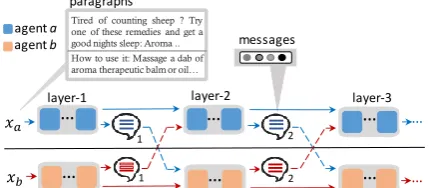
Figure 1: Illustration of deep communicating agents presented in this paper. Each agent aandb encodes
one paragraph in multiple layers. By passing new mes-sages through multiple layers the agents are able to co-ordinate and focus on the important aspects of the input text.
marization addresses these issues using improved attention models (Chopra et al., 2016), pointer networks with coverage mechanisms (See et al., 2017), and coherence-focused training objectives (Paulus et al.,2018;Jaques et al.,2017), an effec-tive mechanism for representing a long document remains a challenge.
Simultaneous work has investigated the use of deep communicating agents (Sukhbaatar et al., 2016) for collaborative tasks such as logic puzzles (Foerster et al., 2016), visual dialog (Das et al., 2017), and reference games (Lazaridou et al., 2016). Our work builds on these approaches to propose the first study on using communicating agents to encode long text for summarization.
The key idea of our model is to divide the hard task of encoding a long text across multiple collab-orating encoder agents, each in charge of a differ-ent subsection of the text (Figure1). Each of these agents encodes their assigned text independently, and broadcasts their encoding to others, allowing agents to share global context information with one another about different sections of the docu-ment. All agents then adapt the encoding of their assigned text in light of the global context and
Loca l Encod er B -L ST M source paragraph-1
Tired of counting
B -L ST M B -L ST M source paragraph-2 You don’t have
B -L ST M W or d At te nt ion B -L ST M source paragraph-3 Melatonin supplement
-B
-L
ST
M
word context vector ( ) agent
attention (t)
…
… …
word context vector ( ) word context
vector ( )
agent context vector ( ) Fragrances
<Start> that make you feel
D ecode r LS TM vocabulary distribution a zoo a zoo “calm” “yen” final distribution agent attention (t-1)
[image:2.595.101.502.67.295.2]C ont ex tual Ag ent At te nt ion … … … … … C ont ex tua l Encod er La ye rs B -L ST M B -L ST M B -L ST M … … …
Figure 2: Multi-agent-encoder-decoder overview. Each agentaencodes a paragraph using a local encoder followed
by multiple contextual layers with agent communication through concentrated messagesza(k) at each layerk.
Communication is illustrated in Figure3. The word context vectorsct
a are condensed into agent contextc∗t.
Agent specific generation probabilities,pt
a, enable voting for the suitable out-of-vocabulary words (e.g., ’yen’) in
the final distribution.
peat the process across multiple layers, generat-ing new messages at each layer. Once each agent completes encoding, they deliver their information to the decoder with a novelcontextual agent atten-tion(Figure2). Contextual agent attention enables the decoder to integrate information from multiple agents smoothly at each decoding step. The net-work is trained end-to-end using self-critical rein-forcement learning (Rennie et al.,2016) to gener-ate focused and coherent summaries.
Empirical results on the CNN/DailyMail and New York Times datasets demonstrate that multi-ple communicating encoders lead to higher quality summaries compared to strong baselines, includ-ing those based on a sinclud-ingle encoder or multiple non-communicating encoders. Human evaluations indicate that our model is able to produce more fo-cused summaries. The agents gather salient infor-mation from multiple areas of the document, and communicate their information with one another, thus reducing common mistakes such as missing key facts, repeating the same content, or including unnecessary details. Further analysis reveals that our model attains better performance when the de-coder interacts with multiple agents in a more bal-anced way, confirming the benefit of representing a long document with multiple encoding agents.
2 Model
We extend the CommNet model of Sukhbaatar
et al.(2016) for sequence generation.
Notation Each document d is a sequence of
paragraphsxa, which are split across multiple
en-coding agentsa=1,..,M (e.g., agent-1 encodes the
first paragraph x1, agent-2 the second paragraph x2, so on). Each paragraph xa={wa,i}I, is a se-quence ofIwords. We construct aV-sized
vocab-ulary from the training documents from the most frequently appearing words. Each word wa,i is
embedded into a n-dimensional vector ea,i. All W variables are linear projection matrices.
2.1 Multi-Agent Encoder
Each agent encodes the word sequences with the following two stacked encoders.
Local EncoderThe first layer is a local encoder of each agent a, where the tokens of the corre-sponding paragraphxaare fed into a single layer
bi-directional LSTM (bLSTM), producing the lo-cal encoder hidden states,h(1)i ∈ RH:
− →
h(1)i ,←−h(1)i =bLSTM(ei,−→h(1)i−1,←−h(1)i+1) (1)
h(1)i =W1[−→h(1)i ,←−h(1)i ] (2)
output of the local encoder layer is fed into the contextual encoder.
Contextual Encoder Our framework enables
agent communication cycles across multiple coding layers. The output of each contextual en-coder is an adapted representation of the agent’s encoded information conditioned on the informa-tion received from the other agents. At each layer
k=1,..,K, each agentajointly encodes the
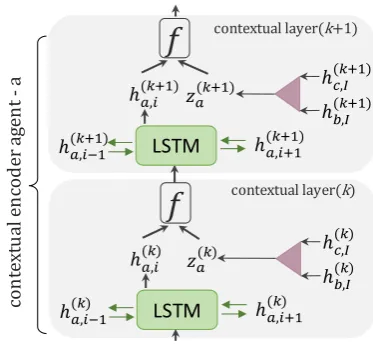
infor-mation received from the previous layer (see Fig-ure3). Each cell of the (k+1)th contextual layer is a bLSTM that takes three inputs: the hidden states from the adjacent LSTM cells,−→h(i−k+1)1 ∈RH
or←−h(ik+1+1)∈RH, the hidden state from the
previ-ous layerh(ik), and the message vector from other
agentsz(k)∈RH and outputsh(ik+1)∈RH:
− →h(k+1)
i ,
←−h(k+1)
i =bLSTM(f(h
(k)
i , z(k)), (3)
− →
h(ik−+1)1 ,←−h(i+1k+1)) (4)
hi(k+1) =W2[−→hi(k+1),←−h(ik+1)] (5)
wherei=1..I indicates the index of each token in the sequence.
The message z(k) received by any agent a in
layerk is the average of the outputs of the other
agents from layerk:
z(k) = M1−1Pm6=ah(m,Ik) (6)
whereh(m,Ik) is the last hidden state output from the kth contextual layer of each agent wherem 6= a.
Here, we take the average of the messages re-ceived from other encoder agents, but a parametric function such as a feed forward model or an atten-tion over messages could also be used.
The message z(k) is projected with the agent’s
previous encoding of its document:
f(h(ik), z(k)) =v1Ttanh(W3h(ik)+W4z(k)) (7)
where v1, W3, and W4 are learned parameters shared by every agent. Equation (7) combines the information sent by other agents with the context of the current token from this paragraph. This yields different features about the current context in relation to other topics in the source document. At each layer, the agent modifies its representa-tion of its own context relative to the informarepresenta-tion received from other agents, and updates the infor-mation it sends to other agents accordingly.
[image:3.595.324.511.63.235.2]LSTM LSTM
Figure 3: Multi-agent encoder message passing. Agentsbandctransmit the last hidden state output (I)
of the current layerkas a message, which are passed
through an average pool (Eq. (6)). The receiving agent
auses the new messagez(ak)as additional input to its
next layer.
2.2 Decoder with Agent Attention
The output from the last contextual encoder layer of each agent {h(a,iK)}I, which is a sequence of
hidden state vectors of each token i, is sent to the decoder to calculate word-attention distribu-tions. We use a single-layer LSTM for the decoder and feed the last hidden state from the first agent
s0 =h(1K,I)as the initial state. At each time stept,
the decoder predicts a new word in the summary
wt and computes a new state st by attending to
relevant input context provided by the agents. The decoder uses a new hierarchical attention mechanism over the agents. First, aword attention
distribution lta (Bahdanau et al. (2015)) is
com-puted over every token{h(a,iK)}Ifor each agenta:
lta=softmax(vT
2tanh(W5h(aK)+W6st+b1)) (8)
wherelt
a∈[0,1]I is the attention over all tokens in
a paragraphxaandv2,W5,W6,b1are learned pa-rameters. For each decoding stept, a new decoder
context is calculated for each agent:
cta=X
i
lta,ih(a,iK) (9)
which is the weighted sum of the encoder hidden states of agenta. Eachword context vector
current decoding stept. This is done by weighting each context vector by an agent attention yielding the document global agent attention distribution
gt(see Figure2):
gt=softmax(vT3tanh(W7ct+W8st+b2)) (10) where v3, W7, W8, and b2 are learned, and gt ∈[0,1]M is a soft selection over M agents.
Then, we compute the agent context vectorc∗t:
c∗t =Pagatcta (11)
The agent contextc∗t∈RH is a fixed length vector
encoding salient information from the entire doc-ument provided by the agents. It is then concate-nated with the decoder state st and fed through
a multi-layer perception to produce a vocabulary distribution (over all vocabulary words) at timet:
Pvoc(wt|st, wt−1) =softmax(MLP([st, c∗t]))
(12) To keep the topics of generated sentences intact, it is reasonable that the decoder utilize the same agents over the course of short sequences (e.g., within a sentence). Because the decoder is de-signed to select which agent to attend to at each time step, we introduce contextual agent attention (caa) to prevent it from frequently switching be-tween agents. The previous step’s agent attention
c∗t−1 is used as additional information to the
de-coding step to generate a distribution over words:
Pvoc(wt|·) =softmax(MLP([st, c∗t, c∗t−1])) (13)
2.3 Multi-Agent Pointer Network
Similar toSee et al.(2017), we allow for copying candidate words from different paragraphs of the document by computing a generation probability value for each agentpt
a∈[0,1] at each timestept
using the context vector cta, decoder statest and
decoder inputyt:
pat =σ(v5Tcta+v6Tst+vT7yt+b) (14)
where b is a learned scalar, yt is the
ground-truth/predicted output (depending on the train-ing/testing time). The generation probability de-termines whether to generate a word from the vo-cabulary by sampling from Pvoc(w|·), or
copy-ing a word from the correspondcopy-ing agent’s input paragraphxaby sampling from its attention
distri-bution lt
a. This produces an extended vocabulary
that includes words in the document that are con-sidered out-of-vocabulary (OOV). A probability distribution over the extended vocabulary is com-puted for each agent:
Pa(wt|·) =ptaPvoc(wt|·) + (1−pta)uta,w (15)
where ut
a,w is the sum of the attention for all
instances where w appears in the source
docu-ment. The final distribution over the extended vo-cabulary, from which we sample, is obtained by weighting each agent by their corresponding agent attention valuesgta:
P(wt|st, wt−1) =PagtaPa(wt|·) (16)
In contrast to a single-agent baseline (See et al., 2017), our model allows each agent to vote for dif-ferent OOV words at time t(Equation (16)). In
such a case, only the word that is relevant to the generated summary up to timetis collaboratively
voted as a result of agent attention probabilitygta.
3 Mixed Objective Learning
To train the deep communicating agents, we use a mixed training objective that jointly optimizes multiple losses, which we describe below.
MLE Our baseline multi-agent model uses max-imum likelihood training for sequence genera-tion. Given y∗ = {y∗1,y∗2,...,y∗T} as the ground-truth output sequence (human summary word se-quences) for a given input documentd, we
mini-mize the negative log-likelihood of the target word sequence:
LMLE =−PNt=1logp(yt∗|y∗1. . . yt∗−1, d) (17)
Semantic Cohesion To encourage sentences in the summary to be informative without repetition, we include a semantic cohesion loss to integrate sentence-level semantics into the learning objec-tive. As the decoder generates the output word se-quence {y1, y2. . . yT}, it keeps track of the end
of sentence delimiter token (‘.’) indices. The hid-den state vectors at the end of each sentence s0q, q=1. . . Q, wheres0q∈{st:yt=‘·’, 1≤t≤T}, are used
to compute the cosine similarity between two con-secutively generated sentences. To minimize the similarity between end-of-sentence hidden states we define asemantic cohesionloss:
The final training objective is then:
LMLE-SEM=LMLE+λLSEM (19)
whereλis a tunable hyperparameter.
Reinforcement Learning (RL) Loss Policy
gradient methods can directly optimize discrete target evaluation metrics such as ROUGE that are non-differentiable (Paulus et al.,2018;Jaques et al.,2017;Pasunuru and Bansal,2017;Wu et al., 2016). At each time step, the word generated by the model can be viewed as an action taken by an RL agent. Once the full sequenceyˆis generated, it is compared against the ground truth sequencey∗
to compute the rewardr(ˆy).
Our model learns using a self-critical training approach (Rennie et al.,2016), which learns by ex-ploring new sequences and comparing them to the best greedily decoded sequence. For each training example d, two output sequences are generated:
ˆ
y, which is sampled from the probability
distribu-tion at each time step, p(ˆyt|yˆ1. . .yˆt−1, d), andy˜, the baseline output, which is greedily generated by argmax decoding from p(˜yt|y˜1. . .y˜t−1, d). The training objective is then to minimize:
LRL = (r(˜y)−r(ˆy))PNt=1logp(ˆyt|yˆ1. . .yˆt−1, d) (20) This loss ensures that, with better exploration, the model learns to generate sequencesyˆthat receive higher rewards compared to the baseline y˜, in-creasing overall reward expectation of the model.
Mixed Loss While training with only MLE loss will learn a better language model, this may not guarantee better results on global performance measures. Similarly, optimizing with only RL loss may increase the reward gathered at the expense of diminished readability and fluency of the gen-erated summary (Paulus et al., 2018). A combi-nation of the two objectives can yield improved task-specific scores while maintaining fluency:
LMIXED =γLRL+ (1−γ)LMLE (21)
whereγ is a tunable hyperparameter used to
bal-ance the two objective functions. We pre-train our models with MLE loss, and then switch to the mixed loss. We can also add the semantic cohesion loss term:LMIXED-SEM=γLRL+(1−γ)LMLE-SEM to analyze its impact in RL training.
Intermediate Rewards We introduce sentence-based rewards as opposed to end of summary re-wards, using differential ROUGE metrics, to pro-mote generating diverse sentences. Rather than re-warding sentences based on the scores obtained at the end of the generated summary, we compute in-cremental rouge scores of a generated sentenceoˆq:
r(ˆoq) =r([ˆo1, . . .oˆq])−r([ˆo1, . . .oˆq−1]) (22)
Sentences are rewarded for the increase in ROUGE they contribute to the full sequence, en-suring that the current sentence contributed novel information to the overall summary.
4 Experimental Setup
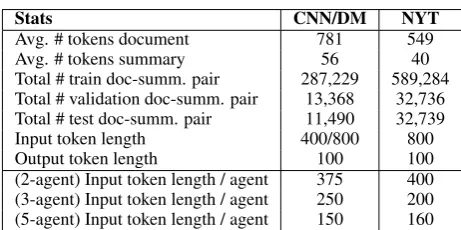
DatasetsWe conducted experiments on two sum-marization datasets: CNN/DailyMail (Nallapati et al.,2017;Hermann et al.,2015) and New York Times (NYT) (Sandhaus,2008). We replicate the preprocessing steps ofPaulus et al. (2018) to ob-tain the same data splits, except that we do not anonymize named entities. For our DCA models, we initialize the number of agents before training, and partition the document among the agents (i.e., three agent→ three paragraphs). Additional de-tails can be found in AppendixA.1.
Training Details During training and testing we truncate the article to 800 tokens and limit the length of the summary to 100 tokens for train-ing and 110 tokens at test time. We distribute the truncated articles among agents for multi-agent models, preserving the paragraph and sentences as possible. For both datasets, we limit the in-put and outin-put vocabulary size to the 50,000 most frequent tokens in the training set. We train with up to two contextual layers in all the DCA models as more layers did not provide additional perfor-mance gains. We fixγ = 0.97for the RL term in Equation (21) and λ = 0.1 for the SEM term in MLE and MIXED training. Additional details are provided in AppendixA.2.
Evaluation We evaluate our system using
ROUGE-1 (unigram recall), ROUGE-2 (bigram recall) and ROUGE-L (longest common se-quence).1 We select the MLE models with the
lowest negative log-likelihood and the MLE+RL models with the highest ROUGE-L scores on a sample of validation data to evaluate on the test
Model ROUGE-1 ROUGE-2 ROUGE-L
SummaRuNNer (Nallapati et al.,2017) 39.60 16.20 35.30
graph-based attention (Tan et al.,2017) 38.01 13.90 34.00
pointer generator (See et al.,2017) 36.44 15.66 33.42
[image:6.595.90.505.60.215.2]pointer generator + coverage (See et al.,2017) 39.53 17.28 36.38 controlled summarization with fixed values (Fan et al.,2017) 39.75 17.29 36.54 RL, with intra-attention (Paulus et al.,2018) 41.16 15.75 39.08 ML+RL, with intra-attention(Paulus et al.,2018) 39.87 15.82 36.90 (m1) MLE, pgen, no-comm (1-agent) (our baseline-1) 36.12 14.38 33.83 (m2) MLE+SEM, pgen, no-comm (1-agent) (our baseline-2) 36.90 15.02 33.00 (m3) MLE+RL, pgen, no-comm (1-agent) (our baseline-3) 38.01 16.43 35.49 (m4) DCA MLE+SEM, pgen, no-comm (3-agents) 37.45 15.90 34.56 (m5) DCA MLE+SEM,mpgen, with-comm (3-agents) 39.52 17.12 36.90 (m6) DCA MLE+SEM,mpgen, with-comm, withcaa(3-agents) 41.11 18.21 36.03 (m7) DCA MLE+SEM+RL,mpgen, with-comm, withcaa(3-agents) 41.69 19.47 37.92
Table 1: Comparison results on theCNN/Daily Mailtest set using theF1variants ofRouge. Best model models are bolded.
Model Rouge-1 Rouge-2 Rouge-L
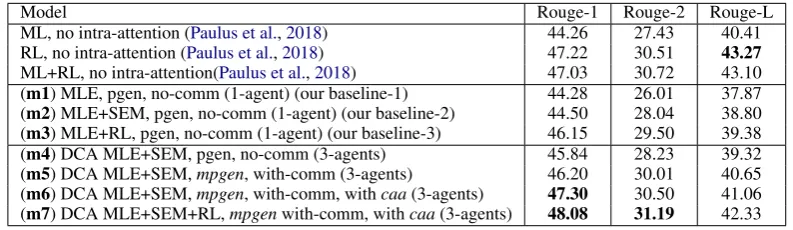
ML, no intra-attention (Paulus et al.,2018) 44.26 27.43 40.41 RL, no intra-attention (Paulus et al.,2018) 47.22 30.51 43.27 ML+RL, no intra-attention(Paulus et al.,2018) 47.03 30.72 43.10 (m1) MLE, pgen, no-comm (1-agent) (our baseline-1) 44.28 26.01 37.87 (m2) MLE+SEM, pgen, no-comm (1-agent) (our baseline-2) 44.50 28.04 38.80 (m3) MLE+RL, pgen, no-comm (1-agent) (our baseline-3) 46.15 29.50 39.38 (m4) DCA MLE+SEM, pgen, no-comm (3-agents) 45.84 28.23 39.32 (m5) DCA MLE+SEM,mpgen, with-comm (3-agents) 46.20 30.01 40.65 (m6) DCA MLE+SEM,mpgen, with-comm, withcaa(3-agents) 47.30 30.50 41.06 (m7) DCA MLE+SEM+RL,mpgenwith-comm, withcaa(3-agents) 48.08 31.19 42.33
Table 2: Comparison results on theNew York Timestest set using theF1variants ofRouge. Best model models are bolded.
set. At test time, we use beam search of width 5 on all our models to generate final predictions. BaselinesWe compare our DCA models against previously published models: SummaRuNNer (Nallapati et al.,2017), a graph-based attentional neural model (Tan et al.,2017) an RNN-based ex-tractive summarizer that combines absex-tractive fea-tures during training; Pointer-networks with and without coverage (See et al., 2017), RL-based training for summarization with intra-decoder at-tention (Paulus et al.,2018)), and Controllable Ab-stractive Summarization (Fan et al., 2017) which allows users to define attributes of generated sum-maries and also uses a copy mechanism for source entities and decoder attention to reduce repetition. Ablations We investigate each new component of our model with a different ablation, producing seven different models. Our first three ablations are: a single-agent model with the same local en-coder, context enen-coder, and pointer network archi-tectures as the DCA encoders trained with MLE loss (m1); the same model trained with additional semantic cohesion SEM loss (m2), and the same model as the (m1) but trained with a mixed loss and end-of-summary rewards (m3).
The rest of our models use 3 agents and in-crementally add one component. First, we add the semantic cohesion loss (m4). Then, we add multi-agent pointer networks (mpgen) and agent communication (m5). Finally, we add contex-tual agent attention (caa) (m6), and train with the
mixed MLE+RL+SEM loss (m7). All DCA
mod-els use pointer networks.
5 Results
5.1 Quantitative Analysis
[image:6.595.99.496.255.370.2]op-timize for sentence level structure similarity with the reference summary (to get higher ROUGE as reward), but also to learn parameters to improve semantic coherence, promoting higher abstraction (see Table4and Appendix B for generated sum-mary examples).
Model ROUGE-1 ROUGE-2 ROUGE-L
2-agent 40.94 19.16 37.54
3-agent 41.69 19.47 37.92
5-agent 40.99 19.02 38.21
Table 3: Comparison of multi-agent models varying the number of agents using ROUGE results of model (m7) from Table1on CNN/Daily Maily Dataset.
Single vs. Multi-AgentsAll multi-agent models show improvements over the single agent base-lines. On the CNN/DailyMail dataset, compared to MLE published baselines, we improve across all ROUGE scores. We found that the 3-agent models generally outperformed both 2- and 5-agent models (see Table 3). This is in part be-cause we truncate documents before training and the larger number of agents might be more effi-cient for multi-document summarization.
Independent vs. Communicating AgentsWhen
trained on multiple agents with no communication (m4), the performance of our DCA models is sim-ilar to the single agent baselines (m1) and (m3). With communication, the biggest jump in ROUGE is seen on the CNN/DailyMail data, indicating that the encoders can better identify the key facts in the input, thereby avoiding unnecessary details. Contextual Agent Attention (caa) Compared to the model with no contextualized agent atten-tion (m5), the (m6) model yields better ROUGE scores. The stability provided by thecaahelps the decoder avoid frequent switches between agents that would dilute the topical signal captured by each encoder.
Repetition Penalty As neurally generated sum-maries can be redundant, we introduced the se-mantic cohesion penalty and incremental rewards for RL to generate semantically diverse sum-maries. Our baseline model optimized together
with SEM loss (m2) improves on all ROUGE
scores over the baseline (m1). Similarly, our model trained with reinforcement learning uses sentence based intermediate rewards, which also improves ROUGE scores across both datasets.
5.2 Human Evaluations
We perform human evaluations to establish that our model’s ROUGE improvements are correlated with human judgments. We measure the com-municative multi-agent network with contextual agent attention in comparison to a single-agent network with no communication. We use the fol-lowing as evaluation criteria for generated sum-maries: (1) non-redundancy, fewer of the same ideas are repeated, (2) coherence, ideas are ex-pressed clearly; (3) focus, the main ideas of the document are shared while avoiding superfluous details, and (4) overall, the summary effectively communicates the article’s content. The focus and non-redundancy dimensions help quantify the im-pact of multi-agent communication in our model, while coherence helps to evaluate the impact of the reward based learning and repetition penalty of the proposed models.
Evaluation ProcedureWe randomly selected 100 samples from the CNN/DailyMail test set and use workers from Amazon Mechanical Turk as judges to evaluate them on the four criteria defined above. Judges are shown the original document, the ground truth summary, and two model sum-maries and are asked to evaluate each summary on the four criteria using a Likert scale from 1 (worst) to 5 (best). The ground truth and model summaries are presented to the judges in random order. Each summary is rated by 5 judges and the results are averaged across all examples and judges.
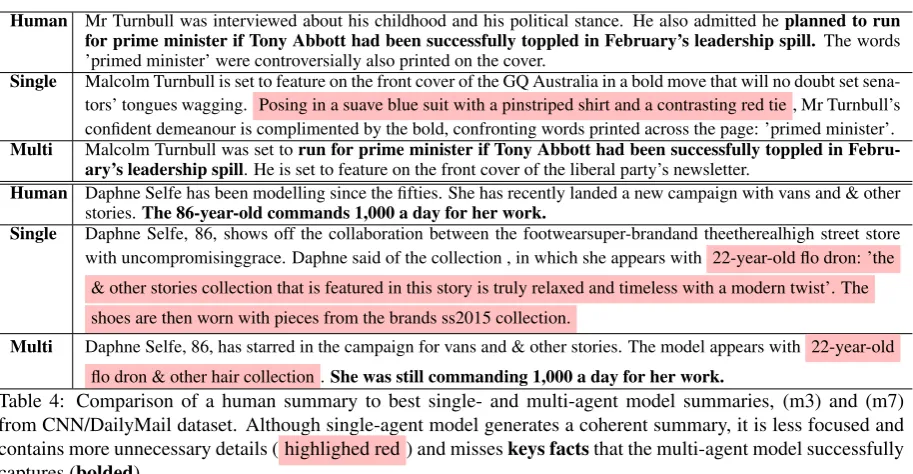
Human Mr Turnbull was interviewed about his childhood and his political stance. He also admitted heplanned to run for prime minister if Tony Abbott had been successfully toppled in February’s leadership spill. The words ’primed minister’ were controversially also printed on the cover.
Single Malcolm Turnbull is set to feature on the front cover of the GQ Australia in a bold move that will no doubt set sena-tors’ tongues wagging. Posing in a suave blue suit with a pinstriped shirt and a contrasting red tie , Mr Turnbull’s confident demeanour is complimented by the bold, confronting words printed across the page: ’primed minister’. Multi Malcolm Turnbull was set torun for prime minister if Tony Abbott had been successfully toppled in
Febru-ary’s leadership spill. He is set to feature on the front cover of the liberal party’s newsletter.
Human Daphne Selfe has been modelling since the fifties. She has recently landed a new campaign with vans and & other stories.The 86-year-old commands 1,000 a day for her work.
Single Daphne Selfe, 86, shows off the collaboration between the footwearsuper-brandand theetherealhigh street store with uncompromisinggrace. Daphne said of the collection , in which she appears with 22-year-old flo dron: ’the
& other stories collection that is featured in this story is truly relaxed and timeless with a modern twist’. The shoes are then worn with pieces from the brands ss2015 collection.
[image:8.595.73.530.58.295.2]Multi Daphne Selfe, 86, has starred in the campaign for vans and & other stories. The model appears with 22-year-old flo dron & other hair collection .She was still commanding 1,000 a day for her work.
Table 4: Comparison of a human summary to best single- and multi-agent model summaries, (m3) and (m7) from CNN/DailyMail dataset. Although single-agent model generates a coherent summary, it is less focused and contains more unnecessary details ( highlighed red ) and misseskeys factsthat the multi-agent model successfully captures (bolded).
Head-to-Head Score Based
Criteria SA MA = SA MA
non-redundancy 68 159 73 4.384 4.428 coherence 89 173 38 3.686 3.754
focus 83 181 36 3.694 3.884∗
[image:8.595.309.512.319.462.2]overall 102 158 40 3.558 3.682∗
Table 5: Head-to-Head and score-based comparison of human evaluations on random subset of CNN/DM dataset. SA=single, MA=multi-agent. ∗indicates
sta-tistical significance at p < 0.001 for focus andp <
0.03for the overall.
5.3 Communication improves focus
To investigate how much the multi-agent models discover salient concepts in comparison to sin-gle agent models, we analyze ROUGE-L scores based on the average attention received by each agent. We compute the average attention received by each agent per decoding time step for every generated summary in the CNN/Daily Mail test corpus, bin the document-summary pairs by the attention received by each agent, and average the ROUGE-L scores for the summaries in each bin.
Figure4 outlines two interesting results. First, summaries generated with a more distributed at-tention over the agents yield higher ROUGE-L scores, indicating that attending to multiple areas of the document allows the discovery of salient concepts in the later sections of the text. Second, if we use the same bins and generate summaries for the documents in each bin using the single-agent model, the average ROUGE-L scores for the single-agent summaries are lower than for the
cor-70-60% 60-50% 50-40% 40-30% 30-20% 20-0% Multi
Single Multi Agent #1 vs Single Agent
70-60% 60-50% 50-40% 40-30% 30-20% 20-0% Multi
Single Multi Agent #2 vs Single Agent
70-60% 60-50% 50-40% 40-30% 30-20% 20-0% Attention received by Agent
Multi
Single Multi Agent #3 vs Single Agent
0.33 0.34 0.35 0.36
0.29 0.31 0.33 0.36
0.10 0.20 0.30 0.36
Figure 4: The average ROUGE-L scores for summaries that are binned by each agent’s average attention when generating the summary (see Section5.2). When the agents contribute equally to the summary, the ROUGE-L score increases.
responding multi-agent summaries, indicating that even in cases where one agent dominates the at-tention, communication between agents allows the model to generate more focused summaries.
Qualitatively, we see this effect in Table 4, where we compare the human generated sum-maries against our best single agent model (m3) and our best multi-agent model (m7). Model (m3) generates good summaries but does not capture all the facts in the human summary, while (m7) is able to include all the facts with few extra details, gen-erating more relevant and diverse summaries.
6 Related Work
[image:8.595.78.288.321.386.2]context that the decoder should focus on within the input encoding (Luong et al.,2015;Vinyals et al., 2015b;Bahdanau et al.,2015). For example, Lu-ong et al.(2015) proposes global and local atten-tion networks for machine translaatten-tion, while oth-ers investigate hierarchical attention networks for document classification (Yang et al.,2016), senti-ment classification (Chen et al.,2016), and dialog response selection (Zhou et al.,2016).
Attention mechanisms have shown to be crucial for summarization as well (Rush et al.,2015;Zeng et al., 2016; Nallapati et al., 2017), and pointer networks (Vinyals et al., 2015a), in particular, help address redundancy and saliency in generated summaries (Cheng and Lapata, 2016; See et al., 2017;Paulus et al.,2018;Fan et al.,2017). While we share the same motivation as these works, our work uniquely presents an approach based on CommNet, the deep communicating agent frame-work (Sukhbaatar et al.,2016). Compared to prior multi-agent works on logic puzzles (Foerster et al., 2017), language learning (Lazaridou et al.,2016; Mordatch and Abbeel,2017) and starcraft games (Vinyals et al.,2017), we present the first study in using this framework for long text generation.
Finally, our model is related to prior works that address repetitions in generating long text. See et al.(2017) introduce a post-trained coverage net-work to penalize repeated attentions over the same regions in the input, whilePaulus et al.(2018) use intra-decoder attention to punish generating the same words. In contrast, we propose a new se-mantic coherence loss and intermediate sentence-based rewards for reinforcement learning to dis-courage semantically similar generations (§3).
7 Conclusions
We investigated the problem of encoding long text to generate abstractive summaries and demon-strated that the use of deep communicating agents can improve summarization by both automatic and manual evaluation. Analysis demonstrates that this improvement is due to the improved ability of covering all and only salient concepts and main-taining semantic coherence in summaries.
References
Dzmitry Bahdanau, Kyunghyun Cho, and Yoshua Ben-gio. 2015. Neural machine translation by jointly learning to align and translate. InICLR.
Huimin Chen, Maosong Sun, Cunchao Tu, Yankai Lin, and Zhiyuan Liu. 2016. Neural sentiment classifica-tion with user and product attenclassifica-tion. InEMNLP.
Jianpeng Cheng and Mirella Lapata. 2016. Neural summarization by extracting sentences and words. InACL.
Sumit Chopra, Michael Auli, and Alexander M. Rush. 2016. Abstractive sentence summarization with at-tentive recurrent neural networks. InNAACL.
Abhishek Das, Satwik Kottur, Jos M. F. Moura, and Dhruv Batra Stefan Lee. 2017. Learning cooper-ative visual dialog agents with deep reinforcement learning. InCVPR.
Greg Durrett, Taylor Berg-Kirkpatrick, and Dan Klein. 2016. Learning-based single-document summariza-tion with compression and anaphoricity constraints. InACL.
Angela Fan, David Grangier, and Michael Auli. 2017. Controllable abstractive summarization. In
arXiv:1711.05217v1.
J. Foerster, G. Farquhar, T. Afouras, N. Nardelli, and S. Whiteson. 2017. Counterfactual multi-agent pol-icy gradients. InarXiv:1705.08926.
Jakob N. Foerster, Yannis M. Assael, Nando de Freitas, and Shimon Whiteson. 2016. Learning to commu-nicate with deep multi-agent reinforcement learning. InNIPS.
Karl Moritz Hermann, Tomas Kocisky, Edward Grefenstette, Lasse Espeholt, Will Kay, Mustafa Su-leyman, and Phil Blunsom. 2015. Teaching ma-chines to read and comprehend. InNIPS.
Kai Hong, Michel Marcus, and Ani Nenkova. 2015. System combination for multi-document summa-rization. InEMNLP.
Kai Hong and Ani Nenkova. 2014. Improving the estimation of word importance for news multi-document summarization. InExtended technical re-port.
Natasha Jaques, Shixiang Gu, Dzmitry Bahdanau, Jose Miguel Hernandez-Lobato, Richard E. Turner, and Douglas Eck. 2017. Sequence tutor: Conserva-tive fine-tuning of sequence generation models with kl-control. InICML.
Angeliki Lazaridou, Nghia The Pham, and Marco Ba-roni. 2016. Towards multi-agent communication-based language learning. InarXiv:1605.07133.
Minh-Thang Luong, Hieu Pham, and Christopher D. Manning. 2015. Effective approaches to attention-based neural machine translation. InEMNLP. Christopher D. Manning, Mihai Surdeanu, John Bauer,
Jenny Finkel, Steven J. Bethard, and David Mc-Closky. 2014. The Stanford CoreNLP natural lan-guage processing toolkit. In Proceedings of 52nd Annual Meeting of the Association for Computa-tional Linguistics: System Demonstrations.
I. Mordatch and P. Abbeel. 2017. Emergence of grounded compositional language in multi-agent populations. InarXiv:1703.04908.
Ramesh Nallapati, Feifei Zhai, and Bowen Zhou. 2017. Summarunner: A recurrent neural network based se-quence model for extractive summarization of docu-ments. InAssociation for the Advancement of Arti-ficial Intelligence.
Ramakanth Pasunuru and Mohit Bansal. 2017. Rein-forced video captioning with entailment rewards. In
EMNLP.
Romain Paulus, Caiming Xiong, and Richard Socher. 2018. A deep reinforced model for abstractive sum-marization.ICLR.
Jeffrey Pennington, Richard Socher, and Christo-pher D. Manning. 2014. Glove: Global vectors for word representation. InEmpirical Methods in Natu-ral Language Processing.
Steven J Rennie, Etienne Marcheret, Youssef Mroueh, Jarret Ross, and Vaibhava Goel. 2016. Self-critical sequence training for image captioning. arXiv
preprint arXiv:1612.00563.
Alexander M. Rush, Sumit Chopra, and Jason Weston. 2015. A neural attention model for abstractive sen-tence summarization. InEMNLP.
Evan Sandhaus. 2008. New york times annotated cor-pus. InLinguistic Data Consortium, Philadelphia. Abigale See, Peter J. Liu, and Christopher Manning.
2017. Gettothepoint: Summarization with pointer-generatornetworks. InACL.
Sainbayar Sukhbaatar, Arthur Szlam, and Rob Fergus. 2016. Learning multiagent communication with back-propagation. InNIPS.
Ilya Sutskever, Oriol Vinyals, and Quoc V Le. 2014. Sequence to sequence learning with neural net-works. InAdvances in neural information process-ing systems.
Jiwei Tan, Xiaojun Wan, and Jianguo Xiao. 2017. Abstractive document summarization with a graph-based attentional neural model. InACL.
O. Vinyals, T. Ewalds, S. Bartunov, P. Georgiev, A. S. Vezhnevets, M. Yeo, A. Makhzani, H. Kuttler, J. Agapiou, and J. et al. Schrittwieser. 2017. Star-craft ii: A new challenge for reinforcement learning. InarXiv preprint arXiv:1708.04782.
Oriol Vinyals, Meire Fortunato, and Navdeep Jaitly. 2015a. Pointer networks. InNIPS.
Oriol Vinyals, Lukasz Kaiser, Terry Koo, Slav Petrov, Ilya Sutskever, and Geoffrey Hinton. 2015b. Gram-mar as a foreign language. InNIPS.
Yonghui Wu, Mike Schuster, Zhifeng Chen, Quoc V Le, Mohammad Norouzi, Wolfgang Macherey, Maxim Krikun, Yuan Cao, Qin Gao, Klaus Macherey, et al. 2016. Google’s neural ma-chine translation system: Bridging the gap between human and machine translation. arXiv preprint
arXiv:1609.08144.
Zichao Yang, Diyi Yang, Chris Dyer, Xiaodong He, Alex Smola, and Eduard Hovy. 2016. Hierarchical attention networks for document classification. In
NAACL.
Wenyuan Zeng, Wenjie Luo, Sanja Fidler, and Raquel Urtasun. 2016. Efcient summarization with read-again and copy mechanism. In arXiv preprint
arXiv:1611.03382.
A Supplementary Material
Stats CNN/DM NYT
Avg. # tokens document 781 549
Avg. # tokens summary 56 40
Total # train doc-summ. pair 287,229 589,284 Total # validation doc-summ. pair 13,368 32,736 Total # test doc-summ. pair 11,490 32,739
Input token length 400/800 800
Output token length 100 100
[image:11.595.71.302.88.203.2](2-agent) Input token length / agent 375 400 (3-agent) Input token length / agent 250 200 (5-agent) Input token length / agent 150 160
Table 6: Summary statistics of CNN/DailyMail (DM) and New York Times (NYT) Datasets.
A.1 Datasets
CNN/DailyMail: CNN/DailyMail dataset ( Nal-lapati et al.,2017;Hermann et al.,2015) is a col-lection of online news articles along with
multi-sentence summaries. We use the same data
splits as in Nallapati et al. (2017). While ear-lier work anonymized entities by replacing each named entity with a unique identifier (e.g., Do-minican Republic→entity15), we opted for non-anonymized version.
New York Times (NYT): Although this dataset has mainly been used to train extractive summa-rization systems (Hong and Nenkova,2014;Hong et al.,2015;Li et al.,2016;Durrett et al.,2016), it has recently been used for the abstractive sum-marization task (Paulus et al.,2018). NYT dataset (Sandhaus, 2008) is a collection of articles pub-lished between 1996 and 2007. We use the scripts provided in Li et al. (2016) to extract and pre-process the NYT dataset with some modifications in order to replicate the processing steps pre-sented inPaulus et al.(2018). Similar to (Paulus et al., 2018), we sorted the documents by their publication date in chronological order and used the first 90% for training, the next 5% for val-idation and last 5% for testing. They also use pointer supervision by replacing all named entities in the abstract if the type is ”PERSON”, ”LOCA-TION”, ”ORGANIZATION” or ”MISC” using the Stanford named entity recognizer (Manning et al., 2014). By contrast, we did not anonymize the NYT dataset to reduce pre-processing.
A.2 Training Details
We train our models on an NVIDIA P100 GPU machine. We set the hidden state size of the en-coders and deen-coders to 128. For both datasets,
we limit the input and output vocabulary size to the 50,000 most frequent tokens in the training set. We initialize word embeddings with 200-d GloVe vectors (Pennington et al., 2014) and fine-tune them during training. We train using Adam with a learning rate of 0.001 for the MLE models and10−5 for the MLE+RL models. We tune the gammahyper-parameter in the mixed loss by
it-erating γ={0.95, 0.97, 0.99}. In almost all DCA
models, the 0.97 value yielded the best gains. We train our models for 200,000 iterations. which took 4-5 days for 2-3 agents and 5-6 days for 5 agents since it has more encoder parameters to tune.
To avoid repetition, we prevent the decoder from generating the same trigram more than once during test, following Paulus et.al. (2018). In ad-dition, for every predicted out-of-vocabulary to-ken (UNK), we replace it with its most likely origin by choosing the source word w with the largest cascaded attentionw := argmax
a,i l t a,i∗gta
(Eq. (8), (10)).
B Generated Summary Examples
This appendix provides example documents from the test set, with side-by-side comparisons of the human generated (golden) summaries and the summaries produced by our models. Baselineis asingle-agentmodel trained with MLE+RL loss, (m3)model in Table1, while our bestmulti-agent model is optimized by mixed MLE+SEM+RL loss, the(m7)model in Table1.
• red highlights : indicate details that should not appear in the summary but the models generated them.
• red: indicates factual errors in the summary.
Document model abbey clancy is helping to target breast cancer , by striking a sultry pose in a new charity campaign . the winner of 2013 ’s strictly come dancing joins singer foxes , 25 , victoria ’s secret angel lily donaldson , 28 , and model alice dellal , 27 , in the new series of pictures by photographer simon emmett for fashion targets breast cancer . clancy , 29 , looks chic as she shows off her famous legs , wearing just a plain white shirt . abbey clancy leads the glamour as she joins forces with her famous friends to target breast cancer , by striking a sultry pose in a new charity campaign the model , who is mother to four - year - old daughter sophia with footballer husband peter crouch , said: ’ as a mum , it makes me proud to be part of a campaign that funds vital work towards ensuring the next generation of young women do not have be afraid of a diagnosis of breast cancer . ’ i’m wearing my support , and i want everyone across the uk to do the same and get behind this campaign . ’ holding onto heaven singer foxes looks foxy in cropped stripy top and jeans . abbey says she is proud to be part of a campaign that funds vital work towards ensuring the next generation of young women do not have be afraid of a diagnosis of breast cancer victoria ’s secret angel lily donaldson , who has been in the industry for years , also adds some glamour to the charity campaign holding onto heaven singer foxes dons a stripy top and jeans for the campaign she says she ’s ’ honoured ’ to be a part of she said: ’ i’m so honoured to be taking part in this year ’s fashion targets breast cancer , and becoming part of the campaign ’s awesome heritage . ’ fashion is a huge part of my life , and if by taking part i can inspire women to wear their support , join the fight and take on breast cancer head on , then that will be something to be really proud of . ’ now in its 19th year , the campaign has so far raised 13 . 5m for breakthrough breast cancer ’s research funding . this year the range of clothes and accessories have been produced in conjunction with high street partners m&s , river island , warehouse , topshop , laura ashley , debenhams , superga , baukjen and the cambridge satchel company . they can be viewed online at www . fashiontargetsbreastcancer . org . uk/lookbook the campaign , which also stars alice dellal , has so far raised 13 . 5m for breakthrough breast cancer ’s research funding
Human
(Gold) models abbey and lily are joined by alice dellal and singer foxes . the women are pictured’ wearing ’ their support . abbey , 29 , says she is proud to be part of a campaign that funds vital work . campaign has raised 13 . 5m for breakthrough breast cancer ’s research . Single
Agent Baseline
strictly come dancing joins singer foxes , 25 , victoria ’s secret angel lily donaldson , 28 , and model alice dellal , 27 , in the new series of pictures by photographer simon emmett for fashion targets breast cancer . clancy , 29 , looks chic as she shows off her famous legs , wearing just a plain white shirt .
Multi
Agent abbey says she is proud to be part of a campaign that funds vital work towards ensuring thenext generation of young women do not have been afraid of a diagnosis of breast cancer . the campaign has raised 13 . 5m for breakthrough breast cancer ’s research .
Document michelle pfeiffer is the latest hollywood star preparing to hit the small screen . the oscar nominated star known for her roles in iconic films such as scarface , dangerous liaisons andthe age of innocence , has teamed up with katie couric to pitch a new television comedy about a morning news program . also involved in the project , in which pfeiffer is attached to star , is diane english , the creator of murphy brown . scroll down for video michelle pfeiffer ( left ) is set to star in a new television comedy about a morning news program produced by katie couric ( right ) the series was created by diane english ( above with candice bergen ) , who was behind the show murphy brown , about a female news anchor according to variety , pfeiffer ’s role will be that of a morning news anchor , making it very similar to the real life role couric played as co - host of today for 15 years . couric will serve as an executive producer and help ’ ensure the series strikes realistic notes . ’ the creator behind the project , english , was previously the brains behind brown , the show starring candice bergen that centered around a female news anchor and ran for ten seasons , winning 18 emmys . english would also serve as a writer , producer and showrunner on the program. the ladies are currently in talks with hbo , showtime , amc , netflix and amazon to pick up the program . couric will serve as an executive producer , drawing on her experience as an anchor on today for 15 years pfeiffer would be the one of the biggest stars yet to move to television , joining a group that now includes house of cards stars robin wright and kevin spacey , true detective leads matthew mcconaughey and woody harrelson , and even lady gaga , who recently announced she would be appearing on the next season of american horror story . the actress has kept a low profile for the past 20 years since becoming a mother , only doing a handful of films in that time . she most recently appeared alongside robert de niro in the mob comedy ’ the family . ’
Human
(Gold) michelle pfeiffer is set to star in a new television comedy about a morning news program .katie couric will serve as an executive producer , drawing on her experience as an anchor on today for 15 years . the series was created by diane english , who was behind the show murphy brown , about a female news anchor . the ladies are currently in talks with hbo , showtime , amc , netflix and amazon to pick up the program .
Single Agent Baseline
the oscar nominated star known for her roles in iconic filmssuch as scarface , dangerous liaisons and the age of innocence , has teamed up with katie couric to pitch a new tele-vision comedy about a morning news program . also involved in the project , in which pfeiffer is attached to star , is diane english , the creator of murphy brown .
Multi
Agent michelle pfeiffer is set to star in a new tv comedy about a morning news program. couric will serve as an executive producer and showrunner on the project . the series was created by diane english , the creator of murphy brown . pfeiffer is the one of the biggest stars .
Document everton manager roberto martinez was forced to defend another penalty fiasco at the club after ross barkley missed from the spot in their 1 - 0 win against burnley at goodison park . the untried barkley inexplicably took the 10th minute kick awarded for a foul by david jones on aaron lennon rather than leighton baines , who has scored 15 penalties from 16 attempts in the premier league . although there was no dispute between the team - mates this time , it brought back memories of everton ’s match against west brom in january when kevin mirallas grabbed the ball from baines to take a penalty - and missed . ross barkley steps up to take a 10th minute penalty despite the presence of leighton baines on the pitch barkley ’s effort is saved byburnley goalkeeper tom heaton at goodison park martinez insisted barkley was within his rights to request penalty - taking duties on saturday . ’ if romelu lukaku had been on the pitch , he would have taken it . otherwise , i am happy to have three or four players who can take penalties and let it depend on how they feel at that moment , ’ argued the everton manager . baines ( left )has scored 15 penalties from 16 attempts in the premier league ’ ross showed incredible responsibility to take it . i love seeing players take control of the big moments and leighton was happy to given him that responsibility . ’ barkley ’s penalty was well - struck but wasn’t put in the corner and burnley goalkeeper tom heaton dived to his right to save . fortunately for the young england player , it didn’t prove costly as mirallas went on to score the only goal of the game after 29 minutes . everton boss roberto martinez issues instructions to his players during a break in play against burnley
Human
(Gold) everton defeated burnley 1 - 0 at goodison park on saturday . kevin mirallas scored theonly goal of the game in the 29th minute . ross barkley had earlier missed a 10th - minute penalty . leighton baines has scored 15 penalties from 16 attempts this season .
Single Agent Baseline
everton manager roberto martinez was forced to defend another penalty fiasco at the club after ross barkley missed from the spot in their 1 - 0 win against burnley at goodison park . the untried barkley inexplicably took the 10th minute kick awarded for a foul by david jones on aaron lennon rather than leighton baines , who has scored 15 penalties from 16 attempts in the premier league .
Multi
Agent everton beat burnley 1 - 0 at goodison park in the premier league . ross barkley steps up totake a 10th minute penalty but missed it . barkley has scored 15 penalties from 16 attempts in the pitch .