Proceedings of NAACL-HLT 2018, pages 551–560
Learning Sentence Representations over Tree Structures for
Target-dependent Classification
Junwen Duan, Xiao Ding, Ting Liu∗
Research Center for Social Computing and Information Retrieval Harbin Institute of Technology, Harbin, China
{jwduan,xding,tliu}@ir.hit.edu.cn
Abstract
Target-dependent classification tasks, such as aspect-level sentiment analysis, perform fine-grained classifications towards specific targets. Semantic compositions over tree structures are promising for such tasks, as they can poten-tially capture long-distance interactions be-tween targets and their contexts. However, previous work that operates on tree structures resorts to syntactic parsers or Treebank an-notations, which are either subject to noise in informal texts or highly expensive to ob-tain. To address above issues, we propose a reinforcement learning based approach, which automatically induces target-specific sentence representations over tree structures. The un-derlying model is a RNN encoder-decoder that explores possible binary tree structures and a reward mechanism that encourages structures that improve performances on downstream tasks. We evaluate our approach on two bench-mark tasks: firm-specific cumulative abnormal return prediction (based on formal news texts) and aspect-level sentiment analysis (based on informal social media texts). Experimental re-sults show that our model gives superior per-formances compared to previous work that op-erates on parsed trees. Moreover, our approach gives some intuitions on how target-specific sentence representations can be achieved from its word constituents.
1 Introduction
We investigate target-dependent classification problem in this paper, with a special focus on the sentence level. Target-dependent classification aims to identify the fine-grained polarities of sen-tences towards specific targets, which is challeng-ing but also important for deep text understand-ing. The definitions of polarity vary across dif-ferent tasks, which can be positiveornegativein
∗
* Corresponding author
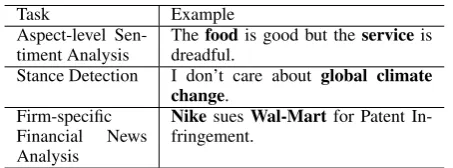
Task Example
Aspect-level
Sen-timent Analysis Thedreadful.foodis good but theservice is Stance Detection I don’t care about global climate
change. Firm-specific
Financial News Analysis
NikesuesWal-Martfor Patent In-fringement.
Table 1: Samples of target-dependent classification tasks. The targets of interest are in bold.
aspect-level sentiment analysis, favor or against
in stance detection, and riseor drop in financial news analysis towards the stock price movement of a particular firm.
Table 1 gives examples of three target-dependent classification tasks. We can find that there can be multiple target mentions in the same text scope, which makes it challenging for generic sentence representation approaches. For the first example, a restaurant manager or a potential cus-tomer may be interested in bothfoodandservice; however, the sentiment polarities towards the two targets are different. Hence, it would be beneficial for such tasks to tailor the sentence representations with respect to particular targets.
Tree structures are promising for such tasks, as they can potentially capture long-distance depen-dencies between target words and their contexts (Li et al., 2015). Therefore, it is not surprising to find work that exploits the syntactically parsed trees for learning target-specific sentence repre-sentations. Dong et al. (2014) and Chang et al. (2016) adapted the word orders in a parsed tree, depending on their distances to the target entities. Nguyen et al. (2015) extended Dong et al. (2014) by combining the constituency tree and the depen-dency tree of a sentence. An important assump-tion of such work is that different tree structures lead to different semantic representations even for the same sentence. However, they all resort to
[image:1.595.305.532.220.304.2]ternal syntactic resources, such as parse trees or Treebank annotations (Marcus et al.,1993), which limits their broader applications. On the one hand, annotated data are highly expensive to produce; and informal texts, such those on the social me-dia, remain a challenge for syntactic parsers (Kong et al.,2014). On the other hand, the tree structures in their pipeline-style architecture are fixed during training, which cascade errors to later representa-tion learning stage.
A desirable solution would be to automatically and dynamically induce the tree structures for target-specific sentence representations. However, the challenge is that the absence of external su-pervisions makes it difficult to evaluate the qual-ity of the tree structures and train the parameters. Inspired by Yogatama et al. (2016), we propose a reinforcement learning based approach that in-tegrates target information and generates target-specific tree structures that benefit downstream classification tasks.
The underlying framework consists of two key components, a RNN encoder-decoder that ex-plores possible binary tree structures according to a given target, and a tree-structured neural net-work that composes the input words into sentence representation based on the structure. The RE-INFORCE algorithm with the self-critic baseline (Rennie et al., 2016) is applied to update the pa-rameters of the two components.
We evaluate our approach on two benchmark tasks: a firm-specific cumulative abnormal return prediction task (based on formal news texts) and an aspect-level sentiment analysis task (based on informal social media texts). Experimental results show that our approach achieves superior perfor-mances compared to baseline methods that oper-ate on parsed trees. Moreover, our model sheds lights on understanding how sentences are com-posed from its word constituents towards specific targets.
2 Problem Definition
We formalize the problem of learning sentence representations for target-dependent classification tasks as constructing and semantically compos-ing the target-specific binary syntactic trees of sentences. The input of the model is a tuple
(x, xtarget, ctarget), in which x is a sentence of
n words {x1, x2,· · ·, xn}; xtarget is the target
[image:2.595.309.524.61.161.2]of interest mentioned in the sentence and ctarget
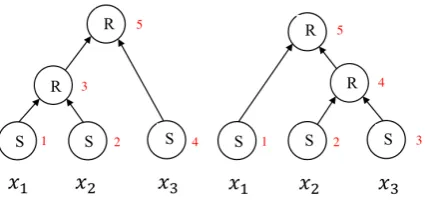
Figure 1: For input sequence {x1, x2, x3}, the
shift-reduce orders can be {S,S,R,S,R} and {S,S,S,R,R}, whereSstands for SHIFT andRstands for REDUCE.
is the polarity regarding the target. For sen-tencex, we can construct a valid binary syntac-tic tree by n SHIFT and n− 1 REDUCE tran-sitionsa = {a0, a1,· · · , a2n−1}, in which at ∈ {SHIFT,REDUCE}specifies the transition taken
at stept. The SHIFT transition adds a leaf node to the tree while the REDUCE transition combines two leaf nodes to form a parent node.
Figure 1 illustrates two examples on how can we construct a binary tree by only using SHIFT and REDUCE transitions and how can we ob-tain different binary trees by varying the SHIFT-REDUCE transition orders.
We design a transition generator G (Sec-tion 3.1) for generating transition orders a, G(x, xtarget) → aand a composition function C
(Section3.2) that composes sentencexfollowing the transition ordersainto sentence representation s,C(a,x)→s.
Our ultimate goal is to use the sentence rep-resentation s for target-dependent classification. The objective is thus to minimize the negative log-likelihood Eq1with L2 norm, in whichθdenotes all the parameters of our model.
J(θ) =−logP(ctarget|s;θ) +λ||θ||2 (1)
3 Model
Figure 2: The framework of our proposed method. The left side is a variant of standard encoder-decoder that gen-erates discrete SHIFT-REDUCE transition orders. It considers the target information at decoding. The right side is a composition function that semantically composes word representations into sentence representation following the transition orders. REINFORCE with the self-critical baseline is applied to reward the generated structures and update the parameters.
the one hand, the transition generator is fully un-supervised as we do not resort to external syntactic resources. On the other hand, the transitions gen-erated at each step are discrete, making it difficult to train and propagate errors to update the model parameters. We give details of the two compo-nents and how we address the challenges in this section.
3.1 Transition Generator
The basic idea of the transition generator is to generate different transition orders given differ-ent targets. We propose using the RNN encoder-decoder framework (Cho et al.,2014), which has shown capacity in shift-reduce parsing (Vinyals et al., 2015; Liu and Zhang, 2017b). A stan-dard RNN encoder-decoder contains two recurrent neural networks, one for encoding a sequence of variable-length into a vector representation and the other for decoding the representation back into an-other variable-length sequence.
Encoder We employ a standard Long Short-Term Memory (LSTM) (Hochreiter and Schmid-huber,1997) as our encoder. Given the input sen-tence{x1, x2,· · ·, xn}, we first obtain their word
vectors{−→e(x1),−→e(x2),· · · ,−→e(xn)}by looking
them up from a pre-trained embedding matrix−→e. We reverse the input sentence and feed their word embeddings sequentially to the LSTM. The hid-den states of each token{h1, h2,· · · , hn}are kept
for the decoding stage. The hidden state and cell state of the last LSTM unit are used as the initial states for decoder.
Decoder Following Bahdanau et al. (2014), we use an attention-based decoder. The decoder aligns with all the encoder hidden states at each step of decoding to obtain a context vectorct, such
that each input words show different weights at decoding. We denote the hidden states of our de-coder as{d1, d2,· · · , d2n−1}. The attention score over each of the encoder hidden statehi is
com-puted by:
uit=dt−1hi (2)
ait= exp(u
i t)
P
i0exp(uit0)
(3)
ct= n
X
i=1
ait·hi, (4)
in whichdenotes element-wise dot product;ai t
is the normalized attention score and the context vectorctis a weighted sum of all the encoder
hid-den states.
To enable the target of interest to influence the decoding process, we enrich the input of the de-coder by concatenating the target entity. The hid-den state of the decoder at timetis obtained by:
dt=LSTM(ct⊕ −→e(at−1)⊕ −→e(xtarget), dt−1), (5)
in which ⊕ denotes concatenation operation; xtarget is the embedding of the target entity; −
→e(at
−1) is the embedding of the last decoded transition andctis the context vector.
Decoding In a supervised RNN decoder setting, the goal of each step is to estimate the conditional probability
P(at|a1:t−1, ct, dt) =g(at−1, ct, dt), (6)
in which a1:t−1 are previously decoded transi-tions, ct is the context vector, dt is current
de-coder hidden state and g is non-linear network. P(at|a1:t−1, ct, dt}is a distribution over the
the decoded outputs with the ground-truth labels, the prediction errors can back-propagate to update parameters of the encoder-decoder network.
However, it is no more applicable in our set-tings, as we do not have any explicit supervisions from external syntactic resources. To make train-ing the transition generator possible, we resort to a reinforcement learning framework, obtaining the transitions by sampling from a policy network. We represent the current stateStby concatenating −
→e(at
−1),−→e(xtarget), ct, dt.
St= [−→e(at−1)⊕ −→e(xtarget)⊕ct⊕dt] (7)
The policy networkπ(at|St)is defined by Eq8,
π(at|St)∝exp(g(St)), (8)
in whichg is a one-layer non-linear feed-forward neural network. We decode the transition at by
sampling from the distributions given by the pol-icy network.
3.2 Composition Function
When a valid binary tree of a sentence is gener-ated, we use the composition function to obtain the representation following the transition orders. We maintain two data structures at composition; a buffer that stores words yet to be processed and a stack that stores the partially completed subtrees. Initially, the stack is empty, and the buffer stores all the words in the sentence. The operations spec-ified by SHIFT and REDUCE are as follows.
• For a SHIFT transition, the buffer pops the
topmost word out and pushes it to the top of the stack.
• For a REDUCE transition, the topmost two elements of the stack are popped out and composed. Their compositions are then pushed back to the stack.
To produce a valid binary tree, we follow Yo-gatama et al. (2016) to disallow SHIFT transi-tion when the buffer is empty and forbid REDUCE transition when the stack has no more than two el-ements.
We use a tree-LSTM (Tai et al.,2015) to seman-tically compose the top two elements of the stack. Initially, the hidden statehtand the cell statestof
leaf nodes are given by another LSTM. The tree-LSTM works as follows,
it
fl t
fr t
ot
gt
=
σ σ σ
tanh
·W ·
hl
t
hrt
(9)
st=ftlslt+ftrsrt +itgt
ht=ottanh(ˆst),
in which denotes element-wise dot product; it and ot are the input and output gate,
respec-tively;ftlandftrare the left and right forget gates; hl
t, hrt, slt, srt are the hidden and cell states of the
left and right nodes in the subtree. The hidden state of the topmost node is used as the represen-tation for the input sentence.
3.3 Training with REINFORCE
The goal for training is to optimize the parameters of the transition generatorθGand the composition
functionθC. It is easy to optimizeθC, the output
of which is directly connected to the classifier, the classification loss can back-propagate to update its parameters.
However, the transitions sampled from the pol-icy networkπ(a|S)are discrete, which makesθG
no more differentiable to our objective. A possi-ble solution is to maximize the expected reward
Ep(a;θG)R(a). As we are in a reinforcement learn-ing settlearn-ing, we can immediately receive a reward R(a) for transitions a = {a1, a2,· · ·, at} at the
end of the classification. The reward is defined as the logarithm of classification probability for the right labelctarget,R(a) = logP(ctarget|C(a,x)).
However, it is computationally intractable to compute Ep(a;θG)R(a), as the number of possi-ble transition ordersa is exponentially large. To address this, we use the REINFORCE algorithm to approximate the gradients by runningM exam-ples.
5θGJ(θG)≈ −
1
M
M
X
m=1
[5θGlogp(a)Rm(a)]
(10)
The5θGlogp(a)can be used to updateθG.
any baselines that do not depend on the actions are applicable. In this paper, we follow Rennie et al. (2016) to apply a self-critical baseline to the re-wards. Rather than estimating a baseline reward, the self-critical method uses the outputs given by the test-time inference algorithm as the baselines. This can thus alleviate the over-fitting problem on test dataset.
At inference, we use a greedy decoding strategy by selecting the most probable transitions given by the policy network (Eq8).
ˆ
ai=argmax
ai π(ai|St) (11)
The self-critical baseline reward is R(ˆa) = logP(ctarget|C(ˆa,x)), the formula to update θG
become Eq12.
5θGJ(θG)≈
− 1
M
M
X
m=1
[5θGlogp(a)(Rm(a)−Rm(ˆa))]
(12)
4 Experiments and Results
The proposed approach is evaluated on two aspect-level tasks: (1) firm-oriented cumulative abnormal return prediction on formal financial news texts and (2) aspect-level sentiment analysis on infor-mal social media texts.
4.1 Firm-specific cumulative abnormal return prediction
Firm-specific Cumulative Abnormal Return (CAR) prediction task (Chang et al.,2016) studies the impact of new information towards a specific firm. Multiple firms may be involved in the same new event, however, the event can present different impacts to these firms. Conceptually,
Abnormal Return is the difference between the actual return of a stock and its expected return. The expected return can be approximated by daily indexes, such as S&P 500 index. For example, if a stock is expected to rise by 5%, but on the event day, it rises by 2%, although it gives a positive return, the abnormal return is -3%. Cumulative Abnormal Return is the accumulated abnormal return in an event window, which is usually triggered by new events. We use a three-day window (-1, 0, 1), denoted as CAR3, with event day centering at day 0. We predict whether an event has positive or negative impact to the cumulative abnormal return of a given firm.
Training Development Test
+CAR3 7167 354 728
-CAR3 7102 387 731
Total 14269 741 1459
[image:5.595.329.503.61.114.2]Firms 1216 302 424
Table 2: Number of CAR3in the datasets
4.1.1 Data
We use the same news dataset as Chang et al. (2016), which are abstracts extracted from the Reuters news dataset released by Ding et al. (2014; 2015; 2016). Compared to the full texts of news documents, abstracts are supposed to be more informative and less noisy. Ding et al. (2014) show that modeling abstracts alone can achieve comparable or even better performances compared to full texts in stock market prediction. To better interpret our approach, we only extract event days with a single news document, which covers over 70% cases in the dataset. This final dataset yields a total of 16469 instances, including 1291 firms, of which 10% are reserved for valida-tion, and 20% are used for testing. The numbers of positive and negative CAR3examples and number of firms in the subsets are listed in Table2.
4.1.2 Baseline
To evaluate the performance of our approach on formal news texts, we compare with state-of-the-art target-independent and target-dependent base-lines. Among the baselines, Sentiment-based
andBi-LSTM are target-independent, which learn generic representations for sentences, while Bi-LSTM + Attention and TGT-CTX-TLSTM are target-dependent.
Sentiment-Based Sentiments among breaking news, earning reports and online message boards, are found to be correlated with market volatil-ity (Schumaker and Chen, 2009; Das and Chen,
2007). We adopt lexicon-based sentiment analysis as our baseline, using the sentiment lexicons re-leased by Loughran and McDonald (2011). We follow the prior literature (Mayew and Venkat-achalam, 2012) and use the count of posi-tive words, negaposi-tive words, the differences be-tween positives and negatives, and their length-normalized values as our feature vectors.
Parameters Value
word dimension 200
LSTM hidden dimension 200
dropout probablity 0.5
batch size 64
[image:6.595.99.264.60.145.2]initial learning rate 0.0005
Table 3: Hyper-parameters for firm-oriented cumula-tive abnormal return task
directions are concatenated and then used for clas-sification.
Bi-LSTM + Attention We extend vanilla Bi-LSTM by adding an attention mechanism over the hidden states. We concatenated the hidden states
ˆ
ht = {hlt, hrt} of each input token xt, the target
representation −→etarget is adopted to weigh each
of the hidden states.
ut=v>tanh(W1−→e(xtarget) +W2ht+b)
(13)
at=sof tmax(ut) (14)
dt=
X
atht (15)
TGT-CTX-TLSTM The method of Chang et al. (2016), which we follow and is used as our main baseline. It is a hybrid model which integrates both sequential information and syntactic parse tree information. As the first step, the abstract is parsed with an external syntactic parser to obtain the dependency relations between the words. The parse tree are then adapted and binarized depend-ing on their distances to targets in the dependency graph. A tree-structured Long Short-Term Mem-ory Network (Tai et al., 2015) is then applied to learn a vector representation of the binarized tree structure.
4.1.3 Parameters & Metrics
The hyper-parameters used in this paper are listed in Table 3. We pretrain word vectors with the Word2Vec (Mikolov et al.,2013) tool on the news dataset released by Ding et al. (2014), which are fine-tuned during training. The embeddings of tar-get firms are obtained by averaging their words of constituents.
We use macro-F1 to evaluate the performance on both positive and negative classes.
4.1.4 Test Results
The macro-F1 scores of our method and baselines are presented in Table4. Sentiment-based method
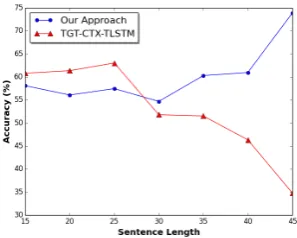
Figure 3: Accuracy with respect to sentence length.
gives the highest F1 score on the positive class. However, its performance is not consistent on the negative class, which suggests that it tends to mis-classify the sentence as positive. Bi-LSTM + At-tention outperforms the vanilla one without atten-tion and is much robust in both positive and neg-ative analysis. Our approach achieves an overall Macro-F1 of 58.2%, with an F1 score of 57.2% and 59.2% on positive and negative classes, re-spectively. Compared to the state-of-the-art model that exploits automatically parsed structures, we obtain an over 2% absolute gains without using explicit supervisions in learning the structures.
Method Class F1-score Sentiment-based +CAR3-CAR3 0.5970.476
Macro 0.536 Bi-LSTM +CAR3-CAR3 0.5570.490 Macro 0.523 Bi-LSTM + Attention +CAR3-CAR3 0.5750.523 Macro 0.549 TD-CTX-TLSTM +CAR3-CAR3 0.5520.570 Macro 0.561 Our Approach +CAR3-CAR3 0.5720.592 Macro 0.582
Table 4: Results for cumulative abnormal return pre-diction task
4.1.5 Accuracy Versus Sentence Length
[image:6.595.339.488.72.191.2]i,5∗(i+ 1)]. TGT-CTX-TLSTM gives higher ac-curacies over sentences with shorter lengths, while the accuracies decline sharply over sentences with lengths of over 30. Our approach is more consis-tent on both long and short sentences. As the sen-tence length grows, the accuracy our model grad-ually increases, showing its robustness and effec-tiveness across sentences of variable lengths.
4.2 Aspect-level Sentiment Analysis
To verify our proposed approach on informal so-cial media texts, we apply it to aspect-level sen-timent analysis on tweets. Aspect-level senti-ment analysis aims to identify sentisenti-ment polari-ties towards specific targets mentioned in a sen-tence. Target-specific sentence representations can be naturally applied to this task.
Dataset #Target #Positive #Negative #Neutral
Training 6248 1568 1560 3127
Testing 692 173 173 346
Table 5: Statistics of aspect-level sentiment analysis datasets
4.2.1 Dataset
We apply our model to a benchmark aspect-level sentiment analysis dataset used in previous work (Dong et al., 2014). The statistics of the dataset are shown in Table5. The target entities and cor-responding ground-truth labels are annotated. The labels belong to one of {positive, neutral,
nega-tive}, thus the task is a three-way classification.
4.2.2 Baselines
We compare our approach with feature-based and neural-based models.
Jiang et al. (2011) They extract rich target-dependent and target-intarget-dependent lexical and syn-tactic features for classification.
Dong et al. (2014) They adapt the parse tree of a sentence concerning the target with predefined rules and use recursive neural network (Socher et al.,2013) to learn a target-specific sentence rep-resentation.
4.2.3 Parameters & Metrics
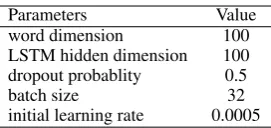
The parameter settings are listed in Table 6. We use 100-dimension GloVe vectors which are pre-trained on a large Twitter Corpus ( Penning-ton et al., 2014) and fine-tuned during training.
Parameters Value
word dimension 100
LSTM hidden dimension 100 dropout probablity 0.5
batch size 32
[image:7.595.349.485.60.124.2]initial learning rate 0.0005
Table 6: Hyper-parameters for aspect-level sentiment analysis
The commonly-used metrics classification accu-racy and macro-F1 are adopted to evaluate the per-formances.
Model Acc F1
[image:7.595.351.482.222.265.2]Jiang et al.(2011) 63.4 63.3 Dong et al.(2014) 66.3 65.9 Our Method 68.2 66.3
Table 7: Final results on aspect-level sentiment analy-sis task
4.2.4 Final Results
The final results on aspect-level sentiment analy-sis task are shown in Table7. Dong et al. (2014) are used as our main baseline, as they build target-specific sentence representation over adapted tree structures. Neural-based models outperform Jiang et al. (2011), which did a lot of feature engi-neerings, showing the effectiveness of automati-cally induced features. Our approach gives supe-rior performances compared to Dong et al. (2014), which operates on parsed trees. We achieve 68.2% classification accuracy and 66.3 macro-F1. We do not rely on a preprocessing syntactic parser as the first step to obtain the tree structures. On the one hand, social media texts are informal and ex-tremely noisy, which remains a challenge for syn-tactic parsers. The pipeline-style architecture of Dong et al. (2014) cascades parse errors to later stages, which will hurt the performances on down-stream tasks. On the other hand, the adapted tree structures in Dong et al. (2014), while in our ap-proach, the tree structures are also tuned dynam-ically during training, so as to find the optimal structures that would benefit downstream classifi-cation tasks.
4.3 Case Study
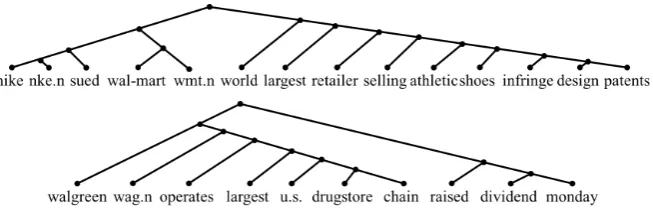
To gain further insights on the induced structures, we inspect the shift-reduce trees our approach gen-erated in this section. We present two examples that our model gives high confidences in Figure
Figure 4: Two tree structures generated by our model. We removed stop words and punctuations. The upper tree structure is for the sentence“Nike NKE.N has sued Wal-Mart WMT.N, saying the world ’s largest retailer is selling athletic shoes that infringe on its design patents”and the bottom one is for the sentence“Walgreen WAG.N , which operates the largest U.S. drugstore chain , raised its dividend on Monday.”
is selling athletic shoes that infringe on its de-sign patents”, the core part“Nike sued Wal-mart”
and the rest of the sentence are in two separate subtrees, which reduces potentially information loss about the key event when composing them into sentence representation. Similarly, for the sentence “Walgreen WAG.N , which operates the largest U.S. drugstore chain , raised its dividend on Monday.”, the model learns to make the tar-get“Walgreen”and key event“raised its dividend on Monday” close to each other in the tree, al-though there are sequentially many words in be-tween. These are good examples given by our model, we also find a lot of highly left- or right-biased tree structures. Intuitively, the completely left- and right-biased tree structures are equivalent to forward and backward sequential structures, re-spectively.
5 Related Work
Our model is related to the following research ar-eas, each having tremendous literatures.
5.1 Target-specific Sentence Representation
It is beneficial for numerous tasks, such as aspect-level sentiment analysis and stance detection, to have the sentence representations being tailored to specific targets. Early approaches rely on feature engineering by extracting target-dependent fea-tures (Jiang et al.,2011), while recent work mainly focuses on semantic compositions over the vec-tor space with deep neural models. Depending on how they model the target and context, we further classify related work into three categories.
The first category relies on syntactic parse trees. Dong et al. (2014) are among the first to ex-ploit tree structures, in which they adapt the parse trees based on the dependency relations between
the words and the target, and then use a recursive neural network to learn the sentence representa-tions. Similarly, Chang et al. (2016) explore a hybrid model that considers both sequential and structural information of a sentence. Nguyen et al. (2015) extend Dong et al. (2014) by combin-ing the constituency tree and the dependency tree of a sentence. The performances of their methods highly rely on external parsers, which is subject to noise in informal social media texts.
The second category models the interactions be-tween the target and its left context and right con-text. Vo and Zhang (2015) split a sentence into three parts and use pooling function to automatic inducing features for a given target. Similar to Vo and Zhang (2015), Zhang et al. (2016) exploit the gates instead of pooling functions to control the information flow of contexts. Tang et al. (2015) model by concatenating the word embeddings and target entity embeddings and use two LSTMs to encode left- and right contexts. Liu et al. (2017a) propose to use the attention mechanism to assign different weights to the left and right context de-pending on the target.
The third category controls the information flow from the target to the sentence representation. Au-genstein et al. (2016) use conditional encoding to encode the target and use it as the initial states for the sentence representation.
Our method belongs to the first category that ex-ploits tree structures. The main difference is we do not use external supervision from dependency parser or treebank annotations.
5.2 Neural-based Syntactic Constituency Parsing
manner. Syntactic constituency parsing is a funda-mental task in natural language processing, which uses phrase structure to organize words into nested constituents. Early approaches rely on proba-bilistic context-free grammars or transition-based models with rich features (Collins, 1997; Klein and Manning, 2003). Recently, recursive neural network (Socher et al., 2013) and neural-based transition model (Liu and Zhang, 2009) are also applied, which achieve competitive or even bet-ter performances compared to traditional state-of-the-art approaches that rely on hand-crafted fea-tures. Vinyals et al. (2015), from which we get inspirations, use the RNN Encoder-Decoder to en-code the sentence and generate its corresponding full parse tree. Bowman et al. (2016) propose a Stack SPINN framework that integrates parsing and interpreting the sentence in a hybrid model. Yogatama et al. (2016) extend their model by us-ing reinforcement learnus-ing to build the tree struc-tures that can improve performances of end tasks. We differ from the aforementioned approaches in two aspects. First, we do not use any explicit supervisions to guide the decoder. The parameters of our framework are optimized by the objective of end tasks. Another difference is that we learn target-specific instead of general-purpose sentence representations.
6 Conclusion
In this paper, we propose a framework that au-tomatically induces target-specific sentence rep-resentations over tree structures without recourse to external syntactic resources. Experimental re-sults on formal and informal texts showed that our approach is both robust and effective compared to previous work that operates on parsed trees. Moreover, the approach gives intuitions on how sentence structures are composed from their word constituents concerning a specific target.
Acknowledgements
We would like to thank the anonymous reviewers for their insightful comments and suggestions to help improve this paper. This work was partly supported by the National Key Basic Research Program of China via grant 2014CB340503, the National Natural Science Foundation of China (NSFC) via grant 61472107 and 61702137.
References
Isabelle Augenstein, Tim Rockt¨aschel, Andreas Vla-chos, and Kalina Bontcheva. 2016. Stance Detec-tion with BidirecDetec-tional CondiDetec-tional Encodingpages 876–885. http://arxiv.org/abs/1606. 05464.
Dzmitry Bahdanau, Kyunghyun Cho, and Yoshua Ben-gio. 2014. Neural machine translation by jointly learning to align and translate. arXiv preprint arXiv:1409.0473.
Samuel R. Bowman, Jon Gauthier, Abhinav Ras-togi, Raghav Gupta, Christopher D. Manning, and Christopher Potts. 2016. A Fast Unified Model for Parsing and Sentence Understanding https: //doi.org/10.18653/v1/P16-1139.
Ching-Yun Chang, Yue Zhang, Zhiyang Teng Teng, Zahn Bozanic, and Bin Ke. 2016. Measuring the information content of financial news. In26th Col-ing.
Kyunghyun Cho, Bart Van Merri¨enboer, Caglar Gul-cehre, Dzmitry Bahdanau, Fethi Bougares, Holger Schwenk, and Yoshua Bengio. 2014. Learning phrase representations using rnn encoder-decoder for statistical machine translation. arXiv preprint arXiv:1406.1078.
Michael Collins. 1997. Three generative, lexicalised models for statistical parsing. InProceedings of the eighth conference on European chapter of the Asso-ciation for Computational Linguistics. AssoAsso-ciation for Computational Linguistics, pages 16–23.
Sanjiv R Das and Mike Y Chen. 2007. Yahoo! for amazon: Sentiment extraction from small talk on the web. Management Science53(9):1375–1388.
Xiao Ding, Yue Zhang, Ting Liu, and Junwen Duan. 2014. Using structured events to predict stock price movement: An empirical investigation. InEMNLP. pages 1415–1425.
Xiao Ding, Yue Zhang, Ting Liu, and Junwen Duan. 2015. Deep learning for event-driven stock predic-tion. InIJCAI. pages 2327–2333.
Xiao Ding, Yue Zhang, Ting Liu, and Junwen Duan. 2016. Knowledge-driven event embedding for stock prediction. In Proceedings of COLING 2016, the 26th International Conference on Computational Linguistics: Technical Papers. pages 2133–2142.
Li Dong, Furu Wei, Chuanqi Tan, Duyu Tang, Ming Zhou, and Ke Xu. 2014. Adaptive recursive neural network for target-dependent twitter sentiment clas-sification. InACL (2). pages 49–54.
Long Jiang, Mo Yu, Ming Zhou, Xiaohua Liu, and Tiejun Zhao. 2011. Target-dependent twitter senti-ment classification. InProceedings of the 49th An-nual Meeting of the Association for Computational Linguistics: Human Language Technologies-Volume 1. Association for Computational Linguistics, pages 151–160.
Dan Klein and Christopher D Manning. 2003. Accu-rate unlexicalized parsing. In Proceedings of the 41st Annual Meeting on Association for Computa-tional Linguistics-Volume 1. Association for Com-putational Linguistics, pages 423–430.
Lingpeng Kong, Nathan Schneider, Swabha Swayamdipta, Archna Bhatia, Chris Dyer, and Noah A Smith. 2014. A dependency parser for tweets. InProceedings of the 2014 Conference on Empirical Methods in Natural Language Processing (EMNLP). pages 1001–1012.
Jiwei Li, Minh-Thang Luong, Dan Jurafsky, and Eu-dard Hovy. 2015. When are tree structures necessary for deep learning of representations? arXiv preprint arXiv:1503.00185.
Jiangming Liu and Yue Zhang. 2009. Shift-Reduce Constituent Parsing with Neural Lookahead Fea-tures 1.
Jiangming Liu and Yue Zhang. 2017a. Attention Modeling for Targeted Sentiment. Short Pa-pers2:572–577. https://www.aclweb.org/ anthology/E/E17/E17-2091.pdf.
Jiangming Liu and Yue Zhang. 2017b. Encoder-decoder shift-reduce syntactic parsing. arXiv preprint arXiv:1706.07905.
Tim Loughran and Bill McDonald. 2011. When is a liability not a liability? textual analysis, dictionaries, and 10-ks. The Journal of Finance66(1):35–65. Mitchell P Marcus, Mary Ann Marcinkiewicz, and
Beatrice Santorini. 1993. Building a large annotated corpus of english: The penn treebank. Computa-tional linguistics19(2):313–330.
William J Mayew and Mohan Venkatachalam. 2012. The power of voice: Managerial affective states and future firm performance. The Journal of Finance 67(1):1–43.
Tomas Mikolov, Ilya Sutskever, Kai Chen, Greg S Cor-rado, and Jeff Dean. 2013. Distributed representa-tions of words and phrases and their compositional-ity. InAdvances in neural information processing systems. pages 3111–3119.
Thien Hai Nguyen. 2015. PhraseRNN : Phrase Re-cursive Neural Network for Aspect-based Sentiment Analysis (September):2509–2514.
Jeffrey Pennington, Richard Socher, and Christo-pher D. Manning. 2014. Glove: Global vec-tors for word representation. In Empirical Meth-ods in Natural Language Processing (EMNLP).
pages 1532–1543. http://www.aclweb.org/ anthology/D14-1162.
Steven J Rennie, Etienne Marcheret, Youssef Mroueh, Jarret Ross, and Vaibhava Goel. 2016. Self-critical sequence training for image captioning. arXiv preprint arXiv:1612.00563.
Robert P Schumaker and Hsinchun Chen. 2009. Tex-tual analysis of stock market prediction using break-ing financial news: The azfin text system. TOIS 27(2):12.
Richard Socher, Alex Perelygin, Jean Y Wu, Jason Chuang, Christopher D Manning, Andrew Y Ng, and Christopher Potts. 2013. Recursive deep mod-els for semantic compositionality over a sentiment treebank. InEMNLP. Citeseer, volume 1631, page 1642.
Kai Sheng Tai, Richard Socher, and Christopher D Manning. 2015. Improved semantic representations from tree-structured long short-term memory net-works. arXiv preprint arXiv:1503.00075.
Duyu Tang, Bing Qin, Xiaocheng Feng, and Ting Liu. 2015. Effective lstms for target-dependent sentiment classification. arXiv preprint arXiv:1512.01100.
Oriol Vinyals, Łukasz Kaiser, Terry Koo, Slav Petrov, Ilya Sutskever, and Geoffrey Hinton. 2015. Gram-mar as a foreign language. InAdvances in Neural Information Processing Systems. pages 2773–2781.
Duy-tin Vo and Yue Zhang. 2015. Target-Dependent Twitter Sentiment Classification with Rich Auto-matic Features (Ijcai):1347–1353.
Dani Yogatama, Phil Blunsom, Chris Dyer, Edward Grefenstette, and Wang Ling. 2016. Learning to Compose Words into Sentences with Reinforcement Learningpages 1–10. https://doi.org/10. 1051/0004-6361/201527329.