Proceedings of the Thirteenth Workshop on Innovative Use of NLP for Building Educational Applications, pages 195–199
Complex Word Identification Based on Frequency in a Learner Corpus
Tomoyuki Kajiwara†‡ †Institute for Datability Science
Osaka University Osaka, Japan
Mamoru Komachi‡
‡Graduate School of Systems Design Tokyo Metropolitan University
Tokyo, Japan [email protected]
Abstract
We introduce the TMU systems for the com-plex word identification (CWI) shared task 2018. TMU systems use random forest clas-sifiers and regressors whose features are the number of characters and words and the fre-quency of target words in various corpora. Our simple systems performed best on 5 of the 12 tracks. Ablation analysis confirmed the use-fulness of a learner corpus for a CWI task.
1 Introduction
Lexical simplification (Paetzold and Specia,
2017) is one of the approaches for text simplifica-tion (Shardlow, 2014), which facilitates children and language learners’reading comprehension. Lexical simplification comprises the following steps:
1. Complex word identification
2. Substitution generation
3. Substitution selection
4. Substitution ranking
In this study, we work on complex word identifica-tion (CWI) (Shardlow,2013), a subtask of lexical simplification.
Previous studies (Specia et al., 2012;
Paetzold and Specia, 2016a) concluded that the most effective way to estimate word difficulty is to count the word frequency in a corpus. How-ever, they counted the word frequency in corpora written by native speakers, such as Wikipedia. Language learners tend to use simple words as compared to native speakers. Therefore, we expect the word frequency in the learner corpus to be a useful feature for CWI.
Our CWI system considers the word frequency in a learner corpus as well as in corpora writ-ten by native speakers. We use the Lang-8 cor-pus1(Mizumoto et al.,2011), a learner corpus that
can be used on a large-scale in many languages.
2 CWI Shared Task 2018
In CWI shared tasks, systems predict whether words in a given context are complex or non-complex for a non-native speaker. The first CWI shared task (Paetzold and Specia, 2016a;
Zampieri et al.,2017) contained only English data designed for non-native English speakers. Totally, 20 annotators were assigned to each instance in the training set. However, in the test set, only one annotator was assigned to each instance. By contrast, the CWI shared task 2018 (Yimam et al.,
2018) used a multilingual dataset (Yimam et al.,
2017a,b) having all instances annotated by mul-tiple annotators. This shared task was divided into two tasks (binary and probabilistic classification) and the following four tracks:
• English monolingual CWI
• Spanish monolingual CWI
• German monolingual CWI
• Multilingual CWI with a French test set
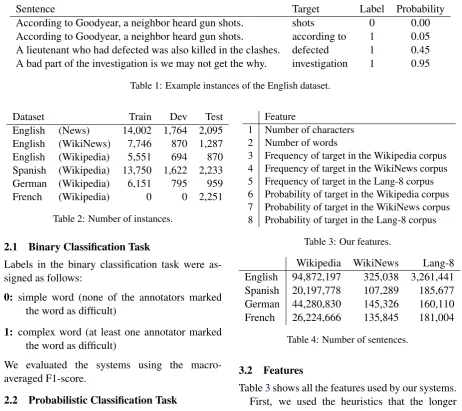
The English dataset contained a mixture of pro-fessionally written news, non-propro-fessionally writ-ten news (WikiNews), and Wikipedia articles. Datasets for languages excluding English were from Wikipedia articles. Tables 1 and 2 display the dataset and the number of instances, respec-tively.
1http://lang-8.com/
Sentence Target Label Probability
According to Goodyear, a neighbor heard gun shots. shots 0 0.00
According to Goodyear, a neighbor heard gun shots. according to 1 0.05
A lieutenant who had defected was also killed in the clashes. defected 1 0.45 A bad part of the investigation is we may not get the why. investigation 1 0.95
Table 1: Example instances of the English dataset.
Dataset Train Dev Test
English (News) 14,002 1,764 2,095
English (WikiNews) 7,746 870 1,287
English (Wikipedia) 5,551 694 870
Spanish (Wikipedia) 13,750 1,622 2,233
German (Wikipedia) 6,151 795 959
[image:2.595.68.531.60.471.2]French (Wikipedia) 0 0 2,251
Table 2: Number of instances.
2.1 Binary Classification Task
Labels in the binary classification task were as-signed as follows:
0: simple word (none of the annotators marked the word as difficult)
1: complex word (at least one annotator marked the word as difficult)
We evaluated the systems using the macro-averaged F1-score.
2.2 Probabilistic Classification Task
Labels in the probabilistic classification task were assigned as the proportion of annotators identify-ing the target as complex. Systems were evaluated using the MAE (mean absolute error).
3 TMU Systems
According to previous studies (Specia et al.,2012;
Paetzold and Specia, 2016a), we estimated the word difficulty by counting word frequency.
3.1 Classifiers
We used random forest classifiers and random for-est regressors for binary classification tasks and probabilistic classification tasks, respectively. We examined all combinations of the following hyper-parameters2:
• n estimators:{10,50,100,500,1000} • max depth:{5,10,15,20,∞}
• min samples leaf:{1,5,10,15,20}
2http://scikit-learn.org/
Feature
1 Number of characters 2 Number of words
3 Frequency of target in the Wikipedia corpus 4 Frequency of target in the WikiNews corpus 5 Frequency of target in the Lang-8 corpus 6 Probability of target in the Wikipedia corpus 7 Probability of target in the WikiNews corpus 8 Probability of target in the Lang-8 corpus
Table 3: Our features.
Wikipedia WikiNews Lang-8
English 94,872,197 325,038 3,261,441
Spanish 20,197,778 107,289 185,677
German 44,280,830 145,326 160,110
French 26,224,666 135,845 181,004
Table 4: Number of sentences.
3.2 Features
Table3shows all the features used by our systems. First, we used the heuristics that the longer words are more complex to understand as the first feature. For example, Flesch reading ease (Flesch,
1948), frequently used in research on text simpli-fication, uses this heuristics.
Second, as shown in Table1, the target includes words and phrases. As long phrases tend to be less frequent, we used the number of words as the second feature.
Others features (3-8) are based on the frequency of targets in a corpus. We counted frequencies from texts written by native speakers and language learners. Language learners are more likely to use simple words than native speakers. Therefore, we expected word frequency in the learner corpus to be a useful feature for CWI. As a text written by native speakers, we counted the frequency from Wikipedia and WikiNews. By contrast, as a text written by language learners, we counted the fre-quency from the Lang-8 corpus (Mizumoto et al.,
News Wikipedia WikiNews Spanish German French
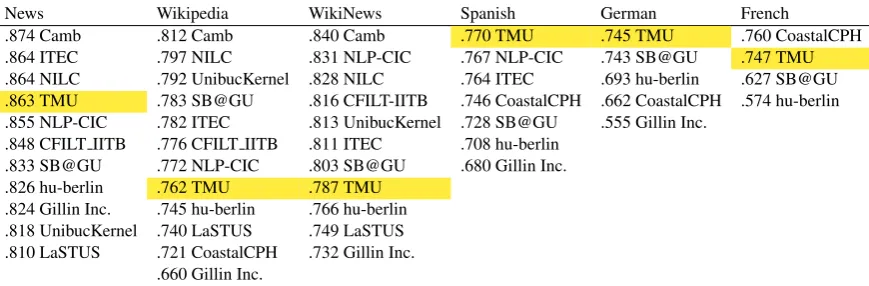
.874 Camb .812 Camb .840 Camb .770 TMU .745 TMU .760 CoastalCPH
.864 ITEC .797 NILC .831 NLP-CIC .767 NLP-CIC .743 SB@GU .747 TMU .864 NILC .792 UnibucKernel .828 NILC .764 ITEC .693 hu-berlin .627 SB@GU .863 TMU .783 SB@GU .816 CFILT-IITB .746 CoastalCPH .662 CoastalCPH .574 hu-berlin .855 NLP-CIC .782 ITEC .813 UnibucKernel .728 SB@GU .555 Gillin Inc.
.848 CFILT IITB .776 CFILT IITB .811 ITEC .708 hu-berlin .833 SB@GU .772 NLP-CIC .803 SB@GU .680 Gillin Inc. .826 hu-berlin .762 TMU .787 TMU
.824 Gillin Inc. .745 hu-berlin .766 hu-berlin .818 UnibucKernel .740 LaSTUS .749 LaSTUS .810 LaSTUS .721 CoastalCPH .732 Gillin Inc.
[image:3.595.83.518.61.204.2].660 Gillin Inc.
Table 5: Performance on the binary classification task. Systems are ranked by their macro-averaged F1-score.
News Wikipedia WikiNews Spanish German French
.051 TMU .074 Camb .067 Camb .072 TMU .061 TMU .066 CoastalCPH .054 ITEC .081 ITEC .070 TMU .073 ITEC .075 CoastalCPH .078 TMU .056 Camb .082 NILC .071 ITEC .079 CoastalCPH .191 Gillin Inc.
.059 NILC .093 TMU .073 NILC .251 Gillin Inc. .153 SB@GU .176 SB@GU .165 SB@GU
.281 Gillin Inc. .316 Gillin Inc. .289 Gillin Inc.
Table 6: Performance on the probabilistic classification task. Systems are ranked by their MAE score.
3.3 Experimental Settings
The dump data of Wikipedia and WikiNews on December 01, 2017, were downloaded and divided into sentences using WikiExtractor3 and NLTK4.
All corpora (Train / Dev / Test and Wikipedia / WikiNews / Lang-8) were tokenized and lower-cased in the script of the statistical machine trans-lation tool Moses5 (Koehn et al., 2007). Table 4
displays the number of sentences in each corpus.
4 Results
Tables 5 and 6present the official evaluation re-sults. In Table 5, systems are ranked by their macro-averaged F1-score for the binary classifi-cation task. TMU systems ranked first in Span-ish and German, and second in French. In Ta-ble6, systems are ranked by their MAE score for the probabilistic classification task. TMU systems ranked first in Spanish, German, and English news track and second in English WikiNews track.
4.1 Ablation Analysis of Freq. and Proba.
Frequency and probability are similar features. Ta-ble 7 indicates that although the probability tures are more important than the frequency fea-tures, systems can yield better performance by
3https://github.com/attardi/wikiextractor/ 4http://www.nltk.org/
5https://github.com/moses-smt/mosesdecoder
considering both features.
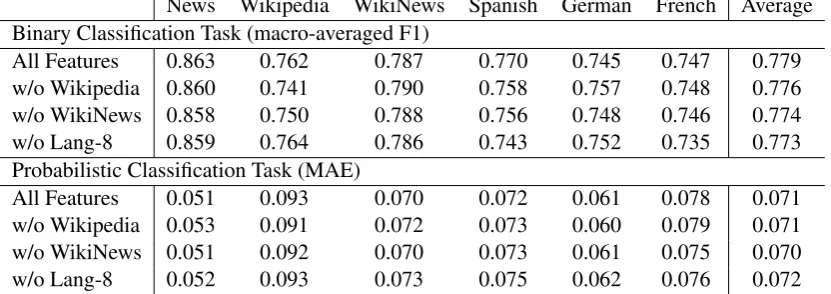
4.2 Ablation Analysis of Corpora
We examined which corpus provides important features. Table 8 shows the most important fea-tures obtained from the Lang-8 corpus. Remark-ably, the largest Wikipedia corpus does not con-tribute significantly to performance.
5 Related Work
Although our systems (random forest with length and frequency of the target word) are simple, they achieve competitive re-sults. In the first CWI shared task 2016, numerous systems (Brooke et al., 2016;
Davoodi and Kosseim, 2016; Mukherjee et al.,
2016; Zampieri et al., 2016; Ronzano et al.,
2016) used random forest classifiers. The length (Wr´obel, 2016; Paetzold and Specia,
2016b; Malmasi and Zampieri, 2016;
Malmasi et al., 2016; Zampieri et al., 2016;
Ronzano et al., 2016; Palakurthi and Mamidi,
2016; Quijada and Medero, 2016; Konkol,
2016) and frequency (Wr´obel, 2016;
Paetzold and Specia, 2016b; Brooke et al.,
2016; Zampieri et al., 2016; Ronzano et al.,
2016; Palakurthi and Mamidi, 2016;
Quijada and Medero, 2016; Konkol, 2016;
News Wikipedia WikiNews Spanish German French Average Binary Classification Task (macro-averaged F1)
All Features 0.863 0.762 0.787 0.770 0.745 0.747 0.779
w/o Frequency 0.864 0.770 0.798 0.774 0.742 0.693 0.774
w/o Probability 0.860 0.767 0.803 0.779 0.753 0.663 0.771
Probabilistic Classification Task (MAE)
All Features 0.051 0.093 0.070 0.072 0.061 0.078 0.071
w/o Frequency 0.052 0.090 0.073 0.071 0.059 0.099 0.074
[image:4.595.91.507.216.363.2]w/o Probability 0.051 0.094 0.070 0.072 0.061 0.111 0.077
Table 7: Ablation analysis of frequency and probability features.
News Wikipedia WikiNews Spanish German French Average Binary Classification Task (macro-averaged F1)
All Features 0.863 0.762 0.787 0.770 0.745 0.747 0.779
w/o Wikipedia 0.860 0.741 0.790 0.758 0.757 0.748 0.776
w/o WikiNews 0.858 0.750 0.788 0.756 0.748 0.746 0.774
w/o Lang-8 0.859 0.764 0.786 0.743 0.752 0.735 0.773
Probabilistic Classification Task (MAE)
All Features 0.051 0.093 0.070 0.072 0.061 0.078 0.071
w/o Wikipedia 0.053 0.091 0.072 0.073 0.060 0.079 0.071
w/o WikiNews 0.051 0.092 0.070 0.073 0.061 0.075 0.070
w/o Lang-8 0.052 0.093 0.073 0.075 0.062 0.076 0.072
Table 8: Ablation analysis of corpora.
features of the CWI shared task 2016. These are used as baselines, and a majority of the systems use them as part of their features.
While previous works counted the word fre-quency in corpora such as Wikipedia, which is written by native speakers, we used corpora writ-ten by language learners. As anticipated, the word frequency in the learner corpus proved to be a vital feature in the CWI task.
6 Conclusion
We explained the TMU systems for CWI shared task 2018. Our systems performed best on 5 of the 12 tracks using only simple features.
Previous studies concluded that the most effec-tive way to estimate word difficulty is to count the word frequency in a corpus. However, it was not clear what kind of corpus is useful for counting word frequencies. We discussed the usefulness of a learner corpus for the CWI task for the first time. As anticipated, the word frequency counted from the learner corpus worked better than that from the in-domain corpus written by the native speakers for the CWI task.
Acknowledgements
We would like to thank Xi Yangyang for granting use of extracted texts from Lang-8.
References
Julian Brooke, Alexandra Uitdenbogerd, and Timo-thy Baldwin. 2016. Melbourne at SemEval 2016 Task 11: Classifying Type-level Word Complexity using Random Forests with Corpus and Word List Features. In Proceedings of the 10th International Workshop on Semantic Evaluation, pages 975–981.
Elnaz Davoodi and Leila Kosseim. 2016. CLaC at SemEval-2016 Task 11: Exploring linguistic and psycho-linguistic Features for Complex Word Iden-tification. InProceedings of the 10th International Workshop on Semantic Evaluation, pages 982–985.
Rudolf Flesch. 1948. A new readability yardstick.
Journal of Applied Psychology, 32:221–233.
David Kauchak. 2016. Pomona at SemEval-2016 Task 11: Predicting Word Complexity Based on Cor-pus Frequency. In Proceedings of the 10th Inter-national Workshop on Semantic Evaluation, pages 1047–1051.
Constantin, and Evan Herbst. 2007. Moses: Open Source Toolkit for Statistical Machine Translation. InProceedings of the 45th Annual Meeting of the As-sociation for Computational Linguistics, pages 177– 180.
Michal Konkol. 2016. UWB at SemEval-2016 Task 11: Exploring Features for Complex Word Identi-fication. In Proceedings of the 10th International Workshop on Semantic Evaluation, pages 1038– 1041.
Shervin Malmasi, Mark Dras, and Marcos Zampieri. 2016. LTG at SemEval-2016 Task 11: Complex Word Identification with Classifier Ensembles. In
Proceedings of the 10th International Workshop on Semantic Evaluation, pages 996–1000.
Shervin Malmasi and Marcos Zampieri. 2016. MAZA at SemEval-2016 Task 11: Detecting Lexical Com-plexity Using a Decision Stump Meta-Classifier. In
Proceedings of the 10th International Workshop on Semantic Evaluation, pages 991–995.
Tomoya Mizumoto, Mamoru Komachi, Masaaki Na-gata, and Yuji Matsumoto. 2011. Mining Revi-sion Log of Language Learning SNS for Auto-mated Japanese Error Correction of Second Lan-guage Learners. InProceedings of 5th International Joint Conference on Natural Language Processing, pages 147–155.
Niloy Mukherjee, Braja Gopal Patra, Dipankar Das, and Sivaji Bandyopadhyay. 2016. JU NLP at SemEval-2016 Task 11: Identifying Complex Words in a Sentence. In Proceedings of the 10th Inter-national Workshop on Semantic Evaluation, pages 986–990.
Gustavo Paetzold and Lucia Specia. 2016a. SemEval 2016 Task 11: Complex Word Identification. In Pro-ceedings of the 10th International Workshop on Se-mantic Evaluation, pages 560–569.
Gustavo Paetzold and Lucia Specia. 2016b. SV000gg at SemEval-2016 Task 11: Heavy Gauge Complex Word Identification with System Voting. In Pro-ceedings of the 10th International Workshop on Se-mantic Evaluation, pages 969–974.
Gustavo Paetzold and Lucia Specia. 2017. A Survey on Lexical Simplification. Journal of Artificial In-telligence Research, 60:549–593.
Ashish Palakurthi and Radhika Mamidi. 2016. IIIT at SemEval-2016 Task 11: Complex Word Identifica-tion using Nearest Centroid ClassificaIdentifica-tion. In Pro-ceedings of the 10th International Workshop on Se-mantic Evaluation, pages 1017–1021.
Maury Quijada and Julie Medero. 2016. HMC at SemEval-2016 Task 11: Identifying Complex Words Using Depth-limited Decision Trees. In Proceed-ings of the 10th International Workshop on Semantic Evaluation, pages 1034–1037.
Francesco Ronzano, Ahmed Abura’ed, Luis Es-pinosa Anke, and Horacio Saggion. 2016. TALN at SemEval-2016 Task 11: Modelling Complex Words by Contextual, Lexical and Semantic Features. In
Proceedings of the 10th International Workshop on Semantic Evaluation, pages 1011–1016.
Matthew Shardlow. 2013. A Comparison of Tech-niques to Automatically Identify Complex Words. In Proceedings of the ACL 2013 Student Research Workshop, pages 103–109.
Matthew Shardlow. 2014. A Survey of Automated Text Simplification. International Journal of Advanced Computer Science and Applications, Special Issue on Natural Language Processing, pages 58–70.
Lucia Specia, Sujay Kumar Jauhar, and Rada Mihal-cea. 2012. SemEval-2012 Task 1: English Lexical Simplification. In Proceedings of the *SEM 2012: The First Joint Conference on Lexical and Compu-tational Semantics, pages 347–355.
Krzysztof Wr´obel. 2016. PLUJAGH at SemEval-2016 Task 11: Simple System for Complex Word Iden-tification. InProceedings of the 10th International Workshop on Semantic Evaluation, pages 953–957.
Seid Muhie Yimam, Chris Biemann, Shervin Mal-masi, Gustavo Paetzold, Lucia Specia, Sanja ˇStajner, Ana¨ıs Tack, and Marcos Zampieri. 2018. A Report on the Complex Word Identification Shared Task 2018. InProceedings of the 13th Workshop on In-novative Use of NLP for Building Educational Ap-plications.
Seid Muhie Yimam, Sanja ˇStajner, Martin Riedl, and Chris Biemann. 2017a. CWIG3G2 - Complex Word Identification Task across Three Text Genres and Two User Groups. InProceedings of the Eighth In-ternational Joint Conference on Natural Language Processing, pages 401–407.
Seid Muhie Yimam, Sanja ˇStajner, Martin Riedl, and Chris Biemann. 2017b. Multilingual and Cross-Lingual Complex Word Identification. In Proceed-ings of the International Conference Recent Ad-vances in Natural Language Processing, RANLP 2017, pages 813–822.
Marcos Zampieri, Shervin Malmasi, Gustavo Paetzold, and Lucia Specia. 2017. Complex Word Identifi-cation: Challenges in Data Annotation and System Performance. InProceedings of the 4th Workshop on Natural Language Processing Techniques for Ed-ucational Applications, pages 59–63.