Natural Language Communication with Robots
Yonatan Bisk
Information Sciences Institute Univ. of Southern California
Deniz Yuret Koc¸ University Computer Engineering [email protected]
Daniel Marcu
Information Sciences Institute & Department of Computer Science
Univ. of Southern California [email protected]
Abstract
We propose a framework for devising empiri-cally testable algorithms for bridging the com-munication gap between humans and robots. We instantiate our framework in the context of a problem setting in which humans give instructions to robots using unrestricted natu-ral language commands, with instruction se-quences being subservient to building com-plex goal configurations in a blocks world. We show how one can collect meaningful training data and we propose three neural architectures for interpreting contextually grounded natural language commands. The proposed architec-tures allow us to correctly understand/ground the blocks that the robot should move when instructed by a human who uses unrestricted language. The architectures have more diffi-culty in correctly understanding/grounding the spatial relations required to place blocks cor-rectly, especially when the blocks are not eas-ily identifiable.
1 Motivation
Much of the progress in Natural Language Process-ing can be attributed to definProcess-ing problems of broad interest (e.g. parsing and machine translation); col-lecting or creating publicly available corpora that en-code meaningfulhinput, outputisamples (e.g. Penn TreeBank and LDC Parallel Corpora); and devising simple, objective and computable evaluation met-rics to automatically assess the performance of algo-rithms designed to solve the problems of interest, in-dependent of the approach or technology used (e.g. ParseEval and Bleu).
As robots become increasingly ubiquituous, we need to learn to interact with them intelligently, in the same manner we interact with members of our own species. To make rapid progress in this area, we propose to use an intellectual framework that has the same ingredients that have transformed our field: ap-pealing science problem definitions; publicly avail-able datasets; and easily computavail-able, objective eval-uation metrics.
In this paper, we study the problem of Human-Robot Natural Language Communication in a set-ting inspired by a traditional AI problem – blocks world (Winograd, 1972). After reviewing previous work (Section 2), we propose a novel Human-Robot Communication Problem that is testable empirically (Section 3.1) and we describe the publicly available datasets (Section 3.2) and evaluation metric that we devised to support our research (Section 6). We then introduce a set of algorithms for solving our problem and we evaluate their performance both objectively and subjectively (Sections 4–8).
2 Previous work
Most research on Human-Robot Interac-tion (Klingspor et al., 1997; Thompson et al., 1993; Mavridis, 2015) bridges the gap between natural language commands and the physical world via a set of pre-defined templates characterized by a small vocabulary and grammar. Progress on language in this area has largely focused on ground-ing visual attributes (Kollar et al., 2013; Matuszek et al., 2014) and on learning spatial relations and actions for small vocabularies with hard-coded ab-stract concepts (Steels and Vogt, 1997; Roy, 2002;
Guadarrama et al., 2013). Language is sometimes grounded into simple actions (MacMahon et al., 2006; Yu and Siskind, 2013) but the data, while multimodal, is relatively formulaic, the vocabularies are small, and the grammar is constrained. Although robots have significantly increased their autonomy and ability to plan, that has not resulted, to date, in more flexible human-robot communication protocols that would enable robots to understand free-er form language and/or acquire simple and complex concepts via human-robot interactions.
Recently the connection between less formulaic language and simple actions has been explored suc-cessfully in the context of simulated worlds (van et al., 2009; Goldwasser and Roth, 2011; Brana-van et al., 2011; Artzi and Zettlemoyer, 2013; An-dreas and Klein, 2015) and videos (Malmaud et al., 2015; Venugopalan et al., 2015). However, to our knowledge, there is no body of work that focuses on understanding the relation between natural language and complex actions and goals or on explaining flex-ibly the actions taken by a robot in natural language utterances. As observed by Klingspor (1997), there is a big gap between the formulaic interactions that are typical of state-of-the-art human-robot commu-nications and human-human interactions, which are more abstract.
3 A Framework for Human-Robot Natural Language Communication Research
3.1 Problem Definition
Problem-Solution Sequences. In order to build models that understand the ambiguous and com-plex language used by people when communicat-ing to solve a task, we adopt the Problem-Solution Sequence (PSS) framework proposed by Bisk et al. (2016). Problem-Solution Sequences provide high and low level descriptions of actions in service of a goal; more specifically, they are sequences of images that encode what a robot might see as it goes about accomplishing a goal. In this paper, we work with PSSs specific to a simple world that has blocks placed on a table and a robot that can visually in-spect the table and manipulate the blocks on it.
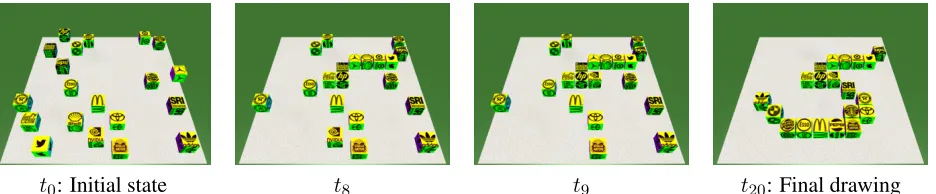
Figure 1 shows four intermediate block configura-tions of a PSS the robot observes as it transforms the initial state block configuration (random) into the
fi-1 coca cola , hp , nvidia . 2 nvidia , to the right of hp
3 place the nvidia block east of the hp block . 4 move the nvidia block to the right of the hp block 5 place the nvidia block to the east of the hp block . 6 move the nvidia block directly to the right of the
hp block .
7 move the nvidia block just to the right of the hp block in line with the mercedes block .
8 put the nvidia block on the right end of the row of blocks that includes the coca cola and hp blocks . 9 put the nvidia block on the same row as the coca
cola block , in the first open space to the right of the coca cola block .
Table 1:Examples of the type of natural language instructions seen in our corpus that verbalize the action needed to transition fromt8tot9in Figure 1.
nal one (the number five). The PSS makes explicit the natural language instructions that a human may give to a robot in order to transform the configura-tion in an Imageiinto the configuration in an Imagej
- the two configurations may correspond to one robot action (for adjacent states in the sequence) or to a se-quence of robot actions (for non-adjacent states). To account for language variance, each simple action or sequence of actions is associated with a set of alter-native natural language instructions. For example, nine descriptions of the same action (t8 →t9) from Figure 1 are shown in Table 1.
We see some structural similarity between the ut-terances, but they require different amounts of in-ference to understand, use different (potentially syn-onymous) language, and choose different blocks as contextual anchors for proper interpretation. Despite this, they each describe the action with equal preci-sion. The natural language instructions encode im-plicitly partial or full descriptions of the world (“in line with” or “first open space”).
Simple Instruction/Command Understanding.
The problem definition we focus on in this paper is that of simple instruction/command understanding: given a state of the world, Imagei, and a human-like
se-t0: Initial state t8 t9 t20: Final drawing Figure 1:Above are four states in a 20-action sequence for drawing the digit 5. The world state can be encoded for the learner as IDs and locations or raw images. Annotations are provided between every adjacent state (See Table 1) or between sequences (e.g.
t8→t20:Create a four-line diagonal which moves to the southeast. Starting with Heineken ...) to describe multi-action plans.
mantics: understanding a command amounts to in-ferring that the block at location (x, y, z)S needs
to be moved and the location (x, y, z)T where the
block needs to be moved. The rest of the blocks are not affected by the move.
3.2 Data
We follow Bisk et al. (2016)’s methodology and col-lect PSSs specific to both goal oriented and random actions.1 Our discussion focuses primarily on the
goal oriented data, wherein blocks are used to draw configurations/scenes that look like the digits zero through nine. To create these abstract drawings in a diverse and natural manner, configurations are de-rived from actual hand-written digits in the MNIST corpus (LeCun et al., 1998). These digits provide an easily recognizable target goal when arranging blocks. To create a sequence of actions that draws out these digits, the MNIST images were sharpened and down-sampled until each had at most 20 active pixels which could be replaced with blocks. The blocks were either decorated with brands (as shown above) or with the numbers one through twenty.
These block configurations were placed into a vir-tual world and scrambled until the board’s initial state was unrecognizable. This was achieved by ran-domly relocating adjacent blocks to new locations in the world. Once every block had been placed at a new location, the world appears random (for ex-ample, Image0 in Figure 1), but when these random actions are played in reverse, the sequence of moves recreates the digit in a deliberate and ordered man-ner. Each of these actions are then shown to Ama-zon Mechanical Turkers. To ensure that our robot 1All data (both single actions and sequences) and
links to code are available at http://nlg.isi.edu/ language-grounding/
learns to understand human-like commands, turkers were asked to provide instructions they would give to another person in order to transform a block con-figuration corresponding to a first image (ti) into a
second block configuration corresponding to an im-age (ti+1). Each image pair was presented to three turkers, each of whom had to provide three different instructions for achieving the same goal.
A total of 100 digits sequences were annotated (10 drawings for every digits). The sequences were split so that half were decorated with numbers and half with logos. The sides of every block have a dif-ferent color and a logo or number is overlayed on every side. Eight sequences for every digit are in-cluded in Training, one for development and two for testing. Overall, the training data has 11,871 com-mands, while the development and test corpora each have 1,719 and 3,177 commands, respectively.
For each learning example, we thus have access to an input that consists of an Imagei (what the
robot sees), the(x, y, z)coordinates of each block in Imagei(a discrete representation of the world
corre-sponding to the image), and a natural language com-mand that a robot needs to understand in order to operate on the world in Imagei. The output consists
of an Imagei+1(what the robot should build) and the
(x, y, z)coordinates of each block in Imagei+1.
MNIST Blank Types Tokens Types Tokens
Train 1,506 177K 961 58K
Dev 583 31K 444 8K
Test 645 48K 575 17K
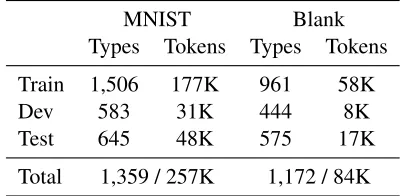
[image:4.612.84.287.61.159.2]Total 1,359 / 257K 1,172 / 84K Table 2:Type and token counts for the Logo and Number dec-orated block data sets (left) and the Blank blocks (right).
a given decoration in the development data.
Perhaps because annotators were not constrained or told they were giving instructions to a robot, the breadth of constructions and variance in command length is substantial. For example, the length of the commands varies wildly. Table 3 shows the num-ber of training commands in a given length range. Some commands span multiple sentences. The av-erage command length is 15 tokens with a standard deviation of 8.
The free form nature of the language and task al-lows for both utilitarian descriptions as well as more flowery instructions which utilize the full three-dimensional world:
take a plunger . plunge the top of the adidas block . lift it into the air , and place it directly to the left of the burgerking block , making sure the right edge of the adidas block and the left edge of the burgerking block are touching . remove the plunger .
Random Blank Blocks. In both Table 2 and 3 we also present statistics on a second much more chal-lenging dataset of blank blocks used to build dom configurations. For this data, blocks were rdomly placed alongside each other, on top of one an-other, or randomly scattered in the space. Addition-ally, these blocks have no identifying labels so they are more difficult to describe, making the ground-ing problem difficult. This leads to more interest-ing language with more spatial cues and countinterest-ing (e.g. third block from the top...). This manifests as much longer descriptions averaging 23.5 words with a standard deviation of 9 words. We see this length bias in Table 3. Finally, this data also presents the challenge of stack creation in the third-dimension. As capturing the language and phenomena of this data is largely out of the scope of our current work, we present baseline results to demonstrate its
dif-# of Commands Command Length (l) MNIST Random
1≤l≤5 81 0
5< l≤10 3,817 61
10< l≤20 5,752 995
20< l≤40 2,028 1,329
40< l≤80 192 107
Table 3:A breakdown of the number of commands in the train-ing data by the number of tokens per sentence.
ficulty in the hope of motivating future research. The complete blank blocks corpus consists of 2,493 training commands, 360 for development and 720 for testing or a total of∼58K/8K/17K tokens.
4 Learning Problems of Interest
Implicitly encoded in our data are three tasks with varying amounts of abstraction and context-specific language: Entity grounding, Spatial Rela-tion grounding, and Planning.
Entity Grounding. As one would expect based on Gricean maxims, there are many ways an object might be referred to in everyday speech. These are context specific and depend on the perceived am-biguity of a scene. For example, the decoration of blocks with logos allows for easy indexing (“nvidia block”) which uniquely identifies the referent. If a human feels the brand is not sufficiently recogniz-able they may choose to describeTexacoas “the star block”, orMercedesas “three lines in a circle”. In these cases, the speaker is appealing to more basic geometric knowledge in lieu of brand recognition.
The introduction of numbered blocks complicates the grounding as many actions also contain mea-sures of how far to move a block:
put block 10 four spaces below block 9 .
In this case, the user has decided to denote the block IDs with the numerals 0-9, but distances by spelling out the number. As is to be expected, most strategies do not hold across users, and an individual user may be very inconsistent:
move block seven two spaces to the right of block 6
[image:4.612.326.529.63.167.2]Finally, blank block descriptions use lots of spa-cial references the involve often complicated recur-sive structure:
Move the block that is to the [left of [the block closest to[the right side of the table ]]]so that it is on top of the block that is at the[top of the [group of blocks[closest to the[left side of the table]]]].
It follows that an important subtask for our mod-els/algorithms is to correctly ground the entities ref-erenced in naturally occurring commands. In gen-eral this may require a thorough understanding of syntax and scoping.
Spatial Relation Grounding. Another subtask is that of understanding spacial relations. Again, we are presented with lots of linguistic ambiguity which can be resolved by the shared context and references of the speaker and listener. For example, the first command in Table 1 is simply a list of three brands:
coca cola, hp, nvidia.
This statement on its own is meaningless, but in the context of an image that contains the first two brands in sequence from left to right, the list implies that the final logo should be appended to the existing line.
Naturally occurring commands also assume basic knowledge of physics. The final description in Ta-ble 1, asks that we place a block in the “first open space to the right ...”. Implicit in this statement is a shared understanding that two blocks cannot occupy the same space. This implies that a human or robot knows to search for the open space, which may be arbitrarily far away. Knowledge of physics or ba-sic geometric shapes appears to be common in the instructions and injecting this knowledge into our models may be helpful.
use block 2 as a bridge to complete the diagonal line formed by blocks 17 , 8 , 6 , 4 and 1 .
Finally, when analyzing the data, we found that command givers would often create an ad hoc grid to assist in specifying where a block should be placed. This was particularly common when placing the first block (t0 → t1) to start the drawing. This initial block may need to be placed in a position that is not near any existing blocks. Common solutions in-clude specifying midpoints between blocks to center a conversation:
place the adidas block in the column between the columns that contain the mercedes and esso blocks , but two block spaces below either .
Often the referenced blocks may be very far apart but appear opposite one another and equidistant from a useful reference point in space.
Plan Recognition. The third problem of interest is plan recognition. The annotation of sequences of ac-tions shows that natural commands are also used in a manner that assumes the ability to plan and execute individual and complex actions:
slide the adidas block 2 blocks straight up . then slide it 6 block spaces to the left .
The models we introduce in this paper have diffi-culty dealing with these kind of commands.
5 Models
In order to correctly interpret commands in context, we need models that ground entities and understand spatial relations, shapes, and the compositionality of language. This is a large and fertile space for ex-ploration. In contrast with previous work which at-tempts to produce deep semantic interpretations of commands (Kim and Mooney, 2012; Dukes, 2014), in this paper we explore the degree to which we can solve our communication problem using seman-tic free models. We are quick to note though that our framework can also assess the performance of semantic-heavy approaches.
We outline here three basic neural models that provide a set of reasonable baselines for other re-searchers interested in solving this problem. Each approach assumes less knowledge injection than the previous. As discussed in Section 3.1, in all three models, the eventual output is a tuple specifying where to find the block to move and where to move
it: (x, y, z)S and (x, y, z)T. For each model
pre-sented below we will try both simple feed-forward and recurrent neural network architectures for en-coding the input utterance.
5.1 Model Architecture
Encoder
W1
Hidden
W1
Wn
...
...
+
(x,y,z)W
orld (3x20)
Hidden
Semantics 2
Semantics 3
*
Semantics 1
Hidden
[image:6.612.75.296.59.229.2]Representation Grounding Prediction
Figure 2:Our models all follow the above architecture. 1-Hot word vectors (orange) are fed as input to a Feed-Forward or Re-current Neural Network for encoding. A semantic representa-tion is extracted (green), which in conjuncrepresenta-tion with knowledge of the world (blue) is grounded to predict an action.
can be trained independently (Sections 5.2 and 5.3) or jointly as a single End-to-End model (Section 5.4). This division of labor also allows for differing amounts of human intervention both during training and in the interpretation of actions and bears some resemblance to (Andreas et al., 2016). Specifically, we will first present results where the model predicts a fixed semantic interpretation of actions which are easily human interpretable (Encoder + Representa-tion). In this setting, the experimenter/human then must convert the semantics to actions in the world. Second, we remove the human interpreter and train a model for Grounding and Predicting from our se-mantic representation. Finally, we maintain our ar-chitecture but remove the human entirely, forcing the model to both converge to and interpret its own internal semantic representation.
The model architecture, regardless of how it is trained, at least implicitly, encodes our beliefs about the best way to solve the learning problem: per-forming single actions requires identifying anchors in the world that can be used as spacial referents from which a target location can be offset.
5.2 Discrete Predictions of a Fixed Semantics
Our first model assumes a setup with very simple se-mantics. Despite all blocks existing in a real-valued world, we will assume that a final location is param-eterized by knowledge of a reference block and the
direction from the reference to the target position.
Move the Adidas block to the right of the BMW.
For example, in the simple command above, we can distill three pieces of relevant information:
Source: Adidas
Reference: BMW
Direction: right (east)
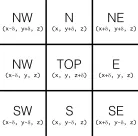
By assuming a grid world, BMW can be con-verted to its location in the world (x, y, z)BMW, which we shift east by changing the y component to yield: (x, y+δ, z). In practice we define a set of nine relative positions:
NW
(x-ẟ, y+ẟ, z) (x, y+N ẟ, z) (x+ẟNE , y+ẟ, z)
NW
(x-ẟ, y, z) (x, y, z+TOP ẟ) (x+ẟ, y, z)E
SW
(x-ẟ, y-ẟ, z) (x, y-S ẟ, z) (x+ẟSE , y-ẟ, z)
First our model produces an encoding of the sen-tence. We present two approaches:
Feed-Forward Neural Network (FFN): This model produces a sentence encoding by concatenat-ing one-hot word vectors as input to a hidden layer. We pad sentences so all inputs are the same length.
Recurrent Neural Network (RNN): In contrast, the RNN encoder consumes the full sentence, each word passing through a hidden layer one at a time, before returning a final representation.
Additionally, in both encoding approaches, words which only occur a single time during training are replaced with anUNKtoken.
We use a single hidden layer architecture with a softmax for prediction and and train with cross en-tropy loss. We train a separate model for each pre-diction (The Encoder and Representation stages of Figure 2). Once three versions of the model have been used to predict the Source, Reference and Di-rection, this triple is used to compute both the source
(x, y, z)S and target (x, y, z)T locations. The
for-mer is computed via a simple look-up table, while the latter amends the reference look-up with the ap-propriate offset from the aforementioned grid.
[image:6.612.392.461.231.299.2]5.3 Continuous Valued Predictions From a Semantic Triple
At this point, we have constructed a model for pre-dicting a specific semantic triple, but rely on the human to convert its output to physical locations given the current state of the world. To address this, we train a simple architecture which is shown the world and automatically learn direction offsets (the Grounding and Prediction stages of Figure 2).
The model takes knowledge of the Source, Refer-ence and Direction and passes them to two hidden layers. One is multiplied by the world (a 3 ×20
matrix of coordinates) and then both are summed to produce a final(x, y, z) prediction. The world ma-trix columns are the locations of each block, with a fixed ordering. If any block is missing from the configuration the matrix is padded with [-1,-1,-1]. This component of the network is then trained with a mean-square error regression loss.
Running this model on the predicted representa-tion of Secrepresenta-tion 5.2 creates a simple pipeline from Sentence and World representations to location pre-dictions, with no human intervention. We are par-ticularly interested in this model’s performance be-cause its intermediary representation is forced to conform to the simple, interpretable semantics we chose for this domain and task.
5.4 End-to-End Model
Finally, we present a single model which takes as input the sentence and world as before and predicts either the location of the block to move or its final location. This corresponds to training the neural ar-chitecture (Figure 2). We train the model twice, once to predict the source location(x, y, z)Sand a second
time to predict the target location(x, y, z)T. While
the model architecture implicitly assumes the pres-ence of an internal semantics we do not train it di-rectly, but rather rely on the model to discover one based solely on its prediction error in the world. This approach is likely to allow for easier future exten-sions that encode finer-grained direction information and scaling (see analysis in Section 8).
6 Evaluation Metric
In our formulation, understanding a commandCin the context of a world configuration Imageiamounts
to inferring the block (x, y, z)S that needs to be
moved and the target location(x, y, z)T where the
block needs to be moved to. Given that we control the manner in which the data is generated, we al-ways have access to the gold interpretation of com-mandC. Therefore, it is trivial to measure the per-formance of various command understanding algo-rithms by tracking two metrics: (i) we measure our ability to identify the block to be moved (and ref-erence/direction information when available) using standard accuracy figures; (ii) and we measure our ability to select and place the block to be moved by measuring the distance between our predicted loca-tions and the gold localoca-tions.
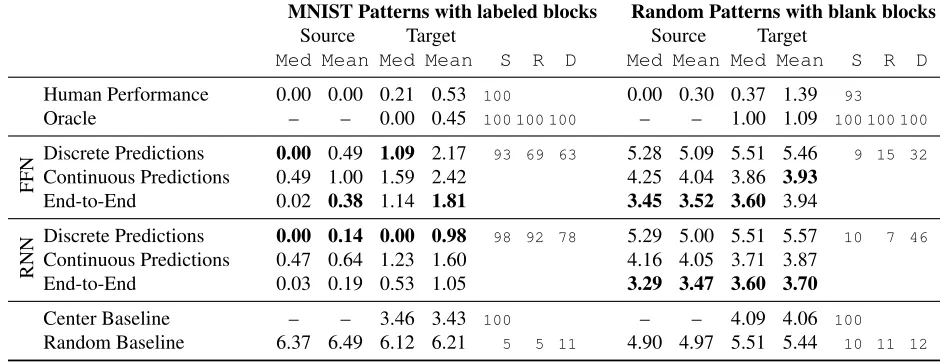
The first evaluation is presented in Table 4 under the S, R, and D columns. The distance errors are computed in terms of block lengths and we present the mean and median errors both for the source block’s initial and final location.
7 Baselines and Human Performance Since the gold annotations make explicit only the block to move and its target location, the Fixed Se-mantics models do not have gold training data for predicting the reference block used for anchoring or the direction to offset. To remedy this, we use a simple string matching heuristic that chooses a ref-erence block during training and that computes a “gold” direction from its location. The reference is chosen as the closest block mentioned in the sen-tence, other than the source.
Oracle. To evaluate the strength of this heuristic, we perform an oracle evaluation (Table 4): we as-sume perfect knowledge of the source block that is moved; we apply our string matching heuristic to choose a reference block; and then assume perfect knowledge of the quadrant in which we place the block that is moved. For the blank blocks, our string matching heuristic fails, so we simply use the closest block to the target location to the reference location. This, unsurprisingly, leads to higher error.
MNIST Patterns with labeled blocks Random Patterns with blank blocks
Source Target Source Target
Med Mean Med Mean S R D Med Mean Med Mean S R D
Human Performance 0.00 0.00 0.21 0.53 100 0.00 0.30 0.37 1.39 93
Oracle – – 0.00 0.45 100 100 100 – – 1.00 1.09 100 100 100
FFN
Discrete Predictions 0.00 0.49 1.09 2.17 93 69 63 5.28 5.09 5.51 5.46 9 15 32
Continuous Predictions 0.49 1.00 1.59 2.42 4.25 4.04 3.86 3.93
End-to-End 0.02 0.38 1.14 1.81 3.45 3.52 3.60 3.94
RNN
Discrete Predictions 0.00 0.14 0.00 0.98 98 92 78 5.29 5.00 5.51 5.57 10 7 46
Continuous Predictions 0.47 0.64 1.23 1.60 4.16 4.05 3.71 3.87
End-to-End 0.03 0.19 0.53 1.05 3.29 3.47 3.60 3.70
Center Baseline – – 3.46 3.43 100 – – 4.09 4.06 100
[image:8.612.69.540.64.245.2]Random Baseline 6.37 6.49 6.12 6.21 5 5 11 4.90 4.97 5.51 5.44 10 11 12
Table 4: Model error when trained on only the subset of the data with decorated blocks or blank blocks. Where appropriateS, R, andDare the model’s predictive accuracy at identifying the Source, Reference and Direction. All models are evaluated on the Median and Mean prediction error the source block and its final target location. Distances are presented in block-lengths.
not told about the high-level goal of drawing a num-ber. Despite this, Table 4 shows human performance is very similar to Oracle performance. Although hu-mans did not place blocks in line “perfectly”, they were comparable to or outperformed the oracle.
Baselines. Finally, Table 4 also shows the results obtained by two baseline models. One (Center) has perfect knowledge of the source block to move, but always places it in the center of the table. The sec-ond baseline (Random), chooses random values for the source, reference, and direction. As expected, the performance of these baselines is abysmal.
8 Results
The results in Table 4 show that there is a massive difference in performance between block configura-tions that use blocks marked with identifiers (logos and digits) and those without. When the blocks are marked with clearly identifiable logos, all models outperform our baselines by a wide margin. How-ever, when blocks are blank the situation is flipped.
The results in Table 4 also highlight a notice-able gap in performance between the simplest Dis-crete model and the two location predicting mod-els. The comparable performance of the Con-tinuous and End-to-End models on labeled blocks seems to imply that the End-to-End model is captur-ing/discovering similar anchoring information with-out being explicitly told to do so. On the blank block
data, the End-to-End model performs best by learn-ing its own more appropriate representation.
Parameters. Where appropriate, we used 256 unit hidden-layers, 0.5 dropout, and the Adam optimizer with a learning rate of 0.001. With the exception of the FFN Discrete Predictions model, SGD parameter grid-search did not yield an improvement.
8.1 Subjective Error Analysis
In Table 5, we collected 50 of our models worst er-rors on the decorated blocks data and categorized them into five classes of error. Eliminating most of these errors require more knowledge or a richer rep-resentation than currently afforded by our simple se-mantic triples. This is often due to the use of multi-ple reference blocks, but grammatical ambiguity and a knowledge of some basic geometric primitives also account for many of the mistakes.
8.2 Future Work on Blank Blocks
Ref-Error Type Count Example
Multi-Relation Actions 20 Place block 20 parallel with the 8 block and slightly to the right of the 6 block. Place block 15 on the same vertical column as blocks 16 and 17, and two rows
above blocks 11 and 3.
Geometric Understanding 10 Continue the diagonal row of 20, 19 and 15 downward with 13.
Put block 12 in the column between the columns with blocks 4 and 13, and on the same row as the lowest block on the board.
Grammatical Ambiguity 10 19 moved from behind the 8 to under the 18th block.
Burger King tile should be directly above the Coca Cola tile. Move Coca Cola. Grounding Names 5 Put the block that looks like a taurus symbol just above the bird.
[image:9.612.74.295.268.471.2]Understanding Distance 5 move the texaco block 5 block lengths above the BMW block
Table 5:We performed a subjective error analysis of the results of our Fixed Semantics model using the RNN encoder. Example sentences and the frequency of each type of error are reported above from the worst 50 errors on the development data.
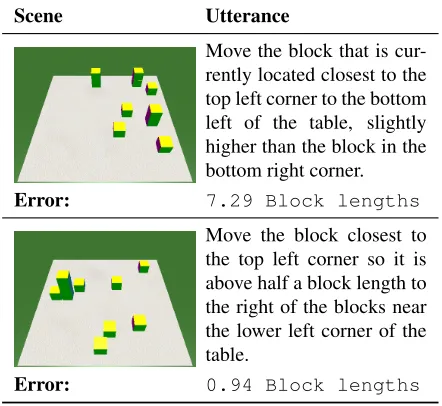
Scene Utterance
Move the block that is cur-rently located closest to the top left corner to the bottom left of the table, slightly higher than the block in the bottom right corner.
Error: 7.29 Block lengths
Move the block closest to the top left corner so it is above half a block length to the right of the blocks near the lower left corner of the table.
Error: 0.94 Block lengths
Table 6:Above are two commands and the worlds they apply to. Below we see the prediction error of our best model.
erence, Direction) paradigm, but automatically ex-tracting that semantics is now more difficult and the purview for future work with scene understanding.
To remove the possibility that this performance difference is due to sparsity, we down-sampled the training data from the decorated blocks to match that of the blank ones. We found the development errors grew (Average 0.27 and 1.35 on source and target, respectively) but were still substantially lower than those observed with blank block data.
Because extracting the semantics for training is so difficult, a particularly nice result is that while the End-to-End model was slightly weaker than the oth-ers on the MNIST based data, it actually performs best in this domain, where we cannot provide an
ex-plicit training signal for the representation.
The nature of the language in the blank blocks dif-fers quite dramatically due to this grounding diffi-culty. Table 6 shows the two sentences we perform best (and worst) on in the development data and that make use of a reference and direction.
9 Conclusion
We showed how human-robot communication can be attacked within an empirical framework that supports alternative models to be evaluated and compared using objective metrics. We intro-duced a set of simple algorithms for human-robot, in-context command/instruction understanding that should serve as strong baselines for future research in this field. The datasets present unique and impor-tant challenges for NLU, in which the interpretation of the language has varying amounts of dependence on the world in which it is uttered. The datasets we created in support of this work are made publicly available and should support the development of in-creasingly sophisticated models and algorithms for solving the problem defined in this paper, as well as additional problems that concern human-robot com-munication.
Acknowledgments
References
Jacob Andreas and Dan Klein. 2015. Alignment-based compositional semantics for instruction follow-ing. InProceedings of the 2015 Conference on Empir-ical Methods in Natural Language Processing, pages 1165–1174, Lisbon, Portugal, September. Association for Computational Linguistics.
Jacob Andreas, Marcus Rohrbach, Trevor Darrell, and Dan Klein. 2016. Learning to compose neural networks for question answering. arXiv preprint arXiv:1601.01705.
Yoav Artzi and Luke S Zettlemoyer. 2013. Weakly Su-pervised Learning of Semantic Parsers for Mapping Instructions to Actions. Transactions of the Associ-ation for ComputAssoci-ational Linguistics, pages 49–62. Yonatan Bisk, Daniel Marcu, and William Wong. 2016.
Towards a dataset for human computer communica-tion via grounded language acquisicommunica-tion. In Proceed-ings of the AAAI’16 Workshop on Symbiotic Cognitive Systems.
SRK Branavan, Harr Chen, Luke S Zettlemoyer, and Regina Barzilay. 2009. Reinforcement Learning for Mapping Instructions to Actions. In Proceedings of the Joint Conference of the 47th Annual Meeting of the ACL and the 4th International Joint Conference on Natural Language Processing of the AFNLP, Suntec, Singapore, August.
S R K Branavan, David Silver, and Regina Barzilay. 2011. Learning to Win by Reading Manuals in a Monte-Carlo Framework. InProceedings of the 49th Annual Meeting of the Association for Computational Linguistics: Human Language Technologies, pages 268–277, Portland, Oregon, USA, June.
Kais Dukes. 2014. Semeval-2014 task 6: Supervised semantic parsing of robotic spatial commands. In Pro-ceedings of the 8th International Workshop on Seman-tic Evaluation (SemEval 2014), pages 45–53, Dublin, Ireland, August.
Dan Goldwasser and Dan Roth. 2011. Learning From Natural Instructions. InTwenty-Second International Joint Conferences on Artificial Intelligence.
Sergio Guadarrama, Lorenzo Riano, Dave Golland, Daniel G¨ohring, Jia Yangqing, Dan Klein, Pieter Abbeel, and Trevor Darrell. 2013. Grounding Spatial Relations for Human-Robot Interaction . InIEEE/RSJ International Conference on Intelligent Robots and Systems (IROS), pages 1640–1647.
Joohyun Kim and Raymond Mooney. 2012. Unsuper-vised pcfg induction for grounded language learning with highly ambiguous supervision. In Proceedings of the 2012 Joint Conference on Empirical Methods in Natural Language Processing and Computational
Natural Language Learning, pages 433–444, Jeju Is-land, Korea, July.
Volker Klingspor, John Demiris, and Michael Kaiser. 1997. Human-Robot-Communication and Machine Learning. Applied Artificial Intelligence Journal, 11:719–746.
Thomas Kollar, Jayant Krishnamurthy, and Grant Strimel. 2013. Toward Interactive Grounded Lan-guage Acquisition. InRobotics: Science and Systems. Y. LeCun, L. Bottou, Y. Bengio, and P. Haffner. 1998. Gradient-based learning applied to document recog-nition. Proceedings of the IEEE, 86(11):2278–2324, November.
Matt MacMahon, Brian Stankiewicz, and Benjamin Kuipers. 2006. Walk the talk: Connecting language, knowledge, and action in route instructions. In Pro-ceedings of the 21st National Conference on Artificial Intelligence - Volume 2, AAAI’06, pages 1475–1482. AAAI Press.
Jonathan Malmaud, Jonathan Huang, Vivek Rathod, Nicholas Johnston, Andrew Rabinovich, and Kevin Murphy. 2015. Whats cookin? interpreting cooking videos using text, speech and vision. InProceedings of the 2015 Conference of the North American Chapter of the Association for Computational Linguistics: Hu-man Language Technologies, pages 143–152, Denver, Colorado, May–June.
Christopher D. Manning, Mihai Surdeanu, John Bauer, Jenny Finkel, Steven J. Bethard, and David McClosky. 2014. The Stanford CoreNLP natural language pro-cessing toolkit. InAssociation for Computational Lin-guistics (ACL) System Demonstrations, pages 55–60. Cynthia Matuszek, Liefeng Bo, Luke S Zettlemoyer, and
Dieter Fox. 2014. Learning from Unscripted Deictic Gesture and Language for Human-Robot Interactions. InProceedings of the Twenty-Eighth AAAI Conference on Artificial Intelligence.
Nikolaos Mavridis. 2015. A review of verbal and non-verbal human–robot interactive communication.
Robotics and Autonomous Systems, 63:22–35, Jan-uary.
Deb K Roy. 2002. Learning visually grounded words and syntax for a scene description task. Computer speech & language, 16(3-4):353–385, July.
Luc Steels and Paul Vogt. 1997. Grounding Adaptive Language Games in Robotic Agents. Proceedings of the Fourth European Conference on Artificial Life. H. Thompson, A. Anderson, E. Bard, G.
Doherty-Sneddon, A. Newlands, and C. Sotillo. 1993. The HCRC map task corpus: natural dialogue for speech recognition. In HLT ’93: Proc. of the workshop on Human Language Technology, pages 25–30. ACL. Subhashini Venugopalan, Huijuan Xu, Jeff Donahue,
Saenko. 2015. Translating videos to natural language using deep recurrent neural networks. InProceedings of the 2015 Conference of the North American Chapter of the Association for Computational Linguistics: Hu-man Language Technologies, pages 1494–1504, Den-ver, Colorado, May–June.
Terry Winograd. 1972. Understanding Natural Lan-guage. Academic Press.