To Link or Not to Link? A Study on End-to-End
Tweet Entity Linking
Stephen Guo
Stanford University
Ming-Wei Chang Emre Kıcıman
Microsoft Research
{minchang, emrek}@microsoft.com
Abstract
Information extraction from microblog posts is an important task, as today microblogs cap-ture an unprecedented amount of information and provide a view into the pulse of the world. As the core component of information extrac-tion, we consider the task of Twitter entity linking in this paper.
In the current entity linking literature, mention detection and entity disambiguation are fre-quently cast as equally important but distinct problems. However, in our task, we find that mention detection is often the performance bottleneck. The reason is that messages on micro-blogs are short, noisy and informal texts with little context, and often contain phrases with ambiguous meanings.
To rigorously address the Twitter entity link-ing problem, we propose a structural SVM algorithm for entity linking that jointly op-timizes mention detection and entity disam-biguation as a single end-to-end task. By com-bining structural learning and a variety of first-order, second-first-order, and context-sensitive fea-tures, our system is able to outperform exist-ing state-of-the art entity linkexist-ing systems by 15%F1.
1 Introduction
Microblogging services, such as Twitter and Face-book, are today capturing the largest volume ever recorded of fine-grained discussions spanning a huge breadth of topics, from the mundane to the his-toric. The micro-blogging service Twitter reports that it alone captures over 340M short messages,
ortweets, per day.1 From such micro-blogging ser-vices’ data streams, researchers have reported min-ing insights about a variety of domains, from elec-tion results (Tumasjan et al., 2010) and democracy movements (Starbird and Palen, 2012) to health is-sues and disease spreading (Paul and Dredze, 2011; Sadilek et al., 2012), as well as tracking prod-uct feedback and sentiment (Asur and Huberman, 2010).
A critical step in mining information from a micro-blogging service, such as Twitter, is the iden-tification of entities in tweets. In order to mine the relationship between drugs, symptoms and side-effects, or track the popularity of politicians or sen-timent about social issues, we must first be able to identify the topics and specific entities being dis-cussed. The challenge is that messages on micro-blogs are short, noisy, and informal texts with little context, and often contain phrases with ambiguous meanings. For example, “one day” may be either a set phrase or a reference to a movie. Given such difficulties, current mining and analysis of micro-blogs lists limits its application to certain domains with easy-to-recognize, unambiguous entities in or-der to avoid noise in the extraction results.
We begin this paper with a thorough investigation of mention detection and entity disambiguation for social media, focused on the Twitter micro-blogging service. Mention detectionis the task of extraction surface form candidates that can link to an entity in the domain of interest. Entity disambiguationis the task of linking an extracted mention to a specific def-inition or instance of an entity in a knowledge base.
1http://blog.twitter.com/2012/03/twitter-turns-six.html
While mention detection and entity disambigua-tion are frequently cast as equally important but dis-tinct and separate problems, we find that mention detection is where today’s systems and our base-line techniques incur the most failures. Detecting the correct entity mention is a significant challenge given mis-capitalizations, incorrect grammar, and ambiguous phrases. In (Ritter et al., 2011), the au-thors report their system achieves 0.64 to 0.67F1on named entity segmentation results with 34K tokens of labeled examples. On the other hand, once the correct entity mention is detected, a trivial disam-biguation that maps to the most popular entity2will achieve 85% accuracy in our set.
Our primary contribution in this paper is a re-casting and merging of the tasks of mention detec-tion and entity disambiguadetec-tion into a single end-to-end entity linking task. We achieve significant improvements by applying structural learning tech-niques to jointly optimize the detection and biguation of entities. Treating detection and disam-biguation as a single task also enables us to apply a large set of new features, conventionally used only for disambiguation, to the initial detection of men-tions. These features, derived from external knowl-edge bases, include entity popularity and inter-entity relations from external knowledge bases, and are not well utilized in current mention detection systems. For example, consider the following partial tweet:
(1) The town is so, so good. And don’t
worry Ben, we already forgave you for Gigli. Really.
Determining whether or not “The town” is a mention of a location or other specific entity based solely on lexical and syntactic features is challenging. Know-ing “The Town” is the name of a recent movie helps, and we can we be more confident if we know that Ben Affleck is an actor in the movie, and Gigli is another of his movies.
To train and evaluate our system, we created three separate annotated data sets of approximately 500 tweets each. These data sets are hand annotated with entity links to Wikipedia. We evaluate our sys-tem by comparing its performance at detecting
en-2
What we mean here is “the most linked entity”. See Sec-tion 3 for details.
tities to the performance of two state-of-the-art en-tity linking systems, Cucerzan (Cucerzan, 2007) and TagMe (Ferragina and Scaiella, 2010), and find that our system outperforms them significantly by 15% in absoluteF1.
The rest of this paper describes related work, our structured learning approach to entity linking, and our experimental results.
2 Related Work
Building an entity linking system requires solving two interrelated sub-problems: mention detection and entity disambiguation. The significant portion of recent work in the literature (Ratinov et al., 2011; Davis et al., 2012; Sil et al., 2012; Demartini et al., 2012; Wang et al., 2012; Han and Sun, 2011; Han et al., 2011) focuses solely upon the entity linking problem. The entity linking systems of these studies assume that entity mentions are provided by a sepa-rate mention detection system. In contrast, our study jointly identifies and disambiguates entity mentions within tweets (short text fragments).
A subset of existing literature targets end-to-end linking (Cucerzan, 2007; Milne and Witten, 2008; Kulkarni et al., 2009; Ferragina and Scaiella, 2010; Han and Sun, 2011; Meij et al., 2012), but there are quite a few differences between our work and each of these systems. Some systems (Milne and Witten, 2008; Kulkarni et al., 2009; Han and Sun, 2011) heavily depend on Wikipedia text and might not work well in short and noisy tweets. Many sys-tems (Mihalcea and Csomai, 2007; Cucerzan, 2007; Milne and Witten, 2008; Ferragina and Scaiella, 2010) treat mention detection and entity disam-biguation as two different problems. (Meij et al., 2012) is the most related to our paper. While their system also considers mention detection and entity disambiguation together, they do not consider entity-to-entity relationships and do not incorporate con-textual words from tweets.
(Rit-ter et al., 2011). There have been a few recent stud-ies proposing Twitter-specific NER systems (Li et al., 2012; Ritter et al., 2011).
3 Preliminaries
For performing entity linking on Twitter, we choose Wikipedia as our external knowledge base of enti-ties.
Entity We define anentityas a nonambiguous, ter-minal page (e.g., The Town (the film)) in Wikipedia (i.e., a Wikipedia page that is not a category, dis-ambiguation, list, or redirect page). We define an anchor phrase (surface form) as the textual phrase (e.g., the town) which can potentially link to some entities. We define an entity mentionas an anchor phrase and the context (“the town” in the exam-ple tweet in Section 1), where its semantic meaning umambiguously represents a specific entity. Note that an entity may be represented by multiple sur-face forms.
Wikipedia Lexicon Construction Following the assumptions used in most prior entity linking re-search, we assume that surface forms of entities can be found as anchor phrases in Wikipedia. In or-der to construct a Wikipedia lexicon, we first collect all anchors phases in Wikipedia. For each anchor phrase (surface form)s, we construct a lexicon en-try by gathering the set of entities {e1, e2, . . . eK} that can be linked froms. We also collect the num-ber of times anchoralinks to the entityei,d(s, ei). We defineP(ei|s) =d(s, ei)/d(s),whered(s) rep-resents the number of timessappears in Wikipedia. We refere0 asthe most linked entityfor anchorsif
e0= arg maxeP(ei|s).
Candidate Generation Given a tweet t, we ex-tract all k-grams of size ≤ k. For each k-gram, we find all entities where this k-gram is an anchor phrase. If ak-gram is an anchor phrase for at least one entity, then the k-gram is a candidate entity mention. In general, we identify many candidate phrase per tweet; let U(t) = {c1, c2, . . .} denote the set of candidates in tweet t. We refer to s(c) as the surface form (e.g., the anchor phrase) of c. Compared to the anchor phrase, the candidate also carries the context and position information. Let
E(ci) ={e1, e2, . . . ,NIL}denote the set of entities
which candidatei may be linked to, plus the addi-tional special tokenNIL. Note that the size ofE(ci) is always at least 2.
Task Definition First, our system generates candi-date entity mentions, textual phrases which can pos-sibly be entity mentions. Our system then performs filtering and optimization to process the list of can-didates. For each candidate, our system links the candidate to a specialNILtoken or links the candi-date to its corresponding entity in Wikipedia. More formally, given a tweettand its candidate setU(t), the goal of the system is to predictyi ∈E(ci),∀ci ∈
U(t).
Comparison to the TAC KBP Competition It is important to state that our definition of the entity linking problem differs significantly from the entity linking problem as defined by the TAC KBP com-petition (Ji et al., 2010; Ji et al., 2011). In the TAC, there is no true mention detection problem; every candidate in the TAC is an entity mention that rep-resents an entity. Another difference is that the TAC allows for an entity mention to map to an entity not in the external knowledge base (Wikipedia); our sys-tem does not provide special handling of this case.
Comparison to Named Entity Recognition
There are also important differences between our
task and the canonical NER task. For example,
NER systems identify common names, such as “Robert,” as entities. In our task, we only consider a prediction as a success if the system can determine which person in Wikipedia “Robert” is referring to. In other words, our definition of entities depends on the given knowledge base, rather than human judgment. Hence, it is difficult to make a fair system comparison of our system to NER systems.
4 Entity Linking as Structural Learning
In our framework, we use structural learning as a tool to capture the relationship between entities. We defineyias the output forci, whereyi ∈E(ci). Let
inference problem:
y0 = arg max
y
wTΦ(t, U(t),y) (1)
We use a Structural SVM (SSVM) (Taskar et al., 2004; Tsochantaridis et al., 2005; Chang et al., 2010) as our learning algorithm. To train the weight vectorw, we minimize the objective function of the SSVM
min
w
kwk2
2 +C
l
X
i=1
ξi2 (2)
wherelis the number of labeled examples and
wTΦ(ti, c(ti),yi)
≥∆(yi,y) +wTΦ(ti, c(ti),y)−ξi,∀i,y
We denoteyi as the gold assignment forxiand de-fine∆(yi,y)as the Hamming distance between two assignmentsyiandy.
4.1 Features
Feature definitions are very important as they define the shapes of the structures. Our feature vector is defined as
Φ(t, U(t),y) =X i
φ(t, ci, yi)+
X
i<j
φ(t, ci, yi, cj, yj)
where ci and cj is the i-th and j-th candidates in
U(t), respectively.
First, we assignΦ(t, ci,NIL)to be a special bias feature. The corresponding weight value behaves as a threshold to cut-off mentions. Recall in our defini-tion thatyi =NILrepresents that the candidateciis not a mention.
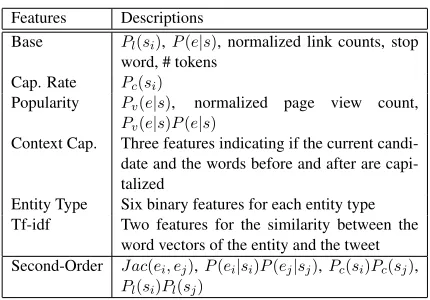
The first order features for Φ(t, ci, e) are de-scribed as follows. In general, we can classify our features into two types: mention-specific features and entity-specific features. For a given candidate
ci, mention-specific features only consider the sur-face form ofci and the tweett. Entity-specific fea-tures also consider the knowledge base content of the entity e. Prior work in the entity linking liter-ature has primarily focused on entity-specific fea-tures, as most prior work solves entity disambigua-tion with given mendisambigua-tions.
Base and Capitalization Rate Our base features are from two resources. Let s(c) denote the sur-face form of candidate c. The link probability
Pl(s(c)) andP(e|s(c))features are extracted from Wikipedia. We explained P(e|s(c)) in Section 3. Link probability Pl(s(c)) is the probability that a phrase is used as an anchor in Wikipedia. We also add a third feature that captures normalized link count. Besides these three features, we also have a feature to indicate ifais a stop word, and a fea-ture indicating the number of tokens ina. The view count andP(e|s)features are entity-specific, while the other three features are mention-specific.
For each phrase s(c), we also collect statistics about the probability that a phrase is capitalized in Wikipedia. We refer to this feature as the capitaliza-tion rate feature,Pc(s(c)).
Popularity Feature We have access to 300GBs of Wikipedia page view counts, representing one months worth of page view information, we use this as popularity data.3 As mentioned in Sec-tion 3, we find that the most often linked Wikipedia articles might not be the most popular ones on Twitter. Using page view statistics helps our
sys-tem correct this bias. We define another
prob-ability based on page view statistics Pv(ei|c) =
v(ei)/(
P
e∈E(c)/{NIL}v(e)), wherev(e) represents
the view count for the pagee.
Context Capitalization Our context capitaliza-tion features indicate if the current candidate, the word before, and the word after the candidate are capitalized.
Entity Type and Tf-idf We use the procedure pro-posed in (Ratinov et al., 2011) to extract keyword phrases from categories for each Wikipedia page, and then build a rule-based system using keyword phrases to classify if each entity page belongs to one of the following entity types: Person, Location, Or-ganization, TV Show, Book/Magazine and Movie.4 For a given candidatec and an entitye, the associ-ated binary feature becomes active if the entity be-longs to a specific entity type. There are six entity type features in our system.
3
http://dammit.lt/wikistats 4
Features Descriptions
Base Pl(si),P(e|s), normalized link counts, stop
word, # tokens
Cap. Rate Pc(si)
Popularity Pv(e|s), normalized page view count,
Pv(e|s)P(e|s)
Context Cap. Three features indicating if the current
candi-date and the words before and after are capi-talized
Entity Type Six binary features for each entity type
Tf-idf Two features for the similarity between the
word vectors of the entity and the tweet Second-Order J ac(ei, ej),P(ei|si)P(ej|sj),Pc(si)Pc(sj),
[image:5.612.78.293.51.201.2]Pl(si)Pl(sj)
Table 1: Summary of the features used in our structural learning systems.
We also include tf-idf features in our system. For each Wikipedia page, we collect the top 100 tf-idf words. We add one feature that is the dot product between the tf-idf word vector ofeand the words of tweett. We include a second feature that represents the average tf-idf score of all words that appear in botheandt.
Second-order features We include four very sim-ple second-order features φ(t, ci, ei, cj, ej) to cap-ture more complex relations between entities and candidates. The first feature is the Jaccard distance between two Wikipedia pagesei andej. Let Γ(ei) denote the set of Wikipedia pages that contain a hy-perlink to ei. We define the Jaccard distance be-tweeneiandej as:
J ac(ei, ej) =
|Γ(ei)∩Γ(ej)| |Γ(ei)∪Γ(ej)|
This feature has a similar effect as the normal-ized Google distance (Cilibrasi and Vitanyi, 2007), which has been used for many entity linking sys-tems. Let us use the following shorthand:si=s(ci) andsj =s(cj). We have also included three features
P(ei|si)P(ej|sj), Pc(si)Pc(sj)andPl(si)Pl(sj)to increase the expressivity of our model.
4.2 Mining Additional Contextual Words
Unlike mention detection systems used in other NLP tasks, there are no lexical features in our system. Lexical features are important as they can capture semantic meaning precisely. However, given that we do not have many labeled examples, lexical fea-tures can lead to overfitting. The diverse language
in tweets also make it more difficult to use lexical features.
Our solution for this problem is to use a very sim-ple method to mine context words for different enti-ties from a large, unlabeled tweet corpus. The algo-rithm works as follows:
1. Train an end-to-end entity linking system and then apply it to a large, unlabeled tweet corpus
2. Extract contextual words for each entity type based on the pseudo-labeled data.
3. Train the entity linking system again with new contextual features.
In this paper, we only use the word before and the word after as our contextual word for a candidate. Note that while there are ambiguous phrases on the surface (e.g., “friends” can be a TV show or just a regular phrase), certain phrases are unambiguous (e.g., “CSI : Miami”). As contextual words are often shared within the same entity type (e.g. “watching” is likely to appear before a tv show), those words can potentially improve our final system.
Let wi denote the i-th word in the tweet and ti denote the entity type for thei-th word.5 We use a very simple rule to select a set of left context words
Q(R)for entity typeR.
Q(R) ={wi |P(ti+1 =R|wi)> r, d(wi)> z}
whered(wi)represent the number of times the word
wi appears in the unlabeled set. The first rule is to simply find a word which is more likely to be fol-lowed by an entity. The second rule filter outs noisy words (e.g., Twitter handles) in the unlabeled set. The right context words are also extracted in a simi-lar way.
To train the second end-to-end entity linking sys-tem, we add one additional feature for the contextual words. For the feature vectorΦ(t, ci, e), the context feature is active if the candidateciis capitalized6and the context words aroundcibelongs toQ(R), given
Ris the entity type for the entitye.
5
The tagtibelongs to the entity typeRif our system links a
candidatecto an entity with typeRandccovers the wordwi.
6
4.3 Cohesiveness Score
There are several ways to consider entity-entity co-hesiveness besides using the second-order features directly. In our model, we also consider a modi-fied cohesiveness score proposed in (Ferragina and Scaiella, 2010). The idea behind the cohesiveness score is to estimate the correlations between differ-ent differ-entities by using weighted Jaccard scores.7
There are two rounds in the procedure of com-puting the cohesiveness score. We first estimate ap-proximately the most probable entity for each candi-date given all the other candicandi-dates in the same tweet. In the second round, the cohesiveness score is then produced with respect to the most probable entity computed in the first round.
More formally, in the first round, we compute the relevance score for each candidate and entity pair:
Rel(e, c|t) =
P
c06=c
P
e0∈E(c0)P(e0|c0)J ac(e, e0)
|U(t)| .
Then, the cohesiveness score is computed by
Scoh(e, c|t) =
P
c06=cJ ac(e,e¯(c0))P(¯e(c0)|c0)
|U(t)| ,
where thee¯(c0) = arg maxe∈E(c0)Rel(e, c0|t). We
then put the cohesiveness score as a feature for each (e, c) pair. In practice, we found that the cohesive-ness score in the model can significantly increase the disambiguation ability of the model without using the second-order information.
4.4 Inference
In order to train and test the SSVM model, one needs to solve both the inference problem Eq. (3) and the loss-augmented inference problem. Without second-order features, the inference and loss-augmented in-ference problems can be easily solved, given that each component can be solved independently by
yi0 = arg max y∈E(ci)
wTΦ(t, ci, y) (3)
While the inference problem can be solved inde-pendently, the training algorithm still considers the whole assignment together in the training procedure.
7In our experiments, we only apply the cohesiveness score
technique on candidates which pass the filtering procedure. See section 5 for more details for our filtering process.
Data #Tweets #Cand #Men. P@1
Train 473 8212 218 85.3%
Test 1 500 8950 249 87.7%
[image:6.612.325.529.53.114.2]Test 2 488 7781 332 89.6%
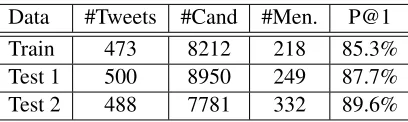
Table 2: Labeled example statistics. “#Cand” represents the total number of candidates we found in this dataset. “#Men.” is the total number of mentions that disam-biguate to an entity. The top-1 rate (P@1) represents the proportion of the mentions that disambiguate to the most linked entity in Wikipedia.
With the second-order features, the inference problem becomes NP-hard. While one can resort to using integer linear programming to find the optimal solution, we choose not to do so. We instead use the beam search algorithm. Our beam search algorithm first arranges the candidates from left to right, and then solve the inference problems approximately.
5 Experiments
We collected unlabeled Twitter data from two re-sources and then asked human annotators to label each tweet with a set of entities present. Our anno-tators ignored the following: duplicate entities per tweet, ambiguous entity mentions, and entities not present in Wikipedia. We next describe the two sets of Twitter data used as our training data and test-ing data. In addition to these two datasets, we also randomly sampled another 200 tweets as our devel-opment set.
Ritter We sampled 473 and 500 tweets8from the data used in (Ritter et al., 2011) to be our training data and test data, respectively. We did not use any labels generated by (Ritter et al., 2011); our annota-tors completely re-annotated each tweets with its set of entities. We refer to the first set asTrainand the second set asTest 1.
Entertainment To check if our system has the ability to generalize across different domains, we sampled another 488 tweets related to
entertain-ment entities. Our main focus was to extract
tweets that contained TV shows, Movies, and
8We originally labeled 1000 tweets but then found 27
Books/Magazines. Identifying tweets from a spe-cific domain is a research topic on its own, so we followed (Dalvi et al., 2012), and used a keyword matching method.9 After sampling this set of tweets, we asked our annotators to label the data in the same way as before (all entities are labeled, not just en-tertainment entities). We refer to this tweet set as
Test 2.
After sampling, all tweets were then normalized in the following way. First, we removed all retweet symbols (RT) and special symbols, as these are
to-kens that may easily confuse NER systems. We
treated punctuation as separate tokens. Hashtags (#) play a very important role in tweets as they often carry critical information. We used the following web service10to break the hashtags into tokens (e.g., the service will break “#TheCloneWars” into “the clone wars”) (Wang et al., 2011).
The statistics of our labeled examples are pre-sented in Table 2. First, note that the average number of mentions per tweet is well below 1. In fact, many tweets are personal conversations and do not carry any entities that can be linked to Wikipedia. Still, many candidates are generated (such as “really”) for those tweets, given that those candidates can still po-tentially link to an entity (“really” could be a TV channel). Therefore, it is very important to include tweets without entities in the training set because we do not want our system to create unnecessary links to entities.
Another interesting thing to note is the percent-age of entity mentions that disambiguate directly to their most often linked entities in Wikipedia. If we simply disambiguate each entity mention to its most linked entity in Wikipedia, we can already achieve 85% to 90% accuracy, if mention detection is per-fectly accurate. However, mention detection is a dif-ficult problem as only about 3% of candidates are valid entity mentions.
It is worthwhile to mention that, as per (Ferragina and Scaiella, 2010), for computational efficiency,
9We use the following word list :“movie”, “tv”, “episode”,
“film”, “actor”, “actors”, “actress”, “director”, “directors”, “movies”, “episodes”, “book”, “novel”, “reading”, “read”, “watch”, “watching”, “show”, “books”, “novels”, “movies”, “author” and “authors”.
10
http://web-ngram.research.microsoft. com/info/break.html
we apply several preprocessing steps before running our entity linking system. First, for each anchor in Wikipedia, we gather all entities it can disambiguate to and remove from that anchor’s entity set all enti-ties that are linked less than 2% of the time. Second, we apply a modified filtering procedure similar to that proposed in (Ferragina and Scaiella, 2010) to filter the set of candidates per tweet.
Evaluation Our annotated datasets contain
enti-ties from many Wikipedia categories. For
eval-uation, we primarily focus on entities belonging to a set of six core categories (Person, Location, Organization, TV Show, Book/Magazine, Movie). We believe it is necessary to focus upon core en-tities, rather than considering all possible entities in Wikipedia. Most common words in the English language have their own Wikpedia page, but most words are not important enough to be considered en-tities. In general, there is a large degree of subjectiv-ity when comparing different entsubjectiv-ity linking datasets; different researchers have their own interpretation of what constitutes an entity. For example, we exam-ined the annotation used in (Meij et al., 2012) and found it to be extremely lenient, when compared to our own beliefs of what is an entity. Therefore, we believe evaluating performance on restricted entity types is the only fair way to compare different end-to-end entity linking systems.
We evaluate the performance of our system on a per-tweet basis, by comparing the set of anno-tated “gold” entities with the set of entities predicted by our system, and computing performance metrics (precision, recall, F1). We choose to evaluate our system on a tweet basis, as opposed to a per-entity basis, because we wish to avoid the issue of matching segmentations. For example, it is quite common to observe multiple overlapping phrases in a tweet that should be linked to the same entity (e.g., “President Obama” and “Obama”). When evaluat-ing our system, we compute performance metrics for both all entities and core entities.11
Parameters In our implementation, we fixed the
regularization parameter C = 10. When
beam-11
Model Test 1 Test 2
P R F1 P R F1
Cucerzan 64.8 42.2 51.1 64.9 39.7 49.5
TagMe 38.8 69.0 49.7 34.9 70.3 46.7
[image:8.612.318.532.55.169.2]SSVM 78.8 59.9 68.0 75.0 57.7 65.2
Table 3: Comparisons between different end-to-end en-tity linking systems. We evaluate performance on core entities, as it is the only fair way to compare different systems.
search is used, the beam size is set to be 50, and we only consider the top 10 candidates for each can-didate to speed the inference process. In the context word mining algorithm,r= 0.5%andz= 1000.
5.1 Results
In the following, we analyze the contributions of each component in our system and compare our final systems to other existing end-to-end entity linking systems.
System Comparison We compare our final sys-tem to other state-of-the-art syssys-tems in Table 3. CUCERZAN represents a modified implementation of the system in (Cucerzan, 2007). TagMe is an end-to-end linking system that focuses on short texts, including tweets. Our system significantly outper-forms these two systems in both precision and re-call. Note that CUCERZAN’s system is a state-of-the-art system on well-written documents with pro-vided entity mentions. The system (Cucerzan, 2007) has been extended by the authors and won the TAC KBP competition in 2010 (Ji et al., 2010).
There are two possible reasons to explain why our system outperforms CUCERZAN. First, their men-tion detecmen-tion is a carefully designed system targeted toward documents, not tweets. Their system has seg-mentation issues when applied to Twitter, as it relies heavily upon capitalization when identifying candi-date entity mentions. Second, their system heav-ily depends on the fact that related entities should appear together within documents. However, given that tweets are very short, some of their most impor-tant features are not suitable for the Twitter domain. Our system outperforms TagMe because we use a more sophisticated machine learning approach, as compared to their system. TagMe links too many
Structural SVM Test 1 Test 2
All Core All Core
Base 35.9 42.9 47.7 52.5
+Cap. Rate 38.4 45.6 49.9 53.7
+Popularity 41.3 47.9 50.3 55.1
+Context Cap 43.7 52.0 50.7 54.8
+Entity Type 47.9 57.0 53.5 59.0
+Tfidf 53.2 63.1 56.8 61.9
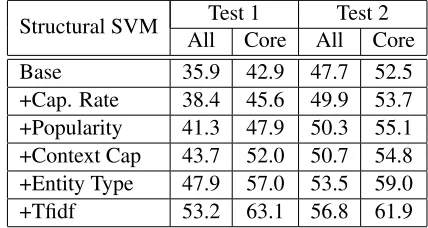
Table 4: Feature Study: F1 for entity linking perfor-mance. “All” means evaluation on all annotated entities. “Core” means evaluation only on our six entity types. Each row contains all additional features of the row above it.
spurious entity mentions for common words. This is a result of their algorithm’s over-emphasis on entity-entity co-occurrence features.
Feature Study We study the contributions of each feature group in our system in Table 4. We summa-rize our discoveries as follows:
First, we find collecting statistics from a large cor-pus helps the system significantly. In addition to
P(e|s), we find that capitalization rate features
of-fer around 3% to 4% F1 improvement in Test 1.
Similarly, popularity features are also important, as it corrects bias existing in Wikipedia link statistics. Compared to lexical features, using statistical fea-tures offers a great advantage of reducing the need for large amounts of labeled data.
Entity Type Words appearing before the mention
Words appearing after the mention
Person wr, dominating, rip, quar-terback, singer, featuring, defender, rb, minister, ac-tress, twitition, secretary
tarde, format, noite, suf-fers, dire, admits, sen-ators, urges, performs, joins
TV Show sbs, assistir, assistindo, otm, watching, nw, watchn, viagra, watchin, ver
[image:9.612.72.297.54.156.2]skit, performances, premieres, finale, par-ody, marathon, season, episodes, spoilers, sketch
Table 5: An example of context words that are automati-cally extracted from 20 million unlabeled tweets. For the sake of brevity, we only display context words for two categories. Note that there are misspelled words (such as “watchn”) and abbreviations (such as nw) that do not appear in well-written documents.
Advance Models Test 1 Test 2
All Core All Core
SSVM (Table 4) 53.2 63.1 56.8 61.9
+Context 53.9 64.6 58.6 63.4
+Cohesiveness 55.6 66.5 59.7 65.1
+2nd order 58.1 68.0 60.6 65.2
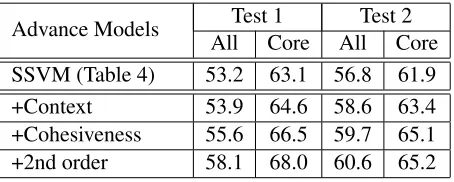
Table 6: Evaluation results (F1) of the advanced models. “+ Context” is the model that uses additional context fea-tures extracted from 20 millions unlabeled tweets. “+ Co-hesiveness” is the model with both additional context and cohesiveness features. “+2nd order” is our final model (which incorporates context, cohesiveness, and second-order features).
Mining Context Words We verify the effective-ness of adding contextual features that are extracted automatically from large unlabeled data. We apply our system (with all first-order features) on a set of 20 million unlabeled tweets we collected. Context words are then extracted using the simple rules de-scribed in Section 4. We list the top 10 words we extracted in Table 5. Due to space limitations, we only list the words for the Person and TV Show cat-egories. The results are interesting as we are able to find common misspelled words and abbreviations used in Twitter. For example, we find that “watchn” means “watching” and “nw” means “now watching,” and they are usually words found before TV shows. We also find tweeters frequently use abbreviations for people’s jobs. For example, “wr” means “wide receiver” and “rb” means “running back.” When mined context is added into our system, the perfor-mance improves significantly (Table 6). We note
that extending context mining algorithms in a large-scale, principled approach is an important next re-search topic.
Capturing Entity-Entity Relationships In this paper, we use two methods to capture the relation-ship between entities: adding the cohesiveness score and using second order information. Until now, we only considered features that can be extracted from only one entity. Past research has shown that consid-ering features that involve multiple entities can im-prove entity linking performance, given that related entities are more likely to appear together in a doc-ument. When these type of features are added, we need to perform beamsearch, as the exact inference procedure can be prohibitively expensive.
As displayed in Table 6, we find that either adding the cohesiveness score or using second order infor-mation can improve prediction. Using both methods improves the model even more. Comparing compu-tation overhead, computing cohesiveness is signifi-cantly more cost-effective than using second-order information.
6 Conclusion
In this paper, we propose a structural SVM method to address the problem of end-to-end entity linking on Twitter. By considering mention detection and entity disambiguation together, we build a end-to-end entity linking system that outperforms current state-of-the-art systems.
There are plenty of research problems left to be addressed. Developing a better algorithm for min-ing contextual words is an important research topic. It would also be interesting to design a method that jointly learns NER models and entity linking mod-els.
References
S. Asur and B.A. Huberman. 2010. Predicting the future with social media. arXiv preprint arXiv:1003.5699. M. Chang, V. Srikumar, D. Goldwasser, and D. Roth.
2010. Structured output learning with indirect super-vision. InProceedings of the International Conference on Machine Learning (ICML).
[image:9.612.73.300.247.338.2]S. Cucerzan. 2007. Large-scale named entity disam-biguation based on Wikipedia data. InProceedings of the 2007 Joint Conference of EMNLP-CoNLL, pages 708–716.
N. Dalvi, R. Kumar, and B. Pang. 2012. Object match-ing in tweets with spatial models. In Proceedings of the fifth ACM international conference on Web search and data mining, WSDM ’12, pages 43–52, New York, NY, USA. ACM.
A. Davis, A. Veloso, A. S. da Silva, W. Meira, Jr., and A. H. F. Laender. 2012. Named entity disambiguation in streaming data. InProceedings of the Annual Meet-ing of the Association for Computational LMeet-inguistics (ACL), pages 815–824, Stroudsburg, PA, USA. Asso-ciation for Computational Linguistics.
G. Demartini, D. E. Difallah, and P. Cudr´e-Mauroux. 2012. Zencrowd: leveraging probabilistic reasoning and crowdsourcing techniques for large-scale entity linking. In The International World Wide Web Con-ference, pages 469–478, New York, NY, USA. ACM. P. Ferragina and U. Scaiella. 2010. Tagme: on-the-fly
annotation of short text fragments (by wikipedia enti-ties). In Proceedings of the 19th ACM international conference on Information and knowledge manage-ment, CIKM ’10, pages 1625–1628, New York, NY, USA. ACM.
X. Han and L. Sun. 2011. A generative entity-mention model for linking entities with knowledge base. In
Proceedings of the 49th Annual Meeting of the Asso-ciation for Computational Linguistics: Human Lan-guage Technologies - Volume 1, HLT ’11, pages 945– 954, Stroudsburg, PA, USA. Association for Compu-tational Linguistics.
X. Han, L. Sun, and J. Zhao. 2011. Collective entity linking in web text: a graph-based method. In Pro-ceedings of the 34th international ACM SIGIR con-ference on Research and development in Information Retrieval, SIGIR ’11, pages 765–774, New York, NY, USA. ACM.
H. Ji, R. Grishman, H.T. Dang, K. Griffitt, and J. Ellis. 2010. Overview of the tac 2010 knowledge base pop-ulation track. InProceedings of the TAC 2010 Work-shop.
H. Ji, R. Grishman, and Dang. 2011. Overview of the tac 2011 knowledge base population track. In Proceed-ings of the TAC 2011 Workshop.
S. Kulkarni, A. Singh, G. Ramakrishnan, and S. Chakrabarti. 2009. Collective annotation of wikipedia entities in web text. In Proceedings of the 15th ACM SIGKDD international conference on Knowledge discovery and data mining, Proceedings of International Conference on Knowledge Discovery and Data Mining (KDD), pages 457–466, New York, NY, USA. ACM.
C. Li, J. Weng, Q. He, Y. Yao, A. Datta, A. Sun, and B.-S. Lee. 2012. Twiner: named entity recognition in tar-geted twitter stream. InProceedings of the 35th inter-national ACM SIGIR conference on Research and de-velopment in information retrieval, Proceedings of In-ternational Conference on Research and Development in Information Retrieval, SIGIR, pages 721–730, New York, NY, USA. ACM.
E. Meij, W. Weerkamp, and M. de Rijke. 2012. Adding semantics to microblog posts. In Proceedings of the fifth ACM international conference on Web search and data mining, pages 563–572, New York, NY, USA. ACM.
R. Mihalcea and A. Csomai. 2007. Wikify!: linking doc-uments to encyclopedic knowledge. In Proceedings of ACM Conference on Information and Knowledge Management (CIKM), pages 233–242. ACM.
D. Milne and I. H. Witten. 2008. Learning to link with wikipedia. In Proceedings of ACM Conference on Information and Knowledge Management (CIKM), pages 509–518, New York, NY, USA. ACM.
M.J. Paul and M. Dredze. 2011. You are what you tweet: Analyzing twitter for public health. InFifth Interna-tional AAAI Conference on Weblogs and Social Media (ICWSM 2011).
L. Ratinov, D. Roth, D. Downey, and M. Anderson. 2011. Local and global algorithms for disambiguation to wikipedia. InProceedings of the Annual Meeting of the Association for Computational Linguistics (ACL), pages 1375–1384, Stroudsburg, PA, USA. Association for Computational Linguistics.
A. Ritter, S. Clark, Mausam, and O. Etzioni. 2011. Named entity recognition in tweets: an experimental study. InProceedings of the Conference on Empirical Methods for Natural Language Processing (EMNLP), pages 1524–1534, Stroudsburg, PA, USA. Association for Computational Linguistics.
A. Sadilek, H. Kautz, and V. Silenzio. 2012. Model-ing spread of disease from social interactions. InSixth AAAI International Conference on Weblogs and Social Media (ICWSM).
A. Sil, E. Cronin, P. Nie, Y. Yang, A.-M. Popescu, and A. Yates. 2012. Linking named entities to any database. In Proceedings of the Conference on Empirical Methods for Natural Language Processing (EMNLP), pages 116–127, Stroudsburg, PA, USA. As-sociation for Computational Linguistics.
B. Taskar, C. Guestrin, and D. Koller. 2004. Max-margin markov networks. InThe Conference on Advances in Neural Information Processing Systems (NIPS). I. Tsochantaridis, T. Joachims, T. Hofmann, and Y.
Al-tun. 2005. Large margin methods for structured and interdependent output variables. Journal of Machine Learning Research, 6:1453–1484, September. A. Tumasjan, T.O. Sprenger, P.G. Sandner, and I.M.
Welpe. 2010. Predicting elections with twitter: What 140 characters reveal about political sentiment. In
Proceedings of the fourth international aaai confer-ence on weblogs and social media, pages 178–185. K. Wang, C. Thrasher, and B.J.P. Hsu. 2011. Web scale
nlp: a case study on url word breaking. InThe Inter-national World Wide Web Conference, pages 357–366. ACM.