Original Article
Prevalence of high-risk human papillomavirus
in Hangzhou, Eastern China
Guo-Hua Zhuang1*, Zhi-Yong Zhang2*, Lu Liu3, Chao Yuan4, Jian Wang1, Li-Feng Wu1, Zhi-Chao Gao1, Fang
Gong5, Chun-Yan Qian1
1Yuhang Branch of The Second Affiliated Hospital of Zhejiang University, Hangzhou 311100, Zhejiang Province,
China; 2Jiangxi Provincial People’s Hospital, Nanchang 330006, China; 3Obstetrics and Gynecology Hospital of Fu -dan University, Shanghai 200001, China; 4Shanghai Skin Disease Hospital, Shanghai 200443, China; 5The Third Hospital Affiliated to Nantong University, Wuxi 214041, Jiangsu Province, China. *Equal contributors.
Received March 27, 2017; Accepted November 14, 2017; Epub December 15, 2017; Published December 30, 2017
Abstract: Human papillomavirus (HPV) has been proved to play a crucial role in the development of cervical cancer and precancerous lesions. The prevalence and distribution of high-risk HPV (HR-HPV) genotypes varies in coun-tries, even in China. The present study aimed to investigate the genotypes prevalence, age- and season-specific prevalence, and frequency of HR-HPV infection in gynecology examination (GE) patients and healthy volunteers (HV) in Hangzhou, Eastern China. A total of 8,918 study subjects were enrolled and assigned into the gynecology examination (GE) group (n = 6,469) and the healthy volunteer (HV) group (n = 2,449), and 15 HR-HPV genotypes were characterized in cervical specimens. HPV-52, -58, -16, and -51 were the four most common genotypes, and higher prevalence of HR-HPV genotypes was seen in the GE group than in the HV group except HPV-59 and -45. In the GE group, the age-specific prevalence of HPV genotypes appeared a “U-shaped” curve; however, no significant difference was seen in the HV group. The HR-HPV genotypes exhibited clear seasonal rhythms, and various geno-types presented season-specific characteristics. A single HR-HPV genotype infection was most frequently observed in both groups and the proportion of infection with a single or two HPV genotypes was comparable between the two groups. Our data indicate that HR-HPV has high prevalence and may have special characteristics in Hangzhou, East-ern China. These findings may provide supplementary data for the surveillance of HPV infection and for the cervical cancer control and prevention in China.
Keywords: Human papillomavirus (HPV), high-risk HPV, genotyping, prevalence, Eastern China
Introduction
Cervical cancer is the third most common can-cer among women, with approximately 530,000 new cases annually worldwide [1]. Cervical can-cer develops through a multistep process, with three cervical intraepithelial neoplasia grades, 1 to 3 (CIN1-3) [2]. However, it will take several years, even decades, from pre-cancer to inva-sive cervical cancer, which offers us many opportunities for interventions [1]. Therefore, early detection of cervical precancerous lesions and their causes likely contribute to reducing the incidence and mortality of the malignancy. Human papillomavirus (HPV) has been identi-fied as a cause of premalignant and malignant tumors in the lower genital and digestive tracts
[3]. Molecular and epidemiologic evidence has shown that persistent infection with high-risk (HR) HPV plays a crucial role in the development of both cervical cancer and cervical precancer-ous lesions [4, 5].
responsible for 90% of anogenital warts (papil-loma) [8].
The prevalence and distribution of HR-HPV gen-otypes varies in countries and regions. In China, the prevalence of HPV genotypes also differs greatly in regions. Additionally, HPV vaccine has been commercially available in Mainland China since July 2016, using the extended schedule (0, 1, and 6 months) [9]. Therefore, it is essen-tial to investigate the characteristics of female HR-HPV infection among different geographic regions.
The present study aimed to investigate the prevalence and genotypes of HR-HPV among women in Hangzhou, Eastern China, in order to provide supplementary data for screening cer-vical cancer and developing vaccination strate-gies in this region.
Material and methods
Ethical approval
This study was approved by the Ethical Review Committee of the Second Affiliated Hospital of Zhejiang University (No. 2016-111) and per-formed in accordance with the 1964 Helsinki Declaration and its later amendments or com-parable ethical standards. Signed informed consent was obtained from all participants fol-lowing a detailed description of the purpose of the study.
Subjects
A total of 8,947 female volunteers, who visited the Yuhang Branch of the Second Affiliated Hospital of Zhejiang University (Hangzhou, China) during the period between January and November, 2016 for screening of HPV infection were recruited in this study. All cases were assigned into the gynecology examination (GE) group (n = 6,469) and the healthy volunteer (HV) group (n = 2,449). The inclusion criteria included (1) age of 18 years or greater; (2) a history of sexual life for more than one year; (3) no sexual intercourse during the past 3 days; (4) having an intact uterus; (5) non-pregnant; and (6) without a history of cervical therapy. Finally, a total of 8,918 women that met the inclusion criteria were enrolled in the study. There were 6,469 subjects in the GE group,
with a median age of 37 years (range, 18 to 84 years), and 2,449 subjects in the HV group, with a median age of 41 years (range, 20 to 85 years).
Collection of cervical specimens
All cervical specimens were collected by well-trained physicians. Cervical secretions were firstly removed with cotton swabs and then exfoliated cervical cells were collected with a cervical brush (Shanghai ZJ Bio-Tech Co., Ltd.; Shanghai, China). The brush was inserted 1 to 1.5 cm into the endocervical canal and rotated for 3 to 5 full turns. Then, each specimen with brush containing cellular materials and the mix-ture with 1.5 mL of specimen transport medi-um, was stored at 4°C immediately prior to detection for less than 72 hours. All specimens were labeled with subjects’ information.
DNA extraction and HPV genotyping
DNA extraction and HPV genotyping were car-ried out using the High-Risk HPV genotype Real-Time PCR kit exactly according to the man-ufacturer’s instructions (Shanghai ZJ Bio-Tech Co., Ltd.; Shanghai, China), and 15 HR-HPV genotypes were characterized on an ABI 7500 Real-time PCR System (Applied Biosystem; Foster City, CA, USA), including HPV-16, -18, -31, -33, -35, -39, -45, -51, -52, -56, -58, -59, -66, -68 and -82. Positive and negative con-trols, provided by the detection kit, were simul-taneously detected in each batch of test.
Statistical analysis
Results
Prevalence of HR-HPV genotypes
[image:3.612.91.287.73.209.2]There were 14 HR-HPV genotypes character-ized in the HV group, including HPV-16, -18, -31, -35, -39, -45, -51, -52, -56, -58, -59, -66, -68 and -82. Of the 2,449 subjects, 12.3% (290/2,449) were infected with one or more HR-HPV genotypes, and HPV-52 was the most common genotype (3.67%), followed by HPV-58 (1.96%), 16 (1.35%), 51 (1.22%), HPV-59 (1.06%), and HPV-56 (1.02%), while less than 1% prevalence of HPV-18, -31, -35, -39, -45, -66, -68 and -82 genotypes was detected (Figure 1).
In the GE group, all 15 HPV genotypes were detected, and 17.08% (1,105/6,469) of the subjects were infected with one or more geno-types. HPV-52 was the most common genotype (4.61%), followed by HPV-58 (3.17%), HPV-16 (2.88%), 51 (2.12%), 39 (1.78%), HPV-18 (1.30%), HPV-56 (1.21%), and HPV-66 (1.16%), while less than 1% prevalence of HPV-33, -68, -59, -31, -35, -82, and -45 genotypes was found (Figure 1).
HPV-52, -58, -16, and -51 were the four most common genotypes characterized in both groups, and higher prevalence of HR-HPV geno-types was seen in the GE group than in the HV group except HPV-59 and -45. There were sig-nificant differences in the prevalence of HPV-16, -33, -39, -51, -58 and -82 genotypes between the GE group and the HV group (P < 0.05 or 0.01) (Figure 1).
Age-specific prevalence of HR-HPV infection
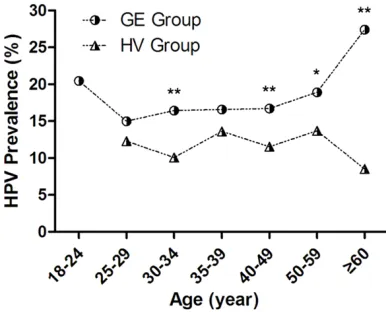
Age-specific prevalence of HR-HPV genotypes is shown in Figure 2. The prevalence of HR-HPV genotypes varied in ages in the HV group, rang-ing from 8.52% to 13.69%; however, there was no significant difference in the HV group (Chi-square test, χ2 = 7.869, P = 0.248). In the GE
group, the age-specific prevalence of HR-HPV genotypes appeared a “U-shaped” curve, with the first peak seen at ages of 18 to 24 years (20.47%, 78/381) and the second peak at ages of 60 years and greater (27.42%, 51/186) (Chi-square test, χ2 = 23.3, P = 0.001). In addition,
higher HR-HPV genotype prevalence was detected in the GE group than in the HV group at all age groups. There were significant differ-ences in the age-specific prevalence of HR-HPV infection between the GE group and HV group at ages of 30-34, 40-49, 50-59 and 60 years and greater (P < 0.05 or 0.01).
Season-specific prevalence of HR-HPV infec-tion
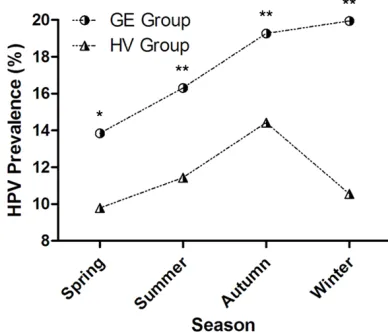
The season-specific prevalence of HR-HPV gen-otypes is presented in Figure 3. The prevalence of HR-HPV genotypes fluctuated with season in the HV group (Chi-square test, χ2 = 7.837, P =
[image:3.612.91.284.293.449.2]0.05), with the lowest prevalence detected in spring (9.79%, 47/480), and the highest seen in autumn (14.42%, 111/770). In the GE group, the lowest HR-HPV genotype prevalence was also found in spring (13.84%, 242/1749), and
Figure 1. Prevalence of HR-HPV genotypes in the study subjects. There were significant differences in the prevalence of HPV-16, -33, -39, -51, -58 and -82 genotypes between the GE group and the HV group. *P < 0.05; **P < 0.01.
the prevalence increased remarkably in sum-mer and remained at a high level in autumn (19.26%, 313/1,625) and winter (19.94%, 249/1249) (Chi-square test, χ2 = 26.426, P =
0). In addition, higher HR-HPV genotype preva-lence was observed in the GE group than in the HV group at all four seasons. There were signifi-cant differences in the season-specific preva-lence of HR-HPV genotype infection between the GE group and HV group in spring, summer, autumn and winter (P < 0.05 or 0.01).
In addition, HPV-52, -58, -16, and -51 were detected as the most common four HPV geno-types in both the GE and HV groups, and vari-ous HPV genotypes exhibited their specific characteristics with seasons. HPV-52 was the
[image:4.612.90.284.76.243.2]primary genotype of infections, and its preva-lence fluctuated with season, with the highest infection (4.93%) seen in autumn. The HPV-58 prevalence increased remarkably from spring to winter, while the prevalence of HPV-16 and -51 showed a peak. The highest prevalence of HPV-16 (3.24%) and -51 infection (2.63%) was detected in summer and autumn, respectively (Figure 4). Also, the four-year data pertaining to the season-specific prevalence of HR-HPV gen-otype infection in this area was very similar with Figure 4 (data not shown).
Frequency of HR-HPV genotype infection
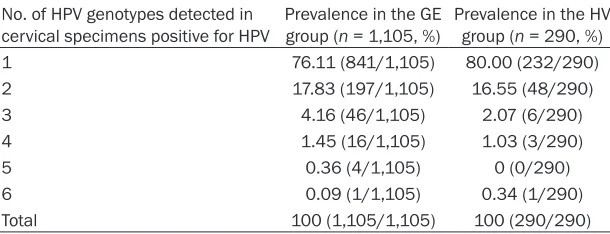
Among the 8,918 subjects enrolled in this study, there were 1,395 subjects with infection of one or more HR-HPV genotypes. In the HV group, 80% of the 290 HPV-positive samples were infected with a single HR-HPV genotype, 16.55% with two genotypes, 2.07% with three genotypes, and 1.38% with more than three genotypes (Table 1). In the GE group, 76.11% of the 1,105 HPV-positive specimens were infect-ed with a single HR-HPV genotype, 17.83% with two genotypes, 4.16% with three genotypes, and 1.9% with more than three genotypes (Table 1). Our data indicated that a single HR-HPV genotype infection was most frequent-ly observed in both groups and the proportion of infection with a single or two HR-HPV geno-types was comparable between the two groups.
Discussion
As the most common sexually transmitted infection, HPV has been identified as a cause of cervical cancer [1, 3, 5]. The prevalence and genotypes of HPV has been extensively investi-gated worldwide [10, 11]. Since the prevalence and distribution of HR-HPV genotypes varies in different regions of China [12, 13], there is still a great need of more knowledge on HR-HPV genotype prevalence in Eastern China. The cur-rent study was therefore designed with aims to investigate the prevalence and genotypes of HR-HPV in Hangzhou, Eastern China. Our data showed 15.64% prevalence of HR-HPV geno-types in Hangzhou, which is similar to the find-ings reported in other regions located in Eastern China, but different from the results detected in Southern and Northern China [14-17].
[image:4.612.91.287.326.467.2]Figure 4. Season-specific prevalence of HR-HPV gen-otype infection.
In the current study, the age-specific HR-HPV genotype prevalence varied from 8.52% to 13.69% in the HV group; however, no signifi-cant difference was seen in the prevalence of HR-HPV genotypes in the HV group (Chi-square test, χ2 = 7.869, P = 0.248), while the HR-HPV
genotype prevalence exhibited a “U-shaped” change with age in the GE group, with two peaks seen at ages of 18 to 24 years, and 60 years and greater, which is similar to other pre-vious reports [18-19]. In addition, significantly higher HR-HPV genotype prevalence was detected in the GE group than in the HV group at all age groups, which may be explained by the following contributors. Young women may have more active sexual intercourse, and their genital systems are not mature enough; as a result, the prevalence of HR-HPV infection exhibited its first peak in women at ages of 18 to 24 years [20]. If elder women, which have alterations of hormone levels and weaker immune function, still have active sex activi-ties, the second peak of HPV prevalence may occur since their viral clearance abilities decrease [21].
It has been shown that HPV genotypes are linked to cervical cancer [1, 3], and the severity of cervical lesions is associated with some spe-cific HPV genotype infection [2]. If the capability of viral clearance reduces, persistent HPV infection may occur, thereby inducing cervical lesions. In this study, HPV-52, -58, -16, and -51 were characterized as the four most common HPV genotypes in both the GE and HV groups. Our findings showed 52, rather than HPV-16 or -18, as the most common genotype in Hangzhou, Eastern China, which may indirectly infer the incidence of cervical cancer and the severity of cervical lesions in this region. The
different countries and regions, and it may have formed 5 phylogenetic groups [23]. In this study, HPV-52, -58, -16, and -51 were detected as the four most common HPV types. It has been shown that the HPV geno-types exhibit clear seasonal rhythms, and vari-ous genotypes present season-specific chara- cteristics [24]. Previous studies have demon-strated a relationship between HPV genotypes and sunlight exposure [25]. It is therefore assumed that the well-known phenomenon of UV-mediated suppression of immune surveil-lance may be causally related to this [26], which may explain the variation of HPV genotypes in different geographic regions.
Our findings showed that one HR-HPV genotype infection was predominant in both the HV and GE groups, followed by infection with two geno-types. Both HPV virus and host are found to affect HPV infection, such as genetic suscepti-bility or host genome, HPV variants, co-infec-tion of HPV, first sexual intercourse, numbers of sexual partners during the past last year, sex partners having sex with others, female educa-tional level, healthy habits, and other life-style factors [27].
[image:5.612.92.397.97.214.2]This study is the most current (from January to December 2016) and relatively large-scale epi-demiological survey pertaining to HR-HPV geno-type prevalence in Eastern China. However, there are still some limitations that should be noted. Since the commercial HPV genotyping kit used in this study can only detect 15 types of known HR-HPV genotypes, underestimation of HPV genotype prevalence cannot be exclud-ed. In addition, occupation-specific HPV preva-lence was not analyzed in the present study, Table 1. HR-HPV genotypes characterized in the cervical specimens
captured from the study subjects
No. of HPV genotypes detected in
cervical specimens positive for HPV Prevalence in the GE group (n = 1,105, %) Prevalence in the HV group (n = 290, %) 1 76.11 (841/1,105) 80.00 (232/290) 2 17.83 (197/1,105) 16.55 (48/290) 3 4.16 (46/1,105) 2.07 (6/290) 4 1.45 (16/1,105) 1.03 (3/290) 5 0.36 (4/1,105) 0 (0/290) 6 0.09 (1/1,105) 0.34 (1/290) Total 100 (1,105/1,105) 100 (290/290)
since subjects’ occupation was not fully recorded.
The results of the present study demonstrate high prevalence of HR-HPV genotypes in Eastern China. Since July 2016, HPV vaccine has been made commercial in Mainland China, using the extended schedule (0, 1, and 6 months). Considering the harm and public health significance of HPV infection, effective interventions are required to reduce HPV infec-tion, such as health educainfec-tion, HPV screening and genotyping in women aged more than 18 years, and monitoring and treatment of HPV infections. Our findings may provide supple-mentary data for the surveillance of HPV infec-tion and for the cervical cancer control and pre-vention in China.
Acknowledgements
This work was supported by the grants from the National Natural Science Foundation of China (grant nos. 81400021, 81601831 and 8160- 2778), Shanghai Municipal Commission of Health and Family Planning (grant no. 2015- 4Y0055), Natural Science Foundation of Jiang- su Province (grant no. BK20140125), Hangzhou Municipal Scientific Research Project for Me- dical Sciences (grant no. 20150633B66) and Yuhang District Key Scientific Research Project for Medical Sciences (grant no. 2015008). Disclosure of conflict of interest
None.
Address correspondence to: Dr. Chun-Yan Qian, Yuhang Branch of The Second Affiliated Hospital of Zhejiang University, No. 369 Yingbin Road, Yuhang District, Hangzhou 311100, Zhejiang Province, China. Tel: 89369003; Fax: +86-0571-89369003; E-mail: [email protected]; Dr. Fang Gong, The Third Hospital Affiliated to Nantong University, No. 585 North Xingyuan Rode, Beitang District, Wuxi 214041, Jiangsu Province, China. Tel: +86-510-82607391; Fax: +86-510-82607391; E-mail: [email protected]
References
[1] Waggoner SE. Cervical cancer. Lancet 2003; 361: 2217-2225.
[2] Cantor SB, Atkinson EN, Cardenas-Turanzas M, Benedet JL, Follen M and MacAulay C. Natural
history of cervical intraepithelial neoplasia: a meta-analysis. Acta Cytol 2005; 49: 405-415. [3] Grulich AE, Jin F, Conway EL, Stein AN and
Hocking J. Cancers attributable to human pap-illomavirus infection. Sex Health 2010; 7: 244-252.
[4] Goodman A. HPV testing as a screen for cervi-cal cancer. BMJ 2015; 350: h2372.
[5] Schiffman M, Castle PE, Jeronimo J, Rodriguez AC and Wacholder S. Human papillomavirus and cervical cancer. Lancet 2007; 370: 890-907.
[6] Brentjens MH, Yeung-Yue KA, Lee PC and Ty-ring SK. Human papillomavirus: a review. Der-matol Clin 2002; 20: 315-331.
[7] Sangar VC, Ghongane B and Mathur G. Devel-opment of human papillomavirus (HPV) vac-cines: a review of literature and clinical update. Rev Recent Clin Trials 2016; 11: 284-289. [8] Giorgi Rossi P, Bisanzi S, Paganini I, Di Iasi A,
Angeloni C, Scalisi A, Macis R, Pini MT, Chini F, Carozzi FM; HPV Prevalence Italian Working Group. Prevalence of HPV high and low risk types in cervical samples from the Italian gen-eral population: a population based study. BMC Infect Dis 2010; 10: 214.
[9] Zhang Q, Liu YJ, Hu SY and Zhao FH. Estimat-ing long-term clinical effectiveness and cost-effectiveness of HPV 16/18 vaccine in China. BMC Cancer 2016; 16: 848.
[10] Clifford GM, Rana RK, Franceschi S, Smith JS, Gough G and Pimenta JM. Human papillomavi-rus genotype distribution in low-grade cervical lesions: comparison by geographic region and with cervical cancer. Cancer Epidem Biomar 2005; 14: 1157-1164.
[11] de Sanjose S, Quint WG, Alemany L, Geraets DT, Klaustermeier JE, Lloveras B, Tous S, Felix A, Bravo LE, Shin HR, Vallejos CS, de Ruiz PA, Lima MA, Guimera N, Clavero O, Alejo M, Llom-bart-Bosch A, Cheng-Yang C, Tatti SA, Kasa-matsu E, Iljazovic E, Odida M, Prado R, Seoud M, Grce M, Usubutun A, Jain A, Suarez GA, Lombardi LE, Banjo A, Menéndez C, Domingo EJ, Velasco J, Nessa A, Chichareon SC, Qiao YL, Lerma E, Garland SM, Sasagawa T, Ferrera A, Hammouda D, Mariani L, Pelayo A, Steiner I, Oliva E, Meijer CJ, Al-Jassar WF, Cruz E, Wright TC, Puras A, Llave CL, Tzardi M, Agorastos T, Garcia-Barriola V, Clavel C, Ordi J, Andújar M, Castellsagué X, Sánchez GI, Nowakowski AM, Bornstein J, Muñoz N, Bosch FX; Retrospective International Survey and HPV Time Trends Study Group. Human papillomavirus genotype attribution in invasive cervical cancer: a retro-spective cross-sectional worldwide study. Lan-cet Oncol 2010; 11: 1048-1056.
and genotype distribution of HPV infection in China: analysis of 51,345 HPV genotyping re-sults from China’s lrgest CAP certified labora-tory. J Cancer 2016; 7: 1037-1043.
[13] Wang R, Guo XL, Wisman GG, Schuuring E, Wang WF, Zeng ZY, Zhu H and Wu SW. Nation-wide prevalence of human papillomavirus in-fection and viral genotype distribution in 37 cities in China. BMC Infect Dis 2015; 15: 257. [14] Liu Q, Li PL, Zhang YY, Wang BD, Zou HX, Meng
CY, Fang L and Ma X. Prevalence of human papillomavirus infection among women with cervical lesion in Harbin. J Harbin Med Univ 2012; 46: 160-162.
[15] Li Y, Huang K, Ji PL, Song L and Liu HT. Cervical infection of oncogenic human papillomavirus (HPV) types in Beijing, china. Biomed Environ Sci 2016; 29: 734-741.
[16] Shi JZ, Liu AS, Wen Y, Chen RG and Yang J. Shenzhen customs in reproductive women of different community theater HPV infection sta-tus and subtype analysis. J Mod Lab Med 2014; 29:144-146.
[17] Yang YB, Lu D, Zeng HT. Risk factors and geno-type of HPV infection among women in Gu-angzhou city. Chin J Public Health 2012; 28: 365-367.
[18] Zeng XX, Yan LX, Huang XX, He CH, Liu WG, Yuan WQ, Qiu YP and Liu ZX. Prevalence and genotype distribution of human papillomavirus among Hakka women in China. Ann Transl Med 2016; 4: 276.
[19] Cao QX, Gao H, Tang Q, Dai W, Xie WL and Wan YP. Analysis on infection status quo of 21 kinds of genotypes of human papillomavirus among women in Hengyang region. Int J Lab Med 2014; 35: 1830-1832.
[20] Liu SS, Chan KY, Leung RC, Chan KK, Tam KF, Luk MH, Lo SS, Fong DY, Cheung AN, Lin ZQ and Ngan HY. Prevalence and risk factors of human papillomavirus (HPV) infection in south-ern Chinese women-a population-based study. PLoS One 2011; 6: e19244.
[21] Baay MF, Smits E, Tjalma WA, Lardon F, Weyler J, Van Royen P, Van Marck EA, Vermorken JB. Can cervical cancer screening be stopped at 50? The prevalence of HPV in elderly women. Int J Cancer 2004; 108: 258-261.
[22] Bernard HU, Burk RD, Chen Z, van Doorslaer K, Hausen H and de Villiers EM. Classification of papillomaviruses (PVs) based on 189 PV types and proposal of taxonomic amendments. Virol-ogy 2010; 401: 70-79.
[23] Chen AA, Heideman DA, Boon D, Chen Z, Burk RD, De Vuyst H, Gheit T, Snijders PJ, Tommasi-no M, Franceschi S and Clifford GM. Human papillomavirus 33 worldwide genetic variation and associated risk of cervical cancer. Virology 2014; 448: 356-362.
[24] Zhao FH, Forman MR, Belinson J, Shen YH and Graubard BI. Risk factors for HPV infection and cervical cancer among unscreened women in a high-risk rural area of China. Int J Cancer 2006; 118: 442-448.
[25] Hrushesky WJ, Sothern RB, Rietveld WJ, Du-Quiton J and Boon ME. Sun exposure, sexual behavior and uterine cervical human papillo-ma virus. Int J Biometeorol 2006; 50: 167-173.
[26] Bruhs A and Schwarz T. Ultraviolet radiation-induced immunosuppression: induction of regulatory T cells. Methods Mol Biol 2017; 1559: 63-73.