UTA DLNLP at SemEval-2016 Task 12: Deep Learning Based Natural
Language Processing System for Clinical Information Identification from
Clinical Notes and Pathology Reports
Peng Li
Computer Science and Engineering University of Texas at Arlington
Heng Huang∗
Computer Science and Engineering University of Texas at Arlington
Abstract
We propose a deep neural network based nat-ural language processing system for clinical information (such as time information, event spans, and their attributes) extraction from raw clinical notes and pathology reports. Our ap-proach uses the context words and their part-of-speech tags and shape information as fea-tures. We utilize the temporal (1D) convolu-tion neural network to learn the hidden fea-ture representations. In prediction step, we use the Multilayer Perceptron (MLP) to predict event spans. The empirical evaluation demon-strates that our approach significantly outper-forms baseline methods.
1 Introduction
In past several years, there has been much interest in applying neural network based deep learning tech-niques to solve many natural language processing (NLP) tasks. From low-level tasks such as language modeling, POS tagging, named entity recognition, and semantic role labeling (Collobert et al., 2011; Mikolov et al., 2013), to high-level tasks such as machine translation, information retrieval, semantic analysis (Kalchbrenner and Blunsom, 2013; Socher et al., 2011a; Tai et al., 2015) and sentence relation modeling tasks such as paraphrase identification and question answering (Socher et al., 2011b; Iyyer et al., 2014; Yin and Schutze, 2015). Deep represen-tation learning has demonstrated its importance for
∗
To whom all correspondence should be addressed. This work was partially supported by NSF-IIS 1117965, NSF-IIS 1302675, NSF-IIS 1344152, NSF-DBI 1356628, NIH R01 AG049371.
these tasks. All the tasks get performance improve-ment via learning either word level representations or sentence level representations.
In this work, we introduce the deep representa-tion learning technologies to the electronic medi-cal record research. Specifimedi-cally, we focus on clin-ical information extraction, using clinclin-ical notes and pathology reports from the Mayo Clinic. Our system is designed to identify event expressions consisting of the following components:
• The spans (character offsets) of the expression in the raw text
• Contextual Modality: ACTUAL, HYPOTHET-ICAL, HEDGED or GENERIC
• Degree: MOST, LITTLE or N/A
• Polarity: POS or NEG
• Type: ASPECTUAL, EVIDENTIAL or N/A The input of our system consists of raw clinical notes or pathology reports. The following is an ex-ample:
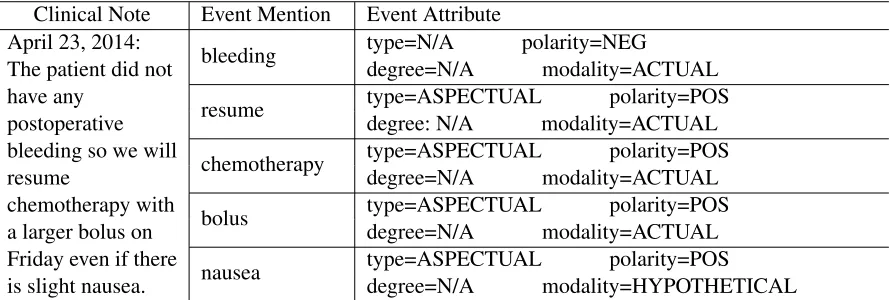
April 23, 2014: The patient did not have any postoperative bleeding so we will resume chemotherapy with a larger bolus on Friday even if there is slight nausea.
The output annotations over the text capture the key information such as event mentions and at-tributes. Table 1 illustrates the output of clinical in-formation extraction in details.
To solve this task, the major challenge is how to precisely identify the spans (character offsets) of
Clinical Note Event Mention Event Attribute April 23, 2014:
The patient did not have any
postoperative bleeding so we will resume
chemotherapy with a larger bolus on Friday even if there is slight nausea.
bleeding type=N/Adegree=N/A polarity=NEGmodality=ACTUAL
resume type=ASPECTUAL polarity=POS
degree: N/A modality=ACTUAL chemotherapy type=ASPECTUALdegree=N/A modality=ACTUALpolarity=POS
bolus type=ASPECTUALdegree=N/A modality=ACTUALpolarity=POS
nausea type=ASPECTUAL polarity=POS
[image:2.612.85.530.60.210.2]degree=N/A modality=HYPOTHETICAL
Table 1:An example of information extraction from clinical note.
the event expressions from raw clinical notes. Tradi-tional machine learning approaches usually build a supervised classifier with features generated by the Apache clinical Text Analysis and Knowledge Ex-traction System (cTAKES)1. For example, BluLab
system (Velupillai et al., 2015) extracted morpholog-ical (lemma), lexmorpholog-ical (token), and syntactic (part-of-speech) features encoded from cTAKES. Although using the domain specific information extraction tools can improve the performance, learning how to use this software well for clinical domain feature en-gineering is still very time-consuming. In short, a simple and effective method that only leverages ba-sic NLP modules and achieves high extraction per-formance is desired for regular users.
To address this challenge, we propose a deep neu-ral networks based method, especially convolution neural network (Collobert et al., 2011), to learn hid-den feature representations directly from raw clin-ical notes. More specifclin-ically, one method first ex-tracts a window of surrounding words for the can-didate word. Then, we attach each word with their part-of-speech tag and shape information as extra features. After that, our system deploys a temporal convolution neural network to learn hidden feature representations. Finally, our system uses Multilayer Perceptron (MLP) to predict event spans. Note that we use the same model to predict event attributes.
1Apache cTAKES is a natural language processing system
for extraction of information from electronic medical record clinical free-text
2 Constructing High Quality Training Dataset
The major advantage of our system is that we only leverage NLTK2 tokenization and a POS tagger to
preprocess our training dataset. When implementing our neural network based clinical information ex-traction system, we found it is not easy to construct high quality training data due to the noisy format of clinical notes. Choosing the proper tokenizer is quite important for span identification. After conducting experiments, we found that “RegexpTokenizer” can match our needs. This tokenizer can generate spans for each token via sophisticated regular expression such as:
n l t k . t o k e n i z e . RegexpTokenizer ( ”\w+|\$ [\d\. ] +| \S+” )
We then use “PerceptronTagger” as our part-of-speech tagger due to its fast tagging speed. Note that when extracting context words, please make sure you deploy the same tokenization module instead of just splitting strings by space.
3 Neural Network Classifier
Event span identification is the task of extracting character offsets of the expression in raw clinical notes. This subtask is quite important due to the fact that the event span identification accuracy will affect the accuracy of attribute identification. We first run our neural network classifier to identify event spans. Then, given each span, our system tries to identify attribute values.
3.1 Temporal Convolutional Neural Network The way we use temporal convolution neural net-work for event span and attribute classification is similar with the approach proposed by (Collobert et al., 2011). Generally speaking, we consider a word as represented byKdiscrete featuresw∈D1×· · ·× DK, whereDK is the dictionary for thekthfeature. In our scenario, we just use three features such as token mention, pos tag, and word shape. Note that word shape features are used to represent the ab-stract letter pattern of the word by mapping lower-case letters to “x”, upper-lower-case to “X”, numbers to “d”, and retaining punctuation. We associate to each feature a lookup table. Given a word, a feature vec-tor is then obtained by concatenating all lookup table outputs. Then a clinical snippet is transformed into a word embedding matrix. The matrix can be fed to further 1-dimension convolutional neural network and max pooling layers. Below we will briefly in-troduce core concepts of Convolutional Neural Net-work (CNN).
Temporal Convolution
Temporal Convolution applies one-dimensional convolution over the input sequence. The one-dimensional convolution is an operation between a vector of weights m ∈ Rm and a vector of inputs
viewed as a sequencex ∈Rn. The vectormis the
filter of the convolution. Concretely, we think ofx
as the input sentence andxi ∈Ras a single feature
value associated with thei-th word in the sentence. The idea behind the one-dimensional convolution is to take the dot product of the vectormwith eachm -gram in the sentencex to obtain another sequence c:
cj =mTxj−m+1:j. (1)
Usually, xi is not a single value, but a d
-dimensional word vector so that x ∈ Rd×n. There
exist two types of 1d convolution operations. One was introduced by (Waibel et al., 1989) and also known as Time Delay Neural Networks (TDNNs). The other one was introduced by (Collobert et al., 2011). In TDNN, weightsm∈Rd×mform a matrix.
Each row ofmis convolved with the corresponding
row ofx. In (Collobert et al., 2011) architecture, a
sequence of lengthnis represented as:
x1:n=x1⊕x2· · · ⊕xn, (2)
where ⊕ is the concatenation operation. In gen-eral, let xi:i+j refer to the concatenation of words xi,xi+1, . . . ,xi+j. A convolution operation
in-volves a filterw∈ Rhk, which is applied to a
win-dow ofhwords to produce the new feature. For ex-ample, a feature ci is generated from a window of
wordsxi:i+h−1by:
ci=f(w·xi:i+h−1+b), (3)
where b ∈ R is a bias term and f is a non-linear function such as the hyperbolic tangent. This filter is applied to each possible window of words in the se-quence{x1:h,x2:h+1, . . . ,xn−h+1:n}to produce the
feature map:
c= [c1, c2, . . . , cn−h+1], (4)
wherec∈Rn−h+1.
We also employ dropout on the penultimate layer with a constraint on`2-norms of the weight vector.
Dropout prevents co-adaptation of hidden units by randomly dropping out a proportion p of the hid-den units during forward-backpropagation. That is, given the penultimate layer z = [ ˆc1, . . . ,cˆm],
in-stead of using:
y=w·z+b (5)
for output unit y in forward propagation, dropout uses:
y=w·(z◦r) +b , (6)
where◦is the element-wise multiplication operator andr∈Rmis a masking vector of Bernoulli random
variables with probabilitypof being 1. Gradients are backpropagated only through the unmasked units. At test step, the learned weight vectors are scaled by psuch thatwˆ =pw, andwˆ is used to score unseen
sentences. We additionally constrainl2-norms of the
weight vectors by re-scalingwto have ||w||2 = s
whenever||w||2 > safter a gradient descent step.
4 Experimental Results
4.1 Dataset
We use the Clinical TempEval corpus3as the
eval-uation dataset. This corpus was based on a set of
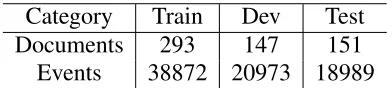
Category Train Dev Test
Documents 293 147 151
[image:4.612.88.284.59.103.2]Events 38872 20973 18989
Table 2:Number of documents, event expressions in the train-ing, development and testing portions of the THYME data
600 clinical notes and pathology reports from can-cer patients at the Mayo Clinic. These notes were manually de-identified by the Mayo Clinic to re-place names, locations,etc. with generic placehold-ers, but time expression were not altered. The notes were then manually annotated with times, events, and temporal relations in clinical notes. These an-notations include time expression types, event at-tributes, and an increased focus on temporal rela-tions. The event, time, and temporal relation anno-tations were distributed separately from the text us-ing the Anafora standoff format. Table 2 shows the number of documents, event expressions in the train-ing, development and testing portions of the 2016 THYME data.
4.2 Evaluation Metrics
All of the tasks were evaluated using the standard metrics of precision (P), recall (R), andF1:
P = |S∩H|
|S|
R= |S∩H|
|H|
F1= 2·P ·R
P +R
(7)
where S is the set of items predicted by the sys-tem and H is the set of items manually annotated by the humans. Applying these metrics of the tasks only requires a definition of what is considered an “item” for each task. For evaluating the spans of event expressions, items were tuples of character offsets. Thus, system only received credit for iden-tifying events with exactly the same character off-sets as the manually annotated ones. For evaluating the attributes of event expression types, items were tuples of (begin, end, value) where begin and end are character offsets and value is the value that was given to the relevant attribute. Thus, systems only re-ceived credit for an event attribute if they both found
an event with correct character offsets and then as-signed the correct value for that attribute (Bethard et al., 2015).
4.3 Hyperparameters and Training Details Objective Function
We want to maximize the likelihood of the correct class. This is equivalent to minimizing the negative log-likelihood (NLL). More specifically, the labelyˆ
given the inputsxhis predicted by a softmax
classi-fier that takes the hidden statehj as input:
ˆ
pθ(y|xh) =sof tmax(W ·xh+b) ˆ
y = argmax
y pˆθ(y|xh)
(8)
After that, the objective function is the negative log-likelihood of the true class labelsyk:
J(θ) =−1
m
m
X
k=1
log ˆpθ(yk|xkh) +
λ
2||θ|| 2 2, (9)
wheremis the number of training examples and the superscriptkindicates thek-th example.
Hyperparameters
We use Lasagne4 deep learning framework. We
first initialize our word representations using pub-licly available 300-dimensional Glove word vec-tors 5. We deploy CNN model with kernel width
of 2, a filter size of 300, sequence length is 2 ∗ windows size+1, number filters isseqlen−kw+1,
stride is 1, pool size is seqlen−f ilter size+ 1,
cnn activation function is tangent, MLP activation function is sigmoid. MLP hidden dimension is 50. We initialize CNN weights using a uniform dis-tribution. Finally, by stacking a softmax function on top, we can get normalized log-probabilities. Training is done through stochastic gradient descent over shuffled mini-batches with the AdaGrad update rule (Duchi et al., 2011). The learning rate is set to 0.05. The mini-batch size is 100. The model param-eters were regularized with a per-minibatch L2 reg-ularization strength of10−4.
4.4 Results and Discussions
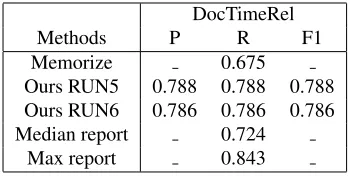
Table 3 shows results on the event expression tasks. Our initial submits RUN 4 and 5 outperformed the memorization baseline on every metric on every task. The precision of event span identification is close to the max report. However, our system got lower recall. The reason of lower recall values is that the word2vec may not cover more domain specific words. Table 4 shows results on the phase 2 subtask.
DocTimeRel Methods P R F1 Memorize 0.675
Ours RUN5 0.788 0.788 0.788 Ours RUN6 0.786 0.786 0.786 Median report 0.724
Max report 0.843
Table 4:Phase 2: DocTimeRel
5 Conclusions
In this paper, we introduced a new clinical infor-mation extraction system that only leverages deep neural networks to identify event spans and their attributes from raw clinical notes. We trained deep neural networks based classifiers to extract clinical event spans. Our method attached each word to their part-of-speech tag and shape information as extra features. We then hire temporal convolution neural network to learn hidden feature representations. The entire experimental results demonstrate that our ap-proach consistently outperforms the existing base-line methods on standard evaluation datasets.
Our research proved that we can get competi-tive results without the help of a domain specific feature extraction toolkit, such as cTAKES. Also we only leverage basic natural language process-ing modules such as tokenization and part-of-speech tagging. With the help of deep representation learn-ing, we can dramatically reduce the cost of clinical information extraction system development. Due to the recall values are still low, we will consider use domain specific tools to enhance feature engineer-ing.
References
Steven Bethard, Leon Derczynski, Guergana Savova, Guergana Savova, James Pustejovsky, and Marc
Ver-hagen. 2015. Semeval-2015 task 6: Clinical tempeval.
Proc. SemEval.
Ronan Collobert, Jason Weston, L´eon Bottou, Michael Karlen, Koray Kavukcuoglu, and Pavel Kuksa. 2011. Natural language processing (almost) from scratch.
The Journal of Machine Learning Research, 12:2493– 2537.
John Duchi, Elad Hazan, and Yoram Singer. 2011. Adaptive subgradient methods for online learning and stochastic optimization. The Journal of Machine Learning Research, 12:2121–2159.
Mohit Iyyer, Jordan Boyd-Graber, Leonardo Claudino, Richard Socher, and Hal Daum´e III. 2014. A neu-ral network for factoid question answering over para-graphs. In Empirical Methods in Natural Language Processing.
Nal Kalchbrenner and Phil Blunsom. 2013. Recur-rent continuous translation models. InProceedings of the 2013 Conference on Empirical Methods in Nat-ural Language Processing, pages 1700–1709, Seat-tle, Washington, USA. Association for Computational Linguistics.
Tomas Mikolov, Ilya Sutskever, Kai Chen, Greg S Cor-rado, and Jeff Dean. 2013. Distributed representations of words and phrases and their compositionality. In
Advances in Neural Information Processing Systems, pages 3111–3119.
Richard Socher, Eric H Huang, Jeffrey Pennin, Christo-pher D Manning, and Andrew Y Ng. 2011a. Dynamic pooling and unfolding recursive autoencoders for para-phrase detection. InAdvances in Neural Information Processing Systems, pages 801–809.
Richard Socher, Jeffrey Pennington, Eric H Huang, An-drew Y Ng, and Christopher D Manning. 2011b. Semi-supervised recursive autoencoders for predicting sentiment distributions. In Proceedings of the Con-ference on Empirical Methods in Natural Language Processing, pages 151–161. Association for Compu-tational Linguistics.
Kai Sheng Tai, Richard Socher, and Christopher D Man-ning. 2015. Improved semantic representations from tree-structured long short-term memory net-works. arXiv preprint arXiv:1503.00075.
Sumithra Velupillai, Danielle L Mowery, Samir Abdel-rahman, Lee Christensen, and Wendy W Chapman. 2015. Blulab: Temporal information extraction for the 2015 clinical tempeval challenge. Association for Computational Linguistics.
span modality degree polarity type
Methods P R F1 P R F1 P R F1 P R F1 P R F1
[image:6.612.92.522.61.111.2]Memorize 0.878 0.834 0.855 0.810 0.770 0.789 0.874 0.831 0.852 0.812 0.772 0.792 0.855 0.813 0.833 Ours RUN4 0.908 0.842 0.874 0.842 0.780 0.810 0.904 0.838 0.869 0.876 0.812 0.842 0.877 0.813 0.844 Ours RUN5 0.900 0.850 0.874 0.837 0.790 0.813 0.896 0.845 0.870 0.861 0.813 0.836 0.869 0.820 0.844 Median report 0.887 0.846 0.874 0.830 0.780 0.810 0.882 0.838 0.869 0.868 0.813 0.839 0.854 0.813 0.844 Max report 0.915 0.891 0.903 0.866 0.843 0.855 0.911 0.887 0.899 0.900 0.875 0.887 0.894 0.870 0.882
Table 3:System performance comparisons. Note that Run4 means the window size is 4, and Run5 means the window size is 5