The FinTOC-2019 Shared Task:
Financial Document Structure Extraction
Rémi Juge* Fortia Financial Solutions
Paris, France
Najah-Imane Bentabet* Fortia Financial Solutions
Paris, France
Sira Ferradans Fortia Financial Solutions
Paris, France
Abstract
In this paper, we present the results and find-ings of The FinTOC-2019 Shared Task on structure extraction from financial documents. This shared task was organized as part of Sec-ond Financial Narrative Processing Workshop, collocated with the 22nd Nordic Conference on Computational Linguistics (NoDaLiDa’19) Conference. The shared task aimed at collect-ing systems for extractcollect-ing table of contents from Financial prospectuses by detecting the document titles and reorganizing them in a hi-erarchical way. The FinTOC shared task is the first to target the task of Table of content ex-traction in the domain of Finance.
1 Introduction
Long document comprehension is still an open problem in Natural Language Processing (NLP). Most of the corporate information or academic knowledge is locked in long documents (> 10
pages) with complex semantic and layout struc-ture. Documents are generally converted into plain text and processed sentence by sentence, where the only structure that is easily identified are the para-graphs, thus loosing the internal organization of the document. Despite the importance long document analysis, there are few available resources and none in a low resource domain such as the finance.
In this shared task, we focus on extracting the table-of-contents (TOC) of financial prospectuses that are official pdf documents in which investment funds precisely describe their characteristics and investment modalities. The majority of prospec-tuses are published without a TOC which is of fun-damental importance for sophisticated NLP tasks such as information extraction or question answer-ing on long documents. Although the content they
*Both authors contributed equally to this work
must include is often regulated, their format is not standardized and displays a great deal of variabil-ity ranging from plain text format, towards more graphical and tabular presentation of data and in-formation, making the analysis of the discourse structure even more complicated.
In this paper, we report the results and findings of the FinTOC-2019 shared task.1The Shared Task was organized as part of Second Financial Narrative Processing Workshop, co-located with the 22nd Nordic Conference on Computational Linguistics (NoDaLiDa’19) Conference.2
A total of 6 teams submitted runs and contributed 4 system description papers. All system description papers are included in the FNP 2019 workshop proceedings and cited in this report.
2 Previous Work on TOC extraction
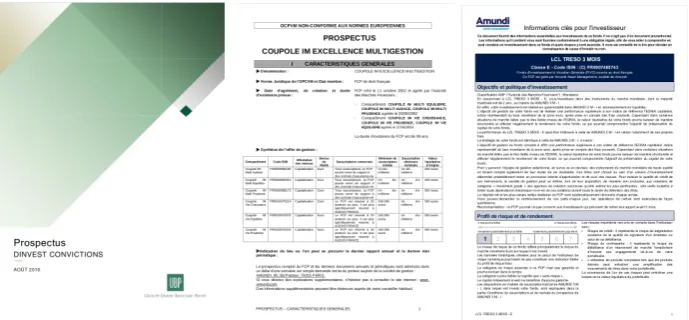
We find mostly two approaches. The goal of the first approach is to parse the hierarchical struc-ture of sections and subsections from the TOC pages embedded in the document. Most of the research developed in this area has been linked to the INEX [1] and ICDAR competitions [2, 3, 4] which target old and long OCR-ised books instead of small papers. These documents are very dif-ferent from the documents that we target in this shared task, charaterized by having complex layout structure (see Fig.1for some examples). Outside these competitions, we find the methods proposed by El-Haj et al [5,6,7], based also in TOC page parsing.
In the second approach, we find methods that detect headings using learning methods based on layout and text features. The set of titles are hier-archically ordered according to a predefined rule-based function [2,8,9]. Recently, we find methods
1
Figure 1: Random pages from the investment document data set. We observe that the title organization and, in general, the layout is complex.
that address TOC extraction as a sequence labelling task to which deep learning methods can be ap-plied [10].
3 Task Description
As part of the Financial Narrative Processing Work-shop, we present a shared task on Financial Docu-ment Structure Extraction.
Systems participating in this shared task were given a sample collection of financial prospectuses with a wide variety of document structures and sizes. The goal was to automatically process them to extract their document structure. In fact the task was decomposed into two subtasks:
• Title detection: The document is splitted into
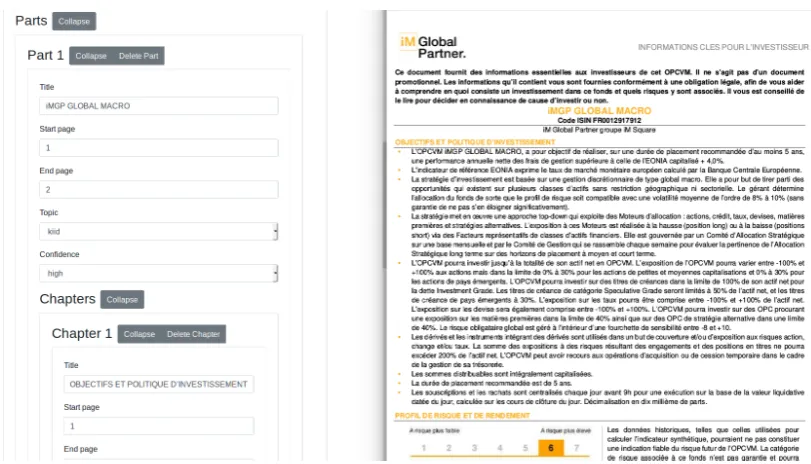
text blocks (a text block regroup lines that have the same layout and that are spatially close to each others) extracted from financial prospectuses by our in-house parser. Each text block needs to be classified as a ‘title’ or ‘non-title’. As shown in Fig.2the titles can have different layouts (marked with red and green boxes) and they have to be distinguished from the regular text (‘non-title’ with grey boxes).
• TOC extraction: In this subtask, the goal is
to (i) identify the hierarchical level of the titles, for instance, in Fig.2, the text in green bound-ing boxes are hierarchically at the same level and at a different level than the title in red, (ii) organize the titles of the document accord-ing to the hierarchical structure to produce the final TOC. Again in Fig. 2, the system needs to identify that the red tagged heading is hierarchically above than the green ones.
It is important to note that two titles, with the same layout and the same text can have dif-ferent hierarchical levels depending on their location in the document.
All participating teams were provided a common training data set for subtask 1 which included the original pdfs, the xml versions of the pdfs obtained using the Poppler3library, and a csv file containing, for each text block, a set of layout features and binary labels indicating if the text block is a title or not. For the second subtask, the training data set also included a TOC of the documents in the xml format proposed by ICDAR competitions[2]. A blind test set was used to evaluate the output of the participating teams.
As stated in Section2, most of the previous re-search on TOC generation has been confined to short papers such as research publications (Arxiv
database), or standard documents such as digital-ized books. However, the task of extracting the TOC of commercial documents with a complex layout structure in the domain of finance is not much explored in the literature.
4 Shared Task Data
Next, we discuss the corpora used for the title de-tection and TOC extraction subtasks.
4.1 Corpus annotation
Financial prospectuses are available online in a pdf format and are also made available from asset managers. We compiled a list of 58 prospectuses from Luxembourg written in English to create the
Figure 2: Screenshot of the annotation tool developed internally.
data sets of the subtasks. We chose prospectuses with a wide variety of layouts and styles.
Xerox F1 Inex08 F1 tagger 1 & tagger 2 93.8% 87.5% tagger 1 & reviewer 96.7% 92% tagger 2 & reviewer 96.8% 93.5%
Table 1: Agreement scores between different annota-tors of the investment document data set.
We provided three annotators with the original pdfs and an internally developed web tool that pro-duces a hierarchicaljsonfile containing each TOC-entry together with some features (title, starting-page, ending-page and children). Each annotator was ask to:
1. Identify the title: Locate a title inside the pdf document.
2. Associate the entry level in the TOC: Every title must have an entry level in the TOC of the document with the following constraints 1) high level entries cannot be inside lower level entries (i.e. a Part cannot be inside a
Chapter), 2) the entries levels must be succes-sive (i.e. after achapterwe have asectionnot asubsection).
3. Add title: Copy-paste the title text directly into a web form, see Fig.2labelTitle
The predefined type of entry levels for the TOC were Part, Chapter, section, subsection or
para-graph, that could be inside theFront matter,Body matterorBack matter. Therefore, the maximum TOC level was 5.
Each document was annotated independently by two people and a third person would review the annotations to resolve the possible conflicts. The agreement scores between annotators are depicted in Table1. We can observe high agreement scores, allowing us to be confident enough about the qual-ity of our data set.
Annotation Challenge: Headings identification Investment prospectuses are commercial docu-ments whose complex layout aims at highlighting specific information such that a potential investor can identify it quickly. Hence, annotating a title and its level in the TOC hierarchy is a difficult task as one cannot rely on the visual appearance of the title to do so. Some examples can be observed in Fig.3and Fig.4.
Annotation Challenge: Tagging pdf documents. The annotation of pdf documents is not evident since they are meant to be used for display. The tool we developed for the annotations does not allow annotators to directly annotate on the pdf and thus they had to manage two different platforms at the same time. Working this way is prone to mistakes.
Annotation Challenge: Matching annotations
and text blocks. Our internal tool uses a
intro-Figure 3: Page from a prospectus with the titles se-lected coloured boxes. An example where title identi-fication is not evident because titles can have the same style as regular text.
Figure 4: Page from a prospectus with the titles se-lected coloured boxes. An example where title identi-fication is not evident because titles may expand a part of a line.
ducing some noise at the string level. On the other hand, we extract text from the pdf using an auto-matic pdf to xml process. For the data set creation, each title annotation had to be matched to a text block. This pipeline introduces noise in the final csv.
4.2 Corpus Description
In the following, we provide an analysis of the data used for the shared task. For both sub-tasks, the released training sets were the same ex-cepted that for subtask 2, an additional xml file (groundtruth[...]max_depth=5.icdar2013.xml) at the ICDAR format was given. The reason for it is twofold: it gave to the participants the output format that they had to respect for the submissions and allowed them to participate in subtask 2 with-out having a title extraction system from subtask 1.
In the csv files available to the participants, each text block came with a set of layout features:
is_bold, is_italic, is_all_caps, begins_with_cap,
be-gins_with_numbering and page_number and its source xml file. Some statistics on this data set are presented in Table2.
number of documents 58
average number of pages 90 number of text blocks 90441 number of titles (% of text blocks) 14% begin_with_numbering (% of text blocks) 20% is_bold (% of text blocks) 18% is_italic (% of text blocks) 1.3% is_all_caps (% of text blocks) 20% begins_with_cap (% of text blocks) 68% level 1 (% of titles) 7% level 2 (% of titles) 26% level 3 (% of titles) 33% level 4 (% of titles) 30% level 5 (% of titles) 4%
Table 2: Statistics on the investment document data set.
5 Participants and Systems
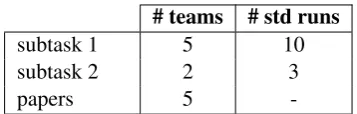
# teams # std runs
subtask 1 5 10
subtask 2 2 3
papers 5
-Table 3: Statistics on the participation in the two sub-atsks.
A total of 24 teams registered in the shared task from 18 different institutions, and 6 teams partici-pated with standard runs and 5 submitted a paper with the description of their method, see Table4for more information about their affiliation. In Table3, we show the details on the submissions per task. It is important to note that not all the participants that submitted a standard run, sent a paper describing
Team Affiliation Tasks
Daniel [11] STIH, Sorbonne Université 1 and 2
FinDSE [12] Faculdade de Engenharia
da Universidade do Porto 1 UWB [13] University of West Bohemia 1
YseopLab [14] Yseop 1
IHSMarkit IHS Markit 2
[image:4.595.241.536.106.314.2]Aiai OPT, Inc 1
[image:4.595.327.506.386.443.2] [image:4.595.306.568.616.730.2]their approach.
Participating teams explored and implemented a wide variety of techniques and features. In this section, we give a brief description of each system, more details could be found in the description pa-pers appearing in the proceedings of the FNP 2019 Workshop.
Daniel [11]: The only team to submit to both
subtasks and a paper. Their approach for the Fin-TOC title detection task assumed the presence of a TOC page which they detect by identifying the page numbers that are aligned at the right of the page. Then, they extract each TOC entry using regular expressions and construct the hierarchical structure of the TOC with a rule-based method based on indentation and multi-level numbering.
FinDSE [12]: They addressed the FinTOC Title
detection as a sentence classification task. They added to the provided features (see Section4.2for more details) some others such as morphological (number of characters distributed into categories), semantic (contains date) and linguistic features (predetermined tokens such as ’appendix’, ’annex’, etc, part-of-speech of the first word, ...). Their best performing model used an extra-tree classifier. It is interesting to note that, according to their ex-periments, adding predetermined tokens actually reduced the performance of the final method.
UWB [13]: Only the FinTOC Title detection was
addressed in this paper. As for the other methods, they state the problem as a binary classification of text sentences, for which they use a Maximum entropy classifier, on top of a diverse set of features. In addition to the provided characteristics, they add others related to style (font size, font type size), orthographic descriptors, and char n-grams.
YseopLab [14]: The authors tackle only the
Fin-TOC Title detection task. Similarly to other partic-ipants, they first try to design an additional set of features to feed an SVM classifier. Then, unlike previous methods, they run two separated experi-ments where they use a character-level CNN and a word-level BiLSTM with attention to extract se-mantic features from text blocks and classify them.
Aiai [15]: This team proposes the use of
word2vec word-embeddings followed by a LSTM and BiLSTM, respectively for run 1 and 2, see Ta-ble5. Then, they add an attention layer. Finally,
they train several times the same model and do ensembling as a last step.
6 Results and Discussion
Evaluation Metric For the first subtask, the
par-ticipating systems are ranked based on the weighted F1 score obtained on a blind test set (official met-ric). Table5reports the results obtained on Fin-TOC title detection task by the teams detailed in the previous section.
Team F1 score
Aiai_2 0.982
Aiai_1 0.98
UWB_2 0.972
YseopLab_2 0.9716
FinDSE_1 0.970
FinDSE_2 0.968
UWB_1 0.965
Daniel_1 0.949
Daniel_2 0.942
[image:5.595.358.480.220.374.2]YseopLab_1 0.932
Table 5: Results obtained by the participants for the first FinTOC task. The teams are ordered by the weighted F1 score.
Regarding the FinTOC TOC extraction subtask, the metric is based on the official title-based mea-sure of the ICDAR 2013 competition on book struc-ture extraction [2] (ICDAR’13 measure from now on). More specifically, the final F1 score is the mean of the InexF1 score and the Inex level ac-curacy. For the results on this task, please check Table6.
Team ICDAR’13 measure
Daniel_1 0.427
IHSMarkit_1 0.39
IHSMarkit_2 0.388
Table 6: Results obtained by the participants for the FinTOC TOC extraction task. The teams are ordered by the ICDAR’13 measure (see the text for more details).
Discussion. A surprising fact of the reported
meaningful features to a maximum entropy classi-fier and they show through ablation tests that all features are important to attain their result. On the other hand, the best performing system of Yseo-pLab_2 implements character-level CNN with no hand-engineered features. Finally, both methods of Aiai use (Bi-)LSTMs with attention mechanisms on top of word embeddings. For the second task, only one paper was submitted describing Daniel_1 team’s method, which proposed a rule-based ap-proach to title hierarchization.
In their paper [12], the team FinDSE performs a set of experiments with a wide variety of fea-tures. An interesting conclusion is that the usage of common first words from titles such asAnnex
orAppendixcan be counter productive. This con-tradicts the methods commonly used in the liter-ature [16, 17, 18, 19]. Moreover, it shows the difficulty of transferring state-of-the-art methods trained on public datasets to commercial docu-ments such as financial prospectuses.
7 Conclusions
In this paper we presented the setup and results for the FinTOC-2019 Shared Task:Financial Docu-ment Structure Extraction, organized as part of the Second Financial Narrative Processing Workshop, collocated with the 22nd Nordic Conference on Computational Linguistics (NoDaLiDa’19) Con-ference. A total of 24 people registered from 18 different institutions. 6 teams participated in the shared task with a wide variety of techniques.
We introduced a new data set on the TOC extrac-tion problem in text automatically extracted from pdf files in English. This scenario is very real-istic in everyday applications which may explain the participation of public universities and profit organizations from the financial domain.
Acknowledgments
We would like to thank our dedicated annotators who contributed to the building of the corpora used in this Shared Task: Anais Koptient, Aouataf Djil-lani, and Lidia Duarte.
References
[1] Bodin Dresevic, Aleksandar Uzelac, Bogdan Radakovic, and Nikola Todic. Book layout analysis: Toc structure extraction engine. In Shlomo Geva, Jaap Kamps, and Andrew Trotman, editors,
Ad-vances in Focused Retrieval, pages 164–171, Berlin, Heidelberg, 2009. Springer Berlin Heidelberg.
[2] Antoine Doucet, Gabriella Kazai, Sebastian Colutto, and Günter Mühlberger. Icdar 2013 competition on book structure extraction. In Document Analysis and Recognition (ICDAR), 2013 12th International Conference on, pages 1438–1443. IEEE, 2013.
[3] Thomas Beckers, Patrice Bellot, Gianluca Demar-tini, Ludovic Denoyer, Christopher M. De Vries, Antoine Doucet, Khairun Nisa Fachry, Norbert Fuhr, Patrick Gallinari, Shlomo Geva, Wei-Che Huang, Tereza Iofciu, Jaap Kamps, Gabriella Kazai, Marijn Koolen, Sangeetha Kutty, Monica Lan-doni, Miro Lehtonen, Véronique Moriceau, Richi Nayak, Ragnar Nordlie, Nils Pharo, Eric Sanjuan, Ralf Schenkel, Xavier Tannier, Martin Theobald, James A. Thom, Andrew Trotman, and Arjen P. De Vries. Report on INEX 2009. Sigir Forum, 44(1):38–57, June 2010. Article disponible en ligne : http://www.cs.otago.ac.nz/homepages/andrew/papers/2010-4.pdf.
[4] Thi Tuyet Hai Nguyen, Antoine Doucet, and Mick-ael Coustaty. Enhancing table of contents extraction by system aggregation. In Proceedings of the In-ternational Conference on Document Analysis and Recognition, ICDAR, 2018.
[5] Mahmoud El Haj, Paul Rayson, Steven Young, and Martin Walker. Detecting document structure in a very large corpus of UK financial reports. LREC’14 Ninth International Conference on Language Re-sources and Evaluation. Proceedings of the Ninth International Conference on Language Resources and Evaluation (LREC-2014) . European Language Resources Association (ELRA), Reykjavik, Iceland, pp. 1335-1338, 2014.
[6] Mahmoud El Haj, Paul Edward Rayson, Steven Eric Young, Paulo Alves, and Carlos Herrero Zorita. Mul-tilingual Financial Narrative Processing: Analysing Annual Reports in English, Spanish and Portuguese. World Scientific Publishing, 2 2019.
[7] Mahmoud El-Haj, Paulo Alves, Paul Rayson, Mar-tin Walker, and Steven Young. Retrieving, clas-sifying and analysing narrative commentary in un-structured (glossy) annual reports published as pdf files. Accounting and Business Research, pages 1– 29, 2019.
[8] Caihua Liu, Jiajun Chen, Xiaofeng Zhang, Jie Liu, and Yalou Huang. Toc structure extraction from ocr-ed books. InInternational Workshop of the Initiative for the Evaluation of XML Retrieval, pages 98–108. Springer, 2011.
[10] Najah-Imane Bentabet, Rémi Juge, and Sira Fer-radans. Table-of-contents generation on contempo-rary documents. InProceedings of ICDAR 2019.
[11] Gael Lejeune Emmanuel Giguet. Daniel fintoc-2019 shared task: Toc extraction and title detec-tion. InThe Second Workshop on Financial Narra-tive Processing of NoDalida 2019, 2019.
[12] Henrique Cardoso Carla Abreu and Eugénio Oliveira. Findsefintoc-2019 shared task. InThe Sec-ond Workshop on Financial Narrative Processing of NoDalida 2019, 2019.
[13] Tomas Hercig and Pavel Král. Uwbfintoc-2019 shared task: Financial document title detection. In
The Second Workshop on Financial Narrative Pro-cessing of NoDalida 2019, 2019.
[14] Anubhav Gupta Hannah Abi-Akl and Dominique Mariko. Fintoc-2019 shared task: Finding title in text blocks. In The Second Workshop on Financial Narrative Processing of NoDalida 2019, 2019.
[15] Ke Tian and Zi Jun Peng. Finance document ex-traction using data augmented and attention. InThe Second Workshop on Financial Narrative Process-ing of NoDalida 2019, 2019.
[16] Anoop M Namboodiri and Anil K Jain. Document structure and layout analysis. InDigital Document Processing, pages 29–48. Springer, 2007.
[17] Alan Conway. Page grammars and page parsing. a syntactic approach to document layout recognition. InDocument Analysis and Recognition, 1993., Pro-ceedings of the Second International Conference on, pages 761–764. IEEE, 1993.
[18] Florendia Fourli-Kartsouni, Kostas Slavakis, Geor-gios Kouroupetroglou, and SerGeor-gios Theodoridis. A bayesian network approach to semantic labelling of text formatting in xml corpora of documents. In International Conference on Universal Access in Human-Computer Interaction, pages 299–308. Springer, 2007.