1
Cite as: Rowe S, French R, Henderson C, Weatherall D, Ougrin D, Slade M,
Moran P
Decisional support for young people who self-harm: Protocol for a
feasibility trial
, BMJ Open, in press.
Decisional support for young people who self-harm: Protocol for a feasibility
trial
Sarah L Rowe¹ PhD
Rebecca S French² PhD
Claire Henderson¹, MRCPsych, PhD
Dennis Ougrin³ MD, PhD
Mike Slade4 PhD Paul Moran5 MD, PhD
¹ Health Service and Population Research Department, King’s College London, Institute of
Psychiatry, Psychology and Neuroscience
² Department of Social and Environmental Health Research, Faculty of Public Health &
Policy, London School of Hygiene and Tropical Medicine,
³ Child and Adolescent Psychiatry Department, King’s College London, Institute of
Psychiatry, Psychology and Neuroscience
4
School of Health Sciences, Institute of Mental Health, University of Nottingham
5
Centre for Academic Mental Health, School of Social & Community Medicine, University of
2 Correspondence to: Dr Sarah Rowe, Health Services and Population Research Department,
King’s College London, Institute of Psychiatry, Psychology and Neuroscience, De Crespigny
Park, London SE5 8AF. Phone: +44 020 3228 0669, Fax: +44 027 277 1462, Email:
ABSTRACT
Introduction: Self-harm is common in adolescents and it is the strongest predictor of
suicide. Young people who self-harm are often unsure of how and where to get help.
Decision aids (DA) have been shown to help with decisional conflict where there is
uncertainty around different options. We have developed an online DA to support young
people in help-seeking for self-harm. A feasibility trial will examine the acceptability of the
online intervention, and the ability to recruit and follow-up participants within a school
setting.
Methods and Analysis: In this parallel arm, single blind feasibility trial, 60 participants aged
12-18 years who have self-harmed in the past 12 months, will be randomised to either: 1) a
group receiving the online DA or 2) a control group receiving general information about
feelings and emotions. Both groups will complete measures assessing decision-making and
help-seeking behaviour. The school counsellor will be notified of any participants who have
been randomised to ensure safeguarding for the young person. Participants in both groups
will be followed up at 4-weeks and the measures will be repeated. Qualitative interviews
will be conducted with a subset of participants to explore their views and experiences of the
3 Ethics and Dissemination: Ethical approval was granted by King’s College London (KCL)
College Research Ethics Committee. Results of this study will help to clarify if we can recruit
and administer an online decisional support intervention within a school setting for young
people who self-harm. The study will inform the design and implementation of a larger
randomised controlled trial to test the effectiveness of the DA. Dissemination of the study
findings will target publication in peer-reviewed journals of general and special interest. The
funder will be sent a report outlining the major findings of the study.
Trial Registration: ISRCTN11230559
Keywords: Adolescent, self-harm, help-seeking, decision aid, protocol, feasibility
Main strengths:
- We have developed an innovative personalised DA aimed at supporting young
people in help-seeking for self-harm
- This is being tested in a school-based population of young people aged 12-18 years
- In addition to outcome measures examining decisional conflict, stage of
decision-making, stigma and help-seeking, we will also conduct qualitative interviews that ask
questions about participation in the study, thoughts on the intervention,
safeguarding measures and recommendations for improvements to the DA or study.
Main limitations:
- Because of the need to obtain parental consent, our ability to recruit a sufficient
4 - Safeguarding procedures may act as a barrier to young people participating and
enforce a help-seeking option
- We are collecting limited information regarding the participants self-harm as the
study is primarily focused on the impact the DA has on decision-making rather than
5 INTRODUCTION
The term self-harm is used to describe a wide range of behaviours with a non-fatal outcome
in which an individual deliberately initiates behaviour (such as self-cutting), or ingests a
substance, an illicit drug or non-ingestible substance or object, with the intention of causing
harm to themselves [1].
Self-harm is a serious health problem and those who repeatedly self-harm can be left with
permanent damage and disability. It is also a strong predictor of suicidal thoughts and
behaviour [2] and is especially prevalent in young people [3].
Young people who self-harm often find it hard deciding where and how to get help [4], thus
increasing their risk of sustaining serious medical harm. Whilst young people may be
reluctant to seek help from healthcare professionals when distressed [5], many turn to the
internet for information or support as a way of coping with psychological distress [6 7]. A
growing number of trials involving children and adolescents suggest positive effects of
interventions that make use of web-based technology [8]. Therefore, a safe and effective,
web-based intervention for young people who self-harm, could be of benefit to large
numbers of individuals.
Decision aids (DA) are designed to help individuals make a specific and deliberate choice
between two or more options where there is uncertainty. They can be used in medical
decision-making when individuals need to choose between treatment or screening options
(BMJ, clinical review, 2013). A Cochrane review of 115 studies assessing the effects of DAs
found that DAs produced higher knowledge, more active participation in decision-making
and lower levels of decisional conflict [9]. A DA may therefore be a useful intervention for
6 conflict and increase active participation in decision making when seeking help for
self-harm.
In this article, we describe a) the development of a novel, web-based decision aid, designed
to support young people who self-harm, b) the methods of a study, which will investigate
the feasibility of conducting a randomised controlled trial of the decision aid.
METHODS AND ANALYSIS
Overview
This study is a 2-group, parallel arm, single blind, feasibility trial. Having obtained the prior
consent of parents, we will invite young people, aged 12-18 years from a London
secondary school, to complete a questionnaire about their mood and feelings and any
self-harm behaviour they may have engaged in over the previous year. Participants who
indicate they have self-harmed in the previous year will then be randomised to either the
group receiving the DA or a control group who will receive general information about
feelings and emotions. Both groups will complete outcome measures on decision-making,
intentional and actual help-seeking behaviour. Participants in both groups will be followed
up at four weeks when we will repeat the scales. Qualitative interviews will be conducted
to explore young people’s views and experience of participation in the study and, for those
in the intervention group, of the DA.
7 1. To assess the feasibility of undertaking a randomised controlled trial of the online
DA, with respect to the following predefined parameters:
- recruitment of young people and consent rates
- the feasibility and acceptability of randomisation procedures
- follow-up rates and response rates to questionnaires
- feasibility and acceptability of the intervention delivered in a school setting
2. To report descriptive data on candidate outcome measures, in order to inform the design of an adequately powered, future effectiveness study
Eligibility criteria
Inclusion criteria:
1. Aged 12 years to 18 years old
2. Attending the study site, a secondary school within an inner London borough
3. Basic proficiency in English language
4. Self-harmed in the past 12 months
Exclusion criteria:
1. Lacking capacity to consent
2. Poor English language proficiency
8
Measures
Baseline assessments: All participants
1. Socio-demographic schedule: including questions on gender, age, ethnicity, who they
live with and whether or not the participants have a sibling, boyfriend/girlfriend or social
worker. Responses to these questions are relevant to the options available for users to
select in the DA (e.g. if a user does not have a boyfriend/girlfriend this help-seeking
option will not be listed) and to describe the sample.
2. Short Mood and Feelings questionnaire (SMFQ): This assessment screens for depression
among children aged 16 and under [10] and its use has been validated in late
adolescence [11]. It consists of 13 statements that are reflective of depressive
symptoms. Ratings are given on a 3-point scale, ranging from “true”, “sometimes” and
“not true”, with “true” indicating that the depressive symptom is present. “True” ratings
are scored as two, “sometimes” as one and “not true” as zero. Total scores range from 0
to 26, with a cut-off score of >8 indicating the likely presence of major depression.
3. Questions on self-harming behaviour: 1) ‘Have you ever deliberately tried to harm
yourself (such as cut yourself or taken an overdose)? 2) When was the last time you
tried to harm yourself?
DA group and control intervention:
4. Stage of decision making scale: This scale measures the individual’s readiness to engage
9 (haven’t started to think about the choices) and 6 (have already made a decision and am
unlikely to change my mind).
5. General seeking questionnaire (intentions) (GHSQ). This assesses future
help-seeking intentions and recent and past help-help-seeking experiences. It uses a 7-point Likert
scale ranging from 1 (extremely unlikely) to 7 (extremely likely) for each help source
option. Help sources assessed are both informal (e.g. friends and family) and formal (e.g.
mental health professional and teacher). Higher scores indicated higher intentions. This
scale has been tested on high school students aged 12-19 years and has satisfactory
reliability and validity (alpha range of 0.70-0.88) [13].
6. Questionnaire on anticipated discrimination (QUAD). This is a 14-item measure that has
expanded on previous versions of the Discrimination and Stigma Scale [14]. It measures
the extent to which people anticipate personally experiencing discrimination in key life
domains as a result of mental health problems. It uses a 4-point Likert scale ranging from
0=strongly disagree to 3=strongly agree. It has good internal consistency (alpha = 0.86)
and adequate convergent validity [15]. We are using five items from this measure that
are relevant to our study population (adolescents).
7. Decisional conflict scale
The decisional conflict scales measures personal perceptions of:
10 2. Modifiable factors contributing to uncertainty including feeling uniformed, lack of
clarity about personal values and feeling unsupported in decision making
3. Effective decision making such as feeling the choice is informed, values-based, likely
to be implemented and expressing satisfaction with the choice
The 16-item version of the scale is the most commonly used [16]. Each item is rated on a
5-point Likert scale ranging from 0=strongly agree to 4=strongly disagree. A total score and 5
sub-scores (uncertainty; informed sub-score; vales clarity sub-score; support sub-score and
effective decision sub-score) are generated. Scores are generated by summing the items,
dividing by the number of items in the (sub) scale and multiplying by 25. Scores range from
0 (no decisional conflict) to 100 (extremely high decisional conflict). The scale has
demonstrated adequate test-retest reliability [17]. Scores exceeding 37.5 are associated
with decisional delay or feeling unsure about implementation. We are asking questions
pertaining to the support and uncertainty subscales only.
8. Questions on the DA
Participants will be asked to provide comments about 1) whether they would follow the
‘recommended’ option, 2) whether the use of the DA has changed any of their
perceptions/feelings about the paths they can go down 3) whether there is anything we
could do to improve the DA, and 4) whether or not they would recommend the DA to other
11 The support and uncertainty subscales from the Decisional Conflict Scale, and the Stage of
Decision-Making Scale will be repeated immediately after completing the DA.
Follow-up assessment
At four weeks, participants in the control group and the DA group will be asked to repeat an
online assessment of the measures below:
1. General help-seeking questionnaire (actual)
2. Stage of decision-making scale
3. Questionnaire on anticipated discrimination
4. Decisional conflict scale
5. Questions on their experience of using DA
Follow-up assessments will take place at the school in the participant’s lunch break or after
school. Once this assessment is complete, they will be invited to participate in a qualitative
interview, which will include exploration of factors relating to involvement in the study (e.g.
influences on participation, potential sources of contamination between control and
intervention groups) and, for intervention participants, views and experiences of the DA
(e.g. how, if at all, the DA prompted help-seeking behaviour).
Intervention
12 The theoretical underpinning of the DA developed for young people who self-harm is
subjective utility analysis. The assumption here is that the decision-maker is provided
with all the information to make a decision, including knowledge of the alternatives, and
is aware of their values and preferences with regard each of these options. [18 19]. In
order to inform the development of the decision aid, we conducted a systematic
literature review to identify help-seeking options and attributes that young people rate
as important when considering where to go for support [20]. In developing the DA, we
conducted extensive consultation with health professionals and groups of young people.
Qualitative interviews were conducted with young people in child and adolescent
mental health services (N=5), adolescents recruited from a local school (N=6), ex-service
users from ChildLine (N=2), and professional staff (including medics, a clinical
psychologist and school counsellor, N=5). Young people that participated in the
qualitative interviews were then invited back and to complete the DA in order to
observe the ease, acceptability and potential utility of the DA.
We then applied this evidence in the subsequent development of the decision aid. The
online DA (termed My Self-Help Tool) was built using two pieces of proprietary software,
Annalisa© [21] and Elicia© [22]. Annalisa is a multi-criteria decision aid with a single screen
interface that allows the user to create and explore decision-making scenarios. Elicia is a
general purpose web-based questionnaire builder. Annalisa is embedded within Elicia,
which allows the decision-making process to be customised and personalised according to
questionnaire responses. Annalisa uses a direct weighting method, which is simpler and less
time-consuming to use than other multi-criteria methods, such as the analytic hierarchy
13 find out about different help-seeking options for self-harm (such as family, GP or telephone
helpline). These options were identified from the help-seeking literature and findings from
qualitative interviews involving young people and service providers. In addition to the
sources of support, users are asked to identify help-seeking attributes that are important to
them, ranging from confidentiality to other concerns (such as not wanting to be seen as
attention seeking) (Figure 1). They are then required to indicate the degree of importance
they attach to each attribute they have identified according to the help-seeking options they
have chosen e.g. weighting how important maintenance of confidentiality is to them.
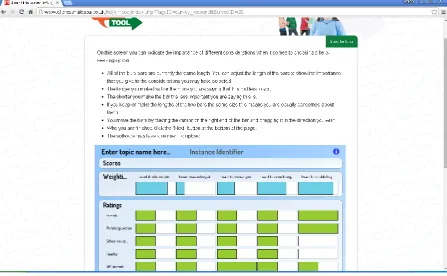
Weights are assigned through simple manipulation of a cursor on a single graphic screen
that presents all the elements of a decision (Figure 2); whilst participants visually assign
weights, this is converted from 0 (not at all important) to 1 (extremely important) within the
computer programme. As we are interested in the relative weights placed on attributes,
these are normalised so that the total sum of weights equals 1 (or 100%). Once they have
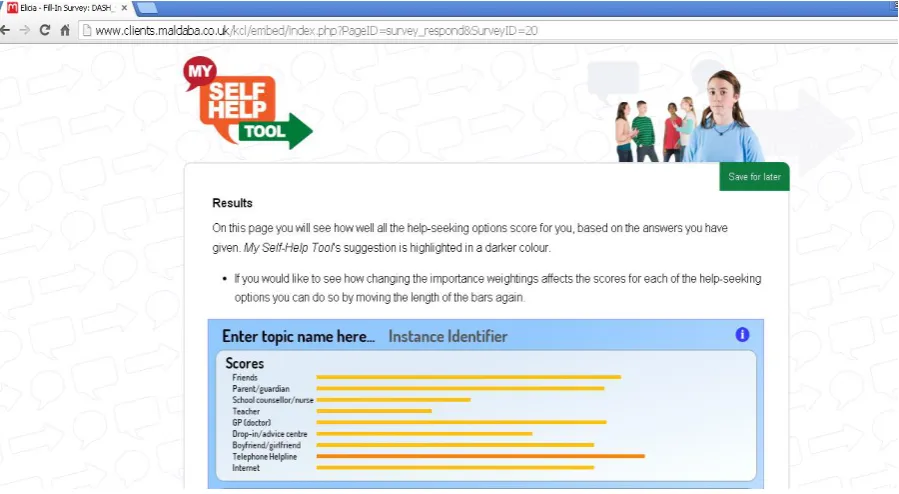
made their selections, a personalised rating and ranking of the help-seeking options are
presented to them, based on the information they have submitted [24]. This is calculated in
the underlying decision analysis [w1+ w2+ w3...] x [p1+ p2+ p3...] = SCORE); the
highlighted bar is the suggested option based on the individual user response (Figure 3).
Information on how to access help-seeking options is also provided. ‘My Self-Help Tool’ was
constructed in consultation with a group of young people (n=6), ex-service users (n=2),
young people currently accessing mental health services (n=5) and health professionals
(n=5). These key stakeholder groups were asked to identify any missing additional support
options and criteria that they considered important to help-seeking (attributes). We also
14 Panel groups of young people recruited from a local school, child and adolescent mental
health services and Childline1 were invited to complete the DA to test progression through the DA and appropriateness of language.
Insert Figure 1 here
Insert Figure 2 here
Insert Figure 3 here
Control intervention
Participants in the control arm will receive general information on feelings and emotions
from the ChildLine website
(www.childline.org.uk/Explore/FeelngsEmotions/Pags/FeelingsEmotions.aspx). This
information has been displayed as a static (non-interactive) page in our questionnaire rather
than a link that young people can use to connect to the ChildLine website. This also
promotes the young person’s awareness of the ChildLine website, so that they can access
the rest of the site after ratings have been completed. We have chosen this comparison
group so that we can assess if the DA effects decision-making over-and-above general
information that is already available to young people on the internet.
Recruitment and baseline procedures (Figure 4)
Participants will be identified through a secondary school in an inner London borough. All
parents/guardians will be sent a letter, information sheet and consent form via post or
1
15 email, asking for their consent to invite their child/children aged 12-18 years to participate
in the study. A range of dissemination activities has been undertaken to promote awareness
of the study among pupils and parents including presentations at school assemblies, school
newsletters, and circulation of a link to an audio recording of the research team providing
information about the study. If consent is given, their child/children will be contacted by a
member of the research team and invited to participate in the study. At an initial meeting
with the young person, an information sheet and consent form will be provided and they
will be given at least 24 hours in which to think about whether or not they wish to
participate.
The young person will be contacted again and scheduled to complete the assessment. At
the start of the appointment, the researcher will explain the study and the potential
participant will be given the opportunity to ask the researcher questions. At the end of the
explanation, the researcher will carefully assess the participant's understanding of the study
and the consequences of participation by asking some questions regarding specific aspects
of the study procedure such as 'What will your participation involve?' If satisfied that the
participant understands the requirements, the researcher will invite the participant to sign
the assent/consent form. Young people aged 12-15 will assent to participate. 16-18 year
olds will sign consent forms.
The young person’s information sheet and consent form have been developed in
consultation with 12-16 year olds, so that the language and information provided are
16 Once consent has been obtained, the young person will complete an online questionnaire at
school in their lunch break or after school, asking demographic questions (e.g. age and
gender), a short questionnaire about their mood and feelings, and a question about any
self-harm behaviour in the previous year. If the participant has not self-harmed in the
previous year (this includes those who have never self-harmed and those who self-harmed
more than 12 months ago) then the questionnaire will end and they will be given a paper
copy of general information about feelings and emotions from the ChildLine website.
Completion of the questionnaire in this instance is a one-time only occurrence that will take
approximately 5-10 minutes. All participants will receive a £5 voucher upon completion of
the assessment to thank them for their time and trouble.
If the participant reports that they have self-harmed in the previous 12 months, they are
automatically randomised by the computer programme to one of two groups: 1) a DA group
whereby they complete the DA and are presented with help-seeking options based on
information they have provided while using the DA or 2) a control group whereby they are
given general information about feelings and emotions from the ChildLine website. Once
they have completed the DA, they receive a paper copy of information on how to access any
of the help-seeking options that are listed in the DA. Participant allocation to the group
receiving the DA or the control group will be subject to simple randomisation, which will be
conducted remotely.
All randomised participants will complete baseline measures before and after they go
17 The process of consent and the administration of the measures and DA were tested on five
young people aged 12-16 years. On average, consent and completion of the measures and
DA took 10-15 minutes, with no dropouts.
Randomisation
Participants who are randomised into the experimental groups (i.e. those who have
self-harmed in the past year) will be placed into one of eight trial strata (all boys will be grouped
into a single stratum, and girls will be grouped into seven age strata). We are stratifying
randomisation by gender because self-harm typically occurs more frequently in female
compared to male adolescents [25]. Each stratum will be randomised using the random
permuted block algorithm, with a block size of four. Appropriate locks are in place to ensure
that it will not be possible for a randomisation token to be used multiple times or skipped
over.
Safety protocols
All participants who disclose self-harm during the study (irrespective if it is in the past 12
months or more than 12 months ago) will be referred to the school counsellor in order to
ensure that they remain safe and are given appropriate support. As per usual school policy,
the school will notify parents if their child has been referred to the school counsellor.
Participants may be concerned about their self-harm being disclosed to the school
18 sheet and consent form and discussed with the researcher so that potential participants are
aware of this before agreeing to participate.
A Trial Steering Committee (TSC) has been formed in order to monitor progress of the trial
adherence to the protocol, to ensure the safety and well-being of the trial participants are
the most important considerations and prevail over the interests of the science and society.
19 Insert Figure 4 here
Sample size
Sample size calculations are not required for most feasibility studies, because the aim is to
gather information about recruitment processes, consent and attrition rates and trial
procedures. Nevertheless, we want to know whether it is feasible to recruit and retain a
pre-determined number of young people who self-harm into a trial of the DA – a group of
young people who may be more difficult to recruit into a trial. For this reason, we have
undertaken a power calculation, in order to give us a target number to aim towards. For
continuous outcomes relating to decision-making and empowerment, a sample size of 60
would detect a standardized effect size of 0.75, with 80% power. The RCT will also allow us
to measure any differences in help-seeking behaviour associated with use of the DA.
Assuming a help-seeking prevalence of 20% [26], a sample size of 60 (30 randomised to the
decision aid, 30 randomised to the control condition) will have greater than 80% power to
detect a three-fold increase in categorically-defined help-seeking behaviour (0.20 to 0.60)
based on a two-sided Chi-squared test at 5% significance.
The 1-year prevalence of self-harm in school children has been found to be approximately
10% [1]. In order to obtain a sample of 60 young people reporting self-harm, we will
therefore need to recruit 600 pupils. For 540 of these pupils, their participation will simply
involve completion of some short demographic measures, the SMFQ and a question about
their self-harm. The remaining 60 pupils will be randomised to receive either the DA, or the
20
Statistical analysis plan
In keeping with recommendations for small-scale feasibility trials, the analysis will focus on
feasibility of scaling up to a full-scale RCT. In this study, it will consist of the following:
1. To determine feasibility of recruitment to the study, all referrals to the study will be
documented, and the number of referrals meeting inclusion/exclusion criteria will be
examined. Details of those who decline to be randomised and an option for their reason for
refusing will be retained.
2. Treatment acceptability will be assessed by the number of participants who refuse to
use the DA. Retention up until 4-week follow-up will be examined.
3. Feasibility of the research protocol will be assessed by the number of participants
failing to adhere to the full research protocol, the burden of which will be similar to that
which could be expected in a full study. The target would be collection of complete data on
90% of all service users recruited.
4. We will report exploratory findings of the outcome measures and use a confidence
interval approach to assist the justification for proceeding to a phase III trial.
Process evaluation
Qualitative interviews will be conducted on a sub-group of participants to explore their
views and experiences of participating in the study, and, for those in the intervention group,
of the DA, including its acceptability and (potential) effects. All participants that have been
21 individual interviews, which will take place at the school with a member of the research
team, shortly after the 4-week follow-up. It will include questions on factors that may have
influenced their participation in the study, thoughts on the intervention, following the
advice of the DA, confidentiality, safeguarding measures (i.e. the referral to the school
counsellor), and recommendations for improvements to the DA or the study. We anticipate
involving 5-10 young people in each of the experimental groups and 3-5 young people from
the excluded group (the group that were not randomised to the DA or the control
intervention). With consent, we will audio record the interviews and transcribe these so
they can be analysed using thematic analysis. Interview transcripts will be repeatedly
examined in depth and coded in reference to the experience of participating in the DASH
study; this iterative method of constant comparison will be used in order to reduce and
condense themes into the most salient categories. Subordinate themes will be established
for each transcript, and then cross–validated, adjusting if required. Superordinate themes
will then be chosen on the basis of forming ‘umbrella’ themes that cover various
subordinate themes. Data will be analysed by two researchers; joint discussions will be held
to ensure that codes and themes are adequately grounded in the raw data.
DISCUSSION
Web-based interventions have been associated with increased mental health literacy and
reduced levels of stigma connected to help-seeking ([27]; [28]; [29] in [30]). However,
testing the usability and potential efficacy of a web-based DA for young people who
self-harm is not without its challenges and limitations. There are two main challenges with
22 young people under the age of 16 years require parental consent. Although young people
aged 16 and above can consent for themselves, it is best practice to obtain parental consent
prior to their involvement in any research. This creates a potential barrier for recruitment
with some evidence showing that response rates are lowered by 40%-67% where active
parental consent is required, resulting in lower participation in school surveys by at-risk
groups [31]. We aim to address this by engaging with the parents using various recruitment
methods e.g. post, email, school newsletter and audio recording. Second, the disclosure of
self-harm in an adolescent population necessitates the need for robust safeguarding
procedures in order to ensure that if a young person is at further risk of harm, they are
provided with appropriate support. However, the process of informing the school counsellor
(and potentially the parents) may conceivably result in the young person not disclosing any
issues with self-harm they are experiencing; subsequently alienating the very people this DA
may benefit. We will try to capture information regarding reasons for non-disclosure or not
participating during the process evaluation, in order to detect any impact of safeguarding
protocols on participation.
Our safeguarding protocol may further act as a study limitation, as we are enforcing a
help-seeking option after completion of the baseline assessment by informing the school
counsellor of their self-harm. At the 4-week follow-up, the GHSQ (actual) asks whether or
not they have sought help for their self-harm from a variety of different sources e.g.
parents/carer, friends, doctor, school counsellor etc. From this (and information from the
school counsellor), we will be able to differentiate our safeguarding procedures from other
23 The feasibility trial will allow us to test if we can recruit and administer a decisional support
intervention for young people who self-harm within a school setting. When we originally
developed the DA, it was with the intention that this would be an online tool that is
available to all young people who self-harm. However, we would be unable to provide
support and safeguarding for adolescents at risk of harm. This limits the generalisability of
our study and any future study should consider how this tool could made more widely
available whilst providing support for young people at risk.
A final consideration in our study is the limited information we are collecting regarding the
participant’s self-harm. We have chosen to only focus on the presence/absence of self-harm
in the previous 12 months rather than obtaining details on frequency, type and severity
simply because the study is primarily concerned with the effect that the DA has on
decision-making, rather than any effect it may have on decreasing future self-harm.
Despite the limitations and challenges of this study, we have developed an innovative
personalised DA aimed at helping young people who are engaging in risky behaviour and
where they may spuriously perceive their support options to be limited. Depending on the
outcome of this feasibility study, there is scope to conduct a larger randomised controlled
trial evaluating the DA or to broaden the DA so it covers help-seeking options for general
mental health issues and resilience.
ETHICS AND DISSEMINATION
The feasibility trial was approved by King’s College London (KCL) College Research Ethics
24 The results of the research will be targeted for publication in peer-reviewed journals of
general and special interest. At the conclusion of the trial, the funder will be sent a report
outlining the major findings of the study. We will also produce a short report of the main
study findings for all participants. The results from the trial will be analysed and presented
first to a meeting to the TSC for comment and discussion. Results will subsequently be
published as soon as possible under the authorship of the writing committee. The writing
committee will consist of the PI, the post-doctoral research worker and members of the
Project Advisory Group. All publications that result from the trial shall include a list of
members of the TSC. The ISRCTN number will be attached to any publications from this trial.
Funding from Guy’s and St Thomas’ Charity and Childline support will be acknowledged in
25 ACKNOWLEDGEMENTS
The DASH study is funded by Guy’s and St Thomas’ charity (project code: MAJ120701).
The authors would like to express their gratitude to Lorenzo Gordon and Mark Clements
from Maldaba Ltd who provided the Annalisa and Elicia software used for the decision aid,
randomisation, support and advice regarding the development of the decision aid and study
methodology.
The authors would like to thank Sue Minto and David Weatherall, members of ChildLine for
their contributions to the project management group and methodological advice.
Particular thanks goes to the students and staff that helped with the development and
piloting of the decision aid.
CONTRIBUTORS
The contributions of the authors are as follows: Sarah Rowe helped to develop the
decision-aid, was involved in the study design and drafted the paper; Rebecca French participated in
the development of the decision-aid, study design and commented on the draft of the
paper; Claire Henderson, Dennis Ougrin and Mike Slade were involved in the study design
and commented on the draft of the paper; Paul Moran participated in the development of
the decision-aid, the study design and commented on drafts of the paper.
COMPETING INTERESTS
26 REFERENCES
1. Madge N, Hewitt A, Hawton K, et al. Deliberate self-harm within an international
community sample of young people: comparative findings from the Child &
Adolescent Self-harm in Europe (CASE) Study. J Child Psychol Psyc 2008;49(6):667-77
doi: DOI 10.1111/j.1469-7610.2008.01879.x[published Online First: Epub Date]|.
2. Whitlock J, Muehlenkamp J, Eckenrode J, et al. Nonsuicidal self-injury as a gateway to
suicide in young adults. J Adolesc Health 2013;52(4):486-92 doi:
10.1016/j.jadohealth.2012.09.010[published Online First: Epub Date]|.
3. Muehlenkamp JJ, Claes L, Havertape L, Plener PL. International prevalence of adolescent
non-suicidal self-injury and deliberate self-harm. Child Adolesc Psychiatry Ment
Health 2012;6:10 doi: 10.1186/1753-2000-6-10
1753-2000-6-10 [pii][published Online First: Epub Date]|.
4. De Leo D, Heller TS. Who are the kids who self-harm? An Australian self-report school
survey. Med J Aust 2004;181(3):140-4 doi: del10634_fm [pii][published Online First:
Epub Date]|.
5. Fortune S, Sinclair J, Hawton K. Help-seeking before and after episodes of self-harm: a
descriptive study in school pupils in England. BMC Public Health 2008;8:369 doi:
10.1186/1471-2458-8-369
1471-2458-8-369 [pii][published Online First: Epub Date]|.
6. Baker D, Fortune S. Understanding self-harm and suicide websites - A qualitative
27 and Suicide Prevention 2008;29(3):118-22 doi: Doi
10.1027/0227-5910.29.3.118[published Online First: Epub Date]|.
7. Jones R, Sharkey S, Ford T, et al. Online disucssion forums for young people who
self-harm: user views. The Psychiatrist 2011;35:364-68
8. Lau EY, Wong DP, Ransdell L. A systematic review of information and communication
technology-based interventions for promoting physical activity behavior change in
children and adolescents. J Med Internet Res 2011;13(3):4-4
9. Stacey D, Legare F, Col NF, et al. Decision aids for people facing health treatment or
screening decisions. Cochrane Database Syst Rev 2014;1:CD001431 doi:
10.1002/14651858.CD001431.pub4[published Online First: Epub Date]|.
10. Angold A, Costello EJ, Messer SC, Pickles A, Winder F, Silver D. Development of a short
questionnaire for use in epidemiological studies of depression in children and
adolescents. Int J Meth Psych Res 1995;5(4):237-49
11. Turner N, Joinson C, Peters TJ, Wiles N, Lewis G. Validity of the Short Mood and Feelings
Questionnaire in Late Adolescence. Psychol Assessment 2014;26(3):752-62 doi:
10.1037/a0036572[published Online First: Epub Date]|.
12. O'Connor A. User Manual - Stage of Decision Making. Secondary User Manual - Stage of
Decision Making 2000. www.ohri ca/decisionaid.
13. Wilson CJ, Deane FP, Ciarrochi JV, Rickwood D. Measuring help seeking intentions:
Properties of the General Help Seeking Questionnaire. Canadian Journal of
Counselling 2005;39(1):15-28
14. Brohan E, Clement S, Rose D, Sartorius N, Slade M, Thornicroft G. Development and
psychometric evaluation of the Discrimination and Stigma Scale (DISC). Psychiat Res
28 15. Gabbidon J, Brohan E, Clement S, Henderson RC, Thornicroft G. The development and
validation of the Questionnaire on Anticipated Discrimination (QUAD). BMC
Psychiatry 2013;13:297 doi: 10.1186/1471-244X-13-297
1471-244X-13-297 [pii][published Online First: Epub Date]|.
16. O'Connor A. User Manual - Decisional Conflict Scale. 1993
17. O'Connor AM. Validation of a decisional conflict scale. Medical Decision Making
1995;15(1):25-30
18. Bekker H, Thornton JG, Airey CM, et al. Informed decision making: an annotated
bibliography and systematic review. Health Technol Assess 1999;3(1):1-156
19. Edwards W. The theory of decision making. Psychological bulletin 1954;51(4):380-417
20. Rowe SL, French RS, Henderson C, Ougrin D, Slade M, Moran P. Help-seeking behaviour
and adolescent self-harm: a systematic review. Aust N Z J Psychiatry
2014;48(12):1083-95 doi: 10.1177/0004867414555718
0004867414555718 [pii][published Online First: Epub Date]|.
21. Annalisa©. Secondary. http://www.annalisa.org.uk.
22. Elicia©. Secondary. http://www.maldaba.co.uk/products/elicia/.
23. Dolan JG. Multi-Criteria Clinical Decision Support A Primer on the Use of
Multiple-Criteria Decision-Making Methods to Promote Evidence-Based, Patient-Centered
Healthcare. Patient 2010;3(4):229-48 doi: Doi
10.2165/11539470-000000000-00000[published Online First: Epub Date]|.
24. French RS, Cowan FM, Wellings K, Dowie J. The development of a multi-criteria decision
analysis aid to help with contraceptive choices: My Contraception Tool. J Fam Plann
29 jfprhc-2013-100699 [pii][published Online First: Epub Date]|.
25. O'Connor RC, Rasmussen S, Miles J, Hawton K. Self-harm in adolescents: self-report
survey in schools in Scotland. Brit J Psychiat 2009;194(1):68-72 doi: DOI
10.1192/bjp.bp.107.047704[published Online First: Epub Date]|.
26. Baetens I, Claes L, Muehlenkamp J, Grietens H, Onghena P. Non-Suicidal and Suicidal
Self-Injurious Behavior among Flemish Adolescents: A Web-Survey. ARCH. SUICIDE
RES. 2011;15(1):56-67 doi: Pii 933021302
Doi 10.1080/13811118.2011.540467[published Online First: Epub Date]|.
27. Christensen H, Griffiths KM, Jorm AF. Delivering interventions for depression by using
the internet: randomised controlled trial. Brit Med J 2004;328(7434):265-68A doi:
10.1136/bmj.37945.566632.EE[published Online First: Epub Date]|.
28. Jorm AF, Griffiths KM. Population promotion of informal self-help strategies for early
intervention against depression and anxiety. Psychological Medicine 2006;36(1):3-6
doi: 10.1017/S0033291705005659[published Online First: Epub Date]|.
29. Griffiths KM, Christensen H, Jorm AF, Evans K, Groves C. Effect of web-based depression
literacy and cognitive-behavioural therapy interventions on stigmatising attitudes to
depression - Randomised controlled trial. Brit J Psychiat 2004;185:342-49 doi: DOI
10.1192/bjp.185.4.342[published Online First: Epub Date]|.
30. Webb M, Burns J, Collin P. Providing online support for young people with mental health
difficulties: challenges and opportunities explored. Early Interv Psychia
2008;2(2):108-13 doi: 10.1111/j.1751-7893.2008.00066.x[published Online First:
30 31. Esbensen FA, Melde C, Taylor TJ, Peterson D. Active parental consent in school-based
research - How much is enough and how do we get it? Evaluation Rev
2008;32(4):335-62 doi: 10.1177/0193841X08315175[published Online First: Epub
31 Figure 1. Help-seeking attributes
32 Figure 2: Weighting of attributes
33 Figure 3: Suggested help-seeking option
34 Figure 4. Flow chart of trial design
Randomised (automatically done using software)
(N= 60) DASH questionnaire
Demographics, Short Mood & Feelings Questionnaire (SMFQ), screening question ‘Have you
self-harmed in the past year’?
Control intervention: Paper copy of general info on feelings and emotions
from the ChildLine website (N = 30)
Allocated to DA and paper copy of info on help-seeking options
for self-harm (N = 30) (N = 30) Invitation to all parents of
people aged 12- 18 years
(N= )
Refused/Declined (Total N= )
(parents declined N=) parents consented but young
person declined N=)
4-week follow-up and qualitative interviews (N = )
Analysed (N = )
Referral to school counsellor
Analysed (N = )
End of questionnaire
Paper copy of general info on feelings and
emotions from the ChildLine website No
Yes
Referral to school counsellor