Pietro Liuzzo-Scorpo and Gerardo Adesso∗
Centre for the Mathematics and Theoretical Physics of Quantum Non-Equilibrium Systems, Quantum Correlations Group, School of Mathematical Sciences, University of Nottingham,
University Park, Nottingham NG7 2RD, United Kingdom (Dated: July 17, 2017)
We investigate quantum teleportation of ensembles of coherent states of light with a Gaussian distributed displacement in phase space. Recently, the following general question has been addressed in [P. Liuzzo-Scorpoet al., arXiv:1705.03017]: Given a limited amount of entanglement and mean energy available as resources, what is the maximal fidelity that can be achieved on average in the teleportation of such an alphabet of states? Here, we consider a variation of this question, where Einstein–Podolsky–Rosen steering is used as a resource rather than plain entanglement. We provide a solution by means of an optimisation within the space of Gaussian quantum channels, which allows for an intuitive visualisation of the problem. We first show that not all channels are accessible with a finite degree of steering, and then prove that practical schemes relying on asymmetric two-mode Gaussian states enable one to reach the maximal fidelity at the border with the inaccessible region. Our results provide a rigorous quantitative assessment of steering as a resource for secure quantum teleportation beyond the so-called no-cloning threshold. The schemes we propose can be readily implemented experimentally by a conventional Braunstein–Kimble continuous variable teleportation protocol involving homodyne detections and corrective displacements with an optimally tuned gain. These protocols can be integrated as elementary building blocks in quantum networks, for reliable storage and transmission of quantum optical states.
I. INTRODUCTION
The quantum internet is dawning [1]. A confluence of technologies, including quantum optics, nano-manufacturing, fibre-based and satellite telecommunications, are accelerating the realisation of a large-scale quantum communication network. The operation of such a network is relying on key primitives, such as storage, retrieval, and teleportation of quantum states of light. In particular, teleportation [2] enables the transfer of unknown quantum states from a sender (Alice) to a receiver (Bob) without physical transport of their carriers, thanks to shared quantum resources such as entanglement distributed over a quantum channel between Alice and Bob. It is of fundamental and practical importance to optimise the performance of teleportation and related communication protocols, while keeping the costs involved in the preparation of the shared resources to a minimum [3].
There are several ways to benchmark the success of a teleportation protocol. Suppose an input state|ψziin, unknown
to Alice, is drawn from a preassigned set according to a prior probability distribution p(z) known to Alice and Bob. After a run of the protocol, the corresponding output state obtained by Bob can be denoted as ρoutz and its fidelity
with the unknown input, as measurable by an independent verifier (Victor), is given by F(z) =inhψ
z|ρout|ψziin. A
suitable figure of merit quantifying the performance of teleportation in this setting is given by the average fidelity over the input ensemble, defined as
¯ F=
Z
z
dz p(z)F(z). (1)
In particular, teleportation of an input alphabet of quantum states iscertified quantumwhen the average fidelity ¯
F exceeds a threshold ¯F(c)corresponding to the best classical scheme, where Alice attempts to directly measure each
input state and then requests Bob to prepare an output state based on her communicated outcome [4]. However, surpassing this threshold does not exclude that a malicious eavesdropper (Eve) trying to interfere with the commu-nication might receive a copy of the transferred state which scores a better fidelity than Bob’s output with Alice’s input. Teleportation is thencertified securewhen the average fidelity ¯F exceeds a larger threshold ¯F(s) obtained by
averaging the fidelity of the best 1→2 cloning protocol over the input ensemble [5].
Achieving security in quantum teleportation is an essential requirement for a reliable quantum internet. In practice, though, reaching ¯F >F¯(s)may require significantly more resources than just fulfilling ¯F >F¯(c), depending on the
specifics of the input set. In fact, comparatively very little is known about the exact nature of the resources needed
∗E-mail: [email protected]
for certified secure teleportation, as opposed to the case of ‘only’ certified quantum teleportation, which is well known to rely on entanglement [6]. A recent work [7] has made some progress towards this question, considering in particular the secure continuous variable teleportation of an input alphabet of coherent states of light [8] |αiin with uniform
distribution in phase space. In such a case, Einstein-Podolsky-Rosen (EPR) steering, a form of asymmetric nonlocality stronger than entanglement [9], has been identified as the necessary resource to attain the secure teleportation regime, which amounts to reaching ¯F>2/3 [5].
Here we will address the question in more general terms, and establish the optimal average fidelity ¯Ffor teleporting an alphabet of coherent states with non-uniform (Gaussian) phase space prior distribution, given a finite amount of EPR steering available as a resource between Alice and Bob. This provides a feasible prescription of immediate practical relevance for the realisation of secure continuous variable teleportation of ensembles of states of light in quantum optics.
In continuous variable teleportation [10], Alice can in principle teleport any input state to Bob with unit fidelity if they share an ideal EPR state [11, 12]. However, such a state has infinite mean energy and is therefore unphysical, yet it can be approximated arbitrarily well by families of resource states with finite mean energy. In particular, Gaussian states of light [13–15], such as two-mode squeezed thermal states, are valuable resources for continuous variable teleportation with limited resources, according to the protocol proposed by Braunstein and Kimble (BK) [16].
In the following, we will briefly review the basics of Gaussian quantum information theory (Sec. II), including states, channels, separability and steerability, as well as the BK teleportation protocol. We will then characterise the single-mode Gaussian channels which can be simulated by teleportation exploiting a limited steering resource (Sec. III) and derive the optimal average fidelity for secure teleportation of coherent states of light as a function of the available steering and the input distribution variance (Sec. IV).
II. BASICS OF GAUSSIAN QUANTUM INFORMATION THEORY
A. Gaussian states
Given an-mode continuous variable system, described by a vector of canonical operators ˆR= (ˆq1,p1, . . . ,ˆ qˆn,pˆn)>,
Gaussian states are entirely specified by their first and second moments [13–15], given respectively by the displacement vectord=hRˆiand the covariance matrixV with entriesVjk=h{Rˆj−dj,Rˆk−dk}+i. Forn-mode Gaussian states with
vanishing displacement vector, the mean energy (precisely, the mean photon number ¯n) per mode can be computed from the covariance matrix via the formula
¯
n= 1
4n(trV −2n). (2)
Specialising to two modesAandB (n= 2), a bipartite Gaussian state with covariance matrixVAB is:
• physical if and only if [17]
VAB+i(ωA⊕ωB)≥0, (3)
where ω=
0 1 −1 0
is the symplectic matrix encoding the canonical commutation relations for each mode;
• separable if and only if [18, 19]
VAB+i(−ωA⊕ωB)≥0 ; (4)
• not steerable by Gaussian measurements from B toAif and only if [9]
VAB+i(ωA⊕0B)≥0 ; (5)
• not steerable by Gaussian measurements from AtoB if and only if [9]
Violation of (4) amounts to entanglement between the modesAandB, while violation of (5) [resp. (6)] revealsB→A
(resp.A→B) steering, a manifestation of the EPR paradox [20] which enables entanglement verification even if Bob’s (resp. Alice’s) devices are untrusted or generally uncharacterised [9].
In block form, any two-mode covariance matrix can be written as
VAB =
A C
C> B
, (7)
where A and B are the reduced covariance matrices of Alice’s and Bob’s modes, respectively, and the off-diagonal blockC contains correlations between the modes. The bona fide condition (3) can be reformulated as a condition on the symplectic spectrum of the covariance matrix,
νAB+ ≥νAB− ≥1, (8)
where the symplectic eigenvaluesνAB± are defined by [21]
ν±AB= s
1 2
∆AB±
q ∆2
AB−4 detVAB
, (9)
with ∆AB = detA+ detB+ 2 detC.
With respect to the block form of Eq. (7), the steerability of a Gaussian state with covariance matrix VAB by
Gaussian measurements in either direction can be quantified by [22]
SB→A(VAB) = max
0,1
2log
detB detVAB
, (10)
SA→B(VAB) = max
0,1
2log
detA detVAB
. (11)
Up to local unitary operations, any two-mode covariance matrixVAB can be written in a standard form where all
the blocksA, B, Cof Eq. (7) are diagonal, withA= diag(a, a), B= diag(b, b), C = diag(−c, d) [18, 23]. A particularly relevant class of Gaussian states is represented by two-mode squeezed thermal states, whose standard form is specified by three parameters only (d=c):
VAB=
a −c
a c
−c b
c b
, (12)
subject to the bona fide condition (3). This class includes the pure two-mode squeezed vacuum states, with covariance matrixVABTMS(r) specified by
a=b= cosh(2r), c= sinh(2r), (13)
whereris a real squeezing parameter. These states approach the ideal EPR state [11] in the asymptotic limit of large squeezing|r| → ∞.
B. Gaussian channels
Quantum channels which map Gaussian states into Gaussian states are known as Gaussian channels [10, 13, 15, 24, 25]. Up to additional displacements, their action on a n-mode continuous variable system can be described by two matrices (X, Y), withY =Y>, which transform first and second moments as follows,
d7→Xd, V 7→XV X>+Y, (14)
Gaussian channels must satisfy the complete positivity condition [15]Y +iXω⊕nX>≥iω⊕n, which in the case of a
single mode (n= 1) reduces to: Y ≥0, √detY ≥ |1−detX|.
We will devote our attention to single-mode phase-insensitive Gaussian channels, which model typical sources of noise in optical communications, and are described by
X =√τ1, Y =y1, (15)
• completely positive if and only if [15]
y≥ |1−τ|; (16)
• entanglement-breaking if and only if [27]
y≥1 +|τ|; (17)
• B →AGaussian steerability-breaking if and only if [28]
y≥ 1
2(1 +|2τ−1|) ; (18)
• A→B Gaussian steerability-breaking if and only if [28]
y≥max{|1−τ|,1}. (19)
Here by an entanglement-breaking (resp. steerability-breaking) channel we mean a single-mode channel defined by (X, Y) such that, when applied to modeBof any two-mode input state, produces always a separable (resp. unsteerable) two-mode output state. In formula,
VABout= (1A⊕XB)VABin (1A⊕XB)>+ (0A⊕YB) (20)
fulfills (4), (5), or (6) for anyVin
AB when the channel is specified by (17), (18), or (19), respectively. Notice that this
holds in particular for the Choi state of the channel [29], which is obtained when the input is the ideal EPR state,
VABin =VABTMS(r) [Eq. (13)] in the limitr→ ∞.
Our analysis will restrict to phase-covariant channels, specified by τ ≥ 0. The Gaussian channels on the lower boundary of the completely positive region, i.e. with (τ, y) saturating (16), reproduce in particular the quantum limited amplifier for τ > 1 and the quantum limited attenuator for 0 ≤τ < 1, while τ = 1 identifies the identity channel, which corresponds to a perfect teleportation channel.
C. Continuous variable teleportation
According to the BK teleportation protocol [16], Alice and Bob share a two-mode Gaussian resource state with vanishing displacement vector and covariance matrix VAB given by Eq. (7). Alice is supplied an unknown input
single-mode Gaussian state with displacement vectordinand covariance matrixVin; she mixes it with her modeAof
the resource state at a balanced beam splitter, and then performs a double homodyne detection. After Alice classically communicates the measurement results to Bob, he performs a displacement on his modeB with a tunable gaing(see e.g. [30, 31] for details). At the end of the protocol, modeB is transformed into the output state with displacement vector and covariance matrix given by [3]
dout =g din, Vout=g2Vin+g2ZAZ+g(ZC+C>Z) +B , (21)
with Z = diag(1,−1). Comparing input and output one sees that, if the shared resource is a two-mode squeezed thermal state with covariance matrix VAB as in Eq. (12), then the BK teleportation protocol with gaing amounts
overall to the action of a single-mode phase-insensitive Gaussian channel, defined by (15) with parameters
τ =g2, y=g2a−2gc+b . (22)
III. TELEPORTATION SIMULATION OF GAUSSIAN CHANNELS WITH FINITE STEERABILITY
In general, teleportation protocols can be used to simulate a variety of physical quantum channels. The problem of channel simulation by teleportation using entanglement as a resource, together with its wider implications for assessing the ultimate limitations of quantum communication, has received significant attention [3, 29, 32–35].
ℱ
_
ℱ
[image:5.612.80.544.48.253.2]_
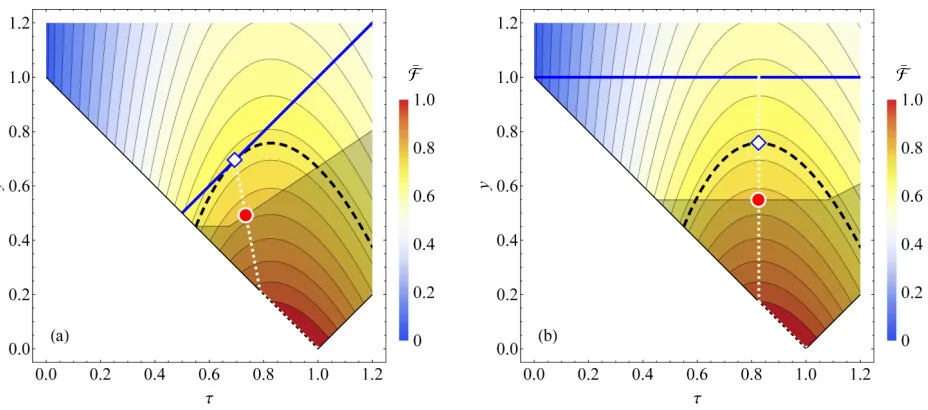
FIG. 1. Diagram of single-mode phase-insensitive Gaussian channels defined by points in the (τ, y) plane according to Eq. (15). The white area accommodates unphysical channels, which violate Eq. (16). Points above the solid blue line in panel (a) correspond to B →AGaussian steerability-breaking channels, defined by Eq. (18), while points above the solid blue line in panel (b) correspond toA→B Gaussian steerability-breaking channels, defined by Eq. (19). In both panels, the contour plot depicts the fidelity ¯Fλ(τ, y), Eq. (31), between an input coherent state|αiin and the corresponding output state obtained by the action of a phase-insensitive channel specified by (τ, y), averaged over the input distributionpλ(α), withλ = 0.2. The dashed black contour identifies the no-cloning threshold ¯Fλ= ¯Fλ(s), Eq. (30); channels below such contour yield average fidelity exceeding the threshold, hence amounting to secure teleportation protocols. The dotted white line spans the family of optimal teleportation protocols at fixed (a) B →A Gaussian steerabilitysba and (b)A→B Gaussian steerabilitysab, each starting from 0 at the intersection with the solid blue line, increasing down the corresponding dotted white line, and converging towards the identity channel (1,0) which is reached in the limit of infinite steerability. Relevant channels are highlighted as special points in the figure: The red-filled circle corresponds to the optimal channel with (a)sba = 0.4 and (b) sab = 0.6, while the white-filled diamond corresponds to the optimal channel at the boundary of the secure teleportation region, given by (a)sba= 0 and (b)sab=sminab , Eq. (34). The shaded gray area corresponds to channels not accessible by teleportation schemes exploiting resources with finite steerabilitiessbaandsabaccording to Eq. (23), with (a)sba= 0.4 andsab defined by Eqs. (25) and (32), and (b)sab= 0.6 andsbadefined by Eqs. (27) and (35). All the quantities plotted are dimensionless.
state described by a covariance matrix VAB which can be used in a continuous variable teleportation protocol to
simulate the corresponding channel with a minimum amount of steerability, and possibly finite mean energy.
For a fixed Gaussian steerability (in either direction) of the resource state shared by Alice and Bob, not all phase-insensitive channels can be implemented through the BK protocol described by Eq. (21). This follows from the fact that the degree of Gaussian steerability is monotonically nonincreasing under Gaussian local operations and classical communication [36], and cannot be distilled by means of such operations, similarly to what happens for entanglement [29]. Hence, let us suppose that Alice wants to transfer one mode of an ideal EPR state to Bob through a teleportation protocol which simulates the channel specified by the pair (τ, y). Let us also suppose that Alice and Bob share a two-mode Gaussian resource state with VAB given by Eq. (7) and with a fixed amount of Gaussian
steerability from B to A [Eq. (10)], SB→A(VAB) = sba. We know that the Gaussian steerability of the output
stateSB→A(VABout) = max{0,log(τ /y)}cannot exceed the steerability of the state initially shared by the two parties.
Therefore, they can simulate the channel defined by (τ, y) only ify≥e−sbaτ. An analogous reasoning could be done for the Gaussian steerability fromA toB [Eq. (11)],SA→B(VAB) =sab, obtaining that Alice and Bob can simulate
the channel with (τ, y) only ify≥e−sab.
We have then that, given a resource state specified by a covariance matrix VAB with steerability degreessba and
sab, the single-mode phase-insensitive Gaussian channels (τ, y) which could be implemented through a continuous
variable teleportation protocol are those satisfying
(τ, y) s.t. (
y≥e−sbaτ
y≥e−sab . (23)
implementation is thus impracticable in any experimental scenario.
We will show that it is possible to construct realistic classes of Gaussian resource states, with minimum steerability degrees (equal to the ones of the Choi state) and finite mean energy, able to simulate all phase-insensitive Gaussian channels saturating the boundaries in Eq. (23), with the only exclusion of the quantum limited attenuator for which these optimal states have again a diverging mean energy. These findings add to the recent analysis [3] where entan-glement, rather than steering, was considered as a limited resource. In the following, we investigate the two steering directions separately, and find in particular optimal states tailored to each of them.
A. Optimal resources with fixed B→A steerability
We begin by discussing the case of a fixedB →Asteerability, given by Eq. (10). The optimal two-mode resource states for teleportation simulation with a finite sba are found by starting from the covariance matrix VAB in the
standard form given by Eq. (12), then fixingb such that SB→A(VAB) =sba, andc such that the boundy≥e−sbaτ,
withy given by Eq. (22) together withg=√τ, holds with equality:
b=τ(a−coshsba+ sinhsba), c= (a−e−sba)
√
τ , a≥ e
sba+τ(1 +e−sba)
esba(τ−1) +τ , (24)
where the condition given onaensures that (3) is fulfilled, i.e., that the state is physical. Within this class of states, we choose those with the minimal mean energy according to Eq. (2), given by the value of a which saturates the inequality in (24). The resulting states are two-mode asymmetric squeezed thermal states with a unit symplectic eigenvalue (νAB− = 1), partially saturating the uncertainty principle (8) [21, 37]. Notice that the lower bound on the coefficient a (and hence on the mean energy since the latter scales linearly with a) diverges only at the point (τ = 1+e1−sba, y =
1
1+esba) corresponding to a quantum limited attenuator. For larger values of τ, all channels along the boundary saturating the first inequality in (23) can be simulated using the states of Eq. (24) with a finite mean energy and minimum steerabilitySB→A(VAB) =sba.
On the other hand, notice that the steerability fromAtoB of the family of states of Eq. (24) is given by
sab=−log
e−2sba(a esba−1)τ
a
, (25)
which is a decreasing function of the parameter a. This means that in the family of states of Eq. (24), for a fixed
B→Asteerabilitysbathe state with the least possible mean energy is the one with the maximumA→Bsteerability.
Conversely, the state with the minimum steerability from A to B, within the family of Eq. (24), has infinite mean energy.
B. Optimal resources with fixedA→B steerability
We now consider the case of a fixed A → B steerability, given by Eq. (11). We hence want to find a class of resource states, described by a covariance matrixVAB withSA→B(VAB) =sab, which allow us to saturate the second
inequality in (23). Following a construction analogous to the one done in the previous subsection, we find
b=aτ+e−sab, c=a√τ , a≥max{a+, a
−} with a±=
τ
1
esab±1 ∓1
±1 −1
. (26)
Also in this case, the state with the minimal mean energy is the one given by the value ofawhich saturates the inequal-ity in (26). Once more, the lower bound for the coefficientadiverges only at the point (τ = 1−coshsab+ sinhsab, y =e−sab)
corresponding to a quantum limited attenuator.
The steerability fromB to Aof the family of states defined by Eq. (26) reads
sba=−log
a
a esabτ+ 1
, (27)
which is a decreasing function ofa. Analogously to the previous case, choosing the minimalais equivalent to maximise the steerability fromB toA, while, on the other hand, fora→ ∞we have thatsba takes its minimum value and the
ℱ_ ℱ_
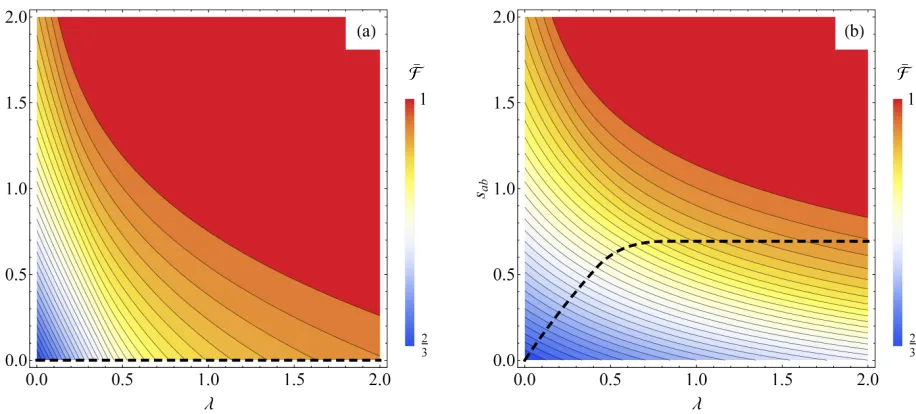
FIG. 2. Contour plot of the optimal average fidelity ¯Fλopt for teleporting an alphabet of coherent states of light sampled from a non-uniform phase space distribution pλ with varianceλ−1, when exploiting a resource with (a) fixed B → A Gaussian steerability sba, Eq. (33), and (b) fixed A →B Gaussian steerability sab, Eq. (36). The Gaussian teleportation is certified secure in the region above the dashed black line, in which case ¯Fλopt exceeds the no-cloning threshold ¯F
(s)
λ given by Eq. (30). This is achieved in (a) for anysba>0 , and in (b) for a finitesab> sminab , see Eq. (34). In the limit of uniform input distribution (λ→0) and vanishing steerability (sba=sab= 0), the optimal average fidelity reduces to the benchmarkF0(s)= 2/3. All the
quantities plotted are dimensionless
IV. OPTIMAL SECURE TELEPORTATION OF COHERENT STATES WITH LIMITED RESOURCES
Here we exploit the results of Sec. III in order to solve the concrete problem of determining the maximum average fidelity ¯F for secure teleportation of an alphabet of coherent states of light, given a finite steerability available as a resource.
Let us suppose that Alice wants to teleport to Bob a coherent state [8]|αiinwith unknown amplitudeα∈Csampled
from a Gaussian phase space distribution
pλ(α) =
λ πe
−λ|α|2
(28)
with finite varianceλ−1. According to Eq. (1), the average input-output teleportation fidelity is given by
¯ Fλ=
Z
C
d2α pλ(α)inhα|ρout|αiin. (29)
As discussed in the Introduction, the security of the teleportation protocol is certified if the average fidelity ¯Fλexceeds
the so-called no-cloning threshold [5], which for the considered input ensemble with inverse varianceλ≥0 and in the assumption of Gaussian cloners is given by [38, 39]
¯ Fλ(s)=
2(1 +λ)
3 +λ , λ≤
√ 2−1 ;
2λ
3−2√2 + 2λ , otherwise.
(30)
Achieving ¯Fλ>F¯
(s)
λ guarantees that no better copy of Alice’s input state than Bob’s output can be received by Eve,
who is entitled to use any Gaussian operation to intercept the communication between Alice and Bob.1
1 In the limit of uniform input distribution (λ→0) the threshold in Eq. (30) reduces to ¯F(s)
0 = 2/3 [5], which is the best 1→2 single-clone
We can study the fidelity between the input state |αiin and the output state obtained from the application of a
phase-insensitive single-mode Gaussian channel with (τ, y), averaged over the input distribution. Using Eq. (29), this yields [3]
¯
Fλ(τ, y) =
2λ
2(1−√τ)2+λ(1 +y+τ) . (31)
The expression in Eq. (31) is overlayed in Fig. 1 as a contour plot in the plane (τ, y), together with the (dashed black) contour line defining the secure teleportation threshold, ¯Fλ(τ, y) =F
(s)
λ [Eq. (30)]. As shown in particular in
Fig. 1(a), the latter line is tangent to the boundaryy=τ of theB→Asteerability-breaking region [Eq. (18)] in the point (1 +λ)−2,(1 +λ)−2
, which corresponds to the best Gaussian teleportation channel that Alice and Bob can implement when sharing a resource with vanishingsba.
Thanks to the results of Sec. III A, we can determine the optimal resource state, within the family of Eq. (24) at fixed SB→A(VAB) = sba, that Alice and Bob must share in order to maximise the average fidelity and beat the
no-cloning threshold (30). As one can see in Fig. 1(a), the corresponding optimal teleportation channel is given for any
sba by the point at which the liney=e−sbaτ, saturating the first boundary in (23), is tangent to the corresponding
contour of the average fidelity given by Eq. (31). Using simple geometry, the solution is hence given by
τλopt(sba) = max
4e2sba [λ+esba(2 +λ)]2,
1 1 +e−sba
, (32)
which yields the optimal average fidelity at fixedsba:
¯
Fλopt(sba) =
2[λ+esba(2 +λ)]
2 +λ+esba(4 +λ) , λ≤
2√esba(esba+1)−esba es
ba+1
;
λ(esba+ 1) 1 +λ+esba 2 +λ−2 √
e−sba+ 1
, otherwise.
(33)
[image:8.612.122.556.263.393.2] [image:8.612.152.468.561.633.2]This confirms that theB →A steerability of the shared state, Eq. (10), is a meaningful, necessary and sufficient resource for optimal secure teleportation of coherent states of light: For anyλ, the optimal average fidelity ¯Fλopt(sba)
[Eq. (33)], plotted in Fig. 2(a), is a monotonically increasing function ofsbaand is larger thanF
(s)
λ [Eq. (30)] as soon
assba>0, reducing to the latter threshold exactly whensba= 0. Notice further that the resource states used in the
optimal protocol at fixed sbaalso have a finiteA→B steerability, given by Eq. (25). This is in agreement with the
observation, originally made in the limiting case of uniform input distribution (λ→0), that secure teleportation of coherent states requires EPR steering in both directions [7].
For the sake of completeness, it is interesting to explore also the alternative scenario in which theA→Bsteerability SA→B(VAB) = sab in the resource state is fixed instead. From Fig. 1(b), we see that in this case the contour line
¯
Fλ(τ, y) =F
(s)
λ does not intersect the boundary y = 1 of theA →B steerability-breaking region [Eq. (19)], which
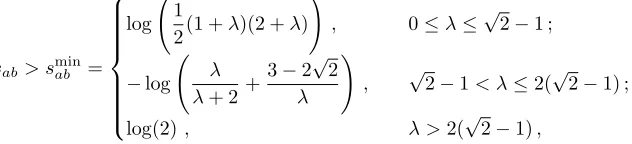
means thatsabmust have a finite value in order to overcome the no-cloning threshold (30). Indeed, using the results
of Sec. III B, it is easy to show that one must have
sab> sminab =
log 1
2(1 +λ)(2 +λ) !
, 0≤λ≤√2−1 ;
−log λ
λ+ 2 +
3−2√2
λ
!
, √2−1< λ≤2(√2−1) ;
log(2), λ >2(√2−1),
(34)
in order to achieve secure teleportation of coherent states of light. This means that, unless the input distribution is uniform [7] (λ → 0), theA →B steerability of the shared state is a necessary but not sufficient resource for this task. Provided (34) is satisfied, the optimal teleportation protocol Alice and Bob can implement uses a shared state belonging to the class of Eq. (26) with
τλopt(sab) = max
4
(2 +λ)2,1−e −sab
This leads to the corresponding optimal average fidelity at fixedsab:
¯
Fλopt(sab) =
2esab(2 +λ)
2 +λ+esab(4 +λ) , λ≤2 q
esab
esab−1−1
;
λ
λ+ √1−e−sab−12
, otherwise.
(36)
For any λ, the optimal average fidelity ¯Fλopt(sab) [Eq. (36)], plotted in Fig. 2(b), is a monotonically increasing
function ofsab and is larger thanF
(s)
λ [Eq. (30)] as soon assab> sminab , reducing to the latter threshold exactly when
sab =sminab [Eq. (34)]. Concerning steerability fromB to A, notice that the resource states of Eq. (26) always have
sba>0 when (34) holds. More generally, SA→B(VAB)>log(2) implies SB→A(VAB)>0 for any two-mode Gaussian
state with covariance matrixVAB[22], confirming once again that two-way steerability is required for a certified secure
teleportation of coherent states of light.
V. CONCLUSIONS
We determined the optimal Gaussian protocols forsecurequantum teleportation[5] of an input alphabet of coherent states of light with generally non-uniform phase space distribution, exploiting Gaussian EPR steering[9, 22] as a limited resource. Our analysis complements a recent study which focused instead on entanglement as a limited resource [3], and goes beyond another recent investigation on the role of EPR steering in secure teleportation, which only specialised to uniform distributions of input coherent states [7]. To obtain our results, we characterised the class of single-mode phase-insensitive Gaussian channels which can be simulated by teleportation exploiting a finite degree of steerability fromB to Aor fromAtoB, identifying families of two-mode Gaussian resource states which are optimal for such a task and can be realised with finite mean energy (except when simulating a quantum limited attenuator).
Our study confirms that steerability in both directions is required to beat the benchmark for secure teleportation.[5, 38, 39] From a practical pespective, we remark that in both cases analysed in this paper, i.e. with fixedB →A or
A→B Gaussian steerability as a limited resource, the optimal average teleportation fidelity ¯Foptdefined respectively
by Eq. (33) or Eq. (36) can be attained by a conventional BK teleportation protocol [Eq. (22)] with optimal gain
gopt=√τopt, where τopt is defined by Eq. (32) or Eq. (35), respectively.
In the near future, it would be desirable to implement the optimal continuous variable teleportation schemes devised here and hence to demonstrate experimentally the key role of Gaussian EPR steering for secure teleportation of coherent states of light with non-uniform phase space distribution. This would constitute a milestone for the quantum internet [1], together with the recent optical demonstration of one-sided device independent quantum key distribution also exploiting Gaussian EPR steering [41].
ACKNOWLEDGMENTS
We acknowledge discussions with Vittorio Giovannetti, Fr´ed´eric Grosshans, Qiongyi He, Ludovico Lami, Andrea Mari, Ladislav Miˇsta Jr., and Margaret Reid. This work was supported by the European Research Council (ERC) under the Starting Grant GQCOP (Grant No. 637352).
[1] H. J. Kimble, “The quantum internet,” Nature453, 1023 (2008).
[2] C. H. Bennett, G. Brassard, C. Cr´epeau, R. Jozsa, A. Peres, and W. K. Wootters, “Teleporting an unknown quantum state via dual classical and Einstein-Podolsky-Rosen channels,” Phys. Rev. Lett.70, 1895 (1993).
[3] P. Liuzzo-Scorpo, A. Mari, V. Giovannetti, and G. Adesso, “Optimal continuous variable quantum teleportation with limited resources,” arXiv:1705.03017 (2017).
[4] S. L. Braunstein, C. A. Fuchs, and H. J. Kimble, “Criteria for continuous-variable quantum teleportation,” J. Mod. Opt. 47, 267 (2000).
[5] F. Grosshans and P. Grangier, “Quantum cloning and teleportation criteria for continuous quantum variables,” Phys. Rev. A64, 010301 (2001).
[7] Q. He, L. Rosales-Z´arate, G. Adesso, and M. D. Reid, “Secure continuous variable teleportation and Einstein-Podolsky-Rosen steering,” Phys. Rev. Lett.115, 180502 (2015).
[8] R. J. Glauber, “Coherent and incoherent states of the radiation field,” Phys. Rev.131, 2766 (1963).
[9] H. M. Wiseman, S. J. Jones, and A. C. Doherty, “Steering, entanglement, nonlocality, and the Einstein-Podolsky-Rosen paradox,” Phys. Rev. Lett.98, 140402 (2007).
[10] S. L. Braunstein and P. van Loock, “Quantum information with continuous variables,” Rev. Mod. Phys.77, 513 (2005). [11] A. Einstein, B. Podolsky, and N. Rosen, “Can quantum-mechanical description of physical reality be considered complete?”
Phys. Rev.47, 777 (1935).
[12] L. Vaidman, “Teleportation of quantum states,” Phys. Rev. A49, 1473 (1994).
[13] C. Weedbrook, S. Pirandola, R. Garc´ıa-Patr´on, N. J. Cerf, T. C. Ralph, J. H. Shapiro, and S. Lloyd, “Gaussian quantum information,” Rev. Mod. Phys.84, 621 (2012).
[14] G. Adesso, S. Ragy, and A. R. Lee, “Continuous variable quantum information: Gaussian states and beyond,” Open Syst. Inf. Dyn.21, 1440001 (2014).
[15] A. Serafini,Quantum Continuous Variables: A Primer of Theoretical Methods (Taylor & Francis, Oxford, 2017). [16] S. L. Braunstein and H. J. Kimble, “Teleportation of continuous quantum variables,” Phys. Rev. Lett.80, 869 (1998). [17] R. Simon, N. Mukunda, and B. Dutta, “Quantum-noise matrix for multimode systems: U(n) invariance, squeezing, and
normal forms,” Phys. Rev. A49, 1567 (1994).
[18] R. Simon, “Peres-horodecki separability criterion for continuous variable systems,” Phys. Rev. Lett.84, 2726 (2000). [19] R. F. Werner and M. M. Wolf, Phys. Rev. Lett.86, 3658 (2001).
[20] M. D. Reid, “Demonstration of the Einstein-Podolsky-Rosen paradox using nondegenerate parametric amplification,” Phys. Rev. A 40, 913 (1989).
[21] G. Adesso, A. Serafini, and F. Illuminati, “Extremal entanglement and mixedness in continuous variable systems,” Phys. Rev. A 70, 022318 (2004).
[22] I. Kogias, A. R. Lee, S. Ragy, and G. Adesso, “Quantification of gaussian quantum steering,” Phys. Rev. Lett.114, 060403 (2015).
[23] L.-M. Duan, G. Giedke, J. I. Cirac, and P. Zoller, “Inseparability criterion for continuous variable systems,” Phys. Rev. Lett.84, 2722 (2000).
[24] C. M. Caves and P. D. Drummond, “Quantum limits on bosonic communication rates,” Rev. Mod. Phys.66, 481 (1994). [25] M. M. Wolf, D. P´erez-Garc´ıa, and G. Giedke, “Quantum capacities of bosonic channels,” Phys. Rev. Lett.98, 130501
(2007).
[26] J. Sch¨afer, E. Karpov, R. Garc´ıa-Patr´on, O. V. Pilyavets, and N. J. Cerf, “Equivalence relations for the classical capacity of single-mode gaussian quantum channels,” Phys. Rev. Lett.111, 030503 (2013).
[27] A. S. Holevo, “Entanglement-breaking channels in infinite dimensions,” Probl. Inf. Trans.44, 3 (2008).
[28] T. Heinosaari, J. Kiukas, and J. Schultz, “Breaking gaussian incompatibility on continuous variable quantum systems,” J. Math. Phys.56, 082202 (2015).
[29] G. Giedke and J. I. Cirac, “Characterization of gaussian operations and distillation of gaussian states,” Phys. Rev. A66, 032316 (2002).
[30] J. Fiur´aˇsek, “Improving the fidelity of continuous-variable teleportation via local operations,” Phys. Rev. A 66, 012304 (2002).
[31] P. van Loock, “Quantum communication with continuous variables,” Fortsch. Phys.50, 1177 (2002).
[32] A. Mari and D. Vitali, “Optimal fidelity of teleportation of coherent states and entanglement,” Phys. Rev. A78, 062340 (2008).
[33] J. Niset, J. Fiur´aˇsek, and N. J. Cerf, “No-go theorem for gaussian quantum error correction,” Phys. Rev. Lett.102, 120501 (2009).
[34] S. Pirandola, R. Laurenza, C. Ottaviani, and L. Banchi, “Fundamental limits of repeaterless quantum communications,” Nature Commun.8, 15043 (2017).
[35] M. M. Wilde, M. Tomamichel, and M. Berta, “Converse bounds for private communication over quantum channels,” IEEE Trans. Inf. Theory 63, 1792 (2017).
[36] L. Lami, C. Hirche, G. Adesso, and A. Winter, “Schur complement inequalities for covariance matrices and monogamy of quantum correlations,” Phys. Rev. Lett.117, 220502 (2016).
[37] G. Adesso and F. Illuminati, “Gaussian measures of entanglement versus negativities: Ordering of two-mode gaussian states,” Phys. Rev. A72, 032334 (2005).
[38] P. T. Cochrane, T. C. Ralph, and A. Doli´nska, “Optimal cloning for finite distributions of coherent states,” Phys. Rev. A 69, 042313 (2004).
[39] F. Grosshans,Communication et cryptographie quantiques avec des variables continues, Ph.D. thesis, Institut d’Optique, Universit´e Paris Sud (2002).
[40] N. J. Cerf, O. Kr¨uger, P. Navez, R. F. Werner, and M. M. Wolf, “Non-gaussian cloning of quantum coherent states is optimal,” Phys. Rev. Lett.95, 070501 (2005).