DELIVERING THE BENEFITS OF PERSISTENCE TO SYSTEM
CONSTRUCTION AND EXECUTION
Quintin Ivor Cutts
A Thesis Submitted for the Degree of PhD
at the
University of St Andrews
1993
Full metadata for this item is available in
St Andrews Research Repository
at:
http://research-repository.st-andrews.ac.uk/
Please use this identifier to cite or link to this item:
http://hdl.handle.net/10023/13488
Delivering the Benefits of Persistence to
System Construction and Execution
Quintin I. Cutts
Department of Mathematical and Computational Sciences
University of St Andrews
St Andrews
FifeKY16 9SS
ProQuest Number: 10167261
All rights reserved
INFORMATION TO ALL USERS
The quality of this reproduction is dependent upon the quality of the copy submitted.
In the unlikely event that the author did not send a com plete manuscript and there are missing pages, these will be noted. Also, if material had to be removed,
a note will indicate the deletion.
uest
ProQuest 10167261
Published by ProQuest LLO (2017). Copyright of the Dissertation is held by the Author.
All rights reserved.
This work is protected against unauthorized copying under Title 17, United States C ode Microform Edition © ProQuest LLO.
ProQuest LLO.
789 East Eisenhower Parkway P.Q. Box 1346
Declarations
I, Quintin Ivor Cutts, hereby certify that this thesis has been composed by myself, that it is a record of my own work, and that it has not been accepted in partial or complete fulfilment of any other degree or professional qualification.
Signed Date
I was admitted to the Faculty of Science of the University of St Andrews under Ordinance General No. 12 on 1st October 1988 and as a candidate for the degree of Ph.D. on 1st October 1988.
Signed Date (Q - ^ ~ ^ 3»
I hereby certify that the candidate has fulfilled the conditions of the Resolution and Regulations appropriate to the Degree of Ph.D.
In submitting this thesis to the University of St Andrews I understand that I am giving permission for it to be made available for use in accordance with the regulations of the University Library for the time being in force, subject to any copyright vested in the work not being affected thereby. I also understand that the title and abstract will be
published, and that a copy of the work may be made and supplied to any bona fide
library or research worker.
Abstract
■3f
In an orthogonally persistent programming system the longevity of data is independentof its other attributes. The advantages of persistence may be seen primarily in the |
areas of data modelling and protection resulting from simpler semantics and reduced 1
complexity. These have been verified by the first implementations of persistent languages, typically consisting of a persistent store, a run-time system and a compiler that produces programs that may access and manipulate the persistent environment. This thesis demonstrates that persistence can deliver many further benefits to the programming process when applied to software construction and execution. To support the thesis, a persistent environment has been extended with aU the components necessary to support program construction and execution entirely within the persistent environment. This is the first known example of a strongly-typed integrated persistent programming environment.
The keystone of this work is the construction of a compiler that operates entirely |
within the persistent environment. During its construction, persistence has been exploited in the development of a new methodology for the construction of applications from components and in the optimisation of the widespread use of type information throughout the environment.
Further enhancements to software construction and execution have been developed |
I
that can only be supported within an integrated persistent programming environment. &
It is shown how persistence forms the basis of a new methodology for dynamic optimisation of code and data. In addition, new interfaces to the compiler are described that offer increased functionality over traditional compilers. Extended by the ability to manipulate structured values within the persistent environment, the interfaces increase the simplicity, flexibility and efficiency of software construction and execution. Reflective and hyper-programming techniques are also supported.
Acknowledgements
Firstly, I would like to thank Ron Morrison, my supervisor, for endless encouragement, advice and patience and for his very significant rôle in my development as a researcher. He has constructed a research environment which is the object of envy and/or admiration to all who enter it.
Special thanks are also due to Fred Brown, Richard Connor, Alan Dearie and Graham Kirby for the many detailed discussions that have lead to work presented here. Not to mention their constant humour and enthusiasm.
Craig Baker, Ray Carrick and Dave Munro from the PISA group have also been involved with this work. Outside the group, advice and encouragement have come from Malcolm Atkinson, Dave McNally, Chris Marlin, John Rosenberg and Dave Stemple.
Fred, Richard and Ron also deserve great praise for reading and re-reading various drafts of the thesis.
1
Contents
1 Introduction...1
1.1 Persistence... ...4
1.1.1 Using a Persistent Environment to Cache Data...6
1.2 Building an Integrated Persistent Programming Environment...9
1.2.1 Conversion into an Integrated Persistent Pi'ogramming Environment... 10
1.3 Constructing a Compiler within the Persistent Environment...12
1.3.1 Constructing Applications in a Persistent Environment... 13
1.3.2 Using Persistence to Optimise Type Checking...15
1.4 Delivering the Benefits of a Persistent Programming Environment...16 I 1.4.1 Using Persistence to Enhance Compilation...17
1.4.2 Using Persistence to Enhance Execution... 18
1.4.3 Further Beneficiaries of an Integrated Environment...20
1.5 Working Practices in the St Andrews Persistence Group...21
1.6 Related Work...22
:3
i
2.1 Introduction...27
2.1.1 Change and the Linking Process... 28 5 2.1.2 Applying Persistence to the Separate Linking Process... 31
I
2.2 The General Architecture... 33 4 I i 2.2.1 Application Construction and Execution...34 < 2.2.1.1 Creation of Component Locations... 352.2.1.2 Constmction of Components...36
2.2.1.3 Execution of an Application...37
2.2.2 Component Evolution ... 38
2.2.2.1 Changing a Component by Assignment 38 |
2.2.2.2 Type Changes...39
2.2.2.3 Changes During Application Execution...40
2.2.3 Supporting the Software Development Process...41
2.2.3.1 Software Reuse...41
2.2.3.2 Application Evolution... 42
2.3 An Implementation of the Architecture...44
2.3.1 Napier88...45
2.3.2 Implementing the architecture... 47
2.3.2.2 Generators...47
2.3.2.3 Execution... 49
2.3.3 Support for the Features of the Architecture... 50
2.3.3.1 Evolution of Components...50
2.3.3.2 Software Reuse and Control over the Component Space... 50
2.4 The Architecture Supported by Other Languages...53
2.5 Conclusions... 54
3 Persistent Type Representations... 56
3.1 Introduction... 56
3.2 Type System Operations in Persistent Systems...60
3.2.1 The Type System Operations... 61
3.2.2 Using the Type System Operations...66
3.2.2.1 Construction... 67
3.2.2.2 Compilation...68
3.2.2.3 Execution... 70
3.2.3 Shai’ing Type Information and Operations...71
3.2.4 Summary...72 |
Î
■3
3.4.0.1 Protecting the Integrity of Type
Representations...79
3.4.1 Choosing Representation Characteristics... 80
3.4.2 Type Type...82
3.4.3 Using Type for all Type Checking Operations...85
3.5 Caching the Results of Type System Operations... 86
3.5.1 The General Technique... 87
3.5.2 Optimising the Specialisation of Parameterised Types... 89
3.5.3 Optimising Structural Type Equivalence Checking...91
3.5.3.1 An Equivalence Cache...91
3.3.0.1 Conversion Between Denotation and Representation... 74
3.3.0.2 Sharing Type Information Between Software Processes ...75
3.3.0.3 Sharing Type Information Between Programs... 76
3.3.1 Assessing the Implementation...76
i 3.3.2 Multiple Type Representations...77
3.3.3 Summary...78
1
3.5.3.2 Including Non-equivalent Pairs in the
Cache...96
3.6 Conclusions...97
4 Using Persistence to Enhance Compilation...99
4.1 Introduction... ... 99
4.2 A Flexible Compiler Interface... 101
4.2.1 Linguistic Reflection...101
4.2.2 Supporting Flexible Binding Strategies... 104
4.2.2.1 Composition-time Binding... 105
4.2.2.2 Compüe-time Binding... 107
4.2.2.3 Separating Checking and Binding...107
4.2.3 The Compiler Interface as an Abstract Data Type...112
4.3 Constructing the Compiler within the Persistent Environment...113
4.3.1 The NapierSS Compiler...113
4.3.2 Building the Compiler on the Construction Architecture... 114
4.3.2.1 General Requirements of the Architecture... 115
4.3.2.2 Bootstrapping the Compiler into the Persistent Environment... ...116
I
4.4 Dynamically Checked Witness Types 121 |
j
4.4.1 Napier88 Abstract Data Types... 122 r|4.4.1.1 Accessing the Fields of Abstract Instances...123
5.4 Storing and Choosing Concrete Specialisations...145
4.4.1.2 Placing Values of Witness Type into Infinite Unions...124 é 4.4.2 Dynamic Witness Type Checking...126
4.4.2.1 Implementation...129
4.5 Conclusions... 129
5 Using Persistence to Optimise Execution...131
5.1 Introduction... 131
5.2 Polymorphic Procedures... 133
5.2.1 Napier88 Polymorphic Procedures... 133
5.2.2 Implementing Polymorphism ...136 |
5.2.2.1 A Mixed Implementation Strategy...139
5.3 Partly-tagged, Semi-uniform Polymorphism...141
5.3.1 Block Retention... 142
5.3.2 Using Block Retention to Store Tag Information...143
5.3.3 Converting to and from the Uniform Polymorphic Form... 144
%
1
5.4.1 Storing Concrete Specialisations... 147
5.4.2 Retrieving Concrete Code Vectors...148
5.5 Cost Functions and Execution Profiles ...150
5.5.1 Affordable vs. Exact Execution Profiles... 150
i
5.5.2 Storing the Execution Profiles... 1525.5.2.1 Making Execution Profiles Persistent... 156
5.6 Polymorphic Code Enhancer... 156 ij 5.6.1 Compiling Concrete Specialisations... 157
5.6.2 Finding Procedures in the Persistent Environment... 158
5.6.3 Overwriting Polymorphic Specialisation Closures...159
5.7 Conclusions...160
6 Conclusions... 161
6.1 Delivering the Benefits of Persistence...161
6.2 Methodologies for Persistent Softwai'e Engineering...164
6.2.1 Constructing Applications from Components...164
6.2.2 Optimisation techniques...165
6.2.2.1 Caching... 165
6.2.2.2 Enhancement ...166
6.3 Enhancing the Functionality of the Compiler... 166 |
6.5 Finale...167
Appendix 1 The Napier88 Type System...168 |
A l.l Universe of Discourse... 168
A1.2 Context Free Syntax and Type Rules... 169
A1.3 Type Equivalence Rule... ... 170
A1.4 Napier88 Context Free Syntax...172
A1.5 Napier88 Type Rules...179
References...184
Ï
i
1
Introduction
The research presented in this thesis was undertaken in the context of the ESPRIT-funded FIDE project [FID90]. The major aim of the project is to facilitate the construction, maintenance and operation of large-scale long-lived and data-intensive application systems, referred to here as Persistent Application Systems (PAS). Typical examples of the systems under consideration are as follows:
• A social security system. The population recorded on such a system represent a very large body of long-lived and constantly-evolving data. The programs operating over that data will evolve as new legislation concerning social security is introduced.
• Management of aircraft design information. All details of the design are required from the initial concepts through to the finished product. Any subsequent modifications must also be recorded. By law, aU of this information must be retained for tens of years after the final aircraft of the design has been manufactured in case of an aircraft failure. Design analysis programs may evolve as new techniques and aircraft characteristics are discovered.
The research of the FIDE consortium is concerned with reducing the cost and difficulty of designing, building and maintaining PAS. Lack of integration between conventional application-building components such as database systems, programming languages, design tools and operating systems unnecessarily increases
the above intellectual and mechanical costs. System failure and the difficulties of |
recovery are also frequently exacerbated by this poor integration.
Improving the design, construction and operation of PAS has been planned within the
' i
• Provision of a suitable language in which to write the components of a PAS. The aim here is to remove the discontinuity between database systems, programming languages and operating systems that must be tackled when constmcdng components of a PAS.
• Provision of a consistent and coherent support environment for the chosen language - a Fully Integrated Data Environment (FIDE). Such an environment can be realised by removing the discontinuities between the design and construction tools and the programming language itself.
Persistent programming languages are seen as an appropriate choice of PAS implementation language. Persistent languages remove the discontinuity between long and short-lived data exemplified by the traditional database, programming language divide. In conjunction with a powerful type system, persistent programming languages support increased power, safety and simplicity, all of which lead to optimisations in the programming process.
Early research in the FIDE project has supported the development of many different styles of persistent programming languages. These range from an embedded sub language [LR89], a statically typed object-oriented language [AC085], to strongly typed multi-paradigm languages [MBC+89,MMS92]. The attempts of C++ implementations [Str86,Car89] and of the Smalltalk implementations [GR83,BOP+89] in trying to integrate a programming language with an object store have the same basic philosophical aims as those of the FIDE project. Their success is discussed at the end of this chapter.
they are poorly integrated and it is left to the programmer to overcome the associated problems.
The required programming support environment will itself be implemented in some programming system. The requirement of the implementation system is that it should support within a consistent framework all the facilities for construction, compilation, binding to existing data and components and execution of programs in the supported language. In particular it must support the conversion of representations of programs in the supported language into representations that may be executed by the supporting language. This task is traditionally performed by a compiler.
This thesis assumes that a persistent programming language and its associated run time environment are the appropriate implementation technology for an integrated programming support environment. It discusses the mechanisms necessary to transform a language that can manipulate a persistent store into a single integrated persistent programming environment and describes the implementation. Furthermore, it will be shown that the construction of the environment is simplified using persistence and subsequently that program construction and execution are enhanced within an integrated persistent environment. The expected benefits are as follows:
• The binding of software components is more flexible.
• The complexity of software construction and evolution is reduced.
• The execution of software may be made more efficient.
A bootstrap implementation of a persistent programming language will be used to construct the integrated programming environment supporting the construction and execution of programs in the same persistent language. The persistence attribute of the language is exploited wherever possible to enhance the construction and execution of the integrated programming environment.
developments may take advantage of the persistent environment in order to support new techniques for software construction and execution within the system demonstrating new levels of power and efficiency.
The mechanisms given in this thesis have all been implemented but should be regarded as instances of methodological paradigms. Many more instances of the paradigms are already envisaged and it is expected that these and others will be implemented as use of the persistent environment becomes widespread.
1.1 Persistence
The persistence of a data item is defined as the length of time for which the item exists and is usable [ABC83]. In an orthogonally persistent system, the persistence of all data items manipulated withm the system is independent of their other properties. A single programming language mechanism handles the longevity of aU data items from micro-seconds to years.
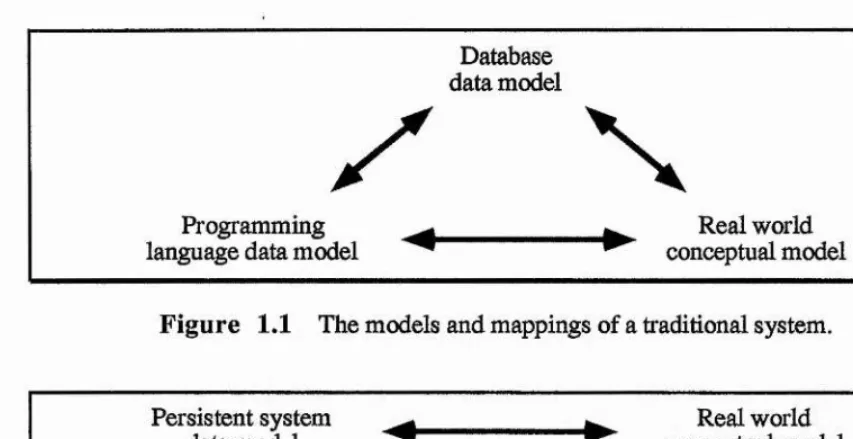
The benefits of orthogonal persistence are well documented [ACC82,ABC+83, ABC+84,AM85,AMP86,AB87,MBC+87,Wai87,AM88,Dea88,Bro89,MBC+90,Con 91,Weg90]. A major advantage of persistent systems is seen in the removal of complexity. An inherent difficulty associated with the programming of data-intensive applications is the understanding of the mappings between the real world and the computational models. The programmer of an application manipulating long-lived data must fully understand all the models shown in Figure 1.1 as well as the mappings between them to be confident of constructing correct code.
Database
A
data model
V
ProgrammingX
^ ^ Real world
language data model ^ ^ conceptual model
Figure 1.1 The models and mappings of a traditional system.
1
Persistent system ^ ^ Real world [image:22.613.67.494.51.270.2]1
data model ^ ^ conceptual modelFigure 1.2 The models and mapping of a persistent system.
As a consequence of the single programming language model, the programmer need not write code to support the mappings that have been discarded. Measurements show that maintaining the mappings constitutes as much as 30% of all code in data-intensive applications [IBM?8]. Thus persistence yields mechanical as well as intellectual benefits.
Some other advantages of orthogonal persistence are as follows:
• Type checking protection covers the entire environment. Since the only way to access the data in the environment is via the persistent language, no other protection mechanism is required
• Referential integrity is automatically supported. References between data values are maintained in a consistent state irrespective of the longevity of that data.
t
r
1.1.1 Using a Persistent Environment to Cache Data
The persistent environment may be used as a cache for the storage of any data type |
supported by the persistent language. The general definition of a cache in this context is a mechanism that may be used to store and later retrieve computed data and thus avoid its repeated recomputation.
There may be many factors involved in the operation of a cache: |
• Which data should be stored in the cache? • How is the data retrieved from the cache?
• Is data ever removed from the cache? There is a trade-off here between the space used to store the cache and the time saved using it.
• How fast may the cache be accessed? The cache access must be fast with respect to the time taken to compute the data for the cache to be worthwhile.
• How expensive in terms of space and time is maintenance of the cache? The trade-off here is against the time and space required to compute the data.
• How frequently whl a cache search result in the required data? There is a
trade-off here between the time taken to perform the search against the !
time to perform the original computation.
• The cache affects only the speed of the required computation.
The traditional hardware cache [PS87] is just one example of the general caching mechanism. A hardware cache stores the results of main memory lookups. The memory devices used for hardware caches are very high speed and so examination of the cache is much faster than a full main memory lookup. The cache lookup is
performed in parallel with the main memory lookup in case the cache fails to produce |
required to determine which data should be placed into the cache and at what point it may be removed. Hardware caching may run into difficulties when many individual operations all use the same cache, since a context switch may result in an unsuitable cache. Thrashing may occur when the contents of the cache are being repeatedly discarded. Cache switching can overcome this problem but suffers the extra penalty of reloading the cache on each switch.
The primary use of a persistent environment as a cache is as a store for structured data
values. The computation that is avoided consists of the storage and retrieval of |
structured data to and from a storage mechanism that only supports flat unstructured #
data, typically a file system.
The persistent environment may also be used as a cache for the results of any other
operations within the system. The results of complex calculations may be stored in a ®
lookup table keyed by the operands of the calculation, for example. The factors involved in the operation of a cache described above should be considered before constructing a caching mechanism for a particular operation.
The thrashing problems of hardware caching described above may be avoided in the r |
persistent environment since each operation may use a different cache. The persistent storage space is conceptually infinite and so the space used by the cache is considered cheap in comparison to the computation time that is saved.
Many instances of caching within the persistent environment will be demonstrated within this thesis. Since the aim is to optimise both the constmction and execution of software, the programs that are caching data will be considered in the following four categories:
• Program composition. • Compilation.
The data cached by a particular program invocation may be used for optimisation by another invocation of the same or any other program. There are many different and useful interactions between the four categories determined by the programs participating in the generation and use of cached data. For example, data cached during compilation of a program may be of use during its execution. Data cached during the execution of one program may be used in the composition of another. As shown in Figure 1.3, the persistent store may form the basis of a feedback mechanism where the results of one program's execution may be used by another.
program
construction
>
program \ ^ compilation
J
)
programlinking
< progr^ A execution
J
Persistent Store
structured data values such as source and executable program components and other data constructed
during program execution.
[image:25.612.78.490.247.476.2]I
Figure 1.3 Caching data between programs via the persistent store.
There is no restriction over the type of the data that may be cached between programs. Examples of data that is cached in the various techniques to be described here are as
follows:
I
• Structured program, representations. These may be source, intermediate or executable code representations.
• Execution profiles. An executing program may cache data that records various aspects of the program's performance in the persistent environment.
a: As with any caching technique, there is a trade-off between the space required in the .
persistent environment to hold the cached data and the time saved by not needing to
I
reconstruct or recalculate it. However, many of the benefits described here apply to data that would otherwise have required storage in an external storage system had it
not been cached. Significant extra space overall is not therefore required to support %
many of these techniques.
1.2 Building an Integrated Persistent Programming
Environment
The early part of the FIDE project has supported the initial implementations of a number of persistent programming languages [MBC+89,AG088,MMS92,BBB+88]. These typically consist of the following components;
• A persistent store implementation.
• A run-time system to support execution of programs in the language and to allow access to the persistent store.
• A compiler.
• Program construction tools.
As shown in Figure 1.4 which depicts an initial persistent language implementation the compiler is implemented outside the persistent environment. Programs are constructed and compiled using tools found in the enclosing environment and may then be
executed against the persistent environment to which they can add and change values.
I
persistent envkonment file system
data structure
^ function
"hello world"
compTer
[âtâ
[image:27.612.75.492.55.191.2]source
Figure 1.4 A typical early persistent system.
Such systems have been sufficient to demonstrate the validity of persistent systems in terms of greater programming simplicity and improved data modelling and protection mechanisms.
1.2.1 Conversion into an Integrated Persistent
Programming Environment
An integrated persistent programming environment is achieved by supporting all programming activity with software constructed within a persistent environment. Such an integrated programming environment may be constructed using one of the initial persistent programming language implementations outlined above. The aim is to build within the persistent environment of such an implementation all the components required for construction, execution and maintenance of programs written within a persistent language. Such a system is depicted in Figure 1.5, where the integrated programming environment is just one program within the persistent environment which contains programming tools such as editors, compilers, browsers and window managers.
Where the implementation persistent language and the language of the constructed integrated environment are the same, a number of benefits are gained, as follows:
• Single consistent environment - simplifies the system. • No conflict between the type system of the two languages.
• No partitioning of the store required between values of the two languages.
10
'■tii
%
Persistent Environment
editor
window !► manager \
[image:28.612.70.491.53.295.2]browser
Figure 1.5 A fully integrated persistent programming system.
The key feature in this transfer process is the construction of a compiler within the persistent environment. As soon as a compiler is available to programs executing within the environment, evolution may take place from within the environment. The programs effecting the evolution may then take full advantage of the integrated persistent environment in which they are embedded in order to intioduce new techniques for the construction and execution of software. These techniques demonstrate new levels of power and efficiency.
13
Constructing a Compiler within the Persistent
Environment
The first half of the work presented in this thesis derives from the conversion of an initial implementation of a persistent programming language into a fully integrated persistent programming system. As stated above, the key to this operation is the construction of a compiler within the persistent environment of the initial persistent language implementation.
#
12
A state-of-the-art persistent programming language, Napier8 8, has been used as the
basis for this work. Napier88 has been developed by the persistent programming i
research group at the University of St Andrews, one member of the FIDE consortium,
and is the culmination of over ten years research into programming language design at 4
St Andrews. The language supports orthogonal persistence, parametric
polymorphism and a strong type system of the kind described in [CW85]. A ' |
description of the Napier88 type system is given in Appendix 1.
Napier88 Release 1,0 on which the work is based is of a similar structure to the style
of persistent programming language implementation depicted in Figure 1.4. This release consists of a stable store implementation, an interpreter for the Persistent
Abstract Machine which is a byte coded interpreter operating over the stable store and 4
supporting persistence and polymorphism, and a compiler constructed outside the Napier88 persistent environment. Program construction and compilation take place outside the Napier88 environment. The compilation techniques used in the compiler implementation may be found in [DM81] [Dea87] [MDC+91]. Further details of the
Napier88 Release 1.0 are not included here but may be found in [MBC+89].
The compiler for Napier88 is the largest application yet written in the initial Napier88 implementation. As such its construction has been a good test of the language's ability to support application construction and of the implementation techniques used in Release 1.0 of the language.
The large number of individually compiled components making up the new compiler caused problems for the type checking implementation of the original Napier88 system. This is an effect of the two separate universes in which type checking takes place in that system. Firstly, independently-prepared components are statically type checked during compilation which takes place outside the persistent environment. Secondly, binding and execution of the components which takes place within the persistent environment may also require type checking. The requirement for type information to pass between the two environments causes severe efficiency problems in a strongly typed language where the amount of type information is typically large. Persistence was again exploited to optimise the type checking and a unified view of type system implementation within persistent systems was realised.
The research into the effect of persistence on application construction and type checking is summarised below.
1.3.1 Constructing Applications in a Persistent
Environment
An application architecture has been developed that supports an evolutionary approach to the construction of software from individual components. The advantageous features of the architecture are efficiency and safety from failure during execution and the flexible evolution of components and applications. Existing construction architectures [Mil84,Car89,AC085,MAE+62,GR83,W ir71,KR78,DOD83] attempting to satisfy these features fail to do so because the sharing of structured executable versions of applications between the construction and execution environments is not supported.
::4
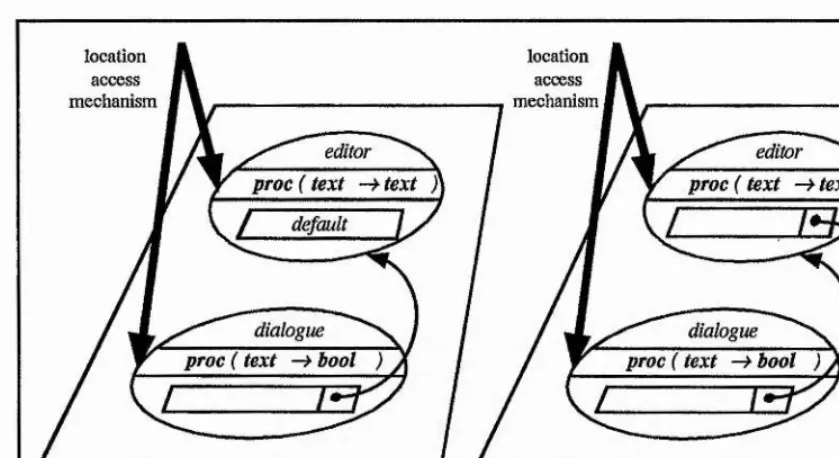
persistent environment are used to hold the individual executable components of an application which are first class values in the environment. Component generation and binding programs cache the constructed components in these locations where they may be directly accessed during execution. They are also available for future invocations
of the binding programs to permit flexible evolution of applications. |
I
The architecture involves the sharing of cached data between the compilation, binding |
and execution of applications. Particular advantages of this architecture are as follows:
• Application components may be independently compiled.
• Individual components may be incrementally linked into an application. • The type compatibility of the components is fully checked before
application execution.
• Components may be reused in different contexts.
• Control over sharing and evolution of components and applications is supported as they progress through the software lifecycle.
One disadvantage is as follows:
• The use of bindings to locations results in less tightly bound applications than in a system using bindings to values [Str67]. Although the architecture guarantees the type of a component prior to application execution, the particular component contained in a location cannot be determined until execution. The control over sharing and evolution mentioned above helps to alleviate this problem.
1.3.2 Using Persistence to Optimise Type Checking
Type systems are well understood as mechanisms which impose static safety constraints upon a program. Within a persistent programming environment the type system provides all the data modelling and protection facilities for the environment. Elsewhere [CBC+90] it has been demonstrated that not all constraints on data may be
captured statically. This leads to a judicious mixture of type checking times being f
I
employed to suit the particular requirements of an application. The spread of times ^
allows a balance between static safety in large applications and dynamic flexibility in constraint expression and reuse.
The type system may be used to perform operations over program and data during any of the four software lifetime processes of composition, compilation, binding and
execution. The point of interest here is the manner in which type information is shared â
among these four phases so that the relevant type system operations may take place. f
Much of the complexity associated with the implementation of type systems stems i
from a lack of support for the sharing of common type information across both independent components and lifetime processes. Few systems have overcome the technical difficulties associated with the transfer of complex type information between independent environments [ACP+91].
A single set of operations to create, manipulate and test representations of type information may be constructed within a persistent envhonment. The set may be shared by all programs in the persistent environment that perform type system operations. Instances of type representations may also be cached in the environment and shared across programs.
system. The persistent store may also be used to cache the results of inherently complex operations over types in order to improve performance.
The benefits of persistence to type system implementation are as follows:
• A single copy of type information may be cached in the persistent environment and shared by all programs.
• A single implementation of all type system operations may be cached in the environment and shared by all programs.
• The results of complex type checking operations may be cached in the persistent environment.
It is demonshated within the thesis how all these benefits may be exploited.
1.4 Delivering the Benefits of a Persistent Programming
Environment
The second half of the work presented in this thesis concerns some of the benefits that may be gained when it is possible to construct and execute programs within an integrated persistent programming environment. A number of general mechanisms for the enhancement of software construction and execution are outlined below. A detailed description and analysis of the first two mechanisms are presented in the thesis. The work leading to the research presented in this thesis also lead to the construction of the remaining mechanisms although they are not presented in detail here.
1.4.1 Using Persistence to Enhance Compilation
Embedding a compiler within a persistent environment creates a symbiotic relationship between the two. The relationship occurs in that the functionality of the compiler is enhanced and compiled code optimised using the persistent environment. The persistent environment benefits in that the execution of progiams, including the
compiler, may be made more efficient. The benefits of the relationship may be described in terms of the manner in which the compiler and other programs executing in the environment share cached data with one another, as follows.
Firstly the compiler, which is itself an item of data cached by the construction architecture, may be accessed by executing programs. An executing program may
construct and execute new programs which manipulate the persistent environment. ^
This ability of a program to alter its own environment during execution is a particular form of reflection [Mae87] known as run-time linguistic reflection [SSS+92]. It is of particular interest in persistent systems because it can allow long-lived data and programs to evolve in a type-safe manner.
■'V
Secondly, the functionality of the compiler may be enhanced by parameterising it with persistent values that are associated with the source. The number of stages at which
programs are bound to data may be extended since the compiler itself can manipulate
I
that data. These stages are defined by the various times at which identifiers embedded in a program are resolved to their associated values, as follows:
• During program composition. The source contains embedded values.
During compilation these values are incorporated into the compiled code. |
This technique is known as hyper-programming [KCC+92].
• During compilation. Free identifiers in the source are resolved using values passed into the compiler [FDK+92].
• Between compilation and execution. The resolution of the identifiers is performed in a separate phase involving an intermediate program representation and the associated values.
• During execution. Identifiers are resolved when the executing program accesses values in the persistent environment.
performance, for example by caching the results of operations repeated across invocations of the compiler. Also, the compiler may associate persistent values with compiled code in order to optimise the execution of that code.
To summarise, the advantages of embedding a compiler in the persistent environment are:
• Run-time linguistic reflection may be supported.
• A wide range of binding techniques between program and data may be supported.
• The performance of both the compiler and the code that it produces may be optimised.
1.4.2 Using Persistence to Enhance Execution
A persistent environment may be used by executing programs to record information detailing aspects of the their operation. This information may then be accessible to other programs executing in the environment. Optimisation within the environment may be performed by these programs based on the data collected during its operation, as follows:
• An execution profile of the program may be cached in the environment during program execution.
• At some later time a program designed to enhance the environment may analyse gathered execution profiles in an attempt to find optimisations that will improve the performance of the environment. The analysis is performed using a cost function that trades the cost of making an improvement against the potential benefit gained from it. The enhancer performs the optimisation if the analysis is favourable.
• Subsequent execution of the environment will be improved by the actions of the enhancer.
Dynamic clustering [BD90] is an example of this technique, where groups of stored # values that are accessed at the same time are placed near each other on secondary
storage to improve access time. The decision on which values to cluster is based on |
statistics collected during execution of the programs that access the values. A second
example is the caching of the results of complex operations in the persistent 4
environment, already described for type checking operations in Section 1.3.2. Where
programs are considered as data there is the possibility of using the same technique to ®
optimise program code in accordance with the dynamic needs of the program. Code enhancement is possible since code generators make static trade-offs with regard to the space requirement and run-time execution speed of the code. Dynamic execution
profiles can be used as a basis for changing these trade-offs. Dynamic query f|
optimisation is a particular example of code enhancement, where execution of the |
query is optimised based on information recorded during previous query executions.
A particular benefit of this technique is as follows:
• Optimisations may be made to the operation of the persistent environment based on information not available statically.
An important consideration when using the architecture is as follows:
• The space and time required to record the execution profile may be significant. There is a trade-off here between the amount of recorded information and the cost of gathering it.
1.4.3 Further Beneficiaries of an Integrated Environment
Hyper-programming
selecting data items to be bound into the programs. This requires that direct links to persistent data items are contained in program source code and that the compiler can manipulate such links. This style of programming is known as hyper-programming [KCC+92] and has been implemented on top of the integrated programming environment described here [Kir92].
Browsing technology
Advanced persistent object browsers [DCK90,FDK+92] have been developed using the technology described in this thesis. In particular, the ABERDEEN environment developed at the University of Adelaide [Far91] permits the browsing and tagging of persistent objects. Tagged objects may subsequently be incorporated into programs under construction. These tags are resolved during compilation providing another time at which program and data may be bound together.
Run-time Linguistic reflection
The provision of run-time linguistic reflection permits a system to evolve under its own control. This is achieved when an executing program constructs a program representation and passes it to a compiler. The compiler returns an executable value to the program which can then execute or store it as required. Reflective programs have traditionally been hard to understand because their source contains representations of language constructs that are in different formats and which will be executed at many different times. Work presented in [Kh92] attempts to simplify reflective programs by providing a construction methodology which highlights the different kinds of code contained in a reflective program. This work depends on the availability of a compiler within the programming environment where it may be accessed by executing programs.
1.5 Working Practices in the St Andrews Persistence
Group
The work presented in this thesis was undertaken within the persistent programming research group at the University of St Andrews. During the time period in which this
work was carried out, the group has consisted of the following researchers: Ron |
Ï
Morrison, Richard Connor, Alan Dearie, Fred Brown, Ray Garrick, Graham Kirby, |
Craig Baker, Dave Munro and myself. Ron Morrison supervised the work with Alan
Dearie who was co-supervisor until he moved to the University of Adelaide at which |
point Richard Connor unofficially took over his role. All members of such a group contribute in some way to nearly all the work of the group. The work presented in this thesis has benefited from two significant collaborations as follows:
x3 • The research into application building was performed in conjunction with
Alan Dearie and Richard Connor.
• The optimisation of the type checking mechanisms took place jointly with
Richard Connor who was responsible for the Napier88 Release 1.0 type
checker.
It was my responsibility to provide the integrated persistent programming environment and demonstrate that persistence may be exploited to support optimisations within the environment. This then allowed others to use the facilities and for me to share in that
work. a
%
Jointly my supervisors and I designed the applications architecture which I then used to implement the compiler. This required the design of the new type representations and type checking optimisations, also undertaken jointly with my supervisors. Completion of this work lead to my designing and implementing the new compiler interface and the optimisation architecture. I have subsequently worked with Graham
%
Kirby on the design and implementation of the hyper-programming system and with ^
1.6 Related Work
There are no other known instances of a strongly-typed persistent programming language having been used as the implementation vehicle for an integrated persistent programming environment. However there are other programming language systems that could be used to support such an environment. In order to catalogue those languages, it is necessary to define exactly what is required to support the work described here.
The base point is a language and environment supporting the orthogonal persistence of strongly typed objects. In particular strongly typed executable code objects can be retained within the persistent environment. The language is used to construct an integrated set of tools within the environment that support the construction, compilation, linking and execution of programs written in the language. The key tool here is the compiler which can take representations of programs in the base language made up from the data structures of that same language and convert these into program components that are executable within the environment. This compiler is a function within the persistent environment available to other programs executing there.
A brief analysis of a number of languages with the basis philosophical aims found in the FIDE project is now given.
C+ +
The C++AJnix™ [Str86,Car89,RT78] world has succeeded in constructing integrated persistent programming environments. However the only data type that may persist in such environments is the byte. The benefits of strong typing such as improved safety and data modelling power over the whole envhonment cannot be achieved. An example of such a system is the combination of the language E [RCS89], an extension of C++, with the EXODUS Storage Manager [Car89]. The Storage Manager provides storage objects which are uninterpreted byte sequences of virtually any size. The aim
is to build and extend datable systems by writing the database system code in E. E inherits from C++ the lack of strong typing and so is unsuitable for the experiments described here.
Smalltalk
The object-based environments of Smalltalk systems [BOP+89] support the entire programming process from construction to execution. However, the compiler used in this environment is not implemented using the Smalltalk language and is not available to executing programs. In addition, Smalltalk implementations are dynamically typed which, while increasing flexibility for program construction and evolution, reduces the safety of completed applications. This is a significant factor in an environment designed to support large-scale and long-lived applications.
O2C
The O2 Database [BBB+88] is an object-oriented database server developed at Altair,
France. An O2 sublanguage is embedded in an existing programming language in
order to allow the creation of objects in and querying over the database. O2C [LR89]
is an extended version of the C language [KR78] that can operate over the O2 Database. O2C programs are stored outside the database and the language is therefore
unsuitable for the construction of system software within the 0 2 persistent
Galileo
Galileo [AC085] is a strongly-typed object-oriented language developed at the University of Pisa in Italy. The language is supported by the Functional Abstract Machine (FAM) [Car83] with extensions to permit access to the Persistent Object Store developed by Brown at the University of St Andrews [BMM+92]. Any top-level declarations in an interactive Galileo session are retained within the persistent environment. The compiler is external to the persistent environment and is not available to executing programs. Executable code may be stored within the persistent environment in the form of first class functions and strongly typed persistent locations are also supported, so it should be possible to construct applications using the methodology outlined in Section 1.3.1. Until a compiler has been constructed within the language, which is possible, the remaining benefits of persistence described here cannot be supported. However it is hoped that collaborative research during the term of the FIDE project will permit these benefits to be demonstrated.
DBPL
Developed at the University of Hamburg in Germany, DBPL [MS89] supports an extended relational data model. "The final DBPL language design provides an orthogonal integration of sets and first order predicates into a strongly and statically typed programming language and the DBPL system supports the language with full database functionality including persistence, query optimisation and multi-user transaction management." [Atk92] A compiler has yet to be constructed within the DBPL language and so the benefits of persistence have yet to be realised. The designers of DBPL have progressed to the language Tycoon which has a more powerful type system in order to continue their experiments into persistent environments.
1
-I
1
Tycoon 1
!Î The typeful language Quest [Car89] was developed by Cardelli to explore the limits of
strong typing within programs. The University of Hamburg combined Quest and the Persistent Object Store of Brown [BMM+92] to construct the language Tycoon [MMS92]. The Quest module mechanism inherited in Tycoon supports the construction of large applications from components which are first class values in the system. This module mechanism permits applications to be constructed that are more statically bound than those constructed using the application architecture outlined in Section 1.3.1. Similarly to Galileo, a compiler has yet to be constructed within the environment and so the benefits of persistence outlined in Sections 1.3.2, 1.4.1 and
1.4.2, whilst possible have yet to be realised. Again, it is hoped to demonstrate the |
benefits of persistence within a Tycoon integrated environment during the FIDE project.
1.7 Thesis Structure
The work described in this thesis is divided into four main chapters describing in detail the benefits of persistence to system construction and execution outlined above.
In Chapter 2, the application architecture outlined in Section 1.3.1 is described independently of any particular supporting language. This is followed by a description of an implementation of the architecture in the persistent programming
language Napier8 8. The suitability of the architecture for other languages is
discussed.
In Chapter 3, an analysis is made of the many different type system operations found in persistent programming systems and describes in which of the four program categories defined in Section 1.1.1 each operation is performed. It is shown how a single set of operations and type representations may be shared by all programs in the
implementation of the type manipulation operations. The use of the persistent store as a cache for the results of complex type system operations is discussed.
In Chapter 4, a flexible approach to compilation and binding is described. An interface supporting this approach is defined. The construction of a compiler within the persistent environment using the construction architecture of Chapter 2 is described. The implementation of a protection mechanism for intermediate program representations and for type representations is discussed.
In Chapter 5, a particular instance of the optimisation technique of Section 1.4.2 is
described that optimises the execution of the polymorphic procedures of Napier8 8.
2
Constructing Applications in a Persistent Environment
2.1 Introduction
This chapter describes an application architecture designed to support an evolutionaiy approach to the construction of software from individual components. The desirable features of such an architecture are efficiency and safety from failure during execution and the flexible evolution of components and applications. Existing construction architectures attempting to satisfy these features fail to do so because the sharing of structured executable versions of applications between the construction and execution environments is not supported.
The strongly typed locations of a persistent envii'onment may be used to hold the individual components of an executable application. The locations may be accessed by both the linking and execution processes. It is shown that an architecture supporting the construction of applications from components contained in these persistent locations may satisfy the desires of safety, efficiency and flexibility.
The architecture was developed during the construction of the Napier88 compiler
within the Napier88 Release 1.0 persistent environment. The compiler was the largest
software item yet constructed in Napier88 consisting of more than 10,000 lines of
code and so construction in a single compilation unit was unacceptable. Using the
binding mechanisms of Napier88, experiments were performed to realise various
methods of binding Napier88 components together, each giving different trade-offs
J
J
"i
2.1.1 Change and the Linking Process
1
Using an evolutionary approach to software construction, software evolves from a #
prototype to a production level system with frequent changes being made during #
implementation and testing. Once the software is released, changes are still needed when bugs are removed, the implementation of the software is improved or
functionality is added as new requirements are perceived. Work by Lehman [LehSO] 4
I
shows that many of the changes required after release are not caused by poor initial |
specification or construction but are the result of a revision in users' expectations
brought about by the new software. Change is therefore an unavoidable process #
throughout the software lifecycle.
Where the source code for an entire software application is contained in a single J
compilation unit the process of making a change is straightforward entailing an update to the source followed by re-compilation and re-execution. However maintaining an application in a single compilation unit becomes increasingly difficult for large
applications, for the following reasons.
I
' y
• The complexity of the single unit of source code may be beyond one |
person's intellectual capacity.
• Only one programmer can work on the application at any one time. • Current compilation technology strains to handle very large compilation
units.
Breaking a large application contained in a single compilation unit into several individual compilation units along the boundaries of the application's logical components helps to overcome these problems. Constructing executable applications from components introduces its own difficulties however. When one component uses
another component an identifier for the latter appears in the source code of the former. |
This identifier must be resolved into a link between the executable code of the two components before one component can use the other. In many languages a type check
performed.
The first group includes the implementations used in languages such as ML, Quest and Galileo [Mil84,Car89,AC085]. In these languages, linking occurs during compilation removing the possibility of failure during execution. In addition, run-time efficiency is not affected, since the checks involved in linking have already been performed. However, separate compilation is not supported since compilation and linking take place simultaneously. Also, a change of a single component may require recompilation of the entire application in order to carry out the necessary relinking. Such an operation is expensive and it may even be impossible to propagate the is also performed at the time of identifier resolution to ensure that the linked
component is of the expected type. The combined operations of resolution and type '4
checking wül be referred to here as linking.
Linking complicates the process of change and affects the level of static safety in an «{
application, as follows:
• Changing an individual component requires that each component referring to it must be relinked to the new version. The required recompilation and relinking after a change should be minimised.
• The linking operation introduces a new source of errors, since it will fail if the component to which an identifier refers cannot be found or if it is of the wrong type. It is desirable to avoid such errors during execution. • In the context of one component the action performed by an external
component cannot be guaranteed. It is a matter of programming convention to ensure that errors are not caused by unexpected component behaviour. Since this is a problem inherent in all linked systems, it will not be discussed further here.
Existing implementations of linking do not satisfactorily solve the first two problems. They fall into three categories, mainly determined by the time at which linking is
changes to an application whose components are spread across a distributed environment.
At the other end of the spectrum are languages such as Lisp and Smalltalk [MAE+62, GR83] in which linking occurs during execution just before the link between components is required. This method loses the safety and efficiency provided by linking during compilation. However changing a single component requires minimal application reconfiguration since the new version will be relinked on the next execution of the application. A suitable architecture for the support of this style of linking is found in the Multics operating system [Org72].
The final category of languages, including Pascal, C and Ada [Wir71,KR78, DOD83], represent a compromise between safety and flexibility where linking is performed in a separate phase in between compilation and execution. Using this method all linking is performed before an application executes, giving the gains in efficiency and safety. In addition, changing an individual component requires the recompilation of at most the components that use it. Although this method is less expensive than linking during compilation, it is still significant in large programs. In general, existing implementations of separate linking do not allow a single changed component to be relinked to an application without forcing the entire application to be relinked. The cost of a component update is therefore approximately proportional to the size of the whole application rather than the size of the changed component. An optimisation of separate linking is proposed in [QL91] where limited manipulation of linked executable applications is possible, but the cost here is still the same in the worst case.
2.1.2 Applying Persistence to the Separate Linking
Process
Of the three existing styles of linking, the first does not support sufficient flexibility for change and the second does not support sufficient safety and efficiency. The third is a good compromise although it is stül inflexible for change.
The inflexibility is caused by the manner in which the executable application is handled by traditional software engineering environments. A typical application consists of many logical components. The source code for an application is split into these components, some of which may be shared by other applications. Traditionally however the executable version of the application is not split up. It is a single self-referencing unit constructed by taking copies of the compiled versions of all the individual components and placing them together as a single unit. All references between components are made within the context of the unit.
This style of operation is caused by the separate environments in which the processes of compilation, linking and execution tiaditionally take place. The only means of communication between the processes is the file system supporting flat unconnected units such as compiled components and executable units. Placing the compiled versions of an application's components into a single file increases the efficiency and safety of the application during execution. It is the uns tinctured nature of that file however that makes it impossible in general to update a single component.