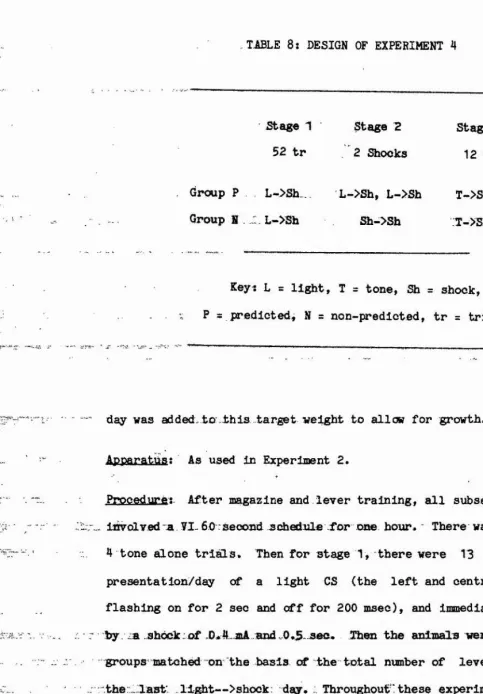
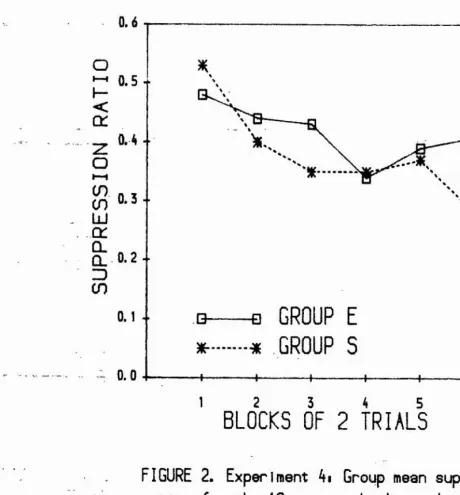
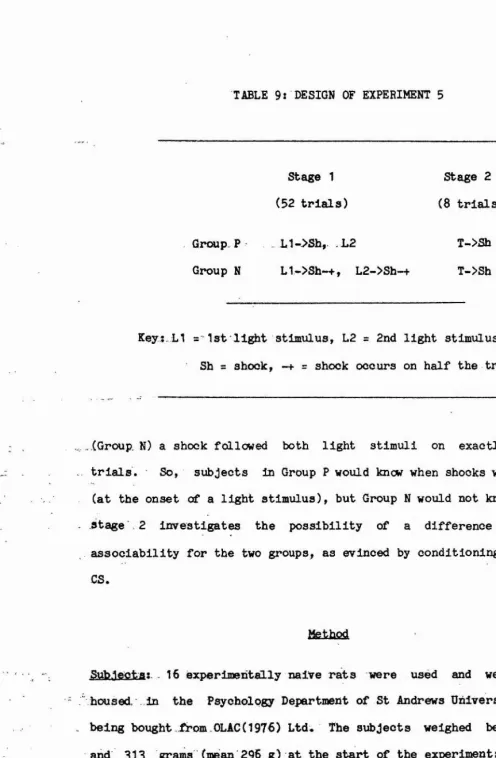
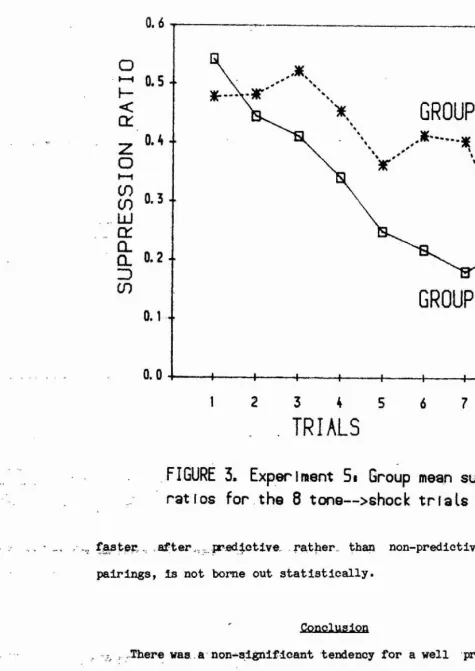
THE EFFECTS OF TEMPORAL RELATIONSHIPS ON
THE ASSOCIABILITY OF BOTH CONDITIONED AND
UNCONDITIONED STIMULI
Ian Davison
A Thesis Submitted for the Degree of PhD
at the
University of St Andrews
1988
Full metadata for this item is available in
St Andrews Research Repository
at:
http://research-repository.st-andrews.ac.uk/
Please use this identifier to cite or link to this item:
http://hdl.handle.net/10023/15083
THE EFFECTS OF TEMPORAL RELATIONSHIPS
ON THE ASSOCIABILITY
OF BOTH CONDITIONED AND UNCONDITIONED STIMULI
Ia n Davison
-!=!ÿ
Thesis subm itted f o r th e degree o f PhD, U n iv e rs ity o f S t. Andrews,
September 1987.
ProQuest Number: 10167320
All rights reserved
INFORMATION TO ALL USERS
The quality of this reproduction is dependent upon the quality of the copy submitted.
In the unlikely event that the author did not send a com plete manuscript and there are missing pages, these will be noted. Also, if material had to be removed,
a note will indicate the deletion.
uest
ProQuest 10167320
Published by ProQuest LLO (2017). Copyright of the Dissertation is held by the Author.
All rights reserved.
This work is protected against unauthorized copying under Title 17, United States C ode Microform Edition © ProQuest LLO.
ProQuest LLO.
789 East Eisenhower Parkway P.Q. Box 1346
:TT iiO
UA.
\L \-\ ...;:' 'ic 'h; ),.w '-u^ .id-r. .-i/y-'edT
I
., ' ' ■ \
!
4 f : r c ; % . j c ' -;’V ^
#
t?V
(a ) I , Ian Davison, hereby c e r tify th a t th is th e s is has been
composed by m yself, th a t i t is a record o f my own w ork, and
th a t i t has not been accepted in p a r tia l o r complete f u lfilm e n t
o f ary o th e r degree or p ro fe ssio n a l q u a lific a tio n .
Signed
(b ) I was adm itted to the Faculty o f Science o f the U n iv e rs ity o f
S t. Andrews under Ordinance General No 12 on 1st O ctober, 1984
and as a candidate fo r the degree of Ph.D. on 1st O ctober, 1984
Signed Date
(c ) I hereby c e r tify th a t the candidate has f u l f i l l e d the c o n d itio n s
o f the R e solu tion and R egulations a p p ro p ria te to the Degree o f
Ph.D.
S igna ture o f Supervisor ^ Date
(d) In s u b m ittin g th is th e s is to the U n iv e rs ity o f S t. Andrews, I
understand th a t I am g iv in g perm ission fo r i t to be made
a v a ila b le fo r use in accordance w ith the re g u la tio n s o f th e
U n iv e rs ity L ib ra ry fo r the tim e being in fo rc e , su b je ct to any
c o p y rig h t vested in the work not being a ffe c te d th e re b y. I
a lso understand th a t the t i t l e and a b s tra c t w i l l be p ub lished,
and th a t a copy of the work may be made and su p p lie d to any
’• ' f-' : r /y;,.' , ■ ■ " : •.. . . -,
Ackncwledgements
I have been supported by a Research stu d e n tsh ip from th e Science
and E ngineering Research C ouncil w h ile the research re p o rte d here was
c a rrie d out and I am g ra te fu l to thrnn fo r th a t.
I should lik e to thank Dr David M iln e r and the Psychology
Department f o r p ro v id in g th e f a c i l i t i e s f o r my w ork; and, e s p e c ia lly
th e s t a f f o f th e Psychology Animal House and the Workshop, w ith o u t
whose support th is research would have been Im possible.
I am g ra te fu l to my colleagues Mark P rice and"** Roger Hendry fo r
t h e ir p ra c tic a l h elp and advice.
W hile I have been in S t. Andrars I have gained from many
conversations „w lth my s u p e rv is o r Paul Garrud and w ith my second
su p e rviso r Richard M o rris , and In York w ith G eoff H a ll: I am deeply
a p p re c ia tiv e o f t h e ir h e lp and encouragement.
F in a lly I must thank Kay Garvey f o r her help In the la s t
CONTENTS
Chapter Page
A b s tra c t
1 In tro d u c tio n
2 Some th e o rie s o f anim al le a rn in g 5
3 How do th e M ackintosh and th e P earce-H all th e o rie s 19
account f o r th e M ackintosh, Bygrave and P lcto n re s u lt?
4 A b r ie f review o f the a s s o c ia b ility lit e r a t u r e 35
5 B lo c k in g : Im p lic a tio n s f o r a s s o c la b lllty 46
6 A framework f o r In v e s tig a tin g a s s o c la b lllty changes 63
7 Evidence f o r a s s o c la b lllty changes d u rin g pre-exposure 67
8 In v e s tig a tio n In to th e M ackintosh e t a l, 1977, 90
and H a ll and Pearce, 1982, experim ents
9 Looking f o r US and CS a s s o c la b lllty changes as a 109
fu n c tio n o f hew w e ll p re d ic te d they are
10 CS a s s o c la b lllty changes In an
a p p e titlv e -a v e rs lv e tra n s fe r paradigm
11 Looking f o r a s s o c la b lllty changes o f a shock
fu n c tio n in g as an El
12 F indin gs and Im p lic a tio n s
147
176
ÜBSTBACT
Several models o f animal a s s o c ia tiv e le a rn in g are de scrib e d . The
evidence f o r the concept o f a s s o c la b lllty Is review ed. The review
co n ta in s a d e ta ile d account o f b lo c k in g , in c lu d in g the M ackintosh,
Bygrave and P lcto n (1977) experim ent. I t Is shown th a t the two m ajor
a s s o c la b lllty models need to be m o d ifie d , m a th e m a tica lly, to sim u la te
the re s u lts of th is experim ent. A gen e ra l, sim ple framework f o r
In v e s tig a tin g p u ta tiv e a s s o c la b lllty changes Is suggested. A review
o f s tim u lu s pre-exposure e ffe c ts Is put In to th is framework, and
In d ic a te s a s u ita b le d ire c tio n f o r research.
The experim ents looked fo r a s s o c la b lllty changes o f both
co n d itio n e d and unconditioned s tim u li. Sometimes th e stim u lu s was a
p re d ic to r o f subsequent events; I f n o t. I t was p re d icte d by another
s tim u lu s . A v a r ie ty o f procedures was employed. Experiments 1, 2,
and 3 tr ie d to re p lic a te and extend previous work w ith a co n d itio n e d
stim u lu s p re d ic tin g subsequent events, b u t they were unsuccessful.
Experiments 4, 5, 6, 7, and 8 In v e s tig a te d whether co n d itio n e d and
unconditioned s tim u li would change In a s s o c la b lllty when they were
w e ll p re d ic te d . U n fo rtu n a te ly , the data were d i f f i c u l t to in te r p r e t.
An a p p e titlv e -a v e rs lv e tra n s fe r paradigm was used in Experiments 9,
10, and 11; th e re was some evidence th a t a tone could change In
a s s o c la b lllty , both when I t was a c tin g as a p re d ic to r, and when I t was
being p re d ic te d . A lte rn a tiv e in te rp re ta tio n s were a lso discussed. In
Experiments 12 and 13, a shock was used to p re d ic t th e occurrence o f
fo o d ; and th e re was no evidence th a t the a s s o c la b lllty o f the shock
.Chapter 1
A r is to tle (see E n g lis h tra n s la tio n : P rio r A n a ly tic s , 1978)
b elie ved th a t a l l form al reasoning could be reduced to s y llo g is tic
reasoning. A sim ple s y llo g is m takes the form : i f A . . . B, and B . . .
C, then A . . . C. Here, th e u n it o f knowledge Is two ’ th in g s ’ A and B
lin k e d by the r e la tio n ’ . . . ’ , eg, A = th e Sun, B = h o t, . . . = Is ,
hence, the Sun Is h o t.
This b e lie f, somewhat em bellished, has been a dominant way o f
re g a rd in g knowledge, and has been taken up by animal le a rn in g
th e o r is ts . Thus, f o r anim als, to o , th e b a sic u n it o f knowledge must
take the form A . . . B, hence the goal o f anim al psychology Is
tw o -fo ld : F ir s t , how and when do anim als le a rn these basic u n its le ,
how do they asso cia te A and B? Second, are anim als able to m anipulate
knowledge once acquired le , can they perform syllo g ism s I f they know
the premises?
This approach to le a rn in g has g re a t appeal because I t s p e c ifie s a
w orkable s c ie n t if ic s tra te g y . Give anim als sim ple ta sks o f the form A
. . . B to le a rn . When I t Is understood how th is task Is perform ed, we
can then b u ild up a model o f how an animal represents the w o rld , using
these basic u n its . Lending support to th is vie w , Dlez-Chamlzo, S te rlo
and M ackintosh (1985) have provided s u b s ta n tia l evidence f o r the Idea
th a t the way r a ts le a m to fin d food In a r ^ a t l v e l y complex maze
ta s k . Is governed by the same p rin c ip le s as the way ra ts associate a
th a t ra ts b u ild up a p ic tu re o f the w o rld from sim ple u n its o f knowledge,
A few words should be said about the focus o f th e approach used.
Only b r ie f ly a t the end, do I mention neuroanatcm ical research in
re g io n s such as the hippocampus (eg, O’Keefe and Nadel, 1978), o r
c e llu la r processes in vo lve d In le a rn in g (eg, Hawkins and Kandel,
1984). The reason f o r th is n e g le ct is th a t lo o k in g in s id e the
a n im a l’ s head has n o t y e t to ld us anything about behaviour. Skinner
has re p e a te d ly asserted t h is : ’’Neurology w i l l e v e n tu a lly give
b e h a vio ra l science what DNA has given g e n e tics, b u t I t has not done so
y e t . . . ” (S kin ner, 1984, p707). Thus, neuroscience Is p ro v id in g
in s ig h t in to the b ra in mechanisms by which anim als le a rn , b u t has to ld
us no th in g about the mental or c o g n itiv e processes them selves. I t Is
hoped th a t research along the lin e s described In th is th e s is w i l l lead
to an Improved understanding o f how animals behave; th is should help
unravel the b ra in mechanisms which mediate th is behaviour. T his Is
because we o n ly knew the consequences o f a l l m anip u la tio n s on the
b ra in by the changes In behaviour e lic ite d . So unless we know how to
In te rp re t these changes in behaviour, we w i l l fin d I t most d i f f i c u l t
to in te rp re t the b ra in m a n ip u la tio n s.
L ike w ise , th e re are many e x c itin g modern advances In s in g le u n it
analogues o f a s s o c ia tiv e c o n d itio n in g , In the s p i r i t o f Hebb (1949),
(eg, S utton and B a rto , 1981), and a ls o in d is trib u te d (eg, m a trix )
memory systems (eg, W lllsha w , 1981). These s o p h is tic a te d m athem atical
models o f le a rn in g are e le g a n t, and appear to have come the c lo s e s t to j
r e fle c tin g the p h ysica l w orkings o f mental l i f e . They can be seen as
neu ra l s u b s tra te s . B ut, lik e neurology, they have not g ive n us any
In s ig h t In to the le a rn in g th e o rie s them selves.
Can understanding animal behaviour and I t s n eu ra l su b stra te s In a
lim ite d number o f species and experim ental s itu a tio n s be gen eralized
to o th e r species and s itu a tio n s , In c lu d in g people In complex
s o c ie tie s ? A lthough I am o p tim is tic th a t such research w i l l
e v e n tu a lly provide Im p o rta n t In s ig h ts , th is q u e stio n Is p re s e n tly
unanswerable because our understanding in th is m a tte r Is so lim ite d .
For th is reason, I do not discuss p o te n tia l a p p lic a tio n s , such as the
d e riv a tio n o f c lin ic a l trea tm ents f o r depression from knowledge o f
’ learned h e lp le ssn e ss’ In anim als, (Sellgman, 1975). To put th is
another way. I t Is necessary to know hew anim als le a rn , before
a tte m p tin g to app ly th is knowledge to people; b u t th e re has re c e n tly
been an explo sio n in Ideas and th e o rie s o f anim al le a rn in g ; u n t il
th e re Is a consensus about how anim als le a rn , we cannot c o n fid e n tly
extend th is knowledge to people.
So, I discuss animal le a rn in g th e o rie s In Is o la tio n . And, as
th is Is an immense f i e l d , I focus on a s s o c la b lllty th e o rie s .
Throughout, the Ideas o f a s s o c la b lllty are contraste d w ith Wagner’ s
(1978) th e o ry, which does n o t In vo lve th is concept, but accounts f o r
Ü iia pte r 2
2£m THEORIES SK ANIMAL LEARNING
I t was Pavlov (1927: E n g lis h tra n s la tio n ) who f i r s t showed th a t
anim als can le a m to a sso cia te two events, I f the f i r s t Is i n i t i a l l y
n e u tra l, such as a b e ll, and th e second Is m o tiv a tio n a lly s ig n ific a n t,
such as food. A m o tiv a tio n a lly s ig n ific a n t event Is c a lle d an
unconditioned stim u lu s (US); as the measurable responses o f th e
anim al, such as s a liv a tin g , on food p re s e n ta tio n , are e lic ite d a t the
s ta r t o f the experim ent. A n e u tra l event Is c a lle d a co n d itio n e d
s tim u lu s (CS) as s a liv a tin g e tc w i l l n o t be observed to th is event
b e fo re th e experim ent; th e s a liv a tin g a t th e sound o f the b e ll is
conditional upon th e animal le a rn in g the CS— >US r e la tio n . In th is example, the f i r s t event (E l) Is a CS, and the second event (E2) Is an
US.
However, I t was much la t e r th a t Kamln (1968, 1969) Introduced the
Idea th a t the second event needed to s u rp ris e the anim al f o r le a rn in g
to occur. I f th e re are many t r i a l s o f P (a n e u tra l s tim u lu s ) fo llo w e d
by the m o tiv a tio n a lly s ig n ific a n t second event (E 2), then subsequent
compound t r i a l s o f P and Q (another n e u tra l s tim u lu s ) fo llo w e d by E2
leads to l i t t l e le a rn in g o f Q— >E2, compared w ith anim als who d id n o t
re ce ive the f i r s t stage (Kamln, 1969). Kamln thought th e knowledge
th a t P le d to shock 'blocked* le a rn in g th a t Q a lso le d to shock.
L a te r researchers have c o n tro lle d f o r the number o f E2 exposures In
stage one (eg, R escorla, 1971b), so th a t th is phenomenon o f 'b lo c k in g '
;
W ith b lo c k in g , we can see th a t th e a b i li t y o f th e anim al to
' / connect Q and E2 depends In v e rs e ly upon the s tre n g th o f th e P— >E2
(c a lle d 'lambda* In most papers).
* A ll symbols have constant meaning throughout th is s c r ip t, except
In ta b le s where the meaning Is explained by th e key.
a s s o c ia tio n . Kam ln's Idea th a t the occurrence o f E2 had to be
-'A s u rp ris in g to a llo w Q— >E2 le a rn in g was fo m a llz e d by Rescorla and
Wagner (1972), as se t out below:
:|
Reaoorla-Wagner Theory, -(Hss.o,prla and Wagner. 1972) % ^dV(p) = S(p) B [L -V (s )]»
A
d = 'th e change i n '.V(p) = th e a s s o c ia tiv e s tre n g th between th e stim u lu s P (E l)
and the US (E2) re p re s e n ta tio n s .
S(p) = ra te le a rn in g parameter dependant upon P (E l) le , I t s s a lie n c e .
B = ra te le a rn in g parameter dependant upon th e E2 le . I t s sa lie n ce " ■ y; (c a lle d 'b e ta ' In most papers). 'M
L = asymptote o f a s s o c ia tiv e le a rn in g th a t can accrue to the E2
V (s) = sum o f the a s s o c ia tiv e s tre n g th s o f a l l E ls p re se n t, f o r th a t
p a r tic u la r E2. .
i
The expression C L-V (s)] Is the d iffe re n c e between f u l l ,asym ptotic knowledge about the E2, and the a c tu a l amount o f knowledge ;
conveyed by th e s tim u li present on th a t t r i a l . That Is , [L -V (s)3
represents the s u rp ris in g n e s s o f the occurrence o f the E2. Thus, In
%
t
%th is model, le a rn in g an a s s o c ia tio n between two events depends upon
the tem poral c o n tig u ity between an I n i t i a l event (E l ) and an
u np re dlcted subsequent event (E 2). I f E2 Is f u l l y p re d ic te d , no
le a rn in g w i l l occur; I f E2 Is p re d ic te d but absent, n eg ative le a rn in g ,
th a t Is co n d itio n e d I n h ib itio n , w i l l occur ( le , th a t El p re d ic ts the
absence o f E2). The e ffe c t o f El on the amount le a rn t on each t r i a l
( le , the Increase In the s tre n g th o f the a s s o c ia tio n between El and
E2) Is considered co n sta n t, b u t the e ffe c t o f E2 changes w ith p r io r
experience; the more p re d icte d o r expected the E2 becomes, the le s s Is
le a m t per t r i a l .
I t should be n o tice d th a t th e re are two ra te le a rn in g parameters
dependant upon the E2. Rescorla and Wagner (1972) described t h e ir
d iff e r e n t fu n c tio n s as fo llo w s : "The betas are le a rn in g ra te
parameters associated w ith th e USs. The assignment o f d iffe r e n t beta
values to d iffe r e n t USs In d ic a te s our assumption th a t th e ra te o f
le a rn in g may depend upon the p a r tic u la r US em ployed." (p76) And: "The
L values represent th e asym ptotic le v e l o f a s s o c ia tiv e s tre n g th which
each US w i l l s u p p o rt; presumably d iffe r e n t USs w i l l y ie ld d iffe r e n t
asym ptotic le v e ls ." (p76)
The c e n tra l fe a tu re o f th e Rescorla-Wagner th e o ry Is th a t an US
has to be s u rp ris in g f o r le a rn in g to occur ( le , [L -V (s )] ) . This
fe a tu re n e a tly e xp la in s Kam ln's b lo c k in g e ffe c t, and has p re d icte d
several o th e r e ffe c ts , w hich w i l l n o t be discussed here. A lso, th is
fe a tu re Is in co rp o ra te d . In one way or another. In to a l l the o th e r
le a rn in g th e o rie s w hich I s h a ll d iscu ss.
An im p ortant lim it a t io n o f th e Rescorla-Wagner th e o ry Is th a t
observed ra te o f le a rn in g th is a s s o c ia tio n . I t should be noted th a t
th is is n o t g e n e ra lly the case in maze experim ents (see M ackintosh,
1983, p i 1-12), where maze pre-exposure o fte n f a c ilit a t e s le a rn in g :
th is Is thought to be due to th e tim e re q u ire d to le a m the r e la tio n s
between th e v a rio u s s tim u li th a t make up the maze and I t s environm ent,
as w e ll as h a b itu a tio n o f any I n i t i a l fe a r fu l re a c tio n to the maze.
However, the concern, here, Is w ith Skinner box experim ents, where no
such p re -le a rn lh g Is necessary. This S kinner box El pre-exposure
phenomenon has been termed la te n t in h ib it io n (Lubow and Moore 1959).
Wagner (1978) has suggested th a t la te n t In h ib itio n r e la tin g to El
can be regarded In e x a c tly th e same way as E2 was regarded by R escorla
and Wagner (1972). For t h is to make sense, I t Is necessary to Includ e
the co n te xtu a l s tim u li (C) In the a n a ly s is . C re presents th e general
co n te xt In which the experim ent takes place, and Includ es such th in g s
as th e house lig h t , c o lo u r o f the w a lls and tim e o f day. T he refore,
El can be p re d icte d by C, In th e same way as El p re d ic ts E2. So when
th e El Is p re d icte d by th e c o n te x t, th e El Is no lo n g e r s u rp ris in g ,
and w i l l n o t be le a m t about. That El must be s u rp ris in g f o r le a rn in g
Is represented by [H -U (s)3, w hich Is e x a c tly analogous to C L -V (s)],
which In d ic a te d th a t E2 needs to be s u rp ris in g .
This Idea o f co n te x tu a l cues has the added advantage th a t I t
a llo w s fo r an easy e x p la n a tio n o f the co n d itio n e d In h ib itio n th a t
occurs w ith unpaired El and E2 t r i a l s : When E2 occurs In th e presence
o f C, a C-E2 a s s o c ia tio n w i l l develop; when El then occurs In the
presence o f C, E’2 w i l l be expected, and so E l— >no E2 le a rn in g occurs
Eagnsr .TWory Isa,. Hagiar.,. J,9.Z^.
dV(p) = S(p) [H -Ü (s )] B [L -V (s )]
H = asymptote o f a s s o c ia tiv e le a rn in g th a t can accrue to
stim u lu s P ( E l) .
U (s) = sum o f th e a s s o c ia tiv e s tre n g th s o f a l l s tim u li present
f o r s tim u lu s P ( E l) .
Note: Wagner a c tu a lly proposed: dV(p) = S(p) [H -U (s)-M ] B
[L -V (s )-N ] where M and N are fa c to rs dependant upon re ce n t
p re s e n ta tio n s o f El and E2 re s p e c tiv e ly . I s h a ll n o t discuss
these s h o rt-te rm e ffe c ts .
• See page 96 f o r th e d e f in it io n o f suppression r a tio s .
Wagner's model s u c c e s s fu lly accounts f o r many observed phenomena
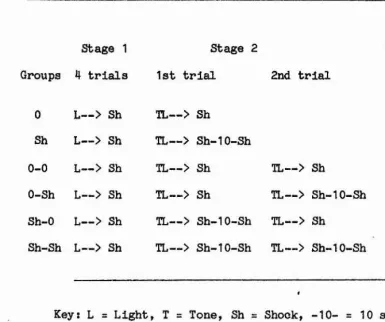
'.'A In animal experim ents, b u t M ackintosh, Bygrave and P lc to n (1977)
performed an experim ent w hich th e model does n o t r e a d ily e x p la in
(Table 1).
Groups 0 and Sh d id n o t d i f f e r s ig n ific a n tly In suppression
r a tio s * , n o r d id Groups 0-0 and 0-Sh, o r Groups Sh-0 and Sh-Sh.
T h e re fo re , th e s u rp ris in g second shock on th e la s t shock t r i a l d id n o t ilîç
n o tic e a b ly Increase le a rn in g o f the tone-shock a s s o c ia tio n . But
Groups Sh-0 and Sh-Sh showed g re a te r suppression than Groups 0-Sh and
-, ..V
0-0. Although the d iffe re n c e In these p a irs o f groups Is the second |
shock on th e f i r s t compound t r i a l , th e d iffe re n c e In suppression
cannot sim ply be due to g re a te r tone-shook le a rn in g on t h is t r i a l , as
Groups 0 and Sh d id n o t d i f f e r ; ra th e r, th is e x tra shock must have
i
TABLE Is DEMONSTRATION OF A CHANGE IN El LEARNING RATE
Stage 1 Stage 2 Test (suppression
Groups 4 t r i a l s 1st t r i a l 2nd t r i a l r a tio )
0 L——^ Sh TL— ^ Sh T (0 .1 6 )
Sh L— ^ Sh TL— ^ Sh-10-Sh T (0.1 3)
0—0 L— ^ Sh TL——^ Sh TL— ^ Sh T (0 .1 0 )
0—Sh L— ^ Sh TL——^ Sh TL— > Sh—10—Sh T (0.0 9)
Sh-0 L——^ Sh TL— > Sh—10—Sh TL— > Sh T (0 .0 1 )
Sh-Sh L——^ Sh TL——^ Sh—10—Sh TL——^ Sh-10-Sh T (0.02)
Key: L = L ig h t, T = Tone, Sh = Shock, -1 0 - = 10 second delay
This experim ent was performed by M ackintosh, Bygrave and P lcto n
(1977, Experiment 3 ).
caused g re a te r le a rn in g on t r i a l 2.
To m a intain W agner's model, we need to p o s tu la te th a t the g re a te r
le a rn in g on t r i a l 2, a fte r a double shock on t r i a l 1, Is due to the
to n e - lig h t a s s o c ia tio n . Thus on t r i a l 1, In Groups Sh-0 and Sh-Sh,
th e lig h t acqu ires g re a te r a ve rslve n e ss; and on t r i a l 2, the tone a ls o
acquires th is averslveness v ia a llg h t- to n e a s s o c ia tio n . However,
M ackintosh (1978) re p o rte d an experim ent which had one group the same
id e n tic a l except th a t a tone was a ls o presented on the f i f t h li g h t
t r i a l ( le , Group O -Sh-0). Group Sh-0 was s ig n ific a n tly more
suppressed to the tone than Group O-Sh-0. I t Is Im p la u sib le th a t th is
d iffe re n c e can be explained by d iffe re n c e s In th e to n e - lig h t
a s s o c ia tio n , as Group O-Sh-0 should have th e s tro n g e r to n e - lig h t
a s s o c ia tio n . T his r e s u lt much more re a d ily f i t s the Idea th a t the
s u rp ris in g double shock has to occur on the f i r s t tone t r i a l , f o r
enhanced tone— >shock le a rn in g . The M ackintosh and P earce-H all
th e o rie s , discussed below, r e f le c t th is Idea.
D ickin so n , N icholas and M ackintosh (1983) have provided an
a d d itio n a l reason f o r doubting th a t a to n e - lig h t a s s o c ia tio n can
enable Wagner's th e o ry to e x p la in th e M ackintosh &L a l. r e s u lt. They
s ta te d th a t "u n p re d lcte d p re s e n ta tio n and om ission o f a US fo llo w in g a
compound c o n d itio n in g t r i a l decreases h lg h e r-o rd e r c o n d itio n in g .”
(D ickin so n at. a L , 1983, p 7 7 )# T herefore the to n e - lig h t a s s o c ia tio n
should be weaker In Groups Sh-0 and Sh-Sh, than In Groups 0-0 and
0-Sh. A lso , Rescorla and D urlach (1981) have found th a t
r e -a c q u ls ltlo n o f w lth ln -e v e n t (CS-CS) a s s o c ia tio n s Is d i f f i c u l t o r
Im po ssible. This suggests th a t tr a d itio n a l a s s o c ia tiv e e xp la n a tio n s
may be Inadequate to account f o r w lth ln -e v e n t le a rn in g . T he refore,
Wagner cannot e x p la in the M ackintosh f i t a l r e s u lt by recourse to
w lth ln -e v e n t a s s o c ia tio n s , as these a s s o c ia tio n s are o u tsid e the scope
o f h is th e o ry .
To summarize, th e Wagner model s ta te s th a t E ls can e n te r In to
a s s o c ia tio n s to th e e x te n t th a t p r io r events. In c lu d in g the c o n te x t,
do n o t p re d ic t them. The M ackintosh s i. ai. experim ent suggests th a t
degree o f s u rp ris e o r u n p re d ic ta b ility o f the events th a t fo llc w i t .
I t is new tim e to In tro d u ce th e concept o f a s s o c la b lllty , as I t
plays a prem inent p a rt In the fo llo w in g th e o rie s . A s s o c la b lllty Is
one o f th e parameters d eterm ining how r e a d ily an event enters In to
a s s o c ia tio n s ; and I s h a ll d e fin e I t as fo llo w s s f i r s t , a s s o c la b lllty
Is p u re ly determined by past experience; second, a s s o c la b lllty on a
s in g le t r i a l is n a t a ffe c te d by p re s e n ta tio n o f o th e r events on th a t
t r i a l * .
Wagner's th e o ry does n o t In vo lve a s s o c la b lllty , because changes
In processing o f an event depend upon p re s e n ta tio n , on th a t t r i a l , o f
o th e r events th a t p re d ic t th e event In q u e stio n . For example, th e
d e c lin e In processing o f an E l, d u rin g la te n t In h ib itio n , Is explained
by a co n te x t-E I a s s o c ia tio n . So th e re Is f u l l processing o f El I f I t
Is presented w ith o u t the c o n te x t.
R eturning to M ackintosh f i t â L 's r e s u lt, we can see th a t the
a s s o c la b lllty o f the tone must have been g re a te r In Groups Sh-0 and
Sh-Sh, than Groups 0-0 and 0-Sh a fte r t r i a l 1 o f stage 2.
M ackintosh (1975a) claim ed th a t an El gains h ig h a s s o c la b lllty to
the e x te n t th a t I t has been a good p re d ic to r o f the events th a t fo llo w
I t , r e la tiv e to the o th e r s tim u li presen t. H igher a s s o c la b lllty leads
to fa s te r le a rn in g o f a s s o c ia tio n s between th a t El and subsequent
events. A lte rn a tiv e ly , I f the El Is a r e la t iv e ly bad p re d ic to r, then
I t s a s s o c la b lllty w i l l f a l l , and le s s w i l l be le a m t about th is E l.
* To me, sa lie n ce p u re ly depends upon p h ys ic a l c h a ra c te ris tic s o f
events, and a s s o c la b lllty o n ly depends on past experience. This Is
s im ila r to Pearce and H a ll's (1980) usage; b u t M ackintosh (1975a)
re c e iv e d ; th e re fo re , the tone lo se s a s s o c la b lllty , and Is l i t t l e
le a m t about on t r i a l 2. However, when two shocks are received on the
f i r s t t r i a l o f stage 2, the li g h t Is a le s s good p re d ic to r, as I t has
d@(p) = iL -V (s -p )I - ÎL -V (p )I - e b u t 0 < § < 1
@ = a s s o c la b lllty
(c a lle d 'a lp h a * In most papers) .
I . . . I = the modulus o f . . .
e = sm all th re sh o ld below which the a s s o c la b lllty d e c lin e s .
V (s-p ) = the sum o f th e a s s o c ia tiv e s tre n g th s o f a l l s tim u li presen t.
' a
So, on t r i a l 1 o f stage 2 In the M ackintosh f i t f i t experim ent, the
li g h t Is a much b e tte r p re d ic to r than the tone I f o n ly one shock Is
!
p re v io u s ly been fo llo w e d by o n ly one shock; so the tone Is a -4
I
r e l a t l v ^ y b e tte r p re d ic to r o f th e shocks than In o th e r Groups, and
consequently has h ig h e r a s s o c la b lllty , and receive s more processing on
t r i a l 2. This means Groups Sh-0 and Sh-Sh have h ig h e r a s s o c la b lllty
on t r i a l 2 than Groups 0-0 and 0-Sh; and th is Is M ackintosh's
--e xp la n a tio n f o r th--e g r--e a t--e r l--e a rn in g In th--e groups w ith 2 shocks on A
t r i a l one o f stage 2, I f a second shocked t r i a l Is g ive n . Thus the
e ffe c tiv e n e s s o f the li g h t and th e tone are assessed r e la tiv e to each
o th e r (and r e la tiv e to C, th e co n te xtu a l s tim u li th a t are In e v ita b ly
present) on each t r i a l . T h is can be expressed m a th e m a tica lly, as 4
fo llo w s ;
-M a c k to s h Theory (1975a)
I
I
y:dV(p) = @(p) S(p) B [L -V (p )] M
a p a rt from P, f o r the E2.
Note: M ackintosh a c tu a lly had:
dV(p) = @(p) B [L-V (p )3 (as S and ê as used here
were combined in to a composite @).
d@(p) > 0 I f iL -V (s -p )! > |L -V (p )|
d@(p) < 0 i f }L-.V (s-p)| < o r = 1L-V (p)i
and added: " . . . I t is fu r th e r assumed th a t th e size o f th e
change in @ is p ro p o rtio n a l to the discrepancy between iL -V (p )l
and ÎL -V (s -p )I . . . " p288*. However, M ackintosh a lso wanted to
e x p la in la te n t I n h ib itio n by a re d u c tio n In @ when |L -V (s -p )l =
IL -V (p )I (as L = V(s~p) = V (p) = 0 ) . A ll th re e Ideas can be
expressed In one fo rm u la w ith o u t s ig n ific a n tly d is to r tin g the
Ideas. Thus f o r unpaired pre-exposure o f the GS, d§(p) = -e ,
the standard la te n t In h ib itio n e ffe c t Is explained In terms o f
lo s s o f a s s o c la b lllty .
M ackintosh (1976) seemed to drop th e Idea o f a re d u c tio n In @
when iL -V (s -p )I = jL -V (p )l. He w rote (p192) " . . . changes In
@(p) are p ro p o rtio n a l to th e d iffe re n c e between [L -V (p )3 and
[ L - V ( s - p ) ] . . and he made no re fe re n ce to la te n t In h ib itio n
In th a t paper. But D ickin son and M ackintosh (1979, p i74)
In d ic a te d th a t th e re would be a d e c lin e In @ I f iL -V (s -p )I =
IL -V (p )I. So I t seems th a t M ackintosh was unsure whether
* In t h is , and subsequent quotes, 'a ', 'A* and 'x * are In the
o r ig in a l te x t, ra th e r than * p ', ’ P’ and 's - p '. This change In
la te n t in h ib it io n e ffe c ts should be In co rp o ra te d In to h is
th e o ry . In q u o tin g the M ackintosh th e o ry , I In clu d e 'e ' to
accommodate the la te n t I n h ib itio n e f fe c t ; b u t I t s om ission
would n o t s ig n ific a n tly a lte r any o f my analyses.
Pearce and H a ll (1980) have provided a d iffe r e n t a n a ly s is o f the
M ackintosh f i t a l (1977) r e s u lt. They c la im th a t s tim u li have high
a s s o c la b lllty I f fo llo w in g events a re s u rp ris in g . So, th e re Is no
tra d e o f f between th e li g h t and the tone, b u t ra th e r both
a s s o c la b llltle s change In the same d ire c tio n . I f the shock Is
s u rp ris in g ( le , th e re are two shocks) then both th e li g h t and the tone
w i l l have h ig h e r a s s o c la b lllty on subsequent t r i a l s , than they would
have had I f th e shock had been u n s u rp ris in g . So In Groups Sh-0 and
Sh-Sh the s u rp ris in g second shock on t r i a l 1, stage 2 leads to h ig h e r
a s s o c la b lllty f o r both th e li g h t and tone, and hence g re a te r le a rn in g
on t r i a l 2, than In Groups 0-0 and 0-Sh. F o rm a lly, t h e ir model is as
fo llo w s :
P earce-H all Theory (Pearoe a M Hai i ., 19_80)
e ( p ) ( t r ia l n) = |L -V (s )+ V » (s )! ( t r i a l n-1)
dV(p) = §(p) S(p) L
o r d V '(p ) = @(p) S(p) CV(s)-V’ (s )-L ]
In the o r ig in a l paper, i t was u n cle a r i f both e x c ita to ry and
In h ib ito r y le a rn in g could occur sim ultan eously. But H a ll (personal
communication, 1985) has since said th a t th is is n o t p o s s ib le . So, I f
L -V (s )+ V '(s ) > 0 th e re Is o n ly e x c ita to ry le a rn in g ; and I f the
In e q u a lity Is th e o th e r way, th e re Is o n ly In h ib ito r y le a rn in g .
Note: Pearce, Kaye and H a ll (1983, p244) subsequently said th a t:
e = g |L -V (s)+ V » (s)| + [1 -g ] @(-1)
where g Is a w e ig h tin g fa c to r th a t can vary between 1 and 0,
and @(-1) Is the value o f the a s s o c la b lllty on the la s t t r i a l .
T his change was made In order to e x p la in why a s s o c la b lllty
changes are n o t e ffe c te d In one t r i a l . The number o f e ffe c tiv e
t r i a l s o b vio u sly depend on g.
I t must be remembered th a t changes In § on one t r i a l only a ffe c t
changes In a s s o c ia tiv e s tre n g th on subsequent t r i a l s . "The
a s s o c la b lllty o f a CS on one t r i a l Is determined by th e size o f th e
discrepancy experienced on th e Immédiat^ y preceding t r i a l between the
magnitude o f th e US th a t a c tu a lly occurred and th a t expected on the
basis o f previous t r a in in g . " (Pearce f i t 1983, p242).
R eturning to the M ackintosh f i t experim ent, a c le a r d iffe re n c e
can be seen between the M ackintosh and the P earce-H all models: the
P earce-H all model p re d ic ts g re a te r le a rn in g f o r the li g h t as w e ll as
the tone In Group Sh-0 and Sh-Sh than Groups 0-0 and 0-Sh, as a l l E1s
Increase In a s s o c la b lllty I f th e E2 Is s u rp ris in g ; whereas M ackintosh
p re d ic ts e x a c tly th e o p p o site r e s u lt, because an Increase In tone
a s s o c la b lllty means a decrease In li g h t a s s o c la b lllty . U n fo rtu n a te ly
lig h t-s h œ k a s s o c ia tio n in stage 2 because alm ost complete suppression
to th e li g h t would be observed In a l l groups, and th e li g h t was not
te s te d In e x tin c tio n . Because o f th e s ig n ific a n c e o f th is discrepancy
In p re d ic tio n s , a repeat o f th e experim ent, designed to te s t the
lig h t-s h o c k a s s o c ia tio n s , was considered w o rth w h ile (See Experiment
1
).
EneyrSfiars .Theory (Frey aoâ Sears.» 1978)
Perhaps th is Is a good space to m ention th e model o f Frey and
Sears (1978). They s ta r t w ith the Rescorla-Wagner model, b u t then
assume a s s o c la b lllty changes can a lso take p la ce ; and a lso g ive
d e ta ile d a n a ly s is o f a response-mapping r u le , so th a t q u a lita tiv e
p re d ic tio n s can be made. Questions about the response-mapping r u le ,
a ltho ugh fa s c in a tin g , need n o t concern us. But th e a s s o c la b lllty ru le
does. They say (p 323): "The c e n tra l n o tio n o f th is ru le Is th a t @
should rep re se n t the In fo rm a tio n value o f a stim u lu s as re fle c te d by
I t s re c e n t a s s o c ia tiv e s tre n g th ". The form ula they present Is as
fo llo w s :*
d@(p) = k [V (p )-ê (p )]
Where k Is a sm all p o s itiv e co n sta n t, and a l l o th e r symbols have the
same s ig n ific a n c e as b e fo re . T he refore, when V (p) Is h ig h , @(p) a ls o
becomes h ig h , and when V(p) Is zero, @(p) tends towards zero. Thus,
* This s im p lifie d form ula om its t h e ir ru le s f o r when V Is below a
th is ru le bears a d is tin c t resemblance to the M ackintosh model: good
p re d ic to rs a cq u ire g re a te r a s s o c la b lllty . However, th is fo rm u la tio n
In d ic a te s th a t the a s s o c la b lllty o f an event must f a l l on the f i r s t
t r i a l , because V=0. T h e re fo re , Frey and Sears cannot e x p la in the
M ackintosh f i t aL (1977) res u l t •
The tra d e o f f between one stim u lu s and another Is e ffe c te d v ia
the Rescorla-Wagner r u le . This means th a t Frey and Sears' model
cannot account f o r dow n sh ift u n b locking, except by wlthln-com pound
a s s o c ia tio n s , as Is necessary f o r the Rescorla-Wagner and Wagner
th e o rie s (see Chapter 5 ). From th e p e rsp e ctive o f a s s o c la b lllty
th e o riz in g , the m ajor advantage over Rescorla-W agner, Is th a t la te n t
I n h ib itio n Is accounted f o r . Perhaps th is Is a sm all gain f o r adding
Chapter 1
m pq m M£ILIJD:X)SH. m u PEABgErHALL THEORIES
ACCOUNT FOB. THE. MACKINTOSH. BYGRAVE ANJI PICTON RESULT:^
When Ideas a re p u t In to m athem atioal language we are able to see
more p re c is e ly th e r a tio n a l consequences o f th e Ideas. Many o f the
le a rn in g th e o rie s have gained considerable support when unexpected
consequences o f th e m athem atical fo rm u la tio n s have proved c o rre c t.
E q u a lly , the m athem atical fo rm u la tio n o f a l l the th e o rie s discussed
produces erroneous p re d ic tio n s ; sometimes d ir e c t ly c o n tra d ic tin g the
ideas the founder o f the th e o rie s Intended to express. For th is
reason I t seems s e n sib le to atte m pt to model th e M ackintosh, Bygrave
and P lcto n r e s u lt, u s in g th e M ackintosh and P earce-H all th e o rie s .
As sta te d e a r lie r (see Table 1 ), In the M ackintosh s i f i l (1977)
experim ent. Group Sh-0 d isp la ye d g re a te r le a rn in g o f th e tone-shock
a s s o c ia tio n than Group 0-Sh, le , had g re a te r a s s o c ia tiv e s tre n g th
a f te r t r i a l 2, stage 2. However, Groups 0 and Sh d id n o t d i f f e r on
te s t, le , they had equal a s s o c ia tiv e s tre n g th s a f te r t r i a l 1, stage 2.
So the models should In d ic a te th a t a f te r stage 2, t r i a l 1, Groups Sh-0
and 0-Sh should a lso have equal a s s o c ia tiv e s tre n g th , b u t Group Sh-0
I
m MACKINTOSH THEORY
For th e purposes o f these c a lc u la tio n s , I s h a ll take i t th a t th e
c o n te xt has n e g lig ib le a s s o c ia tiv e v a lu e ; so th a t th e o n ly re le v a n t
s tim u li are th e li g h t (1 ) and th e tone ( t ) . I s h a ll assume th a t f o r
t r i a l s w ith one shock, L = 1, B = 0 .4 . As 8(1) and S (t) do n o t v a ry ,
they are both s e t equal 1.0 and have been ignored throughout these
c a lc u la tio n s . A fte r stage 1, I hope i t is obvious th a t the
a s s o c ia b ility and a s s o c ia tiv e s tre n g th o f the li g h t should both be
reasonably h ig h ; w ith @ = 0.5 f o r novel s tim u li, a f te r 4 lig h t-s h o c k
t r i a l s , @(1) = 1, and V ( l) = 0.72.
Now i t is necessary to co n sid e r the more d i f f i c u l t problem o f the
f i r s t t r i a l in stage 2. For Group Sh-0, the e ffe c t o f the second
shock needs to be s p e c ifie d . The sim p le st approach is th a t two shocks
have g re a te r a s s o c ia tiv e s tre n g th than one shock; l e t Sh-10-Sh have
asymptote 2 (L = 2 ).
For Group Sh-0: d V (t) = § ( t) B [L -V (t> ]
= @(t) 0.4 [2 - 0]
= 0.8 @(t)
d ê (t) = ÎL-V (1)1 - |L - V ( t) | - e
= |2 — O.7 2I — | 2 — Oi — e
= — (0 .7 2 + e)
i
And f o r Group 0-Sh: d V (t) = @(t) B [L -V (t)3
= § ( t) 0.4 [1 - 03
= 0.4 6 ( t)
d ê (t) = |L -V (1 )Î - {L -V (t)} - e
= I I — O.7 2I — j1 — Ol — e
= - (0 .7 2 + e)
A lready I can see two problems w ith th is a p p lic a tio n o f the
M ackintosh th e o ry : f i r s t , th e model in d ic a te s th a t th e change in
a s s o c ia b ility f o r th e two groups should be id e n tic a l, b u t M ackintosh’ s
v e rb a l statem ent (see below) in d ic a te s th a t th e s u rp ris in g second
shock should increase th e a s s o c ia b ility o f the to n e ; second, the model
shows g re a te r a s s o c ia tiv e s tre n g th fo r the tone in Group Sh-0 than
Group 0-Sh on t r i a l 1, stage 2, b u t the experim ental r e s u lt in d ic a te d
equal suppression f o r Groups Sh and 0.
M ackintosh (1975a, p 289) s a id : ’’U nblocking may occur whenever
the added element ( ie , the to n e : ID) p re d ic ts some event o f
consequence (such as th e second shock in Kam in's exp e rim e n t), w hether
o r n o t th a t event is i t s e l f able to support c o n d itio n in g ” . T his is
s e lf- c o n tra d ic to r y , as events o f consequence are supposed to change L
(th e asymptote o f a s s o c ia tiv e le a rn in g ). The param eter B is unable to
do th is as B w i l l be th e same in th e c o n tro l group ( ie , P— >Sh + Sh,
PQ— >Sh + Sh) o f Kamin’ s experim ent. Even i f we a llo w a change in L,
w ith o u t a lte r in g th e asym ptote o f c o n d itio n in g , th e re w i l l s t i l l be no
change in a s s o c ia b ility . W ith the form ula d@(p) = iL V (s p )!
-|L -V (p )| - e, as lo n g as L remains g re a te r than V (s-p ) and V (p ), a
change in L cannot a lt e r § on th a t t r i a l (o n ly on subsequent t r i a l s
a s s o c ia b ility o f th e CSs because any increase in L must increase
e q u a lly in both p a rts o f the equ ation; f o r example, |L -V (s -p )l -
|L -V (p )| = !2 L -V (s -p )l - |2 L -V (p ){ , as V (s) and V (p) must bo th be
le s s than L.
D ickin so n and M ackintosh (1979) suggested th a t th e two shocks in
Sh-10-Sh may be able to support c o n d itio n in g and changes in
a s s o c ia b ility independently o f each o th e r (the y are a f te r a l l separate
e ve n ts). Thus i t may be p o s s ib le to produce changes in a s s o c ia b ility
w ith o u t changing th e amount o f c o n d itio n in g th a t can be supported.
So:
d V (t) = d V (t— >Sh1) + d V (t— >Sh2)
and d@ (t) = d § ( t— >Sh1) + d@(t— >Sh2)
where Shi = 1st shock e tc .
For the second shock to be able to produce la rg e changes in
a s s o c ia b ility and sm all changes in a s s o c ia tiv e s tre n g th , i t is
necessary to assume th a t B is sm a ll; f o r s im p lic ity I s h a ll assume
th a t B = 0 f o r the second shock. D ickinson and M ackintosh (1979,
p i75) noted a s im ila r p o s s ib ilit y : "th e fu n c tio n r e la tin g a s s o c ia tiv e
s tre n g th to performance may be d iffe r e n t f o r d iffe r e n t a s s o c ia tio n s
in v o lv in g immediate and delayed r e in fo rc e rs " . Now, I s h a ll re a p p ly
th e equations fo r t r i a l 1, stage 2:
Group Sh-0 d V (t) = d V (t— >Sh1) + d V (t— >Sh2)
= @(t) 0.4 [1 - 0 ] + e ( t) 0 [1 - 03
= 0.4 @(t)
Group 0-Sh d V (t) = d V (t— >Sh1)
= @(t) 0.4 [1 - 03
This has era d ica te d the second problem: th e model now r e fle c ts
the equal suppression shown in Groups Sh and 0. The f i r s t problem was
th a t Group Sh-0 should have g re a te r a s s o c ia b ility f o r th e tone than
Group 0-Sh a fte r the f i r s t t r i a l in stage 2. As the change in
a s s o c ia b ility is c a lc u la te d se p a ra te ly f o r th e two shocks, th e change
in a s s o c ia b ility due to the f i r s t shock (and o n ly shock in the case o f
Group 0-Sh) w i l l be th e same in th e two groups, so any d iffe re n c e w i l l
be due to the second shock:
d@(t— >Sh2) = IL - V ( l— >Sh2) | - |L - V ( t— >Sh2) | - e
= 11 — 01 — j 1 — 01 — e
= — e
So th e a s s o c ia b ility o f the tone in Group Sh-0 should d e c lin e
s lig h t ly more than in Group 0-Sh d u rin g t r i a l 1 o f stage 2. The
s u rp ris in g second shock has produced a g re a te r d e c lin e than th e re
would have been w ith no second shock. T his is what D ickin son and
M ackintosh (1979, p i74) concluded, and th is a n a ly s is accounted f o r the
data presented in th a t paper: U n fo rtu n a te ly , the d iffe re n c e in
a s s o c ia b ility between th e groups is too sm all and in th e wrong
d ire c tio n to account f o r the M ackintosh jg i r e s u lt.
Why does M ackintosh 's v e rb a l e x p la n a tio n f i t th e data so e a s ily ,
y e t the fo rm a liz a tio n o f h is model does n o t account fo r the re s u lt?
He w ro te : "The in t u it io n th a t we re q u ire to fo rm a liz e is th a t @(p)
should increase i f P p re d ic ts an otherw ise unexpected r e in fo r c e r ,
w h ile @(p) should decrease i f P s ig n a ls no change in re inforcem ent
frcm the le v e l expected on the basis o f o th e r e v e n ts ." (M ackintosh
1975a, p287). As we have seen, an increase in the value o f L has no
fo rm a liz a tio n . To see why th is is so, consider the fo llo w in g
procedure: W ith a change from li g h t — >shock, to li g h t — >shock +
shock, the a s s o c ia b ility o f the l i g h t remains the same a fte r the f i r s t
double shock t r i a l . The decrease due to the li g h t being a poorer
p re d ic to r, is e x a c tly o ffs e t by the increase due to the shocks being
more unexpected. So, in fa c t, both h is m athem atical form ulae and h is
v e rb a l d e s c rip tio n in d ic a te equal a s s o c ia b ility f o r Groups 0-Sh and
Sh-0 a f te r t r i a l 1, stage 2 (o th e r than th e la te n t in h ib it io n d e c lin e
in Group S h-0).
A sim ple a lte r a tio n we could t r y , is to have V (p )/L as a measure
o f how good a p re d ic to r P is o f th e US; so now in c re a s in g L , decreases
th e value o f V (p )/L and hence decreases th e a s s o c ia b ility o f P.
Instead o f lo o k in g a t the a rith m e tic discrepancy between V(p) and L, j
we would be lo o k in g a t th e percentage discrep ancy*. Thus:
d@(p) = k [ jL —V(s—p ) ! — }L—V (p )}3 / L — e
b u t 0 < @ < 1
dV(p— >US1) = @(p) B(US1) [L(US1) - V(p)3 / L(US1)
L e t B/L ——^ B;
=> dV(p— >US1) = @(p) B(US1) [L(USD - V(p)3
where k is a co nstant
I t does n o t m a tte r f o r present purposes whether we take an
a rith m e tic o r r a tio measure when co n sid e rin g changes in a s s o c ia tiv e
j
* A lthough param etric discu ssio n s are extrem ely d i f f i c u l t in the
realm o f animal le a rn in g th e o ry , th e idea th a t a co nstant r a tio is
perceived as a p sych o lo g ic a l constant is w id e ly accepted in
s tre n g th , as a change In th e fa c to r B is the o n ly d iffe re n c e . A
d e c is io n about th is would be necessary o n ly i f L changes in magnitude,
b u t B remains co n sta n t.
I s h a ll new app ly these equations to t r i a l 1 o f stage 2: Assume
as b e fo re : §(1) = L(Sh1) = L(Sh2) = 1, V ( l) = 0.72, B(Sh1) = 0 .4 ,
B(Sh2) = 0. F u rth e r, le t § ( t) = 0 .5 , and k = 0 .5 , and le t e be
n e g lig ib le .
Group Sh-0: d V (t) = @ [L(S hD - V (t)3 B(Sh1)
= 0.5 Cl - 0] 0.4
= 0.2
As B(Sh2) = 0.
d@ (t) = k [|L -V (1 )Î - |L - V ( t) l3 / L(Sh1+Sh2)
- 0.5 C12-0.72! - 12-01] / 2
= — 0. 18
d V (l) = 1 [1 - 0.723 0.4
= 0 .1 1 2
d@ (l) = 0.5 [12-01 - 12-0.7213 / 2
= 0.18 b u t @ must n o t be more than 1.
=> V ( t) = 0 .2 , V ( l) = 0.832, § ( t) = 0.32, @ (l) = 1.
Group 0-Sh: dVCt) = 0.5 [1 - 03 0.4
= 0 .2
d@ (t) = 0.5 [ 11-0.721 - 11-013 / 1
d V (l) = 1 [1 - 0 .7 2 ] 0.4
= 0.112
d § ( l) = 0.5 [1 1 -0 ! - 11-0. 7 2 |] / 1
= 0.36 b u t @ must n o t be more than 1.
=> V ( t) = 0 .2 , V ( l) = 0.832, @(t) = 0.14, @(1) = 1.
And f o r the second t r i a l o f stage 2:
Group Sh-0: d V (t) = 0.32 [1 - 0 .2 ] 0.4
= 0.1024
d ê (t) = 0.5 [11-0.8321 - 11-0.213 / 1
= - 0.316
d V (l) = 1 [1 - 0.8323 0.4
= 0.0672
d@ (l) = 0.5 [11-0.21 - 11-0.83213 / 1
= 0.316 b u t ê must n o t be more than 1.
=> V (t) = 0.3024, V ( l) = 0.8992,
@(t)
= 0.004, @(1) = 1. Group 0-Sh; d V (t) = 0.14 [1 - 0 .2 ] 0.4= 0.0448
d@ (t) = 0.5 [12-0.8321 - 12-0.213 / 2
d V (l) = 1 [1 - 0.832] 0.4
= 0.0672
d@ (l) = 0 .5 C12-0.21 - 12-0.8321] / 2
= 0.158 b u t @ must n o t be more than 1.
=> V (t) = 0.2448, V ( l) = 1, @(t) = 0.0 , @(1) = 1.
The M ackintosh model new f i t s the M ackintosh s t. a i. d a ta. T h is
fo rm u la tio n o f th e M ackintosh model combines the e ffe c ts o f the f i r s t
and second shocks f o r the purposes o f c a lc u la tin g the changes in
a s s o c ia b ility , b u t ig nores th e second shock f o r th e purpose o f
c a lc u la tin g the change in a s s o c ia tiv e s tre n g th . T h is s p lit t in g o f dV,
b u t n o t d@ is reasonably p la u s ib le . € is intended to be a general
measure o f processing (o r a tte n tio n paid to ) the s tim u lu s ; i t should
c e r ta in ly be a p p lic a b le f o r a c la s s o f USs, and may even be a p p lic a b le
across d is p a ra te USs and c o n te x ts . Thus ë should have o n ly one value
on any s in g le p re s e n ta tio n o f th e CS, irre s p e c tiv e o f the number o f
USs. However, assuming th a t r a ts (and v e rte b ra te s g e n e ra lly ) le a rn
s p e c ific th in g s about t h e ir environm ent, then i t is necessary to
assume th a t V(p— >x) is s e p a ra te ly encoded from V(p— >y) o r e lse they
would n o t be able to d is tin g u is h X and Y, a t le a s t in terms o f past
experience. In th e M ackintosh idi. aiL experim ent, th e shocks are te n
seconds a p a rt so i t is li k e l y th a t they are encoded s e p a ra t^ y .
One problem w ith th is presen t a n a ly s is is th a t D ickin so n and
M ackintosh (1979) have found th a t a s s o c ia b ility changes are r e in fo r c e r
s p e c ific . They employed a b lo c k in g design, and found th a t the
a d d itio n o f a second shock on compound t r i a l s increased subsequent
n o t. L ikew ise, in an a p p e titiv e c o n d itio n in g ta s k , adding more fre e
food on compound t r i a l s caused u n b lo ckin g , but adding a shock d id n o t.
They s im ila r ly found w ith d o w n sh ift unb locking, th a t removing the
se<x>nd shock increased a ve rsive c o n d itio n in g , b u t the unexpected
absence o f fo od, d id n o t; so these re s u lts are n o t sim ply due to the
re in fo rc in g p ro p e rtie s o f the added shock o r food. D ickin son and
M ackintosh concluded th a t a s tim u lu s ' a s s o c ia b ility f o r food is
separate from i t s a s s o c ia b ility f o r shock. T h e re fo re , a s s o c ia b ility
is s p e c ific to a c la s s o f re in fo rc e rs , b u t may be general to a l l
instances o f r e in fo r c e r in a p a r tic u la r c la s s .
Although the M ackintosh model can f i t the M ackintosh s i ja i
r e s u lt, i f the a lte r a tio n s s e t out above are made. I t must be
stressed th a t t h is is inadequate. The statem ent "§ (p ) should increase
i f P p re d ic ts an otherw ise unexpected r e in fo rc e r" suggests equal
a s s o c ia b ility fo r Groups Sh-0 and 0-Sh a fte r the f i r s t stage 2 t r i a l ,
and could ju s t as e a s ily a llo w g re a te r a s s o c ia b ility f o r Group 0-Sh,
as fo r Group Sh-0. My p lo y o f u sin g a r a tio measure is decided ly ad
hoc.
So we should accept M ackintosh 's modest view o f h is th e o ry : "th e
ideas proposed here are more a program f o r a th e o ry than a f u l l y
elaborated fo rm a l model" (M ackintosh, 1975a, p295)* A lthough the
form al mathematics do n o t in fa c t describe what he intended, the
m PEARCE-HALL THEORY
A t th e end o f stage 1, th e a s s o c ia tiv e s tre n g th o f the li g h t w i l l
be h ig h . So the P earce-H all model p re d ic ts th a t th e a s s o c ia b ility o f
th e lig h t w i l l be lo w , o r f a ll in g r a p id ly , as the events th a t fo llo w
i t are c o n s is te n t. S ta rtin g w ith i n i t i a l param eters, @(1) = 0 .4 , S ( l)
= 0 .2 , L = 1, a f te r fo u r t r i a l s , @(1) = 0.54 and f a ll in g , and V ( l) =
0.61. A lso , l e t the i n t i a l va lu e s f o r th e tone be th e same: @(t) =
0 .4 , S (t) = 0 .2 . I s h a ll use these values to a s c e rta in the
p re d ic tio n s f o r Groups 0-Sh and Sh-0:
T r ia l 1, stage 2:
Group 0-Sh: d V (t) = @(t) S (t) L
= 0.4 0.2 1
= 0.08
@(t) = IL - V (D !
= 1 - 0.61
= 0.39
d V (l) = 0.54 0.2 1
= 0.1 0 8
@(1) = 0.39 as i t must be th e same as @ (t).
=> V ( t) = 0.08, V ( l) = 0.718
Again we need to s p e c ify L f o r two shocks. H a ll and Pearce
us,
in the fo llo w in g way: "F u rth e r le a rn in g w i l l be p o s s ib le o n ly when the disorepanoy between th e a s s o c ia tiv e s tre n g th o f the CS andthe new asymptote se t by the s tro n g e r shock has become re fle c te d in
th e a s s o c ia b ility o f th e CS". Thus, they d e scrib e th e change from
weak to stro n g shock by an in crea se in L. I f we assume the same is
tru e f o r a change from one shock to two shocks, then L sim ply
in cre a se s. L e t L = 2 f o r Sh-10-Sh.
For Group Sh-0: d V (t) = 0.4 0.2 2
= 0.16
@(t) = 12 - 0 .6 1 i
= 1.39
d V (l) = 0.54 0.2 2
= 0.216
@(1) = 1.39
=> V (t) = 0.16, V ( l) = 0.826
The present fo rm u la tio n in d ic a te s th a t Group Sh should d is p la y
much g re a te r a s s o c ia tiv e s tre n g th f o r the to n e , than Group 0. There
are several ways to go from here. F ir s t , i t could be claim ed th a t the
above a n a ly s is is c o rre c t, and the d iffe re n c e in a s s o c ia tiv e s tre n g th
a f te r one t r i a l ju s t happens n o t to be detected ( ie . Group Sh has a
s lig h t ly g re a te r tone-shock a s s o c ia tio n than Group 0 ). But w ith o n ly
one compound t r i a l w ith a s in g le shock (Group 0) th e re was a
suppression r a t io o f 0 .1 6 ; so a d o u b lin g o f c o n d itio n in g w ith a double
shock (Group Sh) should produce a n o tic e a b le d iffe re n c e . The
r e s u lt , which has been claim ed to be o f prime im portance in
dem onstrating a s s o c ia b ility changes. Is n o t a c tu a lly expected from the
P earce-H all th e o ry , a ltho ugh I t can be accommodated by i t .
Second, i t could be argued th a t the second shock has a much
weaker asymptote o f a s s o c ia tiv e s tre n g th (say, L = 0 .2 ). Can
parameters be found to show l i t t l e d iffe re n c e in a s s o c ia tiv e s tre n g th
between Groups 0 and Sh, and y e t shew a la rg e d iffe re n c e between
Groups Sh-0 and 0-Sh? I'm n o t sure th a t th is is p o s s ib le , b u t even i f
i t is , i t would mean th a t th e P earce-H all th e o ry does n o t r e a lly
p re d ic t th is r e s u lt. Anyway, I s h a ll not pursue th is approach because
i t runs in to d i f f i c u l t i e s w ith d o w n sh ift u n b lo ckin g , w hich I discuss
in Chapter 5.
T h ird , we can use a d iffe re n c e in an a d d itio n a l parameter (B)
between the f i r s t and second shocks, lik e I d id w ith the M ackintosh
th e o ry . T his a llow s th e P earce-H all th e o ry to account f o r equal
a s s o c ia tiv e s tre n g th s , b u t d iff e r in g a s s o c ia b ilitie s a fte r t r i a l 1 o f
stage 2, f o r Groups Sh-0 and 0-Sh. Again, l e t B va ry between USs, so:
@(p) = IL - V (s) + V '( s ) |
dV(p— >US1) = @(p) B(US1) L(US1)
dV»(p— >US1) = @(p) B(US1) [V (s— >US1) - V *(s — >US1) - L(US1)]
To be c o n s is te n t, i t should be p o ssib le to have e x c ita to ry
le a rn in g f o r some USs sim ultaneous w ith in h ib ito r y le a rn in g f o r o th e r
USs. This is what Pearce and H a ll said w ith re sp e ct to d o w n sh ift
unb lo ckin g ( ie , P— >Sh+Sh, then PQ— >Sh): th e re w i l l be e x c ita to ry
le a rn in g f o r th e f i r s t shock, and in h ib ito r y le a rn in g to th e absence
o f the second shock (see Pearce and H a ll, 1980, p540). I t is n o t
in h ib ito r y f o r another CS, w ith re sp e ct to the same US.
To a llo w th e second shock to increase the a s s o c ia b ility o f the
tone but n o t the a s s o c ia tiv e s tre n g th , we re q u ire th a t B(Sh2) is
s m a ll; again, f o r s im p lic ity , I assume th a t B(Sh2) = 0. B(Sh1) = 1 as
b e fo re .
T r ia l 1, stage 2:
Group Sh-0: d V (t) = @(t) S (t) [B(ShD L(Sh1) + B(Sh2) L (S h2 )]
= 0.4 0.2 [1*1 + 0*1]
= 0.08
where * means 'm u ltip lie d b y'
@(t) = iL (S h l) + L(Sh2) - V ( l) i
“ 11 + 1 — 0 .6 1 1
= 1.39
d V (l) = 0.54 0.2 [1*1 +0*1]
= 0.108
=> V (t) = 0.08, V ( l) = 0.72, 8(1) = 1.39.
Group 0-Sh d V (t) = 0 .4 * 0 .2 * 1
= 0,08
§ ( t) = II - 0 .6 1 1
= 0.39
d V (l) = 0.54 * 0.2 * 1
=> V (t) = 0.08, V ( l) = 0.72, @(1) = 0.39.
T r ia l 2, stage 2:
Group Sh-0 d V (t) = 1.39 * 0.2 » 1
= 0.278
§ ( t ) = ;i - 0.80!
= 0.20
d V (l) = 0.278 as i t must be th e same as d V (t).
§(1) = 0.20 as i t must be the same as § ( t) .
=> V (t) = 0.36, V ( l) = 1.00, @(t) = e ( l) = 0.20.
Group 0-Sh d V (t) = 0.39 *0 .2 *1
= 0.078
@(t) = 12 - 0.801
= 1.2 0
d V (l) = 0.078
@(1) = 1.20
=> V ( t) = 0.16, V ( l) = 0.80, @(t) = @(1) = 1.20.
Now th e P earce-H all model adequately accounts f o r th e M ackintosh
S t âL d a ta . Groups 0 and Sh are equal in suppression, Group 0-Sh is
more suppressed and Group Sh-0 more suppressed s t i l l .
I t should be noted th a t th e a s s o c ia b ility a t th e end o f compound
in fa s te r e x tin c tio n in Group 0-Sh, thereby a ccen tua ting the
d iffe re n c e between these two groups. S im ila rly , Group Sh should
e x tin g u is h fa s te r than Group 0. There was no evidence o f th is in
M ackintosh, Bygrave and P ic to n 's data, b u t Pearce and H a ll (1980,
p546) cla im to have found an analogous r e s u lt: A fte r many tone— >weak
shock t r i a l s . Group Sh were presented w ith one tone— >strong shock
t r i a l before e x tin c tio n t r i a l s , whereas the C o n tro l Group had another
tone-weak shock p a irin g on the la s t c o n d itio n in g t r i a l . Group Sh
e xtin g u ish e d fa s te r , due, according to Pearce and H a ll, to the
increase in a s s o c ia b ility caused by th e s u rp ris in g ly stro n g shock.
I t has been shown th a t th e P earce-H all th e o ry , lik e the
M ackintosh th e o ry , most re a d ily accounts f o r the M ackintosh s i. a i
r e s u lt i f th e re is a d is s o c ia tio n between 's u rp ris in g n e s s * and the
asymptote o f a s s o c ia tiv e s tre n g th (L ). This was n o t p o s s ib le
according to t h e ir fo rm u la tio n o f th e th e o ry , b u t can e a s ily be
acccmmodated by a d d itio n o f an e x tra parameter ( ie , B ).
The M ackintosh th e o ry had an a d d itio n a l, and more se rio u s ,
problem in th a t the form ula f o r changes in a s s o c ia b ility d id n o t
s p e c ify an increase in a s s o c ia b ility in Group Sh-0, over Group 0-Sh
(using a r a tio measure was an ad hoc way o f circum ventin g th is
problem ). However, th e P earce-H all theory has no such problem, and so
Chapt er à
BRIEF REVIEW ££ IHE ASSOCIABILITY
Since Pearce and H a ll p u b lish e d t h e ir th e o ry in 1980, much work
has been undertaken to te s t i t s p re d ic tio n s . So in th is ch a p te r, I
s h a ll compare the P earce-H all th e o ry w ith the M ackintosh and Wagner
th e o rie s , and th e le s s fo rm a l ideas o f re p re s e n ta tio n c o m p e titio n and
a s s o c ia tiv e in te rfe re n c e (describe d below ). The e xte n sive lit e r a t u r e
on b lo ckin g and pre-exposure e ffe c ts w i l l be d e a lt w ith in la t e r
ch a p te rs.
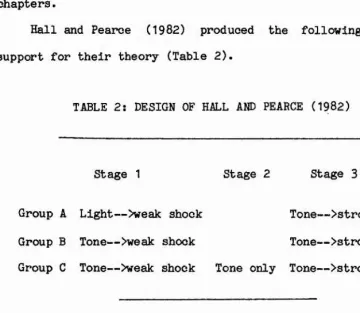
H a ll and Pearce (1982) produced the fo llo w in g experim ent as
support fo r t h e ir th e o ry (Table 2 ).
TABLE 2 : DESIGN OF HALL AND PEARCE (1982) EXPERIMENT
Stage 1 Stage 2 Stage 3
Group A L ig h t— >weak shock Tone— >strong shock
Group B Tone— >weak shock Tone— >strong shock
Group C Tone— >weak shock Tone only Tone— >strong shock
6 t r ia l/ d a y f o r 10 days 2 t r i a l s / 4 tr ia ls /o n e day
[image:42.618.111.472.371.684.2]