This is only a preprint version of the citable published paper. The actual published version may be somewhat different due to editors’ corrections and additional modifications. Only the published version should be considered authoritative. All citations and quotes should be from the published version, and page references should be from the published version.
Accepted on 07 Feb 2016
Processing punctuation and word changes in different editions of
prose fiction
Running Head: Processing punctuation and word changes
Gareth Carrol, Kathy Conklin, Josephine Guy, Rebekah Scott University of Nottingham
Corresponding Author: Dr. Kathy Conklin
University of Nottingham School of English
Nottingham NG7 2RD United Kingdom
Tel: +44 (0) 115-951-5918 Fax: +44 (0) 115-951-5924
Abstract
The digital era has brought with it a shift in the field of literary editing in terms of the amount and kind of textual variation that can reasonably be annotated by editors. However, questions remain about how far readers engage with textual variants, especially minor ones such as small-scale changes to punctuation. In this study we present an eye-tracking experiment investigating reader sensitivity to variations in surface textual features of prose fiction. We monitored eye movements while
participants read textual variants from Dickens and James, hypothesising that readers may pay more attention to lexical rather than punctuation changes. We found longer reading times for both types, but only lexical changes also increased reading times for the rest of the sentence. In addition, eye movement behaviour and conscious ability to report changes were highly correlated. We discuss the implications for how such methods might be applied to questions of “literary” significance and textual processing.
Processing punctuation and word changes in different editions of prose fiction
Publishing history shows us that the fiction of many prominent nineteenth- and early twentieth-century Anglophone authors was brought out in various formats (e.g. book and serial) and for different audiences (e.g. British and American). As a consequence, multiple versions of a single work may survive, and editors of what have been termed “completist” and even nominally “selective” editions aim to exhaustively document the variants between these versions, as well as between any extant manuscripts. For example, a single volume of the on-going 30-volume “selective” Cambridge Edition of The Complete Fiction of Henry James includes a 35,000-word, 120-page document of around 2,000 sets of variants, or more than 7,000 individual variants collated from four texts (including a manuscript) of one short novel. Such large-scale editorial projects require considerable commitment of both time and money, yet little
systematic research has been undertaken into the plethora of data being produced: that is, how do readers, both general and specialist, engage with textual variants, and in what ways do the categories of variants collated by editors contribute to the
appreciation of a literary work?
research has tended to investigate forms of graphic and phonetic manipulation in poetry that are strongly associated with foregrounding, such as rhyme schemes (Carminati, Stabler, Roberts, & Fischer, 2006) and enjambment (Koops van’t Jagt, Hoeks, Dorleijn, & Hendriks, 2014). Such studies demonstrate that readers’ on-line responses and processing are affected by a range of micro and macro textual features. In this paper we use eye-tracking as a way of comparing reader responses to a range of textual variations in an attempt to apply this more objective approach to the
question of textual variation in prose fiction. We aim to demonstrate that an empirical approach to such issues has merit, and also to directly address the issue of textual variation as it relates to “substantive” and “accidental” changes to texts. This broad distinction relates to changes to lexical choice or word order, as opposed to more “minor” changes to punctuation. We investigate this with general readers (non-specialist readers rather than academics or editors with a particular interest in these textual features), in order to investigate whether both categories of variant are noticed, in terms of online reading behaviour as well as strategic, controlled responses to prompt questions. To begin, we provide some brief context for the study in terms of the field of literary editing,1 and then describe some fundamental principles of eye-tracking and their applicability to literary text analysis.
Textual Variation and Digital Text Editing
The proliferation of digital technology has prompted the commissioning of numerous large-scale editorial projects (e.g. Complete Works of Evelyn Waugh [Digital Library], n.d.) and has provided the main impetus behind a remarkable resurgence of interest over the last twenty-five years in the theory and practice of text-editing. Digital
editions enable editors to provide readers with much more information than is possible in a traditional codex edition: not only can details about a text’s physical appearance be recorded, but it is also possible to list the most minute kinds of textual variants, including what have been termed “compositorial” changes, such as, for example, differences between publishers’ house-style in the use of single or double quotation marks. Editors have tended to welcome digitization because of its ability to overcome problems of space (particularly pressing when editing multiple versions of long works of prose fiction), transparency (comprehensiveness avoids editors
exercising contested value-judgements) and timeliness (new manuscript discoveries quickly date codex editions).
However, the potential value of providing all of this information to readers, in particular in relation to minor punctuation variants, is contested. One view is that editors should provided a complete record of all textual changes, and leave it up to the reader to determine what is and is not significant, thereby making readers their own editors (Shillingsburg, 1993). The opposing view is that readers want editors to determine which textual variants should be presented, since they are not equipped to evaluate them. Whether editors adopt a completist approach, meticulously
The following example demonstrates the point that, since most users/readers are not trained editors, it is unclear whether they place the same significance on the
documentation of minor textual variants, such as alternations to punctuation, as opposed to more major changes in lexical items. It seems intuitive that certain changes should affect the processing and interpretation of a given text, while others may not have as much value in determining reader interpretation. For example, on some occasions the 1846 Bradbury and Evans edition of Oliver Twist refers to Fagin as the Jew, while the 1867 Chapman and Hall edition simply refers to him as Fagin:
The Jew affected to laugh very heartily; and Mr Bolter, having had his laugh out, took a series of large bites, which finished his first hunk of bread and butter, and assisted himself to a second. (Dickens, 1846, p. 257)
Fagin affected to laugh very heartily; and Mr Bolter, having had his laugh out, took a series of large bites, which finished his first hunk of bread and butter, and assisted himself to a second. (Dickens, 1867, p. 214)
2010), are also important for how readers respond to literary texts. Are small-scale changes in punctuation – such as those typically found in differences in editorial house-style – “attention capturing” in the manner suggested by Jakobson’s notion of “poetic function” (Jakobson, 1960)?
Eye-Tracking and the Reading of Literary Texts
Eye-tracking provides a potentially illuminating way to explore some of the questions about editorial practice. With eye-tracking technology, the eye is thought to give researchers a window into the mind (Rayner, 1978). Importantly, eye-tracking allows for fairly “natural” language processing – in the sense that texts are presented on a screen and the participant simply has to read.2 Importantly, it provides a very rich moment-to-moment record of looking behaviour that allows us to ascertain how many times, how long and when a word, region or image is fixated.
Eye-tracking has been deployed extensively in psycholinguistics where it is used to study the factors that influence reading in general (e.g. Just & Carpenter, 1980;
Rayner, 1998; Staub & Rayner, 2007). A particularly relevant point for our research is that eye-tracking assumes an “eye-mind equivalence”, whereby what is being looked at is thought to be what is being processed at any given time (Pickering, Frisson, McElree & Traxler, 2004). A well-established finding is that longer, less frequent or otherwise difficult words require longer to process than shorter, more frequent or more predictable ones (Staub & Rayner, 2007). Other factors such as repetition can also lead to shorter fixations, reflecting facilitated processing (e.g. Raney, 2003).
2 This is in contrast to other techniques such as self-paced reading and EEG/ERP in which the presentation of a text is much less natural. For example in EEG/ERP studies, where the
Importantly for the current study, research also suggests that longer sequences of words show processing effects, for example in terms of word order for conventional pairings such as bride and groom (Siyanova-Chanturia, Conklin & van Heuven, 2011, and see Carrol & Conklin, 2014 for a review of multiword effects in eye-tracking). Thus, a number of complex linguistic factors have been shown to contribute to how individual words and longer sequences are processed, with longer processing times or increased fixations indicating that more processing effort and/or reconsideration is required. In addition to these factors, previous research has looked at a number of issues that are relevant to the current study: 1) applying eye-tracking to the reading of literary texts, 2) effects of repetition and reading, as well as noticing changes in re-reading, 3) task demands, and 4) influence of punctuation on processing. We will look at each of these in turn.
The psycholinguistic research that employs eye-tracking is typically conducted on very particular and well-chosen sets of linguistic stimuli that make it possible to control for as many factors as possible (e.g. length and frequency of words). Reading “open text” – as in the case of examples from literary texts – has yet to receive much attention, and as will be discussed below, poses some challenges. Nonetheless in recognition of the technology’s benefits, eye-tracking is increasingly being used to investigate a number of questions in the study of literature (e.g. Koops van’t Jagt et al., 2014; Mahlberg, Conklin, & Bisson, 2014; Riese, Bayer, Lauer, & Schacht, 2014;
Roberts, Stabler, Fischer, & Otty, 2013; Schaffner, Knowles, Weger, & Roberts,
2012).
different poetry conventions by readers. For example, Koops van’t Jagt et al. (2014) investigated how processing was influenced by different types of poetic enjambments (syntactically complete vs. incomplete) compared to prose. They found that poetry and prose were processed differently, as were the different types of enjambment.
They interpreted their results as providing evidence for a dynamic model of language
processing in which the amount and type of integration is determined by both syntactic and semantic completeness/incompleteness and the physical layout of the page. Other recent studies on poetry have focused on spacing and lineation (Roberts et al., 2013; Schaffner et al., 2012), which are less relevant to the current
investigation, but which show that specific textual or formal features play an important role in how readers process poetic material in real-time.
A few studies have begun to apply eye-tracking to investigate questions of how prose fiction is read. In a recent study, similar in design to the current one, Mahlberg, Conklin, and Bisson (2014) used eye-tracking to explore the reading of repeatedly occurring patterns of body language (e.g. his eyes fixed on the) from Dickens. Using reading times, it was shown that corpus-derived body language clusters are read significantly faster than the surrounding text. Results of follow-up questions indicated that readers did not seem to refer to the clusters when talking about character
In contrast to the developing use of eye-tracking in specific literary studies, there is a much wider literature on the effects of repetition and re-reading of text. It is well established that the second reading of a text is significantly faster than a first reading (e.g. Hyona & Niemi, 1990; Levy, Di Persio, & Hollingshead, 1992). For the present study, where participants will see minor changes to otherwise repeated sentences, we expect the second encounter to be read more quickly, but the key question is how the variation itself will be treated. Psycholinguistic research has also investigated the impact of word changes on re-reading in terms of reading times (e.g. Raney &
Rayner, 1995) and on participants’ ability to notice such changes (e.g. Sturt, Sanford, Stewart, & Dawydiak, 2004; Ward & Sturt, 2007).
Raney and Rayner (1995) monitored participants’ eye movements while they read
texts twice in succession, some of which had a word that was replaced by a synonym.
They found an overall facilitation for texts the second time, and both high and low
frequency words that did not change were read more quickly the second time around.
Interestingly, they did not find an increase in reading times for any words that were
replaced, and they attributed this to the synonym providing sufficient conceptual
repetition to obtain facilitation effects in the text. In general participants reported not
noticing any changes, although this was not tested, so it is unclear from this paradigm
how actively noticing a change might relate to reading times. Sturt et al. (2004) did
not monitor participants’ eye movements, but they did present participants with texts
twice in succession, some of which had a word that was replaced, and asked if they
noticed and could identify a change. Both related (hat to cap) and unrelated changes
(hat to dog) were noticed, with higher detection rates in the unrelated condition. Ward
changes of semantically similar words; importantly they found increased fixations and
reading times for changed words when those words had been manipulated to be the
main linguistic focus of the sentence. They also found that even when changes were
not overtly noticed, they still received more and longer fixations during the second
presentation of the text (albeit with a small dataset since most changes were noticed
by participants). The authors suggest that this is evidence that participants were able
to register changes in stimuli even if these did not reach a threshold of conscious
awareness.
An additional area that is of relevance to the current study is that of close reading, and
its effect on how text might be processed. Philips (2015, p.57) describes close reading
as a conscious effort to “look more rigorously at a novel’s form”, and compared
patterns of performance for close reading vs. “pleasure reading” using fMRI and
eye-tracking. Close reading led to a much wider pattern of brain activity, demonstrating
not just heightened attention but also greater cognitive involvement in general. In the
present study, the task might be seen in a similar way: readers encounter short extracts
and are asked to identify any observed changes. Such close attention to the form of
sentences will presumably entail the broader cognitive involvement identified by
Philips (2015).
The effect of paying close attention to texts is also addressed in a number of recent
eye-tracking studies. Lee, Lee, Park, Chang and Kwak (2015) highlighted the
Rayner (2014) demonstrated that asking participants to proofread vs. asking them to read for comprehension induced more careful reading, which was evidenced by longer fixations and shorter saccades. Taken together this research shows that asking participants to engage with a text in a certain way can change the level of attention they allocate to the task. However, important questions remain about when the task demands a great deal of attention, whether readers are able to identify lexical and punctuation changes equally and whether both types of changes influence reading in
the same ways.
Finally, some studies have considered the effect of punctuation on processing. Such
research shows a straightforward effect whereby punctuated words are fixated for
longer than unpunctuated words (Hill & Murray, 2000; Hirotani, Frazier, & Rayner,
2006). Further research has investigated how punctuation at sentence and clause
boundaries interacts with the type of clause, as well as with intonation patterns
(Hirotani et al., 2006). Other work has focused on the influence of punctuation on the
resolution of syntactic ambiguity (Niikuni & Muramoto, 2014), or in leading readers
to expect a complex rather than simple sentence structure (Niikuni, Iwasaki &
Muramoto, 2015). However, such studies have not looked at the impact of changes in
sentence internal punctuation, such as changes from a comma to a colon, nor was the
focus on whether readers notice changes to already well punctuated sentences. In
previous experiments performance was compared on sentences with no punctuation to
those that were punctuated. Thus the question of whether readers notice changes in
well formed punctuation remains to be answered.
sentence pairs. Based on the studies discussed (e.g. Sturt et al., 2004 and Ward &
Sturt, 2007, where change detection overall was very high), we expect participants to
notice lexical changes in general, and for this to be reflected both in automatic eye
movement behaviour and conscious reporting behaviour (ability to articulate a change
when prompted). However, there are two open questions, which have not been
empirically investigated. First, does noticing changes extend to punctuation, and is
this noticing similarly reflected in both the automatic and conscious behaviours?
Importantly, existing research on the processing of punctuation has not looked at the
sorts of changes considered here, such as the effect of changing commas to
semi-colons. Second, we need to establish how reading times relate to consciously noticing
changes. Is there a correlation between unconscious eye movement behaviour and the
ability to report changes, and if so, does this vary according to the type of change?
The Study
Method
Figure 1. Example sentence from the study showing representative eye movement data. Circles represent fixations, with the super-script number giving the exact duration in milliseconds.
Materials.
We selected extracts from different versions of Charles Dickens’s Oliver Twist (from the 1846 and 1867 texts) and Henry James’s The Portrait of a Lady (from the 1881 and 1908 texts); all texts were presented as authoritative, and the list of stimuli is included in the Appendix. Most extracts were one sentence long, but some extended over several sentences. (N.B. all experimental items are referred to as “sentences”, even when they are made up of more than one.) Each experimental item therefore consisted of a pair of sentences that differed in some way between the two editions. We broadly categorised any changes to lexis (word choice or word order) as
“substantive”, and any changes to punctuation (choice of punctuation mark or inclusion/deletion) as “accidental”. There were therefore three categories of sentences, as follows:
1) those that contained substantive (lexical) changes, e.g.:
with evenly distributed features vs. with features evenly distributed
2) those that contained accidental (punctuation) changes, e.g.: recollections of old hopes, cherished as a girl vs. recollections of old hopes: cherished as a girl
a separate accidental change.)
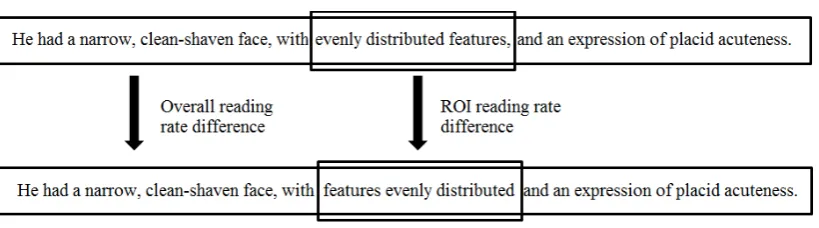
Participants saw both versions of each item, counterbalanced across two presentation lists in terms of which version was presented first.We identified specific regions of interest (ROIs), which represent the parts of the sentence that differ from the first presentation to the second. For substantive changes we considered the word or words that were different to be the ROI (e.g. ROI: evenly distributed features compared to ROI: features evenly distributed, see Figure 2). For accidental changes the
punctuation mark and the words to either side were treated as the ROI, as readers are highly unlikely to fixate on the punctuation mark directly (e.g. ROI: hopes: cherished compared to ROI: hopes, cherished). For any sentences where more than one
difference existed, each change was treated separately. So, for example, if a sentence contained one substantive change and two accidental changes, this was treated as three separate changes, with separate ROIs for the substantive change (the word or words that were different – ROI 1) and the two accidental changes (the words surrounding the punctuation marks that were different – ROIs 2 and 3).
Participants.
reasonable level of literary experience commensurate with having gained a place at university and some experience of reading works of literary fiction. All participants were paid a small fee for their participation.
Apparatus and Procedure.
The study was conducted using an Eyelink 1000+ system from SR Research.
Participants were seated at comfortable height approximately 60 cm from a computer monitor (resolution 1920 x 1080, refresh rate 60hz). A table mounted chin rest was used to minimize head movement and eye movements were recorded using a table mounted camera (sample rate 500hz). Prior to the study the accuracy of the camera was verified using a nine-point calibration and validation grid. Regular recalibrations were performed throughout the study as required.
Following a short introduction where the nature of the study was explained and an example provided, participants were presented with the sentence pairs in a random order. In each case one version of a sentence was presented first and participants were asked to read it as naturally as possible for comprehension, then to press the Enter key when they had finished. Following this a simple yes/no comprehension question was posed, for example (asked about the sentence in Figure 2):
“Did the man have a beard?”
first and second presentation of each sentence, to discourage participants from actively holding the first sentence in working memory.
The second version of the sentence was then presented, after which participants were asked to type a response to the question:
“Did you notice any differences between the two sentences you just saw? If so, what were they?”
A number of sentence pairs were included where the two versions were identical so that readers would not be biased towards all sentence pairs having a difference. Variant pairs were also interspersed with a number of longer passages which formed part of a separate study. This was included to again shift the focus from always looking for variation in a text. Note that at no point in the instructions were participants specifically told that the point was to “spot the difference” between sentences, although clearly this would have become apparent as the experiment progressed. All participants received the same, non-specific instructions to read the variant sentences for comprehension, thereby ensuring that we did not prime any participant to specifically look for changes to lexis or punctuation.
Analysis
(calculated as the sum of all fixations on the ROI during the reading of that item) and the total number of fixations on an ROI during the reading of an item. A number of other measurements are commonly used in eye-tracking research but we chose these two as the most likely to reflect the overall noticing behavior of participants in this study. That is, total reading time and total fixation counts are measures that record behavior throughout the whole trial, so can capture initial reading and later re-reading behavior, both of which would be indicative of increased attention to a particular word or word sequence.
Analysis was conducted on a per-item basis to account for any variation in reading speeds across the course of a trial. This means that for each item, we compared the reading speed for the ROI to the reading speed for the sentence in which it appeared rather than to an overall measure (see Mahlberg, Conklin, & Bisson, 2014 for a similar approach). This also minimises any effects of trial order on the results, since if participants were getting faster (either in general or specifically at spotting
differences), this should be reflected in both the overall trial rate and the ROI rate. To account for length differences in the items, a reading time per character calculation was applied (c.f. and Sanford & Fillik, 2007), both for the sentence as a whole and the region of interest (ROI). This was calculated as follows:
(Total reading time in milliseconds) ÷ (total number of characters, including spaces) = Reading rate
In order to explore whether the changes were noticed by participants, we calculated the relative difference between the first and second presentations of each sentence for the item as a whole and for the ROI in particular. Figure 2 demonstrates this
comparison, for the Overall reading rate difference (what is the relative
[image:19.595.95.505.316.430.2]increase/decrease in reading rate for the sentence as a whole from version 1 to version 2?) and the ROI (what is the relative increase/decrease in reading rate for the ROI from version 1 to version 2?)
Figure 2. Comparison of reading rates from the first to the second presentation of each sentence.
encountered. However, on reading it the second time, if a change to the ROI is noticed, we should see a significant difference between the overall sentence rate and the ROI reading rate, with a slower reading rate for the ROI to reflect the extra attention being paid to it.
Overall Reading and Fixation Rates
[image:20.595.86.513.432.498.2]We report mean values for reading/fixation rates for the first and second reading of each sentence. The results of paired samples t-tests are reported to demonstrate significant differences, as well as Cohen’s d to compare the effect size of any differences. (In the tables of results any significant differences (p < .05) are marked with an asterisk*.)
Table 1. Reading rate and fixation rate for all items (different pairs and same pairs combined)
Reading rate Fixation rate
Sentence ROI Difference Sentence ROI Difference
First reading 50.4 52.2 1.8 0.22 0.23 0.01
Second reading 34.7 42.1 7.4* 0.16 0.18 0.02*
Difference -15.7* -10.1* 5.6* -0.06* -0.05* 0.01*
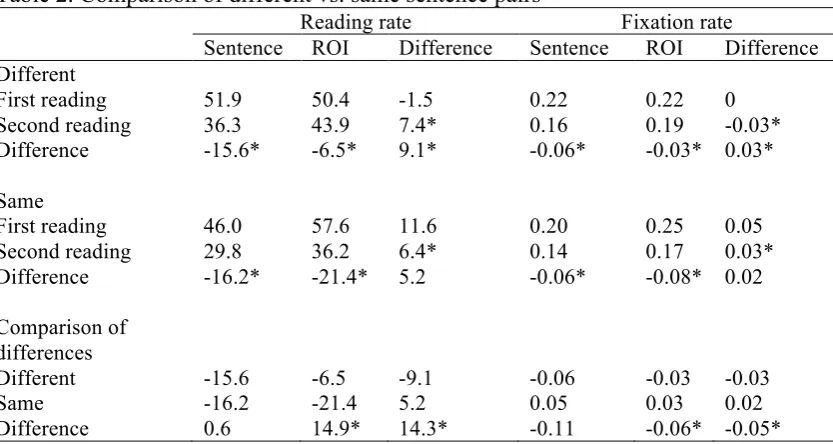
determine whether this difference was due to sentence pairs that had a change, the differences in reading times and fixations were separated into two groups: ROIs that were different in the two sentences and ROIs that were the same in the two sentences (see Table 2).
Table 2. Comparison of different vs. same sentence pairs
Reading rate Fixation rate
Sentence ROI Difference Sentence ROI Difference Different
First reading 51.9 50.4 -1.5 0.22 0.22 0
Second reading 36.3 43.9 7.4* 0.16 0.19 -0.03*
Difference -15.6* -6.5* 9.1* -0.06* -0.03* 0.03* Same
First reading 46.0 57.6 11.6 0.20 0.25 0.05
Second reading 29.8 36.2 6.4* 0.14 0.17 0.03*
Difference -16.2* -21.4* 5.2 -0.06* -0.08* 0.02 Comparison of
differences
Different -15.6 -6.5 -9.1 -0.06 -0.03 -0.03
Same -16.2 -21.4 5.2 0.05 0.03 0.02
Difference 0.6 14.9* 14.3* -0.11 -0.06* -0.05*
For different pairs (51.9ms vs. 36.3ms) and same pairs (46.0ms vs. 29.8ms) the
second reading of the sentence was quicker (both ps < .001, Cohen’s d > 2.6 for both). Importantly, there was a difference in terms of the relative attention paid to the ROI on second reading for the two types (N.B. for same pairs the ROI was the region that would be different if participants had seen two different versions of the sentences. This allows us to see whether there is inherently anything about these regions that requires more attention from readers.) The “Comparison of differences” in Table 2 shows that the change in overall reading rate for the whole sentence from presentation one to presentation two was comparable for different and same sentences (-15.6ms vs. -16.2ms), but the change for ROI reading time was significantly different: the
sentences showed a much larger change (-21.4ms), and the difference between these was significant (p < .001, Cohen’s d = 1.02). This shows that where there were no differences, the ROIs and the surrounding text were both read much more quickly, while for different sentences there was significantly more attention paid to the ROIs on the second presentation, and the effect size for this difference was substantial.
Substantive vs. Accidental Changes
We next compared the two types of change to see if any differences could be
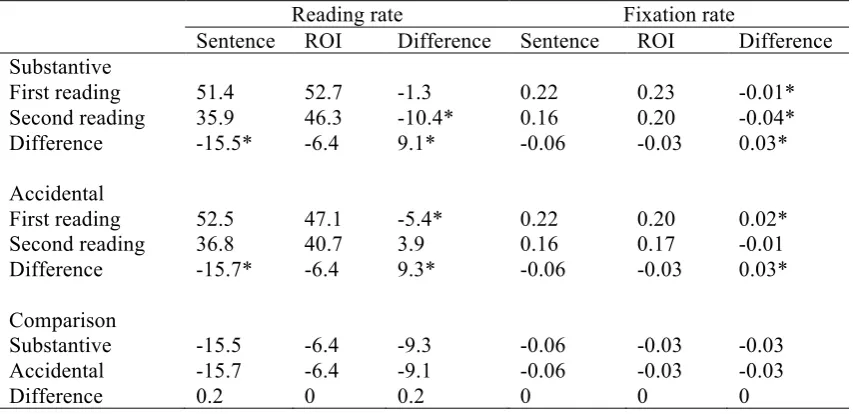
[image:22.595.86.513.542.749.2]observed. For both substantive and accidental changes the second reading was faster than the first (substantive: 51.4ms vs. 35.9ms, p < .001, Cohen’s d = 1.17; accidental: 52.5ms vs. 36.8ms, p < .001, Cohen’s d = 1.18). The relative difference between the sentence and the ROI was also significant for both (substantive: 9.1ms, p < .001, Cohen’s d = 0.71; accidental: 9.3ms, p <.001, Cohen’s d = 0.71), but direct comparison showed no difference between the two types (difference = 0.2ms, p = .82).
Table 3. Comparison of substantive changes vs. accidental changes (different sentences only)
Reading rate Fixation rate
Sentence ROI Difference Sentence ROI Difference Substantive
First reading 51.4 52.7 -1.3 0.22 0.23 -0.01*
Second reading 35.9 46.3 -10.4* 0.16 0.20 -0.04*
Difference -15.5* -6.4 9.1* -0.06 -0.03 0.03*
Accidental
First reading 52.5 47.1 -5.4* 0.22 0.20 0.02*
Second reading 36.8 40.7 3.9 0.16 0.17 -0.01
Difference -15.7* -6.4 9.3* -0.06 -0.03 0.03*
Comparison
Substantive -15.5 -6.4 -9.3 -0.06 -0.03 -0.03
Accidental -15.7 -6.4 -9.1 -0.06 -0.03 -0.03
This suggests that both substantive and accidental changes were noticed, with
relatively more attention being paid to the areas that were different (whether lexical or punctuation) during the second reading than during the first. There is no indication that substantive items were easier to spot than changes in punctuation.
Free Text Comments
The free text responses to the question “Did you notice any difference between the two sentences you just saw? If so, what were they?” were analysed to see if there was any relationship between the differences that were consciously noticed and described and the eye movement record. Each variation was considered separately, i.e. for those sentence pairs that contained more than one difference, each difference was
considered to be a separate item, hence a free text response could identify none, one or all of the changes in any given sentence pair.
A coding system for the comments was developed, and as no specific instructions were given to participants other than to ask them whether they noticed any
differences, it was decided that the coding system should be kept relatively coarse. The system was organized as shown in Table 4. All items from all participants were judged by nine coders (volunteers from the undergraduate population in the School of English at the University of Nottingham), who were asked to judge the data
Table 4. Coding system for free text comments Different sentence pairs:
0 = no difference reported (e.g. an answer of “no” or equivalent, or no response)
1 = a difference was reported but no or minimal detail was provided (e.g. an answer of “yes” with no additional information. N.B. Differences that were wrongly identified were also scored in this category, on the grounds that something must have been noticed for the participant to consider reporting anything)
2 = a difference was reported and the type was indicated, but no specific detail was provided (e.g. an answer of “punctuation” or “words were changed” but without specifying what) 3 = a difference was specifically and correctly identified (e.g. “there was a colon rather than a comma” or “the second sentence used ‘representation’ instead of ‘expression’”)
Same sentence pairs:
0 = difference reported when none existed 1 = no difference reported
The mean scores for different sentence pairs were in general quite low: substantive changes received a mean score of 0.60 out of 3 and accidental changes received a score of 0.41 out of 3, indicating that a lot of changes were not consciously noticed or commented on by the participants. Comparison of the two types using an independent samples t-test showed that this difference was significant: t(617) = -2.91, p < .01. This demonstrates that substantive (lexical) changes were reported more often than
accidental (punctuation) changes, but it is also important to note that in cases where several differences existed in one sentence pair, very often only the most “salient” lexical change was mentioned, which may have impacted how many changes overall were actually reported (and may have contributed to the generally low scores,
especially for accidental changes). This may be because participants paid less attention once they had noticed a difference, or that they did not prioritize reporting numbers of differences accurately.
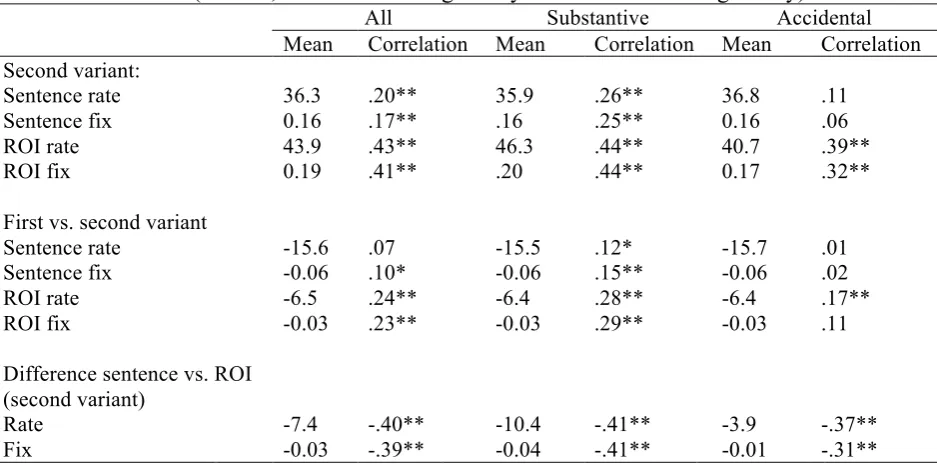
coding score and reading rates for all data, and for substantive and accidental changes considered separately. We considered correlations between reading/fixation rate (sentence and ROI) for the second presentation of each sentence pair; magnitude of the difference in reading/fixation rate (sentence and ROI) from first to second presentation; and magnitude of the difference in reading/fixation rate between sentence and ROI for second presentation of each sentence pair.
Table 5. Correlations between reading rates/differences and mean coding scores for free text comments (all data, substantive changes only and accidental changes only)
All Substantive Accidental
Mean Correlation Mean Correlation Mean Correlation Second variant:
Sentence rate 36.3 .20** 35.9 .26** 36.8 .11
Sentence fix 0.16 .17** .16 .25** 0.16 .06
ROI rate 43.9 .43** 46.3 .44** 40.7 .39**
ROI fix 0.19 .41** .20 .44** 0.17 .32**
First vs. second variant
Sentence rate -15.6 .07 -15.5 .12* -15.7 .01
Sentence fix -0.06 .10* -0.06 .15** -0.06 .02
ROI rate -6.5 .24** -6.4 .28** -6.4 .17**
ROI fix -0.03 .23** -0.03 .29** -0.03 .11
Difference sentence vs. ROI (second variant)
Rate -7.4 -.40** -10.4 -.41** -3.9 -.37**
Fix -0.03 -.39** -0.04 -.41** -0.01 -.31**
Key: mean reading rates are expressed in milliseconds/character; fixation rates expressed in fixations/character. Pearson’s correlation coefficients are expressed on a scale from -1 (perfect negative correlation) to +1 (perfect positive correlation), with significance values (two tailed) marked as *p < .05, **p < .01
relative difference between sentence and ROI on second presentation (reported differences showed relatively more attention compared to the rest of the sentence). This was broadly the same for lexical and punctuation changes, although there was some indication that the effect also generalized to the sentence as a whole for
substantive changes but not accidental changes. That is, the reading and fixation rates for the sentence overall on the comparison “First vs. second variant” show a positive correlation with reported changes (reported changes led to more and longer fixations on the sentence as a whole, as well as the ROI specifically) for substantive changes, but no such pattern is seen for accidental changes (where only ROI reading rate shows a significant correlation).
Discussion
It is important to acknowledge that the nature of the task may have encouraged a level of attentiveness that may not reflect how readers normally engage with texts. That being said, Philips (2015) suggests that reading moves “through a spectrum of intensities” depending on the purpose for which they are reading. A task in which readers are asked to note any differences encourages the type of attentive reading of the sort that might be seen in academic or critical engagement with a text; it also reflects the task that editors invest so much time and money in. Crucially, in such a task, non-specialist readers (non-editors, non-literary scholars) were able to spot both lexical and punctuation differences when the texts were presented one after another.
The key finding, therefore, is that readers seem to be naturally open to the idea that punctuation is as much a textual feature as lexical choices. Of note, however, is the indication that for substantive changes the noticing of a change also translated into greater overall reading times for the sentence. The correlations between noticing and reading times for the second presentation of sentences containing substantive changes were significant for both the ROI and the broader sentence context. This suggests that lexical changes perhaps induce more careful reading of the sentence as whole,
It is also important to point out that the classification of changes in this study was deliberately broad, but this in many ways simply adds weight to the idea that a wide range of lexical and punctuation features are automatically considered by readers in the course of text processing. Previous studies of lexical change monitoring found differing results according to the degree of semantic difference between changed words. Raney and Rayner (1995) found no “noticing” effect for changed words that were synonyms; Sturt et al. (2004) found a larger effect (longer reading on second presentation) for changed words that were semantically unrelated compared to words that were more closely related. In our study the lexical changes were sometimes near synonyms (contemplated became took in), but often related more to an inserted word (but at present, obviously became but at present, obviously, nevertheless) or a change to word order (features evenly distributed became evenly distributed features). The overall pattern for substantive changes suggests that no one type of change was driving this, indicating that readers are indeed sensitive to many kinds of
manipulation. Similarly, punctuation variants were often changes (comma to semi-colon) but also were often additions/removals. Existing work on the processing of punctuation (e.g. Hill & Murray, 2000; Hirotani, Frazier, & Rayner, 2006; Pynte, & Kennedy, 2007) has shown that unpunctuated words are in general read more quickly,
with punctuation playing an important role in how any given clause is interpreted.
Our results suggest that it is not simply the presence/absence of punctuation that
affects reading times, but that readers do pay attention to – or at least are open to
considering – the specific form of grammatically comparable punctuation choices.
by the eye movement data, and the more conscious ability to notice changes, as
measured by the free text responses. In general the pattern here shows a positive
correlation between reading times and “noticing”, indicating that those changes that
were consciously noticed and reported also received relatively more attention on
second reading. The magnitude of the difference between the first and second ROIs
seemed to vary as a function of whether changes were noticed. In other words, variant two was generally read more quickly than variant one (although not as quickly as the sentence overall), but where changes were actively noticed, the time spent on variant two was longer. This suggests that the automatic eye movement behaviour and more conscious behaviour in terms of identifying and reporting changes are generally congruent, in that noticing a change leads to more attention being paid to it during on-line processing and increases the likelihood that the specific change will be reported. Again, the nature of the task may have contributed to this effect, but importantly encouraging attentive reading of the texts showed comparable results for both lexical and punctuation changes. As noted previously, the only area where there was a difference here was in the tendency of the re-reading behavior to generalize to the sentence as a whole for lexical, but not punctuation, changes.
These conditions may involve information about the “authority” of minor variants, thus further studies may help to determine how the provenance of punctuation variants (whether these are typographical errors, authorial choice or editorial
intervention) affects readers’ processing of them. In at least one of the early volumes of the Cambridge James edition, variants in punctuation were sorted into categories and treated accordingly: those judged to be resulting from compositor’s errors were amended in the copy-text and recorded in the textual apparatus; those in which James reverted to punctuation he had used in an earlier, often manuscript, version of the work, or else decided to revise by recourse to a system of lighter punctuation, which he adopted later in his career, were also recorded in the textual apparatus; those variants resulting from differences in house-style were not recorded. Given that the issue of how to assign variants to these categories—especially judging when
punctuation is due to authorial “eccentricity” or compositorial error—can be vexed, an empirical way of determining those which do and do not “matter” is potentially of great value.
methodology takes no account of how features unrelated to ease or difficulty of processing might have an effect on readers. In other words, many textual features may engender pleasure – in the Barthesian sense of the “plaisir du text”, or textual
“jouissance” – or other emotional or cognitive responses in the reader, and may therefore affect processing in ways that we cannot necessarily quantify. The methodology of presenting sentences as isolated extracts was intended to minimize such effects where possible, but has its own limitations in how far we can then claim the results to be a reflection of literary reading or judgements of literariness.
Some other limitations relate to the materials used. The designation of substantive and accidental changes was broad, and deliberately so. A more nuanced way of
subdividing changes might enable us to say more about the specific types of changes that are/are not noticed, and what effects these have on reader responses. For
example, it might be of interest to see whether lexical substitutions for synonyms or near synonyms are less noticeable (as in Raney & Rayner, 1995), compared to changes to word order or the addition or removal of a word or words. Similarly, it would be of value to ensure that sentences contain only one change at a time. As seen in the free text analysis, identification of changes in general was low, but this may be a reflection of the fact that in cases of multiple changes within one sentence,
These limitations notwithstanding, by enabling researchers to discern the relative attention that readers give to different kinds of surface textual features, eye-tracking experiments can be used to further our understanding of how certain textual features are processed. While this does not resolve current disputes in text-editing literature about the value of recording all types of textual variant, it does suggests a
methodology by which, with more systematic research, discussion about the
References
Carminati, M., Stabler, J., Roberts, A., & Fischer, M. (2006). Readers’ responses to
sub-genre and rhyme scheme in poetry. Poetics, 34(3), 204-218.
Carrol, G., & Conklin, K. (2014). Eye-tracking multi-word units: some
methodological questions. Journal of Eye Movement Research, 7(5), 5, 1-11. Complete Works of Evelyn Waugh [Digital Library]. (n.d.). Available from,
http://www2.le.ac.uk/research/current-research/evelyn-waugh/about
Dickens, C. (1846). The Adventures of Oliver Twist. London: Bradbury and Evans. Dickens, C. (1867). The Charles Dickens Edition. The Adventures of Oliver Twist.
London: Chapman and Hall.
Goldman, J., & Sellers, S. (2010). General Editors’ Preface. In M. Herbert & S. Sellers (Eds.) (with research by Ian Blythe), The Cambridge Edition of the Works of Virginia Woolf, The Waves (pp. ix-xx). Cambridge, UK: Cambridge University Press.
Guy, J., Scott, R., Conklin, K., & Carrol, G. (2016). Challenges in Editing Late Nineteenth-and Early Twentieth-Century Prose Fiction: What Is Editorial “Completeness”? English Literature in Transition, 59(4).
Hanauer, D. (1996). Integration of phonetic and graphic features in poetic text categorization judgments. Poetics, 23(5), 363–380.
Hanauer, D. (2001). What we know about reading poetry. Theoretical positions and empirical research. In D. Schram & G. Steen (Eds.), The Psychology and Sociology of Literature (pp. 107–128). Amsterdam, The Netherlands: John Benjamins.
Hill, R., & Murray, W. (2000). Commas and spaces: Effects of punctuation on eye
Pynte (Eds.), Reading as a perceptual process (pp. 565–590). Oxford, UK:
Elsevier.
Hirotani, M., Frazier, L., & Rayner, K. (2006). Punctuation and intonation effects on
clause and sentence wrap-up: Evidence from eye movements. Journal of
Memory and Language, 54(3), 425–443.
Hoffstaedter, P. (1987). Poetic text processing and its empirical investigation. Poetics 16(1), 75–91.
Hyona, J., & Niemi, P. (1990). Eye movements during repeated reading of a text. Acta Psychologica, 73, 259-280.
Jakobson, R. (1960). “Linguistics and Poetics”. In T. Segbeok (Ed.), Style in Language (pp. 350-377). Cambridge, MA: M.I.T. Press.
James, H. (1881). The Portrait of a Lady. London: Macmillan.
James, H. (1908) The Portrait of a Lady. Vol. I. New York: Charles Scribner’s Sons. Vol. III of The Novels and Tales of Henry James.
Just, M., and Carpenter, P. (1980). A theory of reading: From eye fixations to
comprehension. Psychological Review, 87, 329-354.
Kaakinen, J., & Hyönä, J. (2010). Task Effects on Eye Movements During Reading.
Journal of Experimental Psychology: Learning, Memory and Cognition, 36(6),
1561-1566.
Koops van’t Jagt, R., Hoeks, J., Dorleijn, G., & Hendriks, P. (2014). Look before you
leap: How enjambment affects the processing of poetry. Scientific Study of
Literature, 4(1), 3-24.
Landis, J., & Koch, G. (1977). The measurement of observer agreement for categorical data. Biometrics, 33(1), 159–174.
intent on eye-movement patterns in a change detection task. Journal of Eye Movement Research, 8(2):5, 1-10.
Levy, B., Di Persio, R., & Hollingshead, A. (1992). Fluent rereading: Repetition, automaticity, and discrepancy. Journal of Experimental Psychology: Learning, Memory, and Cognition, 18, 951-91.
Mahlberg, M., Conklin, K., & Bisson, M.-J. (2014). Reading Dickens’s characters: employing psycholinguistic methods to investigate the cognitive reality of patterns in texts. Language and Literature, 23(4), 369-388.
Mar, R., Oatley, K., Djikic, M., & Mullin, J. (2011). Emotion and narrative fiction:
Interactive influences before, during, and after reading. Cognition & Emotion,
25(5), 818-833.
McGann, J. (1991). The Textual Condition. Princeton, NJ: Princeton University Press. McKenzie, D. (1986). The Panizzi Lectures 1985: Bibliography and the Sociology of
Texts. London: British Library.
Miall, D., & Kuiken, D. (1994). Foregrounding, defamiliarization, and affect:
Response to literary stories. Poetics, 22(5), 389-407.
Miall, D., & Kuiken, D. (1998). The form of reading: Empirical studies of literariness.
Poetics, 25(6), 327-341.
Niikuni, K., & Muramoto, T. (2014). Effects of punctuation on the processing of
temporarily ambiguous sentences in Japanese. Japanese Psychological
Research, 56(3), 275-287.
Niikuni, K.; Iwasaki, S., & Muramoto, T. (2015), The Role of Punctuation in
Processing Relative-Clause Sentence Constructions in Japanese. In Airenti, G.,
Bara, B., Sandini, G. & Cruciani, M. (Eds.), Proceedings of the meeting of the
Philips, N. (2015). Literary Neuroscience and History of Mind: An Interdisciplinary fMRI Study of Attention and Jane Austen. In L. Zunshine (Ed.), The Oxford Handbook of Cognitive Literary Studies (pp. 55-84). Oxford: Oxford University Press.
Pickering, M. J., Frisson, S., McElree, B., & Traxler, M. (2004). Eye movements and semantic composition. In M. Carreriras & C. Clifton (Eds.), On-line Study of Sentence Comprehension: Eyetracking, ERPs and Beyond (pp. 33-50). New York, NY: Psychology Press.
Pynte, J., & Kennedy, A. (2007). The influence of punctuation and word class on
distributed processing in normal reading. Vision Research, 47(9), 1215-1227.
Raney, G. (2003). A context-dependent representation model for explaining text
repetition effects. Psychonomic Bulletin & Review, 10(1), 15-28.
Raney, G., & Rayner, K. (1995). Word frequency effects and eye movements during
two readings of a text. Canadian Journal of Experimental Psychology/Revue
Canadienne de Psychologie Expérimentale, 49(2), 151-172.
Rayner, K. (1978). Eye Movements in Reading and Information Processing. Psychological Bulletin, 85(3), 618-660.
Rayner, K. (1998). Eye Movements in Reading and Information Processing: 20 Years of Research. Psychological Bulletin, 124(3), 372-422.
Riese, K., Bayer, M., Lauer, G., & Schacht, A. (2014). In the eye of the recipient:
Pupillary responses to suspense in literary classics. Scientific Study of
Literature, 4(2), 211-232.
Roberts, A. M., Stabler, J., Fischer, M. H., & Otty, L. (2013). Space and Pattern in
Linear and Postlinear Poetry: Empirical and theoretical approaches. European
Sanford A., & Filik, R. (2007) ‘They’ as a gender-unspecified singular pronoun:
Eyetracking reveals a processing cost. The Quarterly Journal of Experimental
Psychology, 60(2): 171–178.
Schaffner, A., Knowles, K., Weger, U., & Roberts, A. (2012). Reading Space in
Visual Poetry: New Cognitive Perspectives. Writing Technologies, 4(1), 75-106.
Schotter, E., Bicknell, K, Howard, I., Levy, R., & Rayner, K. (2014). Task effects reveal cognitive flexibility responding to frequency and predictability: Evidence from eye movements in reading and proofreading. Cognition, 131, 1-27.
Shillingsburg, P. (1993). Polymorphic, Polysemic, Protean, Reliable, Electronic Texts. In G. Bornstein & R. Williams (Eds.), Palimpsest: Editorial Theory in the Humanities (pp. 29-44). Ann Arbor, MI: University of Michigan Press. Siyanova-Chanturia, A., Conklin, K., & van Heuven, W.J.B. (2011). Seeing a phrase
“time and again” matters: the role of phrasal frequency in the processing of multiword sequences. Journal of Experimental Psychology: Learning, Memory and Cognition, 37(3), 776-784.
Stape, J. (2013). Reply to Rejoinder: The Cambridge Woolf. English Literature in Transition, 1880-1920, 56(2), 270.
Staub, A., & Rayner, K. (2007). Eye movements and on-line comprehension
processes. In M. G. Gaskell (Ed.), The Oxford Handbook of Psycholinguistics (pp. 327-342). Oxford, UK: Oxford University Press.
Sturt, P., Sanford, A., Stewart, A., & Dawydiak, E. (2004). Linguistic focus and
good-enough representations: An application of the change-detection paradigm.
Psychonomic Bulletin & Review, 11(5), 882-888.
Ward, P., & Sturt, P. (2007). Linguistic focus and memory: An eye movement study.
Appendix
All of the sentence pairs used in the study are presented with changes between versions underlined here for ease of identification. Oliver Twist variants are taken from the 1846 Bradbury and Evans edition (a) and the 1867 Chapman and Hall edition (b). The Portrait of a Lady variants are taken from the 1881 Macmillan first book edition (a) and the 1908 Scribner’s New York Edition (b).
Oliver Twist variants
Accidental variations (punctuation):
1a. Oliver was precisely in this condition. He saw the Jew with his half-closed eyes; heard his low whistling; and recognised the sound of the spoon, grating against the saucepan’s sides; and yet the self-same senses were mentally engaged, at the same time, in busy action with almost everybody he had ever known.
1b. Oliver was precisely in this condition. He saw the Jew with his half-closed eyes; heard his low whistling; and recognised the sound of the spoon grating against the saucepan’s sides; and yet the self-same senses were mentally engaged, at the same time, in busy action with almost everybody he had ever known.
2a. Busy recollections of old hopes: cherished as a girl, long ago: crowded into the mind of Rose, while making this avowal; but they brought tears with them, as old hopes will when they come back withered; and they relieved her.
3a. The man struggled, violently, to release his arms; but those of the girl were clasped round his; and tear her as he would, he could not tear them away.
3b. The man struggled violently to release his arms; but those of the girl were clasped round his; and tear her as he would, he could not tear them away.
4a.The day passed off—day! There was no day; it was gone as soon as come—and night came on again; night so long, and yet so short; long in its dreadful silence, and short in its fleeting hours.
4b. The day passed off. Day? There was no day; it was gone as soon as come—and night came on again; night so long, and yet so short; long in its dreadful silence, and short in its fleeting hours.
Substantive variations (lexical items):
5a. The words no sooner escaped her lips, than Mr Grimwig, who had been affecting to dip into a large book that lay on the table, upset it with a great crash, and falling back in his chair, discharged from his features every expression but one of the most unmitigated wonder, and indulged in a prolonged and vacant stare;
5b. The words no sooner escaped her lips, than Mr Grimwig, who had been affecting to dip into a large book that lay on the table, upset it with a great crash, and falling back in his chair, discharged from his features every expression but one of
unmitigated wonder, and indulged in a prolonged and vacant stare;
They only proposed remaining in London three days, prior to departing for some weeks to a distant part of the coast. It was now midnight of the first day.
6b. Her words and manner had touched Rose Maylie’s heart; and, mingled with her love for her young charge, and scarcely less intense in its truth and fervour, was her fond wish to win the outcast back to repentance and hope.
They purposed remaining in London only three days, prior to departing for some weeks to a distant part of the coast. It was now midnight of the first day.
7a. Rose, Rose, to know that you were passing away like some soft shadow, which a light from above, casts upon the earth; to have no hope that you would be spared to those who linger here; to know no reason why you should be; to feel that you
belonged to that bright sphere whither so many of the fairest and the best have winged their early flight; and yet to pray, amid all these consolations, that you might be restored to those who loved you—these were distractions almost too great to bear. 7b. Rose, Rose, to know that you were passing away like some soft shadow, which a light from above, casts upon the earth; to have no hope that you would be spared to those who linger here; hardly to know a reason why you should be; to feel that you belonged to that bright sphere whither so many gifted creatures, in infancy and youth, have winged their early flight; and yet to pray, amid all these consolations, that you might be restored to those who loved you—these were distractions almost too great to bear.
Variations to substantives and accidentals:
‘Pretty well, I think, for a beginner,’ remarked Mr Bolter, complacently. ‘The pots I took off airy railings, and the milk-can was standing by itself outside a public-house. I thought it might get rusty with the rain, or catch cold, yer know. Eh? Ha! ha! ha!’ The Jew affected to laugh very heartily; and Mr Bolter, having had his laugh out, took a series of large bites, which finished his first hunk of bread and butter, and assisted himself to a second.
8b. ‘No, no, my dear. The pint-pots were great strokes of genius: but the milk-can was a perfect masterpiece.’
‘Pretty well, I think, for a beginner,’ remarked Mr Bolter, complacently. ‘The pots I took off airy railings, and the milk-can was standing by itself outside a public-house. I thought it might get rusty with the rain, or catch cold, yer know. Eh? Ha! ha! ha!’ Fagin affected to laugh very heartily; and Mr Bolter, having had his laugh out, took a series of large bites, which finished his first hunk of bread and butter, and assisted himself to a second.
9a. There were tears in the eye of the gentle girl, as these words were spoken; and when one fell upon the flower over which she bent, and glistened brightly in its cup, making it more beautiful, it seemed as though the outpouring of her fresh young heart, claimed kindred with the loveliest things in nature.
9b. There were tears in the eyes of the gentle girl, as these words were spoken; and when one fell upon the flower over which she bent, and glistened brightly in its cup, making it more beautiful, it seemed as though the outpouring of her fresh young heart, claimed kindred naturally, with the loveliest things in nature.
be prudent to refrain from mentioning, and to which I will assign no fictitious name, there is one anciently common to most towns, great or small: to wit, a workhouse; and in this workhouse was born: on a day and date which I need not trouble myself to repeat, inasmuch as it can be of no possible consequence to the reader, in this stage of the business at all events: the item of mortality whose name is prefixed to the head of this chapter.
10b. Among other public buildings in a certain town which for many reasons it will be prudent to refrain from mentioning, and to which I will assign no fictitious name, it boasts of one which is common to most towns, great or small, to wit, a workhouse; and in this workhouse was born, on a day and date which I need not take upon myself to repeat, inasmuch as it can be of no possible consequence to the reader, in this stage of the business at all events, the item of mortality whose name is prefixed to the head of this chapter.
The Portrait of a Lady variants. Accidental variations (punctuation):
1a. The old man had his cup in his hand; it was an unusually large cup, of a different pattern from the rest of the set, and painted in brilliant colours.
1b. The old man had his cup in his hand; it was an unusually large cup, of a different pattern from the rest of the set and painted in brilliant colours.
2a. It stood upon a low hill, above the river—the river being the Thames, at some forty miles from London.
3a. So that he knew all its points, and would tell you just where to stand to see them in combination, and just the hour when the shadows of its various protuberances—which fell so softly upon the warm, weary brickwork—were ofthe right measure.
3b. So that he knew all its points and would tell you just where to stand to see them in combination and just the hour when the shadows of its various protuberances—which fell so softly upon the warm, weary brickwork—were of the right measure.
4a. The front of the house, overlooking that portion of the lawn with which we are concerned, was not the entrance-front; this was in quite another quarter.
4b. The front of the house overlooking that portion of the lawn with which we are concerned was not the entrance-front; this was in quite another quarter.
Substantive variations (lexical items)
5a. Along gabled front of red brick, with the complexion of which time and the weather had played all sorts of picturesque tricks, only, however, to improve and refine it, presented itself to the lawn, with its patches of ivy, its clustered chimneys, its windows smothered in creepers.
5b. A long gabled front of red brick, with the complexion of which time and the weather had played all sorts of pictorial tricks, only, however, to improve and refine it, presented to the lawn its patches of ivy, its clustered chimneys, its windows smothered in creepers.
6b. At present, obviously, nevertheless, he was not likely to displace himself; his journeys were over, and he was taking the rest that precedes the great rest.
7a. He had a narrow, clean-shaven face, with evenly distributed features, and an expression of placid acuteness.
7b. He had a narrow, clean-shaven face, with features evenly distributed and an expression of placid acuteness.
8a. It seemed to tell that he had been successful in life, but it seemed to tell also that his success had not been exclusive and invidious, but had had much of the
inoffensiveness of failure.
8b. It seemed to tell that he had been successful in life, yet it seemed to tell also that his success had not been exclusive and invidious, but had had much of the
inoffensiveness of failure.
9a. A beautiful collie dog lay upon the grass near his chair, watching the master’s face almost as tenderly as the master contemplated the still more magisterial physiognomy of the house;
10a. His companion, measuring the length of the lawn beside him, was a person of quite another pattern, who, although he might have excited grave curiosity, would not, like the other, have provoked you to wish yourself, almost blindly, in his place.
10b. His companion, measuring the length of the lawn beside him, was a person of quite a different pattern, who, although he might have excited grave curiosity, would not, like the other, have provoked you to wish yourself, almost blindly, in his place.
11a. “Do you mean because I am a banker?” asked the old man.
“Because of that, if you like; and because you are so ridiculously wealthy.” 11b. “Do you mean because I’m a banker?” asked the old man.
“Because of that, if you like; and because you have—haven’t you?—such unlimited means.”
Variations to substantives and accidentals:
12a. It was evidently a face in which the range of expression was not large; so that the air of contented shrewdness was all the more of a merit.
12b. It was evidently a face in which the range of representation was not large, so that the air of contented shrewdness was all the more of a merit.
13a. “I am never bored when I come here,” said Lord Warburton. “One gets such uncommonly good talk.”
“Is that another sort of joke?” asked the old man. “You’ve no excuse for being bored anywhere. When I was your age I had never heard of such a thing.”
14a. “Try as much as you please, but don’t try on my niece,” said the old man, whose opposition to the idea was broadly humorous.
“Ah, well,” said Lord Warburton, with a humour broader still, “perhaps, after all, she is not worth trying on!”
14b. “Try as much as you please, but don’t try on my niece,” smiled the old man, whose opposition to the idea was broadly humorous.
Acknowledgements
Figure Captions
Figure 1. Example sentence from the study showing representative eye movement data. Circles represent fixations, with the super-script number giving the exact duration in milliseconds.