Astronomy & Astrophysicsmanuscript no. paper˙prt c ESO 2012 November 19, 2012
Coronal heating by the partial relaxation of twisted loops
M. R. Bareford
1, A. W. Hood
1, and P. K. Browning
21 School of Mathematics and Statistics, University of St. Andrews, North Haugh, St. Andrews, Fife KY16 9SS, UK
e-mail:[email protected]
2 Jodrell Bank Centre for Astrophysics, Alan Turing Building, School of Physics and Astronomy, University of Manchester, Oxford
Road, Manchester M13 9PL, UK
Received 04/10/2012; accepted 01/11/2012
ABSTRACT
Context.Relaxation theory offers a straightforward method for estimating the energy that is released when a magnetic field becomes unstable, as a result of continual convective driving. Thus, an upper limit to the heating caused by ensembles of nanoflaring coronal loops can be calculated and checked against the level of heating required to maintain observed coronal temperatures (T&106K). Aims.We present new results obtained from nonlinear magnetohydrodynamic (MHD) simulations of idealised coronal loops. All of the initial loop configurations discussed are known to be linearly kink unstable. The purpose of this work is to determine whether or not the simulation results agree with Taylor relaxation, which will require a modified version of relaxation theory applicable to unbounded field configurations. In addition, we show for two cases how the relaxation process unfolds.
Methods.A three-dimensional (3D) MHD Lagrangian-remap code is used to simulate the evolution of a line-tied cylindrical coronal loop model. This model comprises three concentric layers surrounded by a potential envelope; hence, being twisted locally, each loop configuration is distinguished by a piecewise-constant current profile, featuring three parameters. Initially, all configurations carry zero-net-current fields and are in ideally unstable equilibrium. The simulation results are compared with the predictions of helicity-conserving relaxation theory.
Results.For all simulations, the change in helicity is no more than 2% of the initial value; also, the numerical helicities match the analytically-determined values. Magnetic energy dissipation predominantly occurs via shock heating associated with magnetic reconnection in distributed current sheets. The energy release and final field profiles produced by the numerical simulations are in agreement with the predictions given by a new model ofpartialrelaxation theory: the relaxed field is close to a linear force free state; however, the extent of the relaxation region is limited, while the loop undergoes some radial expansion.
Conclusions.The results presented here support the use of partial relaxation theory, specifically, when calculating the heating-event distributions produced by ensembles of kink-unstable loops. The energy release increases with relaxation radius; but, once the loop has expanded by more than 50%, further expansion yields little more energy. We conclude that the relaxation methodology may be used for coronal heating studies.
Key words.Instabilities, Magnetic fields, Magnetic reconnection, Magnetohydrodynamics (MHD), Plasmas, Sun: corona
1. Introduction
The energy required to heat the solar corona is thought to orig-inate from the magnetic fields that permeate the Sun’s atmo-sphere. The geometry of these fields is revealed by coronal loops, where the emitting plasma is constrained to follow the magnetic field: the plasma beta is extremely low (β≈0.01). Coronal loops are closed structures that emerge from the pho-tosphere at one location and re-enter the solar surface at another. The convective motions at these photospheric boundaries (or footpoints) are thought to reconfigure coronal fields and thereby cause free magnetic energy to accumulate, making the fields more susceptible to instability. Essentially, the kinetic energy of the convection zone is transported, via a Poynting flux, through the photosphere and stored within the coronal loop. In the case of a single loop, currents are created by those convective motions that cause the footpoints to be twisted. The approximate time scale for the twisting motions is long compared to the Alfv´en time, and so the coronal loop (not necessarily illuminated) tran-sitions through a series of force-free equilibria, which can be expressed as ∇ ×B=α(r)B; where ris a position vector, and
Send offprint requests to: M. R. Bareford
α=(µ0j·B)/|B|2is related to the parallel electric current density
(i.e.,αis a measure of the twist).
Energy release might be triggered when a loop-like mag-netic field, driven by continual convective motions, reaches the threshold for kink instability (Hood 1992; Browning & Van der Linden 2003, Haynes & Arber 2007; Srivastava et al. 2010). Coronal magnetic fields cover many thousands of kilometers (L≈50 Mm) and exist within a highly conductive environment: therefore, in the absence of instability, magnetic fields diffuse slowly (td≈103yr). Nevertheless, through an ideal kink
instabil-ity, a coronal loop may be deformed such that magnetic flux sur-faces are brought together. As the deformation continues, areas of high current are produced, allowing magnetic reconnection to take place. Hence, energy is released from the magnetic field during the nonlinear phase of an ideal kink instability, as shown by many three-dimensional (3D) magnetohydrodynamic (MHD) models (Baty & Heyvaerts 1996; Velli et al. 1997; Arber et al. 1999; Baty 2000; Browning et al. 2008; Hood et al. 2009).
The coronal heating problem is most pronounced within ac-tive regions, where the heating requirement is approximately 107erg cm−2s−1, significantly higher than that necessary for the quiet Sun (Withbroe & Noyes 1977; Aschwanden & Acton 2001). These regions are often observed as dense thickets of
transient coronal loops, the composition of which changes over the course of hours to days. Sudden reconfigurations are coinci-dent with large-scale solar flares (∼1034erg). The signal strength of such phenomena means these events are more readily ob-served — detailed investigations have revealed strong evidence for magnetic reconnection (Fletcher 2009; Qiu 2009). Miniscule (nano)flares, far weaker than ones commonly observed, could maintain coronal temperatures if these less dramatic events oc-cur with sufficient frequency (Hudson 1991). This type of flaring might be the sort initiated by the kink instability; however, the amount of energy released (i.e., the difference between the en-ergy at instability onset and that of the relaxed field) depends on how much the magnetic field has altered before it relaxes. Bareford et al. (2010, 2011) identified the threshold for linear kink instability with respect to an idealised coronal loop model (both with and without net current). This work determined the subset of field configurations accessible via convective driving that are linearly kink unstable. One approach to calculating the energy release, is to represent each of these configurations within a nonlinear MHD code, allow the instability to take place and follow the reconnection dynamics until a relaxed state emerges. However, it is simply not feasible to run such a computationally-intensive process for more than a few examples. Hence, Bareford et al. (2010, 2011), used relaxation theory to identify the relaxed states for all of the threshold (i.e., marginally unstable) configu-rations.
An unstable field obeys relaxation theory if it relaxes to-wards thelowestenergy state that conserves total magnetic ax-ial flux andglobalmagnetic helicity (Taylor 1974, 1986). This minimum energy state is a linear force-free field; i.e., α(r) is invariant and ∇ ×B=αB. The helicity (K) indicates how in-tertwined a magnetic field is with itself (Berger 1999). Coronal loops have a non-zero normal flux at the footpoints; hence, the gauge-invariance of relative helicity (Berger & Field 1984; Finn & Antonsen 1985) makes it the more useful property:
K = Z
V
(A+A0)·(B−B0)dV, (1)
whereAis the magnetic potential,B0is the potential field with
the same boundary conditions and A0is the corresponding
vec-tor potential. Helicity-conserving relaxation has been seen in many laboratory experiments (Heidbrink & Dang 2000; Taylor 1986). It must be noted that helicity is subject to global resis-tive diffusion. Nevertheless, if localised dissipation occurs on small spatial scales (i.e., across shock fronts or within thin cur-rent sheets), the reduction in helicity will be negligible compared to the decrease in magnetic energy (Browning 1988, Browning et al. 2008). The original intention of relaxation theory was to explain laboratory plasma phenomena; but latterly, it has been frequently applied to the solar corona (Heyvaerts & Priest 1984; Browning et al. 1986; Vekstein et al. 1993; Zhang & Low 2003; Priest et al. 2005).
The relative ease with which relaxation theory can be ap-plied meant that Bareford et al. (2010, 2011) were able to gener-ate heating-event distributions from ensembles of idealised nal loops, representing, albeit crudely, the population of coro-nal loops that exist within an active region. Each energy release is determined by where a loop crosses the instability threshold; this location is the outcome of a defined stochastic process. The distributions lead to an estimate for the heating rate that is just sufficient for coronal heating. However, the assumptions of this work regarding instability and relaxation theory have yet to be tested by a nonlinear 3D MHD code. The purpose of this paper is to elucidate further (Browning et al. 2008; Hood et al. 2009)
the relaxation process and to understand how it can be applied to coronal loops that lack a conducting wall. We simulate a set of zero-net-current coronal loops that sample the linear instability threshold calculated by Bareford et al. (2011). This is a larger set than the one investigated by Hood et al. (2009), and futhermore, the loops represented here feature a current-neutralisation layer that maintains zero net current even if the currents inside the loop are predominantly single signed. (Loops that carry zero net current are preferred since the convective motions that twist the loop and thereby create azimuthal field are spatially localised; the field outside the loop is unaffected by motions within the loop cross-section and therefore remains purely axial.)
A long-standing problem has been how to apply relaxation theory in astrophysical contexts without the presence of con-ducting walls: simplistically, the relaxation should extend out to infinity and lead always to potential fields. Browning (1988) and Dixon et al. (1989) showed that relaxation theory could apply to volumes with free boundaries, but did not give a prediction for the spatial extent of the relaxed state. We find that a modification to Taylor relaxation theory is required before it can be used to es-timate the energy released by a kink-unstable loop. In contrast to previous work, we calculate the helicity directly at specific times during each simulation (Browning et al. 2008 integrated the time differential of the helicity in order to show the change inδK); thus, we are able to verify the extent of helicity conservation. We also examine the performance of the MHD code with regard to energy conservation. Any numerical dissipation will have im-plications for the modelling of plasma processes associated with heating, such as radiation. However, the plasma-βis sufficiently low that any artificial resistivity should not influence the energy released by an unstable magnetic field, nor should it affect the evolution of a relaxing field.
The paper is structured in the following manner. Section 2 describes the numerical code used for the nonlinear MHD simu-lations, along with the loop model and the equations used to cal-culate the magnetic field. The corresponding instability thresh-old for the linear kink mode is introduced, as are the positions of the simulated loop configurations. Section 3 presents the re-sults: specifically, how the different forms of energy vary over the course of the simulation, when the loop goes unstable, and how these results are affected by changes in the code parameters, such as spatial resolution and background resistivity. Following, the evolution of the loop is presented as regards magnetic field and current magnitude. Section 4 discusses how well the results fit a modified Taylor relaxation theory. Finally, in the last sec-tion, the results are summarised and our conclusions are given.
2. Numerical code
LARE3D solves the resistive MHD equations given by ∂ρ
∂t = −∇ ·(ρv), (2)
∂ ∂t ρv
= −∇ ·(ρvv) + 1 µ0
∇ ×B×B − ∇P + ∇σ, (3)
∂B ∂t = ∇ ×
v×B − ∇ × η∇ ×B
µ0
!
, (4)
∂ ∂t ρ
= −∇ ·(ρv) − P∇ ·v + ηJ2 + ε σ, (5)
with specific energy density,
= P
(γ−1)ρ, (6)
whereρis the mass density,vis the plasma velocity,Bthe mag-netic field,Pthe thermal pressure,ηis the resistivity (not mag-netic diffusivity),Jis the current density,γ=5/3 is the ratio of specific heats, andµ0is the magnetic permeability. Viscous
heat-ing is represented by the last term of equation (5), which also in-corporates artificial viscosity (Wilkins 1980) in order to capture the heating effect of shocks. This heating term is expressed as the product of the rate of strain tensor,
εi j =
1 2
∂vi ∂j +
∂vj ∂i
!
, (7)
and the shock tensor,
σi j = ρl
ν1cf + ν2l|s|
εi j −
1 3δi j∇ ·v
!
, (8)
where cf is the fast magnetoacoustic speed, l is the distance
across a grid cell in the direction normal to the shock front, s is a similarly localised strain rate (the subscriptsiand jdenote the different spatial coordinates), and the artificial viscosity co-efficientsν1=0.1 andν2=0.5 are constants. The form of
equa-tion (8) is derived from the Rankine-Hugoniot jump condiequa-tions and the values of the coefficients have been chosen such that nu-merical oscillations behind shock fronts are prevented. Note, the force equation (3) also acquires a viscous term. Gravitational ef-fects are ignored in this study, as are thermal conduction and ra-diation. The simulations are concerned with how the magnetic field changes in response to the kink instability; specifically, how much magnetic energy is released and how the field subse-quently evolves. Conduction becomes important some time after the energy release and later, radiation is the dominant process. Note, numerical studies have shown that conduction can act on MHD time scales (Botha et al. 2011): the amount of energy re-leased from the field is unaffected, but the kinetic energy parallel to the field is much reduced.
The MHD equations are made dimensionless by replacing the variables with dimensionless equivalents. For example,
r = r
∗
Rb
, ρ = ρρ∗ 0
, B = B
∗
B1
,
where asterisks denote dimensional variables,Rb is the loop ra-dius,ρ0the initial mass density, andB1 the initial axial field at
r=0. The other variables are expressed in a similar manner;
L = L
∗
Rb
, t = t
∗
tA
, v = v
∗
vA
, P = P
∗
P0
,
where L∗=20R
b is the loop length, tA=Rb/vA is the
ra-dial Alfv´en transit time,vA=B1/ √
µ0ρ0 the Alfv´en speed, and
P0=B21/µ0 the magnetic pressure. The specific energy density,
current density and resistivity (, J andη) also have reference variables that can be expressed in terms ofRb,ρ0andB1:
0 =
B21 µ0ρ0
= v2A, J0 =
B1
µ0Rb
, η0 = µ0RbvA.
Values appropriate for a coronal active region can be ob-tained by setting Rb=1 Mm, ρ0=1.6726×10⁻¹³kg m−3 and
B1=50 G. Hence, the length becomes 20 Mm,vA≈10 Mm s−1
andη0≈4π×106Ωm.
The resistivity is taken to be non-uniform in these simula-tions,
η = ηb, |J|<Jcrit,
η = ηb + ηc, |J| ≥Jcrit,
where ηb is the background resistivity (normally set to zero,
since actual coronal resistivities are approximately µ0m2s−1)
and ηc=0.001 is the anomalous resistivity, which is only
switched on when the current reaches or exceeds Jcrit=15. The
value ofJcritis set so that it is significantly higher than the
maxi-mum current at the start of the simulation. Super-critical currents appear when, during the nonlinear evolution of the kink instabil-ity, current sheets begin to form and decrease in thickness. The anomalous resistivity is intended to capture the dissipation oc-curring at scales below the grid resolution: at this scale, resistiv-ity is enhanced by small-scale plasma instabilities.
The computational domain is a 3D staggered grid: physical variables are not calculated at the same place for each cell in the domain. This approach improves numerical stability and allows conservation laws to be included in the computation. The do-main size isLx=Ly=6 (-3:+3) andLz=20 (-10:+10). Initially,
the loop axis follows thez-axis and the loop radius isr=1; there-fore, the simulated loops all have an aspect ratio of 20. The loop is line-tied atz=−10,+10, which means, at thosez-coordinates, the velocity components are set to zero. The velocity compo-nents are zero at the boundaries for all directions. The normal derivatives of magnetic field, energy and density are zero at all boundaries. The simulations are run with two grid resolutions: 1282×256 (low) and 2562×512 (high). It is assumed that a re-sult is not a numerical artefact if it is consistent across both res-olutions.
2.1. Initial configuration
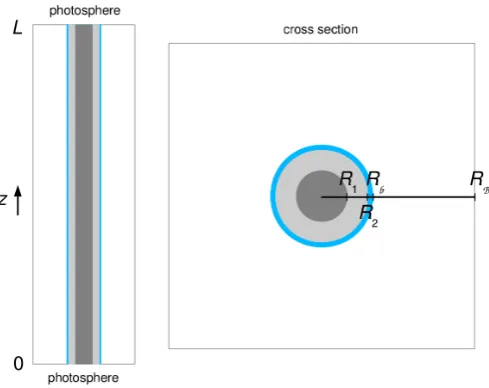
Fig. 1.Schematic of a straightened coronal loop in thex-zplane (left) and in the x-yplane (right). The loop, comprises a core (dark grey), an outer layer (light grey) and a current neutralisation layer (blue); the whole loop is embedded in a rectangular potential envelope. The core radius is half the loop radius (R1:R2:Rb:RB =0.5:0.9:1:3, whereRB is
the distance from the initial loop axis to the edge of the envelope). The loop aspect ratio (L/Rb) in this figure is 20.
to magnetic field isα1 in the core,α2 in the outer layer,α3 in
the neutralisation layer and zero in the potential envelope. The free parameters areα1 andα2, whereasα3 is dependent on the
first two and is determined by the requirement of zero net cur-rent. The magnetic field is continuous everywhere, whereas the current has discontinuities, and the outer surface of the poten-tial envelope, representing the background corona, is placed at RB=3 (three times the loop radius); this is far enough away that the boundary conditions do not influence the plasma evolution.
The fields are expressed in terms of the well-known Bessel function model, generalised to the concentric layer geome-try (Melrose et al. 1994; Browning & Van der Linden 2003; Browning et al. 2008). The field equations for the four regions (core, outer layer, neutralisation layer and envelope) are as fol-lows:
B1z = B1J0(|α1|r), (9)
B1θ = σ1B1J1(|α1|r), 0≤r≤R1, (10)
B2z = B2J0(|α2|r)+C2Y0(|α2|r), (11)
B2θ = σ2(B2J1(|α2|r)+C2Y1(|α2|r)), R1≤r≤R2, (12)
B3z = B3J0(|α3|r)+C3Y0(|α3|r), (13)
B3θ = σ3(B3J1(|α3|r)+C3Y1(|α3|r)), R2≤r≤Rb, (14)
B4z = B4, (15)
B4θ = 0, Rb ≤r≤RB, (16)
whereσi = |ααii| (i=1,2,3) represents the sign ofαi. The fields must be continuous at the inner radial boundaries,R1,R2andRb. (The positions areR1=0.5,R2=0.9 andRb=1, so that most of the loop is similar to the one described by Bareford et al. (2010), but with a thin current neutralisation layer betweenR2 andRb.) Therefore, the coefficientsBjandCj(j=2,3,4) are determined
by the requirement of continuity of the magnetic field at all inter-faces (Bareford et al. 2011). The value ofα3 (the neutralisation
layer current) is found, for a given (α1, α2), by numerical
solu-tion ofB3θ(Rb)=0, ensuring that the net current is zero and that the azimuthal field vanishes outside the loop, see Eq. (14). From the nondimensionalisation of the magnetic field, the field coeffi -cient at the core isB1=1.
The linear kink instability threshold for this current-neutralised loop was determined by the CILTS code (Van der Linden 1991; Browning & Van der Linden 2003) — it uses a bicubic Hermite finite element method to calculate the growth rates and eigenfunctions for specific line-tiedα-configurations. In contrast to the stability space for a loop of net current
-6 -4 -2 0 2 4 6
-6 -4 -2 0 2 4 6
α1 α2
E D C
B A
stable
stable (mixed Bz) stable (mixed Bz)
unstable
[image:4.595.318.557.197.352.2]unstable
Fig. 2. The linear kink instability thresholds for L/Rb=20. These
thresholds have been cropped by a pair of dashed lines that indicate where Bz(r) starts to acquire a mixed polarity. The right threshold is
sampled by a selection of five marginally unstable configurations (black circles).
(Bareford et al. 2010), the instability threshold is open, see Figure 2. This is very similar to the threshold found for a close-fitting conducting shell (Browning & Van der Linden 2003), since in the case of zero net current, perturbations quickly fall to zero beyond the loop radius. A consequence of the Bessel function model is that the axial field changes sign if the values ofα1andα2are too large. This reversal is unphysical and hence,
introduces a restriction to the stable region of Figure 2; namely, all stable configurations should haveBz(r) of uniform sign. The
new stability space is closed by excluding those field profiles that have aBz(r) of mixed polarity, since this could not be achieved
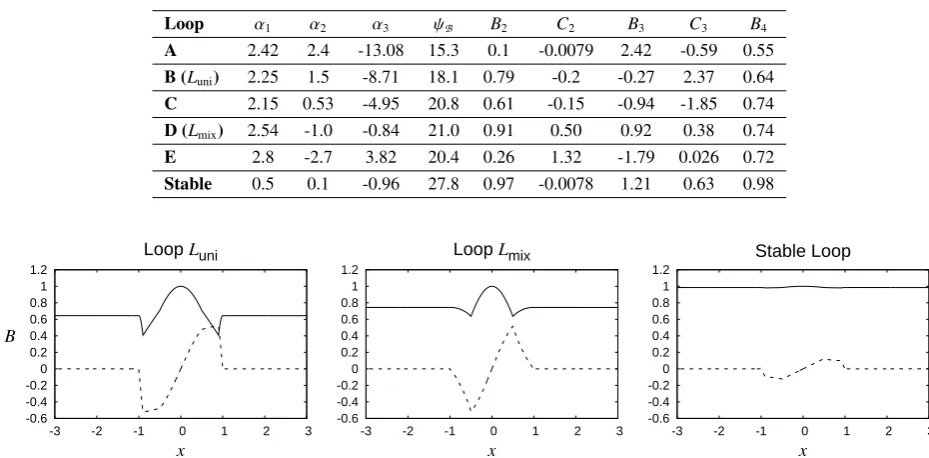
directly by footpoint motions of an initially unidirectional field. The filled circles of Figure 2 identify the loop configurations (see also Table 1) that will be simulated by the LARE3D code (the initial field profiles for Loops B and D are given in Figure 3). All of these configurations are unstable to the ideal kink instability.
Loops of uniform twist (loops A–C) are a more likely result of correlated convective driving (Bareford et al. 2011), where the threshold is approached via a series of steps withδα1≈δα2
— this is the reason why the part of the threshold curve where α2>0 is more finely sampled compared toα2<0. Note, the
sec-tion of threshold on the left of Figure 2 is merely the negative of the section on the right; hence, it is not necessary to sample both threshold sections.
The configurations listed in Table 1 encompass two types of loop; one class whereα1 andα2 have the same sign (A–C) and
Table 1.Theα-profiles, axial fluxes and field coefficients for the simulated loops.
Loop α1 α2 α3 ψB B2 C2 B3 C3 B4
A 2.42 2.4 -13.08 15.3 0.1 -0.0079 2.42 -0.59 0.55
B (Luni) 2.25 1.5 -8.71 18.1 0.79 -0.2 -0.27 2.37 0.64
C 2.15 0.53 -4.95 20.8 0.61 -0.15 -0.94 -1.85 0.74
D (Lmix) 2.54 -1.0 -0.84 21.0 0.91 0.50 0.92 0.38 0.74
E 2.8 -2.7 3.82 20.4 0.26 1.32 -1.79 0.026 0.72
Stable 0.5 0.1 -0.96 27.8 0.97 -0.0078 1.21 0.63 0.98
-0.6 -0.4 -0.2 0 0.2 0.4 0.6 0.8 1 1.2
-3 -2 -1 0 1 2 3
x
Loop L uni
B
-0.6 -0.4 -0.2 0 0.2 0.4 0.6 0.8 1 1.2
-3 -2 -1 0 1 2 3
x
Loop L
mix
-0.6 -0.4 -0.2 0 0.2 0.4 0.6 0.8 1 1.2
-3 -2 -1 0 1 2 3
x
Stable Loop
Fig. 3.The initial analytically-determinedBz (solid) andBθ(dashed) profiles forLuniandLmix. The field profiles for the stable loop (last row of
Table 1) are also shown.
to asLuni (uniform twist) and Loop D will be denoted byLmix
(mixed twist).
Each of the loops indicated in Figure 2 is subjected to a dis-turbance of the form,
vr = c1e−4r 4"
cos π
Lz
!
cos kz−θ #
, (17)
wherevr is the radial component of the perturbed velocity, L
is the loop length,r=px2+y2is the radial coordinate,k=1.1
is the wave number,θ=arctan(x/y), and the constantc1=0.01
reduces the amplitude so that the perturbation is initially linear. This disturbance initiates the kink instability.
Both Luni and Lmix are simulated for low and high
resolu-tions; only the high resolution is used for the other loop configu-rations. Each simulation runs until the magnetic field appears to have settled into a lower energy state.
3. Numerical results
3.1. Energy and resistivity
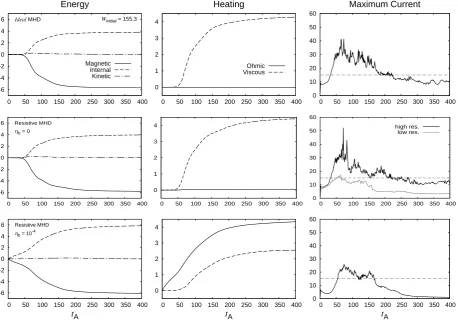
LoopLuni(α1=2.25,α2=1.5) is linearly kink unstable, and the
numerical simulation (Figure 4, middle row) shows that it is also nonlinearlyunstable. The magnetic energy,W, has an initial (di-mensionless) value of 155.3 when integrated over the entire sim-ulation domain,
W = 1
2µ0
Z
B2 dV;
the internal (U) and kinetic (E) energies are also volume inte-grals,
U = 1
γ−1 Z
P dV, E = 1 2
Z
ρv2 dV.
The initial magnetic energy integrated over the loopLunionly is
much less (Wb≈20). All magnetic energies can be dimension-alised by making a simple correction to equation (27) given in
Bareford et al. (2010): since here the axial flux isnotnormalised to 1, the dimensionalising multiplier must first be divided byψ2B, which is the square of the non-dimensional axial flux over the ra-diusRB(Table 1, column 5). For loopLuni, this gives a multiplier
of 4.8×10¹⁹(assuming a radius of 1 Mm and a mean axial field
strength of 50 G): thus, the dimensionalised initial loop energy is roughly 1021J.
At the onset of instability,W undergoes a decrease, coinci-dent with a rise in U and with a much more modest increase in kinetic energy (Emax≈0.2). The maximum current,Jmax, also
rises just before the decrease inW, indicating the formation of a helical current sheet. The nonlinear instability starts at around t=50tAand within the next 50tA, approximately 70% of the
to-tal energy release has been achieved. Magnetic energy reduces more slowly aftert=100tA. The release of magnetic energy is
of a similar size for both resolutions, and significantly, larger currents are recorded at high resolution, which is expected; oth-erwise, spatially-confined changes in current are missed and anomalous resistivity is reduced. The fact that the maximum cur-rent increases with resolution is indicative of curcur-rent sheet for-mation. These structures have (possibly) infinite current density, so higher resolutions should reveal larger values of the maxi-mum.
In the top two cases of Figure 4,idealMHD and zero back-ground resisitivity, it can be seen that there is no detectable change in energy until around 40tA — this is the time when
a current sheet starts to form. The adjectiveideal is italicised because the rate of magnetic diffusion in the corona is easily ex-ceeded by numerical resistivity; therefore, any reduction in mag-netic energy associated with astableconfiguration is artificial. Hence, for the stable case, in which no current sheets ever form, there is no sudden onset of dissipation, only gradual dissipation as expected. In the bottom row of Figure 4 (ηb=10−4), there is a
-6 -4 -2 0 2 4 6
0 50 100 150 200 250 300 350 400 Energy
Ideal MHD W
initial = 155.3
Magnetic Internal Kinetic
0 1 2 3 4
0 50 100 150 200 250 300 350 400 Heating
Ohmic Viscous
0 10 20 30 40 50 60
0 50 100 150 200 250 300 350 400 Maximum Current
-6 -4 -2 0 2 4 6
0 50 100 150 200 250 300 350 400 Resistive MHD
ηb = 0
0 1 2 3 4
0 50 100 150 200 250 300 350 400 0 10 20 30 40 50 60
0 50 100 150 200 250 300 350 400 high res.
low res.
-6 -4 -2 0 2 4 6
0 50 100 150 200 250 300 350 400
t
A Resistive MHD ηb = 10
-4
0 1 2 3 4
0 50 100 150 200 250 300 350 400
t
A
0 10 20 30 40 50 60
0 50 100 150 200 250 300 350 400
t
[image:6.595.75.534.56.376.2]A
Fig. 4.LoopLuni: the temporal variation in energy (magnetic, internal and kinetic), heating (Ohmic and viscous) and maximum current forideal
MHD (top row), for resistive MHD withηb=0 (middle row), and forηb=10−4(bottom row). The initial magnetic energy has been subtracted from
the magnetic energy plots (solid lines, left column). The critical current (Jcrit=15) is indicated by the grey dashed horizontal lines (right column).
For theηb=0 case, the maximum current plots are from the high (black) and low (grey) resolution simulations.
indicates that energy dissipation (conversion from magnetic en-ergy to internal enen-ergy) is closely associated with the existence of current sheets.
However, Figure 4 also shows that energy is not conserved for the two cases mentioned (idealMHD andηb=0). At high
resolution, only∼68% of the energy released from the magnetic field is converted to internal energy, and by the end of the simu-lation, less than one percent of the energy release is in the form of kinetic energy. Halving the spatial resolution worsens the en-ergy conservation by almost 10%. This loss of enen-ergy is due to spatially unresolved current sheets, resulting in numerical diff u-sion. The results forIdealMHD (i.e., zero magnetic diffusivity) are very similar to the ones produced for the resistive MHD case with no background resistivity. This shows that, for these cases, Ohmic dissipation does not contribute significantly to the rise in internal energy, which is instead mainly caused by viscous heating. The use of a non-zero background resistivity (ηb=10−4)
changes the plots. The reduction in magnetic energy starts right away and is more drawn out and the maximum current is much less than whenηb=0. These differences are all consistent with
an increased resistivity. Crucially, Ohmic heating is now clearly present and accounts for nearly all of the previously missing en-ergy. In terms of energy conservation, LARE3D performs better whenηb>0: the internal energy increase is now approximately
96% of the magnetic energy decrease (the final kinetic energy is less than 0.2% ofδW). A background resistivity of 10−4appears
to be the smallest value that effectively minimises the effect of the numerical resistivity, such that the results are likely to be a reasonable description of the thermodynamics. Ifηb is halved,
the percentage of the magnetic energy release lost to the sim-ulation increases to around 10%. Further tests have shown that energy conservation is not improved by a lowering the critical current and thereby causing the anomalous resistivity (ηc) to be
applied earlier in the simulation.
A sufficiently large background resistivity does substantially mitigate the amount of energy lost by numerical resistivity, at least forLuni; butηb=10−4is not realistic by coronal standards,
and Figure 4 (bottom left) reveals a significant drop in field en-ergy before the kink instability takes effect. This initial decline is caused by global Ohmic diffusion rather than magnetic recon-nection, since current sheets have not yet formed. The numerical resistivity comes about when current sheet widths begin to fall below the grid resolution; although magnetic energy continues to be dissipated, it is not converted to other forms of energy (e.g., internal or kinetic). However, shocks can still be resolved during the unstable phase, and these contribute to the internal energy via viscous heating. If the background resistivity is large enough it will limit currents and thereby prevent current sheets from be-coming too thin. Numerical (that is to say artificial) resistivity will be a factor during the conversion process whenηb=0:
ap-proximately 32% of the reduction in magnetic field energy is not accounted for by the final internal energy — this is also true for the other loop configurations. However, virtually all of this arti-ficial resistivity is occurring during the energy conversion. The drop in magnetic energy is a robust result. To demonstrate fur-ther, we have usedidealMHD to simulate a loop (α1=0.5 and
α2=0.1, see Table 1, bottom row) that is well within the stable
-3 -2 -1 0 1 2 3
0 50 100 150 200 250 300 t
A Energy
Resistive MHD
ηb = 0
Winitial = 201.8
-0.5 0 0.5 1 1.5 2
0 50 100 150 200 250 300
t
A Heating
0 5 10 15 20 25 30 35 40
0 50 100 150 200 250 300
t
[image:7.595.78.532.55.172.2]A Maximum Current
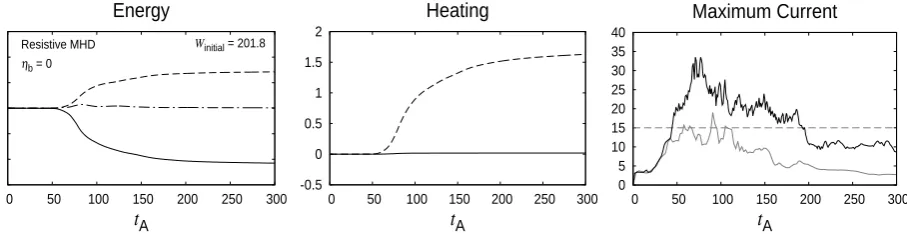
Fig. 5.LoopLmix: the temporal variation in energy (magnetic, internal and kinetic), heating (Ohmic and viscous) and maximum current (low and
high resolution) for resistive MHD withηb=0. The different plot lines follow the same scheme as that used for Figure 4.
(and any applied resistivity), the energy declines by around one thousandth of one percent over 300tA; this reduction is three
or-ders of magnitude smaller than the energy release caused by the kink instability.
LoopLmix(α1=2.54,α2=−1.0) has a core that is oppositely
twisted with respect to its outer layer. Figure 5 shows the same correspondence between the magnetic and internal energies that was seen for the previous loop. Again, the magnetic energy re-lease is of the same size for both resolutions and, at the higher resolution, significantly larger currents are recorded; although the size of the release is around half that found forLuni. Note,
the initial magnetic energy is higher than the value given for the other loop. This is a consequence of setting B1=1:Lmixis less
twisted and therefore has a higher axial flux, which results in a lowerdimensionalisedmagnetic energy.
The general trends for magnetic, internal and kinetic ener-gies are consistent between resolutions (for both loops), and most importantly, so is the size of the magnetic energy lease. Therefore, simulations at higher resolution are not re-quired — this paper will proceed with results taken only from the 2562×512 simulations. The results for the other loop con-figurations on the threshold (Figure 2) also suggest that linear instability evolves to a nonlinear stage, which gives rise to cur-rent sheets, magnetic reconnection and most importantly, shock heating. The following sections will present results based on a current-dependent resistivity and zero background resistivity — this is more compatible with the coronal environment. The breakdown of energy conservation associated with this parame-ter choice can be ignored since we are only inparame-terested in how the magnetic field behaves during and after the instability. However, this issue will have to be addressed for detailed studies of the thermodynamic evolution.
3.2. Magnetic field and current magnitude
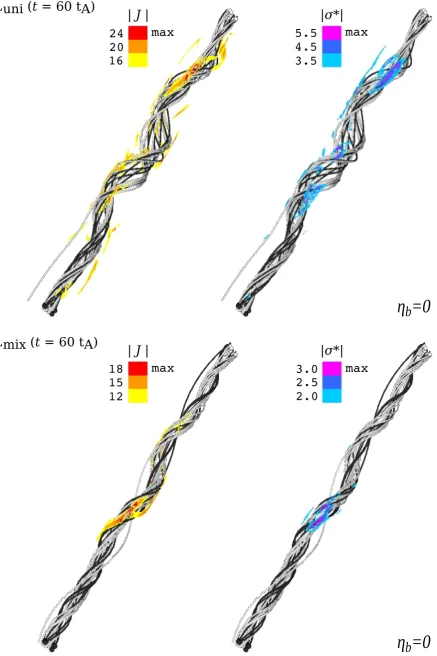
Now we examine the magnetic field (and critical current dis-tribution) at specific times during the simulations. Figure 6 shows how field lines, originally located within the core, be-come kinked as the instability takes hold. The dark grey field lines are drawn from the bottom boundary (or footpoint) and the light grey field lines are drawn from similar locations at the upper boundary. Loops Luni and Lmix follow the same course
of events. Initially, the field lines are intertwined; then, during the growth of the instability, the currents become critical (in-dicated by the yellow, orange and red areas) and anomalous resitivity is applied. The dissipative effects of this anomalous resistivity have a minimal contribution to the internal energy (Section 3.1); instead magnetic energy is dissipated by the ap-plication of viscous heating at shock fronts. Hence, we also
show a proxy for viscous heating, |σ∗|, which is equivalent to σshock
i j /(ρL(ν1cf + ν2L|s|)) — it is represented by the cyan,
blue and purple colours. In general, shocks are coincident with current sheets: i.e., the areas of high viscous heating, as indi-cated by|σ∗|, are cospatial with the largest currents. Note, the
kink instability is more pronounced for Luni than for Lmix. In
terms of azimuthal field, Lmix is the weaker of the two (Figure
3), however, some importance should be attached to the fact that Lmix is twisted both ways. Opposing twists appear to mitigate
the growth of the instability and thereby limit the energy release. If we increase the values of α1 andα2 but keep the opposite
signs, such that the total azimuthal field strength is comparable toLuni(e.g., Loop E), the energy release increases only slightly
(δW≈2.6).
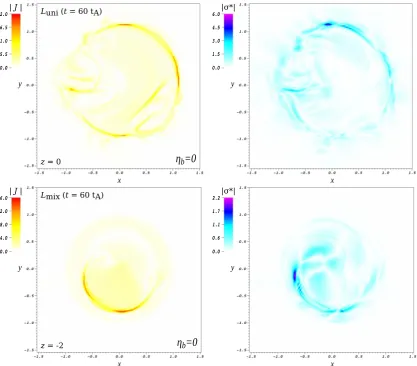
Figure 7 shows cross sections ofLuniatz=0 (halfway along
the loop) and Lmix at z= −2, which is roughly the centre of
the only patch of significant viscous heating forLmixatt=60tA,
see bottom row of Figure 6. Again, the colours represent current magnitudes (left column) and viscous heating (right column), and the plot times are the same as those used for Figure 6; i.e., shortly after the start of the kink instability. At this time, cur-rent sheets of narrow width start to form; furthermore, nearly all of these current sheets are associated with shock formation and viscous heating.
The unstable phase is over quickly (∆t≈50tA) and by the
end of the simulation the (reconnected) field lines have straight-ened considerably, indicative of a low constant-αconfiguration. The areas where shocks have formed must be dispersed through-out the loop volume in order for helicity to be more evenly re-distributed and thereby create a linearα-profile. The reduction in the azimuthal components of the field lines should cause a radial expansion of the loop. At the initial equilibrium, the inward ten-sion force of the azimuthal field is balanced by the outward mag-netic pressure of the axial field; thus, if the tension decreases, the loop must expand before equilibrium can be regained. This be-haviour is clearly demonstrated by Figure 8; note the change in scale for thexandyaxes. The expansion of the loop is mostly associated with the reconnection of initially twisted field lines inside the loop with the ambient axial field. In Figure 8, the fi-nal state calculated by the numerical simulation is overlaid with magnetic field vectors in thex-yplane, which are consistent with a cylindrical configuration, bounded by a current-neutralising layer: the arrows follow each other and the arrow sizes initially increase away from the axis, and then diminish before the loop edge.
LoopLmix expands less thanLuni, which is possibly due to
Fig. 6.Magnetic field lines originating from the bottom left footpoint (dark grey) and from the upper right footpoint (light grey) are shown at t=60tAforLuni(top) andLmix(bottom). At the onset of instability, two plots are shown: one with isosurfaces of current (left) and the other with
isosurfaces of|σ∗|
Fig. 7.The spatial variation of current magnitude (left) and a viscous heating proxy (right) across the loop cross section at the apex (i.e., where z=0) forLuni(top) and atz=−2 forLmix(bottom).
Fig. 8.The spatial variation of current magnitude across the loop cross section at the final time of the simulation forLuni(left) andLmix(right).
All currents are now well below the critical value. The arrows are magnetic field vectors.
following sections will show that the properties of these loops are consistent with relaxation theory.
3.3. Helicity conservation
[image:9.595.96.512.474.655.2]poten-tial for a current-free field that has the same distribution of verti-cal magnetic flux at the lower boundary. DeVore begins by deriv-ing an expression for the scalar potential, usderiv-ing Green’s function for Laplace’s equation as the integration kernel,
φc(x,y,z0,t) =
1 2π
Z +3
−3
dx0 Z +3
−3
dy0 Bz x
0,y0,−10,t
r0 , (18)
wherer0=p(x−x0)2+(y−y0)2+(z0)2. The grid domain used
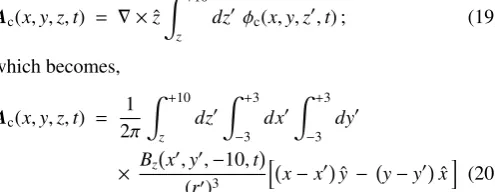
by LARE3D has a Cartesian geometry: the coronal loop is ini-tially represented as a straight cylinder within a rectangular box. Thexandyaxes extend between−3 and+3; hence, the integral limits given above. The photospheric boundaries are located at the limits of thezaxis (z=−10,+10) andz=0 is the loop apex; Eq. (18) uses the first boundary position. The vector potential is constructed using,
Ac(x,y,z,t) = ∇ ×zˆ
Z +10
z
dz0φc(x,y,z0,t) ; (19)
which becomes,
Ac(x,y,z,t) =
1 2π
Z +10
z
dz0 Z +3
−3
dx0 Z +3
−3
dy0
× Bz x
0,y0,−10,t (r0)3
h
x−x0yˆ − y−y0xˆi (20)
when the derivatives are moved inside the integral. Now the gauge-invariant vector potential can be specified as,
A x,y,z,t = A
c x,y,z,t − ˆz×
Z z
−10
dz0 B x,y,z0,t, (21)
by subtracting the helicity due to the potential field, and Eq. (21) can be re-expressed by expanding the cross product of the sec-ond term,
A x,y,z,t = A
c(x,y,z,t) +
Z z
−10
dz0
×hBy x,y,z0,txˆ − Bx x,y,z0,tyˆ i
. (22)
Finally, the gauge-invariant magnetic helicity is
K = Z
V
A·BdV
= Z +3 −3
dx Z +3
−3
dy Z +10
−10
dz A x,y,z,t·B x,y,z,t. (23)
The geometry used by DeVore differs significantly from that used here (Figure 1), which features two separate photospheric boundaries at the limits of thezaxis. Fortunately, the relative po-sitions of the two boundaries mean that if the flux is cancelled for one it will be cancelled for the other, and so the lower bound zcoordinate can simply be set to−10.
[image:10.595.320.550.89.172.2] [image:10.595.46.294.244.340.2]Equations (18)–(23) have been implemented, using the five-point Newton-Cotes integration formula. The marginally unsta-ble loops (Figure 2) have zero net current initially and should continue to do so during the simulation; thus, outside the loop the helicity is zero. This means the helicity, calculated using a straightforward cylindrical geometry, can be compared easily to that calculated for a Cartesian geometry, where the loop is en-closed within a rectangular box. The helicity is zero everywhere in the additional volume between the surface of the rectangular box and the outer edge of a cylindrical potential envelope.
Table 2.Helicity at three times during the simulations (ηb=0)
of all five kink-unstable loops.
Loop Initial Instability Final ∆K/∆W
A 12.3 12.26 (t=50tA) 12.22 0.09
B (Luni) 12.29 12.27 (t=60tA) 12.28 0.03
C 10.47 10.46 (t=100tA) 10.5 0.19
D (Lmix) 6.12 6.12 (t=60tA) 6.11 0.13
E 1.16 1.14 (t=50tA) 1.18 1.32
Table 2 gives the helicities for each loop at three different times. The second time is the time of instability; i.e., when the loop is furthest from equilibrium. The helicity appears to be conserved: it varies little over the course of the simulation. For loops A–D, the helicity varies by less than one percent; whereas for Loop E the helicity increases by∼2%.
Next, we calculate the ratio of the helicity variation to the change in magnetic energy,
∆K
∆W =
ln(Kfinal/Kinitial)
ln(Wfinal/Winitial)
; (24)
both∆K and∆W are weighted by initial value. For four of the five loops, ∆K is around one order of magnitude lower than
∆W (Table 2, fifth column); these results are comparable with Browning et al. (2008). The relationship∆K∆W implies that magnetic energy dissipation is taking place on small spatial scales (i.e., shock fronts). One of the loops (E) has ∆K>∆W; however, it is no coincidence that this loop also has the lowest helicity (Kinitial=1.16). The coarseness of the grid sampling used
to calculate Eq. (23) — thexandydimensions are sampled at every fourth cell and thezdimension at every other cell — is too great for such a small helicity. Hence, for this last loop, the grid sampling is increased from 4×4×2 to 2×2×2, which gives
∆K/∆W≈0.44. A finer sampling and/or higher resolution is re-quired to bring this ratio down to below 0.1.
4. Partial relaxation model
4.1. Analytical calculation
In Browning & Van der Linden (2003), Browning et al. (2008) and Bareford et al. (2010), a loop with net current was assumed to relax such that it expanded to fill the entire potential enve-lope: the α-profile was invariant betweenr=0 andr=3 (RB). Therelaxedalpha was identified by assuming thatψ(axial flux) andK/ψ2(the normalised helicity) were conserved over the loop and envelope, in accordance with Taylor relaxation. The only limit to the relaxation is the position of an (unphysical) bound-ing wall. Hence, the relaxed state always represented a threefold radial expansion of the initial state. Later, Bareford et al. (2011), considered a range of relaxation radii: Rb≤r≤RB. Some form of partial relaxation is more likely to be relevant to the zero-net-current case; it is known from simulation results, presented here and in Hood et al. (2009), that reconnection is of limited extent, leaving much of the external field undisturbed. This contrasts with previous results for loops carrying net current (Browning et al. 2008), in which the disturbances in the nonlinear phase of the kink generally extended to the boundary of the simulation.
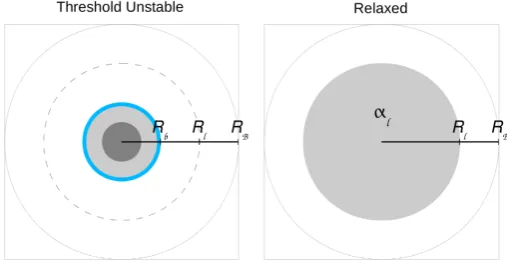
Fig. 9.The unstable and relaxed loop.K/ψ2is conserved over the
re-gion enclosed by the dashed circle, which is the outer boundary (Rl) of
the relaxed loop.
the potential envelope, so that they do not change during relax-ation. In the relaxed state, the envelope is the region betweenRl andRB. Naively, it might have been expected that the partially-relaxed state would consist of a constantαfield embedded di-rectly in a potential field (α=0) with no layer of reversed cur-rent. However, such an arrangement doesnotmatch the simula-tion results, see Secsimula-tion 4.1.1. Furthermore, it would be unphysi-cal for the partially-relaxed state to include a region of azimuthal field extending to infinity, which is the consequence of allowing net current, since in the initial state, the azimthal field is zero outside the loop. The existence of current sheets (here broadened into a narrow current-neutralising layer) bounding localised re-laxed states has also been noted by Gimblett et al. (2006). The axial flux is conserved such thatψl of the threshold state is equal toψl of the relaxed state. The subscriptl denotes the relaxation radius, Rl; it is the radial upper bound over which the associ-ated property is calculassoci-ated — the lower bound being the axis. For example,ψl is the axial flux fromr=0 tor=Rl (similarly, KBis the helicity fromr=0 tor=RB, the outer edge of the po-tential envelope). This method of conservation is illustrated by Figure 9. Left, is the marginally unstable threshold state; the ra-dius that this loop will expand to is indicated by the dashed cir-cle; right, is the expanded relaxed loop. We might expect that, ei-ther the relaxed loop flux (ψl) matches the initial loop flux (ψb), or it matches the initial flux within the radius (Rl) eventually at-tained. The former is correct if the field freely expands into the surrounding field. The latter choice is made if the loop radially expands by reconnection; i.e., the loopeats intothe surrounding axial field. This outcome agrees much better with the simulation results (again see Section 4.1.1). If the loop did not reconnect with its surroundingsand expand to a radius of 1.8Rb (as for Luni), then the axial field would drop by a factor of 1.82, which is
not observed. (The slight mismatch between the numerical and analytical axial field profiles seen in Figure 11 is probably due to some limited free expansion of the loop.)
The relaxation alpha (αl) is determined by ensuring that the axial flux and helicity integrated over the dashed circle in Figure 9 (left), match the values obtained when these same proper-ties are integrated over 0≤r≤Rl of the relaxed loop (Figure 9, right). Also, helicity is absent from the potential envelope sur-rounding a zero-net-current loop; hence,Kb=KB (unlike mag-netic energy,Wb,WB). Thus, we do not need to choose which value of helicity to use. Once αl is known, the energy release can be determined analytically;
δW = Wl(αi1, αi2)−Wl(αl), (25)
whereWl(αi1, αi2) is the energy of the threshold state andWl(αl) is the energy of the relaxed state.
0 0.5 1 1.5 2
1 1.5 2 2.5 3 Rl
Relaxation Alpha
αl
0 1 2 3 4 5 6 7
1 1.5 2 2.5 3 R
l Energy Release
δW
Fig. 10.The variation with relaxation radius (Rl) of relaxed alpha (αl,
left) and of dimensionless energy release (δW, right) forLuni(solid line)
and forLmix(dashed line).
The relaxation radius (Rl) remains as a free parameter, al-though sensible values can be inferred from the numerical re-sults. Figure 10 shows howαl andδW vary with relaxation ra-dius. As expected, these figures show an inverse relationship be-tweenαl andδW. In general, δW increases withRl, however, this relationship is not linear; beyond a moderate expansion of 50% (Rl =1.5) the energy release is∼99% of its maximum for Lmix and∼80% forLuni. This property of diminishing returns
is also true for the other three loops indicated in Figure 2. This means that the energy release is insensitive to the choice of re-laxation radius, so long as it is assumed thatRl&1.5.
4.1.1. Numerical Relaxed States
The final numerically-determined state is merely the last snap-shot provided by the simulation; it is expected to be close to the analytically-determined relaxed state. Each loop is simulated for at least 300tA; so, the sooner the instability occurs, the closer the
loop will be to a fully relaxed state by the end of the simulation. The Cartesian components of the analytical relaxed field are as follows,
Bx(r) = −Bθ(r)(y/r), (26)
By(r) = Bθ(r)(x/r), (27)
Bz(r) = B1J0(|αl|r), (28)
where Bθ(r)=(αl/|αl|)B1J1(|αl|r) andr≤Rl. We generate re-laxed configurations for every value ofRl between 0.9 and 3.0 in increments of 0.01. Then, for each field component, it is checked which of the 211 possibilities has the lowest chi-squared value when compared with the numerical values for the same com-ponent. These field comparisons (Bx,ByandBz) are performed
over the x dimension for a selection of fifteen y-zcoordinate pairs (y∈ {−1,−0.5,0,+0.5,+1},z∈ {−5,0,+5}) — the horizon-tal dashed lines of Figure 13 (left) indicate theypositions of the field plots.
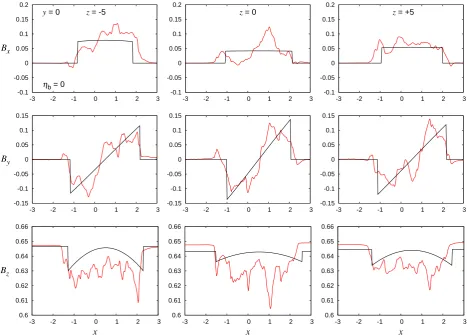
As a result of the kink instability, the loop axis will be shifted from the origin in thex-yplane. The new axis position will be z-dependent and can be recalculated by assuming that the relaxed loop is current neutralised (Figure 8): moving inwards from the edge of the envelope, the loop boundary is detected whenever the α-value rises above some minimal value. Any axis shift is taken into account before the analytical results are compared with the numerical data. Figure 11 presents a subset of the analytical-numerical comparisons forLuniaty=0.
[image:11.595.311.561.95.185.2]-0.1 -0.05 0 0.05 0.1 0.15 0.2
-3 -2 -1 0 1 2 3
Bx
y = 0 z = -5
ηb = 0
-0.1 -0.05 0 0.05 0.1 0.15 0.2
-3 -2 -1 0 1 2 3
z = 0
-0.1 -0.05 0 0.05 0.1 0.15 0.2
-3 -2 -1 0 1 2 3
z = +5
-0.15 -0.1 -0.05 0 0.05 0.1 0.15
-3 -2 -1 0 1 2 3 By
-0.15 -0.1 -0.05 0 0.05 0.1 0.15
-3 -2 -1 0 1 2 3 -0.15
-0.1 -0.05 0 0.05 0.1 0.15
-3 -2 -1 0 1 2 3
0.6 0.61 0.62 0.63 0.64 0.65 0.66
-3 -2 -1 0 1 2 3
x Bz
0.6 0.61 0.62 0.63 0.64 0.65 0.66
-3 -2 -1 0 1 2 3
x
0.6 0.61 0.62 0.63 0.64 0.65 0.66
-3 -2 -1 0 1 2 3
[image:12.595.69.537.54.389.2]x
Fig. 11.LoopLuni: a comparison between theBx(top row),By(middle row) andBz(bottom row) magnetic field profiles obtained numerically
(red line) and analytically (black line). The latter is calculated from theαl andRl that best fit the numerical plot, which is taken from the final
frame (t=400tA) of the high resolution LARE3D simulation (ηb=0). The comparisons are done aty=0 for differentzcoordinates,z=−5 (left
column), 0 (middle column) and 5 (right column).
andαl that best fit the red lines are independently chosen for each of the forty-five subplots (there are fifteeny-zpositions and three field components). Figure 12 (left) shows the variation in these best-fit parameters: each symbol, by virtue of its position, gives theRl−αl pair that best fits the numerical data extracted at specificyandzcoordinates within the simulation domain — the symbol type denotes which field component is being matched. The use of two x-axes (one forRl, the otherαl) means that all forty-five symbols can be clearly distinguished (they-axis has no meaning beyond a simple sorting of the data points). The derived averages arehRli=1.76 ± 0.29 andhαli=0.28 ± 0.31; these two properties have a one-to-one mapping. The dimensionless energy release is 5.87 ± 1.11. Despite the large scatter forαl, the deviation for δW is comparatively modest, this is because d(δW)/d(Rl) is small whenRl≈1.8 (Figure 10, right). Figure 12 suggests that the final numerically-calculated state is tending towards a relaxed loop that can be characterised by a localised invariantα-profile. (Note, all points would lie on a single ver-tical line if there were a perfect match between the analyver-tical and numerical models.) The outlying points on the left haveαl values that are further from hαlithan those on the right, since the relationship betweenαl andRl is not linear (Figure 10, left) - this explains the large deviation for the relaxation alpha. Low levels of magnetic field that fluctuate around the zero line tend to be fitted by lowαl values; whereas values significantly greater than the mean imply that high currents still exist within the fi-nal numerical state. Both of these effects can be ameliorated
1 1.5 2 2.5 3
1.63 0.39 0.13 0.05 0.02
Rl
αl
ηb = 0
Bx By Bz
1 1.5 2 2.5 3
1.63 0.39 0.13 0.05 0.02
Rl
αl
ηb = 10 -4
Fig. 12.LoopLuni: the best-fitRl-αl pairs whenηb=0 (left) and when ηb=10−4 (right). Black circles are for those best fits determined from
Bzprofiles, red plus signs are forBxand blue crossesBy.
[image:12.595.310.562.456.609.2]Table 3. Analytical and numerical comparison for the kink-unstable loops A–E.
Analytical Numerical
Simulation Rl αl K |δW| K |δW|
A 1.9 0.25 12.89 8.47 ±0.42 12.19 8.31
B (Luni) 1.76 0.28 12.92 5.87 ±1.11 12.3 5.8
C 1.8 0.2 11.03 3.7±0.42 10.52 3.15
D (Lmix) 1.59 0.19 6.45 2.38 ±0.28 6.14 2.15 E 1.18 0.19 1.22 2.63 ±0.11 1.15 2.58
The overall impressive level of agreement demonstrated for Luni, also extends to other positions along the instability
thresh-old, see Table 3. This table also confirms that the analytically-calculated helicities of Loops A–E are in approximate agree-ment with the numerical values, which were derived accord-ing to the procedure discussed in Section 3.3. The correspon-dence between the numerical and analytical energy releases is the most significant finding. There is evidence to suggest that this correlation persists even when different settings are used for the LARE3D parameters controlling resistive MHD (Section 3.1 and Figure 4). In addition, these results are consistent with pre-vious work (Browning et al. 2008; Hood et al. 2009).
4.2. Final Current Distribution
The jaggedness of the numerical field profiles shown in Figure 11 clearly indicates that there are deviations from a simple locally-constant αprofile. We show the value of αcomputed
y
α = j⋅B/|B|2
ηb = 0
-2 -1.5 -1 -0.5 0 0.5 1 1.5 2 2.5 x -1.5 -1 -0.5 0 0.5 1 1.5 2 2.5 -8 -6 -4 -2 0 2 4 6 8 y
β = 2P/|B|2
-2 -1.5 -1 -0.5 0 0.5 1 1.5 2 2.5
[image:13.595.41.299.98.193.2]x -1.5 -1 -0.5 0 0.5 1 1.5 2 2.5 0 0.02 0.04 0.06 0.08 0.1 0.12
Fig. 13.The value ofα(left) andplasma-β(right) over thex-yplane forLuni(ηb=0). The grey circle approximates the loop cross section at
z=0 andt=400tA.
over the midplane (z=0) of Luni, see Figure 13. A grey
cir-cle based on the current magnitude plot of Figure 8 (left) has been used to approximate the shape of the cross section. There are many, albeit confined, areas that are far from the calculated mean,αl =0.28. The influence of the initialα3(theα-value for
the current neutralisation layer) can be seen in the limits of the colour bar. In addition, plasma-β (Figure 13, right) has, com-pared to initial values of 10−3, undergone localised increases of
up to two orders of magnitude.
The cosine of the angle between the current and the mag-netic field is plotted in Figure 14; note, positions outside the loop are left unplotted. The current is either parallel (white) or anti-parallel (black) to the field for a high percentage of the cross sectional area (positions that are far from parallel, 20◦<j∠B<160◦, account for approximately 30% of the loop
cross section). Almost three quarters of the energy released from
y
j⋅B/(| j||B|)
-2 -1.5 -1 -0.5 0 0.5 1 1.5 2 2.5 x -1.5 -1 -0.5 0 0.5 1 1.5 2 2.5 -1 -0.8 -0.6 -0.4 -0.2 0 0.2 0.4 0.6 0.8 1 y
B⋅∇P/(|B||∇P|)
-2 -1.5 -1 -0.5 0 0.5 1 1.5 2 2.5 x -1.5 -1 -0.5 0 0.5 1 1.5 2 2.5 -1 -0.8 -0.6 -0.4 -0.2 0 0.2 0.4 0.6 0.8 1
Fig. 14.Left, the cosine of the angle between the current and the mag-netic field over thex-yplane.Right, the cosine of the angle between the magnetic field and the gradient of the pressure over the same area. Positions outside the grey circle, representing the loop cross section, havenotbeen assigned a colour. The background resistivity is zero.
the field becomes internal energy (i.e., thermal pressure), which may be associated with departures from a force-free state (al-though Taylor relaxation would predict a uniform pressure dis-tribution). However, it seems that the loop is heading towards an approximate balance of forces (j×B=∇P): Figure 14 (right) shows that the angle between the field and the pressure gradient is on average close to zero. Interestingly, the parallel and anti-parallel areas are often found next to each other and therefore might be expected to cancel at later simulation times. The plots of Figures 13 and 14 are qualitatively similar to those taken at otherzcoordinates that are not too close to the footpoints (e.g., −5<z<5).
5. Summary and conclusions
A nonlinear 3D MHD code has been used to simulate the evo-lution of a set of zero-net-current cylindrical loops. These loop configurations have been identified by a linear analysis as be-ing marginally kink unstable (Bareford et al. 2011). The sim-ulations show that the instability quickly enters a nonlinear phase and magnetic energy declines sharply before leveling off. Furthermore, the amount of energy released matches the amount predicted by Taylor relaxation (Table 3), taking account of the fact that the relaxation is localised. Evidence for helicity conser-vation was presented, and the change in helicity was shown to be much smaller than the drop in magnetic energy. The implication of this result is that energy diffusion is occuring on small scales compared to the global length scale; i.e., within shocks associ-ated with magnetic reconnection. The low values of kinetic en-ergy during the unstable phase (compared to the internal enen-ergy) imply that these shocks occur near to reconnection sites. (We find that dissipation within current sheets only becomes signifi-cant whenηb=10−4.) Further research could reveal exactly how
magnetic reconnection spreads through the loop volume in re-sponse to a kink instability, which would also reveal where the loop is heated and when. It is this widespread dispersal of recon-nection and shock heating that ensures helicity conservation. At present, we cannot confirm the nature of the shocks: slow-mode shocks are expected since only shocks of this type can reduce magnetic field strength.
[image:13.595.45.298.419.527.2]energy of the same constant-αstate (the field energy is insen-sitive to the spikeness of the numerical data). The property of zero net current is retained after the instability. Typically, the loop expands radially, the field reconnecting with that present in the potential envelope. These results justify the choices made by Bareford et al. (2011) regarding the details of the relax-ation process. Nevertheless, we were concerned that the thin-ness of the current neutralisation layer (Figure 1) might have influenced the results. Hence, we also ran a resistive MHD sim-ulation (withηb=0) for a zero-net-current equilibrium that
pos-sessed a smoothα-profile, see Case 3 of Hood et al. (2009). The constant parameter,λ=1.62, was set such that the equilibrium was on the threshold of instability. We found that the simula-tion results were similar to those produced byLmix. Numerically,
the energy release was 1.2, which was again consistent with the analytically-determined value.
It appears that the assumption of a Taylor-relaxed state, sub-sequent to a kink instability, has been verified by the work pre-sented here. The relaxation does not extend over the full numer-ical volume, but over a region of smaller extent (out to a ra-dius Rl, which is less than the full radius,RB). In this sense, the relaxation is partial. A relaxed state can only be identified if the relaxation radius is known; at present, it is unclear howRl can be precisely determined from the field configuration at insta-bility onset. However, the analytical work has revealed that for marginally-unstable loops, the energy release varies little with relaxation radius onceRl ≥1.5 (Figure 10); hence, a calculation of the energy release does not necessarily require a precise pre-diction forRl.
Energy release could be limited if the unstable loop attains an equilibrium that is less than fully relaxed (i.e., theα-profile remains nonlinear) and still conserves helicity. There is perhaps, for some field configurations, another constraint that decides the relaxed state, such as the topological degree of the field line map-ping between the ends of the loop, as investigated by Yeates et al. (2010). They examined two braided magnetic field config-urations (one based on the simple pigtail braid and the other more complex). Both configurations underwent turbulent relax-ation, leading to a final state that conserved topological degree and waslessrelaxed than that predicted by Taylor theory — the final state for the pigtail braid featured two flux tubes of oppo-site twist. Nevertheless, it is possible for the Taylor-relaxed state and the state that preserves topological degree to coincide. In our case the invariants given by Yeates et al. do not provide any extra constraint, making our results consistent with their predictions. This would explain the level of agreement between the LARE3D simulations and Taylor relaxation.
An issue for further research concerns the interaction of con-vective driving with the relaxation process. The LARE3D code could be used to help resolve this issue. It should be possible to choose a loop configuration (i.e., a set ofα-parameters) that is just inside the threshold for linear kink instability and then, trigger the instability by applying a pre-determined velocity pro-file (vθ) at one of the footpoints. Loop curvature has also not been considered. The linear stability codes require an analytical form for the magnetic fields. If a loop is to retain its curvature, it can only be simulated numerically, which means choices have to be made concerning loop parameters (e.g., length, radius andα -profile). Usefully, those straightened loop configurations that are kink unstable and are likely to be reached by convective driving have been identified. These configurations could be adapted to include curvature and re-simulated within LARE3D. This would reveal what effect, if any, curvature has on the energy release precipitated by kink instability. Of course, this procedure could
also be applied to other improvements; e.g., gravity (withρ(z)), conduction and radiation. However, a feature that improves the realism of the loop model may not be important as regards kink instability and Taylor relaxation.
References
Arber, T. D., Longbottom, A. W., & Van der Linden, R. A. M. 1999, ApJ, 517, 990
Arber, T. D., Longbottom, A. W., Gerrard, C. L., & Milne, A. M. 2001, J. Comput. Phys., 171, 151
Aschwanden, M. J., & Acton, L. W. 2001, ApJ, 550, 475 Baty, H., & Heyvaerts, J. 1996, A&A, 308, 935 Baty, H. 2000, A&A, 360, 345
Bareford, M. R., Browning, P. K., & Van der Linden, R. A. M. 2010, A&A, 521, A70
Bareford, M. R., Browning, P. K., & Van der Linden, R. A. M. 2011, Sol. Phys., 273, 93
Berger, M. A., & Field, G. B. 1984, J. Fluid. Mech., 147, 133 Berger, M. A. 1999, Plasma Phys. Control. Fusion, 41, B167 Botha, G. J. J., Arber, T. D., & Hood, A. W. 2011, A&A, 525, A96+ Browning, P. K., Sakurai T., & Priest, E. R. 1986, A&A, 158, 217 Browning, P. K. 1988, J. Plasma Phys., 40, 263
Browning, P. K., & Van der Linden, R. A. M. 2003, A&A, 400, 355
Browning, P. K., Gerrard, C., Hood, A. W., Kevis, R., & Van der Linden, R. A. M. 2008, A&A, 485, 837
DeVore, C. R. 2000, ApJ, 539, 949
Dixon, A. M., Berger, M. A., Browning, P. K., & Priest, E. R. 1989, A&A, 225, 156
Evans, C. R., & Hawley, J. F. 1988, ApJ, 332, 659
Finn, J. M., & Antonsen, T. M. 1985, Commun. Plasma Phys. Controlled Fusion, 9, 111
Fletcher, L. 2009, A&A, 493, 241
Gerrard, C. L., Arber, T. D., & Hood, A. W. 2002, A&A, 387, 687 Gerrard, C. L., & Hood, A. W. 2003, Sol. Phys., 214, 151
Gimlett, C. G., Hastie, R. J., & Helander, P. 2006, Plasma Phys. Control. Fusion, 48, 1531
Haynes, M., & Arber, T. D. 2007, A&A, 467, 327
Heidbrink, W. W., & Dang, T. H. 2000, Plasma Phys. Control. Fusion, 42, L31 Heyvaerts, J., & Priest, E. R. 1984, A&A, 137, 63
Hood, A. W. 1992, Plasma Physics and Controlled Fusion, 34, 411
Hood, A. W., Browning, P. K., & Van der Linden, R. A. M. 2009, A&A, 506, 913
Hudson, H. S. 1991, Sol. Phys. 133, 357
Melrose, D. B., Nicholls, J., & Broderick, N. G. 1994, J. Plasma Phys., 51, 163 Priest, E. W., Longcope, D. W., & Heyvaerts, J. 2005, ApJ, 624, 1057 Qiu, J. 2009, ApJ, 692, 1110
Srivastava, A. K., Zaqarashvili, T. V., Kumar, P., & Khodachenko, M. L. 2010, ApJ, 715, 292
Taylor, J. B. 1974, Phys. Rev. Lett., 33, 1139 Taylor, J. B. 1986, Rev. Mod. Phys., 58, 741
Van der Linden, R. A. M. 1991, Ph.D. Thesis (Katholieke Universiteit Leuven) Van der Linden, R. A. M., & Hood, A. W. 1999, A&A, 346, 303
Van Leer, B. 1997, J. Comput. Phys., 135, 229
Vekstein, G. E., Priest, E. R., & Steele, C. D. C. 1993, ApJ, 417, 781 Velli, M., Lionello, R., & Einaudi, G. 1997, Sol. Phys., 172, 257 Wilkins, M. L. 1980, J. Comput. Phys., 36, 281
Withbroe, G. L., & Noyes, R. W. 1977, Ann. Rev. Astr. Ap., 15, 363