Munich Personal RePEc Archive
Shared ecological knowledge and wetland
values: a case study
Franco, Daniele and Luiselli, Luca
Planland Org., Eni Group
April 2014
Online at
https://mpra.ub.uni-muenchen.de/66496/
Shared ecological knowledge and wetland values: a case study
Daniel Francoa, Luca Luisellib
a
Planland - Studio Tecnico Daniel Franco, via Paolo Giovio 1*- 00179 Roma (Italy)
b
Eni Group-Nigerian Agip Oil Company Environmental Department, Lagos (Nigeria) /
Centro Studi Ambientali Demetra s.r.l., Roma, Italy
Keywords
Wetlands; ecosystem services; ecological functions; public goods; multiple motivation
analyses; environmental awareness; perceived utility
Highlights
We analyze citizens’ shared ecological knowledge (SEK) of wetlands functions to
describe its nature, its relation with the official knowledge, the relation between the
motivations outlined by SEK and those expected by the standard economic model.
Wetlands functions’ SEK is related to wetlands living proximity and unexpectedly
diminishing for some long since acquired critical services
There is a separation between official knowledge and SEK on crucial aspects like
wetlands’ climate change role.
Economic preferences are driven by multiple motivations well rooted in SEK social
nature and not by simply consequential motivations.
This approach helps to transfer a socio-cultural complex capital into a public
Abstract
The estimation of wetlands’ non-use values to build up a total economic evaluation can be
based on stated preference methods, which derives from the standard economic model that
assumes a rational assessment of the consequence of preferences on personal utility. The
paper describes the citizens’ shared ecological knowledge (SEK) of wetlands functions. It
descibes SEK nature, SEK relation with the official knowledge, the relation between the
motivations outlined by SEK and those expected by the standard economic model. The
results demonstrate that economic preferences are driven by multiple motivations well
rooted in the SEK’s social nature, and not by simply consequential motivations. In this case
study, social knowledge of wetlands' ecological functions is proportionally related to
people's living proximity to those wetlands. Unexpectedly, SEK of historically well-known
and critically important services like hydraulic and hydrologic services has also been
diminishing. Furthermore, there is a partial or clear-cut separation between official
knowledge and SEK on crucial aspects like wetlands’ climate change role. This approach
helps to construct a motivational framework to derive values that are useful as long as they
allow accounting for a complex socio-cultural capital in the public decision making process.
Introduction
In the first half of the 20th century wetlands were perceived by several social groups as
noxious areas hampering economic development and landscape exploitation (Boyer and
Polasky 2004). These beliefs brought about the destruction of a great part of these
ecosystems, but in recent decades their perception has changed dramatically. The Ramsar
Convention on wetlands (1971) was an example of this change.
Wetlands perform multiple functions that in turn produce multiple benefits (Table 1; see
Brander et al. 2006; Costanza et al. 1997; Millennium Ecosystem Assessment 2003-2005).
Wetlands may also produce some benefits competing with those produced by engineering
systems, e.g. wastewater treatment systems (Kadlec and Knight 1996; Mannino et al.,
wetlands is still diminishing, partly because the wetland functions they generate are not
associated with some recognizable monetary values (TEEB 2009). For these reasons the
economic valuation of environmental resources is an increasingly common practice, meant
as the monetary quantification of the benefits (or costs) resulting from the preservation (or
the destruction) of an environmental resource (Adams 1993; Hanemann 1999).
This paper comes from a wider research work used by the Province of Rome (Italy) to
define a set of total economic values for a corresponding set of ecological systems
(wetlands, woods, rural landscape) of its territory. Total economic value is the total amount
of resources that citizens would be willing to forego for an increased amount of ecosystems
services (Turner at al. 2003). The non-market components of the total economic values
were estimated by means of stated preference methods like contingent valuation, that is
one of the widely usable method to estimate the individuals willingness to pay (WTP) for
ecosystem services in a credible proposed market (Bateman et al., 2002; Pagiola et al.,
2004). These total economic benchmark values have been made public
(http://websit.provincia.roma.it:8080/Benicomuni) to stimulate their use by community
(public/private, economic/social) actors in all allowed negotiations or transactions.
This work focuses on the analyses of the citizens’ shared knowledge of wetlands ecological
functions used in a contingent valuation approach, because this kind of knowledge -
overlapped with the official (e.g. scientific/normative) knowledge – is supposed to inform the
individual preferences expressed by WTP, as assumed by the utilitarian philosophy that
underpins the standard economic model.
We examined in depth this aspect because we assumed that the use of monetary
estimates in public decision making about land use policy– especially in a concrete case,-
is only sustainable as long as it is explicitly connected to the socio-cultural complex capital
which generate them.
Shared knowledge is defined as a cumulative body of knowledge and beliefs shared in the
community by cultural transmission that, for these reasons, become social memory (Berkes
Even if not always with brilliant results (Diamond, 2005), social memory has historically,
and all over the world, structured the local communities’ decision making processes in
ecosystems and landscape management (Franco et al., 2007; Horstman & Wightman,
2001). Therefore its loss represents a problem.
The shared ecological (or cultural: Orcherton, 2012) knowledge is a dynamic entity able to
register changes and based on what has been learnt from trial and error management
practices. For all these reasons this kind of social capital is more and more used by means
of participatory approaches even in rural development programs (Anegbeh et al., 2004) or
in natural resource research and programs (Castello et al., 2009; MacDonald & Weber,
1998; Rist et al., 2010; Shen & Tan, 2012).
The aim of the paper is to analyze: (i) the nature of the community citizens’ knowledge of
wetland ecological functions; (ii) the relation of the citizens shared knowledge with the
scientific official knowledge, (iii) the relation between the motivations outlined by this shared
knowledge and those expected by the standard economic model in ecological services’
preference; (iiii) the role of the obtained results in land use policy decision making.
Materials and Methods
The Rome region occupies the flat area of the Tiber Valley and the Tyrrhenian Sea, and
was characterized by a widespread coastal wetland system that disappeared after the
“great reclamation” during the first half of the XIX century. A recent national wetlands
inventory (http://sgi2.isprambiente.it/zoneumide/) led by the Mediterranean Wetland
Initiative identified 24 wetlands covering 9302.79 ha. These wetlands were mainly classified
as inland type, with a mean and median values of 387 and 65 hectares respectively.
Considering that the aim of this research was not site-specific, our survey regarded the
whole province system of wetlands.
The survey was carried out during the summer of 2010: 81 respondents were interviewed in
A questionnaire was designed (i) to depict the relation between sample individuals profile
and shared knowledge / awareness about wetlands ecological functions, (ii) to reduce the
biasing factors of the CV method, e.g. starting point, scenario rejection, free-riding (Franco
& Luiselli, 2013).
The 1st section of the questionnaire proposed the rationale for the interview to reduce
interviewee weariness, expressed by the research aim of the interview and the importance
of the respondent role in this research. Then a complete yet simply defined definition of
wetland, with a follow up phase to clarify possible doubts (that nobody had).
In the 2nd questionnaire section the interviewers proposed a list of careful syntheses of the
range of wetland functions loading services and associated socio/economic benefits as
classified by scientific / normative ecological knowledge (Brander et al., 2006; Costanza et
al. 1997; Leschine et al. 2004; Millenium Ecosystem Assessement 2003-2005). The
wetland ecological services were carefully described as separated statements that
respondents were asked to comment on a five point Likert scale. The statements were
formatted in an easily understandable way, balancing simplicity, clarity and time requested
to the respondent (Table 1).
In this way we defined a robust scenario for each respondent to activate a personal
cognitive map of wetlands ecological knowledge and correspondent benefits.
Given that in this region wetlands no longer have detectable direct economic use values,
we must assume that: (i) the relationship between the individual level of agreement /
disagreement and the knowledge uncertainty about the stated functions / benefit represents
the individual level of information motivating the citizen behavioural preferences; (iii) the
individual motivations for the ecological functions monetary valuing assessed by the CV are
located inside these benefits categories. That is, the more uncertain is the judgment about
an ecosystem service - among the listed ones - the less informed is the resultant WTP, and
vice-versa. Indeed, the economic standard model postulate that individuals can express a
WTP having a well informed preference, like in other less egoistic (Schwartz, 1993) or
In our case the very few “simple” disagreement judgments were actually based on
uncertain answers (I’m not sure, but; perhaps, but I do not know; etc), therefore we merged
these few response to the general uncertain class (I do not know).
During the last interview part, the questionnaire was used to register the demographic,
socio-economic, cultural and geo-spatial attributes of the respondents. Data were grouped
into ordinal scale intervals and used as independent variables: age (17-30, 30-44, 45-64,
>64); schooling (none, lower school, junior high school, high school, Bachelor’s degree,
Master’s degree, PhD); employment (Housewife-student-unemployed,
workman-pensioner, white collar, manager. self-employed – professional); income (t € / year: 0-10,
10-20, 20-30, 30-40, 40-60, >60); respondents’ family (1, 2-4, > 4); . association
belonging (none, other, rural union, environmental, fishing-hunting); sex; respondents’
residence (urban, urban fringe, rural); distance of the respondents’ domicile from the
nearest wetland. We selected this minimum number of variables to balance the criteria of
simplicity, clearness, and admissible interview time and: (i) to analyze the
demo-socio-economic and cultural effects on individual and communities shared ecological knowledge /
awareness, (ii) to account, regarding the overall contingent valuation approach, for the
economic standard model theoretic expectations (Franco & Luiselli, 2013). In fact, we
expect that these characteristics help to represent the nature and the strength of the
motivations that hold up a stated preference (Ajzen 1991; Ryana and Spash, 2011; Spash
et al., 2009).
We used a robust survey approach (Tolley and Fabian 1998) with face-to-face structured
interviews (Bernanard, 1996) and interviewers training to maximize the homogeneity of the
information, the research neutrality, and to reduce the interviewees’ distrust. To include the
elderly / rural population component, we did not use an internet approach, even if it has
been shown of comparable efficiency (Lindhjema & Navrudb, 2011),.
We explored the possible role of shared ecological knowledge on wetland ecological
services preference, so we did not use other techniques (open and semi-structured
research (Palomo et al., 2011; Gómez-Baggethun et al., 2012) for other purpose, like
building participatory process for managing purpose.
We carried out the survey by evenly distributing the interviews in different places
(marketplaces, mainstreets, railways stations, etc.) of the towns (Ladispoli and Cerveteri)
nearest to wetlands residual patches, during all daytime periods and intercepting Rome’s
commuting flux in the city railway stations.
We assessed the sample’s statistical representativeness and we filtered out free riders
and/or outliers by an interactive cross validation reliability procedure fully reported
elsewhere (Franco & Luiselli, 2013).
Statistical models
We used logit models in order to analyze complex interactions among dependent variables
(respondents’ judgment about wetlands functions) and partially autocorrelated predictors
(Hosmer and Lemeshow 1989). We used only sufficiently non-autocorrelated (r<0,70)
predictors in univariate logit models, by means of backward logistic regression modeling,
with a uniband option and iterations stopped at P < 0.001 (Luiselli 2006a). Models
robustness was evaluated by F-test values (α = 5%), with the higher the F-value the better
the fit to a data set (i.e., the better the model). We also used the second order (AICc;
Burnham and Anderson 2002; Hamer et al. 2006) Akaike Information Criterion (Akaike
1973) which allows models’ ranking by means of their relative likelihood and not by any
threshold (alpha-level, Vapnik 2000). Analyses were carried out with STATISTICA (StatSoft
release 10), SPSS (release 10.0, Norman, 1999) and writing the functions for calculating
means and medians in logit functions in R (R Development Core Team 2008).
Results
The sample resulted statistically representative of the considered universe (Rome county),
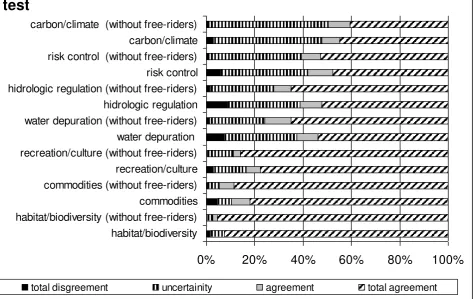
as reported elsewhere (Franco & Luiselli, 2013). Graphic analyses (Figure 1) and
functions/benefits. Total dis-agreement, that anyhow imply a clearly focused knowledge
and motivation, was negligible for all the stated functions/benefits.
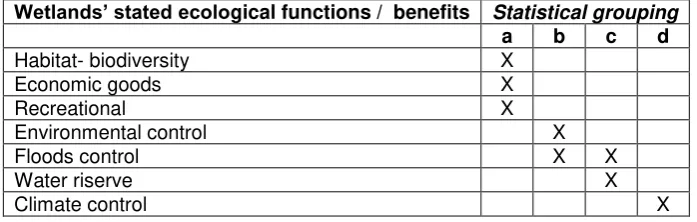
The sharing of the knowledge agreement was nearly total in a first group of functions:
habitat/biodiversity, recreational and commodities production. A second group of functions
registered an uncertainty rate of around 25% (water depuration, hydrologic control) and
40% (hydraulic risk control). The degree of knowledge sharing within this group did not
result statistically different (see b-c columns in Table 2). The climate change mitigation
function (see d column in Table 2) showed the statistically lower degree of shared
knowledge: around 50% of respondents were unaware of the wetlands role in the climate
change issue (Figure 1).
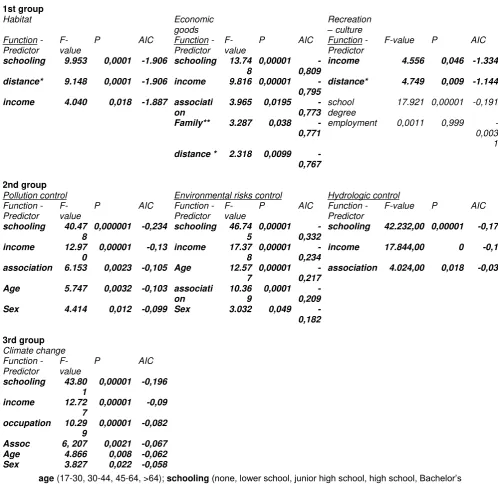
The complex interactions between social ecologic knowledge, e.g. the sharing rate of a
clear agreement and/or disagreement versus the uncertainty to the stated ecological
function / benefit, and the individual profiles (defined by the demo-socio-economic, cultural
and geo-spatial predictors) are reported in Table 3, and the key results are listed below.
Given the statistical strength of the well-known direct relationship between Schooling and
income, these predictors were selected by the regression models for almost all the
considered wetlands functions, but, more meaningfully, with increasingly stronger positive
relationships from the 1st to the 3rd group of wetlands functions, as outlined by the relative
F-values.
A similar, but negative, relation was systematically detected among the first function group
(habitat/biodiversity, economic goods and recreation / culture functions) and the
respondents residence distance from wetlands.
Associationism was selected in all of the 2nd group models and in one (wetland
commodities) of the 1st group. In the 2nd and 3rd functions group was selected a systematic
DISCUSSION
We verified that a first group of wetlands functions (habitat/biodiversity, economic goods
and recreation / culture functions) showed an almost complete sharing of knowledge and
related social memory among citizens. The universality of this sharing was not evidently
determined by individual schooling (and the related income) level, and tended to decrease
as distance increased from the wetland.
Another group of wetland functions (water depuration, hydrologic control, environmental
risk control) had a decreasing shared knowledge, however increasingly related with
schooling (and related income) and inversely with both age and sex. This last relation
reflects, in the not-urban areas, the decreasing rate of schooling in the elderly classes,
mostly for women, and their subsequently reluctance to give judgments with insufficient
background information (e.g. Alberini et al., 2005).
Lastly, the recently recognized wetlands function related to climate change mitigation was
only partially shared among some citizens and clearly does not belong to the community’
social memory.
To interpret this clear pattern we should consider the underlying element that differentiates
the three groups of functions, i.e. the different role of social effects on valuing behaviour.
The theory of planned behaviour (Ajzen 1991) helps in differentiating this aspects as: (i)
attitude toward a behaviour, referred to the degree to which a person has a favorable / not
favorable evaluation of the behaviour in question; (ii) subjective norms, referred to the
perceived social pressure to perform a specific behaviour; (iii) perceived behavioral control,
referred to the believed ease of performing the behaviour.
The habitat / biodiversity function is likely perceived in an instantaneous way by means of
psychological deep mechanisms (Kaplan and Kaplan 1982) which identify “nature” as a
symbolically high valued entity (Shama 1995) especially for those people having
cosmopolitan traits (Buijs et al. 2006). It is very unlikely that the expressed universal
knowledge. Instead, it emerges that this valuing comes from ethical attitude and subjective
norms, where uncertainty or disagreement would be perceived in contrast with the common
sense. The same seems to be the origin of the strong agreement on the cultural and
recreational wetlands functions, even because wetlands are rare in the region and because
they are not a generalized recreational option. From the valuing behaviour point of view,
even the total agreement with the wetland’s commodities functions can be found in the
social memory role. It is important to note that the valuing behaviour of habitat/biodiversity
and recreational/cultural functions seems to be generally applied to systems perceived as
“natural” (woods and rural landscape; Franco and Luiselli, 2011). In the case of the
wetland’s commodities function, the presence of the predictor ‘associationism’ suggests
that this aspect is actively maintained into the social memory by ethical (rights-based)
motivations, like that of belonging to NGO. A remarkable aspect is that all this shared
knowledge connected to social influence in valuing behavior was spatially dependent:
indeed, it does not belong to the whole county social memory, but tends to diminish when
moving away from each wetland.
In the second group of functions we found that the shared knowledge is coupled of
individual gains of knowledge more (pollution control) or less (environmental risk control)
recently stratified, either of technical/cognitive or ethical/philosophical nature. Here, the
valuing behaviour seems more influenced by individual cognitive awareness based on
personal experience/knowledge or training, indicated by the relation with the education /
income predictor. The ethic valuing attitude seems still present, as can be deduced by the
constant presence of the associationism as a predictor underlining the sense of
responsibility towards own community or group. Besides, the cultural link maintaining alive
the social memory of peculiar wetland services - the hydraulic and hydrologic functions, so
strongly reassessed by official knowledge in the last decades - in regions historically linked
to a wetland and his management (e.g. Venice Lagoon; Franco et al., 2007), seems to have
been lost in the Roman littoral. This is probably due to the dramatic ongoing change of the
In the last group of functions we found functions with widespread uncertainty, like climatic
change mitigation. Despite the dominant role of this issue in the official knowledge, the
awareness and valuation of these functions results not socially shared and attain to who
had the opportunity to acquire the education level needed to filter and select information.
Summarizing, we detected a decrease in uncertainty from the functions clearly present in
the social shared knowledge and memory, which share wide ethic-aesthetic attitudes, to
those characterized by an increasing degree of direct experience or expert knowledge.
Conclusions
Some wetlands’ ecological functions are well rooted in the communities shared knowledge
that greatly influences the individual valuing behaviour with attitude and subjective norms
effects. These functions represent the general social expectations of “nature” (biodiversity,
cultural value) which have a strong ethic and aesthetic implications. The valuing behaviour
of the other functions is less and less rooted in social memory, therefore less and less
connected to subjective norms, and increases with personal awareness, linked to individual
training and experience.
In this region it appears that the wetlands social shared ecological knowledge tends to
decrease moving away from wetlands. Furthermore, the historical awareness about some
services, mostly for some critical ones like the risk (hydraulic, hydrologic) control, is
dramatically fading in the local communities. This could be linked to the ongoing rapid
change of the socio-economic structure of local communities.
From our results it clearly emerges a partial or sometimes clear-cut separation between
official knowledge and socially shared knowledge on crucial themes like the hydrologic and
climate change role of wetlands. Functions that should be well recognized for their
international relevance do not enter at all in the shared community knowledge. This implies
that a great effort on environmental education on these issues should be quickly developed
in the next years to bridge present social knowledge gaps’ on crucial issues of the next
Furthermore, the standard economic model does assume that preference is based on
individual knowledge, so that the consequences of actions determine whether they are
preferred or otherwise. Considering the relation between knowledge uncertainty and
motivations, our findings are coherent with other studies (Ryana and Spash, 2012) showing
how economic choices are greatly influenced by the socio-cultural context. Our results
suggest that a great part of the motivations to pay for the wetland services in this European
province comes from a social shared knowledge, spatially related to wetlands, which seems
to influence in a not rational way the valuing behavior.
Given our results, in our view the monetary estimates of ecosystem services’ value, such
as those obtained by contingent valuation, are useful tools in public decision making when:
1) they inform the decision making process by facilitating the expression of the cultural
capital held by society, without distorting it, and 2) they are explicitly rooted in normative
values (Farley, 2012).
Regarding point 1, the WTP monetary estimate is an unbiased representation of the social
capital in public decision making in cases where the social knowledge/awareness of the
ecological service is widely shared. In cases where the social knowledge/awareness of the
ecosystem service is significantly less shared, the resulting WTP figures tend to
underestimate the best possible value for good public decisions, e.g. coming from the
entirety of the best scientific knowledge and the shared ecological knowledge.
In this concrete case study, for instance, policy makers are now aware that: (i) the total
economic value of wetlands is generally underestimated due to the lack of social
knowledge about the climate change mitigation service wetlands provide; (ii) there is a
social awareness gap on a crucial environmental issue; (iii) other methods should be
possibly coupled with contingent valuation in the case of an isolated monetary estimation of
this specific ecosystem service.
Furthermore, the conditions 1) and 2) reported above can be obtained even using
additional motivational predictors in the estimating multivariate models (Spash, 2009), or
listed ecosystem services as motivational interpretative keys. We believe that this last
approach coupled with a robust methodological design to avoid information bias (Price,
1999) and the selection of the “true no-bidders” respondents is a more intuitive but robust
alternative for concrete policy case purpose (Franco & Luiselli, 2013). In our case these
considerations are corroborated by the fact that: (i) a part from ‘Bids’ none of the candidate
predictors (including motivational ones) were used by the statistical selection process,
which produced parsimonious and robust statistical models; (ii) the willingness to pay
estimates were significantly different for wetlands compared to the other assessed
ecosystems; (iii) the single monetary estimates were characterized by a significantly
different pattern of motivations, attitudes and shared ecological knowledge (Official
Research Report, available at: www.provincia.roma.it/sites/default/files/vta roma
web_0.pdf).
The multiple motives that compose the valuing behaviors are based on the social capital
represented by the shared knowledge distribution among citizens of the multiple and
interconnected ecosystems services (Franco et al. 2007; IFEN 2000; Luginbüil 2001; Spash
2009; Turner et al. 2003). Fully accounting for these relationships in using ecosystem
services monetary estimates is very useful in informing public decisions dealing with land
use policies.
Acknowledgements
The project was funded by Capitale Lavoro S.p.a. (Italy) on behalf of the Province of Rome.
We gratefully acknowledge surveying from Artifex Formazione S.r.l. (Italy).
References
Adams J. 1993. The emperor’s old clothes: the curious comeback of cost benefit analysis.
Environmental Values 2(3): 247-260.
Ajzen I. 1991. The theory of planned behaviour. Organisational Behaviour and Human
Alberini A., Rosato P., Longo A., Zanatta V. 2005. Information and willingness to pay in a
contingent valuation study: the value of S. Erasmo in the Lagoon of Venice. Journal of
Environmental Planning and Management. 48: 155–175.
Asciuto A, Fiandaca F, Schimmenti E. 2005. Formati di domanda nella valutazione
contingente. Estimo e Territorio 2: 9-21.
Balram S, Dragićević S. 2005. Attitudes toward urban green spaces : integrating
questionnaire survey and collaborative GIS technique to improve attitude measurements.
Landscape and Urban Planning 71: 147-162.
Bateman, I.J., Brouwer, R., Ferrini, S., Schaafsma, M., Barton, D.N., Dubgaard, A., Hasler,
B., Hime, S., Liekens, I., Navrud, S., De Nocker, L., Ščeponavičiūté, R., and Seméniené, D.
2009. Making benefit transfers work: Deriving and testing principles for value transfers for
similar and dissimilar sites using a case study of the non-market benefits of water quality
improvements across Europe. CSERGE Working Paper EDM 09-10. Online URL
http://www.cserge.ac.uk/sites/default/files/edm_2009_10.pdf.
Bateman, I.J., Carson, R.T., Day, B.H., Hanemann, W.M., Hanley, N., Hett, T., Jones-Lee,
M., Loomes, G., Mourato, S., Özdemiroğlu, E., Pearce, D.W., Sugden, R. and Swanson, J.
2002. Economic Valuation with Stated Preference Techniques: A Manual, Edward Elgar
Publishing, Cheltenham.
Berkes F., Colding J., Folke C., 2000. Rediscovery of traditional ecological knowledge as
adaptive management. Ecological Applications 10:1251–1262
Bernard, H.R. 1996. Structured and semi-structured interview. In: Research Methods in
Anthropology. Newbury Park, CA: Sage Publications
Boyer T, Polasky S. 2004. Valuing urban wetlands: a review of non-market valuation
studies. Wetlands 24:744-755.
Brander, L.M., Florax, J.G.M. & Vermaat, J.E. 2006. The empirics of wetland valuation: A
comprehensive summary and meta-analysis of the literature. Environmental and Resource
Burnham KP, Anderson D.R. 2002. Model selection and multi model inference. Springer,
New York. 236 pp.
Castello, L., J. P., Viana, G. Watkins, M. Pinedo-Vasquez, Luzadis V. A.. 2009. Lessons
from integrating fishers of Arapaima in small-scale fisheries management at the Mamirauá
Reserve, Amazon. Environmental Management. 43(2):197-209.
Costanza R., d’Arge R, de Groot R, Farber S, Grasso M, Hannon B, Limburg K, Naeem S,
O’Neill RV, Paruelo J, Raskin RG, Sutton P, van den Belt M. 1997. The value of the world’s
ecosystem services and natural capital. Nature 387: 253-260.
Davidson-Hunt I., Berkes F. 2003. Learning as you journey: Anishinaabe perception of
social-ecological environments and adaptive learning. Conservation Ecology 8(1): 5.
[online] URL: http://www.consecol.org/vol8/iss1/art5
Farley J., 2012. Ecosystem services: The economics debate. Ecosystem Services. 1: 40–
49. available at: http://dx.doi.org/10.1016/j.ecoser.2012.07.002
Diamond J, 2005. Collapse. How Societies Choose to Fail Or Succeed. Viking, USA.
Franco D, Mannino I, Favero L, Mattiuzzo E., 2007. The Total Economic Value of the
wetlands in a European Region. Proceedings of Multifunctions of wetland systems
Congress "International Conference on Multiple Roles of Wetlands". Legnaro (Padova) 26 -
29 June 2007.
Franco D., Luiselli L. 2011. Cosa c’è dietro la volontà a pagare per i beni comuni? Un caso
studio nella provincia di Roma. Territori. 3: 22-35.
Franco D., Luiselli L., 2013. A procedure to analyse the strategic outliers and the multiple
motivations in a contingent valuation: a case study for a concrete policy purpose.
International Journal of Social Economics, 3:246-266.
Gómez-Baggethun E., Reyes-García V., Olsson P., Montes C., 2012. Traditional ecological
knowledge and community resilience to environmental extremes: a case study in Doñana,
Grahn P, Stigsdotter UA. 2003. Landscape planning and stress, Urban Forestry and Urban
Greening 2: 1-18.
Hanemann WM, Kanninen B, 1999. The statistical analysis of discrete-response CV data.
In: Bateman I. and Willis K. (Eds). Valuing Environmental Preferences: Theory and Practice
of the Contingent Valuation Method in the US, EU, and Developing Countries. Oxford,
Oxford University Press. pp. 302-441.
Horstman M.; Wightman G., 2001. Karparti ecology: Recognition of Aboriginal ecological
knowledge and its application to management in north-western Australia. Ecological
Management & Restoration. 2 (2): 99-109.
Hosmer DW, Lemeshow S. 1989. Applied Logistic Regression. Wiley, New York.
IFEN 2000. La Sensibilité Ecologique des Française à Travers l'Opinion Publique. Institut
National de l'Environnement.
INFC - Inventario Nazionale delle Foreste e dei Serbatoi Forestali di Carbonio (2005) Corpo
Forestale dello Stato – Ispettorato Generale
Kadlec RH, Knight RL. 1996. Treatment Wetlands: Theory and Implementation. Lewish
Publishers, Boca Raton, FL.
Kaplan S, Kaplan R. 1982. Cognition and environment: functioning in a uncertain world.
Praeger Publisher, New York.
Leschine TM, Wellman KF, Green TH. 1997. The Economic Value of Wetlands: Wetlands’
Role in Flood Protection in Western Washington. Washington Department of Ecology.
Publication No. 97-100.
Lindhjema E., Navrudb S. 2011. Are Internet surveys an alternative to face-to-face
interviews in contingent valuation? Ecological Economics. 70 (9): 1628–1637.
Luginbüil Y. 2001. Paysage modèles et modèle de paysage. In: CREDOC, Ministère de
l'Environnement: l'Eenvironnement, Question Sociale. Edition Odile Jacob, Paris, pp.
Luiselli L. 2006. Ecological modelling of convergence patterns between European and
African ‘whip’ snakes. Acta Oecologica 30: 62-68.
MacDonald DH, Weber M., 1998. Using Participatory Research Methods in Economic
Research. Rural Economy Staff Paper 98 -11. Department of Rural Economy, Faculty of
Agriculture, Forestry and Home Economics, University of Alberta, Edmonton, Canada. on
line (18.10.2012) at:
http://www.rees.ualberta.ca/Research/~/media/rees/Research/Documents/Staff%20Papers/
sp-98-11.pdf.
Mannino I., Franco D., Piccioni E., Favero L., Mattiuzzo E., Zanetto G. 2008. A
cost-effectiveness analysis of semi-natural wetlands and activated sludge wastewater treatment
systems. Environmental Management. 41:118-119.
Millennium Ecosystem Assessment 2003. Ecosystems and Human Well-being: A
Framework for Assessment. Washington: Island Press.
Millennium Ecosystem Assessment 2005. Ecosystems and Human Well-being: Biodiversity
Synthesis. World Resources Institute, Washington, DC.
Moser D, Dunning M 1986. A Guide For Using the Contingent Valuation Methodology in
Recreation Studies, National Economic Development Procedures Manual-Recreation, Vol.
2. IWR Report 86-R-5, U.S. Fort Belvoir, Virginia, Army Corps of Engineers.
Mullarkey DJ, Bishop RC. 1999. Sensitivity to scope: evidence from a CVM study of
wetlands. American Journal of Agricultural Economics 81: 1313.
Norman H. N. 1999. SPSS for Windows, Release 10.0. SPSS, New York, NY
Orcherton, D. 2012. Raising the bar: Recognizing the intricacies of cultural ecological
knowledge in natural resource management. BC Journal of Ecosystems and Management
12(3): 55–82. http://jem.forrex.org/index.php/jem/article/view/48/102
Pagiola S., von Ritter K., Bishop J. 2004. Assessing the economic value of ecosystem
conservation. The International Bank for Reconstruction and Development. Env. Dep.
Palomo, I., B. Martín-López, C. López-Santiago, C. Montes. 2011. Participatory scenario
planning for protected areas management under the ecosystem services framework: the
doñana social-ecological system in southwestern spain. Ecology and Society 16(1): 23.
online http://www.ecologyandsociety.org/vol16/iss1/art23/
Pearce D.W., Markandya A., Barbier E. 2000. Blueprint for a green economy. Earthscan,
London.
Pfeiffer J. M., Butz R.J., 2005. Assessing cultural and ecological variation in ethnobiological
research: the importance of gender. Journal of Ethnobiology 25(2):240-278. 2005
Piano Territoriale Provinciale Generale 2010. Supplemento ordinario n.45 "Bollettino
Ufficiale della Regione Lazio" n.9 del 6 marzo 2010.
Price, C., 1999. Contingent valuation and retrograde information bias. In Park, A. and
Stewart Roper, C. (Eds) The Living Forest. Proceedings of the International Symposium on
the Non-market Benefits of Forestry, Edinburgh, June 1996, TSO, London (1999): 37-44.
Provincia di Roma 2009. La Provincia Capitale: rapporto annuale sull’area romana 2007
-2008.
R Development Core Team 2008. A Language and Environment for Statistical Computing.
R Foundation for Statistical Computing. <http://www.Rproject.org> (downloaded on January
2009).
Rist, L., R. Uma Shaanker, E. J. Milner-Gulland, and J. Ghazoul. 2010. The use of
traditional ecological knowledge in forest management: an example from India. Ecology
and Society 15(1): 3. [online] URL: http://www.ecologyandsociety.org/vol15/iss1/art3/
Ryana A. M., Spash C. L. (2011). WTP an attitudinal measure? Empirical analysis of the
psychological explanation for contingent values. Journal of Economic Psychology. 32 (5):
674–687
Schwartz B. 1993. Why altruism is impossible... and ubiquitous. Social Service Review.
Shama S. 1995. Landscape and Memory. Alfred A. Knopf, New York.
Shen, X., Tan J. 2012. Ecological conservation, cultural preservation, and a bridge
between: the journey of Shanshui Conservation Center in the Sanjiangyuan region,
Qinghai-tibetan Plateau, China. Ecology and Society 17(4): 38.
http://dx.doi.org/10.5751/ES-05345-170438
Spash CL, Urama K, Burton R, Kenyon W, Shannon P, Hill G. 2009. Motives behind
willingness to pay for improving biodiversity in a water ecosystem: Economics, ethics and
social psychology. Ecological Economics 68: 955 – 964.
TEEB 2009. The Economics of Ecosystems and Biodiversity for National and International
Policy Makers – Summary: Responding to the Value of Nature.
Tolley G, Fabian RG. 1998. Issues in improvement of the valuation of non market goods.
Resource and Energy Economics 20: 75-83.
UNESCO 1971. Ramsar’s Convention. UNESCO Press, New York.
V.A., 2010. Rapporto sullo sviluppo socio economico del litorale del Lazio. Litorale S.p.A.,
Roma, Italy. ISBN 978-80-6060-264-0
Whittington D., Pagiola, S. 2011. Using contingent valuation in the design of payments for
environmental services mechanisms: a review and assessment. MPRA Paper 32730,
Figure 1 Percent distribution of the shared knowledge expressed by a 4 four point Likert scale (total agreement, agreement, partial disagreement / uncertainty, total disagreement) to stated wetlands ecological functions/benefits.
test
0%
20%
40%
60%
80%
100%
habitat/biodiversity habitat/biodiversity (without free-riders) commodities commodities (without free-riders) recreation/culture recreation/culture (without free-riders) water depuration water depuration (without free-riders) hidrologic regulation hidrologic regulation (without free-riders) risk control risk control (without free-riders) carbon/climate carbon/climate (without free-riders)
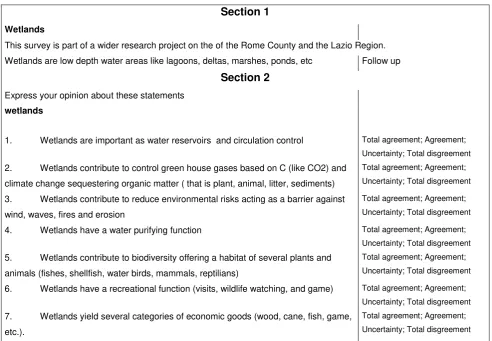
Table 1 Description of the first two sections of the questionnaires. The second section lists the wetlands ecological functions / benefits as stated by scientific / normative ecological knowledge to what respondents were asked to comment on.
Section 1
Wetlands
This survey is part of a wider research project on the of the Rome County and the Lazio Region. Wetlands are low depth water areas like lagoons, deltas, marshes, ponds, etc Follow up
Section 2
Express your opinion about these statements
wetlands
1. Wetlands are important as water reservoirs and circulation control Total agreement; Agreement; Uncertainty; Total disgreement 2. Wetlands contribute to control green house gases based on C (like CO2) and
climate change sequestering organic matter ( that is plant, animal, litter, sediments)
Total agreement; Agreement; Uncertainty; Total disgreement 3. Wetlands contribute to reduce environmental risks acting as a barrier against
wind, waves, fires and erosion
Total agreement; Agreement; Uncertainty; Total disgreement 4. Wetlands have a water purifying function Total agreement; Agreement;
Uncertainty; Total disgreement 5. Wetlands contribute to biodiversity offering a habitat of several plants and
animals (fishes, shellfish, water birds, mammals, reptilians)
Total agreement; Agreement; Uncertainty; Total disgreement 6. Wetlands have a recreational function (visits, wildlife watching, and game) Total agreement; Agreement;
Uncertainty; Total disgreement 7. Wetlands yield several categories of economic goods (wood, cane, fish, game,
etc.).
Table 2 Significant differences (Friedman’s ANOVA) in the ecological knowledge uncertainty of the stated functions / benefits of wetlands. The uncertainty, inversely proportional to the agreement sharing, increase from group a to d.
Wetlands’ stated ecological functions / benefits Statistical grouping
a b c d
Habitat- biodiversity X
Economic goods X
Recreational X
Environmental control X
Floods control X X
Water riserve X
Table 3 F-values, P-values and model selection scores for the shared ecological knowledge of each wetland function, and the predictors used. Results are ranked for likelihood (boldface) and significance (italic). Higher likelihood and significant scores are reported, in one case significant but not likelihood score.
1st group
Habitat Economic goods
Recreation – culture Function -
Predictor F-value
P AIC Function - Predictor
F-value
P AIC Function - Predictor
F-value P AIC
schooling 9.953 0,0001 -1.906 schooling 13.74 8
0,00001 -0,809
income 4.556 0,046 -1.334
distance* 9.148 0,0001 -1.906 income 9.816 0,00001 -0,795
distance* 4.749 0,009 -1.144
income 4.040 0,018 -1.887 associati on
3.965 0,0195 -0,773
school degree
17.921 0,00001 -0,191
Family** 3.287 0,038 -0,771
employment 0,0011 0,999 -0,003 1
distance * 2.318 0,0099 -0,767
2nd group
Pollution control Environmental risks control Hydrologic control Function -
Predictor F-value
P AIC Function - Predictor
F-value
P AIC Function - Predictor
F-value P AIC
schooling 40.47 8
0,000001 -0,234 schooling 46.74 5
0,00001 -0,332
schooling 42.232,00 0,00001 -0,17
income 12.97 0
0,00001 -0,13 income 17.37 8
0,00001 -0,234
income 17.844,00 0 -0,1
association 6.153 0,0023 -0,105 Age 12.57 7
0,00001 -0,217
association 4.024,00 0,018 -0,03
Age 5.747 0,0032 -0,103 associati on
10.36 9
0,0001 -0,209 Sex 4.414 0,012 -0,099 Sex 3.032 0,049
-0,182 3rd group Climate change Function - Predictor F-value
P AIC
schooling 43.80 1
0,00001 -0,196
income 12.72 7
0,00001 -0,09
occupation 10.29 9
0,00001 -0,082
Assoc 6, 207 0,0021 -0,067 Age 4.866 0,008 -0,062 Sex 3.827 0,022 -0,058
age (17-30, 30-44, 45-64, >64); schooling(none, lower school, junior high school, high school, Bachelor’s
degree, Master’s degree, PhD); employment (Housewife-student-unemployed, workman-pensioner, white collar, manager. self-employed – professional); income(t € / year: 0-10, 10-20, 20-30, 30-40, 40-60, >60); respondents’ family (1, 2-4, > 4); . association belonging (none, other, rural union, environmental,