Path-based vs. Distributional Information
in Recognizing Lexical Semantic Relations
Vered Shwartz Ido Dagan
Computer Science Department, Bar-Ilan University, Ramat-Gan, Israel
[email protected] [email protected]
Abstract
Recognizing various semantic relations between terms is beneficial for many NLP tasks. While path-based and distributional information sources are considered complementary for this task, the superior results the latter showed recently suggested that the former’s contribution might have become obsolete. We follow the recent success of an integrated neural method for hypernymy detection (Shwartz et al., 2016) and extend it to recognize multiple relations. The empirical results show that this method is effective in the multiclass setting as well. We further show that the path-based information source always contributes to the classification, and analyze the cases in which it mostly complements the distributional information.
1 Introduction
Automated methods to recognize the lexical semantic relation the holds between terms are valuable for NLP applications. Two main information sources are used to recognize such relations: path-based and distributional. Path-based methods consider thejointoccurrences of the two terms in a given pair in the corpus, where the dependency paths that connect the terms are typically used as features (A. Hearst, 1992; Snow et al., 2004; Nakashole et al., 2012; Riedel et al., 2013). Distributional methods are based on the
disjointoccurrences of each term and have recently become popular using word embeddings (Mikolov et al., 2013; Pennington et al., 2014), which provide a distributional representation for each term. These embedding-based methods were reported to perform well on several common datasets (Baroni et al., 2012; Roller et al., 2014), consistently outperforming other methods (Santus et al., 2016; Necsulescu et al., 2015).
While these two sources have been considered complementary, recent results suggested that path-based methods have no marginal contribution over the distributional ones. Recently, however, Shwartz et al. (2016) presentedHypeNET, an integrated path-based and distributional method for hypernymy detec-tion. They showed that a good path representation can provide substantial complementary information to the distributional signal in hypernymy detection, notably improving results on a new dataset.
In this paper we presentLexNET, an extension ofHypeNETthat recognizesmultiplesemantic relations. We show that this integrated method is indeed effective also in the multiclass setting. In the evaluations reported in this paper,LexNETperformed better than each individual method on several common datasets. Further, it was the best performing system in the semantic relation classification task of the CogALex 2016 shared task (Shwartz and Dagan, 2016).
We further assess the contribution of path-based information to semantic relation classification. Even though the distributional source is dominant across most datasets, path-based information always con-tributed to it. In particular, path-based information seems to better capture the relationship between terms, rather than their individual properties, and can do so even for rare words or senses. Our code and data are available athttps://github.com/vered1986/LexNET.
This work is licenced under a Creative Commons Attribution 4.0 International License. License details: http://creativecommons.org/licenses/by/4.0/
X/NOUN/nsubj > be/VERB/ROOT < Y/NOUN/attr
X/NOUN/dobj >define/VERB/ROOT < as/ADP/prep < Y/NOUN/pobj
~op
. . .
average pooling ~vpaths(x,y) Embeddings: lemma POS dependency label direction ...
(x, y)
classification (softmax)
~ vxy
~vpaths(x,y) ~ vwx
~ vwy
~ vwx
...
(x, y)
classification
~ vwy
~ vxy
~ vwx
...
(x, y)
classification (softmax)
~ vwy
~ vxy
~vpaths(x,y)
(1) PB (2) DS (3) LexNET
~ vwx
...
(x, y)
classification (softmax) ~ vwy ~h ~ vwy
~ vxy
~ vwx
...
(x, y)
classification (softmax) ~h ~ vwy ~ vxy
~vpaths(x,y)
[image:2.595.76.521.60.545.2](4) DSh (5) LexNETh
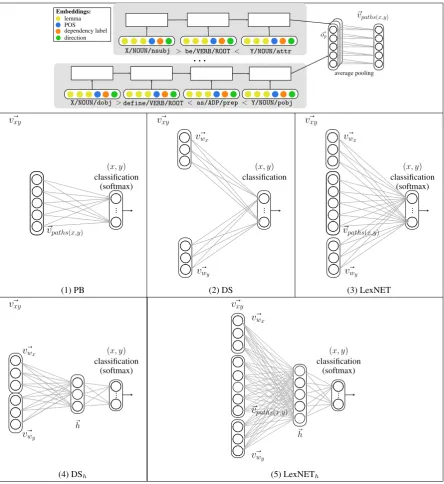
Figure 1:Illustrations of classification models. Top row: path-based component. A path is a sequence of edges, and each edge consists of four components: lemma, POS, dependency label and direction. Edge vectors are fed in sequence into the LSTM, resulting in an embedding vectoro~pfor each path.~vpaths(x,y)is the average of(x, y)’s path embeddings.
2 Background: HypeNET
Recently, Shwartz et al. (2016) introducedHypeNET, a hypernymy detection method based on the inte-gration of the best-performing distributional method with a novel neural path representation, improving upon state-of-the-art methods. InHypeNET, a term-pair(x, y) is represented as a feature vector, con-sisting of both distributional and path-based features:~vxy = [~vwx,~vpaths(x,y),~vwy], where~vwx and~vwy
arexandy’s word embeddings, providing their distributional representation, and~vpaths(x,y)is a vector
representing the dependency paths connecting xandy in the corpus. A binary classifier is trained on these vectors, yieldingc= softmax(W ·~vxy), predicting hypernymy ifc[1]>0.5.
Each dependency path is embedded using an LSTM (Hochreiter and Schmidhuber, 1997), as illustrated in the top row of Figure 1. This results in a path vector space in which semantically-similar paths (e.g.X is defined as YandX is described as Y) have similar vectors. The vectors of all the paths that connectx
dataset dataset relations #instances K&H+N hypernym, meroynym, co-hyponym, random 57,509
BLESS hypernym, meroynym, co-hyponym, , event, attribute, random 26,546
ROOT09 hypernym, co-hyponym, random 12,762
[image:3.595.86.510.62.116.2]EVALution hypernym, meronym, attribute, synonym, antonym, holonym, substance meronym 7,378
Table 1:The relation types and number of instances in each dataset, named by their WordNet equivalent where relevant.
Shwartz et al. (2016) showed that this new path representation outperforms prior path-based methods for hypernymy detection, and that the integrated model yields a substantial improvement over each indi-vidual model. While HypeNET is designed for detecting hypernymy relations, it seems straightforward to extend it to classify term-pairs simultaneously to multiple semantic relations, as we describe next. 3 Classification Methods
We experiment with several classification models, as illustrated in Figure 1:
Path-based HypeNET’s path-based model (PB) is a binary classifier trained on the path vectors alone:
~vpaths(x,y). We adapt the model to classify multiple relations by changing the network softmax outputcto a distribution overktarget relations, classifying a pair to the highest scoring relation:r= argmaxic[i].
Distributional We train an SVM classifier on the concatenation of x and y’s word embeddings
[~vwx,~vwy] (Baroni et al., 2012) (DS).1 Levy et al. (2015) claimed that such a linear classifier is
inca-pable of capturing interactions betweenxandy’s features, and that instead it learns separate properties ofxory, e.g. thatyis aprototypical hypernym. To examine the effect of non-linear expressive power on the model, we experiment with a neural network with a single hidden layer trained on[~vwx,~vwy](DSh).2
Integrated We similarly adapt the HypeNET integrated model to classify multiple semantic relations
(LexNET). Based on the same motivation ofDSh, we also experiment with a version of the network with
a hidden layer (LexNETh), re-definingc= softmax(W2·~h+b2), where~h= tanh(W1·~vxy+b1)is the
hidden layer. The technical details of our network are identical to Shwartz et al. (2016). 4 Datasets
We use four common semantic relation datasets that were created using semantic resources:K&H+N (Nec-sulescu et al., 2015) (an extension to Kozareva and Hovy (2010)), BLESS (Baroni and Lenci, 2011), EVALution(Santus et al., 2015), andROOT09(Santus et al., 2016).
Table 1 displays the relation types and number of instances in each dataset. Most dataset relations are parallel to WordNet relations, such as hypernymy (cat, animal) and meronymy (hand, body), with an ad-ditionalrandomrelation for negative instances.BLESScontains theeventandattributerelations, connect-ing a concept with a typical activity/property (e.g.(alligator, swim)and(alligator, aquatic)).EVALution contains a richer schema of semantic relations, with some redundancy: it contains both meronymy and holonymy (e.g. forbicycleandwheel), and the fine-grained substance-holonymy relation. We removed two relations with too few instances:EntailsandMemberOf.
To prevent the lexical memorization effect (Levy et al., 2015), Santus et al. (2016) added negative switched hyponym-hypernym pairs (e.g. (apple, animal),(cat, fruit)) toROOT09, which were reported to reduce this effect.
5 Results
Like Shwartz et al. (2016), we tuned the methods’ hyper-parameters on the validation set of each dataset, and used Wikipedia as the corpus. Table 2 displays the performance of the different methods on all datasets, in terms of recall, precision andF1.3
Our first empirical finding is that Shwartz et al.’s (2016) algorithm is effective in the multiclass setting as well (LexNET). The only dataset on which performance is mediocre isEVALution, which seems to be
1We experimented also with difference~v
wx−~vwy and other classifiers, but concatenation yielded the best performance.
2This was previously done by Bowman et al. (2014), with promising results, but on a small artificial vocabulary.
K&H+N BLESS ROOT09 EVALution
method P R F1 P R F1 P R F1 P R F1
PB 0.713 0.604 0.55 0.759 0.756 0.755 0.788 0.789 0.788 0.53 0.537 0.503 DS 0.909 0.906 0.904 0.811 0.812 0.811 0.636 0.675 0.646 0.531 0.544 0.525 DSh 0.983 0.984 0.983 0.891 0.889 0.889 0.712 0.721 0.716 0.57 0.573 0.571
LexNET 0.985 0.986 0.985 0.894 0.893 0.893 0.813 0.814 0.813 0.601 0.607 0.6
[image:4.595.70.519.61.136.2]LexNETh 0.984 0.985 0.984 0.895 0.892 0.893 0.812 0.816 0.814 0.589 0.587 0.583
Table 2:Performance scores (precision, recall andF1) of each individual approach and the integrated models. To compute the
metrics we used scikit-learn (Pedregosa et al., 2011) with the “averaged” setup, which computes the metrics for each relation, and reports their average, weighted by support (the number of true instances for each relation). Note that it can result in anF1
score that is not the harmonic mean of precision and recall.
dataset #pairs x y gold label DShprediction possible explanation
K&H+N 102 racehorsefirefly horsecar hypofalse hypofalse out of the embeddings vocabulary(x, car)frequent label is hypo larvacean salp sibl false rare termslarvaceanandsalp
BLESS 275 squirreltanker shiplie randomhyper eventevent (x, ship)(x, lie)frequent label is eventfrequent label is event herring salt event random non-prototypical relation
ROOT09 562 toasterrice vehiclegrain RANDOMHYPER RANDOMHYPER (x, grain)(x, vehicle)frequent label is RANDOMfrequent label is HYPER
lung organ HYPER COORD polysemous termorgan
[image:4.595.68.529.184.318.2]EVALution 235 abstractpick concretemetal AntonymMadeOf MadeOfIsA polysemous termrare sense ofpickconcrete line thread Synonym MadeOf (x, thread)frequent label is MadeOf
Table 3:The number of term-pairs that were correctly classified by the integrated model while being incorrectly classified by DSh, in each test set, with corresponding examples of such term-pairs.
inherently harder for all methods, due to its large number of relations and small size. The performance differences betweenLexNETandDSare statistically significant on all datasets with p-value of 0.01 (paired t-test). The performance differences betweenLexNETandDShare statistically significant on BLESSand
ROOT09with p-value of 0.01, and onEVALutionwith p-value of 0.05.
DShconsistently improves uponDS. The hidden layer seems to enable interactions betweenxandy’s
features, which is especially noticed inROOT09, where the hypernymyF1 score in particular rose from
0.25 to 0.45. Nevertheless, we did not observe a similar behavior inLexNETh, which worked similarly
or slightly worse thanLexNET. It is possible that the contributions of the hidden layer and the path-based source over the distributional signal are redundant.4 It may also be that the larger number of parameters in
LexNEThprevents convergence to the optimal values given the modest amount of training data, stressing
the need for large-scale datasets that will benefit training neural methods.
6 Analysis
Table 2 demonstrates that the distributional source is dominant across most datasets, withDSperforming better thanPB. Although by designDSdoes not consider the relation betweenxandy, but rather learns properties ofxory, it performs well onBLESSandK&H+N.DShfurther manages to capture relations at
the distributional level, leaving the path-based source little room for improvement on these two datasets. On ROOT09, on the other hand, DS achieved the lowest performance. Our analysis reveals that this is due to the switched hypernym pairs, which drastically hurt the ability to memorize individual single words, hence reducing performance. TheF1 scores ofDSon this dataset were 0.91 for co-hyponyms but
only 0.25 for hypernyms, whilePBscored 0.87 and 0.66 respectively. Moreover,LexNETgains 10 points overDSh, suggesting the better capacity of path-based methods to capture relations between terms.
6.1 Analysis of Information Sources
To analyze the contribution of the path-based information source, we examined the term-pairs that were correctly classified by the best performing integrated model (LexNET/LexNETh) while being incorrectly
classified by DSh. Table 3 displays the number of such pairs in each dataset, with corresponding term-pair examples. The common errors are detailed below:
Lexical Memorization DShoften classifies(x, y)term-pairs according to the most frequent relation of
one of the terms (usuallyy) in the train set. The error is mostly prominent inROOT09 (405/562 pairs, 72%), as a result of the switched hypernym pairs. However, it is not infrequent in other datasets (47% inBLESS, 43% inEVALutionand 34% inK&H+N). As opposed to distributional information, path-based information pertains to both terms in the pair. With such information available, the integrated model succeeds to overcome the most frequent label bias for single words, classifying these pairs correctly.
Non-prototypical Relations DShmight fail to recognize non-prototypical relations between terms, i.e.
whenyis a less-prototypical relatum ofx, as inmero:(villa, guest),event:(cherry, pick), andattri:(piano, electric). While being overlooked by the distributional methods, these relations are often expressed in joint occurrences in the corpus, allowing the path-based component to capture them.
Rare Terms The integrated method often managed to classify term-pairs in which at least one of the
terms is rare (e.g. hyper:(mastodon, proboscidean)), where the distributional method failed. It is a well known shortcoming of path-based methods that they require informative co-occurrences ofx and
y, which are not always available. With that said, thanks to the averaged path representation, PB can capture the relation between terms even if they only co-occur once within an informative path, while the distributional representation of rare terms is of lower quality. We note that the path-based information of(x, y)is encoded in the vector~vpaths(x,y), which is the averaged vector representation of all paths that connectedxandyin the corpus. Unlike other path-based methods in the literature, this representation is indifferent to the total number of paths, and as a result, even a single informative path can lead to successful classification.
Rare Senses Similarly, the path-based component succeeded to capture relations for rare senses of
words whereDShfailed, e.g.mero:(piano, key), event:(table, draw). Distributional representations suffer
from insufficient representation of rare senses, whilePBmay capture the relation with a single meaningful occurrence of the rare sense with its related term. At the same time, it is less likely for a polysemous term to co-occur, in its non-related senses, with the candidate relatum. For instance, paths connecting
pianotokeyare likely to correspond to the keyboard sense ofkey, indicating the relation that does hold for this pair with respect to this rare sense.
Finally, we note that LexNET, as well as the individual methods, perform poorly on synonyms and antonyms. The synonymy F1 score in EVALution was 0.35 in LexNET and in DSh and only 0.09 in
PB, reassessing prior findings (Mirkin et al., 2006) that the path-based approach is weak in recognizing synonyms, which do not tend to co-occur. DShperformed poorly also on antonyms (F1 = 0.54), which
were often mistaken for synonyms, since both tend to occur in the same contexts. It seems worthwhile to try improving the model using insights from prior work on these specific relations (Santus et al., 2014; Mohammad et al., 2013) or additional information sources, like multilingual data (Pavlick et al., 2015). 7 Conclusion
We presented an adaptation to HypeNET (Shwartz et al., 2016) that classifies term-pairs to one of ple semantic relations. Evaluation on common datasets shows that HypeNET is extensible to the multi-class setting and performs better than each individual method.
Although the distributional information source is dominant across most datasets, it consistently bene-fits from path-based information, particularly when finer modeling of inter-term relationship is needed.
Finally, we note that all common datasets were created synthetically using semantic resources, leading to inconsistent behavior of the different methods, depending on the particular distribution of examples in each dataset. This stresses the need to develop “naturally” distributed datasets that would be drawn from corpora, while reflecting realistic distributions encountered by semantic applications.
Acknowledgments
References
Marti A. Hearst. 1992. Automatic acquisition of hyponyms from large text corpora. InCOLING 1992 Volume 2: The 15th International Conference on Computational Linguistics.
Marco Baroni and Alessandro Lenci. 2011. Proceedings of the gems 2011 workshop on geometrical models of natural language semantics. pages 1–10.
Marco Baroni, Raffaella Bernardi, Ngoc-Quynh Do, and Chung-chieh Shan. 2012. Entailment above the word level in distributional semantics. InProceedings of EACL 2012, pages 23–32.
Samuel R Bowman, Christopher Potts, and Christopher D Manning. 2014. Learning distributed word representa-tions for natural logic reasoning.AAAI.
Sepp Hochreiter and J¨urgen Schmidhuber. 1997. Long short-term memory. Neural computation, 9(8):1735–1780. Zornitsa Kozareva and Eduard Hovy. 2010. A semi-supervised method to learn and construct taxonomies using
the web. InProceedings of EMNLP 2010, pages 1110–1118.
Omer Levy, Steffen Remus, Chris Biemann, and Ido Dagan. 2015. Do supervised distributional methods really learn lexical inference relations? InProceedings of NAACL-HLT 2015, pages 970–976.
Tomas Mikolov, Ilya Sutskever, Kai Chen, Gregory S Corrado, and Jeffrey Dean. 2013. Distributed representations of words and phrases and their compositionality. InNIPS, pages 3111–3119.
Shachar Mirkin, Ido Dagan, and Maayan Geffet. 2006. Integrating pattern-based and distributional similarity methods for lexical entailment acquisition. InProceedings of COLING/ACL 2006, pages 579–586.
Saif M Mohammad, Bonnie J Dorr, Graeme Hirst, and Peter D Turney. 2013. Computing lexical contrast. Com-putational Linguistics, 39(3):555–590.
Ndapandula Nakashole, Gerhard Weikum, and Fabian Suchanek. 2012. Patty: A taxonomy of relational patterns with semantic types. InProceedings of the 2012 Joint Conference EMNLP and CoNLL, pages 1135–1145. Silvia Necsulescu, Sara Mendes, David Jurgens, N´uria Bel, and Roberto Navigli. 2015. Reading between the
lines: Overcoming data sparsity for accurate classification of lexical relationships. In Proceedings of *SEM 2015, pages 182–192.
Ellie Pavlick, Johan Bos, Malvina Nissim, Charley Beller, Benjamin Van Durme, and Chris Callison-Burch. 2015. Adding semantics to data-driven paraphrasing. InProceedings of ACL 2015 (Volume 1: Long Papers), pages 1512–1522.
F. Pedregosa, G. Varoquaux, A. Gramfort, V. Michel, B. Thirion, O. Grisel, M. Blondel, P. Prettenhofer, R. Weiss, V. Dubourg, J. Vanderplas, A. Passos, D. Cournapeau, M. Brucher, M. Perrot, and E. Duchesnay. 2011. Scikit-learn: Machine learning in Python. Journal of Machine Learning Research, 12:2825–2830.
Jeffrey Pennington, Richard Socher, and Christopher Manning. 2014. Glove: Global vectors for word representa-tion. InProceedings of EMNLP 2014, pages 1532–1543.
Sebastian Riedel, Limin Yao, Andrew McCallum, and M. Benjamin Marlin. 2013. Relation extraction with matrix factorization and universal schemas. InProceedings of NAACL-HLT 2013, pages 74–84.
Stephen Roller, Katrin Erk, and Gemma Boleda. 2014. Inclusive yet selective: Supervised distributional hyper-nymy detection. InProceedings of COLING 2014, pages 1025–1036.
Enrico Santus, Qin Lu, Alessandro Lenci, and Churen Huang. 2014. Unsupervised antonym-synonym discrimi-nation in vector space.
Enrico Santus, Frances Yung, Alessandro Lenci, and Chu-Ren Huang. 2015. Proceedings of the 4th workshop on linked data in linguistics: Resources and applications. pages 64–69.
Enrico Santus, Alessandro Lenci, Tin-Shing Chiu, Qin Lu, and Chu-Ren Huang. 2016. Nine features in a random forest to learn taxonomical semantic relations. InLREC.
Vered Shwartz and Ido Dagan. 2016. Cogalex-v shared task: Lexnet - integrated path-based and distributional method for the identification of semantic relations. InProceedings of the 5th Workshop on Cognitive Aspects of
the Lexicon (CogALex-V).
Vered Shwartz, Yoav Goldberg, and Ido Dagan. 2016. Improving hypernymy detection with an integrated path-based and distributional method. InProceedings of ACL 2016 (Volume 1: Long Papers), pages 2389–2398. Rion Snow, Daniel Jurafsky, and Andrew Y Ng. 2004. Learning syntactic patterns for automatic hypernym