CogALex-V Shared Task:
LexNET - Integrated Path-based and Distributional Method
for the Identification of Semantic Relations
Vered Shwartz Ido Dagan
Computer Science Department, Bar-Ilan University, Ramat-Gan, Israel [email protected] [email protected]
Abstract
We present a submission to the CogALex 2016 shared task on the corpus-based identification of semantic relations, usingLexNET(Shwartz and Dagan, 2016), an integrated path-based and distributional method for semantic relation classification. The reported results in the shared task bring this submission to the third place on subtask 1 (word relatedness), and the first place on subtask 2 (semantic relation classification), demonstrating the utility of integrating the comple-mentary path-based and distributional information sources in recognizing concrete semantic rela-tions. Combined with a common similarity measure,LexNETperforms fairly good on the word relatedness task (subtask 1). The relatively low performance ofLexNETand all other systems on subtask 2, however, confirms the difficulty of the semantic relation classification task, and stresses the need to develop additional methods for this task.
1 Introduction
Discovering whether words are semantically related and identifying the specific semantic relation that holds between them is a key component in many NLP applications, such as question answering and rec-ognizing textual entailment (Dagan et al., 2013). Automated methods for semantic relation identification are commonly corpus-based, and mainly rely on the distributional representation of each word.
The CogALex shared task on the corpus-based identification of semantic relations consists of two subtasks. In the first task, the system needs to identify for a word pair whether the words are semantically related or not (e.g. True:(dog, cat), False:(dog, fruit)). In the second task, the goal is to determine the specific semantic relation that holds for a given pair, if any (PART OF:(tail, cat), HYPER:(cat, animal)). In this paper we describe our approach and system setup for the shared task. We useLexNET(Shwartz and Dagan, 2016), an integrated path-based and distributional method for semantic relation classification.
LexNETwas the system with the overall best performance on subtask 2, and was ranked third on subtask 1, demonstrating the utility of integrating the complementary path-based and distributional information sources in recognizing semantic relatedness.1
To aid in recognizing whether a pair of words are related at all (subtask 1), we combine LexNET
with a common similarity measure (cosine similarity), achieving fairly good performance, and a slight improvement upon using cosine similarity alone. Subtask 2, however, has shown to be extremely diffi-cult, withLexNETand all other systems achieving relatively lowF1 scores. The conflict between the mediocre performance and the recent success of distributional methods on several other common datasets for semantic relation classification (Baroni et al., 2012; Weeds et al., 2014; Roller et al., 2014) could be explained by the stricter evaluation setup in this subtask, which is supposed to demonstrate more closely real-world application settings. The difficulty of the semantic relation classification task emphasizes the need to develop better methods for this task.
This work is licenced under a Creative Commons Attribution 4.0 International License. License details:
http://creativecommons.org/licenses/by/4.0/
1LexNET’s code is available athttps://github.com/vered1986/LexNET, and the shared task results are avail-able athttps://sites.google.com/site/cogalex2016/home/shared-task/results
2 Background
2.1 Word Relatedness
Recognizing word relatedness is typically addressed by distributional methods. To determine to what ex-tent two termsxandyare related, a vector similarity or distance measure is applied to their distributional representations: sim(~vwx,~vwy). This is a straightforward application of the distributional hypothesis
(Harris, 1954), according to which related words occur in similar contexts, hence have similar vector representations.
Most commonly, vector cosine is adopted as a similarity measure (Turney et al., 2010). Many other measures exist, including but not limited to Euclidean distance, KL divergence (Cover and Thomas, 2012), Jaccard’s coefficient (Salton and McGill, 1986), and more recently neighbor rank (Hare et al., 2009; Lapesa and Evert, 2013) and APSyn (Santus et al., 2016a).2 To turn this task into a binary clas-sification task, wherex andy are classified as either related or not, one can set a threshold to separate similarity scores of related and unrelated word pairs.
2.2 Semantic Relation Classification
Recognizing lexical semantic relations between words is valuable for many NLP applications, such as ontology learning, question answering, and recognizing textual entailment. Most corpus-based methods classify the relation between a pair of wordsxandy based on the distributional representation of each word (Baroni et al., 2012; Roller et al., 2014; Fu et al., 2014; Weeds et al., 2014). Earlier methods utilized the dependency paths that connect the joint occurrences ofx andy in the corpus as a cue to the relation between the words (A. Hearst, 1992; Snow et al., 2004; Nakashole et al., 2012). Recently, Shwartz and Dagan (2016) presentedLexNET, an extension ofHypeNET(Shwartz et al., 2016). This method integrates both path-based and distributional information for semantic relation classification, which outperformed approaches that rely on a single information source, on several common datasets (Baroni and Lenci, 2011; Necsulescu et al., 2015; Santus et al., 2015; Santus et al., 2016b).
3 System Description
InLexNET, a word-pair(x, y)is represented as a feature vector, consisting of a concatenation of distri-butional and path-based features: ~vxy = [~vwx,~vpaths(x,y),~vwy], where~vwx and~vwy arexandy’s word
embeddings, providing their distributional representation, and~vpaths(x,y)is the average embedding vec-tor of all the dependency paths that connect x andy in the corpus. Dependency paths are embedded using a LSTM (Hochreiter and Schmidhuber, 1997), as described in Shwartz et al. (2016). This vector is then fed into a neural network that outputs the class distribution~c, and then the pair is classified to the relation with the highest scorer:
~c= softmax(MLP(~vxy)) (1a)
r = argmaxi~c[i] (1b)
MLP stands for Multi Layer Perceptron, and could be computed with or without a hidden layer (equations 2 and 3, respectively):
~h= tanh(W1·~vxy+b1) (2a)
MLP(~vxy) =W2·~h+b2 (2b)
MLP(~vxy) =W1·~vxy+b1 (3)
whereWiandbi are the network parameters and~his the hidden layer.
Method Hyper-parameters Corpus size P R F1
Subtask 1 LexNETCos hidden layers: 0, dropout: 0.0, epochs: 3word2vec,t: 0.3 100B6B 0.7590.780 0.7950.561 0.7760.652
LexNET+Cos word2vec,wL= 0.3, wC= 0.7, t= 0.29 ∼100B 0.814 0.854 0.833
Subtask 2 Dist dep-based, method: concat, classifier: SVM,L1 3B 0.611 0.598 0.600
[image:3.595.63.528.62.126.2]LexNET hidden layers: 0, dropout: 0.0, epochs: 5 6B 0.658 0.646 0.642
Table 1:Performance scores on the validation set along with hyper-parameters and effective corpus size (#tokens) used by each method. Subtask 2 results refer to the subset of related pairs, as detailed in§4.2.
3.1 A Note About Word Relatedness
While path-based approaches have been commonly used for semantic relation classification (A. Hearst, 1992; Snow et al., 2004; Nakashole et al., 2012; Necsulescu et al., 2015), they have never been used for word relatedness, which is considered a “classical” task for distributional methods. We argue that path-based information can improve performance of word relatedness tasks as well (see Section 4.1). We trainLexNETto distinguish between two classes: RELATEDandUNRELATED, and combine it with the common cosine similarity measure to tackle subtask 1.
4 Experimental Settings
The shared task organizers provided a dataset extracted from EVALution 1.0 (Santus et al., 2015), which was split into training and test sets. As instructed, we trained and tuned our method on the training set, and evaluated it once on the test set. To tune the hyper-parameters, we split the training set to 90% train and 10% validation sets. Since the dataset contains only 318 different words in thexslot, we performed the split such that the train and the validation contain distinctxwords.3
LexNET has several tunable hyper-parameters. Similarly to Shwartz and Dagan (2016), we used the English Wikipedia dump from May 2015 as an underlying corpus (3B tokens), and initialized the network’s word embeddings with the 50-dimensional pre-trained GloVe word embeddings (Pennington et al., 2014), trained on Wikipedia and Gigaword 5 (6B tokens). We fixed this hyper-parameter due to computational limitations with higher-dimensional embeddings. For each subtask, we tunedLexNET’s hyper-parameters on the validation set: the number of hidden layers (0 or 1), the number of training epochs, and the word dropout rate (see Shwartz et al. (2016) for technical details). Table 1 displays the best performing hyper-parameters in each subtask, along with the performance on the validation set, which is detailed below.
4.1 Subtask 1: Word Relatedness
We tunedLexNET’s hyper-parameters on the validation set, disregarding the similarity measure at this point, and then chose the model that performed best on the validation set and combined it with the similarity measure.
We computed cosine similarity for each(x, y)pair in the dataset: cos(~vwx,~vwy) = k~vwx~vwxk·k·~v~vwywyk, and
normalized it to the range[0,1]. We scored each(x, y)pair by a combination ofLexNET’s score for the RELATEDclass and the cosine similarity score:
Rel(x, y) =wC·cos(~vwx,~vwy) +wL·~c[RELATED] (4)
wherewC, wLare the weights assigned to cosine similarity andLexNET’s scores respectively, such that wC +wL = 1. We tuned the weights and a thresholdtusing the validation set, and classified (x, y)
as related ifRel(x,y)≥t. The word vectors used to compute the cosine similarity scores were chosen among several available pre-trained embeddings.4 For completeness we also report the performance of two baselines: cosine similarity (wC = 1) andLexNET(wL= 1, fixedt= 0.5).
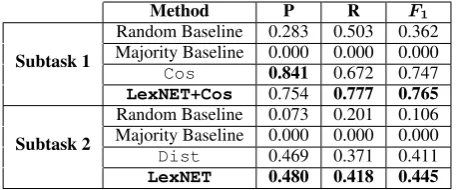
Method P R F1
Subtask 1
Random Baseline 0.283 0.503 0.362 Majority Baseline 0.000 0.000 0.000
Cos 0.841 0.672 0.747
LexNET+Cos 0.754 0.777 0.765
Subtask 2
Random Baseline 0.073 0.201 0.106 Majority Baseline 0.000 0.000 0.000
Dist 0.469 0.371 0.411
[image:4.595.185.415.62.157.2]LexNET 0.480 0.418 0.445
Table 2: Performance scores on the test set in each subtask, of the selected methods and the baselines.
4.2 Subtask 2: Semantic Relation Classification
The subtask’s train set is highly imbalanced towards random instances (roughly 10 times more than any other relation), and training any supervised method leads to overfitting to the random class. We therefore trained the model only on the related classes (excludingRANDOMpairs), for which the classes are more balanced. During inference time, we used the model from subtask 1 to assign a relatedness score to each pair,Rel(x, y), and computed the class distribution using the model from subtask 2, only for pairs that were related according to this score.
Finally, we applied a heuristic that if for a word pair(x, y), the difference in scores between the top scoring classes is low (<0.2), and the top class isSYN, then it is only classified asSYNif the number of paths betweenxandyis smaller than 3. This is due to the fact that synonyms are hard to recognize with both distributional and path-based approaches (Shwartz and Dagan, 2016), but it is known that they do not tend to co-occur.
To compare LexNET’s performance on the validation set with other methods’ performances, we adapted the distributional baseline employed by Shwartz et al. (2016) and Shwartz and Dagan (2016), where a classifier is trained on the combination ofxandy’s word embeddings. We experimented with several combination methods (concatenation (Baroni et al., 2012), difference (Fu et al., 2014; Weeds et al., 2014), and ASYM (Roller et al., 2014)), regularization factors, and pre-trained word embeddings (Mikolov et al., 2013; Pennington et al., 2014; Levy and Goldberg, 2014). This time, we used cosine similarity (subtask 1) to separate related from unrelated pairs, and trained the classifier only to distinguish between the related classes. Similarly to subtask 1, we tuneLexNETand the baseline’s hyper-parameters on the validation set. The best performance is reported in Table 1.
5 Results and Analysis
Table 2 displays the performance of our methods and the baselines on the test set. In addition to the two baselines provided by the shared task organizers (majority and random), we report also the results of our baselines detailed in Section 4. The majority baseline classifies all the instances asUNREALTED (subtask 1) orRANDOM(subtask 2). Since these labels are excluded from the averagedF1computation,
this baseline’s performance metrics are all zero.
Subtask 1: Word Relatedness Cos achieves fairly good performance (F1 = 0.747), and
LexNET+Cos slightly improves upon it. To better understandLexNET’s contribution, we examined pairs that were correctly classified byLexNET+Cos while being incorrectly classified by Cos. Out of the 57 pairs that were true negative in LexNET and false positive in Cos, we judged only one as somehow related ((death, man)).
We sampled 25 (from the 184) true positive pairs inLexNET+Costhat were false negatives inCos, and found that they were all connected via paths in the corpus, suggesting thatLexNET’s contribution comes also from the path-based component, rather than only from adding distributional information. 12 of the pairs contained a polysemous term, for which the relation holds in a specific sense (e.g. (fire, shoot)). 5 other pairs had a weak relation, e.g.(compact, car). While acarcan becompact, non of these words is one of the most related words to the other.5 As noted by Shwartz and Dagan (2016), these are
predictions
ANT RANDOM HYPER PART OF SYN
gold
ANT 40.28 30.28 5.56 5.83 18.06
RANDOM 2.35 93.07 1.31 1.37 1.90
HYPER 10.21 22.77 45.81 6.02 15.18
PART OF 2.23 37.05 6.70 47.77 6.25
SYN 25.96 20.43 14.47 7.23 31.91
[image:5.595.84.519.68.137.2]relation P R F1 ANT 0.450 0.403 0.425 RANDOM 0.897 0.931 0.914 HYPER 0.616 0.458 0.526 PART OF 0.510 0.478 0.493 SYN 0.278 0.319 0.297
Figure 1:Left: confusion matrix ofLexNET’s predictions to the subtask 2 test set. Rows indicate gold labels and columns indicate predictions. The value in[i, j]is the percentage of pairs classified to relation
jof those labeledi. Right: Per-relationF1scores ofLexNET’s predictions to the test set of subtask 2.
cases in which distributional methods may fail to identify the relation between the words, while even a single meaningful path connectingxandycan capture the relation between them.
Subtask 2: Semantic Relation Classification We note that the overall results on this task are low, in contrast to the success of several methods on common datasets (Baroni et al., 2012; Weeds et al., 2014; Roller et al., 2014; Shwartz and Dagan, 2016). One possible explanation is the stricter and more informative evaluation, that considers the RANDOMclass as noise, discarding it from theF1 average.6 Additionally, the dataset is lexically split, disabling lexical memorization (Levy et al., 2015). However, the strict evaluation spots a light on the difficulty of this task, which was somewhat obfuscated by the strong results published so far, but might have been obtained thanks to dataset and evaluation peculiarities (Levy et al., 2015; Santus et al., 2016b; Shwartz and Dagan, 2016).
Figure 1 displaysLexNET’s per relationF1 scores on the test set, with the corresponding confusion matrix. While theF1scores of individual classes are relatively low, the confusion matrix shows that pairs
were always classified to the correct relation more than to any other class. A common error comes from subtask 1’s model: while most unrelated pairs were classified as unrelated, many related pairs were also classified as unrelated. This may be solved in the future by learning the two subtasks jointly rather than applying a pipeline.
Among the other relations, the performance on synonyms was the worst. The path-based component is weak in recognizing synonyms, which do not tend to co-occur. The distributional information causes confusion between synonyms and antonyms, since both tend to occur in the same contexts. Moreover, synonyms were also sometimes mistaken with hypernyms, as the difference between the two relations is often subtle (Shwartz et al., 2016).
6 Conclusion
We have presented our submission to the CogALex 2016 shared task on corpus-based identification of semantic relations. The submission is based onLexNET(Shwartz and Dagan, 2016), an integrated path-based and distributional method for semantic relation classification. LexNETwas the best-performing system on subtask 2, demonstrating the utility of integrating the complementary path-based and distri-butional information sources in recognizing semantic relatedness.
We have shown that subtask 1 (word relatedness) reaches reasonable performance with cosine simi-larity, and is slightly improved when combined withLexNET, especially when the relation between the words is non-prototypical. The performance on subtask 2, however, was relatively low for all systems that participated in the shared task, includingLexNET. This demonstrates the difficulty of the semantic relation classification task, and emphasizes the need to develop improved methods for this task, possibly using additional sources of information.
Acknowledgments
This work was partially supported by an Intel ICRI-CI grant, the Israel Science Foundation grant 880/12, and the German Research Foundation through the German-Israeli Project Cooperation (DIP, grant DA 1600/1-1).
6When the random class is included in the averagedF
References
Marti A. Hearst. 1992. Automatic acquisition of hyponyms from large text corpora. InCOLING 1992.
Marco Baroni and Alessandro Lenci. 2011. Proceedings of the gems 2011 workshop on geometrical models of natural language semantics. pages 1–10.
Marco Baroni, Raffaella Bernardi, Ngoc-Quynh Do, and Chung-chieh Shan. 2012. Entailment above the word level in distributional semantics. InProceedings of EACL 2012, pages 23–32.
Thomas M Cover and Joy A Thomas. 2012.Elements of information theory. John Wiley & Sons. Ido Dagan, Dan Roth, and Mark Sammons. 2013. Recognizing textual entailment.
Ruiji Fu, Jiang Guo, Bing Qin, Wanxiang Che, Haifeng Wang, and Ting Liu. 2014. Learning semantic hierarchies via word embeddings. InProceedings of ACL 2014, pages 1199–1209.
Mary Hare, Michael Jones, Caroline Thomson, Sarah Kelly, and Ken McRae. 2009. Activating event knowledge. Cognition.
Zellig S Harris. 1954. Distributional structure. Word.
Sepp Hochreiter and J¨urgen Schmidhuber. 1997. Long short-term memory.Neural computation.
Gabriella Lapesa and Stefan Evert. 2013. Evaluating neighbor rank and distance measures as predictors of seman-tic priming. InACL Workshop on Cognitive Modeling and Computational Linguistics (CMCL 2013).
Lillian Lee. 1999. Measures of distributional similarity. InProceedings of ACL 1999.
Omer Levy and Yoav Goldberg. 2014. Dependency-based word embeddings. InProceedings of ACL 2014, pages 302–308.
Omer Levy, Steffen Remus, Chris Biemann, and Ido Dagan. 2015. Do supervised distributional methods really learn lexical inference relations? InProceedings of NAACL-HLT 2015, pages 970–976.
Tomas Mikolov, Ilya Sutskever, Kai Chen, Gregory S Corrado, and Jeffrey Dean. 2013. Distributed representations of words and phrases and their compositionality. InNIPS, pages 3111–3119.
Ndapandula Nakashole, Gerhard Weikum, and Fabian Suchanek. 2012. Patty: A taxonomy of relational patterns with semantic types. InProceedings of the 2012 Joint Conference EMNLP and CoNLL, pages 1135–1145. Silvia Necsulescu, Sara Mendes, David Jurgens, N´uria Bel, and Roberto Navigli. 2015. Reading between the
lines: Overcoming data sparsity for accurate classification of lexical relationships. In Proceedings of *SEM 2015, pages 182–192.
Jeffrey Pennington, Richard Socher, and Christopher Manning. 2014. Glove: Global vectors for word representa-tion. InProceedings of EMNLP 2014, pages 1532–1543.
Stephen Roller, Katrin Erk, and Gemma Boleda. 2014. Inclusive yet selective: Supervised distributional hyper-nymy detection. InProceedings of COLING 2014, pages 1025–1036.
Gerard Salton and Michael J McGill. 1986. Introduction to modern information retrieval.
Enrico Santus, Frances Yung, Alessandro Lenci, and Chu-Ren Huang. 2015. Proceedings of the 4th workshop on linked data in linguistics: Resources and applications. pages 64–69.
Enrico Santus, Emmanuele Chersoni, Alessandro Lenci, Chu-Ren Huang, and Philippe Blache. 2016a. Testing apsyn against vector cosine on similarity estimation. PACLIC.
Enrico Santus, Alessandro Lenci, Tin-Shing Chiu, Qin Lu, and Chu-Ren Huang. 2016b. Nine features in a random forest to learn taxonomical semantic relations. InLREC.
Vered Shwartz and Ido Dagan. 2016. Path-based vs. distributional information in recognizing lexical semantic relations. Proceedings of the 5th Workshop on Cognitive Aspects of the Lexicon (CogALex-V).
Vered Shwartz, Yoav Goldberg, and Ido Dagan. 2016. Improving hypernymy detection with an integrated path-based and distributional method. InProceedings of ACL 2016, pages 2389–2398.
Rion Snow, Daniel Jurafsky, and Andrew Y Ng. 2004. Learning syntactic patterns for automatic hypernym discovery. InNIPS.
Peter D Turney, Patrick Pantel, et al. 2010. From frequency to meaning: Vector space models of semantics. Journal of artificial intelligence research, 37(1):141–188.