Enhancing the Inside-Outside Recursive Neural Network Reranker
for Dependency Parsing
Phong Le
Institute for Logic, Language and Computation University of Amsterdam, the Netherlands
Abstract
We propose solutions to enhance the Inside-Outside Recursive Neural Network (IORNN) reranker of Le and Zuidema (2014). Replacing the original softmax function with a hierarchical softmax us-ing a binary tree constructed by combinus-ing output of the Brown clustering algorithm and frequency-based Huffman codes, we significantly reduce the reranker’s com-putational complexity. In addition, en-riching contexts used in the reranker by adding subtrees rooted at (ancestors’) cousin nodes, the accuracy is increased.
1 Introduction
Using neural networks for syntactic parsing has become popular recently, thanks to promising re-sults that those neural-net-based parsers achieved. For constituent parsing, Socher et al. (2013) using a recursive neural network (RNN) got an F1 score close to the state-of-the-art on the Penn WSJ cor-pus. For dependency parsing, the inside-outside recursive neural net (IORNN) reranker proposed by Le and Zuidema (2014) is among the top sys-tems, including the Chen and Manning (2014)’s extremely fast transition-based parser employing a traditional feed-forward neural network.
There are many reasons why neural-net-based systems perform very well. First, Bansal et al. (2014) showed that using word-embeddings can lead to significant improvement for dependency parsing. Interestingly, those neural-net-based sys-tems can transparently and easily employ word-embeddings by initializing their networks with those vectors. Second, by comparing a count-based model with their neural-net-count-based model on
perplexity, Le and Zuidema (2014) suggested that predicting with neural nets is an effective solution for the problem of data sparsity. Last but not least, as showed in the work of Socher and colleagues on RNNs, e.g. Socher et al. (2013), neural net-works are capable of ‘semantic transfer’, which is essential for disambiguation.
We focus on how to enhance the IORNN reranker of Le and Zuidema (2014) by both reduc-ing its computational complexity and increasreduc-ing its accuracy. Although this reranker is among the top systems in accuracy, its computation is very costly due to its softmax function used to com-pute probabilities of generating tokens: all possi-ble words in the vocabulary are taken into account. Solutions for this are to approximate the original softmax function by using a hierarchical softmax (Morin and Bengio, 2005), noise-contrastive esti-mation (Mnih and Teh, 2012), or factorization us-ing classes (Mikolov et al., 2011). A cost of usus-ing those approximations is, however, drop of the sys-tem performance. To reduce the drop, we use a hi-erarchical softmax with a binary tree constructed by combining Brown clusters and Huffman codes. We show that, thanks to the reranking frame-work and the IORNN’s ability to overcome the problem of data sparsity, more complex contexts can be employed to generate tokens. We intro-duce a new type of contexts, namedfull-history. By employing both the hierarchical softmax and the new type of context, our new IORNN reranker has significantly lower complexity but higher ac-curacy than the original reranker.
2 The IORNN Reranker
We firstly introduce the IORNN reranker (Le and Zuidema, 2014).
2.1 The∞-order Generative Model
The reranker employs the generative model pro-posed by Eisner (1996). Intuitively, this model is top-down: starting with ROOT, we generate its left dependents and its right dependents. We then generate dependents for each ROOT’s dependent. The generative process recursively continues until there is no dependent to generate. Formally, this model is described by the following formula
P(T(H)) = L
Y
l=1 PHL
l|CHL l
PT(HL l )
×
R
Y
r=1 PHR
r |CHRr
PT(HR r)
(1)
whereH is the current head,T(N)is the subtree rooted atN, andCN is the context to generateN. HL, HRare respectivelyH’s left dependents and right dependents, plus EOC (End-Of-Children), a special token to inform that there are no more dependents to generate. Thus, P(T(ROOT))is the probability of generating the entireT.
Le and Zuidema’s∞-order generative model is defined as the Eisner’s model in which the context
C∞
D to generate D contains all of D’s generated siblings, its ancestors and theirs siblings. Because of very large fragments that contexts are allowed to hold, traditional count-based methods are im-practical (even if we use smart smoothing tech-niques). They thus introduced the IORNN archi-tecture to estimate the model.
2.2 Estimation with the IORNN
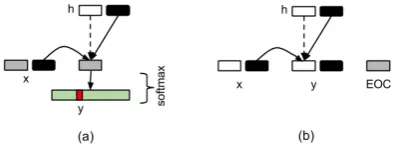
Each tree nodey carries three vectors: inner rep-resentationiy, representingy, outer representation oy, representing thefull context ofy, and partial outer representation o¯y, representing the partial contextC∞
y which generates the token ofy. Without loss of generality and ignoring direc-tions for simplicity, we assume that the model is generating dependentyfor nodehconditioning on contextC∞
y (see Figure 1). Under the approxima-tion that the inner representaapproxima-tion of a phrase equals the inner representation of its head, and thanks to the recursive definition of full/partial contexts (C∞
y is a combination ofC∞
h andy’s previously gener-ated sisters), the (partial) outer representations of yare computed as follows.
¯
[image:2.595.317.516.67.139.2]oy =f(Whiih+Whooh+bo+r)
Figure 1: The process to (a) generatey, (b) com-pute outer representationoy, given headhand sib-ling x. Black, grey, white boxes are respectively inner, partial outer, and outer representations. (Le and Zuidema, 2014)
wherer =0 ify is the first dependent ofh; oth-erwise,r= |S¯(1y)|Pv∈S¯(y)Wdr(v)iv, whereS(¯y)
is the set ofy’s sisters generated before. And,
oy =f(Whiih+Whooh+bo+s) where s = 0 if y is the only depen-dent of h (ignoring EOC); otherwise s =
1
|S(y)| P
v∈S(y)Wdr(v)iv where S(y)is the set of y’s sisters. dr(v) is the dependency relation ofv withh.Whi/ho/dr(v)aren×nreal matrices, and
bois ann-d real vector. The probabilityP(w|C∞
y )of generating a token wat nodeyis given by
softmax(w,o¯y) = e u(w,oy¯ )
P
w0∈V eu(w0,¯oy) (2)
whereu(w1,o¯y), ..., u(w|V|,o¯y)T =W¯oy+b andV is the set of all possible tokens (i.e. vocab-ulary). Wis a|V| ×nreal matrix,bis an|V|-d real vector.
2.3 The Reranker
Le and Zuidema’s (mixture) reranker is T∗= arg max
T∈D(S) αlogP(T(ROOT)) + (1−α)s(S, T) (3) where D(S) and s(S, T) are a k-best list and scores given by a third-party parser, andα∈[0,1].
3 Reduce Complexity
The complexity of the IORNN reranker above for computingP(T(ROOT))is approximately1
O =l×(3×n×n+n× |V|)
1Look at Figure 1, we can see that each node requires
wherelis the length of the given sentence,nand
|V|are respectively the dimensions of representa-tions and the vocabulary size (sums of vectors are ignored because their computational cost is small w.r.t l×n×n). In Le and Zuidema’s reranker,
|V| ≈ 14000 n = 200. It means that the reranker spends most of its time on computing softmax(w,o¯y) in Equation 2. This is also true for the complexity in the training phase.
To reduce the reranker’s complexity, we need to approximate this softmax. Mnih and Teh (2012) propose using the noise-contrastive esti-mation method which is to force the system to discriminate correct words from randomly chosen candidates (i.e., noise). This approach is very fast in training thanks to fixing normalization factors to one, but slow in testing because normalization fac-tors are explicitly computed. Vaswani et al. (2013) use the same approach, and also fix normalization factors to one when testing. This, however, doest not guarantee to give us properly normalized prob-abilities. We thus employ the hierarchical sofmax proposed by Morin and Bengio (2005) which is fast in both training and testing and outputs prop-erly normalized probabilities.
Assume that there is a binary tree whose leaf nodes each correspond to a word in the vocabulary. Let(uw
1, uw2, ..., uwL)be a path from the root to the leaf nodew (i.e. uw
1 = root anduwL = w). Let L(u)the left child of nodeu, and[x]be 1 ifxtrue and−1otherwise. We then replace Equation 2 by
P(w|Cy∞) =LY−1
i=1
σ [uwi+1=L(uwi )]vuTw i ׯoy
whereσ(z) = 1/(1 +e−z). If the binary tree is perfectly balanced, the new complexity is approx-imatelyl×(3×n×n+n×log(|V|)), which is less than4l×n×nif|V| < 2n (1.6×1060 as
n= 200in the Le and Zuidema’s reranker). Constructing a binary tree for this hierarchi-cal softmax turns out to be nontrivial. Morin and Bengio (2005) relied on WordNet whereas Mikolov et al. (2013) used only frequency-based Huffmann codes. In our case, an ideal tree should reflect both semantic similarities between words (e.g. leaf nodes for ‘dog’ and ‘cat’ should be close to each other), and word frequencies (since we want to minimize the complexity). Therefore we propose combining output of the Brown hierarchi-cal clustering algorithm (Brown et al., 1992) and
frequency-based Huffman codes.2 Firstly, we use the Brown algorithm to findchierarchical clusters (c = 500in our experiments).3 We then, for each cluster, compute the Huffman code for each word in that cluster.
4 Enrich Contexts
Although suggesting that predicting with neural networks is a solution to overcome the problem of sparsity, Le and Zuidema’s reranker still relies on two widely-used independence assumptions: (i) the two Markov chains that generate dependents in the two directions are independent, given the head, and (ii) non-overlapping subtrees are generated in-dependently.4 That is why its partial context (e.g. the red-dashed shape in Figure 2) used to generate a node ignores: (i) sisters in the other direction and (ii) ancestors’ cousins and their descendants.
We, in contrast, eliminate those two assump-tions by proposing the following top-down left-to-right generative story. From the head node, we generate its dependents from left to right. The par-tial context to generate a dependent is the whole fragment that is generated so far (e.g. the blue shape in Figure 2). We then generate subtrees rooted at those nodes also from left to right. The full context given to a node to generate the sub-tree rooted at this node is thus the whole fragment that is generated so far (e.g. the combination of the blue shape and the blue-dotted shape in Fig-ure 2). In this way, the model always uses the whole up-to-date fragment to generate a depen-dent or to generate a subtree rooted at a node. To our knowledge, these contexts, which contain full derivation histories, are the most complete ones ever used for graph-based parsing.
Extending the IORNN reranker in this way is straight-forward. For example, we first generate a subtreetr(x)rooted at node xin Figure 3. We then compute the inner representation fortr(x): if tr(x)contains onlyxthenitr(x) =ix; otherwise
itr(x)=f(Wihix+|S(1x)|
X
u∈S(x)
Widr(u)itr(u)+bi)
2Another reason not to use the Brown clustering
algo-rithm alone is that the algoalgo-rithm is inefficient with high num-bers of clusters (|V| ≈14000in this case).
3We run Liang (2005)’s implementation at https:// github.com/percyliang/brown-cluster on the training data.
4Le and Zuidema rephrased this assumption by the
Figure 2: Context used in Le and Zuidema’s reranker (red-dashed shape) and full-history context (blue-solid shape) to generate token ‘authorization’.
Figure 3: Compute the full-history outer represen-tation fory.
whereS(x)is the set ofx’s dependents,dr(u)is the dependency relation ofuwithx,Wi
h/dr(u)are
n×nreal matrices, andbiis ann-d real vector.5
5 Experiments
We use the same setting reported in Le and Zuidema (2014, Section 5.3). The Penn WSJ Tree-bank is converted to dependencies using the Ya-mada and Matsumoto (2003)’s head rules. Sec-tions 2-21 are for training, section 22 for devel-opment, and section 23 for testing. The develop-ment and test sets are tagged by the Stanford POS-tagger trained on the whole training data, whereas 10-way jackknifing is used to generate tags for the training set. For the new IORNN reranker, we set n = 200, initialise it with the 50-dim word em-beddings from Collobert et al. (2011). We use the MSTParser (with the 2nd-order feature mode) (McDonald et al., 2005) to generate k-best lists, and optimize kandα (Equation 3) on the devel-opment set.
Table 1 shows the comparison of our new reranker against other systems. It is a surprise that our reranker with the proposed hierarchical soft-max alone can achieve an almost equivalent score with Le and Zuidema’s reranker. We conjecture that drawbacks of the hierarchical softmax com-pared to the original can be lessened by probabil-ities of generating other elements like POS-tags,
5Note that the overall computational complexity increases
linearly with l × n × n. For instance, for computing P(T(ROOT)), the increase is approximately2l×n×n since each node requires maximally two more matrix-vector multiplications.
System UAS
MSTParser (baseline) 92.06
Koo and Collins (2010) 93.04
Zhang and McDonald (2012) 93.06
Martins et al. (2013) 93.07
Bohnet and Kuhn (2012) 93.39
Reranking
Hayashi et al. (2013) 93.12
Le and Zuidema (2014) 93.12
Our reranker (h-softmax only,k= 45) 93.10
Our reranker (k= 47) 93.27
Table 1: Comparison with other systems on sec-tion 23 (excluding punctuasec-tion).
dependency relations. Adding enriched contexts, our reranker achieves the second best accuracy among those systems.
Because in this experiment no words have paths longer than20 n = 200, our new reranker has a significantly lower complexity than the one of Le and Zuidema’s reranker. On a computer with an Intel Core-i5 3.3GHz CPU and 8GB RAM, it takes 20 minutes to train this reranker, which is implemented in C++, and 2 minutes to evaluate it on the test set.
6 Conclusion
Solutions to enhance the IORNN reranker of Le and Zuidema (2014) were proposed. We showed that, by replacing the original softmax function with a hierarchical softmax, the reranker’s com-putational complexity significantly decreases. The cost of this, which is drop on accuracy, is avoided by enriching contexts with subtrees rooted at (an-cestors’) cousin nodes. The new reranker, accord-ing to experimental results on the Penn WSJ Tree-bank, has even higher accuracy than the old one.
Acknowledgments
[image:4.595.138.227.189.246.2]References
Mohit Bansal, Kevin Gimpel, and Karen Livescu. 2014. Tailoring continuous word representations for dependency parsing. InProceedings of the Annual Meeting of the Association for Computational Lin-guistics.
Bernd Bohnet and Jonas Kuhn. 2012. The best of both worlds: a graph-based completion model for transition-based parsers. InProceedings of the 13th Conference of the European Chapter of the Associ-ation for ComputAssoci-ational Linguistics, pages 77–87. Association for Computational Linguistics.
Peter F Brown, Peter V Desouza, Robert L Mercer, Vincent J Della Pietra, and Jenifer C Lai. 1992. Class-based n-gram models of natural language. Computational Linguistics, 18(4):467–479.
Danqi Chen and Christopher D Manning. 2014. A fast and accurate dependency parser using neural net-works. InProceedings of the 2014 Conference on Empirical Methods in Natural Language Processing (EMNLP), pages 740–750.
Ronan Collobert, Jason Weston, L´eon Bottou, Michael Karlen, Koray Kavukcuoglu, and Pavel Kuksa. 2011. Natural language processing (almost) from scratch. The Journal of Machine Learning Re-search, 12:2493–2537.
Jason M Eisner. 1996. Three new probabilistic models for dependency parsing: An exploration. In Pro-ceedings of the 16th conference on Computational linguistics-Volume 1, pages 340–345. Association for Computational Linguistics.
Katsuhiko Hayashi, Shuhei Kondo, and Yuji Mat-sumoto. 2013. Efficient stacked dependency pars-ing by forest rerankpars-ing. Transactions of the Associ-ation for ComputAssoci-ational Linguistics, 1(1):139–150. Terry Koo and Michael Collins. 2010. Efficient
third-order dependency parsers. In Proceedings of the 48th Annual Meeting of the Association for Com-putational Linguistics, pages 1–11. Association for Computational Linguistics.
Phong Le and Willem Zuidema. 2014. The inside-outside recursive neural network model for depen-dency parsing. In Proceedings of the 2014 Con-ference on Empirical Methods in Natural Language Processing. Association for Computational Linguis-tics.
Percy Liang. 2005. Semi-supervised learning for nat-ural language. InMASTERS THESIS, MIT.
Andre Martins, Miguel Almeida, and Noah A. Smith. 2013. Turning on the turbo: Fast third-order non-projective turbo parsers. InProceedings of the 51st Annual Meeting of the Association for Computa-tional Linguistics (Volume 2: Short Papers), pages 617–622, Sofia, Bulgaria, August. Association for Computational Linguistics.
Ryan McDonald, Koby Crammer, and Fernando Pereira. 2005. Online large-margin training of dependency parsers. In Proceedings of the 43rd Annual Meeting on Association for Computational Linguistics, pages 91–98. Association for Computa-tional Linguistics.
Tomas Mikolov, Stefan Kombrink, Lukas Burget, JH Cernocky, and Sanjeev Khudanpur. 2011. Extensions of recurrent neural network language model. InAcoustics, Speech and Signal Processing (ICASSP), 2011 IEEE International Conference on, pages 5528–5531. IEEE.
Tomas Mikolov, Ilya Sutskever, Kai Chen, Greg S Cor-rado, and Jeff Dean. 2013. Distributed representa-tions of words and phrases and their compositional-ity. InAdvances in Neural Information Processing Systems, pages 3111–3119.
Andriy Mnih and Yee Whye Teh. 2012. A fast and simple algorithm for training neural probabilistic language models. In Proceedings of the 29th In-ternational Conference on Machine Learning, pages 1751–1758.
Frederic Morin and Yoshua Bengio. 2005. Hierarchi-cal probabilistic neural network language model. In AISTATS, volume 5, pages 246–252. Citeseer. Richard Socher, John Bauer, Christopher D Manning,
and Andrew Y Ng. 2013. Parsing with composi-tional vector grammars. InProceedings of the 51st Annual Meeting of the Association for Computa-tional Linguistics, pages 455–465.
Ashish Vaswani, Yinggong Zhao, Victoria Fossum, and David Chiang. 2013. Decoding with large-scale neural language models improves translation. In EMNLP, pages 1387–1392. Citeseer.
Hiroyasu Yamada and Yuji Matsumoto. 2003. Statis-tical dependency analysis with support vector ma-chines. InProceedings of International Conference on Parsing Technologies (IWPT), pages 195–206. Hao Zhang and Ryan McDonald. 2012. Generalized