Proceedings of the NAACL HLT Workshop on Unsupervised and Minimally Supervised Learning of Lexical Semantics, pages 18–26,
Corpus-based Semantic Lexicon Induction with Web-based Corroboration
Sean P. Igo
Center for High Performance Computing University of Utah
Salt Lake City, UT 84112 USA [email protected]
Ellen Riloff School of Computing
University of Utah Salt Lake City, UT 84112 USA
Abstract
Various techniques have been developed to au-tomatically induce semantic dictionaries from text corpora and from the Web. Our research combines corpus-based semantic lexicon in-duction with statistics acquired from the Web to improve the accuracy of automatically ac-quired domain-specific dictionaries. We use a weakly supervised bootstrapping algorithm to induce a semantic lexicon from a text cor-pus, and then issue Web queries to generate co-occurrence statistics between each lexicon entry and semantically related terms. The Web statistics provide a source of independent ev-idence to confirm, or disconfirm, that a word belongs to the intended semantic category. We evaluate this approach on 7 semantic cate-gories representing two domains. Our results show that the Web statistics dramatically im-prove the ranking of lexicon entries, and can also be used to filter incorrect entries.
1 Introduction
Semantic resources are extremely valuable for many natural language processing (NLP) tasks, as evi-denced by the wide popularity of WordNet (Miller, 1990) and a multitude of efforts to create similar “WordNets” for additional languages (e.g. (Atserias et al., 1997; Vossen, 1998; Stamou et al., 2002)). Semantic resources can take many forms, but one of the most basic types is a dictionary that associates a word (or word sense) with one or more semantic categories (hypernyms). For example, truck might be identified as aVEHICLE, and dog might be
identi-fied as anANIMAL. Automated methods for
generat-ing such dictionaries have been developed under the rubrics of lexical acquisition, hyponym learning, se-mantic class induction, and Web-based information extraction. These techniques can be used to rapidly create semantic lexicons for new domains and lan-guages, and to automatically increase the coverage of existing resources.
Techniques for semantic lexicon induction can be subdivided into two groups: corpus-based methods and Web-based methods. Although the Web can be viewed as a (gigantic) corpus, these two approaches tend to have different goals. Corpus-based methods are typically designed to induce domain-specific se-mantic lexicons from a collection of domain-specific texts. In contrast, Web-based methods are typically designed to induce broad-coverage resources, simi-lar to WordNet. Ideally, one would hope that broad-coverage resources would be sufficient for any do-main, but this is often not the case. Many domains use specialized vocabularies and jargon that are not adequately represented in broad-coverage resources (e.g., medicine, genomics, etc.). Furthermore, even relatively general text genres, such as news, con-tain subdomains that require extensive knowledge of specific semantic categories. For example, our work uses a corpus of news articles about terror-ism that includes many arcane weapon terms (e.g., M-79, AR-15, an-fo, and gelignite). Similarly, our disease-related documents mention obscure diseases (e.g., psittacosis) and contain many informal terms, abbreviations, and spelling variants that do not even occur in most medical dictionaries. For example, yf refers to yellow fever, tularaemia is an alternative spelling for tularemia, and nv-cjd is frequently used
to refer to new variant Creutzfeldt Jacob Disease. The Web is such a vast repository of knowledge that specialized terminology for nearly any domain probably exists in some niche or cranny, but find-ing the appropriate corner of the Web to tap into is a challenge. You have to know where to look to find specialized knowledge. In contrast, corpus-based methods can learn specialized terminology directly from a domain-specific corpus, but accuracy can be a problem because most corpora are relatively small. In this paper, we seek to exploit the best of both worlds by combining a weakly supervised corpus-based method for semantic lexicon induction with statistics obtained from the Web. First, we use a bootstrapping algorithm, Basilisk (Thelen and Riloff, 2002), to automatically induce a semantic lexicon from a domain-specific corpus. This pro-duces a set of words that are hypothesized to be-long to the targeted semantic category. Second, we use the Web as a source of corroborating evidence to confirm, or disconfirm, whether each term truly belongs to the semantic category. For each candi-date word, we search the Web for pages that con-tain both the word and a semantically related term. We expect that true semantic category members will co-occur with semantically similar words more of-ten than non-members.
This paper is organized as follows. Section 2 dis-cusses prior work on weakly supervised methods for semantic lexicon induction. Section 3 overviews our approach: we briefly describe the weakly su-pervised bootstrapping algorithm that we use for corpus-based semantic lexicon induction, and then present our procedure for gathering corroborating evidence from the Web. Section 4 presents exper-imental results on seven semantic categories repre-senting two domains: Latin American terrorism and disease-related documents. Section 5 summarizes our results and discusses future work.
2 Related Work
Our research focuses on semantic lexicon induc-tion, where the goal is to create a list of words that belong to a desired semantic class. A sub-stantial amount of previous work has been done on weakly supervised and unsupervised creation of se-mantic lexicons. Weakly supervised corpus-based
methods have utilized noun co-occurrence statis-tics (Riloff and Shepherd, 1997; Roark and Char-niak, 1998), syntactic information (Widdows and Dorow, 2002; Phillips and Riloff, 2002; Pantel and Ravichandran, 2004; Tanev and Magnini, 2006), and lexico-syntactic contextual patterns (e.g., “re-sides in <location>” or “moved to<location>”) (Riloff and Jones, 1999; Thelen and Riloff, 2002). Due to the need for POS tagging and/or parsing, these types of methods have been evaluated only on fixed corpora1, although (Pantel et al., 2004) demonstrated how to scale up their algorithms for the Web. The goal of our work is to improve upon corpus-based bootstrapping algorithms by using co-occurrence statistics obtained from the Web to re-rank and filter the hypothesized category members.
Techniques for semantic class learning have also been developed specifically for the Web. Sev-eral Web-based semantic class learners build upon Hearst’s early work (Hearst, 1992) with hyponym patterns. Hearst exploited patterns that explicitly identify a hyponym relation between a semantic class and a word (e.g., “such authors as<X>”) to automatically acquire new hyponyms. (Pas¸ca, 2004) applied hyponym patterns to the Web and learned se-mantic class instances and groups by acquiring con-texts around the patterns. Later, (Pasca, 2007) cre-ated context vectors for a group of seed instances by searching Web query logs, and used them to learn similar instances. The KnowItAll system (Etzioni et al., 2005) also uses hyponym patterns to extract class instances from the Web and evaluates them fur-ther by computing mutual information scores based on Web queries. (Kozareva et al., 2008) proposed the use of a doubly-anchored hyponym pattern and a graph to represent the links between hyponym oc-currences in these patterns.
Our work builds upon Turney’s work on seman-tic orientation (Turney, 2002) and synonym learning (Turney, 2001), in which he used a PMI-IR algo-rithm to measure the similarity of words and phrases based on Web queries. We use a similar PMI (point-wise mutual information) metric for the purposes of semantic class verification.
There has also been work on fully unsupervised
1
semantic clustering (e.g., (Lin, 1998; Lin and Pan-tel, 2002; Davidov and Rappoport, 2006; Davidov et al., 2007)), however clustering methods may or may not produce the types and granularities of seman-tic classes desired by a user. Another related line of work is automated ontology construction, which aims to create lexical hierarchies based on semantic classes (e.g., (Caraballo, 1999; Cimiano and Volker, 2005; Mann, 2002)).
3 Semantic Lexicon Induction with Web-based Corroboration
Our approach combines a weakly supervised learn-ing algorithm for corpus-based semantic lexicon in-duction with a follow-on procedure that gathers cor-roborating statistical evidence from the Web. In this section, we describe both of these components. First, we give a brief overview of the Basilisk boot-strapping algorithm that we use for corpus-based se-mantic lexicon induction. Second, we present our new strategies for acquiring and utilizing corrobo-rating statistical evidence from the Web.
3.1 Corpus-based Semantic Lexicon Induction via Bootstrapping
For corpus-based semantic lexicon induction, we use a weakly supervised bootstrapping algorithm called Basilisk (Thelen and Riloff, 2002). As in-put, Basilisk requires a small set of seed words for each semantic category, and a collection of (unanno-tated) texts. Basilisk iteratively generates new words that are hypothesized to belong to the same seman-tic class as the seeds. Here we give an overview of Basilisk’s algorithm and refer the reader to (Thelen and Riloff, 2002) for more details.
The key idea behind Basilisk is to use pattern con-texts around a word to identify its semantic class. Basilisk’s bootstrapping process has two main steps: Pattern Pool Creation and Candidate Word Selec-tion. First, Basilisk applies the AutoSlog pattern generator (Riloff, 1996) to create a set of lexico-syntactic patterns that, collectively, can extract every noun phrase in the corpus. Basilisk then ranks the patterns according to how often they extract the seed words, under the assumption that patterns which ex-tract known category members are likely to exex-tract other category members as well. The highest-ranked
patterns are placed in a pattern pool.
Second, Basilisk gathers every noun phrase that is extracted by at least one pattern in the pattern pool, and designates each head noun as a candidate for the semantic category. The candidates are then scored and ranked. For each candidate, Basilisk collects all of the patterns that extracted that word, computes the logarithm of the number of seeds extracted by each of those patterns, and finally computes the average of these log values as the score for the candidate. Intuitively, a candidate word receives a high score if it was extracted by patterns that, on average, also extract many known category members.
The N highest ranked candidates are automati-cally added to the list of seed words, taking a leap of faith that they are true members of the semantic category. The bootstrapping process then repeats, using the larger set of seed words as known category members in the next iteration.
Basilisk learns many good category members, but its accuracy varies a lot across semantic cate-gories (Thelen and Riloff, 2002). One problem with Basilisk, and bootstrapping algorithms in general, is that accuracy tends to deteriorate as bootstrapping progresses. Basilisk generates candidates by iden-tifying the contexts in which they occur and words unrelated to the desired category can sometimes also occur in those contexts. Some patterns consistently extract members of several semantic classes; for ex-ample, “attack on<NP>” will extract both people (“attack on the president”) and buildings (“attack on the U.S. embassy”). Idiomatic expressions and parsing errors can also lead to undesirable words be-ing learned. Incorrect words tend to accumulate as bootstrapping progresses, which can lead to gradu-ally deteriorating performance.
this assumption.
3.2 Web-based Semantic Class Corroboration
The novel aspect of our work is that we introduce a new mechanism to independently verify each candi-date word’s category membership using the Web as an external knowledge source. We gather statistics from the Web to provide evidence for (or against) the semantic class of a word in a manner completely independent of Basilisk’s criteria. Our approach is based on the distributional hypothesis (Harris, 1954), which says that words that occur in the same contexts tend to have similar meanings. We seek to corroborate a word’s semantic class through statis-tics that measure how often the word co-occurs with semantically related words.
For each candidate word produced by Basilisk, we construct a Web query that pairs the word with a se-mantically related word. Our goal is not just to find Web pages that contain both terms, but to find Web pages that contain both terms in close proximity to one another. We consider two terms to be collo-cated if they occur within ten words of each other on the same Web page, which corresponds to the functionality of the NEAR operator used by the Al-taVista search engine2. Turney (Turney, 2001; Tur-ney, 2002) reported that the NEAR operator outper-formed simple page co-occurrence for his purposes; our early experiments informally showed the same for this work.
We want our technique to remain weakly super-vised, so we do not want to require additional hu-man input or effort beyond what is already required for Basilisk. With this in mind, we investigated two types of collocation relations as possible indicators of semantic class membership:
Hypernym Collocation: We compute co-occurrence statistics between the candidate word and the name of the targeted semantic class (i.e., the word’s hypothesized hypernym). For example, given the candidate word jeep and the semantic category VEHICLE, we would issue the Web query “jeep NEAR vehicle”. Our intuition is that such queries would identify definition-type Web hits. For example, the query “cow NEAR animal” might retrieve snippets such as “A cow is an animal found
2
http://www.altavista.com
on dairy farms” or “An animal such as a cow has...”.
Seed Collocation: We compute co-occurrence statistics between the candidate word and each seed word that was given to Basilisk as input. For ex-ample, given the candidate word jeep and the seed word truck, we would issue the Web query “jeep NEAR truck”. Here the intuition is that members of the same semantic category tend to occur near one another - in lists, for example.
As a statistical measure of co-occurrence, we compute a variation of Pointwise Mutual Informa-tion (PMI), which is defined as:
P M I(x, y) =log(p(px()x,y∗p()y))
wherep(x, y)is the probability thatxandyare col-located (near each other) on a Web page,p(x)is the probability thatxoccurs on a Web page, andp(y)is the probability thatyoccurs on a Web page.
p(x)is calculated as countN(x), wherecount(x)is the number of hits returned by AltaVista, searching forx by itself, andN is the total number of docu-ments on the World Wide Web at the time the query is made. Similarly, p(x, y) is count(x N EAR yN ). Given this, the PMI equation can be rewritten as:
log(N) +log(countcount((x N EAR yx)∗count(y)))
N is not known, but it is the same for every query (assuming the queries were made at roughly the same time). We will use these scores solely to compare the relative goodness of candidates, so we can omit N from the equation because it will not change the relative ordering of the scores. Thus, our PMI score3 for a candidate word and related term (hypernym or seed) is:
log(countcount((x N EAR yx)∗count(y)))
Finally, we created three different scoring func-tions that use PMI values in different ways to cap-ture different types of co-occurrence information:
Hypernym Score: PMI based on collocation
be-tween the hypernym term and candidate word.
3
Average of Seeds Score: The mean of the PMI
scores computed for the candidate and each seed word:
1
|seeds| |seedsX|
i=1
P M I(candidate, seedi)
Max of Seeds Score: The maximum (highest) of
the PMI scores computed for the candidate and each seed word.
The rationale for the Average of Seeds Score is that the seeds are all members of the semantic cat-egory, so we might expect other members to occur near many of them. Averaging over all of the seeds can diffuse unusually high or low collocation counts that might result from an anomalous seed. The ra-tionale for the Max of Seeds Score is that a word may naturally co-occur with some category mem-bers more often than others. For example, one would expect dog to co-occur with cat much more fre-quently than with frog. A high Max of Seeds Score indicates that there is at least one seed word that fre-quently co-occurs with the candidate.
Since Web queries are relatively expensive, it is worth taking stock of how many queries are nec-essary. Let N be the number of candidate words produced by Basilisk, and S be the number of seed words given to Basilisk as input. To com-pute the Hypernym Score for a candidate, we need 3 queries: count(hypernym), count(candidate), and count(hypernym N EAR candidate). The first query is the same for all candidates, so forN
candidate words we need 2N + 1queries in total. To compute the Average or Max of Seeds Score for a candidate, we needS queries forcount(seedi),S
queries forcount(seediN EAR candidate), and 1
query for count(candidate). So for N candidate words we needN ∗(2S+ 1)queries. Sis typically small for weakly supervised algorithms (S=10 in our experiments), which means that this Web-based cor-roboration process requiresO(N)queries to process a semantic lexicon of sizeN.
4 Evaluation
4.1 Data Sets
We ran experiments on two corpora: 1700 MUC-4 terrorism articles (MUC-4 Proceedings, 1992) and a combination of 6000 disease-related documents,
consisting of 2000 ProMed disease outbreak re-ports (ProMed-mail, 2006) and 4000 disease-related PubMed abstracts (PubMed, 2009). For the terror-ism domain, we created lexicons for four semantic categories: BUILDING, HUMAN, LOCATION, and WEAPON. For the disease domain, we created lexi-cons for three semantic categories: ANIMAL4, DIS
-EASE, and SYMPTOM. For each category, we gave Basilisk 10 seed words as input. The seeds were chosen by applying a shallow parser to each corpus, extracting the head nouns of all the NPs, and sort-ing the nouns by frequency. A human then walked down the sorted list and identified the 10 most fre-quent nouns that belong to each semantic category5.
This strategy ensures that the bootstrapping process is given seed words that occur in the corpus with high frequency. The seed words are shown in Ta-ble 1.
BUILDING: embassy office headquarters church offices house home residence hospital airport HUMAN: people guerrillas members troops
Cristiani rebels president terrorists soldiers leaders LOCATION: country El Salvador Salvador
United States area Colombia city countries department Nicaragua
WEAPON: weapons bomb bombs explosives arms missiles dynamite rifles materiel bullets
ANIMAL: bird mosquito cow horse pig chicken sheep dog deer fish
DISEASE:SARS BSEanthrax influenzaWNV FMDencephalitis malaria pneumonia flu SYMPTOM: fever diarrhea vomiting rash paralysis
weakness necrosis chills headaches hemorrhage
Table 1: Seed Words
To evaluate our results, we used the gold standard answer key that Thelen & Riloff created to evaluate Basilisk on the MUC4 corpus (Thelen and Riloff, 2002); they manually labeled every head noun in the corpus with its semantic class. For the ProMed / PubMed disease corpus, we created our own answer key. For all of the lexicon entries hypothesized by Basilisk, a human annotator (not any of the authors)
4
ANIMALwas chosen because many of the ProMed disease outbreak stories concerned outbreaks among animal popula-tions.
5
BUILDING HUMAN LOCATION WEAPON
N Ba Hy Av M x Ba Hy Av M x Ba Hy Av M x Ba Hy Av M x
25 .40 .56 .52 .56 .40 .72 .80 .84 .68 .88 .88 1.0 .56 .84 1.0 1.0
50 .44 .56 .46 .40 .56 .80 .88 .86 .80 .86 .84 .98 .52 .74 .76 .90
75 .44 .45 .41 .39 .65 .84 .85 .85 .80 .88 .80 .99 .52 .63 .65 .79
100 .42 .41 .38 .36 .69 .81 .80 .87 .81 .85 .78 .95 .55 .55 .56 .63
300 .22 .82 .75 .26
ANIMAL DISEASE SYMPTOM
N Ba Hy Av M x Ba Hy Av M x Ba Hy Av M x
25 .48 .88 .92 .92 .64 .84 .80 .84 .64 .84 .92 .80
50 .58 .82 .84 .80 .72 .84 .60 .82 .62 .76 .90 .74
75 .55 .68 .67 .69 .69 .83 .59 .81 .61 .68 .79 .71
100 .45 .55 .54 .57 .69 .78 .58 .80 .59 .71 .77 .64
[image:6.612.89.526.69.254.2]300 .20 .62 .38
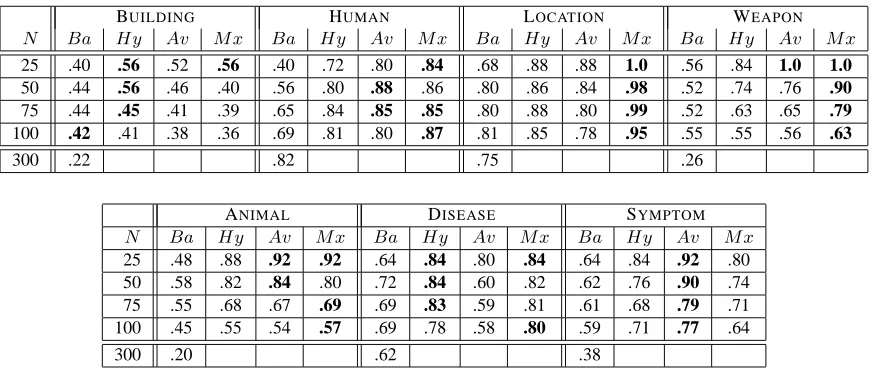
Table 2: Ranking results for 7 semantic categories, showing accuracies for the top-rankedNwords.
(Ba=Basilisk,Hy=Hypernym Re-ranking,Av=Average of Seeds Re-ranking,M x=Max of Seeds Re-ranking
labeled each word as either correct or incorrect for the hypothesized semantic class. A word is consid-ered to be correct if any sense of the word is seman-tically correct.
4.2 Ranking Results
We ran Basilisk for 60 iterations, learning 5 new words in each bootstrapping cycle, which produced a lexicon of 300 words for each semantic category. The columns labeled Bain Table 2 show the accu-racy results for Basilisk.6 As we explained in Sec-tion 3.1, accuracy tends to decrease as bootstrapping progresses, so we computed accuracy scores for the top-ranked 100 words, in increments of 25, and also for the entire lexicon of 300 words.
Overall, we see that Basilisk learns many cor-rect words for each semantic category, and the top-ranked terms are generally more accurate than the lower-ranked terms. For the top 100 words, accu-racies are generally in the 50-70% range, except for LOCATIONwhich achieves about 80% accuracy. For the HUMAN category, Basilisk obtained 82%
accu-racy over all 300 words, but the top-ranked words actually produced lower accuracy.
Basilisk’s ranking is clearly not as good as it could be because there are correct terms co-mingled with incorrect terms throughout the ranked lists. This has
6These results are not comparable to the Basilisk results
re-ported by (Thelen and Riloff, 2002) because our implementa-tion only does single-category learning while the results in that paper are based on simultaneously learning multiple categories.
two ramifications. First, if we want a human to man-ually review each lexicon before adding the words to an external resource, then the rankings may not be very helpful (i.e., the human will need to review all of the words), and (2) incorrect terms generated during the early stages of bootstrapping may be hin-dering the learning process because they introduce noise during bootstrapping. The HUMAN category
seems to have recovered from early mistakes, but the lower accuracies for some other categories may be the result of this problem. The purpose of our Web-based corroboration process is to automatically re-evaluate the lexicons produced by Basilisk, using Web-based statistics to create more separation be-tween the good entries and the bad ones.
Our first set of experiments uses the Web-based co-occurrence statistics to re-rank the lexicon en-tries. The Hy, Av, and M x columns in Ta-ble 2 show the re-ranking results using each of the Hypernym, Average of Seeds, and Maximum of Seeds scoring functions. In all cases, Web-based re-ranking outperforms Basilisk’s original rank-ings. Every semantic category except for BUILDING
yielded accuracies of 80-100% among the top can-didates. For each row, the highest accuracy for each semantic category is shown in boldface (as are any tied for highest).
out-BUILDING HUMAN LOCATION WEAPON ANIMAL DISEASE SYMPTOM consulate guerrilla San Salvador shotguns bird-to-bird meningo-encephalitis nausea pharmacies extremists Las Hojas carbines cervids bse).austria diarrhoea aiport sympathizers Tejutepeque armaments goats inhalational myalgias zacamil assassins Ayutuxtepeque revolvers ewes anthrax disease chlorosis airports patrols Copinol detonators ruminants otitis media myalgia parishes militiamen Cuscatancingo pistols swine airport malaria salivation Masariegos battalion Jiboa car bombs calf taeniorhynchus dysentery chancery Ellacuria Chinameca calibers lambs hyopneumonia cramping residences rebel Zacamil M-16 wolsington monkeypox dizziness police station policemen Chalantenango grenades piglets kala-azar inappetance
Table 3: Top 10 words ranked by Max of Seeds Scores.
performed once by the Hypernym Scores (BUILD
-ING) and once by the Average of Seeds Scores
(SYMPTOM).
The strong performance of the Max of Seeds scores suggests that one seed is often an especially good collocation indicator for category membership – though it may not be the same seed word for all of the lexicon words. The relatively poor performance of the Average of Seeds scores may be attributable to the same principle; perhaps even if one seed is especially strong, averaging over the less-effective seeds’ scores dilutes the results. Averaging is also susceptible to damage from words that receive the special-case score of -99999 when a hit count is zero (see Section 3.2).
Table 3 shows the 10 top-ranked candidates for each semantic category based on the Max of Seeds scores. The table illustrates that this scoring func-tion does a good job of identifying semantically cor-rect words, although of course there are some mis-takes. Mistakes can happen due to parsing errors (e.g., bird-to-bird is an adjective and not a noun, as in bird-to-bird transmission), and some are due to issues associated with Web querying. For exam-ple, the nonsense term “bse).austria” was ranked highly because Altavista split this term into 2 sep-arate words because of the punctuation, and bse by itself is indeed a disease term (bovine spongiform encephalitis).
4.3 Filtering Results
Table 2 revealed that the 300-word lexicons pro-duced by Basilisk vary widely in the number of true category words that they contain. The least dense category is ANIMAL, with only 61 correct words,
and the most dense is HUMAN with 247 correct words. Interestingly, the densest categories are not always the easiest to rank. For example, the HU
-MANcategory is the densest category but Basilisk’s ranking of the human terms was poor.
θ Category Acc Cor/Tot
-22
WEAPON .88 46/52 LOCATION .98 59/60 HUMAN .80 8/10 BUILDING .83 5/6 ANIMAL .91 30/33 DISEASE .82 64/78 SYMPTOM .65 64/99
-23
WEAPON .79 59/75 LOCATION .96 82/85 HUMAN .85 23/27 BUILDING .71 12/17 ANIMAL .87 40/46 DISEASE .78 82/105 SYMPTOM .62 86/139
-24
[image:7.612.345.504.328.602.2]WEAPON .63 63/100 LOCATION .93 111/120 HUMAN .87 54/62 BUILDING .45 17/38 ANIMAL .75 47/63 DISEASE .74 94/127 SYMPTOM .60 100/166
Table 4: Filtering results using the Max of Seeds Scores.
presupposes that we know where to draw the line be-tween the good and bad entries, and Table 2 shows that this boundary varies across categories. For HU
-MANS, the top 100 words are 87% accurate, and in fact we get 82% accuracy over all 300 words. But for ANIMALSwe achieve 80% accuracy only for the top 50 words. It is paramount for semantic dictio-naries to have high integrity, so accuracy must be high if we want to use the resulting lexicons without manual review.
As an alternative to ranking, another way that we could use the Web-based corroboration statistics is to automatically filter words that do not receive a high score. The key question is whether the values of the scores are consistent enough across categories to set a single threshold that will work well across the different categories.
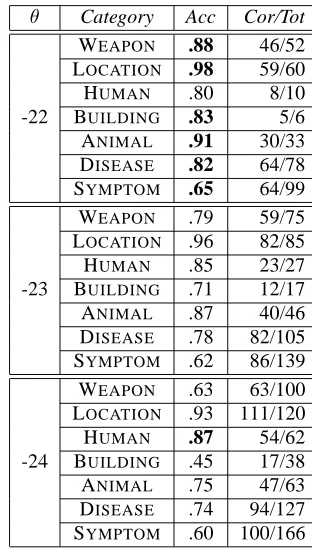
Table 4 shows the results of using the Max of Seeds Scores as a filtering mechanism: given a thresholdθ, all words that have a score< θare dis-carded. For each threshold valueθand semantic cat-egory, we computed the accuracy (Acc) of the lex-icon after all words with a score< θ have been re-moved. TheCor/T otcolumn shows the number of correct category members and the number of total words that passed the threshold.
We experimented with a variety of threshold val-ues and found that θ=-22 performed best. Table 4 shows that this threshold produces a relatively high-precision filtering mechanism, with 6 of the 7 cat-egories achieving lexicon accuracies ≥ 80%. As expected, the Cor/Tot column shows that the num-ber of words varies widely across categories. Au-tomatic filtering represents a trade-off: a relatively high-precision lexicon can be created, but some cor-rect words will be lost. The threshold can be ad-justed to increase the number of learned words, but with a corresponding drop in precision. Depending upon a user’s needs, a high threshold may be desir-able to identify only the most confident lexicon en-tries, or a lower threshold may be desirable to retain most of the correct entries while reliably removing some of the incorrect ones.
5 Conclusions
We have demonstrated that co-occurrence statis-tics gathered from the Web can dramatically
im-prove the ranking of lexicon entries produced by a weakly-supervised corpus-based bootstrapping al-gorithm, without requiring any additional supervi-sion. We found that computing Web-based co-occurrence statistics across a set of seed words and then using the highest score was the most success-ful approach. Co-occurrence with a hypernym term also performed well for some categories, and could be easily combined with the Max of Seeds approach by choosing the highest value among the seeds as well as the hypernym.
In future work, we would like to incorporate this Web-based re-ranking procedure into the bootstrap-ping algorithm itself to dynamically “clean up” the learned words before they are cycled back into the bootstrapping process. Basilisk could consult the Web-based statistics to select the best 5 words to generate before the next bootstrapping cycle begins. This integrated approach has the potential to sub-stantially improve Basilisk’s performance because it would improve the precision of the induced lex-icon entries during the earliest stages of bootstrap-ping when the learning process is most fragile.
Acknowledgments
Many thanks to Julia James for annotating the gold standards for the disease domain. This research was supported in part by Department of Homeland Secu-rity Grant N0014-07-1-0152.
References
J. Atserias, S. Climent, X. Farreres, G. Rigau, and H. Ro-driguez. 1997. Combining Multiple Methods for the Automatic Construction of Multilingual WordNets. In
Proceedings of the International Conference on Recent Advances in Natural Language Processing.
S. Caraballo. 1999. Automatic Acquisition of a Hypernym-Labeled Noun Hierarchy from Text. In
Proc. of the 37th Annual Meeting of the Association for Computational Linguistics, pages 120–126.
P. Cimiano and J. Volker. 2005. Towards large-scale, open-domain and ontology-based named entity classi-fication. In Proc. of Recent Advances in Natural
Lan-guage Processing, pages 166–172.
D. Davidov and A. Rappoport. 2006. Efficient unsu-pervised discovery of word categories using symmet-ric patterns and high frequency words. In Proc. of the
D. Davidov, A. Rappoport, and M. Koppel. 2007. Fully unsupervised discovery of concept-specific relation-ships by web mining. In Proc. of the 45th Annual
Meeting of the Association of Computational Linguis-tics, pages 232–239, June.
O. Etzioni, M. Cafarella, D. Downey, A. Popescu, T. Shaked, S. Soderland, D. Weld, and A. Yates. 2005. Unsupervised named-entity extraction from the web: an experimental study. Artificial Intelligence, 165(1):91–134, June.
Z. Harris. 1954. Distributional Structure. In J. A. Fodor and J. J. Katz, editor, The Structure of Language, pages 33–49. Prentice-Hall.
M. Hearst. 1992. Automatic acquisition of hyponyms from large text corpora. In Proc. of the 14th
In-ternational Conference on Computational Linguistics (COLING-92).
Z. Kozareva, E. Riloff, and E. Hovy. 2008. Semantic Class Learning from the Web with Hyponym Pattern Linkage Graphs. In Proceedings of the 46th Annual
Meeting of the Association for Computational Linguis-tics: Human Language Technologies (ACL-08).
D. Lin and P. Pantel. 2002. Concept discovery from text. In Proc. of the 19th International Conference on
Com-putational linguistics, pages 1–7.
D. Lin. 1998. Dependency-based Evaluation of MINI-PAR. In Workshop on the Evaluation of Parsing
Sys-tems, Granada, Spain.
G. Mann. 2002. Fine-grained proper noun ontologies for question answering. In Proc. of the 19th International
Conference on Computational Linguistics, pages 1–7.
G. Miller. 1990. Wordnet: An On-line Lexical Database.
International Journal of Lexicography, 3(4).
MUC-4 Proceedings. 1992. Proceedings of the Fourth
Message Understanding Conference (MUC-4).
Mor-gan Kaufmann.
M. Pas¸ca. 2004. Acquisition of categorized named en-tities for web search. In Proc. of the Thirteenth ACM
International Conference on Information and Knowl-edge Management, pages 137–145.
P. Pantel and D. Ravichandran. 2004. Automatically labeling semantic classes. In Proc. of Conference of
HLT / North American Chapter of the Association for Computational Linguistics, pages 321–328.
P. Pantel, D. Ravichandran, and E. Hovy. 2004. To-wards terascale knowledge acquisition. In Proc. of the
20th international conference on Computational Lin-guistics, page 771.
M. Pasca. 2007. weakly-supervised Discovery of Named Entities using Web Search Queries. In CIKM, pages 683–690.
W. Phillips and E. Riloff. 2002. Exploiting Strong Syn-tactic Heuristics and Co-Training to Learn Semantic
Lexicons. In Proceedings of the 2002 Conference on
Empirical Methods in Natural Language Processing,
pages 125–132.
ProMed-mail. 2006. http://www.promedmail.org/. PubMed. 2009. http://www.ncbi.nlm.nih.gov/sites/entrez. E. Riloff and R. Jones. 1999. Learning Dictionaries for
Information Extraction by Multi-Level Bootstrapping. In Proceedings of the Sixteenth National Conference
on Artificial Intelligence.
E. Riloff and J. Shepherd. 1997. A Corpus-Based Ap-proach for Building Semantic Lexicons. In
Proceed-ings of the Second Conference on Empirical Methods in Natural Language Processing, pages 117–124.
E. Riloff. 1996. Automatically Generating Extraction Patterns from Untagged Text. In Proceedings of the
Thirteenth National Conference on Artificial Intelli-gence, pages 1044–1049. The AAAI Press/MIT Press.
B. Roark and E. Charniak. 1998. Noun-phrase Co-occurrence Statistics for Semi-automatic Semantic Lexicon Construction. In Proceedings of the 36th
Annual Meeting of the Association for Computational Linguistics, pages 1110–1116.
Sofia Stamou, Kemal Oflazer, Karel Pala, Dimitris Chris-toudoulakis, Dan Cristea, Dan Tufis, Svetla Koeva, George Totkov, Dominique Dutoit, and Maria Grigo-riadou. 2002. Balkanet: A multilingual semantic net-work for the balkan languages. In Proceedings of the
1st Global WordNet Association conference.
H. Tanev and B. Magnini. 2006. Weakly supervised ap-proaches for ontology population. In Proc. of 11st
Conference of the European Chapter of the Associa-tion for ComputaAssocia-tional Linguistics.
M. Thelen and E. Riloff. 2002. A Bootstrapping Method for Learning Semantic Lexicons Using Extraction Pa ttern Contexts. In Proceedings of the 2002 Conference
on Empirical Methods in Natural Language Process-ing, pages 214–221.
Peter D. Turney. 2001. Mining the Web for Syn-onyms: PMI-IR versus LSA on TOEFL. In EMCL
’01: Proceedings of the 12th European Conference on Machine Learning, pages 491–502, London, UK.
Springer-Verlag.
P. D. Turney. 2002. Thumbs up or thumbs down? se-mantic orientation applied to unsupervised classifica-tion of reviews. In Proceedings of the 40th Annual
Meeting of the Association for Computational Linguis-tics (ACL’02), pages 417–424.
Piek Vossen, editor. 1998. EuroWordNet: A Multilingual
Database with Lexical Semantic Networks. Kluwer
Academic Publishers, Norwell, MA, USA.
D. Widdows and B. Dorow. 2002. A graph model for unsupervised lexical acquisition. In Proc. of the 19th