Determining Compositionality of Word Expressions
Using Word Space Models
Lubom´ır Krˇcm´aˇr, Karel Jeˇzek
University of West Bohemia Faculty of Applied Sciences
Department of Computer Science and Engineering Pilsen, Czech Republic
{lkrcmar,jezek ka}@kiv.zcu.cz
Pavel Pecina
Charles University in Prague Faculty of Mathematics and Physics Institute of Formal and Applied Linguistics
Prague, Czech Republic [email protected]
Abstract
This research focuses on determining seman-tic compositionality of word expressions us-ing word space models (WSMs). We discuss previous works employing WSMs and present differences in the proposed approaches which include types of WSMs, corpora, preprocess-ing techniques, methods for determinpreprocess-ing com-positionality, and evaluation testbeds.
We also present results of our own approach for determining the semantic compositionality based on comparing distributional vectors of expressions and their components. The vec-tors were obtained by Latent Semantic Analy-sis (LSA) applied to the ukWaC corpus. Our results outperform those of all the participants in the Distributional Semantics and Composi-tionality (DISCO) 2011 shared task.
1 Introduction
A word expression is semantically compositional if its meaning can be understood from the literal meaning of its components. Therefore, semanti-cally compositional expressions involve e.g. “small island” or “hot water”; on the other hand, seman-tically non-compositional expressions are e.g. “red tape” or “kick the bucket”.
The notion of compositionality is closely related to idiomacy – the higher the compositionality the lower the idiomacy and vice versa (Sag et al., 2002; Baldwin and Kim, 2010).
Non-compositional expressions are often referred to as Multiword Expressions (MWEs). Baldwin and Kim (2010) differentiate the following sub-types of
compositionality: lexical, syntactic, semantic, prag-matic, and statistical. This paper is concerned with semantic compositionality.
Compositionality as a feature of word expressions is not discrete. Instead, expressions populate a con-tinuum between two extremes: idioms and free word combinations (McCarthy et al., 2003; Bannard et al., 2003; Katz, 2006; Fazly, 2007; Baldwin and Kim, 2010; Biemann and Giesbrecht, 2011). Typical ex-amples of expressions between the two extremes are “zebra crossing” or “blind alley”.
Our research in compositionality is motivated by the hypothesis that a special treatment of se-mantically non-compositional expressions can im-prove results in various Natural Language Process-ing (NPL) tasks, as shown for example by Acosta et al. (2011), who utilized MWEs in Information Re-trieval (IR). Besides that, there are other NLP ap-plications that can benefit from knowing the degree of compositionality of expressions such as machine translation (Carpuat and Diab, 2010), lexicography (Church and Hanks, 1990), word sense disambigua-tion (Finlayson and Kulkarni, 2011), part-of-speech (POS) tagging and parsing (Seretan, 2008) as listed in Ramisch (2012).
The main goal of this paper is to present an anal-ysis of previous approaches using WSMs for de-termining the semantic compositionality of expres-sions. The analysis can be found in Section 2. A special attention is paid to the evaluation of the pro-posed models that is described in Section 3. Section 4 presents our first intuitive experimental setup and results of LSA applied to the DISCO 2011 task. Sec-tion 5 concludes the paper.
2 Semantic Compositionality of Word Expressions Determined by WSMs
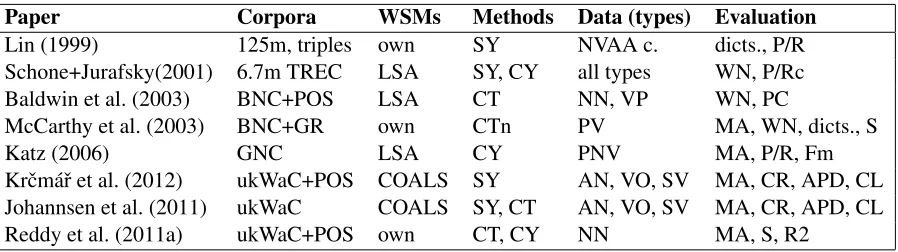
Several recent works, including Lin (1999), Schone and Jurafsky (2001), Baldwin et al. (2003), Mc-Carthy et al. (2003), Katz (2006), Johannsen et al. (2011), Reddy et al. (2011a), and Krˇcm´aˇr et al. (2012), show the ability of methods based on WSMs to capture the degree of semantic compositionality of word expressions. We analyse the proposed meth-ods and discuss their differences. As further de-scribed in detail and summarized in Table 1, the ap-proaches differ in the type of WSMs, corpora, pre-processing techniques, methods for determining the compositionality, datasets for evaluation, and meth-ods of evaluation itself.
Our understanding of WSM is in agreement with Sahlgren (2006): “The word space model is a com-putational model of word meaning that utilizes the distributional patterns of words collected over large text data to represent semantic similarity between words in terms of spatial proximity”. For more information on WSMs, see e.g. Turney and Pan-tel (2010), Jurgens and Stevens (2010), or Sahlgren (2006).
WSMs and their parameters WSMs can be built by different algorithms including LSA (Landauer and Dumais, 1997), Hyperspace Analogue to Lan-guage (HAL) (Lund and Burgess, 1996), Random Indexing (RI) (Sahlgren, 2005), and Correlated Oc-currence Analogue to Lexical Semantics (COALS) (Rohde et al., 2005). Every algorithm has its own specifics and can be configured in different ways. The configuration usually involves e.g. the choice of context size, weighting functions, or normaliz-ing functions. While Schone and Jurafsky (2001), Baldwin et al. (2003), and Katz (2006) addopted LSA-based approaches, Johannsen et al. (2011) and Krˇcm´aˇr et al. (2012) employ COALS; the others use their own specific WSMs.
Corpora and text preprocessing Using differ-ent corpora and their preprocessing naturally leads to different WSMs. The preprocessing can differ e.g. in the choice of used word forms or in re-moval/retaining of low-frequency words. For exam-ple, while Lin (1999) employs a 125-million-word newspaper corpus, Schone and Jurafsky (2001) use
a 6.7-million-word subset of the TREC databases, Baldwin et al. (2003) base their experiments on 90 million words from the British National Corpus (Burnard, 2000). Krˇcm´aˇr et al. (2012), Johannsen et al. (2011), and Reddy et al. (2011a) use the ukWaC corpus, consisting of 1.9 billion words from web texts (Baroni et al., 2009). As for preprocessing, Lin (1999) extracts triples with dependency relation-ships, Baldwin et al. (2003), Reddy et al. (2011a), and Krˇcm´aˇr et al. (2012) concatenate word lemmas with their POS categories. Johannsen et al. (2011) use word lemmas and remove low-frequency words while Reddy et al. (2011a), for example, keep only frequent content words.
Methods We have identified three basic methods for determining semantic compositionality:
1) The substitutability-based methods exploit the fact that replacing components of non-compositional expressions by words which are similar leads to anti-collocations (Pearce, 2002). Then, frequency or mutual information of such expressions (anti-collocations) is compared with the frequency or mutual information of the original expressions. For example, consider expected occur-rence counts of “hot dog” and its anti-collocations such as “warm dog” or “hot terrier”.
2) The component-based methods, utilized for ex-ample by Baldwin et al. (2003) or Johannsen et al. (2011), compare the distributional characteristics of expressions and their components. The context vec-tors expected to be different from each other are e.g. the vector representing the expression “hot dog” and the vector representing the word “dog”.
3) The compositionality-based methods compare two vectors of each analysed expression: the true co-occurrence vector of an expression and the vec-tor obtained from vecvec-tors corresponding to the com-ponents of the expression using a compositional-ity function (Reddy et al., 2011a). The most com-mon compositionality functions are vector addition or pointwise vector multiplication (Mitchell and La-pata, 2008). For example, the vectors for “hot dog” and “hot”⊕“dog” are supposed to be different.
ten-Paper Corpora WSMs Methods Data (types) Evaluation
Lin (1999) 125m, triples own SY NVAA c. dicts., P/R Schone+Jurafsky(2001) 6.7m TREC LSA SY, CY all types WN, P/Rc Baldwin et al. (2003) BNC+POS LSA CT NN, VP WN, PC
McCarthy et al. (2003) BNC+GR own CTn PV MA, WN, dicts., S
Katz (2006) GNC LSA CY PNV MA, P/R, Fm
[image:3.612.84.533.53.179.2]Krˇcm´aˇr et al. (2012) ukWaC+POS COALS SY AN, VO, SV MA, CR, APD, CL Johannsen et al. (2011) ukWaC COALS SY, CT AN, VO, SV MA, CR, APD, CL Reddy et al. (2011a) ukWaC+POS own CT, CY NN MA, S, R2
Table 1: Overview of experiments applying WSMs to determine semantic compositionality of word expressions. BNC - British National Corpus, GR - grammatical relations, GNC - German newspaper corpus, TREC - TREC corpus; SY - substitutability-based methods, CT - component-based methods, CTn - component-based methods comparing WSM neighbors of expressions and their components, CY - compositionality-based methods; NVAP c. - noun, verb, adjective, adverb combinations, NN nounnoun, VP verbparticles, AN adjectivenoun, VO verbobject, SV -subject-verb, PV - phrasal-verb, PNV - preposition-noun-verb; dicts. - dictionaries of idioms, WN - Wordnet, MA - use of manually annotated data, S - Spearman correlation, PC - Pearson correlation, CR - Spearman and Kendall correlations, APD - average point difference, CL - classification, P/R - Precision/Recall, P/Rc - Precision/Recall curves, Fm - F measure, R2 - goodness.
dency to exploit manually annotated data from a specific corpus, ranging from semantically composi-tional to non-composicomposi-tional expressions (McCarthy et al., 2003; Katz, 2006; Johannsen et al., 2011; Reddy et al., 2011a; Krˇcm´aˇr et al., 2012).
This approach, as opposed to the methods based on dictionaries of MWEs (idioms) or Word-net (Miller, 1995), has the following advantages: Firstly, the classification of a manually annotated data is not binary but finer-grained, enabling the evaluation to be more detailed. Secondly, the low-coverage problem of dictionaries, which originates for example due to the facts that new MWEs still arise or are domain specific, is avoided.1 For exam-ple, Lin (1999), Schone and Jurafsky (2001), Bald-win et al. (2003) used Wordnet or other dictionary-type resources.
3 Evaluation Methods
This section discusses evaluation methods includ-ing average point difference (APD), Spearman and Kendall correlations, and precision of classifica-tion (PoC) suggested by Biemann and Giesbrecht (2011); Precision/nBest, Recall/nBest and Preci-sion/Recall curves proposed by Evert (2005); and
1The consequence of using a low-coverage dictionary can
cause underestimation of the used method since the dictionary does not have to contain MWEs correctly found by that method.
Average Precision used by Pecina (2009). Our eval-uation is based on the English part of the manu-ally annotated datasets DISCO 2011 (Biemann and Giesbrecht, 2011), further referred to as DISCO-En-Gold.
Disco-En-Gold consists of 349 expressions di-vided into training (TrainD), validation (ValD), and test data (TestD) manually assigned scores from 0 to 100, indicating the level of compositionality (the lower the score the lower the compositionality and vice versa). The expressions are of the following types: adjective-noun (AN), verb-object (VO), and subject-verb (SV). Based on the numerical scores, the expressions are also classified into three disjoint classes (coarse scores): low, medium, and high com-positional.2 A sample of the Disco-En-Gold data is presented in Table 2.
Comparison of evaluation methods The purpose of the DISCO workshop was to find the best meth-ods for determining semantic compositionality. The participants were asked to create systems capable of assigning the numerical values closest to the ones assigned by the annotators (Gold values). The pro-posed APD evaluation measure is calculated as the mean difference between the particular systems’
val-2
Type Expression Ns Cs
EN ADJ NN blue chip 11 low EN V OBJ buck trend 14 low EN ADJ NN open source 49 medium EN V OBJ take advantage 57 medium EN ADJ NN red squirrel 90 high EN V SUBJ student learn 98 high
Table 2: A sample of manually annotated expressions from Disco-En-Gold with their numerical scores (Ns) and coarse scores (Cs).
ues and the Gold values assigned to the same expres-sions. PoC is defined as the ratio of correct coarse predictions to the number of all the predictions.
Following Krˇcm´aˇr et al. (2012), we argue that for the purpose of comparison of the methods, the values assigned to a set of expressions by a certain model are not as important as is the ranking of the expressions (which is not sensitive to the original distribution of compositionality values). Similarly as Evert (2005), Pecina (2009), and Krˇcm´aˇr et al. (2012) we adopt evaluation based on ranking (al-though the measures such as PoC or APD might pro-vide useful information too).
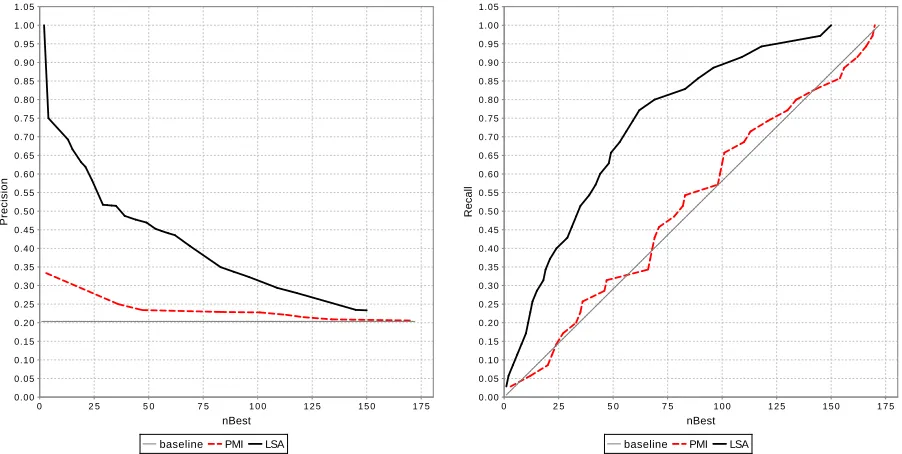
Evaluation based on ranking can be realized by measuring ranked correlations (Spearman and Kendall) or Precision/Recall scores and curves com-monly used e.g. in IR (Manning et al., 2008). In IR, Precision is defined as the ratio of found rele-vant documents to all the retrieved documents with regards to a user’s query. Recall is defined as the ra-tio of found relevant documents to all the relevant documents in a test set to the user’s query. The Precision/Recall curve is a curve depicting the de-pendency of Precision upon Recall. Analogously, the scheme can be used for evaluation of the meth-ods finding semantically non-compositional expres-sions. However, estimation of Recall is not possible without knowledge of the correct class3for every ex-pression in a corpus. To bypass this, Evert (2005) calculates Recall with respect to the set of annotated data divided into non-compositional and composi-tional classes. The Precision/nBest, Recall/nBest, and Precision/Recall curves for the LSA experiment
3
A semantically non-compositional expression or a seman-tically compositional expressions
described in the following section are depicted in Figures 1 and 2.
Evert’s (2005) curves allow us to visually com-pare the results of the methods in more detail. To facilitate comparison of several methods, we also suggest using average precision (AP) adopted from Pecina (2009), which reduces information provided by a single Precision/Recall curve to one value. AP is defined as a mean Precision at all the values of Recall different from zero.
4 LSA experiment
LSA is WSM based on the Singular Value De-composition (SVD) factorization (Deerwester et al., 1990) applied to the co-occurrence matrix. In the matrix, the numbers of word occurrences in speci-fied contexts4are stored. The row vectors of the ma-trix capture the word meanings.5 The idea of using SVD is to project vectors corresponding to the words into a lower-dimensional space and thus bring the vectors of words with similar meaning near to each other.
We built LSA WSM and applied the component-based method to Disco-En-Gold. We used our own modification of the LSA algorithm originally implemented in the S-Space package (Jurgens and Stevens, 2010). The modification lies in treating ex-pressions and handling stopwords. Specifically, we added vectors for the examined expressions to WSM in such a way that the original vectors for words were preserved. This differentiates our approach e.g. from Baldwin et al. (2003) or Johannsen et al. (2011) who label the expressions ahead of time and build WSMs treating them as single words. Treat-ing the expressions as the sTreat-ingle words affects the WSM vectors of their constituents. As an example, consider the replacement of occurrences of “short distance” by e.g. the EXP#123 label. This affects the WSM vectors of “short” and “distance” since the numbers of their occurrences and the numbers of contexts they occur in drops. Consequently, this also affects the methods for determining the compo-sitionality which are based upon using the vectors of
4The commonly used contexts for words are documents or
the preceding and following words in a specified window.
5WSMs exploit Harris’ distributional hypothesis (Harris,
expressions’ constituents.
As for treating stopwords, we mapped the trigram expressions containing the determiners “the”, “a”, or “an” as the middle word to the corresponding bi-gram expressions without the determiners. The intu-ition is to extract more precise co-occurrence vectors for the VO expressions often containing some inter-vening determiner. As an example, compare the oc-currences of “reinvent wheel” and “reinvent (deter-miner) wheel” in the ukWaC corpus which are 27 and 623, respectively, or the occurrences of “cross bridge” and “cross (determiner) bridge” being 50 and 1050, respectively.6
We built LSA WSM from the whole ukWaC POS-tagged corpus for all the word lemmas con-catenated with their POS tags excluding stopwords. We treated the following strings as stopwords: the lemmas with frequency below 50 (omitting low-frequency words), the strings containing two adja-cent non-letter characters (omitting strings such as web addresses and sequences of e.g. star symbols), and lemmas with a different POS tag from noun, proper noun, adjective, verb, and adverb (omitting closed-class words). As contexts, the entire docu-ments were used.
The co-occurrence matrix for words was normal-ized by applying the log-entropy transformation and reduced to 300 dimensions. Using these settings, Landauer and Dumais (1997) obtained the best re-sults. Finally, the co-occurrence vectors of expres-sions were expressed in the lower-dimensional space of words in a manner analogous to how a user’s query is being expressed in lower-dimensional space of documents in IR (Berry et al., 1995). The Disco-En-Gold expressions were sorted in ascending order by the average cosine similarity between the vec-tors corresponding to the expressions and the vecvec-tors corresponding to their components.
Evaluation We have not tried to find the optimal parameter settings for the LSA-based model yet. Therefore, we present the results on the concate-nation of TrainD with ValD giving us TrainValD and on TestD. The expressions “leading edge” and “broken link” were removed from TestD because they occur in the ukWaC corpus assigned with the
6
More precisely, the occurrences were calculated from the POS-tagged parallels of the expressions.
required POS tags less than 50 times. APs with the Spearman and Kendall correlations between the compositionality values assigned by the LSA-based model and the Gold values are depicted in Table 3. The Spearman correlations of the LSA model ap-plied to the whole TrainValD and TestD are highly significant with p-values<0.001. For the AP evalu-ation, the expressions with numerical values less or equal to 50 were classified as non-compositional7, giving us the ratio of non-compositional expressions in TrainValD and TestD equal to 0.26 and 0.20, re-spectively. The Precision/nBest and Recall/nBest graphs corresponding to the LSA-based model ap-plied to TestD are depicted in Figure 1. The Preci-sion/Recall graphs corresponding to the LSA-based model applied to TrainD and TestD are depicted in Figure 2.
For comparison, the graphs in Figures 1 and 2 also show the curves corresponding to the evaluation of Pointwise Mutual Information (PMI).8 The co-occurrence statistics of the expressions in Disco-En-Gold was extracted from the window of size three, sliding through the whole lemmatized ukWaC cor-pus.
Discussion As suggested in Section 3, we com-pare the results of the methods using Spearman and Kendall correlations, AP, and Everts’ curves. We present the results of the LSA and PMI models alongside the results of the best performing models participating in the DISCO task. Namely, Table 3 presents the correlation values of our models, the best performing WSM-based model (Reddy et al., 2011b), the best performing model based upon as-sociation measures (Chakraborty et al., 2011), and random baseline models.
The poor results achieved by employing PMI are similar to the results of random baselines and in ac-cordance with those of participants of the DISCO workshop (Chakraborty et al., 2011). We hypoth-esize that the PMI-based model incorrectly assigns low values of semantic compositionality (high
val-7Choice of this value can affect the results. The value of 50
was chosen since it is the middle value between the manually assigned scores ranging from 0 to 100.
8
Model Dataset ρ-All ρ-AN ρ-VO ρ-SV τ-All τ-AN τ-VO τ-SV AP-All
LSA TrainValD 0.47 0.54 0.36 0.57 0.32 0.38 0.24 0.44 0.61 PMI TrainValD 0.02 -0.25 0.29 0.14 0.01 -0.18 0.20 0.10 0.28 baseline TrainValD 0.00 0.00 0.00 0.00 0.00 0.00 0.00 0.00 0.26 LSA TestD 0.50 0.50 0.56 0.41 0.35 0.36 0.39 0.30 0.53
Reddy-WSM TestD 0.35 - - - 0.24 - - -
-StatMix TestD 0.33 - - - 0.23 - - -
-PMI TestD -0.08 -0.07 0.13 -0.08 -0.06 -0.04 0.08 -0.07 0.21 baseline TestD 0.00 0.00 0.00 0.00 0.00 0.00 0.00 0.00 0.20
Table 3: The values of AP, Spearman (ρ) and Kendall (τ) correlations between the LSA-based and PMI-based model respectively and the Gold data with regards to the expression type. Every zero value in the table corresponds to the theoretically achieved mean value of correlation calculated from the infinite number of correlation values between the ranking of scores assigned by the annotators and the rankings of scores being obtained by a random number genarator. Reddy-WSM stands for the best performing WSM in the DISCO task (Reddy et al., 2011b). StatMix stands for the best performing system based upon association measures (Chakraborty et al., 2011). Onlyρ-All andτ-All are available for the models explored by Reddy et al. (2011b) and Chakraborty et al. (2011).
ues of PMI) to frequently occurring fixed expres-sions. For example, we observed that the calculated values of PMI for “international airport” and “reli-gious belief” were high.
To the contrary, our results achieved by employ-ing the LSA model are statistically significant and better than those of all the participants of the DISCO workshop. However, the data set is probably not large enough to provide statistically reliable com-parison of the methods and it is not clear how re-liable the dataset itself is (the interannotator agree-ment was not analyzed) and therefore we can not make any hard conclusions.
5 Conclusion
We analysed the previous works applying WSMs for determining the semantic compositionality of ex-pressions. We discussed and summarized the major-ity of techniques presented in the papers. Our anal-ysis reveals a large diversity of approaches which leads to incomparable results (Table 1). Since it has been shown that WSMs can serve as good predic-tors of semantic compositionality, we aim to create a comparative study of the approaches.
Our analysis implies to evaluate the proposed ap-proaches using human annotated data and evalua-tion techniques based on ranking. Namely, we sug-gest using Spearman and Kendall correlations, Pre-cision/nBest, Recall/nBest, Precision/Recall curves, and AP.
Using the suggested evaluation techniques, we present the results of our first experiments exploit-ing LSA (Figures 1, 2 and Table 3). The results of the LSA-based model, compared with random base-lines, PMI-based model, and all the WSM-based and statistical-based models proposed by the participants of the DISCO task, are very promising.
Acknowledgments
We thank to V´ıt Suchomel for providing the ukWaC corpus and the anonymous reviewers for their helpful comments and suggestions. The re-search is supported by Advanced Computing and Information Systems (grant no. SGS-2013-029) and by the Czech Science Foundation (grant no. P103/12/G084). Also, the access to the CERIT-SC computing facilities provided under the programme Center CERIT Scientific Cloud, part of the Opera-tional Program Research and Development for Inno-vations, reg. no. CZ. 1.05/3.2.00/08.0144 is highly appreciated.
References
Otavio Costa Acosta, Aline Villavicencio, and Viviane P. Moreira. 2011. Identification and treatment of multi-word expressions applied to information retrieval. In
Timothy Baldwin and Su Nam Kim. 2010. Multiword expressions. In Nitin Indurkhya and Fred J. Damerau, editors, Handbook of Natural Language Processing, Second Edition. CRC Press, Taylor and Francis Group, Boca Raton, FL. ISBN 978-1420085921.
Timothy Baldwin, Colin Bannard, Takaaki Tanaka, and
Dominic Widdows. 2003. An empirical model of
multiword expression decomposability. Proceedings of the ACL 2003 workshop on Multiword expressions analysis acquisition and treatment, pages 89–96. Colin Bannard, Timothy Baldwin, and Alex Lascarides.
2003. A statistical approach to the semantics of
verb-particles. In Proceedings of the ACL 2003
work-shop on Multiword expressions: analysis, acquisition and treatment, volume 18 ofMWE ’03, pages 65–72, Stroudsburg, PA, USA.
Marco Baroni, Silvia Bernardini, Adriano Ferraresi, and
Eros Zanchetta. 2009. The WaCky wide web: a
collection of very large linguistically processed web-crawled corpora. Journal of Language Resources And Evaluation, 43(3):209–226.
Michael W. Berry, Susan T. Dumais, and Gavin W. O’Brien. 1995. Using linear algebra for intelligent information retrieval. SIAM Rev., 37(4):573–595. Chris Biemann and Eugenie Giesbrecht. 2011.
Distri-butional semantics and compositionality 2011: shared task description and results. In Proceedings of the Workshop on Distributional Semantics and Composi-tionality, DiSCo ’11, pages 21–28.
Lou Burnard. 2000. User reference guide for the British National Corpus. Technical report, Oxford University Computing Services.
Marine Carpuat and Mona Diab. 2010. Task-based eval-uation of multiword expressions: a pilot study in statis-tical machine translation. InHuman Language Tech-nologies: The 2010 Annual Conference of the North American Chapter of the Association for Computa-tional Linguistics, HLT ’10, pages 242–245, Strouds-burg, PA, USA.
Tanmoy Chakraborty, Santanu Pal, Tapabrata Mondal,
Tanik Saikh, and Sivaju Bandyopadhyay. 2011.
Shared task system description: Measuring the com-positionality of bigrams using statistical methodolo-gies. In Proceedings of the Workshop on Distribu-tional Semantics and ComposiDistribu-tionality, pages 38–42, Portland, Oregon, USA.
Kenneth Ward Church and Patrick Hanks. 1990. Word association norms, mutual information, and lexicogra-phy. Comput. Linguist., 16(1):22–29.
Scott C. Deerwester, Susan T. Dumais, Thomas K. Lan-dauer, George W. Furnas, and Richard A. Harshman. 1990. Indexing by latent semantic analysis. Jour-nal of the American Society of Information Science, 41(6):391–407.
Stefan Evert. 2005. The statistics of word
cooccur-rences: word pairs and collocations. Ph.D. the-sis, Universit¨at Stuttgart, Holzgartenstr. 16, 70174 Stuttgart.
Afsaneh Fazly. 2007. Automatic Acquisition of Lexical Knowledge about Multiword Predicates. Ph.D. thesis, University of Toronto.
Mark Alan Finlayson and Nidhi Kulkarni. 2011. De-tecting multi-word expressions improves word sense disambiguation. InProceedings of the Workshop on Multiword Expressions: from Parsing and Generation to the Real World, MWE ’11, pages 20–24, Strouds-burg, PA, USA.
Zellig Harris. 1954. Distributional structure. Word, 10(23):146–162.
Anders Johannsen, Hector Martinez Alonso, Christian Rishøj, and Anders Søgaard. 2011. Shared task sys-tem description: frustratingly hard compositionality prediction. InProceedings of the Workshop on Distri-butional Semantics and Compositionality, DiSCo ’11, pages 29–32, Stroudsburg, PA, USA.
David Jurgens and Keith Stevens. 2010. The s-space package: an open source package for word space mod-els. InProceedings of the ACL 2010 System Demon-strations, ACLDemos ’10, pages 30–35, Stroudsburg, PA, USA.
Graham Katz. 2006. Automatic identification of
non-compositional multi-word expressions using
la-tent semantic analysis. In In Proceedings of the
ACL/COLING-06 Workshop on Multiword Expres-sions: Identifying and Exploiting Underlying Proper-ties, pages 12–19.
Lubom´ır Krˇcm´aˇr, Karel Jeˇzek, and Massimo Poesio. 2012. Detection of semantic compositionality using semantic spaces. Lecture Notes in Computer Science, 7499 LNAI:353–361.
Thomas K. Landauer and Susan T. Dumais. 1997. A so-lution to Plato’s problem: The latent semantic analysis theory of acquisition, induction, and representation of knowledge.Psychological Review, 104(2):211–240.
Dekang Lin. 1999. Automatic identification of
non-compositional phrases. In Proceedings of the 37th annual meeting of the Association for Computational Linguistics on Computational Linguistics, ACL ’99, pages 317–324, Stroudsburg, PA, USA.
Kevin Lund and Curt Burgess. 1996. Producing
high-dimensional semantic spaces from lexical co-occurrence. Behavior Research Methods, 28(2):203– 208.
Diana McCarthy, Bill Keller, and John Carroll. 2003. Detecting a continuum of compositionality in phrasal verbs. InProceedings of the ACL 2003 workshop on Multiword expressions analysis acquisition and treat-ment, volume 18 ofMWE ’03, pages 73–80.
George A. Miller. 1995. WordNet: A lexical database for English.Communications of the ACM, 38:39–41. Jeff Mitchell and Mirella Lapata. 2008. Vector-based
models of semantic composition. In Proceedings of ACL-08: HLT, pages 236–244, Columbus, Ohio.
Darren Pearce. 2002. A Comparative Evaluation of
Collocation Extraction Techniques. InProceedings of the Third International Conference on Language Re-sources and Evaluation, LREC.
Pavel Pecina. 2009. Lexical Association Measures: Col-location Extraction, volume 4 of Studies in Compu-tational and Theoretical Linguistics. UFAL, Praha,´ Czechia.
Carlos Ramisch. 2012. A generic framework for multi-word expressions treatment: from acquisition to appli-cations. InProceedings of ACL 2012 Student Research Workshop, ACL ’12, pages 61–66, Stroudsburg, PA, USA.
Siva Reddy, Diana McCarthy, and Suresh Manandhar.
2011a. An empirical study on compositionality in
compound nouns. InProceedings of 5th International Joint Conference on Natural Language Processing, pages 210–218, Chiang Mai, Thailand.
Siva Reddy, Diana McCarthy, Suresh Manandhar, and Spandana Gella. 2011b. Exemplar-based word-space model for compositionality detection: Shared task sys-tem description. In Proceedings of the Workshop on Distributional Semantics and Compositionality, pages 54–60, Portland, Oregon, USA.
Douglas L. Rohde, Laura M. Gonnerman, and David C. Plaut. 2005. An improved model of semantic sim-ilarity based on lexical co-occurrence. Unpublished manuscript.
Ivan A. Sag, Timothy Baldwin, Francis Bond, Ann A. Copestake, and Dan Flickinger. 2002. Multiword ex-pressions: A pain in the neck for nlp. InProceedings of the Third International Conference on Computa-tional Linguistics and Intelligent Text Processing, CI-CLing ’02, pages 1–15, London, UK. Springer-Verlag. Magnus Sahlgren. 2005. An introduction to random in-dexing. InMethods and Applications of Semantic In-dexing Workshop at the 7th International Conference on Terminology and Knowledge Engineering, Leipzig, Germany.
Magnus Sahlgren. 2006. The Word-Space Model:
Us-ing distributional analysis to represent syntagmatic and paradigmatic relations between words in high-dimensional vector spaces. Ph.D. thesis, Stockholm University.
Patrick Schone and Daniel Jurafsky. 2001. Is
knowledge-free induction of multiword unit dictionary headwords a solved problem? InProceedings of the 2001 Conference on Empirical Methods in Natural Language Processing, pages 100–108.
Violeta Seretan. 2008. Collocation extraction based on syntactic parsing. Ph.D. thesis, University of Geneva. Peter D. Turney and Patrick Pantel. 2010. From fre-quency to meaning: vector space models of semantics.
baseline PMI LSA
0 2 5 5 0 7 5 1 0 0 1 2 5 1 5 0 1 7 5 nBest
0.00 0.05 0.10 0.15 0.20 0.25 0.30 0.35 0.40 0.45 0.50 0.55 0.60 0.65 0.70 0.75 0.80 0.85 0.90 0.95 1.00 1.05
Precision
baseline PMI LSA
0 2 5 5 0 7 5 1 0 0 1 2 5 1 5 0 1 7 5 nBest
0.00 0.05 0.10 0.15 0.20 0.25 0.30 0.35 0.40 0.45 0.50 0.55 0.60 0.65 0.70 0.75 0.80 0.85 0.90 0.95 1.00 1.05
[image:9.612.83.534.83.310.2]Recall
Figure 1: Smoothed graphs depicting the dependency of Precision (left) and Recall (right) upon the nBest selected non-compositional candidates from the ordered list of expressions in TestD created by the LSA and PMI-based models.
baseline PMI LSA
0 . 0 0 . 1 0 . 2 0 . 3 0 . 4 0 . 5 0 . 6 0 . 7 0 . 8 0 . 9 1 . 0 Recall
0.00 0.05 0.10 0.15 0.20 0.25 0.30 0.35 0.40 0.45 0.50 0.55 0.60 0.65 0.70 0.75 0.80 0.85 0.90 0.95 1.00 1.05
Precision
baseline PMI LSA
0 . 0 0 . 1 0 . 2 0 . 3 0 . 4 0 . 5 0 . 6 0 . 7 0 . 8 0 . 9 1 . 0 Recall
0.00 0.05 0.10 0.15 0.20 0.25 0.30 0.35 0.40 0.45 0.50 0.55 0.60 0.65 0.70 0.75 0.80 0.85 0.90 0.95 1.00 1.05
Precision
[image:9.612.86.535.411.638.2]