Extracting Transfer Rules for Multiword Expressions from Parallel Corpora
Petter Haugereid and Francis Bond Division of Linguistics and Multilingual Studies,
Nanyang Technological University, Singapore [email protected],[email protected]
Abstract
This paper presents a procedure for extract-ing transfer rules for multiword expressions from parallel corpora for use in a rule based Japanese-English MT system. We show that adding the multi-word rules improves transla-tion quality and sketch ideas for learning more such rules.
1 Introduction
Because of the great ambiguity of natural language, it is hard to translate from one language to another. To deal with this ambiguity it is common to try to add more context to a word, either in the form of multi-word translation patterns (Ikehara et al., 1991) or by adding more context to the translations in sta-tistical MT systems (Callison-Burch et al., 2005).
In this paper, we present a way to learn large numbers of multi-word translation rules from either dictionaries or parallel text, and show their effec-tiveness in a semantic–transfer-based Japanese-to-English machine translation system. This research is similar to work such as Nichols et al. (2007). The novelty lies in (i) the fact that we are learning rules from parallel text and (ii) that we are learning much more complex rules.
In Section 2, we outline the semantic transfer ma-chinery and we introduce the DELPH-IN machine translation initiative that provided the resources used in its construction. We describe in more detail how we learn new rules in Section 3, and show their ef-fect in Section 4. We briefly discuss the results and outline future work in Section 5 and, finally, we con-clude this paper in Section 6.
2 Semantic transfer
All experiments are carried out using Jaen, a se-mantic transfer based machine translation system (Bond et al., 2011). The system uses Minimal Re-cursion Semantics (MRS) as its semantic representa-tion (Copestake et al., 2005). The transfer process takes place in three steps. First, a Japanese string is parsed with the JapaneseHPSGgrammar,JACY. The grammar produces anMRSwith Japanese predicates. Second, the JapaneseMRSis transferred into an En-glishMRS. And finally, the English HPSG grammar ERG generates an English string from the English MRS.
At each step of the translation process, stochastic models are used to rank the output. There is a cutoff at 5, so the maximal amount of generated sentences is 125 (5x5x5). The final results are reranked using a combined model (Oepen et al., 2007).
While JACY and the ERG have been developed over many years, less effort has been put into the transfer grammar, and this component is currently the bottleneck of the system. In general, transfer rules are the bottleneck for any system, and there is a long history of trying to expand the number of transfer rules types (Matsuo et al., 1997) and tokens (Yamada et al., 2002).
In order to increase the coverage of the system (the number of words that we can translate) we build rules automatically. We look at strings that have a high probability of being a translation (identified from parallel corpora), and see if they fit a pattern defined in the transfer grammar. A very simple pat-tern would be that of a noun predicate being trans-ferred as another noun predicate. The transfer rule type for this pattern is given in (1). The type makes
sure that theLBLand theARG0 values are kept when the relation is transferred, while the PRED value is left underspecified.1
(1) noun-mtr
IN|RELS
h
LBL h1, ARG0 x1
i
OUT|RELS
h
LBL h1, ARG0 x1
i
The rule for本(hon)→book, which is a subtype ofnoun-mtr, is given in (2).
(2) hon_book
IN|RELS
h
PRED _hon_n_rel
i
OUT|RELS
h
PRED _book_n_of_reli
A linguistically more interesting transfer rule is that for PP → Adjective transfer (see (3)), which takes as input 3 relations (the first for the noun, the second for the postposition, and the third for the quantifier of the noun, all properly linked), and out-puts one relation (for the adjective), for exampleof an angle→angular, to give an English-to-English example. The output adjective relation is given the same handle, index and external argument as the in-put postposition, so that the semantic linking with the rest of theMRSis preserved. In this way, modi-fiers of the PP will modify the Adjective, and so on. The use of this transfer rule is demonstrated in Sec-tion 3.1.2
1the
LBL(label) of the relation is a tag, which can be used to refer to the relation (conventionally written with anhfor han-dle). TheARG0 is the index of the relation. Nouns and deter-miners have referential indices (conventionally written with an x), while adjectives and verbs have event indices (written with ane).
2The HCONS feature has as value a list ofqeqconstraints (equality modulo quantifiers), which function is to express that the label of a relation is equal to a handle in an argument posi-tion (without unifying them).
(3) pp-adj_mtr IN RELS * h
LBL h1, ARG0 x1
i
"
LBL h0, ARG0 e0, ARG1 ext, ARG2 x1
#
h
ARG0 x1, RSTR hr
i +
HCONS
h
HARG hr, LARG h1
i
OUT|RELS
*"
LBL h0, ARG0 e0, ARG1 ext #+ 3 Procedure
We are using GIZA++ (Och and Ney, 2003) and Anymalign (Lardilleux and Lepage, 2009) to gener-ate phrase tables from a collection of four Japanese English parallel corpora and one bilingual dictio-nary. The corpora are the Tanaka Corpus (2,930,132 words: Tanaka (2001)), the Japanese Wordnet Cor-pus (3,355,984 words: Bond et al. (2010)), the Japanese Wikipedia corpus (7,949,605),3 and the Kyoto University Text Corpus with NICT transla-tions (1,976,071 words: Uchimoto et al. (2004)). The dictionary is Edict, a Japanese English dictio-nary (3,822,642 words: Breen (2004)). The word totals include both English and Japanese words.
We divided the corpora into development, test, and training data, and extracted the transfer rules from the training data. The training data of the four corpora together with the Edict dictionary form a parallel corpus of 20 million words (9.6 million En-glish words and 10.4 million Japanese words). The Japanese text is tokenized and lemmatized with the MeCab morphological analyzer (Kudo et al., 2004), and the English text is tokenized and lemmatized with the Freeling analyzer (Padró et al., 2010), with MWE, quantities, dates and sentence segmentation turned off.
When applying GIZA++ and Anymalign to the lemmatized parallel corpus they produced phrase ta-bles with 10,812,423 and 5,765,262 entries, respec-tively, running GIZA++ with the default MOSES settings and Anymalign for approximately 16 hours.
We filtered out the entries with an absolute fre-quency of 1,4 and which had more than 4 words on the Japanese side or more than 3 words on the En-glish side. This left us with 6,040,771 Moses entries and 3,435,176 Anymalign entries. We then checked against the Jacy lexicon on the Japanese side and the ERG lexicon on the English side to ensure that the source and the target could be parsed/generated by the MT system. Finally, we filtered out entries with a translation probability, P(English|Japanese), of less than 0.1. This gave us 1,376,456 Moses entries and 234,123 Anymalign entries. These were all phrase table entries with a relatively high probability, con-taining lexical items known both to the parser and the generator.
For each of these phrase table entries, we looked up the lexemes on either side in the Jacy/ERG lexi-cons, and represented them with the semantic predi-cate (and their syntactic predi-category).5 Ambiguous lex-emes were represented with a list of predicates. We represented each possible surface rule with a list of all possible semantic predicate rules. So a possible surface rule with two (two times) ambiguous lexi-cal items would give four possible semantic rules, a possible surface rule with three (two times) ambigu-ous lexical items would give eight possible seman-tic rules, and so on. A total of 53,960,547 possible semantic rules were created. After filtering out se-mantic transfer rules containing English predicates of probability less than 0.2 compared to the most frequent predicate associated with the same surface form, this number was reduced to 26,875,672.6Each of these rules consists of two ordered lists of seman-tic predicates (one for Japanese and one for English). From these possible semantic transfer rules, we extracted transfer rules that fitted nine different
pat-4The absolute frequency number can, according to Adrien Lardilleux (p.c.), be thought of as a confidence score. The larger, the more accurate and reliable the translation probabili-ties. 1 is the lowest score.
5As shown in (2), predicates reflect the syntactic category of the lexical item by means of an infix, e.g. ‘_n_’ fornoun.
6We used a profile of the English training data from the Tanaka Corpus and the Japanese Wordnet Corpus, parsed with the ERG grammar, to find the probability of each English pred-icate, given its surface form. For example the wordsleepis assigned the predicate "_sleep_n_1_rel" 103 times, the predi-cate "_sleep_v_1_rel" 89 times, and "_sleep_v_in_rel" 2 times. Hence, semantic transfer rules containing the first two are ac-cepted, while rules conataining the last are filtered out.
terns. We extracted 81,690 rules from the Moses en-tries, and 52,344 rules from the Anymalign entries. The total number of rules extracted was 97,478. (36,556 rules overlapped.) Once the rule templates have been selected and the thresholds set, the entire process is automatic.
The distribution of the extracted rules over the nine patterns is shown in Table 1.
In the first three patterns, we would simply see if the predicates had the appropriate ‘_n_’ and ‘_a_’ infixes in them (for nouns and adjectives respec-tively). 82,651 rules fitted these patterns and were accepted as transfer rules. The last six patterns were slightly more complex, and are described below.
3.1 PP→adjective
Japanese PPs headed by the postpositionのno“of” often correspond to an adjective in English as illus-trated in (4).
(4) a. 小型 small.size
の of small
b. 音楽 music
の of musical
In order to extract transfer rules that fit this pat-tern, we checked for possible semantic rules hav-ing two predicates on the Japanese side and one on the English side. The first Japanese predicate would have the infix ‘_n_’ (be a noun), and the second would be ‘_no_p_rel’ (the predicate of the postpo-sition の). The sole English predicate would have the infix ‘_a_’ (be an adjective).
3.2 PP→PP
Japanese PPs headed by the postposition で de “with/by/in/on/at” are, given certain NP comple-ments, translated into English PPs headed by the preposition ’by’ (meaning ‘by means of’) where the prepositional object does not have a determiner, as illustrated in (5).
(5) タクシー taxi
で DE by taxi
Input Output Moses Anymalign Merged rules noun + noun → noun + noun 34,691 23,333 38,529 noun + noun → adj + noun 21,129 13,198 23,720
noun + noun → noun 11,824 12,864 20,402
PP → adj 753 372 1,022
PP → PP 131 24 146
verb + NP → verb + NP 9,985 1,926 10,256
noun + adj → adj 544 243 566
postp + noun + verb → verb 1,821 173 1,921
PP + verb → verb 812 211 916
[image:4.612.81.288.336.493.2]Total 81,690 52,344 97,478
Table 1: Transfer rule patterns.
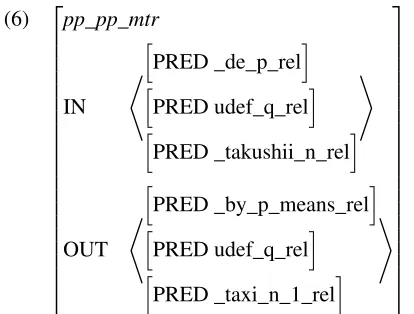
side, and the patternby_p_relandnounon the En-glish side, we created PP to PP transfer rules where, in addition to the predicates stemming from the lex-ical items, the English determiner was set to the empty determiner (udef_q_rel). The resulting trans-fer rule for (5) is illustrated in (6).
(6)
pp_pp_mtr
IN
* h
PRED _de_p_reli
h
PRED udef_q_rel
i
h
PRED _takushii_n_rel
i +
OUT
* h
PRED _by_p_means_reli
h
PRED udef_q_rel
i
h
PRED _taxi_n_1_rel
i +
With this particular pattern we get transfer rules which prevent us from generating all possible trans-lations of で (‘with’, ‘by’, ‘on’, ‘in’, or ‘at’), and keeps the quantifier unexpressed.
There are many other possible PP→PP patterns, such as始め にstart in/on/at/to“in the beginning”. We started with one well known idiomatic English type, but should learn many more.
3.3 Verb + NP→Verb + NP
Japanese MWEs fitting the pattern noun + object marker (を) +verb usually are translated into En-glish MWEs fitting one out of threeverb+NP pat-terns, illustrated in (7). In (7a), the NP has an unex-pressed quantifier. The English pattern in these cases
will beverb +noun. In (7b), the NP has an indef-inite article. The English pattern will then beverb + _a_q_rel + noun. And in (7c), the NP has defi-nite article. The English pattern will then beverb+ _the_q_rel+noun.
(7) a. テニス tenisu tennis
を wo ACC
し shi do
ます masu POLITE play tennis
b. 生計
seikei living
を wo ACC
立てる tateru stand up
make a living
c. 責め seme blame
を wo ACC
負う ou bear
take the blame
By adding these rules to the transfer grammar, we avoid generating sentences such as I play the ten-nisand He took a blame. In addition, we are able to constrain the translations of the individual words, greatly reducing the transfer search space
3.4 Noun + Adjective→Adjective
subject and links it to the subject of the English ad-jective. (8) X X X ga ga ga
背 se NOM
が ga height
高い takai NOMhigh X is tall
With the new rules, the transfer grammar now cor-rectly translates (9) as She is very intelligent. and notHer head is very good., which is the translation produced by the system without the new multiword rules. Notice the fact that the adverb modifying the adjective in Japanese is also modifying the adjective in English.
(9) 彼女 kanojo She
は wa TOPIC
大変 taihen very
頭 atama head
が ga NOM
いい yoi good
。 . .
She is very intelligent.
Because of the flexibility of the rule based sys-tem, we can also parse, translate and generate many variants of this, including those where the adverb comes in the middle of the MWE, or where a dif-ferent topic marker is used as in (10). We learn the translation equivalences from text n-grams, but then match them to complex patterns, thus taking advan-tage of the ease of processing of simple text, but still apply them flexibly, with the power of the deep grammar.
(10) 彼女 kanojo She
も mo FOCUS
頭 atama head
が ga NOM
大変 taihen very
いい yoi good
。 . .
She is also very intelligent.
She is very intelligent also.
3.5 Postp + Noun + Verb→Verb / PP + Verb
→Verb
Japanese has two MWE patterns consisting of a postposition, a noun, and a verb, corresponding to a verb in English. The first is associated with the postpositionのno“of” (see (11)), and the second is associated with the postpositionに ni“in/on/at/to” (see (12)).
(11) 歴史 rekishi history
の no of
勉強
benkyou study
を wo ACC
する suru make
study history
(12) 金魚 kingyo goldfish
に ni
in/on/at/to えさ esa feed
を wo ACC
やる yaru give
feed the goldfish
In (11), the postpositionのno“of”, the noun勉
強benkyou“study”, and the verbするsuru“make” are translated asstudy, while in (12), the postposi-tion に ni“in/on/at/to”, the noun えさesa“feed”, and the verbやるyaru“give” are translated asfeed. In both MWE patterns, the noun is marked with the object markerをwo. The two patterns have differ-ent analysis: In (11), which has theno-pattern, the postposition attaches to the noun, and the object of the postposition歴史rekishi“history” functions as a second subject of the verb. In (12), which has the ni-pattern, the postposition attaches to the verb, and the object of the postposition金 魚kingyo“goldfish” is a part of a PP. Given the different semantic rep-resentations assigned to the two MWE patterns, we have created two transfer rule types. We will have a brief look at the transfer rule type for theno transla-tion pattern, illustrated in (13).7
(13) p+n+arg12_arg12_mtr IN RELS * "
LBL h2, ARG0event, ARG1 x3, ARG2 x2
#
h
LBL h2, ARG0 x3
i
h
ARG0 x3, RSTR h3
i
"
LBL h1, ARG0 e1, ARG1 x1, ARG2 x3
# +
HCONS
h
HARG h3, LARG h2
i
OUT|RELS
*"
LBL h1, ARG0 e1, ARG1 x1, ARG2 x2
#+
The input of thep+n+arg12_arg12_mtrtransfer rule type consists of (i) a postposition relation, (ii) a noun relation, (iii) a quantifier (of the the noun),
and (iv) a verb relation (listed as they appear on the RELSlist). The output relation is a verb relation. No-tice that theARG1 of the input verb relation is reen-tered as ARG1 of the output relation ( x1 ), and the ARG2 of the input postposition relation is reentered asARG2 of the output relation ( x2 ). The output re-lation is also given the same LBL and ARG0 value as the input verb relation. In this way, the Japanese MWE is collapsed into one English relation while semantic links to the rest of the semantic representa-tion are maintained.
3.6 Summary
Out of the 26,875,672 possible semantic predicate rules, we extracted 97,478 rules that fitted one of the nine patterns. These rules were then included in the transfer grammar of the MT system.
4 Results
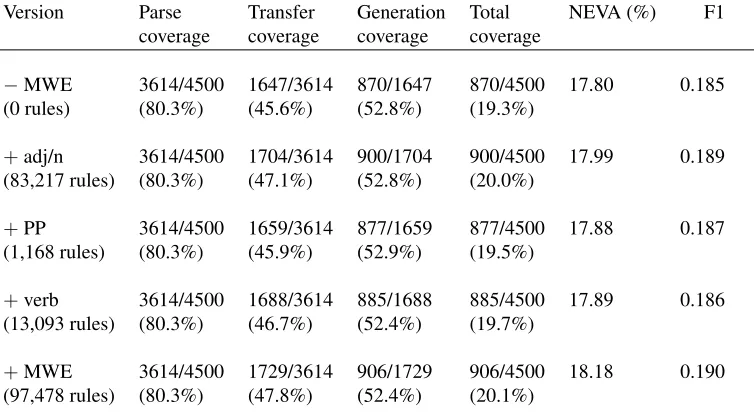
The impact of the MWE transfer rules on the MT system is illustrated in Table 2.
We compare two versions of the system, one with automatically extracted MWE rules and one with-out. They both have hand-written MWE and single word rules as well as automatically extracted sin-gle word rules extracted from Edict by Nichols et al. (2007).
The additional rules in + MWE are those pro-duced in Section 3. The system was tested on held out sections of the Tanaka Corpus (sections 003 to 005). As can be seen from the results, the overall system is still very much a research prototype, the coverage being only just over 20%.
Adding the new rules gave small but consistent increases in both end-to-end coverage (19.3% to 20.1%) and translation quality (17.80% to 18.18%) measured with NEVA (Forsbom, 2003).8
When we look only at the 105 sentences whose translations were changed by the new rules the NEVA increased from 17.1% to 21.36%. Investigat-ing the effects on development data, we confirmed that when the new MWE rules hit, they almost al-ways improved the translation. However, there is still a problem of data-sparseness, we are missing
8NEVA is an alternative to BLEU that is designed to provide a more meaningful sentence-level score for short references. It is calculated identically to BLEU, but leaving out the log and exponent calculations. We find it correlates highly with BLEU.
instances of rule-types as well as missing many po-tential rule types.
As an example of the former, we have a pattern for verb+NP →verb+NP, but were unable to learn
慈悲を願うjihi wo negau“beg for mercy: lit. ask for compassion”. We had one example in the train-ing data, and this was not enough to get over our threshold. As an example of the latter, we do not currently learn any rules for Adverb+Verb→Verb al-though this is a common pattern.
5 Discussion and Further Work
The transfer rules learned here are based on co-occurrence data from corpora and a Japanese-to-English dictionary. Many of the translations learned are in fact compositional, especially for the com-pound noun and verb-object patterns. For exam-ple, 穴 を 掘る ana-wo horu “dig hole” → dig a whole would have been translated using existing rules. In this case the advantage of the MWE rule is that it reduces the search space, so the system does not have to consider less likely translations such as carve the shortages. More interestingly, many of the rules find non-compositional translations, or those where the structure cannot be translated word for word. Some of these are also idiomatic in the source and target language. One of our long term goals is to move these expressions into the source and tar-get grammars. Currently, both Jacy and the ERG have idiom processing (based on Copestake et al., 2002), but there are few idiomatic entries in their lexicons. Bilingual data can be a good source for identifying these monolingual idioms, as it makes the non-compositionality explicit. An example of a rule that uses the current idiom machinery is the (hand-built) ruleN-ga chie-wo shiboru“N squeezes knowledge”→N racks N’s brains, where the subject is co-indexed with a possessive pronoun modifying the object: I/You rack my/your brains. Adding such expressions to the monolingual grammars simplifies the transfer rules and makes the grammars more use-ful for other tasks.
Version Parse Transfer Generation Total NEVA (%) F1 coverage coverage coverage coverage
−MWE 3614/4500 1647/3614 870/1647 870/4500 17.80 0.185
(0 rules) (80.3%) (45.6%) (52.8%) (19.3%)
+adj/n 3614/4500 1704/3614 900/1704 900/4500 17.99 0.189
(83,217 rules) (80.3%) (47.1%) (52.8%) (20.0%)
+PP 3614/4500 1659/3614 877/1659 877/4500 17.88 0.187
(1,168 rules) (80.3%) (45.9%) (52.9%) (19.5%)
+verb 3614/4500 1688/3614 885/1688 885/4500 17.89 0.186
(13,093 rules) (80.3%) (46.7%) (52.4%) (19.7%)
+MWE 3614/4500 1729/3614 906/1729 906/4500 18.18 0.190
[image:7.612.118.495.57.263.2](97,478 rules) (80.3%) (47.8%) (52.4%) (20.1%)
Table 2: Coverage of the MT system before and after adding the MWE transfer rules.
and by extending the number of rule instances.
Shirai et al. (2001) looked at examples in a 65,500-entry English-Japanese lexicon and esti-mated that there were at least 80 multi-word Japanese patterns that translated to a single word in English. As we are also going from multi-word to multi-word we expect that there will be even more than this. Currently, adding another pattern is roughly an hour’s work (half to make the rule-type in the transfer engine, half to make the rule matcher in the rule builder). To add another 100 patterns is thus 6 weeks work. Almost certainly this can be speeded up by sharing information between the templates. We therefore estimate that we can greatly reduce the sparseness of rule-types with four weeks work.
To improve the coverage of rule instances, we need to look at more data, such as that aligned by Utiyama and Takahashi (2003).
Neither absolute frequency nor estimated transla-tion probability give reliable thresholds for deter-mining whether rules are good or not. Currently we are investigating two solutions. One is feedback cleaning, where we investigate the impact of each new rule and discard those that degrade translation quality, following the general idea of Imamura et al. (2003). The second is the more traditional human-in-the loop: presenting each rule and a series of rele-vant translation pairs to a human and asking them to judge if it is good or not. Ultimately, we would like
to extend this approach to crowd source the deci-sions. There are currently two very successful online collaborative Japanese-English projects (Edict and Tatoeba, producing lexical entries and multilingual examples respectively) which indicates that there is a large pool of interested knowledgeable people.
Finally, we are working in parallel to qualitatively improve the MWE rules in two ways. The first is to extend rules using semantic classes, not just words. This would mean we would need fewer rules, but each rule would be more powerful. Of course, many rules are very idiomatic and should trigger on actual lexemes, but there are many, such as 慈悲を願う himei wo negau“beg for mercy” which allow some variation — in this case there are at least three differ-ent verbs that are commonly used. At a lower level we need to improve our handling of orthographic variants so that a rule can match on different forms of the same word, rather than requiring several rules. We are working together with the Japanese WordNet to achieve these goals.
Resource Availability
The MWE expression rules made here and the ma-chine translation system that uses them are avail-able through an open source code repository. In-stallation details can be found at http://wiki. delph-in.net/moin/LogonInstallation. The code to make the rules is undergoing constant re-vision, when it settles down we intend to also add it to the repository.
6 Conclusion
This paper presented a procedure for extracting transfer rules for multiword expressions from paral-lel corpora for use in a rule based Japanese-English MT system. We showed that adding the multi-word rules improves translation coverage (19.3% to 20.1%) and translation quality (17.8% to 18.2% NEVA). We show how we can further improve by learning even more rules.
Acknowledgments
We would like to thank the members of the LO-GON, andDELPH-INcollaborations for their support and encouragement. In addition we would like to thank the developers and maintainers of the other resources we used in our project, especially JMDict, Tatoeba, Anymalign and Moses. This project was supported in part by Nanyang Technological Univer-sity (through a start-up grant on “Automatically de-termining meaning by comparing a text to its trans-lation”).
References
Francis Bond, Hitoshi Isahara, Kiyotaka Uchimoto, Takayuki Kuribayashi, and Kyoko Kanzaki. 2010. Japanese WordNet 1.0. In16th Annual Meeting of The Association for Natural Language Process-ing, pages A5–3. Tokyo.
Francis Bond, Stephan Oepen, Eric Nichols, Dan Flickinger, Erik Velldal, and Petter Haugereid. 2011. Deep open source machine translation. Ma-chine Translation. (Special Issue on Open source Machine Translation, to appear).
James W. Breen. 2004. JMDict: a Japanese-multilingual dictionary. InColing 2004 Workshop on Multilingual Linguistic Resources, pages 71– 78. Geneva.
Chris Callison-Burch, Colin Bannard, and Josh Schroeder. 2005. Scaling phrase-based statistical machine translation to larger corpora and longer phrases. In43nd Annual Meeting of the Associa-tion for ComputaAssocia-tional Linguistics: ACL-2005.
Ann Copestake, Dan Flickinger, Carl J. Pol-lard, and Ivan A. Sag. 2005. Minimal Re-cursion Semantics: an introduction. Re-search on Language and Computation, 3(4):281– 332. URLhttp://lingo.stanford.edu/sag/ papers/copestake.pdf.
Ann Copestake, Fabre Lambeau, Aline Villavicen-cio, Francis Bond, Timothy Baldwin, Ivan Sag, and Dan Flickinger. 2002. Multiword expres-sions: Linguistic precision and reusability. In Proceedings of the Third International Confer-ence on Language Resources and Evaluation (LREC 2002), pages 1941–7. Las Palmas, Canary Islands.
Eva Forsbom. 2003. Training a super model look-alike: Featuring edit distance, n-gram occurrence, and one reference translation. InIn Proceedings of the Workshop on Machine Translation Evalua-tion. Towards Systemizing MT Evaluation.
Satoru Ikehara, Satoshi Shirai, Akio Yokoo, and Hiromi Nakaiwa. 1991. Toward an MT system without pre-editing — effects of new methods in ALT-J/E —. In Third Machine Translation Summit: MT Summit III, pages 101–106. Wash-ington DC. URLhttp://xxx.lanl.gov/abs/ cmp-lg/9510008.
Kenji Imamura, Eiichiro Sumita, and Yuji Mat-sumoto. 2003. Feedback cleaning of machine translation rules using automatic evaluation. In Proceedings of the 41st Annual Meeting of the Association for Computational Linguistics, pages 447–454. Association for Computational Lin-guistics, Sapporo, Japan. URL http://www. aclweb.org/anthology/P03-1057.
Michael Jellinghaus. 2007.Automatic Acquisition of Semantic Transfer Rules for Machine Translation. Master’s thesis, Universität des Saarlandes.
2004, pages 230–237. Association for Computa-tional Linguistics, Barcelona, Spain.
Adrien Lardilleux and Yves Lepage. 2009. Sampling-based multilingual alignment. In Proceedings of Recent Advances in Natural Language Processing (RANLP 2009), pages 214–218. Borovets, Bulgaria.
Yoshihiro Matsuo, Satoshi Shirai, Akio Yokoo, and Satoru Ikehara. 1997. Direct parse tree translation in cooperation with the transfer method. In Daniel Joneas and Harold Somers, editors,New Methods in Language Processing, pages 229–238. UCL Press, London.
Eric Nichols, Francis Bond, Darren Scott Appling, and Yuji Matsumoto. 2007. Combining resources for open source machine translation. In The 11th International Conference on Theoretical and Methodological Issues in Machine Translation (TMI-07), pages 134–142. Skövde.
Franz Josef Och and Hermann Ney. 2003. A system-atic comparison of various statistical alignment models. Computational Linguistics, 29(1):19–51.
Stephan Oepen, Erik Velldal, Jan Tore Lønning, Paul Meurer, and Victoria Rosen. 2007. Towards hybrid quality-oriented machine translation. on linguistics and probabilities in MT. In11th Inter-national Conference on Theoretical and Method-ological Issues in Machine Translation: TMI-2007, pages 144–153.
Lluís Padró, Miquel Collado, Samuel Reese, Marina Lloberes, and Irene Castellón. 2010. Freeling 2.1: Five years of open-source language processing tools. InProceedings of 7th Language Resources and Evaluation Conference (LREC 2010). La Val-letta. (http://nlp.lsi.upc.edu/freeling.
Satoshi Shirai, Kazuhide Yamamoto, and Kazutaka Takao. 2001. Construction of a dictionary to translate japanese phrases into one english word. In Proceedings of ICCPOL’2001 (19th Interna-tional Conference on Computer Processing of Oriental Languages, pages 3–8. Seoul.
Yasuhito Tanaka. 2001. Compilation of a mul-tilingual parallel corpus. In Proceedings of PACLING 2001, pages 265–268. Kyushu. (http://www.colips.org/afnlp/archives/ pacling2001/pdf/tanaka.pdf).
Kiyotaka Uchimoto, Yujie Zhang, Kiyoshi Sudo, Masaki Murata, Satoshi Sekine, and Hitoshi Isahara. 2004. Multilingual aligned parallel treebank corpus reflecting contextual informa-tion and its applicainforma-tions. In Gilles Séras-set, editor, COLING 2004 Multilingual Linguis-tic Resources, pages 57–64. COLING, Geneva, Switzerland. URL http://acl.ldc.upenn. edu/W/W04/W04-2208.bib.
Masao Utiyama and Mayumi Takahashi. 2003. English-Japanese translation alignment data.
http://www2.nict.go.jp/x/x161/members/ mutiyama/align/index.html.
Andy Way. 1999. A hybrid architecture for robust MT using LFG-DOP. Journal of Experimental and Theoretical Artificial Intelligence, 11. Special Issue on Memory-Based Language Processing.