Proceedings of the EACL 2009 Workshop on GEMS: GEometical Models of Natural Language Semantics, pages 74–82,
Unsupervised and Constrained Dirichlet Process Mixture Models for Verb
Clustering
Andreas Vlachos
Computer Laboratory University of Cambridge Cambridge CB3 0FD, UK [email protected]
Anna Korhonen
Computer Laboratory University of Cambridge Cambridge CB3 0FD, UK [email protected]
Zoubin Ghahramani
Department of Engineering University of Cambridge Cambridge CB2 1PZ, UK [email protected]
Abstract
In this work, we apply Dirichlet Process Mixture Models (DPMMs) to a learning task in natural language processing (NLP): lexical-semantic verb clustering. We thor-oughly evaluate a method of guiding DP-MMs towards a particular clustering so-lution using pairwise constraints. The quantitative and qualitative evaluation per-formed highlights the benefits of both standard and constrained DPMMs com-pared to previously used approaches. In addition, it sheds light on the use of evalu-ation measures and their practical applica-tion.
1 Introduction
Bayesian non-parametric models have received a lot of attention in the machine learning commu-nity. These models have the attractive property that the number of components used to model the data is not fixed in advance but is actually determined by the model and the data. This property is particularly interesting for NLP where many tasks are aimed at discovering novel, pre-viously unknown information in corpora. Recent work has applied Bayesian non-parametric mod-els to anaphora resolution (Haghighi and Klein, 2007), lexical acquisition (Goldwater, 2007) and language modeling (Teh, 2006) with good results. Recently, Vlachos et al. (2008) applied the ba-sic models of this class, Dirichlet Process Mix-ture Models (DPMMs) (Neal, 2000), to a typical learning task in NLP: lexical-semantic verb clus-tering. The task involves discovering classes of verbs similar in terms of their syntactic-semantic properties (e.g. MOTION class for travel, walk, run, etc.). Such classes can provide important support for other NLP tasks, such as word sense disambiguation, parsing and semantic role label-ing (Dang, 2004; Swier and Stevenson, 2004).
Although some fixed classifications are available (e.g. VerbNet (Kipper-Schuler, 2005)) these are not comprehensive and are inadequate for specific domains (Korhonen et al., 2006b).
Unlike the clustering algorithms applied to this task before, DPMMs do not require the number of clusters as input. This is important because even if the number of classes in a particular task was known (e.g. in the context of a carefully controlled experiment), a particular dataset may not contain instances for all the classes. Moreover, each class is not necessarily contained in one cluster exclu-sively, since the target classes are defined manu-ally without taking into account the feature rep-resentation used. The fact that DPMMs do not require the number of target clusters in advance, renders them promising for the many NLP tasks where clustering is used for learning purposes.
quantita-tively the contribution of each constraint type of independently, complementing it with qualitative analysis. The latter demonstrates how the pairwise constraints added affects instances beyond those involved directly. Finally, we discuss how the un-supervised and the constrained version of DPMMs can be used in a real-world setup.
The results from our comprehensive evaluation show that both versions of DPMMs are capable of learning novel information not in the gold stan-dard, and that the constrained version is more ac-curate than a previous verb clustering approach which requires setting the number of clusters in advance and is therefore less realistic.
2 Unsupervised clustering with DPMMs
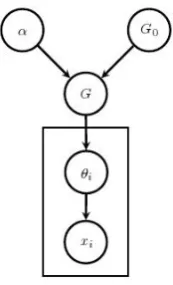
[image:2.595.373.460.63.206.2]With DPMMs, as with other Bayesian non-parametric models, the number of mixture compo-nents is not fixed in advance, but is determined by the model and the data. The parameters of each component are generated by a Dirichlet Process (DP) which can be seen as a distribution over the parameters of other distributions. In turn, each in-stance is generated by the chosen component given the parameters defined in the previous step:
G|α, G0∼DP(α, G0)
θi|G∼G (1)
xi|θi∼F(θi)
In Eq. 1,G0andGare probability distributions
over the component parameters (θ), andα > 0is the concentration parameter which determines the variance of the Dirichlet process. We can think ofGas a randomly drawn probability distribution with meanG0. Intuitively, the largerαis, the more
similarGwill be toG0. Instancexi is generated
by distributionF, parameterized byθi. The
graph-ical model is depicted in Figure 1.
The prior probability of assigning an instance to a particular component is proportionate to the number of instances already assigned to it (n−i,z).
In other words, DPMMs exhibit the “rich get richer” property. In addition, the probability that a new cluster is created is dependent on the con-centration parameterα. A popular metaphor to de-scribe DPMMs which exhibits an equivalent clus-tering property is the Chinese Restaurant Process (CRP). Customers (instances) arrive at a Chinese restaurant which has an infinite number of tables (components). Each customer sits at one of the ta-bles that is either occupied or vacant with popular tables attracting more customers.
Figure 1: Graphical representation of DPMMs.
In this work, the distribution used to model the components is the multinomial and the prior used is the Dirichlet distribution (F andG0 in Eq. 1).
The conjugacy between them allows for the ana-lytic integration over the component parameters. Following Neal (2000), the component assign-mentsziare sampled using the following scheme:
P(zi =z|z−i, xi)∝
p(zi =z|z−i)DirM(xi|zi =z, x−i,z, λ) (2)
In Eq. 2DirMis the Dirichlet-Multinomial distri-bution,λare the parameters of the Dirichlet prior G0andx−i,zare the instances assigned already to
componentz (none if we are sampling the prob-ability of assignment to a new component). This sampling scheme is possible due to the fact that the instances in the model are exchangeable, i.e. the order in which they are generated is not relevant.
In terms of the CRP metaphor, we consider each instance xi as the last customer to arrive and he
chooses to sit together with other customers at an existing table or to sit at a new table. Following Navarro et al. (2006) who used the same model to analyze individual differences, we sample the con-centration parameter αusing the inverse Gamma distribution as a prior.
3 Evaluation measures
classes C = {cl|l = 1, ...,|C|}. Given this, the
goal is to find a partitioning of the instances K that is as close as possible to the gold standardC. Most work on verb clustering has used the F-measure or the Rand Index (RI) (Rand, 1971) for evaluation, which rely on counting pairwise links between instances. However, Rosenberg and Hirschberg (2007) pointed out that F-measure as-sumes (the missing) mapping between cl andkj.
In practice, RI values concentrate in a small inter-val near 100% (Meil˘a, 2007).
Rosenberg & Hirschberg (2007) proposed an information-theoretic metric: V-measure. V-measure is the harmonic mean of homogeneity and completeness which evaluate the quality of the clustering in a complementary way. Homogeneity assesses the degree to which each cluster contains instances from a single class of C. This is com-puted as the conditional entropy of the class dis-tribution of the gold standard given the clustering discovered by the algorithm, H(C|K), normal-ized by the entropy of the class distribution in the gold standard,H(C). Completeness assesses the degree to which each class is contained in a single cluster. This is computed as the conditional en-tropy of the cluster distribution discovered by the algorithm given the class, H(K|C), normalized by the entropy of the cluster distribution, H(K). In both cases, we subtract the resulting ratios from 1 to associate higher scores with better solutions:
h= 1−H(C|K) H(C)
c= 1−H(K|C) H(K)
Vβ =
(1 +β)∗h∗c
(β∗h) +c (3)
The parameter β in Eq. 3 regulates the balance between homogeneity and completeness. Rosen-berg & HirschRosen-berg set it to1in order to obtain the harmonic mean of these qualities. They also note that V-measure favors clustering solutions with a large number of clusters (large|K|), since such so-lutions can achieve very high homogeneity while maintaining reasonable completeness. This ef-fect is more prominent when a dataset includes a small number of instaces for gold standard classes. While increasing |K| does not guarantee an in-crease in V-measure (splitting homogeneous clus-ters would reduce completeness without improv-ing homogeneity), it is easier to achieve higher
scores when more clusters are produced.
Another relevant measure is the Variation of In-formation (VI) (Meil˘a, 2007). Like V-measure, it assesses homogeneity and completeness using the quantitiesH(C|K)andH(K|C)respectively, however it simply adds them up to obtain a final result (higher scores are worse). It is also a metric, i.e. VI scores can be added, subtracted, etc, since the quantities involved are measured in bits. How-ever, it can be observed that if|C|and|K|are very different then the terms H(C|K) and H(K|C)
will not necessarily be in the same range. In par-ticular, if|K| |C|thenH(K|C)(andV I) will be low. In addition, VI scores are not normalized and therefore their interpretation is difficult.
Both V-measure and VI have important advan-tages over RI and F-measure: they do not assume a mapping between classes and clusters and their scores depend only on the relative sizes of the clus-ters. However, V-measure and VI can be mislead-ing if the number of clusters found (|K|) is sub-stantially different than the number of gold stan-dard classes (|C|). In order to ameliorate this, we suggest to take advantage of the β parameter in Eq. 3 in order to balance homogeneity and com-pleteness. More specifically, settingβ =|K|/|C| assigns more weight to completeness than to ho-mogeneity in case|K| > |C|since the former is harder to achieve and the latter is easier when the clustering solution has more clusters than the gold standard has classes. The opposite occurs when |K| < |C|. In case|K| = |C|the score is the same as the original V-measure. Achieving 100% score according to any of these measures requires correct prediction of the number of clusters.
In this work, we evaluate our results using the three measures described above (V-measure, VI, V-beta). We complement this evaluation with qualitative evaluation which assesses the poten-tial of DPMMs to discover novel information that might not be included in the gold standard.
4 Experiments
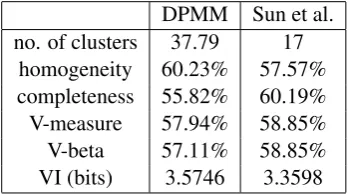
DPMM Sun et al. no. of clusters 37.79 17
[image:4.595.94.269.65.162.2]homogeneity 60.23% 57.57% completeness 55.82% 60.19% V-measure 57.94% 58.85% V-beta 57.11% 58.85% VI (bits) 3.5746 3.3598
Table 1: Clustering performances.
syntactic context in which the verb occurs. SCFs were extracted from the publicly available VALEX lexicon (Korhonen et al., 2006a). VALEX was ac-quired automatically using a domain-independent statistical parsing toolkit, RASP (Briscoe and Car-roll, 2002), and a classifier which identifies verbal SCFs. As a consequence, it includes some noise due to standard text processing and parsing errors and due to the subtlety of argument-adjunct dis-tinction. In our experiments, we used the SCFs obtained from VALEX1, parameterized for the prepositional frame, which had the best perfor-mance in the experiments of Sun et al. (2008).
The feature sets based on verbal SCFs are very sparse and the counts vary over a large range of values. This can be problematic for generative models like DPMMs, since a few dominant fea-tures can mislead the model. To reduce the spar-sity, we applied non-negative matrix factorization (NMF) (Lin, 2007) which decomposes the dataset in two dense matrices with non-negative values. It has proven useful in a variety of tasks, e.g. infor-mation retrieval (Xu et al., 2003) and image pro-cessing (Lee and Seung, 1999).
We use a symmetric Dirichlet prior with param-eters of 1 (λin Equation 2). The number of di-mensions obtained using NMF was 35. We run the Gibbs sampler 5 times, using 100 iterations for burn-in and draw 20 samples from each run with 5 iterations lag between samples. Table 1 shows the average performances. The DPMM discov-ers 37.79 verb clustdiscov-ers on average with its perfor-mance ranging between 53% and 58% depending on the evaluation measure used. Homogeneity is 4.5% higher than completeness, which is expected since the number of classes in the gold standard is 17. The fact that the DPMM discovers more than twice the number of classes is reflected in the dif-ference between the V-measure and V-beta, the lat-ter being lower. In the same table, we show the re-sults of Sun et al. (2008), who used pairwise
clus-tering (PC) (Puzicha et al., 2000) which involves determining the number of clusters in advance.
The performance of the DPMM is 1%-3% lower than that of Sun et al. As expected, the differ-ence in V-measure is smaller since the DPMM discovers a larger number of clusters, while for VI it is larger. The slightly better performance of PC can be attributed to two factors. First, the (correct) number of clusters is given as in-put to the PC algorithm and not discovered like by the DPMM. Secondly, PC uses the similarities between the instances to perform the clustering, while the DPMM attempts to find the parameters of the process that generated the data, which is a different and typically a harder task. In addition, the DPMM has two clear advantages which we il-lustrate in the following sections: it can be used to discover novel information and it can be modified to incorporate intuitive human supervision.
5 Qualitative evaluation
The gold standard employed in this work (Sun et al., 2008) is not fully accurate or comprehensive. It classifies verbs according to their predominant senses in the fairly small SemCor data. Individ-ual classes are relatively coarse-grained in terms of syntactic-semantic analysis1 and they capture some of the meaning components only. In addi-tion, the gold standard does not capture the se-mantic relatedness of distinct classes. In fact, the main goal of clustering is to improve such exist-ing classifications with novel information and to create classifications for new domains. We per-formed qualitative analysis to investigate the ex-tent to which the DPMM meets this goal.
We prepared the data for qualitative analysis as follows: We represented each clustering sample as a linking matrix between the instances of the dataset and measured the frequency of each pair of instances occurring in the same cluster. We constructed a partial clustering of the instances using only those links that occur with frequency higher than a thresholdprob link. Singleton clus-ters were formed by considering instances that are not linked with any other instances more fre-quently than a thresholdprob single. The lower theprob linkthreshold, the larger the clusters will be, since more instances get linked. Note that cluding more links in the solution can either
in-1
crease the number of clusters when instances in-volved were not linked otherwise, or decrease it when linking instances that already belong to other clusters. The higher the prob single threshold, the more instances will end up as singletons. By adjusting these two thresholds we can affect the coverage of the analysis. This approach was cho-sen because it enables to conduct qualitative analy-sis of data relevant to most clustering samples and irrespective of individual samples. It can also be useful in order to use the output of the clustering algorithm as a component in a pipeline which re-quires a single result rather than multiple samples.
Using this method, we generated data sets for qualitative analysis using 4 sets of values for prob link and prob single, respectively: (99%, 1%), (95%, 5%), (90%, 10%) and (85%, 15%). Table 1 shows the number of a) verbs, b) clusters (2 or more instances) and c) singletons in each resulting data set, along with the percentage and size of the clusters which represent 1, 2, or mul-tiple gold standard classes. As expected, higher threshold values produce high precision clusters for a smaller set of verbs (e.g. (99%,1%) pro-duces 5 singletons and assigns 70 verbs to 20 clus-ters, 55% of which represent a single gold stan-dard class), while less extreme threshold values yield higher recall clusters for a larger set of verbs (e.g. (85%,15%) produces 10 singletons and as-signs 140 verbs to 25 clusters, 20% of which con-tain verbs from several gold standard classes).
We conducted the qualitative analysis by com-paring the four data sets against the gold standard, SCF distributions, and WordNet (Fellbaum, 1998) senses for each test verb. We first analysed the 5-10 singletons in data sets and discovered that while 3 of the verbs resist classification because of syntactic idiosyncrasy (e.g.unitetakes intransi-tive SCFs with frequency higher than other mem-bers of class 22.2), the majority of them (7) end up in singletons for valid semantic reasons: taking several frequent WordNet senses they are “too pol-ysemous” to be realistically clustered according to their predominant sense (e.g.getandlook).
We then examined the clusters, and discovered that even in the data set created with the lowest prob link threshold of 85%, almost half of the “errors” are in fact novel semantic patterns discov-ered by clustering. Many of these could be new sub-classes of existing gold standard classes. For example, looking at the 13 high accuracy clusters
which correspond to a single gold standard class each, they only represent 9 gold standard classes because as many as 4 classes been divided into two clusters, suggesting that the gold standard is too coarse-grained. Interestingly, each such sub-division seems semantically justified (e.g. the 11.1
PUT verbs bury and immerse appear in a differ-ent cluster than the semantically slightly differdiffer-ent placeandsituate).
In addition, the DPMM discovers semantically similar gold standard classes. For example, in the data set created with the prob link threshold of 99%, 6 of the clusters include members from 2 different gold standard classes. 2 occur due to syntactic idiosyncrasy, but the majority (4) oc-cur because of true semantic relatedness (e.g. the clustering relates 22.2 AMALGAMATE and 36.1
CORRESPOND classes which share similar
mean-ing components). Similarly, in the data set pro-duced by the prob link threshold of 85%, one of the largest clusters includes 26 verbs from 5 gold standard classes. The majority of them be-long to 3 classes which are related by the meaning component of “motion”: 43.1 LIGHT EMISSION, 47.3MODES OF BEING INVOLVING MOTION, and 51.3.2RUNverbs:
• class 22.2AMALGAMATE:overlap
• class 36.1CORRESPOND:banter, concur, dissent, hag-gle
• class 43.1LIGHT EMISSION:flare, flicker, gleam, glis-ten, glow, shine, sparkle
• class 47.3 MODES OF BEING INVOLVING MOTION: falter, flutter, quiver, swirl, wobble
• class 51.3.2RUN: fly, gallop, glide, jog, march, stroll, swim, travel, trot
Thus many of the singletons and the clusters in the different outputs capture finer or coarser-grained lexical-semantic differences than those captured in the gold standard. It is encouraging that this happens despite us focussing on a rela-tively small set of 204 verbs and 17 classes only.
6 Constrained DPMMs
% and size of clusters containing THR verbs clusters singletons 1 class 2 classes multiple classes 99%,1% 70 20 5 55% (3.0) 30% (2.8) 15% (4.5) 95%,5% 104 25 9 40% (3.7) 44% (2.8) 16% (6.8) 90%,10% 128 28 9 46% (3.4) 39% (2.5) 14% (11.0) 85%,15% 140 25 10 44% (3.7) 28% (3.3) 20% (13.0)
Table 2: An overview of the data sets generated for qualitative analysis
Preliminary work by Vlachos et al. (2008) intro-duced a constrained version of DPMMs that en-ables human supervision to guide the clustering solution when needed. We model the human su-pervision as pairwise constraints over instances, following Wagstaff & Cardie (2000): given a pair of instances, they are either linked together (must-link) or not (cannot-(must-link). For example, charge and run should form a must-link if the aim is to cluster 51.3 MOTION verbs together, but they should form acannot-link if we are interested in 54.5BILLverbs. In the discussion and the experi-ments that follow, we assume that all links are con-sistent with each other. This information can be obtained by asking human experts to label links, or by extracting it from extant lexical resources. Specifying the relations between the instances re-sults in a partial labeling of the instances. Such labeling is likely to be re-usable, since relations between the instances are likely to be useful for a wider range of tasks which might not have identi-cal labels but could still have similar relations.
In order to incorporate the constraints in the DPMM, we modify the underlying generative pro-cess to take them into account. In particular must-linked instances are generated by the same com-ponent andcannot-linkedinstances always by dif-ferent ones. In terms of the CRP metaphor, cus-tomers connected with must-links arrive at the restaurant together and choose a table jointly, re-specting their cannot-links with other customers. They get seated at the same table successively one after the other. Customers withoutmust-linkswith others choose tables avoiding theircannot-links.
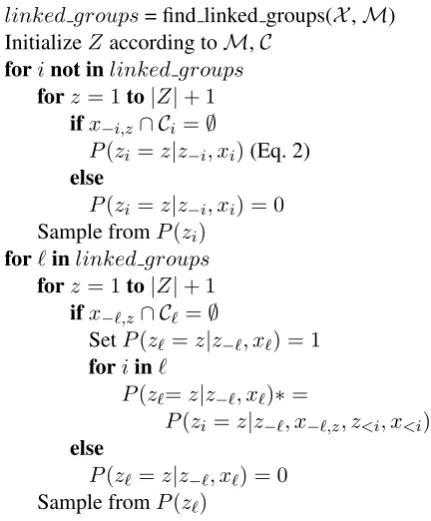
In order to sample the component assignments according to this model, we restrict the Gibbs sam-pler to take them into account using the sampling scheme of Fig. 2. First we identifylinked-groups of instances, taking into account transitivity2. We then sample the component assignments only from distributions that respect the links provided. More
2
If A is linked to B and B to C, then A is linked to C.
specifically, for each instance that does not belong to alinked-group, we restrict the sampler to choose components that do not contain instances cannot-linkedwith it. For instances in alinked-group, we sample their assignment jointly, again taking into account their cannot-links. This is performed by adding each instance of the linked-group succes-sively to the same component. In Fig. 2,Ciare the cannot-linksfor instance(s)i, `are the indices of the instances in alinked-group, and z<i andx<i
are the assignments and the instances of a linked-groupthat have been assigned to a component be-fore instancei.
Input:dataX,must-linksM,cannot-linksC linked groups= find linked groups(X,M) InitializeZ according toM,C
forinot inlinked groups
forz= 1to|Z|+ 1 ifx−i,z∩ Ci =∅
P(zi =z|z−i, xi)(Eq. 2)
else
P(zi =z|z−i, xi) = 0
Sample fromP(zi)
for`inlinked groups
forz= 1to|Z|+ 1 ifx−`,z∩ C` =∅
SetP(z`=z|z−`, x`) = 1
foriin`
P(z`=z|z−`, x`)∗=
P(zi =z|z−`, x−`,z, z<i, x<i)
else
P(z`=z|z−`, x`) = 0
Sample fromP(z`)
Figure 2: Gibbs sampler incorporatingmust-links andcannot-links.
7 Experiments using constraints
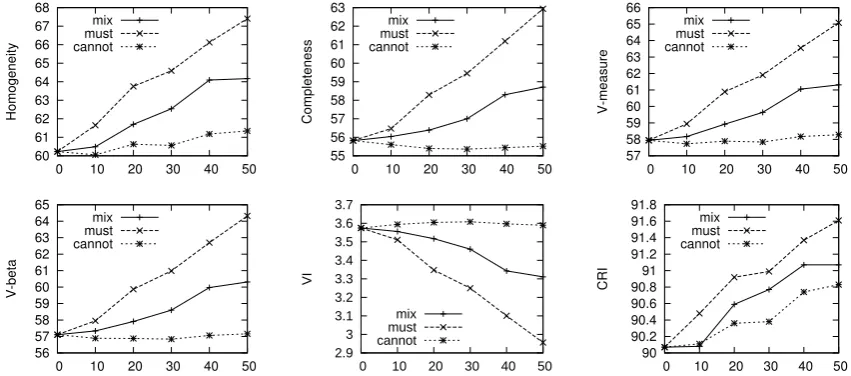
[image:6.595.305.521.393.654.2]exper-iments in which the links are sampled randomly from the gold standard. The number of links var-ied from 10 to 50 and the random choice was re-peated 5 times without checking for redundancy due to transitivity. All the other experimental set-tings are identical to those in Section 4. Follow-ing Wagstaff & Cardie (2000), in Table 3 we show the impact of each link type independently (la-beled “must” and “cannot” accordingly), as well as when mixed in equal proportions (“mix”).
Adding randomly selected pairwise links is ben-eficial. In particular,must-linksimprove the clus-tering rapidly. Incorporating 50 must-links im-proves the performance by 7-8% according to the evaluation measures. In addition, it reduces the average number of clusters by approximately 4. The cannot-links are rather ineffective, which is expected as the clustering discovered by the un-supervised DPMM is more fine-grained than the gold standard. For the same reason, it is more likely that the randomly selectedcannot-linksare already discovered by the DPMM and are thus re-dundant. Wagstaff & Cardie also noted that the impact of the two types of links tends to vary across data sets. Nevertheless, a minor improve-ment is observed in terms of homogeneity. The balanced mix improves the performance, but less rapidly than themust-links.
In order to assess how the links added help the DPMM learn other links we use the Constrained Rand Index (CRI), which is a modification of the Rand Index that takes into account only the pair-wise decisions that are not dictated by the con-straints added (Wagstaff and Cardie, 2000; Klein et al., 2002). We evaluate the constrained DPMM with CRI (Table 3, bottom right graph) and our re-sults show that the improvements obtained using pairwise constraints are due to learning links be-yond the ones enforced.
In a real-world setting, obtaining the mixed set of links is equivalent to asking a human expert to give examples of verbs that should be clustered to-gether or not. Such information could be extracted from a lexical resource (e.g. ontology). Alterna-tively, the DPMM could be run without any con-straints first and if a human expert judges the clus-tering too coarse (or fine) then cannot-links (or must-links) could help, since they can adapt the clustering rapidly. When 20 randomly selected must-links are integrated, the DPMM reaches or exceeds the performance of PC used by Sun et
al. (2008) according to all the evaluation mea-sures. We also argue that it is more realistic to guide the clustering algorithm using pairwise con-straints than by defining the number of clusters in advance. Instead of using pairwise constraints to affect the clustering solution, one could alter the parameters for the Dirichlet prior G0 (Eq. 1) or
experiment with varying concentration parameter values. However, it is difficult to predict in ad-vance the exact effect such changes would have in the solution discovered.
Finally, we conducted qualitative analysis of the samples obtained constraining the DPMM with 10 randomly selected must-links. We first prepared the data according to the method described in Sec-tion 5, using prob link andprob single thresh-olds of 99% and 1% respectively. This resulted in 26 clusters and one singleton for 79 verbs. Recall that without constraining the DPMM these thresh-olds produced 20 clusters and 5 singletons for 70 verbs. 49 verbs are shared in both outputs, while the average cluster size is similar.
The resulting clusters are highly accurate. As many as 16 (i.e. 62%) of them represent a sin-gle gold standard class, 7 of which contain (only) the pairs ofmust-linkedverbs. Interestingly, only 11 out of 17 gold standard classes are exempli-fied among the 16 clusters, with 5 classes sub-divided into finer-grained classes. Each of these sub-divisions seems semantically fully motivated (e.g. 30.3 PEER verbs were subdivided so that peepandpeekwere assigned to a different cluster than the semantically different gaze, glance and stare) and 4 of them can be directly attributed to the use ofmust-links.
From the 6 clusters that contained members from two different gold standard classes, the ma-jority (5) make sense as well. 3 of these contain members of must-link pairs together with verbs from semantically related classes (e.g. 37.7SAY
and 40.2NONVERBAL EXPRESSIONclasses). 3 of
the clusters that contain members of several gold standard classes include must-link pairs as well. In two cases must-links have helped to bring to-gether verbs which belong to the same class (e.g. the members of themust-linkpair broaden-freeze which represent 45.4CHANGE OF STATEclass
60 61 62 63 64 65 66 67 68
0 10 20 30 40 50
Homogeneity
mix must cannot
55 56 57 58 59 60 61 62 63
0 10 20 30 40 50
Completeness
mix must cannot
57 58 59 60 61 62 63 64 65 66
0 10 20 30 40 50
V-measure
mix must cannot
56 57 58 59 60 61 62 63 64 65
0 10 20 30 40 50
V-beta
mix must cannot
2.9 3 3.1 3.2 3.3 3.4 3.5 3.6 3.7
0 10 20 30 40 50
VI
mix must cannot
90 90.2 90.4 90.6
90.8 91
91.2 91.4 91.6 91.8
0 10 20 30 40 50
CRI
[image:8.595.79.505.69.257.2]mix must cannot
Table 3: Performance of constrained DPMMs incorporating pairwise links.
(i.e. 15%) of the clusters in the output examined are not meaningful (mostly due to the mismatch between the syntax and semantics of verbs).
8 Related work
Previous work on unsupervised verb clustering used algorithms that require the number of clus-ters as input e.g. PC, Information Bottleneck (Ko-rhonen et al., 2006b) and spectral clustering (Brew and Schulte im Walde, 2002). In terms of apply-ing non-parametric Bayesian approaches to NLP, Haghighi and Klein (2007) evaluated the cluster-ing properties of DPMMs by performcluster-ing anaphora resolution with good results.
There is a large body of work on semi-supervised learning (SSL), but relatively little work has been done on incorporating some form of supervision in clustering. It is important to note that the pairwise links used in this work consti-tute a weak form of supervision since they cannot be used to infer class labels which are required for SSL. However, the opposite can be done. Wagstaff & Cardie (2000) employedmust-linksand cannot-linksto constrain the COBWEB algorithm, while Klein et al. (2002) applied them to complete-link hierarchical agglomerative clustering. The latter also studied how the added links affect instances not directly involved in them.
It can be argued that one could use clustering algorithms that require the number of clusters to be known in advance to discover interesting sub-classes such as those discovered by the DPMMs. However, this would normally require multiple runs and manual inspection of the results, while
DPMMs discover them automatically. Apart from the fact that fixing the number of clusters in ad-vance restricts the discovery of novel information in the data, such algorithms cannot take full ad-vantage of the pairwise constraints, since the latter are likely to change the number of clusters.
9 Conclusions - Future Work
In this work, following Vlachos et al. (2008) we explored the application of DPMMs to the task of verb clustering. We modified V-measure (Rosen-berg and Hirsch(Rosen-berg, 2007) to deal more appro-priately with the varying number of clusters dis-covered by DPMMs and presented a method of agregating the generated samples which allows for qualitative evaluation. The quantitative and qual-itative evaluation demonstrated that they achieve performance comparable with that of previous work and in addition discover novel information in the data. Furthermore, we evaluated the incorpo-ration of constraints to guide the DPMM obtaining promising results and we discussed their applica-tion in a real-world setup.
Acknowledgments
We are grateful to Diarmuid ´O S´eaghdha and Jur-gen Van Gael for helpful discussions.
References
Chris Brew and Sabine Schulte im Walde. 2002. Spec-tral Clustering for German Verbs. InProceedings of the 2002 Conference on Empirical Methods in
Nat-ural Language Processing, pages 117–124.
Ted Briscoe and John Carroll. 2002. Robust accurate statistical annotation of general text. InProceedings of the 3rd International Conference on Language
Resources and Evaluation, pages 1499–1504.
Hoa Trang Dang. 2004. Investigations into the role
of lexical semantics in word sense disambiguation.
Ph.D. thesis, University of Pennsylvania, Philadel-phia, PA, USA.
Christiane Fellbaum, editor. 1998. WordNet: An Elec-tronic Lexical Database (Language, Speech, and
Communication). The MIT Press.
Sharon J. Goldwater. 2007. Nonparametric bayesian
models of lexical acquisition. Ph.D. thesis, Brown
University, Providence, RI, USA.
Aria Haghighi and Dan Klein. 2007. Unsupervised coreference resolution in a nonparametric bayesian model. In Proceedings of the 45th Annual
Meet-ing of the Association of Computational LMeet-inguistics,
pages 848–855, Prague, Czech Republic.
Karin Kipper-Schuler. 2005. VerbNet: A
broad-coverage, comprehensive verb lexicon. Ph.D. thesis,
University of Pennsylvania.
Dan Klein, Sepandar Kamvar, and Chris Manning. 2002. From instance-level constraints to space-level constraints: Making the most of prior knowledge in data clustering. InProceedings of the Nineteenth
In-ternational Conference on Machine Learning.
Anna Korhonen, Yuval Krymolowski, and Ted Briscoe. 2006a. A large subcategorization lexicon for natural language processing applications. InProceedings of the 5th International Conference on Language
Re-sources and Evaluation.
Anna Korhonen, Yuval Krymolowski, and Nigel Col-lier. 2006b. Automatic classification of verbs in biomedical texts. In Proceedings of the COLING-ACL, pages 345–352.
Daniel D. Lee and Sebastian H. Seung. 1999. Learning the parts of objects by non-negative matrix factoriza-tion. Nature, 401(6755):788–791, October.
Beth Levin. 1993. English Verb Classes and
Alter-nations: a preliminary investigation. University of
Chicago Press, Chicago.
Chih-Jen Lin. 2007. Projected gradient methods for nonnegative matrix factorization. Neural Compua-tion, 19(10):2756–2779.
Marina Meil˘a. 2007. Comparing clusterings—an in-formation based distance. Journal of Multivariate
Analysis, 98(5):873–895.
Daniel J. Navarro, Thomas L. Griffiths, Mark Steyvers, and Michael D. Lee. 2006. Modeling individual dif-ferences using dirichlet processes. Journal of
Math-ematical Psychology, 50(2):101–122, April.
Radford M. Neal. 2000. Markov Chain Sam-pling Methods for Dirichlet Process Mixture
Mod-els. Journal of Computational and Graphical
Statis-tics, 9(2):249–265, June.
Jan Puzicha, Thomas Hofmann, and Joachim Buh-mann. 2000. A theory of proximity based clus-tering: Structure detection by optimization. Pattern
Recognition, 33(4):617–634.
William M. Rand. 1971. Objective criteria for the eval-uation of clustering methods. Journal of the
Ameri-can Statistical Association, 66(336):846–850.
Andrew Rosenberg and Julia Hirschberg. 2007. V-measure: A conditional entropy-based external clus-ter evaluation measure. InProceedings of
EMNLP-CoNLL, pages 410–420, Prague, Czech Republic.
Lin Sun, Anna Korhonen, and Yuval Krymolowski. 2008. Verb class discovery from rich syntactic data.
InProceedings of the 9th International Conference
on Intelligent Text Processing and Computational
Linguistics.
Robert S. Swier and Suzanne Stevenson. 2004. Unsu-pervised semantic role labelling. InProceedings of the 2004 Conference on Empirical Methods in
Nat-ural Language Processing, pages 95–102.
Yee Whye Teh. 2006. A hierarchical Bayesian lan-guage model based on Pitman-Yor processes. In
Proceedings of COLING-ACL, pages 985–992,
Syd-ney, Australia.
Andreas Vlachos, Zoubin Ghahramani, and Anna Ko-rhonen. 2008. Dirichlet process mixture models for verb clustering. InProceedings of the ICML
work-shop on Prior Knowledge for Text and Language.
Kiri Wagstaff and Claire Cardie. 2000. Clustering with instance-level constraints. In Proceedings of the Seventeenth International Conference on
Ma-chine Learning, pages 1103–1110, San Francisco,
CA, USA. Morgan Kaufmann Publishers Inc.
Wei Xu, Xin Liu, and Yihong Gong. 2003. Docu-ment clustering based on non-negative matrix factor-ization. InProceedings of the 26th annual interna-tional ACM SIGIR conference on Research and
de-velopment in informaion retrieval, pages 267–273,