Clause Identification and Classification in Bengali
Aniruddha Ghosh1 Amitava Das2 Sivaji Bandyopadhyay3
Department of Computer Science and Engineering Jadavpur University
[email protected] [email protected] [email protected]
Abstract
This paper reports about the develop-ment of clause identification and classi-fication techniques for Bengali language. A syntactic rule based model has been used to identify the clause boundary. For clause type identification a Conditional random Field (CRF) based statistical model has been used. The clause identi-fication system and clause classiidenti-fication system demonstrated 73% and 78% pre-cision values respectively.
1 Introduction
The clause identification is one of the shallow semantic parsing tasks, which is important in various NLP applications such as Machine Translation, parallel corpora alignment, Informa-tion ExtracInforma-tion and speech applicaInforma-tions. Gram-matically a clause is a group of words having a subject and a predicate of its own, but forming part of a sentence. Clause boundary identifica-tion of natural language sentences poses consi-derable difficulties due to the ambiguous nature of natural languages. Clause classification is a convoluted task as natural language is generally syntactically rich in formation of sentences or clauses.
By the classical theory of Panini (Paul and Staal, 1969) a clause is the surface level basic syntactic element which holds the basic depen-dent semantics (i.e. lexical semantic have no dependency) to represent the overall meaning of any sentence. This syntactic to semantic deriva-tion proceeds through two intermediate stages: the level of karaka relations, which are compa-rable to the thematic role types and the level of inflectional or derivational morphosyntax.
Fillmore’s Case Grammar (Fillmore et. al, 2003), and much subsequent work, revived the Panini’s proposals in a modern setting. A main objective of Case Grammar was to identify syn-tactic positions of semantic arguments that may have different realizations in syntax.
In the year of 1996 Bharati et al. (1996) de-fines the idea of Chunk or local word group for Indian languages. After the successful imple-mentation of Shakti1 , the first publicly available English-Hindi machine translation system the idea of chunk became the most acceptable syn-tactic/semantic representation format for Indian languages, known as Shakti Standard Format (SSF).
In 2009 Bali et al. (2009) redefines the idea of chunk and establishes that the idea of chunking varies with prosodic structure of a language. Boundary of chunk level is very ambiguous it-self and can differ by writer or speaker accord-ing to their thrust on semantic.
Therefore it is evident that automatic clause identification for Indian languages needs more research efforts. In the present task, clause boundary identification is attempted using the classical theory of Panini and the Case Grammar approach of Fillmore on the shallow parsed out-put in SSF structure. It may be worth mentioning that several basic linguistic tools in Indian lan-guages such as part of speech tagger, chunker, and shallow parser follow SSF2 as a standard.
Previous research on clause identification was done mostly on the English language (Sang and Dejean, 2001). There have been limited efforts on clause identification for Indian languages. One such effort is proposed in Ram and Devi,
1
http://shakti.iiit.ac.in/ 2
(2008) with statistical method. The idea of ge-nerative grammar based on rule-based descrip-tions of syntactic structures introduced by Chomsky (Chomsky, 1956) points out that every language has its own peculiarities that cannot be described by standard grammar. Therefore a new concept of generative grammar has been pro-posed by Chomsky. Generative grammar can be identified by statistical methods. In the present task, conditional random field (CRF)3 -based machine learning method has been used in clause type classification. According to the best of our knowledge this is the first effort to identi-fy and classiidenti-fy clauses in Bengali.
The present system is divided into two parts. First, the clause identification task aims to iden-tify the start and the end boundaries of the claus-es in a sentence. Second, Clause classification system identifies the clause types.
Analysis of corpus and standard grammar of Bengali revealed that clause boundary identifica-tion depends mostly on syntactic dependency. For this reason, the present clause boundary identification system is rule based in nature. Classification of clause is a semantic task and depends on semantic properties of Bengali lan-guage. Hence we follow the theory of Chomsky’s generative grammar to disambiguate among possible clause types. The present classi-fication system of clause is a statistics-based approach. A conditional random field (CRF) based machine learning method has been used in the clause classification task. The output of the rule based identification system is forwarded to the machine learning model as input.
The rest of the paper is organized as follows. In section 2 we elaborate the rule based clause boundary identification. The next section 3 de-scribes the implementation detail with all identi-fied features for the clause classification prob-lem. Result section 4 reports about the accuracy of the hybrid system. In error analysis section we reported the limitations of the present sys-tem. The conclusion is drawn in section 5 along with the future task direction.
2 Resource Acquisition
Bengali belongs to Indo-Aryan language family. A characteristic of Bengali is that it is
3
http://crf.sourceforge.net/
resourced. Language research for Bengali got attention recently. Resources like annotated cor-pus and linguistics tools for Bengali are very rarely available in the public domain.
2.1 Corpus
We used the NLP TOOLS CONTEST: ICON 20094 dependency relation marked training data-set of 980 sentences for training of the present system. The data has been further annotated at the clause level. According to the standard grammar there are two basic clause types such as Principal clause and Subordinate clause. Subor-dinate clauses have three variations as Noun clause, Adjective clause and Adverbial clause. The tagset defined for the present task consists of four tags as Principal clause (PC), Noun clause (NC), Adjective clause (AC) and Adver-bial clause (RC). The annotation tool used for the present task is Sanchay5. The detailed statis-tics of the corpus are reported in Table 1.
Train Dev Test
No of Sentences 980 150 100
Table 1: Statistics of Bengali Corpus
2.1.1 Annotation Agreement
Two annotators (Mr. X and Mr. Y) participated in the present task. Annotators were asked to identify the clause boundaries as well as the type of the identified clause. The agreement of anno-tations among two annotators has been eva-luated. The agreements of tag values at clause boundary level and clause type levels are listed in Table 2.
Boundary Type
Percentage 76.54% 89.65%
Table 2: Agreement of annotators at clause boundary and type level
It is observed from the Table 2 that clause boundary identification task has lower agree-ment value. A further analysis reveals that there are almost 9% of cases where clause boundary has nested syntactic structure. These types of clause boundaries are difficult to identify. One of such cases is Inquisitive semantic (Groenen-dijk, 2009) cases, ambiguous for human
4
http://ltrc.iiit.ac.in/nlptools2009/ 5
tors too. It is better to illustrate with some spe-cific example.
If John goes to the party, will Mary go as well?
In an inquisitive semantics for a language of propositional logic the interpretation of disjunc-tion is the source of inquisitiveness. Indicative conditionals and conditional questions are treated both syntactically and semantically. The semantics comes with a new logical-pragmatically notion that judges and compares the compliance of responses to an initiative in inquisitive dialogue (Groenendijk, 2009). Hence it is evident that these types of special cases need special research attention.
2.2 Shallow Parser
Shallow parser6 for Indian languages, developed under a Government of India funded consortium project named Indian Language to Indian Lan-guage Machine Translation System (IL-ILMT), are now publicly available. It is a well developed linguistic tool and produce good credible analy-sis. For the present task the linguistic analysis is done by the tool and it gives output as pruned morphological analysis at each word level, part of speech at each word level, chunk boundary with type-casted chunk label, vibhakti computa-tion and chunk head identificacomputa-tion.
2.3 Dependency parser
A dependency parser for Bengali has been used as described in Ghosh et al. (2009). The depen-dency parser follows the tagset7 identified for Indian languages as a part of NLP TOOLS CONTEST 2009 as a part of ICON 2009.
3 Rule-based Clause Boundary Identi-fication
Analysis of a Bengali corpus and standard grammar reveals that clause boundaries are di-rectly related to syntactic relations at sentence level. The present system first identifies the number of verbs present in a sentence and sub-sequently finds out dependant chunks to each verb. The set of identified chunks that have rela-tion with a particular verb is considered as a clause. But some clauses have nested syntactic
6
http://ltrc.iiit.ac.in/analyzer/bengali/ 7
http://ltrc.iiit.ac.in/nlptools2009/CR/intro-husain.pdf
formation, known as inquisitive semantic. These clauses are difficult to identify by using only syntactic relations. The present system has limi-tations on those inquisitive types of clauses.
Bengali is a verb final language. Most of the Bengali sentences follow a Subject-Object-Verb (SOV) pattern. In Bengali, subject can be miss-ing in a clause formation. Missmiss-ing subjects and missing keywords lead to ambiguities in clause boundary identification. In sentences which do not follow the SOV pattern, chunks that appear after the finite verb are not considered with that clause. For example:
wAra AyZawana o parimANa xeKe buJawe asubiXA hayZa ei paWa hAwi geCe.
After seeing the size and effect, it is hard to under-stand that an elephant went through this way.
In the above example, there is hardly any clue to find beginning of subordinate clause. To solve this type of problem, capturing only the tree structure of a particular sentence has been treated as the key factor to the goal of disambig-uation. One way to capture the regularity of chunks over different sentences is to learn a ge-nerative grammar that explains the structure of the chunks one finds. These types of language properties make the clause identification prob-lem difficult.
3.1 Karaka relation
Dependency parsing generates the inter chunk relation and generates the tree structure. The de-pendency parser as described in Section 2.3 used as a supportive tool for the present problem.
Figure 1: Karaka Relations
3.2 Compound verbs
In Bengali language a noun chunk with an infi-nite verb chunk or a fiinfi-nite verb chunk can form a compound verb. An example is shown in Figure 2.
Figure 2: Compound Verb
In the above example, the noun chunk and the VGF chunk form a compound verb. These two consecutive noun and verb chunks appearing in a sentence are merged to form a compound verb. These chunks are connected with a part-of rela-tion in Dependency Parsing. The set of related chunks with these noun and verb chunks are merged.
3.3 Shasthi Relation (r6)
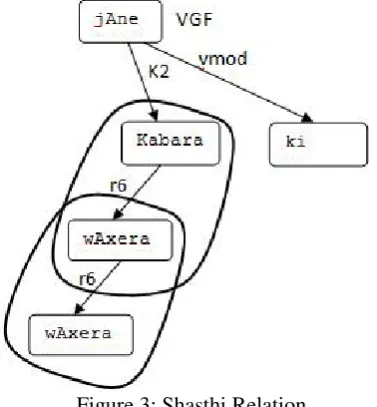
In dependency parsing the genitive relation are marked with shasthi (r6) relation. The chunk with shasthi (r6) (see the tagset of NLP Tool Contest: ICON 2009) relation always has a rela-tion with the succeeding chunk. An example is shown in Figure 3.
In the example as mentioned in Figure 3, the word “wadera”(their) has a genitive relation with the word in the next chunk “manera”(of mind). These chunks are placed in a set. It forms a set of two chunks members. The system gene-rates two different types of set. In one forms a set of members having relation with verb
[image:4.595.323.512.164.368.2]chunks. Another set contains two noun chunks with genitive relation. Now the sets containing only noun chunks with genitive relation does not form a clause. Those sets are merged with the set containing verb chunk and having dependency relation with the noun chunks. An example is shown in Figure 3.
Figure 3: Shasthi Relation
Consider ω is set of all sets containing two chunk members connected with genitive marker. Consider β is a set of all sets consisting of re-lated chunks with a verb chunk. λ is a element of ω. α is a element of β. Now, If a set λ which can have common chunks from a α set then λ set is associated with the proper α set. So, λ ∩ α ≠ Null then α = α ∪ λ. If a set λ which can have common chunks from two α sets which leads to ambiguity of associability of the λ set with the proper α set. If λ ∩ α = verb chunk, then λ set will be associated with α set containing the verb chunk. From the related set of chunk of verb chunks, system has identified the clauses in the sentence. Afterwards, the clauses are marked with the B-I-E (Beginning-Intermediate-End) notation.
4 Case Grammar-Identification of Ka-raka relations
The classical Sanskrit grammar Astadhyayi8 (‘Eight Books’), written by the Indian
8
[image:4.595.87.293.273.421.2]rian Panini sometime during 600 or 300 B.C. (Robins, 1979), includes a sophisticated theory of thematic structure that remains influential till today. Panini’s Sanskrit grammar is a system of rules for converting semantic representations of sentences into phonetic representations (Ki-parsky, 1969). This derivation proceeds through two intermediate stages: the level of karaka rela-tions, which are comparable to the thematic role types described above; and the level of morpho-syntax.
Fillmore’s Case Grammar (Fillmore, 1968), and much subsequent work, revived the Panini’s proposals in a modern setting. A main objective of Case Grammar was to identify semantic ar-gument positions that may have different realiza-tions in syntax. Fillmore hypothesized ‘a set of universal, presumably innate, concepts which identify certain types of judgments human be-ings are capable of making about the events that are going on around them’. He posited the fol-lowing preliminary list of cases, noting however that ‘additional cases will surely be needed’.
• Agent: The typically animate perceived
instigator of the action.
• Instrument: Inanimate force or object
causally involved in the action or state.
• Dative: The animate being affected by
the state or action.
• Factitive: The object or being resulting
from the action or state.
• Locative: The location or time-spatial
orientation of the state or action.
• Objective: The semantically most
neu-tral case, the concept should be limited to things which are affected by the action or state.
The SSF specification handles this syntactic dependency by a coarse-grain tagset of Nomini-tive, AccusaNomini-tive, Genitive and Locative case markers. Bengali shallow parser identifies the chunk heads as part of the chunk level analysis. Dependency parsing followed by a rule based module has been developed to analyze the inter-chunk relationships depending upon each verb present in a sentence. Described theoretical as-pect can well define the problem definition of clause boundary identification but during
prac-tical implementation of the solution we found some difficulties. Bengali has explicit case markers and thus long distant chunk relations are possible as valid grammatical formation. As an example:
bAjAre yAoyZAra samayZa xeKA kare gela rAma.
bAjAre yAoyZAra samayZa rAma xeKA kare gela.
rAma bAjAre yAoyZAra samayZa xeKA kare gela.
Rama came to meet when he was going to market.
In the above example rAma could be placed anywhere and still all the three syntactic forma-tion are correct. For these feature of Bengali many dependency relation could be missed out located at far distance from the verb chunk in a sentence. Searching for uncountable numbers of chunks have dependency relation with a particu-lar verb may have good idea theoretically but we prefer a checklist strategy to resolve the problem in practice. At this level we decided to check all semantic probable constituents by the definition of universal, presumably innate, concepts list. We found this is a nice fall back strategy to iden-tify the clause boundary. Separately rules are written as described below.
4.1 Agent
Bengali is a verb final language. Most of the Bengali sentences follow a Subject-Object-Verb (SOV) pattern. In Bengali, subject can be miss-ing in a clause formation. Missmiss-ing subjects and missing keywords lead to ambiguities in clause boundary identification.
я n ।
Close the door.
In the previous case system marks “я/door” as an “Agent” whereas the “Agent” is “you” (2nd person singular number), silent here.
types of phenomena. These rules help to stop false hits by identifying no 2nd person phrase was there in the example type sentences and em-power to identify proper phrases by locating proper verb modality matching with the right chunk.
4.2 Instrument
Instrument identification is ambiguous for the same type of case marker (nominative) taken by agent and instrument. There is no ani-mate/inanimate information is available at syn-tactic level.
ntg।
The music of Shyam’s messme-rized me.
।
The umbrella of Sumi.
Bengali sentences follow a Subject-Object-Verb (SOV) pattern. Positional information is helpful to disambiguate between agent and in-strument roles.
4.3 Dative
G
en
er
a
l
Bengali English Gloss
/ n//
...
Morn-ing/evening/night/da wn…
_
///
/ n...
O
clock/time/hour/min ute/second…
//
...
Mon-day/Tuesday/Sunday …
/я /... Bengali months… я!/"b! January/February… //... Day/month/year… /k/%... Long
time/moment…
R
el
a
ti
v
e
& '/% ... Before/After… /% ... Upcoming/ Special
Cases
uঠ / * .. .
[image:6.595.73.293.383.689.2]When rise/When stop…
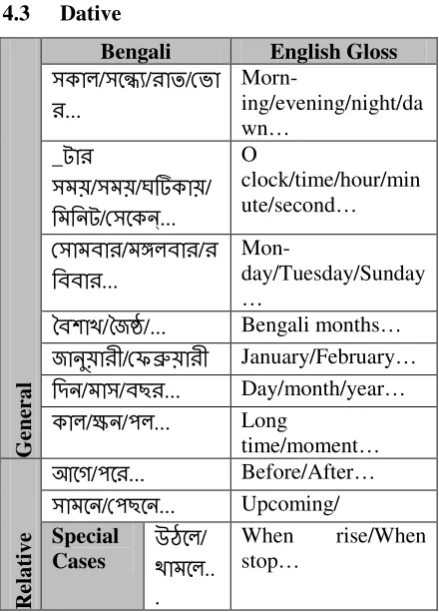
Table 3: Categories of Time Expressions
Time expression identification has a different aspect in NLP applications. People generally studied time expression to track event or any other kind of IR task. Time expressions could be categorized in two types as General and Rela-tive.
In order to apply rule-based process we veloped a manually augmented list with pre de-fined categories as described in Table 3. Still there are many difficulties to identify special cases of relative time expressions. As an exam-ple:
+ uঠ & o - ।
When moon rise we will start our journey.
In the previous example the relative time ex-pression is “uঠ /when rise” is tagged as infinite verb (for Bengali tag level is VGNF). Statistics reveals that these special types of cases approx-imately are only 1.8-2% in overall corpus.
These types of special cases are not handled by the present system.
4.4 Factitive
The particular role assignment is the most chal-lenging task as it separately known as argument identification. To resolve this problem we need a relatively large corpus to learn fruitful feature similarities among argument structures.
A manually generated list of causative post-positional words and pair wise conjuncts as re-ported in Table 4 has been prepared to identify argument phrases in sentences.
General
Bengali English Gloss
я/ /-... Hence/Reason/ Reason
Relative য_ If_else
যo_o If_else
Table 4: Categories of Causative Expressions
4.5 Locative
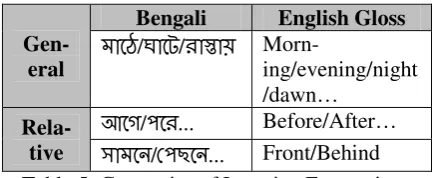
[image:6.595.304.523.511.582.2]suffixes as: ◌, ◌ etc). There is less differences we noticed among their syntactic dependency structure throughout the corpus. Positional in-formation helps in many cases to disambiguate these cases.
я i ।
There is unemployment in country side.
A different type of problem we found where verb plays locative role. As an example:
য я ।
Where people works there.
Here “য я /Where people works”
should be identified as locative marker. But this is a verb chunk and leads difficulty. Corpus sta-tistics reveals that this type of syntactic forma-tion is approximately 0.8-1.0% only and not been handled by the present system.
Gen-eral
Bengali English Gloss
ঠ/ /s
Morn-ing/evening/night /dawn…
Rela-tive
[image:7.595.74.291.327.416.2]& '/% ... Before/After… /% ... Front/Behind Table 5: Categories of Locative Expressions
4.6 Objective
The concept of objectivity is limited to things or human which are affected by the action or state. Statistical parser is a best way out for the present problem. The karma karaka (k2) identified by the dependency parser is simply the objective constituent of any clause.
5 Identification the Type of Clauses
After marking of the clause boundaries, clause types are identified. According to the clause structure and functions in a sentence, clauses are classified in to four types as principal clause, noun clause, adverbial clause and adjective clause. To identify the clause types, a CRF based statistical approach has been adopted.
5.1 Generative Grammar
In theoretical linguistics, generative grammar refers to a particular approach to the study of syntax. A generative grammar of a language at-tempts to give a set of rules that will correctly
predict which combinations of words will form grammatical sentences. Chomsky has argued that many of the properties of a generative grammar arise from an "innate" universal gram-mar. Proponents of generative grammar have argued that most grammar is not the result of communicative function and is not simply learned from the environment. Strongly moti-vated by Chomsky’s generative grammar we adopt the CRF based machine learning to learn the properties of a language and apply the know-ledge to typecast clause classification as well.
5.2 Conditional Random Fields (CRF)
CRFs are undirected graphical models which define a conditional distribution over a label se-quence given an observation sese-quence. CRF usually trained based on input features. Maxi-mum likelihood is being calculated on chosen features for training.
5.2.1 Features
The vitality of using any machine learning ap-proach is in identification of proper feature set. Conditional Random Field (CRF) works on a conditional distribution over a label sequence given an observation sequence. Hence CRF used here to statistically capture the prosodic structure of the language. The features experimentally found useful are chosen as listed below.
5.2.2 Chunk Label
An n-gram chunk label window has been fixed to capture internal arrangement of any particular clause type.
5.2.3 Chunk Heads
Chunk head pattern is the vital clue to identify the any clause pattern.
5.2.4 Word
In the clause type identification task words play a crucial part as word carries the information of the clause type.
the morphological information along with the dependency relations of the previous three and next three chunks. For the present task a quad-gram technique is used as most of the sentences have around 10 chunks.
The input file in the SSF format includes Chunk labels and word. The clause information in the input files are in B-I-E format so that the begin (B) / inside (I) / end (E) information for a clause are associated as a feature. The chunk heads, words are identified from the training file and noted as an input feature in the CRF based system. Each sentence is represented as a feature vector for the CRF machine learning task. The input features associated with each word in the training set are the word, clause boundary tags, chunk tag and clause type tags.
6 Error Analysis
[image:8.595.81.509.288.544.2]During the development stage of the system we had studied the various clause boundary labeling errors committed by the system. In the above examples, the system faces ambiguity to derive the rules for the identification of the clause members when a noun chunk acts as a noun modifier of a clause. In complex sentences, the verb chunk of the subordinate clause may have noun modifier relation with the principal clause. As System forms the groups the chunks with dependency relation, system merges the subor-dinate clause with principal clause. An example is shown in Figure 4.
Figure 4: Shasthi Relation
7 Experimental results
System Precision Recall
Boundary 73.12% 75.34%
Classification 78.07% 78.92%
Table 6: Performance of present System
The accuracy of the rule-based clause boundary identification system is 73.12% and 78.07% is the accuracy clause type classification system as reported in Table 6.
8 Conclusion
This paper reports about our works on clause identification and classification in Bengali lan-guage. We have used the rule based system to identify clause boundary and a statistical CRF based model is used to decide the type of a clause.
References
A. Ghosh, A. Das, P. Bhaskar, S. Bandyopadhyay. Dependency Parser for Bengali: the JU System at ICON 2009, In NLP Tool Contest ICON 2009, December 14th-17th, 2009, Hyderabad.
Akshar Bharati, Vineet Chaitanya , Rajeev Sangal. Natural Language Processing A Paninian Perspec-tive. Prentice Hall of India (1995).
Charles J. Fillmore, Christopher R. Johnson, and Mi-riam R. L. Petruck. 2003. Background to Frame-Net. International Journal of Lexicography, 16:235–250.
Chomsky, Noam (1956). "Three models for the de-scription of language". IRE Transactions on In-formation Theory 2: 113–124.
Erik F. Tjong kim sang and Herve Dejean Introduc-tion to CoNLL-2001 shared task: clause identifica-tion.
Groenendijk, J.: (2009), ‘Inquisitive Semantics: Two Possibilities for Disjunction’. In Lecture Notes in Computer Science. ISBN- 978-3-642-00664-7. Volume- 5422/2009. Berlin, Heidelberg. Pages- 80-94.
Kalika Bali, Monojit Choudhury, Diptesh Chatterjee, Arpit Maheswari, Sankalan Prasad. Correlates be-tween Performance, Prosodic and Phrase Struc-tures in Bangla and Hindi: Insights from a Psycho-linguistic Experiment. In Proceeding of ICON 2009. Hyderabad. India.
Kiparsky, Paul and J. F. Staal (1969). ‘Syntactic and semantic relations in Panini.’ Foundations of Lan-guage 5, 83-117.
Robins, R. H. (1979). A Short History of Linguistics (2nd Edition). London: Longman.