An Empirical Study of Combining Multiple Models in Bengali Question
Classification
Somnath Banerjee
Department of Computer Science and Engineering
Jadavpur University, India
Sivaji Bandyopadhyay
Department of Computer Science and Engineering
Jadavpur University, India
sivaji cse [email protected]
Abstract
This paper demonstrates that combination of multiple models achieves better clas-sification performance than that obtained by existing individual models for ques-tion classificaques-tion task in Bengali. We have exploited state of the art multiple model combination techniques, i.e., en-semble, stacking and voting on lexical, syntactical and semantic features of Ben-gali question for the question classification task. Bagging and boosting have been ex-perimented as ensemble techniques. Na¨ıve Bayes, kernel Na¨ıve Bayes, Rule Induc-tion and Decision Tree classifiers have been used as base learners. The exper-imental results show that classifier com-bination models outperform existing sin-gle model approaches. Overall voting approach has achieved maximum clas-sification accuracy of 91.65% and out-performed the existing single model ap-proaches (maximum accuracy of 87.63%).
1 Introduction
Although different types of question answering systems (QA) have different architectures, most of them follow a framework in which question clas-sification (QC) plays an important role (Voorhees, 2001) and QC has significant influence on the overall performance of a QA system (Ittycheriah et al., 2001; Hovy et al., 2001; Moldovan et al., 2003). The task of a question classifier is to assign one or more class labels, depending on classifica-tion strategy, to a given quesclassifica-tion written in natural language.
Basically there are two main motivations for question classification: locating the answer and choosing the search strategy. Knowing the ques-tion class not only reduces the search space needed
to find the answer, it can also help to find the true answer in a given set of candidate answers.
One of the main issues of classification model-ing is the improvement of classification accuracy. For that purpose, many researchers have recently placed considerable attention to the task of clas-sifier combination methods. The idea is not to rely on a single decision making scheme. Instead, many single classifiers are used for decision mak-ing by combinmak-ing their individual opinions to ar-rive at a consensus decision.
2 Related Work and Motivations
A lot of researches on QC, question taxonomies, and question features are being published con-tinuously. There are basically two different ap-proaches used to classify questions- one is rule based (Hull, 1999; Prager et al., 1999) and another is machine learning based (Zhang et al., 2003; Li and Roth, 2004). However, a number of re-searchers have also used some hybrid approaches which combine rule-based and machine learning based approaches (Huang et al., 2008; Silva et al., 2011).
Many researchers have investigated the tech-nique of combining the predictions of multiple classifiers to produce a single classifier (Breiman, 1996; Clemen, 1989; Perrone, 1993; Wolpert, 1992). The resulting classifier is generally more accurate than any of the individual classifiers mak-ing up the ensemble. Both theoretical (Hansen and Salamon, 1990; Krogh and Vedelsby , 1995) and empirical (Hashem, 1997; Opitz and Shav-lik, 1996a, 1996b) researches have been carried out successfully. Last decade a group of re-searchers focused on classifier combination meth-ods in question classification task. LIet al. (2005) trained four SVM classifiers based on four dif-ferent types of features and combined them with various strategies. Later LI et al. (2006) per-formed similar type of experiments and achieved
improved accuracy on TREC dataset. (Jia et al., 2007; Su et al., 2009) proposed ensemble learning for Chinese question classification.
Recently, (Banerjee and Bandyopadhyay, 2012) have worked on Bengali QC task and achieved 87.63% accuracy using single classifier approach. So far, classifier combination methods have not been used by any researcher in Bengali question classification task. So, we employ the use of clas-sifier combination methods to improve question classification accuracy.
3 Question Type Taxonomies
The present work follows the QC taxonomies pro-posed by (Banerjee and Bandyopadhyay, 2012) for two reasons. First, that is the only standard taxon-omy that exists in Bengali QC so far. Secondly, the results of the present work can be compared with the work of (Banerjee and Bandyopadhyay, 2012) to establish the improvement in accuracy.
4 Features
In the task of question classification, there is al-ways an important problem to decide the optimal set of features to train the classifiers. Different studies have extracted various features with differ-ent approaches. The features in question classifi-cation task can be categorized into three different types: lexical, syntactical and semantic features (Loni, 2011).
Loni et al. (2011) also represented a question in the QC task similar to document representation in vector space model, i.e., a question is a vector which is described by the words inside it. There-fore a questionQcan be represented as:
Q= (W1, W2, W3, ..., WN−1, WN) Where,WK= frequency of termKin questionQ, andN= total number of Terms
We have also used three types of features for QC. We use the same features previously used by (Banerjee and Bandyopadhyay, 2012).
Lexical features(fLex): wh-word, wh-word posi-tions, wh-type, question length, end marker, word shape.
Syntactical features(fSyn): POS tags, head word.
Semantic features (fSem): related words, named entity.
5 Combined Model Learning for QC
There are three approaches of classifier combina-tion: 1) Ensemble, 2) Stacking and 3) Voting.
Two popular methods for creating accurate en-sembles arebagging (Breiman, 1996) and boost-ing(Freund and Schapire, 1996; Schapire, 1990). We have used Rapid Miner1 tool in the experi-ments of this work.
6 Experiments
This section describes our empirical study of en-semble, stackingandvotingapproaches. Each of these three approaches has been tested with Na¨ıve Bayes (NB), Kernel Na¨ıve Bayes (k-NB), Rule In-duction (RI) and Decision Tree (DT). The previ-ous work (Banerjee and Bandyopadhyay, 2012) on Bengali question classification task used these four classifiers. So in this work, we have used those classifiers to establish the effect of combin-ing models.
6.1 Dataset
The present research work adopts the same cor-pus used by (Banerjee and Bandyopadhyay, 2012). The corpus consists of 1100 Bengali questions of different domains, e.g., education, geography, his-tory, science etc. We have used 770 questions (70%) for training and rest 330 questions (30%) to test the classification models.
6.2 Results
In total thirteen different experiments have been performed. Four different experiments have been performed for each bagging and boosting. So, altogether eight different experiments have been performed for the ensemble approach. Four dif-ferent experiments have been performed for stack-ing. But forvoting, a single experiment has been performed. Actually, each experiment can be thought of as three experiments, because a clas-sifier model has been tested onfLex,fSyn+fSem andfLex+fSyn+fSemfeatures separately. The outcome of the experiments have been tabulated and described in the next sub-sections.
In our study, classification accuracy has been used to evaluate the results of the experiments. ac-curacyis the widely used evaluation metric to de-termine the class discrimination ability of classi-fiers, and is calculated using the following equa-tion:
accuracy(%) = TP+TN P+N
where,TP = true positive samples;TN = true neg-ative samples;P= positive samples;N = negative samples.
It is a primary metric in evaluating classifier per-formances and it is defined as the percentage of test samples that are correctly classified by the al-gorithm.
6.2.1 Results based on Bagging
Bagging approach has been applied separately to four classifiers (i.e., NB, k-NB, RI and DT) and Table-1 tabulates the detailed information of the accuracy obtained.
BL fLex fLex+fSyn fLex+fSyn+fSem
NB 81.53% 82.77% 83.25%
k-NB 82.09% 83.37% 84.22%
RI 83.96% 85.61% 86.90%
DT 85.23% 86.41% 91.27%
Table 1: Experimental results of Bagging.
Initially the size (number of iteration) of the base learner is set to 2. Then experiments have been performed with gradually increased size (size>2). The classification accuracy has been increased with increase in size. But after a cer-tain size, the accuracy has been almost stable. At size=2 and feature=fLex +fSyn +fSem, the NB classifier achieves 82.23% accuracy and at size>= 9, it becomes stable with 83.25% accu-racy. At size=2 and feature=fLex+fSyn+fSem, the k-NB classifier achieves 83.87% accuracy and at size>=15, it becomes stable with 84.22% accu-racy. At size=2 and feature=fLex+fSyn+fSem, the RI classifier achieves 85.97% accuracy and at size>=8, it becomes stable with 86.90% accu-racy. At size=2 and feature=fLex+fSyn+fSem, the DT classifier achieves 88.09% accuracy and at size>=7, it becomes stable with 91.27% accu-racy. It has been observed from the experiments that at each case Bagging with DT requires less size, i.e., less iteration then the other used classi-fiers. For experiment withfLexfeatures, the bag-ging size of NB, k-NB, RI and DT are 12, 19, 11 and 10 respectively after which classification ac-curacy becomes stable. And For experiment with
fLex+fSyn features, the bagging size of NB, k-NB, RI and DT are 10, 17, 9 and 8 respectively af-ter which classification accuracy becomes stable.
6.2.2 Results based on AdaBoost.M1
Like bagging, AdaBoost.M1 has also been applied separately to the four classifiers (i.e., NB, k-NB, RI and DT). Table-2 tabulates the detailed infor-mation of the accuracy obtained.
Here, we empirically fix the iterations of Ad-aBoost.M1 for four classifiers to 12, 16, 10 and 8 respectively for features=fLex+fSyn+fSem, be-cause the weight of 1/βtis less than 1 after those values. If 1/βt is less than 1, then the weight of classifier model in boosting may be less than zero for that iteration.
BL fLex fLex+fSyn fLex+fSyn+fSem
NB 81.74% 82.71% 83.51%
k-NB 83.97% 85.63% 86.87%
RI 83.55% 85.59% 86.27%
DT 85.21% 86.58% 91.13%
Table 2: Experimental results of AdaBoost.M1.
Similarly, for features=fLex + fSyn and features=fLex the iterations are 13, 18, 12, 9 and 14, 19, 14, 11 respectively for four classifiers cor-respondingly. The experiment results show that the performance of k-NB classifier has been im-proved over RI. But, overall DT performs better than all.
6.2.3 Results based on Stacking
In stacking, out of four classifiers three classi-fiers have been used as thebase learner(BL) and the remaining classifier has been used as model learner (ML). So, four experiments have been conducted separately where each classifier get a chance to be themodel learner. Table-3 shows the detailed information of the accuracy obtained.
BL ML fLex fLex+fSynfLex+fSyn+fSem
k-NB,RI,DT NB 81.76% 82.79% 83.64% NB, RI, DT k-NB 83.86% 85.54% 86.75% NB,k-NB,DT RI 85.55% 87.69% 91.32%
NB,k-NB,RI DT 85.07% 86.73% 89.13%
Table 3: Experimental results of Stacking.
In the first experiment, three classifiers k-NB, RI and DT have been selected as thebase learners and the NB classifier has been selected as the
that with RI as themodel learner and NB, k-NB, DT as the base learners, the classifier achieves best classification accuracy.
6.2.4 Results Based on Voting
In voting, four classifiers altogether have been used as the base learners and majority vote has been used as voting approach. Table 4 tabulates the detailed information of the accuracy obtained.
BL fLex fLex+fSynfLex+fSyn+fSem NB, RI,
k-NB,DT
86.59% 88.43% 91.65%
Table 4: Experimental results of Voting.
7 Conclusions and Perspectives
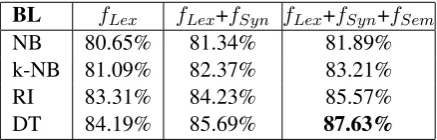
The automated Bengali question classification sys-tem by (Banerjee and Bandyopadhyay, 2012) is based on four classifiers namely Na¨ıve Bayes, Kernel Na¨ıve Bayes, Rule Induction and Decision Tree. Table-5 tabulates the detailed information of the accuracy obtained.
BL fLex fLex+fSyn fLex+fSyn+fSem
NB 80.65% 81.34% 81.89%
k-NB 81.09% 82.37% 83.21%
RI 83.31% 84.23% 85.57%
DT 84.19% 85.69% 87.63%
Table 5: Experimental results of (Banerjee and Bandyopadhyay, 2012)
Na¨ıve Bayes has been used as the baseline and they have achieved 87.63% accuracy using Deci-sion Tree. But, they have used each classifier as single model separately. The present work shows that classifier combination technique can improve the performance of question classification. Each classifier combination model performs well than single classifier model in terms of classification accuracy.
If we compare the results of previous experi-ment (Banerjee and Bandyopadhyay, 2012) with
baggingapproach, then classification accuracy of all the classifiers have been notably increased. The classification accuracy onfLex ,fLex+fSyn and
fLex+fSyn+fSemfeatures have been increased by 1.04%, 0.72% and 3.64%. Similarly in the
boosting approach, the classification accuracy of
all the classifiers have been notably increased and onfLex,fLex+fSynandfLex+fSyn+fSem fea-tures the classification accuracy have increased by 1.02%, 0.89% and 3.50%. Stackingapproach no-tably increases the accuracy onfLex+fSyn fea-tures thanbagging andboostingapproaches. The classification accuracy onfLex ,fLex+fSyn and
fLex+fSyn+fSemfeatures have been increased by 1.36%, 2.74% and 0.69% respectively. Voting
approach not only increases the classification ac-curacy but also hits the maximum acac-curacy on all features than other combined approaches. Voting
approach increases the classification accuracy on
fLex ,fLex+fSynandfLex+fSyn+fSem fea-tures by 2.40%, 2.40% and 4.02% respectively.
So, overall voting approach withmajority vot-inghas performed best among all four classifiers combination approaches namely bagging, boost-ing, stacking and voting. Experimental results show that classifiers combination approaches out-perform the previous single classifier classification approach by (Banerjee and Bandyopadhyay, 2012) for Bengali question classification.
The main future direction of our research is to exploit other lexical, semantic and syntactic fea-tures for Bengali question classification. In future an investigation can be performed on including new Bengali interrogatives using a large corpus. It is also worth investigating fine-grained classes for Bengali questions. In the current work, we have only investigated the Bengali questions. But, this work can be applied to other languages having low resources.
Acknowledgments
We acknowledge the support of the Department of Electronics and Information Technology (De-itY), Ministry of Communications and Informa-tion Technology (MCIT), Government of India funded project “Development of Cross Lingual In-formation Access (CLIA) System Phase II”.
References
Abraham Ittycheriah , Franz Martin, Zhu Wei-Jing, Adwait Ratnaparkhi, and Richard J. Mammone. 2001. IBMs statistical question answering system. In Proceedings of the 9th Text Retrieval Conference, NIST.
sys-tems, Vol. 7, pp. 231-238 Cambridge, MA. MIT Press.
Babak Loni. 2011. A survey of state-of-the-art meth-ods on question classification. Delft University of Technology, Tech. Rep (2011): 1-40.
Babak Loni, Gijs van Tulder, Pascal Wiggers, Marco Loog, and David Tax. 2011. Question classifica-tion with weighted combinaclassifica-tion of lexical, syntacti-cal and semantic features. TSD, pages 243-250.
Dan Moldovan, Marius Pasca, SandaHarabagiu, and MihaiSurdeanu. 2003. Performance issues and er-ror analysis in an open-domain question answering system. ACM Trans. Inf. Syst., 21:133-154.
David A. Hull. 1999.Xerox TREC-8 question answer-ing track report. In Voorhees and Harman.
David H. Wolpert. 1992.Stacked generalization. Neu-ral Networks, 5, 241-259.
David W. Opitz and Jude W. Shavlik. 1996a. Actively searching for an effective neural network ensemble. Connection Science, 8( 3/4): 337-354.
David W. Opitz and Jude W. Shavlik. 1996b. Gen-erating accurate and diverse members of a neural
network ensemble. Advances in Neural Information
Processing Systems, Vol. 8, pp. 535-541 Cambridge, MA. MIT Press.
Dell Zhang and Wee Sun Lee. 2003.Question
classifi-cation using support vector machines. ACM SIGIR,
pages 26-32,New York,USA, ACM.
Eduard Hovy, Laurie Gerber, Ulf Hermjakob, Chin yew Lin, and Deepak Ravichandran. 2001. Toward semantics-based answer pinpointing.
Ellen M. Voorhees. 2001.Overview of the TREC 2001 question answering track. TREC, pp. 42-51.
Joao Silva, Luisa Coheur, Ana Mendes, and Andreas Wichert. 2011. From symbolic to sub-symbolic in-formation in question classification. Artificial Intel-ligence Review, 35(2):137-154.
John Prager, Dragomir Radev, Eric Brown, and Anni Coden. 1999. The use of predictive annotation
for question answering in trec8.
TREC-8,pp.399-411.NIST.
Keliang Jia, Kang Chen, Xiaozhong Fan, Yu Zhang. 2007. Chinese Question Classification Based on
En-semble Learning. ACIS. pp. 342-347.
Lars Kai Hansen, and Peter Salamon. 1990. Neural
network ensembles. IEEE Transactions on Pattern
Analysis and Machine Intelligence, 12, 993-1001.
Lei Su, Hongzhi Liao, Zhengtao Yu, Quan Zhao. 2009. Ensemble Learning for Question Classifica-tion. ICIS 2009. pp. 501-505.
Leo Breiman. 1996. Stacked regressions. Machine Learning, 24(1), 49-64.
LI Xin, Xuan-Jing HUANG, and Li-de WU. 2006.
Question Classification by Ensemble Learning. IJC-SNS, 6(3), page : 147.
Michael Peter Perrone. 1993. Improving Regression Estimation: Averaging Methods for Variance Reduc-tion with Extension to General Convex Measure Op-timization. Ph.D. thesis, Brown University, Provi-dence, RI.
Robert E. Schapire. 1990.The strength of weak learn-ability. Machine Learning, 5(2), page:197-227.
Robert T. Clemen. 1989. Combining forecasts: A
review and annotated bibliography. International
Journal of Forecasting 5, no. 4: 559-583.
Sherif Hashem. 1997. Optimal linear combinations of
neural networks. Neural Networks, 10 (4),
pp:599-614.
Somnath Banerjee and Sivaji Bandyopadhyay. 2012.
Bengali Question Classification: Towards
Devel-oping QA System. In Proceedings of
SANLP-COLING, pages 25-40, Mumbai, India.
Somnath Banerjee and Sivaji Bandyopadhyay. 2012a.
Question Classification and Answering from
Proce-dural Text in English. In Proceedings of
QACD-COLING, pages 11-26, Mumbai, India.
Xin Li and Dan Roth. 2004. Learning question clas-sifiers: The role of semantic information. COLING, pp. 556-562.
Zhiheng Huang, Marcus Thint, and Zengchang Qin. 2008. Question classification using head words and