Restricting Inverse Scope in Synchronous Tree-Adjoining Grammar
Michael Freedman Yale University 370 Temple Street, Rm 210 New Haven, CT 06511, USA [email protected]
Robert Frank Yale University 370 Temple Street, Rm 312 New Haven, CT 06511, USA
Abstract
This paper provides an account for inverse scope restrictions with nominal quantifiers using synchronous tree adjoining grammar. It aims to provide an alternative account to Beghelli & Stowell’s (1997) work on similar data.
1 Introduction
Recent work in the study of the syntax-semantics in-terface [Nesson and Shieber, 2006, 2007, 2008] us-ing synchronous tree-adjoinus-ing grammars (STAGs) has attempted to cover a broad range of empirical issues with respect to scopal interactions (control verbs, relative clauses, inverse linking). The major-ity of this work has attempted to relax the localmajor-ity restrictions enough to be able to derive possible in-terpretations while remaining as restricted as possi-ble.
These analyses however are unable to account for asymmetries in the scopal interaction of nomi-nal quantifiers (see §2). This paper aims to explain these asymmetries through two novel mechanisms: (1) Operations on an elementary tree must proceed in the opposite order of the prominence ordering of the nodes on the tree (to be explained in §3). (2) Different classes of quantifiers, represented as multi-component sets, differ in their derivation procedure, where some classes must combine simultaneously in an elementary tree while other classes’ scopal tree is able to adjoin later in the derivation.
This paper gives an alternative analysis to Beghelli and Stowell’s (henceforth B&S) (1997)
analysis of quantifier scope in English. In partic-ular this paper examines the restriction on inverse scope readings in English when the object quantifier is a count quantifier as compared to the the ability to have inverse scope readings when the quantifier is a universal quantifier. Additionally, these same re-strictions will be shown to hold in the double object constructions in English.
This paper will then extend this analysis to quanti-fier scope puzzles in Mandarin Chinese and ian. Quantifier scope in both Mandarin and Hungar-ian is said to correspond to the hierarchical positions of the nominal quantifiers, allowing no scopal ambi-guities. Yet it has been observed that there are cer-tain constructions in both languages where there are scopal ambiguities. Mandarin “passive” sentences and Hungarian sentences where both quantifiers fol-low the verb are known to alfol-low inverse scope read-ings as well as surface scope readread-ings. Previous analyses of these phenomena in conjunction with the constraints proposed in this paper derive the ambi-guity in these constructions while keeping the other constructions unambiguous in their scope readings.
2 Data
2.1 English Nominal Quantifiers
As discussed in Beghelli and Stowell [1997], cer-tain classes of nominal quantifiers are able to scope over quantificational subjects when in object posi-tion, while other classes may not. This is exempli-fied in (1) and (2).
(1) Every student read 2 papers. (∀>2, 2>∀)
(2) Every student read more than 2 papers. (∀>2+,2+≯∀)
The examples in (1) and (2) show that quanti-fiers like 2 (called group-denoting quantifier phrases (GQPs) by B&S) can take wide scope while in object position while quantifiers like more than 2 (called count quantifier phrases (CQPs) by B&S) cannot. Universal quantifiers (DQPs) also pattern with GQPs by being able to scope over the deno-tation of the subject NP, as shown in (3).
(3) 2 students read every book. (∀>2, 2>∀)
2.2 English Double Object Construction
Double object constructions in English also seem to follow the same pattern where DQPs seem to be able to take scope over other quantifiers when in a hi-erarchically lower position, while CQPs are unable to (as in (4)1. The pattern of scope rigidity versus scope ambiguity is exhibited in both double object and prepositional dative constructions in (4) and (5).
(4) a. John assigned more than 2 students every paper on the syllabus. (∀>2+, 2+>∀)
b. John assigned every student more than 2 pa-pers on the syllabus. (∀>2+)
(5) a. John assigned more than 2 papers on the syllabus to every student. (∀>2+, 2+>∀)
b. John assigned every paper on the syllabus to more than 2 students. (∀>2+)
1Some speakers consider this construction to be
unambigu-ous. An analysis of this dialectal difference is outside the scope of this paper and awaits future work.
3 Restricting Inverse Scope 3.1 Inverse Scope in STAG
Common to many STAG analyses is the use of multiple adjunction [Schabes and Shieber, 1994] to get inverse scope. With multiple adjunction, the sco-pal part of all QPs are able to adjoin at the same node in the course of the derivation. A further convention states that the later combined tree adjoins above the earlier combined tree. Inverse scope is derived be-cause either quantifier is able to adjoin first. This type of analysis runs into problems accounting for the data in§2 because the only restriction on scopal parts of two clausemate quantifiers is that they both appear within the semantic tree associated with the verb of which they are both arguments. As a result, it fails to distinguish among different classes of quan-tifiers and also between the scopal possibilities when the quantifiers are in subject and object position.
3.2 Beghelli & Stowell
B&S obtain the differences in scope possibilities (developed within the minimalist framework) by positing a series of functional projections above VP. They argue that different sets of quantifiers have dif-ferent features that need to be checked and this leads to movement at LF where the QPs move to a func-tional projection that satisfies some feature. They categorize quantifier phrases into five groups: Inter-rogative QPs, Negative QPs, Group-denoting QPs, Distributive QPs, and Count QPs. Each group is de-noted by a shared semantic feature: WhQPs intro-duce questions, NQPs negate, GQPs denote groups (and plural individuals), DQPs distribute over sets and are universally quantified, and CQPs count indi-viduals with a certain property. The different scope possibilities are constrained by the positions each class of quantifier can move to. The different func-tional projects (hierarchically ordered) with the as-sociated QP class that moves to the specifier position of the functional projection are in (6).
(6) RefP(GQP) > CP(WhQP) > AgrSP(CQP)>
DistP(DQP)>ShareP(GQP)>NegP(NQP)>
AgrOP(CQP)
specifier of AgrOP while GQPs and DQPs move to a position higher in the structure. The c-command relationship then determines the scope relation.
Although this style of analysis may be available in a STAG, this paper aims to provide an alterna-tive account. An alternaalterna-tive account is preferable because (a) this type of analysis seems to go against the spirit of STAG where syntactic and semantic el-ements combine synchronously; and (b) it is worth while to see if this approach can be simplified within STAG. Complexities that arise in the B&S analysis include the notion that quantifiers must be ambigu-ous as to their feature specifications, and that a large number of functional projections are necessary for any verbal tree. For instance they analyze ‘every’ as a DQP or a GQP, this would entail three differ-ent possible landing spots for ‘every’ and thus three different lexical items.
3.3 Current Proposal
Our proposed analysis assumes a synchronous derivation [Shieber and Schabes, 1990], multi-component trees (MCTAG) [Joshi, 1987], and mul-tiple adjunction. Also following the literature on multiple adjunction, I will assume that the tree that is adjoined later in the derivation scopes over the previously adjoined structure [Schabes and Shieber, 1994].
The analysis aims to capture the intuition that the derivation of the sentence reflects the sentence struc-ture and that a different strucstruc-ture stems at least par-tially from a different derivation. For the present data this assumes that there is a structural differ-ence between the two different scope readings. In the present analysis this will manifest itself in the semantic trees.
3.4 Hierarchy in Derivation Order
Traditionally, TAGs do not specify the order of derivation among the substitution and adjoining op-erations that target a given elementary tree. One way in which to limit the inverse scope possibilities is to restrict the ordering of such operations in the fol-lowing fashion: The order of operations on an ele-mentary tree must proceed in the opposite order of the asymmetrical c-command (ACC) and irreflexive dominance (DOM) ordering of the nodes of the tree. More formally we define a relation PROM in (7) and
then impose the following restriction in (8).
(7) PROMdef={(x,y)|(x,y)∈DOMirr∪ACC}
(8) PROMINENCE RESTRICTION ON DERIVA
-TION (PROD)
If node a in syntactic tree T is targeted (by sub-stitution or adjoining) prior to node b in T, then (a,b) must not be in PROM
This constraint ensures that a hierarchically lower node is targeted before a higher one. The dominance relation applies in sentences like (9) where the ad-verb that adjoins to S scopes over the adad-verb that scope over VP.
(9) a. Intentionally, John knocked twice.
b. Twice, John knocked intentionally
The c-command relation applies in the cases of nom-inal quantifiers discussed in §2. Since the subject of a transitive sentence c-commands its object, the object quantifier must combine into the elementary tree first in the derivation. Since the combination of the syntactic and semantic trees is synchronous, this restriction does not allow scope ambiguity in these cases.
3.5 Relaxing Derivation Order
Different applications of MCTAG have assumed that the properties of all instances of multicomponent ad-joining in a grammar behave in a uniform fashion, whether restricted to being tree-local, set-local, or non-local. In particular MCTAG [Joshi, 1987] as-sumes that all members of a tree set combine with a target tree simultaneously and VTAG [Rambow, 1994, Nesson and Shieber, 2008] assumes that that there is no simultaneity constraint on members of a tree set. I propose instead that a tree set can specify derivational restrictions on its use during a deriva-tion. In particular, I will consider two possibilities for a given set, which interact with my proposal con-cerning derivational order:
2. Delayed combination (DC): the integration of the trees within a tree-set may take place at dif-ferent points during the derivation.
Only the variable-trees must be derived follow-ing the hierarchical order (as in vector-TAG [Ram-bow, 1994, Nesson and Shieber, 2008]). I argue that the different classes of quantifiers differ along the SC/DC dimension. Specifically, the tree-set of CQPs is SC, while the other QP classes are DC. For present purposes, it will suffice for me to assume that all quantifier trees are constrained to adjoin in a tree-local fashion. Note that non-local derivation in combination with SC will be equivalent to non-local MC-TAG and is NP-hard to parse[Rambow and Satta, 1992, Champollion, 2007].2
3.6 English Nominal Quantifiers
With these preliminaries in place, we can now turn to the analysis of the scopal asymmetries in (1) and (2). Since the object QP in (1) is DC, two possible derivations are available (using the trees in Figure 1). In the first of these, the object quantifier 2 pa-pers is combined first, following the PROMINENCE
RESTRICTION ON DERIVATION order. On the
se-mantic side, this means that the variable tree must be substituted into the read tree. At this point, the scopal component is also free to adjoin to the t* root of the read tree. If it does this, the subsequent in-tegration of the subject quantifier every student will result in the scope of the universal being outside of the numeral (as in figure 1). In the other derivation, the DC property of the universal quantifier tree is ex-ploited. The scope portion of the numeral quantifier is not adjoined immediately. Instead, the derivation proceeds through the integration of the subject quan-tifier, including its scope, and then the scope of the object quantifier is finally adjoined. This yields wide scope for the object quantifier (as in figure 1).
For example (2), in which the object quantifier, in virtue of being a CQP, is SC, only the first of these derivations is possible: the scope of more than 2 books must adjoin to t* at the point that the variable is substituted, resulting in obligatory narrow scope for the object quantifier.
Note that when CQPs are in subject position, they nonetheless show scope ambiguity with respect to
2Thanks to an anonymous reviewer for pointing this out.
object quantifiers, as in (10).
(10) More than 2 students read every book. (2+>∀)
This possibility is predicted by the current analy-sis: the flexibility of the object quantifier to adjoin at t* either before or after the subject quantifier will permit the generation of either scope, even in the face of a SC requirement on the subject quantifier.
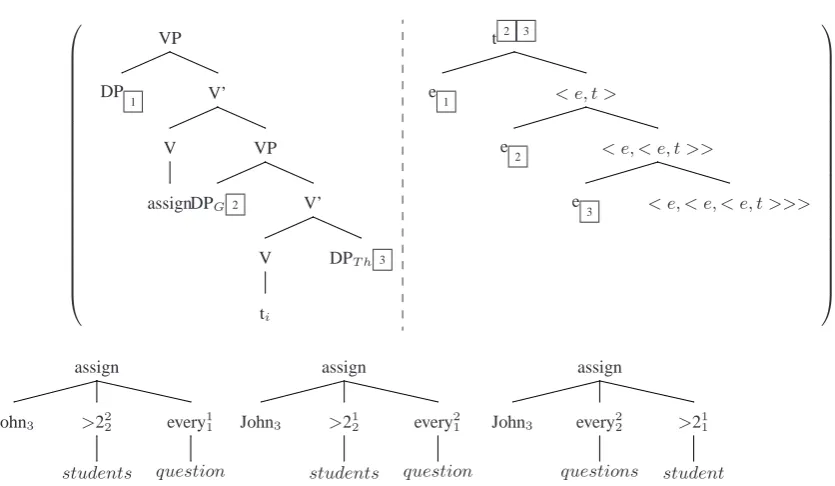
The double object construction described in §2 also can be explained using the c-command con-straint and delayed combination. Adopting the Lar-sonion VP-shell analysis [Larson, 1988] as in fig-ure 2, the node that is targeted by the goal object c-commands the node that is targeted by the theme object. Theme object quantifiers that have the DC property are able to take scope over the theme ob-ject quantifier, while ones that have the SC property are unable to. The prepositional dative case works analogously, where only when the lower goal object has the DC property does inverse scope take place.
4 Extending the Analysis
The behavior of nominal quantifiers in various other languages differs from the English case described above. Both Mandarin and Hungarian are purported to have their scope ordering match surface structure very closely. “Active” Mandarin sentences and Hun-garian sentences where both quantifiers are in the pre-verbal field only have surface scope readings. This corresponds with all the quantifiers in both lan-guages having the SC feature. Yet there are con-structions in both languages where scope ambiguity does arise. This section aims to show how the con-straints in this analysis are able to account for the varying scopal behavior in these languages without DC.
4.1 Data
4.1.1 Mandarin Chinese Passives
alter-
S
DP
1 VP
V DP2
read
t1 2
e
1< e, t >
read e2
DP
D’
2+ (Every)
NP
t*
2+ (∀)
x t t
< e, t > x
e
x
NP
student (book)
< e, t >
x
read
2+22 every11
students book
read
2+12 every21
students book
read
every22 2+11
student books
Figure 1: This figure shows elementary trees for the verb, quantifiers, and NPs. Derivation trees for examples (2) and (3) are provided: the leftmost and middle derivation trees show the two ordering options when a DQP is in object position and the rightmost one shows the one option when a CQP is in object position. The subscripted numbering represents the order of syntactic derivation the superscripted numbering represents the order of semantic derivation of the scopal-trees with delayed combination.
VP
DP
1 V’
V VP
assignDPG2 V’
V DPT h 3
ti
t2 3
e
1 < e, t >
e
2 < e, < e, t >>
e
3 < e, < e, < e, t >>>
assign
John3 >222 every11
students question
assign
John3 >212 every21
students question
assign
John3 every22 >211
[image:5.595.80.498.389.632.2]questions student
IP DP 1 I’ I VP
bei DP2 V’
V DP
1
zhuazoule
t1 2
e
1 < e, t >
arrested e 2
DP D’ meige (yige) NP DP ti t* ∀ (one)
x t t
< e, t > x
e x bei
meige1 yige2
ren nuren
bei
meige2 yige1
[image:6.595.71.522.94.273.2]ren nuren
Figure 3: This figure shows (1) an elementary tree containingBEI and a main verb. It has three positions for DP substitutions. (2) A multi-component tree for meige, and (3)derivation trees for the BEI sentence. The leftmost derivation tree has meige adjoin first making yige take wide scope. The rightmost derivation tree has yige adjoin first making meige take wide scope. The numbering on these trees represents the ordering on the derivation where either of the quantifiers is able to combine first. Not pictured are trees corresponding to the NPs and the other quantifier; these trees are identical to the trees for the same type lexical items in figure 1.
VP V DP 1 2 DP 1 2 evett
t1 2
e
1 < e, t >
eat e 2 evett
a legt¨obb1 k´et2
ember s¨utem´enyb¨ol
evett
a legt¨obb2 k´et1
ember s¨utem´enyb¨ol FP1 DP 1 F’ F FP2 DP 2
F2′
F2 V P
V DP 1 2 DP 1 2 evett
t1 2
e
1 < e, t >
eat e 2
[image:6.595.84.528.404.614.2]natively a passive marker or preposition-like lexical item.
(11) Meigeren dou xihuan yige nuren everyone all like one woman ‘Everyone loves a woman’ (∀>1)
(12) Meige ren dou bei yige nuren zhuazou le every man all BEIone woman arrested
‘Everyone was arrested by a woman (∀>1, 1>∀)
4.1.2 Hungarian Scope
In Hungarian, transitive sentences with two quan-tifiers can be in a number of different word orders. When both quantifiers precede the verb the scope or-dering is strict and no inverse scope reading is possi-ble, as in (13). When both quantifiers are unstressed and follow the verb inverse scope readings are pos-sible, as in (14).
(13) tegnap a legt¨obb ember k´et yesterday the most person two s¨utem´enyb¨ol evett
cakes-from ate
‘Yesterday most people ate from two cakes’ (most>2)
(14) tegnap evett a legt¨obb ember yesterday ate the most person k´et s¨utem´enyb¨ol
two cakes-from
‘Yesterday most people ate from two cakes’ (most>2, 2>most)
4.2 Extending the Analysis
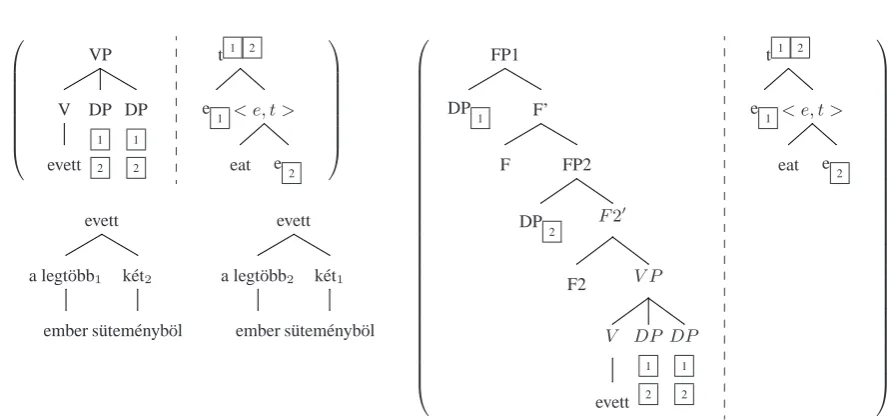
The syntactic trees chosen for the Mandarin and Hungarian data in figures 3 and 4 are chosen based on previous analyses of this data. Aoun and Li [1993] argue that the trace allows either scope read-ing because each quantifier c-commands the other. Kiss [2002] argues that the structure of Hungarian has a hierarchical preverbal field and a flat structure in the VP field. Ambiguous scope is available when the quantifiers are in the VP field because neither c-commands the other, yet while they are above VP
there is surface scope because one quantifier will c-command the other. Both of these analyses base their analysis off of the idea that c-command rela-tions derive scope relarela-tions [May, 1977].
These cases force us to complicate the analysis given in §3. In both the Hungarian and Mandarin cases quantifiers are represented by MC-sets. As such, there are cases where a MC-set both com-mands and is c-commanded by some other tree (set). The current definition of PROM when utilized by PROD leads to paradox as two different nodes can-not be be targeted until the other one has been tar-geted. The definition of PROM needs to be refined by accounting for this configuration. To do this a new relation PROM’ will be defined in (7).
(15) PROM’def ={(x,y)|(x,y)∈PROM, no z such
that (1) (y,z) ∈ PROM, (x,z) is targeted by a MC-set or (2) (z,x)∈PROM, (z,y) is targeted by a MC-set.}
The definition of PROM’ eliminates from PROM pairs (a,b),(b,c) where a and b are targeted by differ-ent MC-sets (a,c) and (b); and (a,b) and (b,c) are in PROM. In these cases there is no possible ordering between the two sets based on their hierarchical po-sition. PROM’ then replaces PROM in the PROD.
to take wide scope during the derivation of the se-mantic tree. This produces the scope ambiguity, and does so without delayed combination. Thus, both the strict scope behaviour and ambiguous scope be-haviour can be derived.
The Hungarian data also can be derived given the revised PROD. The ambiguous scope cases are
de-rived because the nodes the quantifiers substitute into are not in a PROM relation with respect to one another. Thus either DP is able to combine first and on the semantic side either scopal tree is able to then adjoin first. The unambiguous case is derived be-cause the highest DP node is in a PROM’ relation with a DP under VP. Thus the tree-set that targets the DP under FP2 must combine first with the ele-mentary tree. On the semantics side the scopal tree must attach before the scopal tree for the other quan-tifier. This produces the surface scope reading only.
5 Conclusions and Further Ideas 5.1 Summary
This paper has explored one method of restricting scope relations in S-TAG. The two mechanisms dis-cussed in the paper have been shown to predict the correct scope possibilities in English sentences with subject and object quantifiers (and object quantifiers in the double object construction), in Mandarin Chi-nese “active” and “passive” constructions, and the different Hungarian configurations. The former uti-lized both the PROM constraint on derivation and delayed combination while the latter two utilized only a revised PROM constraint.
5.2 Further Work
Further work on this topic involves a more indepth look at the scopal possibilities in the English, Man-darin, and Hungarian. Notably a comparison to Szabolcsi [1997] for Hungarian would be advanta-geous. Further work on this analysis involves see-ing how the constraints proposed in this paper in-teract with other scopal elements. For instance how does this paper’s analysis affect the scopal possibil-ities between negative markers, questions, or inten-tional operators, and nominal quantifiers. Phenom-ena from other languages should also be explored: It might prove interesting to see what languages utilize DC and which don’t and whether DC varies
cross-linguistically in what lexical items possess it. Evi-dence for this type of analysis may be borne out of a coherent typology. Another avenue of exploration would be to seek out an alternative to the PROM’ relation that is less complex and independently mo-tivated.
References
J. Aoun and Y.A. Li. Syntax of scope. The MIT Press, 1993.
F. Beghelli and T. Stowell. The Syntax of Each and Every. Ways of scope taking, pages 71–107, 1997.
L. Champollion. Lexicalized non-local MCTAG with domi-nance links is NP-complete. In Gerald Penn and Ed Stabler, editors, Proceedings of Mathematics of Language (MOL) 10, CSLI On-Line Publications, 2007.
A. Joshi. An Introduction to Tree Adjoining Grammar. Mathe-matics of Language, 1987.
K. ´E. Kiss. The syntax of Hungarian. Cambridge Univ Pr, 2002.
R.K. Larson. On the double object construction. Linguistic inquiry, 19(3):335–391, 1988.
R. May. The Grammar of Quantification. PhD thesis, MIT, 1977.
R. Nesson and S. Shieber. Simpler TAG semantics through syn-chronization. In Proceedings of the 11th Conference on For-mal Grammar, Malaga, Spain, pages 29–30, 2006.
R. Nesson and S. Shieber. Extraction phenomena in syn-chronous TAG syntax and semantics. In Proceedings of the NAACL-HLT 2007/AMTA Workshop on Syntax and Structure in Statistical Translation, pages 9–16. Association for Com-putational Linguistics, 2007.
R. Nesson and S. Shieber. Synchronous vector tree adjoining grammars for syntax and semantics: Control verbs, relative clauses, and inverse linking. In Proceedings of the Ninth International Workshop on Tree Adjoining Grammars and Related Formalisms, pages 73–80, 2008.
O. Rambow. Formal and Computational Aspects of Natural Language Syntax. PhD thesis, University of Pennsylvania, Philadelphia, PA, 1994.
O. Rambow and G. Satta. Formal properties of non-locality. In Proceedings of 1st International Workshop on Tree Adjoin-ing Grammars, 1992.
Y. Schabes and S. Shieber. An alternative conception of tree adjoining derivation. Computational Linguistics, 20:91–124, 1994.
S. Shieber and Y. Schabes. Synchronous tree-adjoining gram-mars. In Proceedings of the 13th conference on Computa-tional linguistics-Volume 3, pages 253–258. Association for Computational Linguistics Morristown, NJ, USA, 1990.