J. exp. Biol 127, 355-372 (1987) 3 5 5 Printed in Great Britain © The Company of Biologists Limited 1987
A COMPARATIVE STUDY OF THE FLIGHT MECHANISM
OF DIPTERA
BY A. ROLAND ENNOS
Department of Biological Sciences, Hatherly Laboratories, University of Exeter, Prince of Wales Road, Exeter EX4 4PS
Accepted 22 September 1986
SUMMARY
1. The mechanism of dipteran flight has been investigated in a comparative study involving thorax manipulation, analysis of high-speed films and direct observation of tethered flies under stroboscopic illumination.
2. The click action observed in CCl^-anaesthetized Calliphora was found to be due to an interaction between the radial stop and the pleural wing process at the top of the upstroke. The movements occurring during unanaesthetized tethered flight were quite different as these structures were vertically separated except towards the bottom of the downstroke (Miyan & Ewing, 1985a,b).
3. Results of observations on tethered insect flight and on morphology did not give full support to either the click mechanism (Boettiger & Furshpan, 1952) or the model of Miyan & Ewing.
4. A novel model for the wingbeat is proposed. Distortion of the thorax brought about by the flight muscles results in upward and outward movement of the lateral scutum during the downstroke and inward and downward movement during the upstroke. In more advanced flies flexion lines result in a differentiated scutellar lever and parascutal shelf. Distortion is thereby limited largely to the posterior scutum. The parascutal shelf moves as a part of the scutal distortion, not as an independent element in the articulation, and the system is not bistable.
5. The automatic changes in angle of attack are caused by inertial and aero-dynamic forces acting around the torsional axis of the wing during the beat, which twist the compliant wing base.
INTRODUCTION
The morphology of the thorax of the order Diptera has been extensively studied (see Matsuda, 1970). There are few functional studies, however, and these have been performed only on a narrow range of insects.
The most widely accepted model for the manner in which the wings are moved is the 'click mechanism'. This was first proposed by Boettiger & Furshpan (1952) following observations of bistable operation in specimens of Sarcophaga bullata anaesthetized with carbon tetrachloride (Boettiger & Furshpan, 1950, 1951) and a morphological examination of the same species.
356
PSS SLA Scutellum
PWP
Axl
Fig. 1. The click mechanism (redrawn from Boettiger & Furshpan, 1952). (A) Thorax of Sarcophaga bullata. Vertical transverse sections through the thorax at the wing base at the start of the downstroke (B) and upstroke (C). PSS, parascutal shelf; SLA, scutellar lever arm; PWP, pleural wing process; PSM, pleurosternal muscles; Ax 1, Ax2, first and second axillary sclerites.
Flight mechanism ofDiptera 357
throughout the second half of the stroke. Pronation and supination are effected as the first and second axillary sclerites are tilted by the scutellarr lever at the start of each wing stroke, before the springs will allow translational movement.
Later work which apparently confirmed the existence of a click mechanism (Pfau, 1973; Wisser & Nachtigall, 1983) also relied on studies of species in the family Calliphoridae and on specimens anaesthetized with CC14.
Pfau (1973, 1977, 1985) elaborated the click mechanism. He called attention to the presence on the base of the subcosta of a projection, the radial stop, which could fit into either of two grooves in a dorsal projection of the pleural wall, the pleural wing process. He stated that the downstroke click could be intensified at high wingbeat frequencies by contraction of the tergopleural muscle. This occurred while the stop was held in one of the grooves at the start of the downstroke before the structures finally slipped past each other. Contraction of the third axillary muscle at this stage could cause pronation.
However, no evidence of a click mechanism is seen in kinematic records of dipteran flight (Ellington, 1984a; Miyan & Ewing, 19856) and the arguments proposing advantages for such a mechanism have largely been discredited.
Boettiger & Furshpan (1952) initially believed that a click mechanism was necessary, since they believed that the flight muscles were under constant tetanic stimulation. Movements could thus only be produced if the loads on the muscles could be altered, as they would be by a click mechanism. However, Machin & Pringle (1960) have since shown that inertially loaded fibrillar muscles can produce self-excited oscillations, and Pringle (1962) showed that the honey-bee (Apis mellifera) does not possess a click mechanism.
Pringle (1981) suggested that a click mechanism could provide intermittent flaps which would produce a greater propulsive force for a given wingbeat frequency (lift is proportional to the square of the wing velocity). The power expended to produce such a force, however, is proportional to the cube of the wing velocity. Intermittent flapping would therefore be more energetically costly than sinusoidal motion. Films of Eristalis tenax, Tipula obsoleta and T. paludosa (Ellington, 1984a) in 'normal hovering' flight show smooth wing movements in which the wing velocity is slightly
more constant than would occur in a simple harmonic oscillator.
Pringle (1968) also suggested that the click mechanism could uncouple the stretch—contraction properties of the muscle from the resonant frequency of the thorax. This would allow flies to take off in the cold without needing to warm up beforehand. Only small flies are able to take off in the cold, however, and the wingbeat frequencies of such flies vary with temperature in the same manner as do those of small bees and wasps (Unwin & Corbet, 1984). This ability is related to the low wing loading of small insects.
Alexander (1982) suggested that the muscles of flies are capable of storing too much energy at the ends of the wingbeat, since the power supplied by elastic storage in muscle is proportional to the wingbeat frequency. The click mechanism takes up
of frequency. Ellington (19846) calculated that the flight muscles of a drone fly
{Eristalis tenax) were capable of storing only 52 % of the inertial energy of the wing.
This compares with a possible 100% in the honey-bee, in which no click mechanism has been demonstrated and which has similar kinematics.
Miyan & Ewing (1985a,b) have recently re-examined the thorax, looking at a range of flies, but concentrating on the calyptrate Glossina morsitans. They studied insects 'frozen in natural flight' by application of liquid nitrogen and found that in contrast to Pfau's findings there was a vertical separation of the radial stop and pleural wing process when the wing was at an attitude above horizontal.
They reject the click mechanism and put forward a model of their own (Fig. 2). The model involves the same elements but incorporates three major modifications. First, when the wing is just below horizontal the radial stop contacts the pleural wing process. Second, at about the same time the medial (anterior ventral) arm of the first axillary sclerite (Ax 1) contacts the parascutal shelf and forces it up, thus directly raising the scutum. The click into the lower stable position is thus 'inhibited'. The rotation of the parascutal shelf predicted by the model is in the opposite direction to that predicted by Boettiger & Furshpan (Fig. 1). Third, changes in angle of attack at stroke reversal are said to be caused by movements of the fourth axillary sclerite, attached to the rear of the wing and oscillating with the scutellar lever arm and not by the sclerites Ax 1 and Ax 2.
In the present paper a comparative functional and morphological study is made in an attempt to describe fundamental features and give rise to a single model which could explain the wingbeat of the whole order. The 'primitive' family Tipulidae was a logical choice of lower fly, and the scorpion fly Panorpa was also examined as a
Flight mechanism ofDiptera 359
representative of the sister-group of Diptera, and as a possible source of information on the ancestral flight mechanism.
It was clearly desirable to look at what was happening during the wingbeat. Direct observations were thus made on tethered animals flying under stroboscopic illumi-nation. High-speed films of tethered flies were also examined and analysed.
The relative three-dimensional positions of the different elements is crucial in reconstruction of a model thorax. Great care was taken to incorporate interactions of movements in all three planes.
The wing movements are very rapid and so dynamic forces will be predominant, especially during stroke reversal (Weis-Fogh, 1973; Ellington, 1984a). Thus'inertial torques' and 'elastic storage' had to be taken into account.
MATERIALS AND METHODS
A wide range of Diptera was caught wild by the author and either used im-mediately or preserved by freezing. Manipulation and dissection of these specimens were routinely performed under a stereomicroscope, the animals being mounted under water on a wax tray.
The examination involved a study of the external morphology of the thorax. To investigate the changes occurring during flight, movements of the wing were studied as the thorax was distorted, as were movements of the thorax and axillary sclerites as the wing was directed along the course of the wingbeat. Dissections were also performed in order to find the shape and relative positions of the components of the thorax and wing base. These were carried out on flies mounted to expose the left side or the dorsal surface. Drawings were made as the dissections progressed.
The species examined in this way included all the major sub-divisions of the order. Nematocera were represented by Tipula paludosa, Bibio marci and Simulium spp. The Brachycera studied were Rhagio scolopacea, Chrysops relictus, Asilus
crabroniformis, Bombilins minor, Empis sp. and unidentified members of the families
Stratiomyidae and Lonchopteridae. Syrphus ribesii, Eristalis tenax, E.pertinax,
Volucella pellucens and an unidentified member of the family Pipunculidae
rep-resented the Aschiza. The acalyptrates examined were Conops strigatus and
Drosophila melanogaster, and the calyptrates Calliphora erythrocephala, Sarcophaga bullata and a Scatophaga species.
Finally, a similar study was carried out on a member of the genus Panorpa, a scorpion fly of the related order Mecoptera.
Of necessity study further to this morphological work was confined to only three of the species: Tipula paludosa, Eristalis tenax and Calliphora erythrocephala.
Specimens of Calliphora were anaesthetized with carbon tetrachloride fumes. They were mounted onto abdominal tethers and manipulated under the stereo-microscope.
were then provoked into flight and examined under a stereomicroscope, the strobo-scope being adjusted to apparently slow down the flight movements. Flights were prolonged by using a small fan to provide an airflow past the insects.
Although the wing kinematics of tethered flight are not identical to those of free flight the fundamental movements are broadly similar. It may be assumed, therefore, that the thoracic mechanism is unchanged.
High-speed films of tethered and free-flying flies were taken using a high-speed cine" camera (John Hadland Photographic Instruments Ltd), capable of 10000 frames s"1. The framing rate was usually set at 5000 frames s"1. The films were analysed using a photo optical data analyser, manufactured by L. W. International, Woodland Hills, California, to investigate distortions of the thorax during the wingbeat.
Results were compared with the predictions and assumptions of the different models.
RESULTS
CCl4-anaesthetized flies
The wing articulation of Calliphora specimens treated with CC14 displayed a bistable 'click mechanism'. Close examination revealed that the course of events of the wingstroke produced by manipulation was similar to that described by Pfau (1973).
The radial stop is engaged into the pleural wing process at the top of the upstroke and prevents wing depression until a sufficiently large downward force is applied. The stop then slides laterally to allow the wing to be depressed.
In the 'depressed' position the wings were set straight, pointing 80° below horizontal. When seen in such a position in films of free or tethered flight the wings were always bent extensively downwards at the transverse flexion line (Wootton 1981), so the wing base was still nearly horizontal. (For a detailed account of the kinematics of tethered calliphorids see Nachtigall, 1966).
Destruction of the radial stop or wing process removed the strong 'click' effect. The wing could still move down to its unnaturally depressed position.
Direct observations of tethered Calliphora Movements of the radial stop
During the downstroke the radial stop moved anteroventrally to contact a groove in the pleural wing process towards the end of the downstroke, providing a mechanical limit for downward movement. During the upstroke the stop moved posterodorsally but remained slightly anterior to the downstroke path. The move-ment is similar to that predicted by Miyan & Ewing (1985a,b) following their study of flies 'instantaneously' frozen in flight. This movement was also seen in Eristalis. In
Calliphora the stop was always observed to move into the larger anterior ventrai
Flight mechanism of Diptera 361
The events of tethered flight are therefore quite different from those occurring under CCI4 anaesthesia and from those predicted by the click mechanism, in which the downstroke is not limited by such a mechanical stop.
Movements of the scutum and scutellum
During the downstroke the scutum is raised and the scutellum tilted as the notum is arched longitudinally. This motion is that predicted by the click mechanism and by the model of Miyan & Ewing.
Movements of the parascutal shelf
During the downstroke the parascutal shelf rotates continuously upwards around its hinge line with the lateral scutum. This observation is again that predicted by Boettiger & Furshpan. In Miyan & Ewing's model the parascutal shelf is shown rotating in the opposite direction, clearly conflicting with observation.
Wing motion
The plane of motion of the wing, radial stop and Ax 2 was at approximately 45° to the vertical (see Nachtigall, 1966; Ellington, 1984a). Examination of the thorax of
Calliphora (Figs 1, 6) shows that movement of these structures is therefore nearly
parallel to the tergal fissure.
Movement of the lever arm
The parascutal shelf constrained the dorsal border of the lever arm to move in a largely transverse plane. During the downstroke the border between the two regions moved laterally and only slightly upwards and the direction was reversed during the upstroke, movement being mostly inwards.
Rotation of the wing base
Large angular rotation of the wing base is said by Boettiger & Furshpan and by Pringle (1957) to be the cause of wing pronation and supination. No such motion is seen in natural flight. Changes in angle of attack occur distal to the axillary sclerites. Miyan & Ewing postulate that movements of the fourth axillary sclerite raise and lower the rear part of the wing, so causing pronation and supination. No such motion of the sclerite is seen, since distally it is bound to the stationary subalar sclerite. It has only a flexible attachment to the lever arm and is too light to affect the wing by an inertial mechanism. Tonic contractions of the muscles inserting on the sclerite (Nachtigall & Wilson, 1967; Miyan & Ewing, 1985a) could, however, modify the basic pattern of changes in angle of attack (see below).
Results of film analysis Movements of the wing base
Thoracic movements
Distortions of the whole thorax occurred during the wingbeat. During the downstroke the upward movement of the scutum was confirmed, relative to the pronotum. Downward movement of the sternum was also observed, however, so distortion is clearly not restricted to the dorsal thorax. Motions were reversed during the upstroke.
Results of morphological studies The thoracic box
Insect thoraxes can be structurally visualized as boxes with an opening in each side wall across which the wing articulation is strung. Movements between structures on the dorsal surface and on the lateral wall, which is attached to the ventral surface, cause the wingbeat.
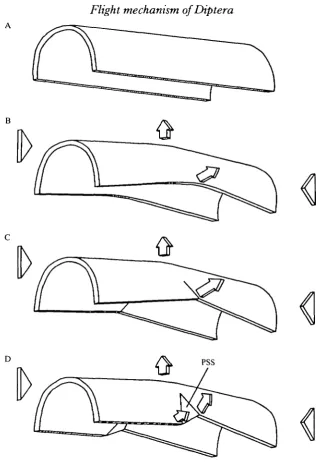
The thorax of Panorpa (Ferris & Rees, 1939) is essentially a cuboidal box. The indirect muscles are arranged approximately at right angles, the dorsal longitudinal muscles inserting on the prescutum and postnotum are essentially horizontal, the dorsoventral muscles inserting on the scutum and sternum being vertical. If the dorsal longitudinal muscles contract, the prescutum and postnotum will be drawn together. The scutum, essentially a dome of cuticle, will be arched upwards to a greater extent and also splay outwards (Fig. 3B) due to the interaction of arching that occurs between two planes at right angles. Contraction of the dorsoventral muscles will pull the scutum down and also result in the lateral walls being drawn in. The motion is localized at the wing base, since the scutum is flattest and hence most compliant at this point.
The thoracic box of Tipula paludosa (Fig. 4) is more elongate and more like a parallelogram in side view (Fig. 5), although the rear and dorsal surfaces are more-or-less continuous. The dorsal longitudinal muscles are at a slight angle to the vertical, being attached anteriorly largely to the prescutum. Their contraction will shear the box, more directly causing scutal arching, and again resulting in outward movement of the lateral scutum (Fig. 5A). Contraction of the dorsovental muscles will cause the opposite movement, drawing the lateral scutum down and in (Fig. 5B). Movement is localized by the flexion line provided by the tergal fissure, separating the scutellar lever from the incipient parascutal shelf (Fig. 3C), although this is incompletely differentiated from the rest of the lateral scutum (Matsuda, 1970).
The thoracic box of Calliphora is squarer in side view (Fig. 6), but the muscles are arranged in a similar way to those of Tipula. The dorsal longitudinal muscles shearing the box will therefore cause the ventral thorax to move mainly forwards relative to the scutum. Relative movement between the scutum and pleural wall is therefore at a greater angle to the vertical. Movement is facilitated and localized by
two flexion lines (Fig. 3D), the tergal fissure and the hinge of the parascutal sheUj
Flight mechanism of Diptera
363
Fig. 3. Schematic diagram of downstroke distortion in the scutum of study insects. (A) Before the downstroke; (B) Panorpa. Inward pressure at the end causes the walls to buckle outwards. (C) Tipula. Distortion is localized by a flexion line. (D) Calliphora. Two flexion lines localize distortion forming a parascutal shelf (PSS).
the relative movement of the scutum and pleural wall. The dorsal longitudinal muscles will provide increased scutal arching, localized at the scutoscutellar border and resulting in outward splaying of the tergal fissure. The dorsoventral muscles will
364
Scutum
Prothorax
\ \ \
Fig. 4. The thorax of Tipula paludosa, lateral view with wing and axillary sclerites removed. Note the tergal fissure in the lateral scutum and the stroke plane.
The wing articulation
The wing articulation of the species studied is essentially similar to that of Glossina
morsitans described by Miyan & Ewing (1985a). The hinge between the scutum and
pleural wall is formed by the two axillary sclerites Ax 1 and Ax 2. Ax 1 articulates with the scutum, across the tergal fissure where that is present, at two points: the antemedian and postmedian notal processes (Fig. 7). It is therefore free to rotate only about these points, approximately parallel to the tergal fissure when that is present; and in Panorpa in a vertical plane.
In no fly examined, therefore, could the medial arm (anterior ventral) of Ax 1 be manipulated so that it could contact the parascutal shelf, an essential feature of the model of Miyan & Ewing.
Ax 2 is an L-shaped sclerite. The short arm is held between the two dorsal arms of Ax 1, the long arm extending laterally in the plane of rotation of Ax 1. The distal end is then attached by an anteriorly directed prong to unsclerotized tissue on the pleural wall just below the pleural wing process, forming a strong universal joint.
Flight mechanism ofDiptera
365DLM
[image:11.451.33.393.60.271.2](ii)
Fig. 5. Diagrammatic representation of the thorax of Tipula paludosa. (A) After contraction of the dorsal longitudinal muscles (DLM); (B) after contraction of the dorsoventral muscles (DVM I—III); (i) longitudinal section; (ii) transverse section. Note the changes in the arching of the scutum in both planes.
Tergal fissure
Stroke plane
Head
Scutellum
Postnotum
Haltere
1 mm
Legs
[image:11.451.42.387.335.597.2]366
Tergal fissure
PWP
Ax i
l l H I m n
Fig. 7. The wing articulation of Tipula paludosa, lateral view. Note the two pivot points of the first axillary sclerite (Ax 1) on the lateral scutum and the single pivot of the second axillary sclerite (Ax 2) on the pleural wall. PWP, pleural wing process.
The wing base is attached to the sclerite assembly (Fig. 8), the tip of the radius being connected to the anterior dorsal arm of Ax 1 via the basiradiale, while Ax 2 connects along the rear of the basiradiale. Rotation of the sclerites will therefore cause wing translation in the same plane. In all the species examined, however, the joint between the radius and basiradiale is incompletely sclerotized: longitudinal hinges along the anterior and posterior margins increase torsional compliance without reducing bending stiffness. Passive basal twisting of the radius is therefore possible, so Ax 1 and Ax 2 do not control the angle of attack.
In all the species studied the limit to wing depression is set by contact of the radial stop (Miyan & Ewing, 1985a,b), a heavily sclerotized projection of the ventral subcosta with elements of the pleural wall. In Panorpa it contacts a dorsal sclero-tization of the basalar sclerite, homologous with the 'pterale c' of Ritter (1911). In
Tipula a cup formed by the basalar sclerite and the pleural wing process provides the
Flight mechanism ofDiptera
367Basiradialc
Costa
[image:13.451.54.373.37.357.2]Anterior
Fig. 8. The wing base of Tipula paludosa, dorsal view. Note the lines of weakness at the base of the radius and the position of the third axillary sclerite (Ax 3). Lying between the median plate and the posterior arm of the first axillary sclerite (Ax 1) it stops pronation a few degrees below the horizontal.
DISCUSSION
Neither existing model for the wingbeat was fully supported by my results. The events of flight under CCI4 anaesthesia in which a click action is observed are quite different from those observed directly in unanaesthetized, tethered flight. The universal presence of a radial stop which contacts the pleural wall when the wing is just below horizontal (Miyan & Ewing, 1985a,b) is also inconsistent with the model of Boettiger & Furshpan (1952) (Fig. 1).
The events described by Pfau (1973, 1977, 1985) were never observed in tethered flight of Calliphora, although the state of contraction of direct muscles was unknown. In two respects the results were also inconsistent with the model of Miyan & Ewing. First, the rotation of the parascutal shelf during the downstroke which was observed in tethered flight was upwards around the medial hinge. This is the opposite direction from that depicted in the model of Miyan & Ewing. Second, in none of the insects studied was it possible for the medial arm of Ax 1 to contact the parascutal shelf, an event central to their model.
Fig. 9. The novel model of the wingbeat. A transverse section along the tergal fissure. (A) Downstroke. The lateral scutum moves dorsolaterally, and the movement is converted into downward wing motion. (B) End of downstroke as the radial stop (RS) contacts the pleural wing process (PWP). (C) The upstroke, powered by the dorsoventral muscles. Note the reaction forces on the pleural wall. Ax 1, Ax 2, first and second axillary sclentes.
position is inhibited. Energy is stored in the middle of each stroke as the scutum is forced inwards and the pleural wall forced outwards (Fig. 1). The scutal spring is tensioned by the outward force produced in the lateral scutum by the contraction of both sets of indirect muscles.
Analysis of the distortions of the dorsal thoracic dome of the study insects (Fig. 3) has shown, however, that although the dorsal longitudinal muscles cause outward movements of the lateral regions during the downstroke, during the upstroke the dorsoventral muscles will cause the lateral scutum to move inwards. In Tipula and especially Calliphora the movements are localized by flexion lines but all lateral areas will experience these inward and outward forces. The notum is clearly not tensioned in the manner stated by Boettiger & Furshpan.
Flight mechanism ofDiptera
369schematic diagrams of earlier models depict the parascutal shelf moving parallel to the wing, whereas in reality it moves largely at right angles to it. The diagrams also omit the scutellar lever, which surely has a structural role. Consideration of the entire scutum (Fig. 3D) shows that movements of the rather weak parascutal shelf merely reflect the extent of scutal distortion rather than control it. No special significance should therefore be attached to its exact orientation.
I therefore propose a novel model of the dipteran wingbeat based on the distortion of the whole thorax, especially the scutum. The model is drawn in Fig. 9, which shows a transverse section of a thorax cut along the tergal fissure, and through the plane of motion of the axillary sclerites.
The downstroke is caused by contraction of the dorsal longitudinal muscles which shorten the thorax (Panorpa) or shear it (Diptera), so increasing longitudinal arching of the scutum. As a result the lateral arching of the scutum is decreased and the lateral scutum moves upwards and outwards so forcing the wing down (Fig. 9A). Wing depression proceeds until the radial stop makes contact with the pleural wall (Fig. 9B). Further wing depression involves rotation around the fulcrum of the radial stop (Miyan & Ewing, 1985a,b) and hence inward bending of the stiff pleural wall. There will be high deceleration and elastic strain energy may be stored in the pleural wall as well as in the rest of the distorted thorax and in the lengthening dorsoventral muscles.
The upstroke is then powered by the contraction of the dorsoventral muscles and by elastic recoil. The scutum is drawn downwards and inwards and the wing raised (Fig. 9C). The wing will be decelerated at the top of the stroke as the thorax is distorted from its rest position and as the mass of the dorsal longitudinal muscles (usually larger than the dorsoventral muscles) is stretched.
The movements of the pleural wall during the wingbeat are predicted well by this model. Records taken by Boettiger (1957) (Fig. 10) show that throughout most of the downstroke the pleural wall moves outwards, which it must do to provide the
Wing up
[image:15.451.114.337.453.594.2]Wing down
couple that lowers the wing (Fig. 9A). At the end of the stroke, however, when the radial stop contacts the pleural wall there will be a large inward force at the articulation with Ax 2 as the wing is decelerated (Fig. 9B). The pleural wall will thus be forced in. At the start of the upstroke it will initially recoil outwards and then as the top of the articulation is drawn inwards, so the pleural wall will be drawn in until it provides the couple needed to raise the wing (Fig. 9C). Boettiger (1957) also recorded similar movements in the pleural wall of the wasp Polistes in which no click mechanism was found.
The large angular rotations of the wing base sclerites said to cause angle of attack changes (Boettiger & Furshpan, 1952) were not observed in tethered flight. Neither were the movements of Ax 4 postulated by Miyan & Ewing (1985a). I propose that the changes in angle of attack are largely passive. As a result of the basal weakenings of the radius described above the wing can twist fairly easily at its base away from its rest position which is approximately horizontal. Torsion tests on freshly killed insects show that the wing may be supinated to about 100° above horizontal, the restoring couple being proportional to angular deflection. Pronation, however, is stopped a few degrees below horizontal as the third axillary sclerite prevents the rear of the radius from rising (Fig. 8).
Air pressure acts behind the centre of torsion (Wootton, 1981) and so will pronate the wing up to the limit set by Ax 3 during the downstroke. As the wing is decelerated at the end of the downstroke three factors will cause it to be supinated. (1) The aerodynamic force and so the torque keeping the wing pronated will disappear. The elastic recoil of the wing will thus be able to initiate supination. (2) Since the centre of mass of the wing is also behind the torsional axis (Wootton, 1981; Ellington, 1984a) the wing inertia will also cause a couple supinating the wing. (3) Wing deceleration is largely caused by contact of the radial stop with the pleural wall. The radial stop is anterior to the basal articulation of the radius so the resulting reaction force may cause a moment about the wing base that will aid supination.
Elastic strain energy will be stored in the radius, which is twisted away from its rest position, and the wing is kept supinated during the upstroke again by the air pressure acting behind the torsional axis. The films of Tipula taken by Ellington (1984a) show a slight recoil after supination, probably due to wing inertia carrying the wing beyond its equilibrium upstroke angle of attack.
Pronation occurs at the end of the upstroke by the elastic recoil and inertial mechanisms outlined in (1) and (2) above.
Although calculations reveal that the observed patterns of wing rotation may be accounted for by the above mechanisms, the basic pattern may be altered for manoeuvres by changing the level of tonic contractions in wing base muscles such as those of Ax 3 and Ax 4.
Evolutionary development of the mechanism
Flight mechanism ofDiptera 371
vertical. The previous models, based largely on consideration of advanced flies, are not applicable to flies which do not possess well-differentiated scutal regions.
Panorpa seems to have the most primitive pattern of the insects studied. Both
thoracic segments are cuboidal and contract and elongate to distort the scutum. Scutal distortion is localized at the wing base only by its shape, the scutum being laterally flattest at this point.
In Tipula the mechanism seems to have been developed to a greater extent. The scutum is more directly distorted by the dorsal longitudinal muscles and the movement is localized at the wing base by the flexion line of the tergal fissure (Fig. 3C). There is even incipient differentiation of the parascutal shelf.
In Calliphora, in most higher flies, and in the family Bibionidae the parascutal shelf is completely differentiated and the hinge with the lateral scutum forms a further flexion line (Fig. 3D). This results in even greater localization of scutal distortion, with greatly reduced movement of the anterior scutum, allowing the precise movements of the articulation seen in higher flies.
The thoracic box of Calliphora is squarer than that of Tipula and, as a result, when the thorax is sheared the relative movement of dorsal and ventral thorax will be more horizontal. The result is a more oblique stroke plane, as the wing articulation is between these two regions. The advantage of such a stroke plane would be that an insect in forward flight would be able to hold its body more horizontal and so be better streamlined. The flexion lines in the scutum in such flies are also more oblique and so the tergal fissure remains parallel to the stroke plane.
A further sophistication possessed by Calliphora and by many calyptrate flies is the presence of two grooves in the pleural wing process into which the radial stop may locate (Pfau, 1973). In tethered flight the radial stop was always observed to move into the anterior ventral groove. It is possible that the posterior dorsal stop is only used when great wingbeat asymmetry is required to effect the sudden turns charac-teristic of bluebottles. Several turns accompanied by unilateral low-amplitude wingbeats have been recorded on high-speed films of free flight.
Finally, Calliphora and many other flies possess transverse flexion lines near the wing base which allow ventral flexion at the end of the downstroke (Wootton, 1981; Miyan & Ewing, 1985a,b). These may help store energy at this point and reduce stress at the wing articulation.
I thank Dr R. J. Wootton for his help and criticism in the production of the manuscript. The work was carried out under tenure of an SERC research studentship.
REFERENCES
ALEXANDER, R. M C N . (1982). Locomotion of Animals. London: Blackie & Son.
BOETTIGER, E. G. (1957). The machinery of insect flight. In Recent Advances in Invertebrate
Physiology (ed. B. T . Scheer), pp. 117-142. University of Oregon Publications.
BOETTIGER, E. G. & FURSHPAN, E. (1950). Observations on the flight motor of Diptera. Biol.
BOETTIGER, E. G. & FURSHPAN, E. (1951). Observations on the flight motor of Diptera. Fedn
Proc. Fedn Am. Socs exp. Biol. 10, 17.
BOETTIGER, E. G. & FURSHPAN, E. (1952). The mechanics of flight movements in Diptera. Biol.
Bull. mar. biol. Lab., Woods Hole 102, 200-211.
E L L I N G T O N , C . P . (1984a). T h e aerodynamics of hovering insect flight. III. K i n e m a t i c s . Phil. Trans. R. Soc. Ser. B 305, 41-78.
ELLINGTON, C. P. (19846). The aerodynamics of hovering insect flight. VI. Lift and power requirements. Phil. Trans. R. Soc. Ser. B 305, 145-181.
FERRIS, G. F. & REES, B. E. (1939). The morphology of Panorpa nuptialis Gerstaecker (Mercoptera: Panorpidae). Microentomology 4, 79-108.
MACHIN, K. E. & PRINGLE, J. W. S. (1960). The physiology of insect fibrillar muscle. III. The effect of sinusoidal changes of length on a beetle flight muscle. Proc. R. Soc. B 152, 311-330. MATSUDA, R. (1970). Morphology and Evolution of the Insect Thorax. The Entomological Society
of Canada.
MIYAN, J. A. & EWING, A. W. (1984). A wing synchronous receptor for the dipteran flight motor.
J. Insect Physiol. 30, 567-574.
MIYAN, J. A. & EWING, A. W. (1985a). How Diptera move their wings: a re-examination of the wing base articulation and muscle systems concerned with flight. Phil. Trans. R. Soc. Ser. B 311, 271-302.
MIYAN, J. A. & EWING, A. W. (19856). Is the 'click' mechanism of dipteran flight an artefact of CC14 anaesthesia? J . exp. Biol. 116, 313-322.
NACHTIGALL, W. (1966). Die Kinematikder Schlagflugelbewegungen von Dipteren. Methodische und Analytische Grundlagen zur Biophysik des Insektenflugs. Z. vergl. Physiol. 52, 155-211. NACHTIGALL, W. & WILSON, D. M. (1967). Neuro-muscular control of dipteran flight. J. exp. Biol.
47, 77-97.
PFAU, H. K. (1973). Fliegt unsere Schmeissfliege mit Gangschaltung? Naturwissenschaften 60, 160.
PFAU, H. K. (1977). Funktion einiger direkter, tonischer Flugelmuskeln von Calliphora
erythro-cephala Meig. Verh. dt. zool. Ges. 70, 275.
PFAU, H. K. (1985). Zur funktionellen und phylogenetischen Bedeutung der "Gangschaltung" der Fliegen. Verh. dt. zool. Ges. 78, 168.
PRINGLE, J. W. S. (1957). Insect Flight. Cambridge: Cambridge University Press.
PRINGLE, J. W. S. (1962). Wing Mechanism of the Bee. Animated film. Mcqueen Film Organisation Ltd.
PRINGLE, J. W. S. (1968). Comparative physiology of the flight motor. Adv. Insect Physiol. 5, 163-227.
PRINGLE, J. W. S. (1981). The evolution of fibrillar muscle in insects. J . exp. Biol. 94, 1-14. RTTTER, W. (1911). The flying apparatus of the blow-fly. Smithson. misc. Collns 56, 1-79. UNWIN, D. M. & CORBET, S. A. (1984). Wingbeat frequency, temperature and body size in bees
and flies. Physiol. Entomol. 9, 115-121.
WEIS-FOGH, T . (1973). Quick estimates for flight fitness in hovering animals, including novel mechanisms for lift production.^, exp. Biol. 59, 169-230.
WISSER, A. & NACHTIGALL, W. (1983). Funktionelle Gelenkmorphologie und Flugelantrieb bei der Schmeissfliege. In Biona-Report I (ed. W. Nachtigall), pp. 29-34. Akad. Wiss. Mainz. Stuttgart, New York: G. Fischer.