1
Master Thesis
Designing a tool for norm interventions in IT strategy projects
J.J.M. van Dalen
Master Business & IT
University of Twente
(08-06-2011)
Master Thesis:
2
Master thesis Jeroen van Dalen
Restricted version
This version of this thesis is restricted and does contain confidential chapters
Utrecht, 8th of June 2011
Author
Author: J.J.M. van Dalen Student number: s0117854
Study: Master Business Information Technology
E-mail: [email protected]
Graduation Committee
Dr. Klaas Sikkel
Department: Information systems group
Faculty: Electical Engineering, Mathematics and Computer Science University of Twente
Dr. Ir. Christiaan Katsma
Department: ERP Implmentation and organizational change Faculty: Management and Governance
Univeristy of Twente
Supervisor
Sandra van der Hulst (MSc)
Consultant
3
S
UMMARYChanging an IT strategy, actually executing an IT strategy, can be problematic. Many IT strategies are developed but never executed. This same problem is likely to hold up in other project activities were planning and execution is separated in time. Typically, a consultancy firm helps a client to develop an IT strategy. Once the IT strategy is put on paper, the client chooses to implement it. Subsequently, the client often fails in implementing the developed strategy. A substantial part of this failure can be attributed to behavioral aspects.
One could argue, to increase the success rate, we have to intervene in such a way that we can influence the behavior of the people executing the strategy. Behavior can be changed in multiple ways. A method which is not regularly used in business is the use of social norms. Social norms are social rules that guide human behavior. As it turns out, social norms can be used to influence behavior over a longer period of time. There are some difficulties with social norm interventions. The social norm interventions are unknown to consultants. Further, social norms can backfire when used in the wrong situations. In this thesis, a tool has been developed which uses social norms to increase the success of implementing IT strategies.
Literature on social norm interventions, expert interviews and cases are used to build and validate the tool. The final tool exists of four steps:
Step 1: Determine the target behavior. Which behavior is targeted by the intervention? Some behaviors are stronger effected by norm interventions than others. Also, the behavior must impact the IT strategy project as well. For example the Key Success Factors of the project. Taking into account this kind of variables, the first step is determining the behavior that should be changed. After step 1, it is known which norm and which behavior are being targeted.
Step 2: Determine the current situation. Every situation is unique. For each situation a
different norm intervention is useful. In step 2 a questionnaire is used to determine the current situation. The questionnaire measures the current norms in the situations. The result of step 2 is a better understanding of the situation.
4
Step 4: Execute the interventions. In this step it is explained how interventions have to be executed. Many interventions involve sending a message to people involved in the IT strategy project. This message contains a norm of some sort. For example: “80% of the people in this company collaborate with another department on a weekly basis”. Interventions have to be adjusted for each setting. The information collected in step two has to be used to fine-tune an intervention. Further, based on the result of the execution the intervention has to be repeated. Together, these four steps form a guide to successfully execute a norm intervention. Based on the discussions, literature and cases, other conclusions are made as well:
The knowledge on social norm interventions is both welcome and practical from a business perspective
Social norms play an important role in IT strategy settings
There are three variables (subjective norm, descriptive norm and actual performance) which can be used to determine for a situation which norm interventions are most suitable
These variables can be put into a mapping, with good practical value, that is easy to use for consultants, that helps to quickly determine which social norm intervention is suitable in a given situation. The mapping also proves to be sufficiently valid to consider in academic use.
The mapping has limitations, and noninvolved users should use the mapping with caution
There are some limitations of this study.
The methods that are used are good for initial investigation only
Validating the effect of the tool on IT strategy success is to be determined by experts. The tool is not actually used in any IT strategy situation.
The first step of the tool has not been properly validated.
The mapping is only validated for “archetypical” situations. The marginal cases are unknown and unclear.
There has been scarce investigation about the generalizability of the findings.
5
Contents
1. Introduction ... 7
2. Academic background, relevance and definition of key concepts ... 9
2.1. The IT strategy context and defining IT strategy ... 9
2.2. The problem of IT strategy ... 10
2.3. Social norm interventions as a solution for the problems in IT strategy ... 11
1.1. Social influence further described ... 13
3. Method & structure ... 15
3.1. The structure of this thesis... 15
3.2. Method for each research question ... 17
4. The latest insights on social Norms ... 20
4.1. Social norms are important determinants of a wide range of behavior ... 20
4.2. The three types of norms ... 22
4.3. Subjective norm ... 23
4.4. Injunctive norm ... 24
4.5. Descriptive norm ... 26
4.6. Conclusion ... 27
5. Some norms are relevant for IT strategy projects ... 28
5.1. Descriptive norms seem most relevant to IT strategy projects ... 28
5.2. Four questions that help find relevant norms in IT strategy projects ... 30
5.3. Conclusion ... 32
6. Application of norm interventions to influence behavior ... 33
6.1. Social norm Interventions typically have an effect size of 20% ... 33
6.2. Seven social norm interventions ... 34
6.3. Design choices ... 38
6.4. Conclusion ... 39
7. Which IT strategy situation requires which norm interventions? ... 40
7.1. The resulting three variables which determine the right intervention ... 40
6
7.3. Improving the mapping ... 43
7.4. Conclusion ... 47
8. Measure the current situation to determine the most suitable norm intervention ... 49
8.1. The final result: The questionnaire ... 49
8.2. Built on existing questionnaires ... 50
8.3. Statistically testing the questionnaire ... 51
8.4. Minimize biases in questionnaire ... 55
8.5. Design choices ... 56
8.6. Conclusion ... 57
9. Validation of the tool ... 58
9.1. Testing with a simple case ... 59
9.2. Two Cases with an expert on Norm Interventions ... 60
9.3. Testing with IT strategy consultants ... 63
9.4. Conclusions... 64
10. Final Conclusions ... 65
10.1. Findings ... 65
10.2. Limitations ... 67
10.3. Further research ... 69
10.4. Implications of the results ... 70
Acknowledgements ... 72
Literature ... 73
Appendix 1: Version one of the tool ... 77
Appendix 2: Final version of the tool ... 79
Appendix 3: Final Version Questionnaire ... 82
Appendix 4: Determining the variables which determine the choice of intervention ... 83
Appendix 5: Description case studies KPMG consultants ... 89
7
1.
I
NTRODUCTION“Are you influenced by what your friends do or buy?”, this is a question I often ask when I am asked to introduce my thesis. The answer is mostly the same:
“No, I’m not”
or
“Not really, but my friends are”.
Most people think they are only marginally influenced by what others do. People tend to attribute their behavior fully to themselves and not to the situation or to external influences. After reading this thesis you know this is not true, it is a misperception. You will see that social norms influence almost everybody’s behavior in any setting and in a much more covert and powerful ways than we imagine. You will also find that social norm interventions can be a good tool to change behavior in organizational settings. There are some difficulties though: some aspects of behavior are easier to change than others and some social norm interventions are perfect in one situation but dangerous in others. If these interventions are used wrongly, they may have the opposite effect of what is desired.
How did I get to this conclusion and why is it relevant? In September 2010 I arrived for the first time at KPMG in the IT strategy division. This would be the office I would spend the next 7 months working on my thesis. At that moment, I did not have a subject for my thesis and was looking for a good topic. That first day I spend speaking with a lot of different people; most conversations were just nice and polite conversations. Then I overheard a conversation of someone who would leave KPMG within a week. My curiosity was spiked, why would this person leave? Was the pay bad, or did he dislike the people? The answers I came up with felt unsatisfactory. Luckily the answer came soon, as I met him during a coffee break. Carefully I tried to lead the conversation to the reason for him leaving the company. While reluctant at first, after a while he looked at me rather sad and started telling:
“About 1,5 years ago I did a consulting job, I had to advise on a project. I worked really hard and the end result was promising. We gave a presentation to the board of directors of that company and did a workshop with all key players of the project to get
involvement and backing for the project. About a year later, the same company called us to solve a problem. After a day it became apparent that this was the same problem as the year before, and they just didn’t or couldn’t implement the solution we had
presented. This happens a lot you know, our solutions just end up not being
8 I was puzzled at first, how could a company spend money on hiring consultants and then do nothing with the solution that was provided? Was this just incidental, or was it common? After talking to more people, it became clear that this is a major problem in consulting. Many advices end up being just that: advice. No action is taken once the advice is handed over. Why does this happen? After a short while it dawned on me that I actually knew part of the answer from another experience I have. I perform coaching for people who want to improve their social skills, and I try to help people change their behavior. Although these people are highly
motivated, just telling them what to do does not work. The advice just ends up being advice, no action is taken. Old habits, friends, and fears prevent them from changing. In order to bring about change in these people all these aspects have to change first! Only with the combination of change in environment, emotion and rational thought, change can be realized.
Would the same mechanism apply for large consulting firms? This question is too complicated to answer fully in this master thesis. I knew from experience that people can have a major influence on each other’s behavior; this is backed up by research as there is a large body of research on the effects of social norms on behavior. This led me to the question: Can social norms help to solve the problem of implementing an advice in a corporate setting? Eventually I looked into a more practical and specific version of this question. I looked into building a tool that can be used in IT strategy settings to partially solve the implementation problem of IT strategy. In the next chapters, the tool that I developed is presented. This tool can be used by consultants to select which norms should be changed and select which norm interventions are most useful in their IT strategy situation. Ultimately, the tool is developed to change norms and behavior in IT strategy projects which should results in better implementation of this IT
strategy.
9
2.
A
CADEMIC BACKGROUND,
RELEVANCE AND DEFINITION OF KEY CONCEPTS2.1.
T
HEIT
STRATEGY CONTEXT AND DEFININGIT
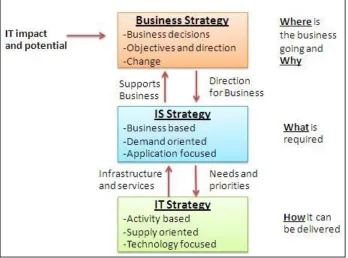
STRATEGY [image:9.612.73.421.329.587.2]The context of this thesis can be described as “IT strategy development setting with client and consultant”. What IT strategy is can be described by describing its relationship to a business strategy. A business strategy is supported by an IS strategy and the business provides directions for the IS strategy. Based on this IS strategy an IT strategy is developed. Ward and Peppard explain it as follows: “There is an IS component and an IT component. The IS strategy defines the organization’s requirement or demand for information and systems to support the overall strategy of the business; it is firmly grounded in the business, taking into consideration the competitive impact and alignment requirements of IS. (…) The IT strategy is concerned with outlining the vision of how the organizations demand for information and systems will be supported by technology – essentially it is concerned with IT supply.“ Ward and Peppard show the relationship between strategy, IS strategy and IT strategy in the following diagram:
FIGURE 1: WARD AND PEPPARD DESCRIBE RELATION BETWEEN BUSINESS, IT AND IT STRATEGY
10 competitive impact of IT while the central concern of the practitioners was in delivering friction-free and cost-effective IT services to business”(Teubner 2007).
Further, in academia, a related process is researched, which is called the process of strategic information system planning. Although Ward and Peppard have written extensively on SISP, some authors argue that our understanding of information system strategy is still blurred. The process of strategic information system planning (SISP) results in an information system strategy (ISS). The information system strategy (ISS) is considered to be the same as an IT strategy(Teubner 2007). The concept of IT strategy or ISS has been widely neglected in research: “In a survey of 137 SISP related articles published between 1991 and 2004 Brown identified that only one fourth of all articles are concerned with ISS in one way or another.” They continue: “the concept of information systems strategy is … blurred”.
In this thesis the explanation of Ward and Peppard, is used to define IT strategy. While taking into account that in business and academics disagree on what it actually means.
2.2.
T
HE PROBLEM OFIT
STRATEGYThe case of interest to this thesis is the process of developing and executing an IT strategy process. It is argued in this section that the step from IT strategy to IT strategy execution is a difficult one and often causes problems.
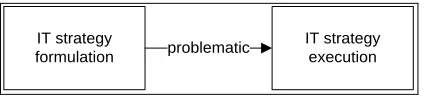
Getting a good IT strategy seems difficult. Often, the first step is developing the IT strategy plan, and many companies seek assistance from consulting firms to help develop their IT strategy (Robinson 1982; Schraeder 2002). After the strategy has been formulated, the strategy has to be implemented or executed. This is also been called “making the strategy work”. Often, this is problematic. This is schematically descriptive in figure 2.
IT strategy formulation
[image:10.612.72.284.500.549.2]IT strategy execution problematic
FIGURE 2: VISUALIZING THE PROBLEM SITUATION
Wilma van ‘t Kruijs (Kruijs 2010) describes in her book about (none IT) strategy implementation, that strategy implementation is a very common problem. She explains that plans are made, but executing them is difficult. Then she argues that this happens often, and she is not the only one. These problems have been known to many consultants at some of the large ‘big four’
11 The same problem can also be described by looking at the consulting process. The work of a consultant can be described as a process; the process is shown in figure 3. This version of the process based on the work of Vrakking, but other authors use similar process steps(Kurpius, Fuqua et al. 1993).
Diagnose phase Change strategy Implementation
Acquisition phase Design and
development Use
FIGURE 3: THE CONSULTING PROCESS
For the design and development phase consultants are often hired. Many clients choose to continue on their own from this phase onwards. This is the phase where the consultant typically gives a presentation of the strategy to the client, and the client wants to pick up the project from then on. Consultants argue that this transition is an important but difficult phase. It seems that clients sometimes have trouble starting the next phases after the consultants have done their job. The focus of this thesis will be exactly this transition. The “getting to execution” phase.
2.3.
S
OCIAL NORM INTERVENTIONS AS A SOLUTION FOR THE PROBLEMS INIT
STRATEGY
One of the solutions for the problem at hand might be the use of social norms. Since part of the problem is a behavior problem, and behavior is influenced by social norms, social norms might be part of the solution. Social norms prove a strong predictor of behavior for a great variety of behaviors. In the next section we will argue that social norms are also relevant in the context of IT strategy even though social norms are not often discussed in the context of IT strategy or IT strategy implementation.
12 can feel that aspects such as norms, or peer pressure are relevant in most organizational
settings. Although there is little direct evidence, some authors in related fields such as strategic planning and organizational development argue that social norms are relevant.
Long Range Planning, a journal about strategy and strategic planning. The journal clearly shows the need and demand for further focus on a better understanding of the social and people aspect in strategic planning. For example, they state that “how people act and interact in the formulation and implementation of strategy is a highly relevant research topic”(Nordqvist and Melin 2008). In the same paper, Nordqvist refers to norms as an important aspect that a leader in strategic planning should take into account. Nordqvist is not alone in this view. A second paper argues that change of strategy should be accomplished via involving people, by codifying the change in the culture (Colville and Murphy 2006). Strategic change cannot be done
involving people. People are of key importance to change, and they need to be committed. As Harrington (Harrington 2004) noted: “It has become conventional wisdom that organizational members react more favorably and are more committed when they are involved in the change making”. In another paper it is argued that, top management, middle management and staff planning are important factors for strategic planning (Aldehayyat, Al Khattab et al. 2010). These people factors make or break the strategic planning. In strategy, people and thus norms are important.
Furthermore, a KPMG IT project manager stated the following when we were discussing the topic: “De relatie tussen sociale druk en de performance van IT-projecten is een interessant aspect en blijft in project- en programmamethodiek vaak onderbelicht. En dat terwijl je in een project in een snelkookpan een soort ‘afdelingscultuur’ neerzet met eigen normen binnen de muren van het project. Is de cultuur door de projectleiding te beïnvloeden? Hoe belangrijk is voorbeeldgedrag? Wat zijn de consequenties als je projectmedewerkers bij elkaar op één kamer te zet of juist op afstand van elkaar laat werken? Kortom: ik vind je onderzoek erg interessant en relevant.” Based on experience, he expresses the importance of social norms in (IT) strategy settings.
Beside the fact that norms influence behavior, two aspects of norms make them a strong candidate for solving the IT strategy problem. The first aspect is that norms are universal, they apply to and work in almost any social situation and secondly, norms tend to be stable over time.
13 human brain. Such a universal, fundamental and instinctual aspect is a good aspect for any behavioral change, including one which is related to IT strategy projects.
Another reason why norms are a good candidate for improving IT strategy implementation is their stability. The interventions we are looking for in IT strategy projects have to have long term effects. It is not a behavior that needs to be executed once or changed for a short period, but the behavior must be changed for a long time. So, the stability of norms makes them a good candidate. If the norms can be changed, the results will most likely last for a longer term, and that is exactly what we are looking for.
1.1.
S
OCIAL INFLUENCE FURTHER DESCRIBEDSocial norms are well researched, and are seen as important predictors in a large range of broad and specific behaviors, including IT related behavior such as system use. System use is extensively researched and is seen as having an important correlation to social or subjective norm (Schepers and Wetzels 2006). Social norm is an important factor of the well-studied Theory of Planned Behavior (TPB); it has been tested in many fields and for many types of behavior and has a large influence on our behavior. Other aspects where relevance of social norms is found besides system use (Sykes, Venkatesh et al. 2009) are change management (Kotter 2000; Have, Have et al. 2010), IT usage (Huang and Chuang 2007), interpersonal influence (Cialdini 2007), and leadership (Brock and Green 2005). Finally, teams and projects are shown to be significantly influenced by team norms and group pressure (Taggar and Ellis 2007). These examples show some of the large body of evidence of the relevance of social influence in corporate, teams, projects and IT settings.
14 Another interesting aspect is social influence interventions. Social influence can be actively used by individual or organization to influence people’s behavior. A wide variety of behavior has been investigated by researchers to see the effect size of social influence interventions. Social influence interventions has been shown to effectively change behavior in the field of smoking (Putte, Yzer et al. 2004), alcohol (Haines and Spear 1996), obesity (Bennett 1986), environmental friendly behavior such as towel reuse in hotels[in press] and energy
15
3.
M
ETHOD&
STRUCTUREIn the prior chapter it has been argued that social norms show promising results in domains different from the ICT and implementation domain. This brings us to the main goal of this thesis:
”Design a tool that can be used in IT strategy projects to improve implementation success via social norm interventions”.
In the current chapter the method of developing the tool is presented. The section starts with the structure of this thesis. This is followed by the research questions and ends with the methodology for each of the parts of this thesis.
There are at least three problems when wanting to use social norm interventions. First, the knowledge about social norm intervention isn’t accessible. It is mostly found in academic literature, not in a way easily accessible for management. Secondly, the impact of a social norm intervention is dependent on the situation it is executed in. In the wrong situation, it might backfire or have a different result than expected. Therefore it is necessary to know which interventions are suitable in which situation. Thirdly, not any behavior can be changed by social norm interventions. Some behavior is more likely to be influenced by social norms than other. The tool which is developed should deal with these three problems, making social norm interventions more usable in practice.
This study is a design study. That seems appropriate in this case because there is a need for a practical tool. Much information is already available and this information now needs to be transformed into a tool. According to Wieringa, having a practical problem (Wieringa 2008) is a typical engineering driver, which allows for a design study. This means that the result of this thesis should yield a solution for a problem. It also means that it does not follow the steps of empirical research but instead of a design study. Such a design cycle follows four main steps: Problem investigation, Solution design, Solution validation and solution implementation (Wieringa 2008). In our case the solution design contains multiple components. For each of these components, the design cycle is followed. Therefore, there is one main design cycle; and within that design cycle are four sub-design cycles. In this study, the first three steps of the design cycle have been executed; the solution implementation was not possible within the span of this project.
The tool that has been developed exists of multiple parts, which will be discussed first separately. Next the tool is put together from these parts and discussed as a whole.
3.1.
T
HE STRUCTURE OF THIS THESIS16
Norms in IT strategy situations
Suitable interventions for IT
strategy
Mapping Questionnaire
Resulting tool
Conclusions Insights in norms
[image:16.612.76.401.66.377.2]Method & structure
FIGURE 4: THE STRUCTURE OF THIS THESIS
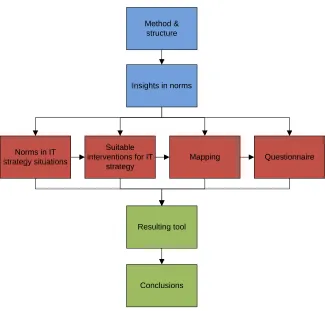
This thesis contains six parts and the conclusions. Each of these parts answers one of the following research questions:
1) What, according to literature, are the latest insights on social norms? 2) What norms are relevant for IT strategy?
3) Which norm interventions can be used to influence behavior? 4) Which intervention is suitable in which it strategy situation?
5) How to measure the current situation in order to determine which intervention is suitable? 6) How practical and valid is the tool?
The dependency of the research questions can be described as follows: In question 1 the literature of norms is presented. In question 2 it is determined which type of norms and what norms are relevant for IT strategy projects. In the third research question, based on the
17
3.2.
M
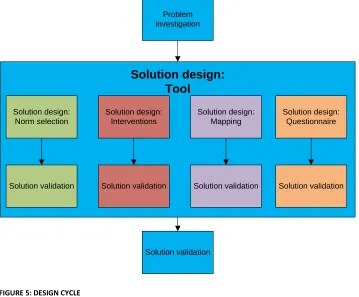
ETHOD FOR EACH RESEARCH QUESTIONIn order to properly answer each research question, the methodology for each of the questions is further explained. Globally, there is a literature chapter, followed by the four parts of the tool. Each of the parts is designed, and validated. This ensures high quality of each of the parts of the tool. Each part has its own validation. Then, the four parts are taken together, and are validated as a whole. This is represented in the figure below. Now, for each of the research questions, the methodology and the result of each question is discussed.
Solution design: Tool
Problem investigation
Solution design: Norm selection
Solution validation
Solution design: Interventions
Solution validation
Solution design: Mapping
Solution validation
Solution design: Questionnaire
Solution validation
[image:17.612.73.432.210.507.2]Solution validation
FIGURE 5: DESIGN CYCLE
3.2.1. WHAT, ACCORDING TO LITERATURE, ARE THE LATEST INSIGHTS ON SOCIAL NORMS?
This chapter is aimed to get more insight into social norms. A literature study is executed to do this.
3.2.2. WHAT NORMS ARE RELEVANT WITHIN IT STRATEGY?
18 The result is a step by step tool which helps determine which behavior and norms should be changed.
3.2.3. WHICH NORM INTERVENTIONS DOES LITERATURE SUGGEST CAN BE USED TO INFLUENCE BEHAVIOR?
The goal of this question is to come up with a list of relevant norm interventions that can be used in an IT strategy setting. The same reasoning and method is chosen as in the previous question; it was chosen to base the first research question on scientific theory. Here also another option would be to ask experts or a combination of theory and experts.
3.2.4. WHICH INTERVENTION IS SUITABLE IN WHICH IT STRATEGY SITUATION?
Some norm interventions work better in one situation than another. It is therefore useful to determine for each situation which norm intervention is most suitable. The result of this research question is a mapping.
We will base the initial mapping on literature and reasoning. Then the mapping is improved and validated by expert interviews on the proposed mapping. Experts are asked whether they think the mapping is correct and useful in the field. It is also asked what they consider as risks when using this kind of mappings and what they thought was missing. It is chosen to do an expert interview as there was no time to statistically prove the correctness of the mapping. Another reason is that the mapping should be practical and logical and not only be correct. An expert interview can help answer these subjective questions.
3.2.5. HOW TO MEASURE IN ORDER TO DETERMINE WHICH INTERVENTION IS SUITABLE?
The mapping that results from the last research question will contain variables. These variables such as “current performance” are used to determine which intervention is most suitable. In order to use the tool, a consultant should have a way to measure these variables in their specific situation. As it will be further explained in the chapter itself, a questionnaire turns out to be most suitable.
The questionnaire can be tested in multiple ways. The first method of testing can be a construct validity test. This determines if the constructs used (such as current performance) are useable, i.e. are we measuring what we think we are measuring. Because the questionnaires are based on existing questionnaires it is chosen to assume the correctness of the construct validity. A second aspect can be internal validity. We have chosen to validate the internal validity of the questionnaire by testing it in two cases. An easy and frequently used statistical tool for determining statistical validity is a Chronbach Alpha test. Further details on this test can be found in the corresponding chapter.
19 3.2.6. HOW PRACTICAL AND VALID IS THE TOOL?
20
4.
T
HE LATEST INSIGHTS ON SOCIALN
ORMS4.1.
S
OCIAL NORMS ARE IMPORTANT DETERMINANTS OF A WIDE RANGE OF BEHAVIORSocial norms are a sub component of social influence. Social influence according to Lisa Rashotte: “Social
influence is defined as change in an individual’s thoughts, feelings, attitudes, or behaviors that result from
interaction with another individual or a group.” Social influence is thus also the change of any thought caused by any interaction. Norms are more specific: they are
triggered by similar thoughts and behavior of others. “Social norms are sets of beliefs about what other people are doing or what they approve or disapprove” (Cialdini and Trost 1998). Defining social norms is a good start but does not give any feeling about what social norms are or how they work. In order to get a better feeling for social norms and how they work, three scenarios will be described.
Scenario 1: dance event. Imagine yourself being at an event with loud music, but none of the people is dancing. It is considered ‘weird’ to start dancing now. The following images show how that can change with one dissident.
21
FIGURE 6: ILLUSTRATING NORMS: THE DANCING NORM
Scenario 2: working a bit longer. This happened to me during my internship.It is five o’clock and I like to go home. I could do some extra work but don’t really feel like it, and it is not really necessary to do so. I intended to leave, but then I overhear the following conversation between two colleagues. “Did you know that 80% of the people work over hours in our company?
Tonight I will stay half an hour extra too!” The other person answers with: “Yeah, I know, but the 20% are just a bunch of free riders, we do the hard work and go for the extra mile!” At that moment I decided that it was better to continue the work on my project. If my colleagues do it, so should I! In this situation, I felt a social pressure to stay at work.
Scenario 3: Stop using Hyves. I recently overheard a conversation in the train. It was between two girls who were about 20 years of age. One was trying to convince the other that she should stop using Hyves and start using Facebook, both quite similar websites for ‘managing’ your social life. None of the arguments seemed to work, until the pro-Facebook girl said: “But
22 Remember the last time you did something, because everybody was doing it? That is social norms at work. It is fair to say that social norms are everywhere, at work, during leisure, and among friends. Let’s now further dissect norms and see what they are made of.
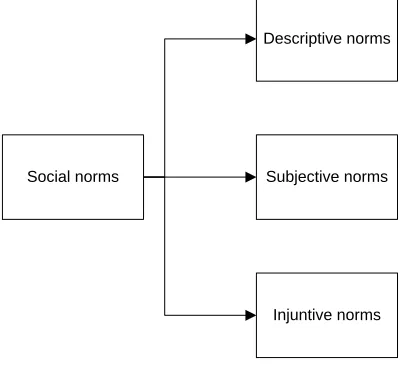
As it turns out, social norms are not atomic; there are many different types of social norms (Putte, Yzer et al. 2004).Three types of norms are found in literature: subjective, injunctive and descriptive norms (Klein 2005). It has been shown that the distinction between these three types is meaningful, as they are conceptually different as can be shown with statistical analysis.
Social norms
Descriptive norms
Subjective norms
Injuntive norms
[image:22.612.74.275.213.396.2]FIGURE 7: SOCIAL INFLUENCE
We will now discuss each of these types of social influence further. For each element a
definition will be given and their (sometimes complex) relation with behavior is described. Also we will list examples of behaviors related to that element.
4.2.
T
HE THREE TYPES OF NORMSIn the next sections the three types of social norms are described in detail and a first overall conclusion is presented. The concepts subjective norm, injunctive norm and descriptive norm are adequate predictors of behavioral intention and behavior. They predict between 10% and 40% of the variance in behavior. For most types of behavior a significant relation between social norms and behavior has been found. Table 1 summarizes the definitions of the three types of norms.
Social influence Definition Example
Subjective norm
an individual's perception of social normative pressures, of relevant others' beliefs that he or she is expected to perform such behavior
My friend groups consider working for a consultant a good thing
Injunctive norm social pressures to engage in a behavior based on the perception of what other people want you to
23 do
Descriptive norm
the perception of the quantity and frequency of others performing a behavior
Seeing all your colleagues work on an IT Project
TABLE 1: THE THREE TYPES OF NORMS
4.3.
S
UBJECTIVE NORMSubjective norm can be defined as: “an individual's perception of social normative pressures of relevant others that he or she should perform such behavior” (Wikipedia 2011). A subjective norm can be: my friends consider smoking to be wrong. Another example of a subjective norm is: be quiet in the university library; it is ‘not done’ to speak loudly. Subjective norms are found in many social contexts and prescribe what behavior is expected from people.
Subjective norm has received major coverage in research. Subjective norm originated as part of a theory called “theory of planned behavior (TPB)”. This theory attempts to predict what behavior a person will perform. TPB has over 5000 citations in Scopus showing it is well
researched. The theory of planned behavior is considered to be a strong predictor of behavioral intention and behavior. The variance of TPB to behavior is 27% and to behavior intention 39%, according to a large meta review (Armitage and Conner 2001).
Within TPB, behavior is predicted by three variables, subjective norm is one of three variables. The aspect of subjective norm in the model of TBP is depicted in figure 8. In these studies subjective norm is found to be only a weak predictor of behavior according to the meta-analysis (Armitage and Conner 2001). In some studies, subjective norm is found to be a better predictor for behavior, with a variance of up to 30% (Schepers and Wetzels 2006). Subjective norm has been proven to be a reliable predictor of behavior but not a strong one. Thus, if it is socially acceptable to not smoke, then this has impact on actual behavior, but not a major one.
Subjective norm Behavioral
[image:23.612.73.415.509.556.2]intention Behavior
FIGURE 8: SUBJECTIVE NORM, BEHAVIOR LINK
Subjective norm is also used in the Technology Acceptance Model. TAM is based on TPB. TAM has the goal to make predictions in the use of technology. It is for example used to predict the amount of system use. In a meta-analysis study of TAM, large effect sizes are found for the correlation of subjective norm and behavioral intention(Schepers and Wetzels 2006).
24 Subjective norm has been found – in literature - to be connected to a wide range of behaviors; the list is longer than useful for this thesis or to grasp the range. Here follows a selection of the latest 15 papers when searching for “subjective norm” on Scopus (December 2010). The list does not stop at: system usage (King and He 2006), leaving Hong Kong (Abrams, Hinkle et al. 1999), sun related behavior (Bränström, Ullén et al. 2004), drinking (Haines and Spear 1996; Maddock and Glanz 2005; Hampson, Andrews et al. 2006), customer acceptance for an airline (Kim, Kim et al. 2009), job satisfaction (Lam, Baum et al. 2003), food & fruit (McGregor, Hoerr et al. 2001; O'Connor and White 2010) and mobile data services (Yang and Jolly 2009). Most behavior proves to be affected by subjective norm, but not all are.
A noteworthy correlation is found with normative commitment. There is a relationship with work absenteeism, job satisfaction, job performance, and employee well-being. This shows that normative influences have effect on various levels of organization behavior (Meyer, Stanley et al. 2002).
To summarize: subjective norms are extensively researched among a range of behaviors. It turns out to have a correlation to behavior and behavior intention in most cases but is insignificant in others. A direct relation to social norms and behavior within organizations is found, but as yet not for IT strategy.
4.4.
I
NJUNCTIVE NORMInjunctive norm has been described as: social pressure to engage in a behavior based on the perception of what other people want you to do (Klein 2005). There seems to be a close
resemblance with subjective norm. This may be caused by lack of consensus on the definitions. But some authors state that these are different concepts, as has been shown statistically (Klein 2005). Injunctive norms seem to be more society oriented, while subjective norms are more peer oriented. A useful example of an injunctive norm is that it is wrong to be drunk during daytime. Injunctive norms also have been researched in relationship with actual behavior and behavior intention, mostly also via the theory of planned behavior.
According to studies, Injunctive norm has a positive relation with behavior and behavioral intention. Thus, if people assume society judge drinking during daytime is wrong; people will be less likely to do that.
The strength of the link between injunctive norm and behavior is dependent on some other variables. In other words, injunctive norms are moderated by some factors; this is depicted in figure 9. One of these moderating factors is the descriptive norm. If injunctive norm is
25 norm [Manning 2009]. This means that the variance is determined by the descriptive norm, and there is little or no extra variance caused by the injunctive norm.
Injunctive norm
Moderator
[image:25.612.75.327.116.222.2]Behavior
FIGURE 9: VISUAL REPRESENTATION OF RELATION BETWEEN INJUNCTIVE NORM AND BEHAVIOR
The injunctive norm is also affected by other moderating variables. A moderator is a variable which impacts the relationship between two variables as depicted in figure 9. The following moderators have been well researched: compatibility of behavior and measured norm, time interval of SN and behavior, social approval of behavior, social motivation of action in behavior and utility of behavior (is it pleasant or useful). See table 2 for a definition of each of these moderators [Manning 2009].
Moderator Definition
Compatibility Is the measured norm compatible with the measured behavior? For example, a broad norm such as “following religious practices is good” and specific behavior such as “praying before dinner” have a smaller relation that specific norms “praying before dinner is good” and specific behavior “praying before dinner”. The latter is considered to be more compatible. Compatible norms are expected to have a stronger relationship with behavior.
Time interval The time between the measurement of the norm, and the measurement of the behavior.
Social approval
Is the behavior socially approved? Social
motivation
Some behavior is more socially motivated than others. For example a person who likes to be social at parties, might be socially motivated to drink, as opposed to drinking by yourself which is motivated by the taste and not by other people. Socially motivated behavior is expected to be more effected by the opinion (norm) of others.
Utility Is the behavior considered useful or pleasurable? Useful behavior is often more elaborated on, and therefore less likely to be influenced by others.
[image:25.612.66.547.393.656.2]26 According to a large Meta-analysis study the effects of the injunctive norm are dependent on the type of behavior and the compatibility. If the type of behavior is more socially oriented and the descriptive norm is taken into account, then injunctive norm is likely to have a small but significant negative relation with behavior. The compatibility is also an influence on the total effect of injunctive norm on behavior, in somewhat compatible cases there is a positive effect size (0.11) in a fully compatible case the effect size is negative (-0.11) (Manning 2009).
Injunctive norms are researched in a broad range of behaviors, by definition behavior relevant to society, such as smoking or behavior in public places. Injunctive norms are not typically researched in the context of an organization, as I could not find any research looking in the like between injunctive norms and organizations. This makes sense, as by definition injunctive norms handle more broad norms, which wouldn’t differ much within or even between organizations.
Concluding, injunctive norms are considered a weak predictor of behavior, and there is little evidence for corporate related behavior.
4.5.
D
ESCRIPTIVE NORMDescriptive norm refers to the perception of the quantity and frequency of others performing a behavior. For example, how often do I see my friends perform sports? The hypothesis is that if I see or know that others perform behavior, I am more likely to follow that. Another example, if I know my neighbors do not consume much energy, I should also use little energy.
According to literature, descriptive norm has a large effect on behavior intention and behavior. The effect size and relation between descriptive norm and behavior is larger than the effect size of injunctive norm and behavior, making descriptive norm a better predictor of behavior than the injunctive norm.
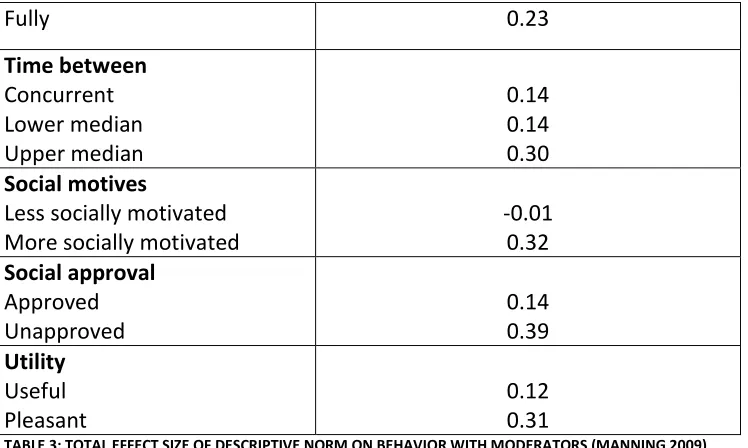
The effect size of the descriptive norm is also limited by the same moderators as just discussed in the injunctive norm section as expressed in table 3. The numbers in the table represent the effect size, 0 means no effect, the higher the number, the stronger the relationship between the descriptive norm and behavior with a range between -1 and 1. A moderator which shows a large difference is seen in the upper median and lower median is social motivation. This makes sense as behavior that is socially motivated should by definition be affected by norms. This means for example that behavior which is socially motivated is highly effected by norms (effect size of 0,32) and behavior which is not socially motivated is not influenced by norms (-0,01).
Factor Effect: Descriptive norm – Behavior
Compatibility
27
Fully 0.23
Time between
Concurrent Lower median Upper median
0.14 0.14 0.30
Social motives
Less socially motivated More socially motivated
-0.01 0.32
Social approval
Approved Unapproved
0.14 0.39
Utility
Useful Pleasant
[image:27.612.70.444.71.295.2]0.12 0.31
TABLE 3: TOTAL EFFECT SIZE OF DESCRIPTIVE NORM ON BEHAVIOR WITH MODERATORS (MANNING 2009)
Many types of behaviors are influenced by the descriptive norm. A list of behavior found by a random search and selecting the top 15 articles: common food eating (Tuu, Olsen et al. 2008), speeding (Forward 2009), exercising (Priebe and Spink), drinking (Grossbard, Geisner et al. 2009) and smoking (Putte, Yzer et al. 2004). A direct link with IT strategy projects has not yet been established to my knowledge. Some initial research shows that norms are relevant for IT usage (Schot 2011). Descriptive norms are also found in team performance (Taggar and Ellis 2007). As IT projects are often executed in project teams, this gives indication that norms do play a role in IT projects.
Descriptive norms - how you perceive what your friends are doing - is thus a pretty reliable predictor of behavior in many contexts.
4.6.
C
ONCLUSION28
5.
S
OME NORMS ARE RELEVANT FORIT
STRATEGY PROJECTS5.1.
D
ESCRIPTIVE NORMS SEEM MOST RELEVANT TOIT
STRATEGY PROJECTSThe goal of this thesis is to use normative interventions to influence norms in IT strategy settings. Now that we have shown the latest thoughts on norms it is interesting to see what can be expected from using these norms in IT strategy settings. In this chapter I will show that the descriptive norm is considered the most relevant aspect of social influence in the IT context. This is done by reviewing each of the three
facets of social norms. For each it is discussed whether they will be relevant in an IT strategy setting. It also shows that it is expected that the descriptive norm will predict 10-20% of the variance in some behavior in IT strategy settings. In other words, if we think our colleagues do something, we might do it as well. Injunctive and subjective norms seem to have a smaller relationship with IT strategy. There are three reasons why descriptive norm seems to have the strongest effect on IT strategy. Descriptive norm seems effective when looking at the
moderating values of descriptive norms. Relevant studies with significant results are conducted in a similar environment. Also, descriptive norm tends to show the highest effect sizes in others situations.
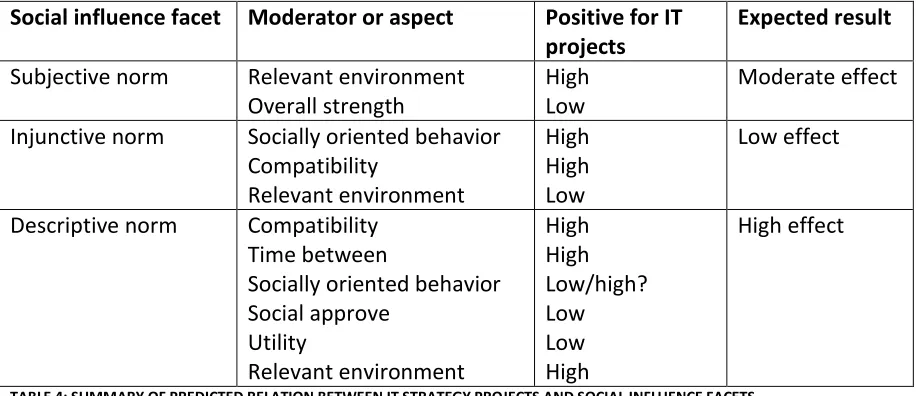
In the next sections, we will explain in detail for each of the social influence aspects why they are (not) relevant to IT strategy projects. A summary is given in table 4.
Social influence facet Moderator or aspect Positive for IT projects
Expected result
Subjective norm Relevant environment Overall strength
High Low
Moderate effect Injunctive norm Socially oriented behavior
Compatibility Relevant environment High High Low Low effect
Descriptive norm Compatibility Time between
[image:28.612.67.525.453.651.2]Socially oriented behavior Social approve Utility Relevant environment High High Low/high? Low Low High High effect
TABLE 4: SUMMARY OF PREDICTED RELATION BETWEEN IT STRATEGY PROJECTS AND SOCIAL INFLUENCE FACETS Relevant
29 5.1.1. SUBJECTIVE NORM VERSUS IT STRATEGY PROJECTS
The relationship between subjective norm and IT strategy can be described as follows: If our colleagues consider it the right thing to perform certain behavior in IT strategy projects, can it be expected to have impact on our behavior?
It can be expected that subjective norm has a moderate relationship to organizational behavior such as the behavior necessary for a successful IT strategy project. It is expected because subjective norm has been shown to be relevant for a large range of behaviors, including organizational oriented behavior, behavior like team norms or IT usage. The relationship is expected to be weak, because generally the overall relationship between behavior and subjective norms is considered as weak.
5.1.2. INJUNCTIVE NORM VERSUS IT STRATEGY PROJECTS
Injunctive norm is the society’s pressure to perform specific behavior. Another way of
expressing it: If society proclaims it is the right thing to work on the IT strategy projects, will I be more inclined to do it?
Injunctive norm is expected to have a weak relationship with IT strategy projects. Injunctive norm has a smaller overall effect than descriptive or subjective norm. Its effect is possibly significant, but not very strong. It also seems to be more applicable in generally approved behavior. Society is not expected to have any pressure in relation to IT strategy; generally people do not think much of IT strategy as something that is good or bad. Thus, injunctive norms are most likely irrelevant for It strategy success.
5.1.3. DESCRIPTIVE NORM VERSUS IT STRATEGY PROJECTS
In practice, the relationship between the descriptive norm and IT strategy projects would mean the following: Knowing that my colleagues are working on the IT strategy, does this affect my behavior towards the IT strategy?
Descriptive norms seem a good candidate for influencing IT strategy projects. It is considered a stronger predictor of behavior than injunctive or subjective norm in general.
There are several moderating effects for the descriptive norm. For each of these moderators it is assessed whether it can be expected to strengthen or weaken the link between the
30 likely to be weak as well. Descriptive norm tends to be stronger over a longer time span. In the case of an IT strategy project, taking between 3 months and a few years, this would mean that the expected relationship between IT strategy projects and descriptive norm is strong.
Descriptive norms are found relevant in a wide range of behavior, including behavior within organizations. This would suggest it might also be effective in IT strategy projects settings. Overall, the descriptive norm is a decent candidate for being a predictor of IT strategy projects. Do you see yourself help realizing the IT strategy projects if none of your colleagues are doing it?
5.2.
F
OUR QUESTIONS THAT HELP FIND RELEVANT NORMS INIT
STRATEGY PROJECTSIn the background study it has been shown that norms are most likely relevant in IT strategy settings, and in the former chapter it has been shown what type of norm is relevant in an IT strategy setting. Another important question is which specific behavior and related norms are relevant within IT strategy settings. Some behavior such as communication between
departments is most likely relevant for IT settings, others such as coffee drinking during IT strategy is not. It is thus useful to consider which behavior is to be changed with the social norm interventions as not all norms will be equally relevant. In this chapter, based on knowledge gained so far, some guidelines for finding the relevant specific behavior are considered.
Although norms are the means and focus of the interventions, the result – a change in behavior – is the goal. We want to change behavior, and not norms in the end. Two questions emerge: “Which behavior contributes to IT strategy success?” and “Can this behavior be changed by social norms?”
It is outside the scope of this thesis to determine which behavior is most relevant in IT strategy settings and thus answer the first question. What can be said is that much research has been done in the area of critical success factors which often are about behavior(Umble, Haft et al. 2003). Examples of these is: end user involvement, top management support, sufficient
funding, clear goals and communication between business and IT(Jang and Lee 1998; Khazanchi and Reich 2008). For this research, it is also expected that the consultants who ultimately will use this tool, are experts at knowing what is important in IT strategy settings.
31 In the previous chapter, we have shown that descriptive norms are likely to be relevant in IT strategy settings. If the behavior and the norm are strongly correlated, it can be assumed that changing the norm also has a large impact on the behavior, and when the behavior norm link is weak, a change in norm will less likely have a large impact on behavior. Although this seems plausible, it is not proof because the link is not proven to be causal, but correlational. It does seem to make sense that there should be a strong link between norm and behavior for it can be effectively targeted by norm interventions. The previous described moderators can be used to find the most relevant behavior to change. Behavior that is compatible, high on time between, socially oriented and fun, is more likely to have a strong behavior-norm link and thus have a larger impact by a social norm intervention than behavior that is not compatible with the norm, there is a low time between, and it is not socially oriented and is mostly useful and not fun. This implicates that the moderators might help estimating that the behavior is a good target for norm interventions. It is chosen to leave one moderator out (social approval) because it would most likely rule out to much behavior.
Moderator Questions
Compatibility Can the behavior and norm be made specific and alike? Time between Does the behavior happen over time?
Socially oriented behavior Is the behavior socially oriented?
Utility Is it fun, useful or both?
TABLE 5: SUMMARY OF QUESTIONS OF WHICH CAN BE USED TO DETERMINE RELEVANT BEHAVIOR TO CHANGE WITH NORMS
Illustrating this with an example, this would make “communication between business and IT” relevant behavior (can be specific, happens over time, is socially oriented and can be both useful and fun). It would make “usage of project software” less relevant, as it is not socially oriented.
Are all of these moderators equally important? It seems that they are probably not. If behavior is low on social orientation, it has no link between descriptive norm and behavior. Thus making it quite important that behavior is socially oriented. If it is low on utility, there is still sufficient room for impact. Based on this logic, social orientation and time between are the most
important moderators. Utility and compatibility are less important.
32
5.3.
C
ONCLUSIONThis chapter has a two part conclusion. The first conclusion is about which type of norms are expected to be relevant for IT strategy situations. The second conclusion is about determining which behavior can be influenced in IT strategy situations.
First, which types of norms is expected to be relevant for IT strategy situations? Descriptive norms are most likely to be effective in IT strategy situations. Descriptive norms are relevant for a wide variety of behaviors, especially if these behaviors are disapproved or socially motivated. In those cases, the descriptive norms have a strong effect on the behavior of people. As some behavior in IT strategy is considered socially motivated it can be expected that the descriptive norm should also have an effect on that behavior. Further, subjective norms seem also a likely candidate for behavior influence, mostly for the same reasons. The link between injunctive norms and behavior is less strong, also injunctive norms seem to be more relevant to societal behavior, and thus makes injunctive norm irrelevant for IT strategy.
Second, which behavior can be influenced in IT strategy situation via social norms? Literature is scarce on this topic. Based on reasoning and the previous analysis, four questions are
developed in order to determine which behavior is a good candidate to change via social norms in IT strategy settings:
Can the behavior and the norm be made specific and alike?
Does the behavior happen over time? Is the behavior socially oriented Is the behavior fun, useful or both?
33
6.
A
PPLICATION OF NORM INTERVENTIONS TO INFLUENCE BEHAVIORThe second research question will be answered in this chapter: “Which norm interventions does literature suggests can be used to influence behavior?” It is necessary to know which norms interventions exist and can be used in IT strategy settings. In this chapter, scientific literature is used to find norm based interventions which are proven to work.
Let’s look at social norm interventions, how can they be defined? They can be defined as: “Actions that use, change, or enforce a norm in order to change behavior”. To understand what such an intervention might look like, think about the following example: Imagine we want to decrease energy consumption of our neighborhood. We can then use social norm interventions to achieve this. An example of such an intervention is the following: people are shown that they use more energy than their neighbors by a note on their door. This note says: “Your energy consumption is higher than that of your neighbors”. Hereby giving feedback about how people act compared to the norm (the behavior of their neighbors) and showing people that they fail to meet the norm. People will then try to conform to the norm by changing their energy usage. This illustrates a typical experiment where norms are used to change behavior. The result in this experiment is that people tend to decrease their energy consumption by 20%, this is the typical result seen in such experiments.
Although some experiments have been done, the process of creating and changing norms seems poorly understood. There seems to be no meta-analysis, reviews or other papers that combine the efforts of various experiments. As Cialdini states: “Although social scientist have used norms as explanatory constructs throughout the twentieth century the empirical literature specifically studying the emergence and transmission of social norms is exceedingly small.” Thus, although there is some progress with interventions and norms, we still don’t really understand how they come about.
In this chapter, a deeper insight into the social norm interventions is presented. First, I will start with the overall conclusion from literature. Then, the social norm interventions found in
literature are presented.
6.1.
S
OCIAL NORMI
NTERVENTIONS TYPICALLY HAVE AN EFFECT SIZE OF20%
The overall conclusion is the following: Few experiments have been done using social influence to change behavior. Some experiments have been done in the following fields: team work, sun block usage, towel reuse, energy consumption, curb garbage, group helping behavior, alcohol usage, and team performance. Most of these interventions prove to be effective and the
34 typically result is an effect size of 10-40%, with most around 20%. Clear guidelines or
mechanisms are not distilled from these experiments. There seem to be few interventions in a corporate setting, and I could not find any interventions done within an IT strategy setting. It can be argued that other experiments have been done besides the ones that are presented in this thesis. Often there is a problem with these interventions, as the results from these
experiments cannot be clearly attributed to norms. For example, a large scale intervention, which is a type of workshop with a large part of the organization involved, might raise the norm. The effectiveness of such intervention is not often quantified. This makes it hard to say if there is impact at all. Another complication is that such intervention does not isolate the effect of social norms, as other aspects are also influenced by the intervention. The effect might come from others variables which are also influenced. This literature is thus hard to use in this study and therefore chosen not to be used.
6.2.
S
EVEN SOCIAL NORM INTERVENTIONS6.2.1. SEND MESSAGES THAT CHANGE THE PERCEPTION OF THE NORM
The first intervention changes the perception of the norm via a message. With messages that change the perception of the norm, we mean that new information that leads us to believe that a certain norm holds. For example, hearing that all your friends except for yourself, have filled in a petition, might change your perception of the norm and motivates you to act. I will illustrate this by some examples from literature.
An intervention which uses these kinds of messages is used in hotels to increase towel reuse: Some hotels want to increase the towel reuse of their customers. In the normal situation a note is placed in the hotel room asking the guest to reuse their towel, for environments sake. In the norm intervention, the note is replaced by a note which says: “75% of the people in this room reuse their towels”. This results in a 20% increase in towel reuse(Goldstein, Cialdini et al. 2008). The same has been done for sun block. People received either information about risk of
sunbathing and the use of sunblock or information about sunblock use by other people (the norm). The norm situation effectively changed their sunblock usage(Mahler, Kulik et al. 2008), just like the hotel towel, there was a 20% increase in sun block use. Another intervention is alcohol usage in college students. From these examples some conclusion can be drawn. First, multiple carriers of information can be used, like notes, face-to-face, computer, mail or other. It is not clear which are most effective and in which situation each of them is most effective. Secondly, messages work in a variety of behaviors for different social groups.
6.2.2. RECRUIT LEADERS THAT SET A NORM
35 the following example. Imagine that Jim, good friend, star employee and project leader works one hour extra on Wednesday, while another low regarded employee who never finishes his work leaves early; whose norm are you following? If act like most people you will follow Jim and also work an hour extra. In this section I will show what literature has to say about leaders and high performs that set the norm. Unfortunately, the literature is scare.
People tend to conform to leaders and high performers. The first evidence comes from an experiment with student groups. In this setting teams are formed and the leader either sets high or low collaboration norms. The other team members themselves have either high or low norms. It shows that the norms of the leader have most influence on the actual team behavior (Taggar and Ellis 2007) largely independent of the norms of the other team members. This illustrates that leaders set the norm.
An even more persuasive study was done in a real life setting. In a manufacturing company, people where working alone. They then received the opportunity to work in teams. Some employees joined the teams, some did not. For each team and individual the productivity before and after joining a team was measured. Upon statistical analysis it shows that team productivity is more dependent on the high achievers than on the low achievers. It was concluded that the high achievers were better at setting and maintaining a high productivity norm (Hamilton, Nickerson et al. 2003). Again the conclusion: one person, a leader or a high achiever can have a significant influence on the norm.
6.2.3. MAKE DESIRED BEHAVIOR PUBLIC
In this section the interventions “making desired behavior public” is explained. This is an intervention which is based on the mechanism of anonymity. Anonymity refers to being publically unknown. In this context, a person is considered anonymous when people do now know you or when you do not perform a certain type of behavior. Social norms are by
definition socially motivated; it makes sense to imagine that if behavior is private, social norms are less effective. This is exactly what research shows.
The first example is a classical study on conformity. Ash’s classic experiment on conformity shows the following. Four people, one participant and three actors, are placed inside a room. They are asked to assess the length of lines on a piece of paper and judge which is the longest. People who perform this test alone tend to do this correctly 95+% of the time. If the three actors, purposely mention the wrong line, about 30% of the participants will also join the incorrect opinion of the group; they thus conform to the opinion of the group. This is quite strange, because people have no problem assessing the correct lie. Still, even though they know which line is correct, they agree to the standards of the group.
36 The effects of Ash’s experiment were found independent of whether the participant knew the actors, or if the actors could punish the participants. People just conformed to a group that they didn’t know, and could not punish them. Ash’s experiments have been performed in many forms and the results seem solid.
Another study suggesting the effects of anonymity is done by Schofield. Schofield asked people to join in a voluntary study where the norm was either absent or present and their choice would be presented either public or kept private. As predictable: when their behavior was published, people tended to conform more to the norm of joining the voluntary behavior. (Schofield 1975).
Both interventions show that making behavior publics results in people complying to the norm. 6.2.4. MONITOR AND GIVE FEEDBACK
Monitoring and feedback is another intervention that makes people follow the norm and act on it. Monitoring and feedback means getting information about your own behavior in comparison with the norm. I will illustrate this with an example that shows the difference between just setting the norm and making people monitor the norm. Setting a norm for energy usage can be done by messages. One can inform people what the average energy usage of the neighborhood is. One can make people experience the norm by monitoring them and providing feedback. One can send them a note saying how much energy they used compared to the norm. This is called normative feedback. This will show the effects of using monitoring and feedback in multiple interventions.
The example of the energy usage is actually executed. People got a note on their doors
informing their energy use compared to the neighborhood averages(Schultz, Nolan et al. 2007). As predicted, people adjusted to the norm. This however didn’t result in overall lower energy consumption. Both the high energy spenders conformed to the norm (by using less), as the low energy users conformed by started using more. The average saving was 1,72 KWh in the long term for the high energy users, which is a strong significant lowering of use.
37 multiple forms of normative feedback are used. It has been tested via the web, face-to-face and via mail. All forms seem to work, where via the web is considered the cheapest and just as effective as the others.
The same has been tested with curb collection(Schultz 1999), production norm(Schultz, Juran et al. 1999) and in group helping behavior for productivity norms(Bamberger and Levi 2008). These show similar results as drinking and energy usage. In curb side collection people got feedback via a door hanger, this resulted in significant increase in the participation and total amount of recycled material. In the papers about the production norm, the authors argue that social norms apply in small groups because people can monitor each other. The monitoring ensures the effectiveness of the social norm.
This evidence shows that social norms can be strengthened by monitoring and giving normative feedback. This results in a significant improvement in social norm in a multitude of behaviors.
6.2.5. PROMOTE AND ALLOW PEER PRESSURE
This intervention doesn’t seem to be researched at all. It was mentioned by another norm researcher V. Schot. The intervention will work as follows. People who already perform the desired behavior are asked to put pressure on the peers who do not perform the desired behavior. It is expected that this intervention will result in higher compliance with the norm. I couldn’t find any literature supporting this intervention. I do expect it to work, because it is likely to increase the sense that one is monitored, which is researched and considered effective.
6.2.6. ADD GROUP INCENTIVES
Group incentives can raise group norms. Multiple authors suggest that group incentives can increase group performance via group norms. In the example giving in the introduction, it can be seen that when there is a group benefit from a certain behavior, the whole group will cooperate to enforce this behavior. In the case of a soccer team, the entire group benefits if other players join the training, this will give them incentive to use group pressure to ensure people come to training. Group pressure based on this mechanism is also found in
organizational settings.
If a company changes performance management from individual incentives, to group incentives, an increase in average performance is seen. One of the mechanisms of how this works, is via elimination of the free rider (Hamilton, Nickerson et al. 2003; Taggar and Ellis 2007). If there is a group incentive to perform, and one of the group members fails to contribute to this performance, the other group members are likely to pressure him into
cooperating(Fehr and Fischbacher 2004; Fehr and Fischbacher 2004). Also, when in a team, you don’t want to let down the other members and thus tend to try to keep up realizing the
38 peer pressure to achieve a group norm". Such norms may arise, we argue, from intra team bargaining in which worker heterogeneity affects group norms through different threat points among workers”.
Thus, raising group incentive might increase performance and adherence to high group norms. The group incentive doesn’t have to be financial, as can be seen in the soccer example.
Currently, there seems no literature which states that non-financial team incentives are considered effective, but there is also no proof for the opposite. I expect that non-financial group incentives also work to increase team performance or adherence to team norms. For example, removing anonymity for the performance of a team might work as well as financial team incentives.
6.2.7. GIVE MEANS FOR SOCIAL PUNISHMENT OR REWARDS
In literature some other interventions are found. It is problematic considering these interventions pure norm interventions. These interventions can be called incentive based interventions. Complying or non-complying with norms can result in punishment or reward. This punishment or rewards can be either financial or socially. It is hard to draw the line and determine which interventions are still norm interventions and which aren’t. For this thesis, if the norms are enforced by financial incentives, it is not considered a normative intervention. If the norms are enforced by social incentives, it can be considered a normative intervention. Norms are inherently social, and the social gains such as approval or rejection can be considered norm interventions.
Literature shows that giving the possibility for social punishments leads to adherence to social norms. It is thus expected that increasing social incentives when complying with a norm or social punishment when failing to adhere to the norms, will be effective interventions( chter and Fehr 1999; Fehr and Falk 2002; Fehr and Gachter 2002; Fehr and Fischbacher 2004; Fehr and Fischbacher 2004).
6.3.
D
ESIGN CHOICESAll interventions which suited the norm intervention definition which could be found in academic literature have been collected and discussed in the past chapter.
It is chosen to base the interventions on academic literature. Academic literature ensures that the interventions are likely to have an effect, it adds to the credibility. Other sources could have been popular literature or experts. As the interventions form the foundation, and the