Performance managers as HRM
implementers: are they effective?
A study on the perceived effectiveness of
HRM implementation by performance managers
Master thesis of: Ellen Kuiper
Business Administration School of Management & Governance
Supervised by: dr. M.J. van Riemsdijk drs. M.B.J. de Lat
1
Summary
For any company, it is important to have satisfied employees. For KPMG, it is no different. Humans are their most valuable asset. However, results of a satisfaction survey in 2010 at KPMG were rather critical and showed that employees are unsatisfied with or cannot recognize the human resource intentions of KPMG. This prompt the question at KPMG whether first-line managers (performance managers) are able to implement KPMG’s intended HR practices. This thesis aims (1) to explore whether first-line managers
experience limitations in implementing HR practices, (2) to investigate how employees judge the effectiveness of HR implementation by their first-line manager, (3) to examine whether the hindering factors influence the perceived effectiveness of HR implementation and (4) to explore to what extent the relationship between supervisor and subordinate influence the perceived effectiveness of HR implementation. The main question in this study is “to what extent do first-line managers implement HRM practices effectively?”
The study is conducted in the accountable unit Public sector. There are nine performance managers and sixty-one employees working for this unit.
Data is gathered by quantitative and qualitative research. Interviews were held with performance managers and employees to gather general information. Performance
managers filled in a questionnaire (100% response rate) to measure five constraining factors (independent variable): desire, capacity, competences, support and policies & procedures. Employees filled in a questionnaire (61% response rate) to evaluate the quality of the relationship with their performance manager (independent variable) and the perceived effectiveness of the HR implementation by their performance manager (dependent variable). Data is analysed by using reliability analyses, correlation analyses and a regression
analysis.
2
Practical recommendations for KPMG are (1) to be clear about roles & responsibilities byproviding clear policies & procedures, (2) to provide sufficient support for performance managers, (3) to pay attention to the relationship between performance managers and employees and (4) to conduct a study to the content of the HR practices.
This study empirically supports that the quality of the relationship between supervisor and subordinate (measured by LMX) should be included in scientific research to perceived effectiveness. Furthermore, in further research it is recommended to evaluate the
3
Preface
This master thesis is the final project for receiving the Master of Science degree in Business Administration. It is the result of a research project for the University of Twente, conducted at KPMG. Using this opportunity, I would like to thank several people who gave me support during my graduation period.
I would like to thank my supervisors of the University of Twente. Maarten van Riemsdijk for his theoretical knowledge, support and for triggering me in the in-depth understanding of my research topic and providing feedback during the graduation process. Mark de Lat for
introducing me at KPMG and giving me the opportunity to write my thesis for this challenging and global organization.
I would like to thank my supervisor of KPMG, Martijn Hulshof, for helping me know the ropes of KPMG and for providing knowledge about the field of HR and consultancy.
I would like to thank my colleagues of KPMG for participating in this research, supporting me during the process, providing me baggage for the thesis and for my future at KPMG and for the positive day-to-day interaction at the offices.
Finally, I would like to thank my family and friends for their never ending support, interest and trust they gave to me. Graduating in 2011 didn’t work out, but the care and confidence of all of you really helped me in finishing this project.
4
Contents
1. Introduction ... 6
1.1 Importance ... 6
1.2 Scientific relevance ... 7
1.2.1 Success of HR practices ... 7
1.2.2 HR practices as a communication tool ... 8
1.2.3 HRM – performance linkage ... 10
1.3 Contribution and research question... 12
1.4 Thesis structure ... 12
2. Theoretical framework... 14
2.1 HRM as a system ... 14
2.2 HR Integration as a multidimensional concept ... 14
2.3 HRM Implementation ... 15
2.4 Line management HR responsibilities ... 16
2.5 Consequences of devolution ... 17
2.6 Perceived effectiveness of HR implementation ... 21
3. Context and methodology ... 26
3.1 Context ... 26
3.2 Procedure ... 27
3.3 Research population ... 29
3.4 Measurement ... 31
3.5 Reliability analysis ... 34
4. Results ... 36
4.1 Data analysis ... 36
4.2 Performance managers limitations’ in HRM implementation ... 36
4.3 Perceived effectiveness of HRM implementation ... 39
4.4 The effect of performance managers’ limitations on the perceived effectiveness... 40
4.5 Leader-Member Exchange (LMX) ... 44
5
4.6.1 Correlation analysis ... 44
4.6.2 Regression analysis ... 45
4.7 Qualitative results ... 47
4.7.1 Performance managers ... 47
4.7.2 Employees ... 48
5. Conclusion & recommendations ... 49
5.1 Conclusions ... 49
5.2 Practical recommendations ... 52
5.3 Scientific implications ... 53
6. Discussion ... 54
6.1 Limitations ... 54
6.2 Further research ... 56
7. References ... 57
8. Appendices ... 63
Appendix 1: Questionnaire performance managers ... 63
Appendix 2: Questionnaire employees ... 76
6
1.
Introduction
In this chapter, a description of the research topic will be given and the practical and theoretical relevance will be clarified. Furthermore, the research question, the structure of this thesis and the context and population of the study will be described.
1.1
Importance
In October 2010, 70,000 employees of KPMG N.V. filled in a Global People Survey (GPS). In the Netherlands, 2,500 employees filled in this satisfaction survey (65% response rate). Despite the pros and cons of satisfaction surveys, the results were rather critical. In general, commitment of employees decreased (compared to 2008). Just 18% argues that KPMG became more attractive to work for. Furthermore, many employees answered that they cannot understand strategic leadership choices. Other criticisms were that choices in daily practice are motivated insufficiently, and that personal communication about policies and preventions is not optimal. More than 50% of the employees answered negative or more negative than positive on the question whether reasons behind decisions on higher management level are well communicated to employees on their work level. The
management of KPMG was quite shocked by the GPS results, because their (unsatisfied) human capital is their most valuable asset. Their vision is ‘becoming one, by being one’. They see employee engagement as their propelling force for business performance. Leading by example, talent management, rewards & appraisals, career counselling, and being
attractive for employees are important pillars for HRM. Nevertheless, the results show that employees are not satisfied with it or cannot recognize the HR practices. The results prompt the question at KPMG whether first line managers (performance managers) are able to implement KPMG’s intended HR practices, which is the research topic of this thesis.
The initial plan of this study was to measure the quality of the defined HR practices, describe discrepancies between intended and perceived HR practices and measure the success of the implementation of HR practices. However, practical problems made that some
7
1.2
Scientific relevance
In the section below, the scientific relevance of the research topic will be clarified. In the first part, critical factors for the success of HR practices and the role of first line managers in HR implementation will be described. In the second part, the HRM – performance linkage will be clarified.
1.2.1 Success of HR practices
There are two critical factors for the success of HR practices: (1) the presence of properly designed HR practices and (2) the success of their implementation. A distinction can be made between intended HR practices, the actual enactment of these practices and how they are experienced by employees.
Intended HR practices are the practices formulated by policy makers (Khilji & Wang, 2006, p. 1172).
Actual HR practices are the practices implemented in organizations, which recognizes that not all the intended HR practices are implemented or that they may be implemented in a way that differs from the underlying intention (Wright & Nishii, 2007).
Perceived HR practices are the practices perceived and interpreted subjectively by individual employees (Wright & Nishii, 2007).
As mentioned earlier, only the second factor (the success of the implementation) can be measured in this study, due to lack of support for this study by the HR department of KPMG. However, gaps between intended and perceived HR practices are documented by several researchers (e.g. Truss, 2001; Purcell & Hutchinson, 2003; Khilji & Wang, 2006). A major cause of perceived differences in HR practices is the implementation of those practices by line managers (Khilji & Wang, 2006; Gilbert et al., 2011). According to several authors (Appelbaum, 2000; Wright & Nishii, 2007; Purcell & Hutchinson, 2007; Bos-Nehles, 2010) the way line managers implement HR practices vary due to differences in the level of desire, capacity, competences, support and policies & procedures. Consequently, the perception of employees on the effectiveness of HRM implementation is highly dependent on the effort, quality and capabilities of the line manager (Bos-Nehles, 2010; Gilbert et al., 2011).
As mentioned by Kinnie et al. (2005, p.10) “employee attitudes are influenced not so much by the way these policies are intended to operate as by the way they are actually
8
mentioned; “poorly designed or inadequate policies can be ‘rescued’ by good management behaviour of FLMs in much the same way as ‘good’ HR practices can be negated by poor FLM behaviour”. It means that well-developed HR practices are necessary, but not sufficient. The extent to which those practices are properly applied by first-line managers play an important role as well(Gratton & Truss, 2003; Wright & Nishii, 2007). Focusing on actual implementation within the organization is therefore crucial.First-Line Managers (FLMs) are responsible for the implementation of HR practices, because they have to execute the HR practices on the work floor. FLMs can be defined as the first level of managers to whom non-managerial employees report and who are responsible for implementing and executing of HR practices on the operational level (Den Hartog, Boselie & Paauwe, 2004; Hales, 2005). Intended HR practices will be delivered or enacted by these FLMs with direct supervisory responsibility (Purcell & Hutchinson, 2007). A study of Purcell & Hutchinson (2007) on the gap between formal HR policies and delivered HR practices shows that the main problem for this gap is explained by the difficulties FMLs have in applying and implementing HR practices, in translating HR policies into actions. In her doctoral dissertation, Bos-Nehles (2010) summarized -based on existing literature- the five main challenges hindering FLM in implementing HR practices: lack of desire, lack of capacity, lack of competencies, lack of support, and lack of policies & procedures. It is expected that these five factors hinder FLMs in implementing HR practices effectively.
1.2.2 HR practices as a communication tool
The crucial role of FLMs in the HR process can be clarified by theory of Bowen and Ostroff (2004) and Rousseau (1995). Bowen and Ostroff (2004) see HRM as a way to organize the communication between employer and employee and focus on understanding what features of the HRM process can lead employees to desirable interpretations and responses to HR practices (Paauwe & Boselie, 2005).
HRM content and process
Bowen and Ostroff (2004) describe two features of an HRM system which should be
9
same interpretation on what the organization wants and expects. The situation refers to the HRM content and describes the (un)ambiguity of the messages which are sent. A situation is strong if the messages which are sent are unambiguous. According to Bowen and Ostroff (2004) a strong situation leads to a strong climate. In other words: if the messages (HR practices) sent are unambiguous, it will result in a shared interpretation and perception of what the organization expects. Distinctiveness, consistency and consensus are the key features of HR system strength that will create messages which will be perceived and interpreted uniformly by employees.Based on the theory of Bowen and Ostroff (2004) it can be concluded that if first line
manager sent HR practices which are high in distinctiveness, consistency and consensus, it increases organizational climate and thus the likelihood of shared perception and
interpretation by employees.
Psychological contracts
The role of organizational climate (shared perception) is also described by Rousseau (1995) who describes that “HR practices serve a signaling function by sending messages that employees use to define the psychological meaning of their work situation” (Rousseau, 1995 in Nishii & Wright, 2007, p. 10). People perceptually filter external information, and “their attitudinal and behavioral responses to that information differ” (Nishii & Wright, 2007, p.8). The concept of the psychological contract has become very popular as determinant of employee’s behavior (McDonald & Makin, 2000). Schein (1980) defined psychological contract as an “unwritten set of expectations operating at all times between every member of an organization and the various managers and others in that organization” (in McDonald & Makin, 2000).
Rousseau (1990) goes one step further by arguing that psychological contracts are not just based on expectations, but that contracts are promissory and contain reciprocal obligations (McDonald & Makin, 2000; Rousseau, 1990). Rousseau (1990, p.390) argued that
10
psychological contract (Suazo et al.,2009). “HR practices send strong messages toindividuals regarding what the organization expects of them and what they can expect in return. HR practices shape the day-to-day behavior of employees” (Rousseau, 1995, p. 182). The interpretation of HR practices results in a psychological contract between employer and employee. It is likely that some HR practices (e.g. training, job descriptions, recruiting decisions, performance reviews) trigger psychological contracts more than others, but details or mechanisms about how and by which these HR practices influence
psychological contracts are lacking in theory (Suazo et al., 2009). However, research on psychological contracts shows that a lack of management communication might result in conflicting perceptions between employer and employee and causes contract breach. On the other hand, adequate communication results in a positive climate; trust, perceived
participation, a feeling of being taken seriously and organizational identification (Dorenbosch et al., 2006). This line of thought supports the theory of Bowen and Ostroff (2004). It
underlines the crucial role of sending strong HR messages by first-line managers and the importance of a strong organizational climate in it. Organizational climate is built on an individual’s psychological climate, defined as “an experientially based perception of what people ‘see’ and report happening to them as they make sense of their environment” (Bowen & Ostroff, 2004, p.205). These individual’s psychological climates are highly influenced by the perceptions of employees by means of psychological contracts.
However, this thesis is focused on the effectiveness of HR practices in terms of implementation by performance managers and the satisfaction of employees about facilitating HR practices by performance managers and not on how employees behave in daily practice. Therefore, it is not that relevant for KPMG to include the role of psychological contract in this study. Nevertheless, it shows that HR practices communicate goals and desired employee behaviors from organization to employee. It underlines that sending strong HR messages will result in shared perceptions by employees which supports the HR
implementation.
1.2.3 HRM – performance linkage
The relationship between HRM and performance was studied intensively in the last decades (e.g. Guest, 1987; Huselid, 1995; Becker & Gerhart,1996; Guthrie, 2001). Based on these studies, it can be concluded that HR practices (individually or bundled) are linked to performance. HRM indirectly influence performance by a causal chain of mediating
11
outcomes (e.g. sales, profits, market share) or organizational outcomes (e.g. productivity,efficiency, quality) (Wright & Nishii, 2007; Paauwe, 2009). This means that the employee response to HR practices is important in the HRM-performance linkage, because it is the link between employee reactions and their subsequent behaviour which is crucial in reaching performance (Purchell & Hutchinson, 2007).
Different approaches
Much of the studies on the link between HRM and performance are based on two content-based approaches: ‘best practice’ and ‘best fit’. The best practice approach argues that a set of HR practices influences performance in all types of organizations, under all
circumstances. In the best fit approach, it is argued that HR practices influence performance only if the HR practices are appropriately integrated with their context, like the business strategy. Weaknesses of both the best practice and the best fit approach are that “they assume that HR policies adopted will be implemented as intended and have the same effect on all employees who work for the organization (Kinnie et al, 2005, p.9). However, this is questionable because employees interpret, respond and experience the same set of HR practices in a different way (Kinnie et al., 2005). In the recent decades another approach emerged, a process based approach (Bowen & Ostroff, 2004; Li et al, 2011). This approach highlights the importance of processes through which employees interpret (or attach
meanings to) HRM practices. The line of reasoning behind this approach is that the
intentions of HR practices not fully can be realized unless the HR practices are delivered in a way that employees can perceive the HR practices as intended (Bowen & Ostroff, 2004; Li et al., 2011). Several empirical studies (e.g. Nishii et al., 2008; Sanders et al., 2008; Li et al, 2011; Guest, 2011) demonstrated the validity of this approach. Nevertheless, more research to this approach is needed.
HRM from employee’ perspective
12
As mentioned earlier, the actual HR practices and the way they are (subjectively)experienced by individual employees can be different, due to different values, roles, employment relationships etc. People react based on their perception of a practice rather than an ‘objective’ practice and the resulting outcomes (attitudes & behaviours) have an effect on organizational performance. So, the individual perceptions of intended and actual HR practices play a crucial role in the HRM-performance linkage. The effectiveness of actual HR practices depends not only of quality of the implementation by line managers (Bos-Nehles, 2010), but also of the perceptions of employees about those practices. Several researchers (Liden & Maslyn, 1998; Nishii & Wright, 2007) mentioned that employee perceptions are likely to be influenced by their organizational roles, like; reported
relationships, satisfaction with and attitudes towards supervisors and personal experiences with leaders. This suggests that the perceptions of employees about perceived effectiveness of HR implementation will be influenced by the relationship with their supervisor. In previous research, little attention is paid to the influence of the relationship between supervisor and subordinate on the effectiveness of HR implementation. However, the studies of Liden and Maslyn (1998) and Nishii and Wright (2007), show that it is likely that this relationship influence the perceived effectiveness of HR implementation. The study at KPMG gives the opportunity to include this (extra) variable.
1.3 Contribution and research question
The presumption of KPMG is that their intended HR practices are not adequately implemented by performance managers of KPMG. Possible factors which can cause ineffective implementation are known in literature. This study aims to investigate if the effectiveness of implementation by FLMs is indeed insufficient. If so, a second question will raise, namely: which factors cause the bad implementation by FLMs.
This results in the following main research question: To what extent do line managers implement HRM practices effectively?
The sub questions are described in chapter two.
1.4 Thesis structure
13
by the results of the analyses in chapter four. In chapter five, a conclusion and14
2.
Theoretical framework
In this chapter the existing literature on effective HRM implementation and the role of first line managers will be reviewed and conceptually linked. The literature analysis results in a research model and research questions relevant for this study.
2.1
HRM as a system
The purpose of human resource management (HRM) is to “(…) ‘effectively utilize human resources vis-à-vis the strategic needs of the organization’ (Schuler, 1992, p.18). It refers to “all those activities associated with the management of people in firms” (Boxall & Purchell, 2008, p.1). Many researchers advocate that HRM must be strategic to be successful. It must be strategic, because human resources of an organization ‘makes the difference’, and resources that make the difference must be managed in a strategic way (Brewster & Larsen, 1992; Storey, 1992). Therefore, HRM should be embedded in the strategic needs of the firm by integrating the HR strategy with the business strategy (Brewster & Larsen, 1992). HR integration is defined as “the degree to which the HRM issues are considered as part of the business strategy” (Brewster & Larsen, 1992, p.411). HRM is conceptualized along different levels. Schuler (1992) defines HRM in five P’s: HR philosophy, policies, programs, practices and processes. Lepak et al. (2004) describe HRM in terms of HR philosophy, HR policies and HR practices. Independent of the typology of different levels, HRM systems are
characterized by a collection of practices that should be internally aligned with the business strategy and the HR philosophy and thus should reinforce employees’ behaviours and contributions as well as desired organizational results (Lepak et al., 2004). In this thesis, the focus is not on the HRM system in terms of content (collection of practices) but in terms of process, namely: the features of an HRM system that support to get the HR message across to employees, described by Bowen & Ostroff (2004, p.204)as “the features of an HRM system that send signals to employees that allow them to understand the desired and appropriate responses and form a collective sense of what is expected”.
2.2 HR Integration as a multidimensional concept
15
Storey (1992, p.26) noted that inHR integration“people-management decisions ought not to be treated as incidental operational matters or be sidelined into the hands of personnel officers” .In accordance to Storey’s empirical observation, Gratton and Truss (2003) described how HRM should be integrated in organizations. According to them, vertical alignment between business goals and people strategy is important. Furthermore, HR policies should reflect business needs as well and should be internally aligned and consistently related to one another, also called horizontal alignment.
The necessity of these two dimensions is extensively described in the literature (e.g. Schuler & Jackson, 1987; Schuler, 1992; Gratton & Truss, 2003). However, some researchers (e.g. Schuler, 1992; Gratton & Truss, 2003) argue that horizontal and vertical fit are essential, but not sufficient. It may be misleading to focus only on the presence of practices in terms of vertical and horizontal alignment, because there is the risk that line managers fail to
implement the HR practices (Guest, 2011). The way HR policies are implemented in day-to-day life of the organization is a third essential key dimension, called action by Gratton and Truss (2003). Having the appropriate HRM policies does not automatically mean that they will be effectively implemented and will produce desired and intended results even if they have been designed properly and/or are horizontally and vertically aligned (Truss, 2001; Nehles et al., 2006), Guest and Conway (2011, p.1698) concluded on a study of UK companies randomly selected from the Dun and Bradstreet database and employing 50 or more UK staff that that “the effectiveness of HR practices will be more important than the presence of practices in determining organizational outcomes” like financial performance, labour productivity, quality and commitment (p.1698).
2.3 HRM Implementation
Focusing on the crucial role of the implementation of HR practices, leads to shifting attention from personnel specialists in HRM towards those managers who are playing a far more central role in labour management (Schuler, 1992). According to Larsen and Brewster (2003) HR departments should act in a more strategic (aligning HRM with business strategy) and consulting role in which they are responsible for the development of agreeable and realistic policies which can be implemented, while the responsibility of day-to-day HRM work and the human factor of people’s everyday work experience is devolved to line managers (Larsen & Brewster, 2003; Hope Hailey et al., 2005). Integrated HRM presumes that
16
p.413). It drives organizations to give more responsibility for the management of employees to line managers and reduces the sole responsibility of human resource departments (Brewster & Larsen, 2000). This tendency is called HR-devolution which is defined as “the degree to which HRM practice involves and gives responsibility to line managers rather than personnel specialists” (Brewster & Larsen, 1992, p.412).A crucial role in implementing HRM is assigned to first-line managers (FLMs) because of their management responsibilities for people positioned lower in the organization (Renwick, 2002). Storey (1992, in Thornhill & Saunders, 1998) found in a study that first line managers became key channels for involving and developing employees. Due to the movement towards business units in a lot of companies, the role of these managers has changed from day-to-day supervisors into business-unit managers in which they are responsible for broader business responsibilities like devolved HRM (Hales, 2005; Storey, 1992). It means that FLMs who will manage human resources in their own community are able and have the attitudes to link the management of human resources to the strategic direction of the
organization, to implement it and to put it in practice (Thornhill & Saunders, 1998). This implicates that first line managers should play a key role in the implementation of HR practices in daily practice.
2.4 Line management HR responsibilities
That HR practices should be adjusted, accepted and used by line managers and employees as part of their daily work is stated by different researchers (Schuler, 1992; Gratton & Truss, 2003). However, the question is which HR responsibilities are devolved to FLMs and to what extent FLMs do pick up their HR roles. Cascón-Pereira, Valverde and Ryan (2005) argue – based on empirical research that -despite the overall agreement about the definition of devolution-, there is no such common understanding with regards to what devolution actually means in organizational practice, and how it materializes.
Many other researchers (Luthans, Hodgetts & Rosenkrantz, 1988; Hall & Torrington, 1998; McConville & Holden, 1999; Whittaker & Marchington, 2003) empirically studied which aspects of HRM are devolved and thus, are the responsibility of the line. These studies confirm that, although devolvement is highly context dependent, generally, first-line
managers are responsible for the following HR practices: (1) motivating and reinforcing, (2) disciplining and punishing, (3) managing conflict, (4) staffing, and (5) training and
17
Hall and Torrington (1998) concluded that HR specialists play the biggest role (or makedecisions alone) in issues related to payment admin and fringe benefits and the least in quality initiatives, career planning, appraisals, redundancy and communication (p. 49). McConville and Holden (1999) found that practices related to departmental performance like training & development, performance appraisal, safety & healthy monitoring and record keeping are devolved to FLMs, while those FLMs are not involved in administration of pensions and benefits, and determining pay levels and other terms and conditions.
Research showed that in many HR practices collaboration between HR department and line managers takes place; e.g. in recruitment/selection, industrial relation, work expansion and reduction and employee relations (McConville & Holden, 1999; Whittaker & Marchington, 2003, Brewster & Larsen, 2000).
2.5
Consequences of devolution
The devolution of HR responsibilities has positive and negative consequences. Perry & Kulik (2008, p.263) found a positive effect of devolution on perceived HR effectiveness by HR professionals and describe that “by pushing HR decision making down to the line, managers should be better able to make faster decisions that are more tailored to individual
circumstances”. However, other studies emphasize that FLMs are unable to deal with HR- responsibilities, because “they have other more pressing priorities than managing and developing the people working for them ”(Whittaker & Marchington, 2003, p. 250). They see managing and developing people therefore as a secondary task (McGovern et al., 1997). Several studies on HR devolution indicate that there are five perceived limitations hindering FLMs in implementing HR practices, which can result in ineffective HR implementation (Storey, 1992; Bevan & Hayday, 1994; McGovern, 1999; Whittaker & Marchington, 2003). Line managers would be ‘reluctant’ to HR responsibilities (lack of desire), have not enough time or insufficient capacities (lack of capacity), do not have the competences (lack of competences), do not receive enough support from the HR department (lack of support) or do not have policies and procedures (lack of procedures) to successfully fulfil an HR-role (Bos-Nehles, 2010). Each of these potential hindrances will be now discussed in turn.
Desire
18
responsibilities do not get priority if they are not integral part of performance appraisals, jobdescriptions or business policy. In that case, short term business targets dominate (Cunningham & Hyman, 1999; Brewster & Larsen, 2000; Whittaker & Marchington, 2003; Nehles, 2010). It can be concluded that for implementing HR practices effectively, FLMs need to have the willingness to perform HR practices.
Capacity
Capacity is a second factor that can hinder or foster FLMs to implement HR practices. Line managers report frustration that they are not able to devote sufficient time to HR issues because “harder” priorities tend to dominate (Cunningham and Hyman, 1999, p.25).Due to lack of capacity, FLMs could be unable to devote enough time to HRM. HR responsibilities are often devolved to FLMs, without reducing original tasks (Brewster & Larsen, 2000). In that case HR responsibilities are not instead of original tasks and responsibilities, but beside other ones. Therefore, it can be assumed that for implementing HR tasks effectively, FLMs need to have sufficient time for it.
Competences
A third barrier to implementation is a lack of competencies by line managers to implement HR practices. “Line managers challenged the wisdom of increasing their responsibilities in an area where they lacked specialist knowledge” (Harris et al., 2002, p.225). Lack in education and technical base are constraints of effective HRM devolution (McGovern et al. (1997). For effective implementation, specific HRM knowledge and skills are needed (Gennard & Kelly, 1997; Renwick, 2000). These competences can be obtained through (continuous) training and support from HR specialists (Renwick, 2002; Nehles et al. 2006; Whittaker & Marchington, 2003). If FLMs have the knowledge and skills to perform their HR tasks and responsibilities, it might positively influence their HRM implementation
effectiveness.
Support
Insufficient support for line managers is a fourth obstacle that hinders effective
19
Therefore, it can be assumed that the higher the support from HR professionals to linemanagers in performing HR practices, the more effectively FLMs will implement them.
Policies and procedures
The absence of clear HR policies and procedures is a fifth barrier. Different studies showed that FLMs were not adequately consulted about what their roles and responsibilities should be (Bevan & Hayday, 1994; McGovern, 1997). Policies and procedures about which HR practices should be executed and how this should be done, could prevent this problem (Gennard & Kelly, 1997). Beside clarity about new roles, highly structured and
‘depersonalized’ policies and procedures reduces inconsistencies, individual judgment and potential bias in implementing HR practices to a minimum (Brewster & Larsen, 2000; Harris et al.,2002; Whittaker & Marchington, 2003; Bos-Nehles, 2010). Clear policies and
procedures will reduce the likelihood of different interpretations of HR practices. Shared interpretations may contribute to actual HR practices which are as intended and expected (Nishii et al., 2008). It is likely that the more well stated policies and procedures line managers have on their HR tasks and responsibilities, the more effectively they will implement them.
Bos – Nehles (2010) studied the limitations line managers perceive in implementing HR practices at operational level. She did empirical research on the effect of the five factors (described above) on the implementation of HR practices by FLMs. The strength of this research is that –in contrast with previous studies- it placed the five factors in one
comprehensive model and data were collected on limitations experienced by line managers themselves. She applied a case study approach and used quantitative and qualitative cross-sectional data collected in the Netherlands. The sample consisted of 470 line managers and 1000 employees across six (multinational) organizations which made cross-case comparison possible. She found that line managers pick up their HR role. As it appeared from her study, the only barrier that significantly influences the effective implementation of HR practices is the factor competences of managers (0.21**)1. This means that the more managers experience they are competent in implementing HR practices, the more positive
implementation of HR practices is perceived by their subordinates. The results of the factors capacity (0.03), support (0.15)and policy & procedures (-0.01) were all insignificant and do not seem to hinder FLMs in effective implementation. For the factor desire even a significant negative effect was found (-0.28**). The more desire FLMs have to take on HR
responsibilities, the less effective subordinates perceive the implementation of those practices. However, this study highlighted the importance of context and confirmed that
20
organizations highly differ in the way they organize and implement devolvement of HRresponsibilities and thus differ in the way FLMs perceive and fill in their HR role. The results of this study vary per organization.
Results of the study conducted by Bos-Nehles (2010 ) show for example significantly lower mean scores on the factor capacity. Line managers in two organization perceive less time for their HR tasks than line managers in the other two organizations. In a third organization, line managers perceive they are significantly ‘worse’ supported by the HR department than line managers in the other organizations (p.79).
Hence, the effectiveness of HR implementation seems to be organizationally contingent. The study of Bos-Nehles (2010) showed that it is related to differences in level of education, span of control, hierarchies and level of experience. In sum, the situation in which a line manager operates influence the line managers perceptions of the five limitations.
Therefore, it is likely to assume that in different organizations any of the aforementioned hindering factors could play a role, which might imply that results are diverse, due to contextual differences. This makes it relevant to study it at KPMG. Theoretically relevant, because it makes cross-comparison possible and can help to explain how organizational settings influence the perceived effectiveness of HR implementation. It is practically relevant, because it can provide guidelines to KPMG to improve the HR implementation by
performance managers by getting insight in experienced constraining factors.
Based on the literature described in this chapter, it can be concluded that due to HR
integration, HRM responsibilities are devolved to FLMs in organizations. However, there are limitations which can hinder effective implementation of HR practices by FLMs, namely: lack of desire, lack of capacity, lack of competences, lack of support and lack of policies &
procedures.
21
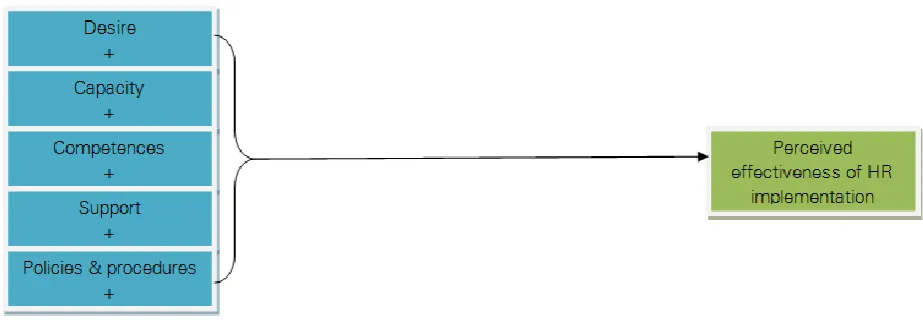
Figure 1: Research model, part 1As mentioned earlier, HR-performance of FLMs can best be evaluated by employees,
because they experience how their FLM implement HRM practices on daily basis and are the stakeholders in HR implementation. In the next section we are going to elaborate how the perceived effectiveness of HR implementation could be conceptualized.
2.6
Perceived effectiveness of HR implementation
The experiences of FLMs and the perceived effectiveness of HR implementation by employees are of interest in this thesis. To measure the perceived effectiveness of the implementation process, subordinates will be asked to judge their level of satisfaction with the way their FLM implement the HR practices on the work floor. However, Nishii and Wright (2007) argue that the effect of actual HR practices is heavily influenced by the perceptions employees have about those practices and that these perceptions differ per individual and per group due to differences in values, schemas, expectancies, social roles and goals (Nishii & Wright, 2007). Several researchers (e.g. Kinnie et al.,2005; Nishii & Wright, 2007) suggest that employee perceptions are partially a functions of and are shaped by experiences with, and attitudes toward supervisors. This suggests that different subordinates with the same FLM can perceive the HR implementation by their FLM differently, due to differences in the personal relationship with their FLM.
Evidence for the assumption that managers play a critical role in shaping individuals’
22
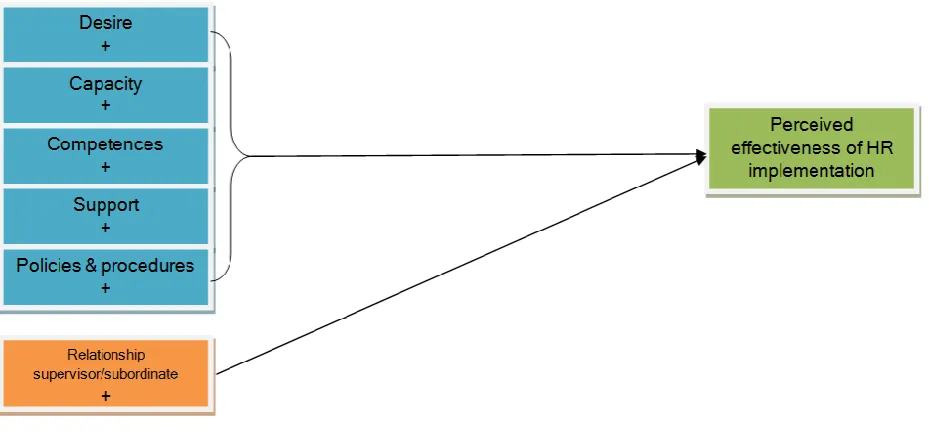
implementation effectiveness by their supervisor, since the implementation of HR practices is nowadays part of supervision. It implies that employee perceptions of HR practices and the effectiveness of implementation by FLMs, are partially a function of experiences with, and attitudes toward, their FLMs (Nishii & Wright, 2007).This implies that an explicit distinction can be made between two different variables which both influence perceived effectiveness: (1) the five factors hindering factors by FLMs
(described in the previous paragraphs) and (2) the personal relationship between FLMs and their subordinates (described below).
Gratton and Truss (2003) support this line of thought and argue that by measuring the
implementation of HR practices in daily practice, the behaviours and values of line managers should be taken into account, because with their “attitudes, conversations, and body
language, line managers send out very clear messages” (p.77). In other words, by evaluating effectiveness of HR implementation on employee level, but not including the behaviour of FLMs and the relationship between FLMs and subordinates, it is unclear whether perceived HR implementation (in)effectiveness is the result of well-applied practices or the outcome of a close relationship between supervisor and subordinate (Bos-Nehles, 2010). In order to measure and control the influence of the relationship between FLM (supervisor) and
subordinate on the perceived effectiveness of HR implementation by employees, the quality of this relationship between FLM and subordinate will be included in this study as a third variable. By doing so, clearer conclusions about whether FLMs implement HR practices effectively can be drawn.
The quality of the relationship between FLM/subordinate can be explained and understood using the Leader-Member Exchange Theory (LMX). LMX receives much attention from research since decades and has been utilized as a foundation for measuring the outcomes of supervisors and subordinates relationships in a variety of fields (Graen & Uhl-Bien, 1995). The widespread application of LMX theory shows that it is a useful instrument for
23
work contract and can be seen as a partnership, whereas a low-quality relationship ischaracterized by low levels of trust, sympathy, interaction, support and rewards and can be seen as just a formal relationship created by the job position of both parties and based on employment contract (Wayne & Green, 1993; Tierney, 1999).
It can be assumed that a high-quality relationship between supervisor and subordinate positively influences the perceived effectiveness of HR implementation. Employees who develop a close relationship with mutual trust, sympathy, support and rewards from their supervisor have other attitudes and experiences with their supervisor than people with a low-quality relationship. It is likely that a high-low-quality relationship reflects a more positive attitude towards a supervisor which might result in higher perceived effectiveness of HR
implementation. Contrary to low-quality relationships, which might negatively affect the attitudes toward supervisor and might result in lower perceived effectiveness of HR implementation. LMX will be measured as an extra independent variable to control for a possible second influence on perceived effectiveness by employees. A direct effect of LMX on the perceived effectiveness by employees can be expected. Empirical evidence for this can be found in the work of Tierney (1999) who examined the key role of interpersonal relationships between supervisors and subordinates in creating psychological climate perceptions. She found that the quality of the relationship between supervisor and subordinates positively influence climate perceptions. As known from Bowen and Ostroff (2004), climate perceptions result in a (un)shared interpretation and perception of what the organization expects.
If we combine the studies of Tierney (1999) and Bowen and Ostroff (2004), the quality of the relationship between supervisor and subordinate positively influences climate perceptions, and climate perceptions influence the interpretation and perceptions of and responses to HR practices and the implementation of them. It implies that climate perceptions assess how employees judge the perceived effectiveness of HR implementation. If we expand this line of reasoning with the evidence of Liden and Maslyn (1998) who argue that individual
perceptions of employees influence the judgements about the supervisor (and reasonably also the opinion about HR implementation since it is part of supervision) and with the line of thought of Gratton and Truss (2001) that the relationship between supervisor and
subordinate should be taken into account by evaluating perceived effectiveness of HR implementation, it can be concluded that a direct effect of LMX on perceived effectiveness of HR implementation can be expected. The quality of the relationship between supervisor and subordinates, influence the judgements about their supervisor and the manner in which employees respond to, define and interpret the perceived effectiveness of HR
24
One could also think of a moderating or mediating effect of LMX on the relationship between the five hindrances and the perceived effectiveness, but this seems unlikely. The five(experienced) hindering factors can influence the effectiveness of HR implementation. The perception about the effectiveness can be influenced by the quality of the LMX-relationship and thus can LMX influence the effect variable: the perceived effectiveness. However, this a direct effect of LMX on the perceived effectiveness. It is no moderating effect on possible consequences of the five hindering factors on the implementation effectiveness by FLMs. Those effects will not be influenced by a high or low quality relationship of subordinates with their supervisor.
To identify to what extent the relationship between supervisor and subordinate influence the (perceived) effectiveness of HR implementation, a second and final research model is sketched in Figure 2.
In sum, this study aims:
to explore whether FLMs experience limitations in implementing HR practices;
to investigate how employees judge the effectiveness of HR implementation by their FLMs;
to examine whether the five hindering factors influence the perceived effectiveness of HR implementation;
25
Figure 2: Final research modelThese four goals formulated in sub questions:
1. To what extent are first line managers hindered by the five factors in implementing HR practices?
2. How do employees judge the effectiveness of HR implementation by their FLM? 3. What is the influence of the limitations experienced by first line managers experience
in implementing HRM on HRM implementation effectiveness?
26
3.
Context and methodology
In this chapter, information will be given about the population and context, the research procedure, research population and sample, the operationalization of the variables, the measures used to collect data and the reliability analyses to test homogeneity of the items.
3.1
Context
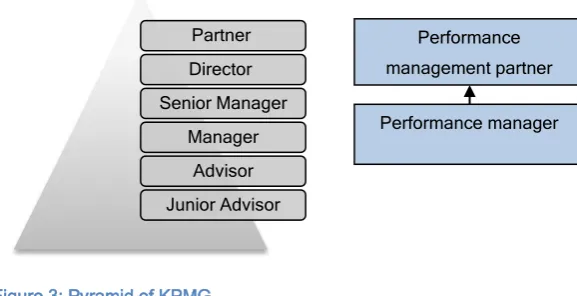
At KPMG Advisory, many HR practices are devolved to the line. Performance managers are responsible for implementing and executing several HR practices at the operational level and can be seen as FLMs. Performance management is not a position, but an additional function. Hence, performance managers are not part of the hierarchical structure as shown in Figure 3. Performance management is a separate function, supervised by a performance
[image:27.595.220.509.412.560.2]management partner. To be (or become) a performance manager, it is required to have a position which is at least one level higher in hierarchy than the function of the subordinate (e.g. a director can be the performance manager of an senior manager) and to successfully complete relevant trainings. Each performance manager supervises 5 – 15 employees.
Figure 3: Pyramid of KPMG
The relationship between performance managers and employees needs some further explanation. Performance managers can be seen as FLMs because they are the managers to whom non managerial employees report and they supervise the work of operational employees. However, not always on a daily basis and in two different roles. During many (external) projects, employees work together with their performance manager. In the case of projects, collaboration is not based on their additional function as performance manager but as part of their regular (hierarchical) position in the organization. Employees who are
performance managers fulfil two separate roles and would wear two hats, one as advisor, (senior) manager, director or partner and one as performance manager.
Partner
Director
Senior Manager
Manager
Advisor
Junior Advisor
Performance management partner
27
The authority of performance managers makes the relationship quite different. Performance managers are responsible for yearly appraisals and rewards of their employees which can result in an artificial relationship between performance manager and employee. Political interests and mutual benefits at stake are considerable. It can lead to “liking as bias” (Turban et al. 1990, p. 216). There is empirical evidence (Cardy & Dobbins, 1986; Tsui & Barry, 1986) that personal liking of a reviewer for the person reviewed directly biases the evaluation of the person reviewed’ performance by the reviewer. It supports the argument that supervisors (or performance managers) evaluate liked subordinates more positively than disliked subordinates, or the other way around: subordinates with a more positiveperformance are liked more by their supervisor (or performance manager) (Turban et al., 1990). A possible consequence is that employees want to be in a person’s good graces to become a preferred subordinate of their performance manager.
It is important to keep the special nature of the relationship in mind, because it can influence the results in this study, due to subjective views and social desirable answers of employees about performance managers.
Performance managers at KPMG are responsible for: performance management (annual plans, interim + year end reviews, talent reviews, appraisals, rewards and promotions etc.), health & well-being (preventions, support, interest), planning & project executions, training & development, coaching of employees and employee turnover. Performance Managers have to possesses different competences. They must be able to build relationships, to develop people and to make impact and they also should be driven and resilient.
Each performance manager gets 100 fixed hours and 15 hours per employee on a yearly base to fulfil their role. An HR-manager and HR-advisor assist the performance managers in implementing and executing HR practices.
In many HR practices collaboration between the HR department and performance managers takes place, for example in recruitment and selection, prevention of absenteeism, career planning and labour-disputes. Other practices are still the responsibility of the HR
department, like signaling trends on the labor market and modifying the HR - policy.
3.2
Procedure
After having selected measures (described in section 3.3), individual appointments were planned between the researcher and the nine performance managers to reduce the
28
and to gather information about performance management at KPMG. It was important for this research to link the completed questionnaires of employees to the completed questionnaires of their managers, which might raise doubts about confidentiality and anonymity. This link is crucial for two reasons: (1) to explore whether the presence or absence of the fiveconstraining / effectiveness factors influence the perceived effectiveness by employees. and (2) to judge the type of relationship (LMX) between performance manager and the
subordinates. During the meeting, the agreement was made that questionnaires would be treated confidentiality. There would not be reported in a manner in which results can be reduced to individuals.
The first meeting with performance managers is also utilized to get a picture of obstacles performance managers experience in fulfilling their role. The aim was to provide qualitative information to reinforce (or weaken) the results found by quantitative measures. The meeting can be categorized as an informal conversation interview (Gall et al., 2003). The purpose was to rely “entirely on the spontaneous generation of questions in a natural interaction” (p. 239). With this approach, researchers do not ask any predefined questions, but rely on the interactions with participants to guide the process of interviewing. This type of interview is by many considered as beneficial for two reasons: (1) the lack of structure, which allows for flexibility. Furthermore, (2) due to the informal nature informants may sometimes forget that they are being interviewed which reduces social desirability.
Similar meetings took place with 15 (of the 61) employees (subordinates). The employees were selected on availability, also known as convenience or opportunity sampling (Marshall, 1996). It means that an employee is selected because he or she was ‘near to the hand’ and readily available. It is an easy and convenient way of (non-probability) sampling for the researcher, but “does not permit any control over the representativeness of the sample” (Babbie, 2010, p. 192) The aim was to gather information about their experiences and satisfaction with performance managers. The same freewheel style of interviewing as in the case of the performance managers was chosen because of the advantages described above. The qualitative information will be compared with the (quantitative) results of the questionnaire to reinforce (or weaken) results. The results of the interviews with performance managers and employees and the comparison with the quantitative data will be described in section 4.7.
29
easiness in answering questions (rapidly in use) and the real time statistical compilation forthe researcher.
Quantitative data collection took place in two phases. In the first phase, the performance managers in the sample received an email notification with a short letter of information and the link to the survey. Performance managers were asked to fill in the questionnaire within two weeks. After that, individual reminders were sent to the participants who did not complete the questionnaire yet. In a time period of three weeks, all the performance managers completed the online questionnaire.
In the second phase, all the employees in the sample received an email notification with a letter of information about the survey, anonymity and confidentiality, the link to the survey and the request to complete the questionnaire within two weeks. Beside employees, performance managers were part of this sample. They also have a performance manager that manages them. After two weeks, the response rate was quite low (just around 30%). A first reminder to participate within a week was sent to the employees who did not completed the questionnaire yet. After a week, the response rate was still just 40%. To increase the response rate, a second reminder and a short letter was sent by the performance manager partner to all employees who did not complete to survey with the friendly request to complete the questionnaire as soon as possible. In a time period of four weeks, a response rate of 61% was achieved. According to Babbie (2010) a response rate of 60% or higher can be considered as good.
3.3
Research population
Participants in this study were 61 matched performance managers/subordinates of the accountable unit Public Sector (PS). All the (61) employees working for PS (population) are part of this study. So, the sample contains all the members of the total population. This implies that the quality of the intended sample has the same distribution of characteristics as the population, which makes the intended sample representative (Babbie, 2010).
Performance managers (PM)
On the 1st of September 2011, there were 249 performance managers at KPMG Advisory give the employees as well. However, since this research is limited by KPMG to one department only, the accountable unit Public Sector, the population in this research is 61, that is all the employees working for this unit. The population and sample contains 9
30
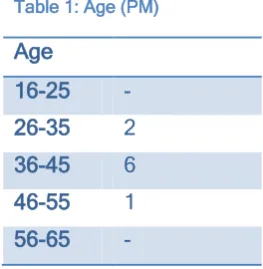
40.6 years (SD 5.47). Table 1 contains additional information about the age distribution of [image:31.595.65.197.125.260.2]performance managers.
Table 1: Age (PM)
Age
16-25 - 26-35 2 36-45 6 46-55 1 56-65 -
All the performance managers are highly educated. One performance manager finished higher vocational education as highest, eight performance managers finished university.
[image:31.595.63.534.392.470.2]The performance managers are distributed among several locations which are figured in Table 2.
Table 2: Locations (PM)
Arnhem Groningen Den Haag Other locations
Total
Performance Managers
3 1 5 0 9
For anonymity reasons, no distinction in location will be made in the analysis. The years of experience as performance manager are listed in Table 3.
Table 3: Years of experience (PM)
Years of experience as performance manager
0-1 years 0 1-2 years 1 2-5 years 5 6-10 years 3 Longer than 10 years 0
31
Employees ( E)The population consists of 61 employees. All the employees working for PS (subordinates and performance managers). This is so, because performance managers themselves also have a performance manager that manages them, so they also have to fill in the
questionnaire inform their role as a subordinate. In total, 37 employees completed the questionnaire, so our realized sample is 37 (61% response rate). As mentioned earlier, a response rate of 61% can be considered as good. As response to this survey was
confidential, no information is obtained about non-responders. Non-response may create potential bias if the answers of respondents differ from (potential) answers of persons who did not fill in the questionnaire However, confidentiality was important to minimize social desirability and maximize the response.
70.3% of the respondents is male, the others are female (29.7%). 94.6% of the respondents work on a permanent contract, 5.4% indicated that they have a temporary contract. The employees are working on different locations which are figured in Table 4
Table 4: Locations (E)
Amstelveen Arnhem Breda Den Haag
Groningen Zwolle Total
Employees 4 12 1 15 3 2 37
3.4
Measurement
As mentioned in the previous section two questionnaires were used to measure the independent variables and the dependent variable (see appendices 1 and 2). The five constraining factors (independent variable) were part of the questionnaire for performance managers. The perceived effectiveness of HR implementation and the subordinate version of LMX were part of the questionnaires for all employees. Both questionnaires were composed based on existing scales and constructs from previous studies to assure reliability and validity.
Independent variable: experienced limitations in HRM implementation
In order to measure the limitations that performance managers can experience in their work and to what extent these factors hinder them, Bos-Nehles (2010) developed a questionnaire to investigate how the five limitations are perceived by line managers (performance
32
spend on the HR tasks to achieve an optimal result (less time to more time). The questions in the first part of the questionnaire were measured on a three point scale.In the second part of the questionnaire, the five hindering/effectiveness factors desire, capacity, competences, support and policies & procedures were measured. Bos-Nehles (2010) operationalized these five factors in different constructs. Desire (16 items) is based on the constructs intrinsic motivation, identified motivation, amotivation and value added.
Capacity (7 items)is based on the construct role-overload and consists of 7 items.
Competences (10 items)is operationalized in the constructs occupational self-efficacy, and training & experience. Support (18 items) consists of the constructs: reliability,
responsiveness, assurance and empathy. Policies & Procedures (23 items) is based on the constructs role conflict, role ambiguity, and user friendliness of HR forms. Each item (74 in total) was measured on a five-point Likert scale ranging from 1 (disagree ) – 5 (agree) . For example, the construct desire contains statements related to why they (FLMs) are involved in the execution of HR tasks, like: ‘Because I always give human interest priority to business interests’ which can be answered on a scale from 1 (disagree) – 5 (agree). Policies & procedures consists of items about experiences with policies & procedures, e.g.: ‘I work under incompatible HR policies and HR guidelines’ which can be answered on a scale from 1 (disagree) – 5 (agree) etcetera. The reliability of the scales in the original research and this study of KPMG is described in section 3.4.
Alternative explanation: Quality of relationship supervisor/subordinate
As mentioned earlier, the quality of the relationship between FLM/subordinate can be explained and measured by the Member Exchange Theory (LMX). The Leader-Member Exchange theory (LMX) receives attention from research over 30 years and has undergone many refinements over the years. LMX is traditionally considered as a one-dimensional construct that measures the general quality of the relationship between
supervisor and subordinate (Greguras & Ford, 2006). Liden and Maslyn (1998) developed a multi-dimensional scale (LMX-MDM) based on role theory and social exchange theory. They argue that multidimensional conceptualization of LMX relationships provide insights in which aspects are (more) important for a certain outcomes and theorize that LMX relationship should be measured by four dimensions; affect, loyalty, contribution and professional.
Empirical evidence for the different LMX-scales can be found in the work of Greguras and Ford (2006). They empirically studied the utility of LMX by comparing a multidimensional scale MDM & SLMX-MDM by Liden & Maslin, 1998) to an unidimensional scale (LMX-7 and SLMX-(LMX-7 by Scandura & Graen, 1984). A study of 422 matched
33
459). In this research, the unidimensional LMX- scales will be applied for different reasons.First of all, both measures are valid, although they are not interchangeable. Unidimensional measures account for unique variance above multidimensional measures, and vice versa which means that both measures uniquely predict criteria (Greguras & Ford, 2006, p. 459). Furthermore, “the multidimensional LMX scales may be deficient in measuring the LMX construct given that the unidimensional measures accounted for incremental variance in criteria above that of multidimensional measures” (p.459). This means there is no evidence that measuring LMX by four dimensions provide useful insights above unidimensionality. The unidimensional scale of LMX measures three dimensions: respect, trust and obligation (Graen & Uhl-Bien, 1995). These dimensions are so highly correlated that they can be measured with the single (unidimensional) measure of LMX (Graen & Uhl-Bien,1995).
Beside these scientific arguments, there are some practical reasons for using a
unidimensional LMX-scale. For this research, a Dutch validated LMX-questionnaire (Janssen & van Yperen, 2004) is used. It contains seven items (see appendix 2) of the member
version of Leader-Member Exchange questionnaires developed and applied in prior research (Scandura & Graen, 1984; Janssen & van Yperen, 2004). Subordinates indicated the seven items on a five point Likert scale ranging from 1 (low extent) to 5 (high extent), characterizing the quality of their exchange relationships with their supervisor. The reliability of the scales in the original research and this study of KPMG is described in section 3.4.
Dependent variable: Perceived effectiveness of HRM implementation
The effectiveness of HRM implementation measures the satisfaction of employees with the HRM implementation and the execution of HR tasks by their FLM (Bos-Nehles, 2010). So, the effectiveness of HRM implementation is measured from the employees’ perspective. The satisfaction of employees is operationalized and measured (Bos-Nehles, 2010; based on Truss, 2001) on five HR-practices: personnel administration, recruitment & selection, career management, evaluation & rewarding and people management. The 25 items were
measured on a five point Likert-scale ranging from (1) dissatisfied to (5) satisfied. The reliability of the scales in the original research and this study of KPMG is described in section 3.4.
Additional control variables
34
span of control were included as parameters to neutralize or control the effect of thosevariables.
In the questionnaire for employees the variables age, gender, level of education, experience at KPMG and under current performance manager and type of contract were added as control variables.
3.5
Reliability analysis
[image:35.595.67.483.376.557.2]To test the homogeneity and internal consistency of the items, reliability analyses on the sample of KPMG were performed. The Cronbach’s Alpha (α) is commonly used as measure for internal consistency and reliability of items. Cronbach’s Alpha gives measures the extent to which items in a scale measure the same construct. In general, an (α) of .70 or higher is acceptable (Field, 2009). In the tables 5, 6 and 7 is shown that all the constructs have a (α) of .70 or higher which provides enough strength to rely on those measures.
Table 5: Reliability analysis constraining factors
Construct Cronbach’s Alpha (α)
(in study KPMG)
Cronbach’s Alpha (α)
(In original research: Bos-Nehles, 2010)
Constraining/
effectiveness factors
Desire .74 .78
Capacity .79 .84 Competences .71 .76
Support .98 .87
Policies & Procedures
35
Table 6: Reliability analysis perceived effectivenessTable 7: Reliability analysis LMX
Scales Cronbach’s Alpha (α)
(in study KPMG)
Cronbach’s Alpha (α)
(in original research: Janssen & van Yperen, 2004)
Leader-Member Exchange
(Unidimensional)
Subordinate .94 .93 Construct Cronbach’s Alpha
(α)
(in study KPMG)
Cronbach’s Alpha (α)
(in original research: Bos-Nehles, 2010)
Perceived effectiveness
of HR Implementation
Personnel administration
.76 .64
Recruitment & selection .85 .78 Evaluation & rewarding
of employees
.90 .87
36
4.
Results
In this chapter, the results of the analyses will be described and the sub questions of this thesis will be answered. The first part of the chapter contains results of the quantitative results. In the last section, the qualitative contribution is described.
4.1
Data analysis
First step in analysing the data was to generate a data set of the performance managers and a data set of the subordinates by exporting the data out of the online survey tool into SPSS. After that, reliability analyses were performed for the different variables which are already described in the previous section. To create reliability analyses (and reliable statistics) several questions needed to be reversed coded because the questions are negatively formulated instead or positively. The next step was to generate descriptive statistics for both groups by creating frequency tables, calculating means, standard deviations and variances in the two datasets. The descriptive statistics were calculated per construct (e.g. capacity, competences) and for the constructs together. For some questions, respondents had the possibility to answer ‘I do not know’ or ‘not applicable (n/a). Those answers were categorized as missing values. There was chosen for working without missing values, because any assumption made regarding the values could introduce the potential for bias or error.
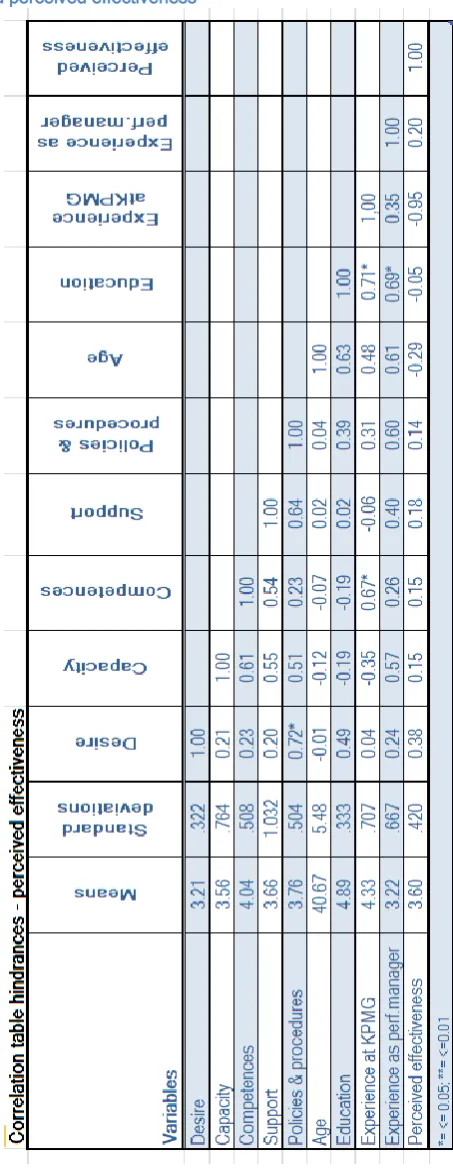
In order to generate analyses about the relationship between FLMs limitations’ (independent variable) and the perceived effectiveness of HR implementation (dependent variable) and about the relationship between the leader-member exchange (independent variable) and the perceived effectiveness of HR implementation both data sets were merged and the data of the performance managers and their subordinates were matched. Correlation analyses were performed to measure the relationship between the different variables.
4.2
Performance managers limitations’ in HRM implementation
To measure the extent to which performance managers experience possible limitations in the implementation of HR practices, performance managers were asked to rate how much the factors desire, capacity, competences, support and policies & procedures constrain them in performing HR tasks.
37
Although 3 is the middle of the scale, a score of 3 is not that positive. A score of 3.21 (desire) means that performance managers do not dislike or hate the execution of HR tasks and responsibilities, but they are also not eager to perform them. [image:38.595.71.276.184.350.2]
Table 8: Means independent variable
Constraining factors
M
ea
ns
S
tan
da
rd
de
viat
ion
s
Desire 3.21 .322
Capacity 3.56 .764
Competences 4.04 .508
Support 3.66 1.032
Policies &
procedures 3.76 .504
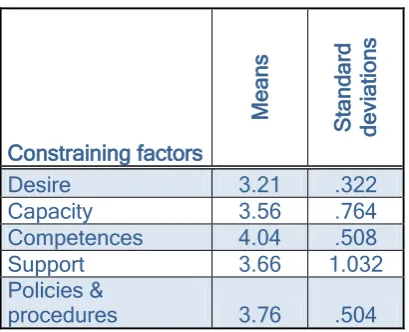
The means in Table 8 show the results for the independent variable. It can be seen that the five (constraining) factors do not really hinder performance in the implementation of HR practices. A mean score of 1 means that the factor is a constraint, a mean score of 5 represents the factor is no constraint for performance managers. Four of the five factors score means above the middle of the scale (3). Noteworthy is that the statements in the questionnaire were positively formulated.
However, it means that the factors desire, capacity, competences, support and policies and procedures do not hinder performance managers in the implementation of HR tasks, from performance managers’ point of view. They do not experience a lack of desire (mean 3.21) nor a lack of capacity (mean 3.56) in executing their HR tasks and they consider themselves as competent (mean 4.04). Performance managers are satisfied with the support of the HR department (mean 3.66). Though the standard deviation of support is relatively high, which indicates a wide range in scores on this construct. It implies that there are substantial differences among performance managers about the received support from the HR department. It means that some performance managers experience a lack of support as hindering factor, while others do not. Furthermore, the results show performance managers are satisfied about the policies & procedures regarding their HR tasks & responsibilities and that their roles are clear (mean 3.76).
38
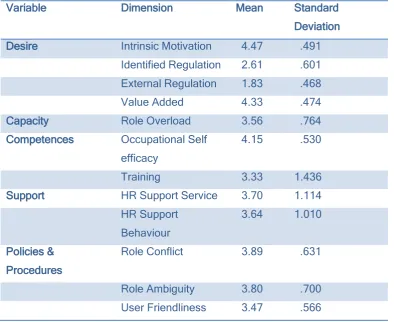
Table 9: Means independent variable per dimensionVariable Dimension Mean Standard Deviation Desire Intrinsic Motivation 4.47 .491
Identified Regulation 2.61 .601 External Regulation 1.83 .468 Value Added 4.33 .474 Capacity Role Overload 3.56 .764 Competences Occupational Self
efficacy
4.15 .530
Training 3.33 1.436 Support HR Support Service 3.70 1.114
HR Support Behaviour
3.64 1.010
Policies & Procedures
Role Conflict 3.89 .631
Role Ambiguity 3.80 .700 User Friendliness 3.47