Anonymous attestation with user-controlled linkability
D. Bernhard
G. Fuchsbauer
E. Ghadafi
N.P. Smart
B. Warinschi
Dept. Computer Science, University of Bristol, Merchant Venturers Building,
Woodland Road, Bristol, BS8 1UB,
United Kingdom.
{bernhard,georg,ghadafi,nigel,bogdan}@cs.bris.ac.uk
Abstract
This paper is motivated by the observation that existing security models for Direct Anonymous Attestation (DAA) have problems to the extent that insecure protocols may be deemed secure when analysed under these models. This is particularly disturbing as DAA is one of the few complex cryptographic protocols resulting from recent theoretical advances actually deployed in real life. Moreover, standardisation bodies are currently looking into designing the next generation of such protocols.
Our first contribution is to identify issues in existing models for DAA and explain how these errors allow for proving security of insecure protocols. These issues are exhibited in all deployed and proposed DAA protocols (although they can often be easily fixed).
Our second contribution is a new security model for a class of “pre-DAA scheme”, i.e., DAA schemes where the computation on the user side takes place entirely on the trusted platform. Our model captures more accurately than any previous model the security properties demanded from DAA by the Trusted Computing Group (TCG), the group that maintains the DAA standard. Extending the model from pre-DAA to full DAA is only a matter of refining the trust models on the parties involved.
Finally, we present a generic construction of a DAA protocol from new building blocks tailored for anony-mous attestation. Some of them are new variations on established ideas, and may be of independent interest. We give instantiations for these building blocks that yield a DAA scheme more efficient than the one currently deployed, and as efficient as the one about to be standardised by the TCG which has no valid security proof.
Contents
1 Introduction 1
2 Issues in existing security models for DAA 3
2.1 Simulation-based models . . . 4
2.2 Game-based models . . . 6
3 Security models for pre-DAA 6 3.1 Syntax . . . 6
3.2 Security definitions . . . 8
4 From pre-DAA to full DAA schemes 12 5 Adding authentication to a DAA scheme 14 6 Building blocks 14 6.1 Randomizable Weakly Blind Signatures . . . 15
6.2 Linkable Indistinguishable Tags . . . 18
6.3 Signature proofs of knowledge . . . 18
7 A pre-DAA scheme in the random oracle model 19 7.1 Proof of Theorem 1 . . . 20
8 Instantiating the Primitives 24 8.1 Mathematical preliminaries . . . 24
8.2 CL signatures and the LRSW assumptions . . . 25
8.3 Non-interactive zero-knowledge proofs . . . 27
8.4 Two example Randomizable Weakly Blind Signature schemes . . . 27
8.5 An example of Linkable Indistinguishable Tags . . . 29
9 An example DAA and pre-DAA scheme 31
1
Introduction
Direct Anonymous Attestation (DAA) [4] is one of the most complex cryptographic protocols deployed in the real world. This protocol, standardised by the Trusted Computing Group (TCG), allows a small embedded processor on a PC motherboard, called a Trusted Platform Module (TPM), to attest to certain statements about the configuration of the machine to third parties. One can think of this attestation as a signature on the current configuration of the embedding machine. The key requirement behind DAA is that this attestation is done in a way that maintains the privacy (i.e. anonymity) of the machine. The large scale of TPM distribution (there are about 200 million TPMs embedded in various platforms), and the potential for interesting applications that rely on trusted computation, triggered a significant research effort on DAA security [4, 6, 5, 7, 8, 18, 20, 19, 21, 22, 17].
This paper is motivated by the observation that all existing security models for DAA are deficient: they are either unrealisable in the standard model, do not capture some of the required functionality of the scheme or, worse, do not cover all realistic attack scenarios. In fact, even the existing deployed protocol [4] does not possess security properties one would expect given the informal description of what a DAA scheme enables. The reason for this is that the underlying security model in [4] does not capture certain desired properties. The main contribution of this paper is a security model for DAA that improves on all of these points. In addition, we give a construction which we prove secure with respect to our model. Our construction is in terms of abstract building blocks that we identify in this paper and which, for efficiency, we instantiate in the random-oracle model. Below we put our work in context and detail our results.
Issues in existing security models for DAA.Existing models for DAA are informed by the TPM standard put forth by TCG [36]. This standard reflects some intuitively appealing security guarantees but, like many other industrial standards, the specification is fuzzy in important respects. Some of the aspects that are left open to interpretation have unfortunately been imported by the more rigorous formal security models for DAA. Our first contribution is identifying significant shortcomings in all of the existing models. In brief, we argue that current models may allow security proofs for schemes against which attacks considered by TCG as complete breaks may still exist; indeed, the deployed scheme from [4] is such an example.1 Our findings in relation to security models apply to both the original simulation-based model [4], including later attempts to enhance security [21], as well as the more recently proposed game-based models [6, 18]. In Section 2 we detail some of the problems with the model of [4], still considered to be the quintessential model for DAA.
We note that our findings regarding the models do not imply that schemes analysed with respect to them are necessarily insecure. Nevertheless, we show that the underspecification of the execution setting in [4] allows for situations where attacks against the scheme are possible.
New model. In light of the above discussion, it is fair to say that all of the existing models proposed so far for DAA security raise various issues as to applicability, sometimes in several respects. The absence of a good model is however critical for a rigorous analysis of any new anonymous attestation protocols: currently, TCG is in the process of specification of the next generation of TPMs. Without a complete formal model against which their goals can be compared the mistakes of the past are likely to be repeated. The main contribution of this paper is a security model for direct anonymous attestation. We leave most of the discussion of our model and the design decisions that we took for Section 3 and here we only highlight some of its more important aspects.
We chose to formalise our notion using game-based definitions rather than simulation. Our choice was moti-vated not only by some of the criticism generally applicable to simulation-based security (sensitivity to adaptive corruption; sometimes too strong to be realisable). We also felt that specifying the different security properties separately leads to a better understanding of what DAA should achieve. Despite occasional claims to the contrary, for complex interactions and requirements, specifying security through a single ideal specification is not always clearer, or cleaner, than through cryptographic games. The problems that we have uncovered in the simulation-based definition of [4] support our claim. They show that it is in fact quite difficult to assess whether a given functionality does capture the desired security properties despite years of scrutiny.
To simplify the understanding of how we model the security properties of DAA schemes, we proceed in two steps. First, we eliminate the need for complex trust scenarios involving three parties (the Host, the TPM, and the Issuer) and model the TPM and the Host as a single party in the system (as opposed to separate entities). On the one hand, this reduces the complexity of the model (avoiding three-party protocols and the associated complex trust). On the other hand, the resulting model directly captures the security of DAA protocols where the
1Note that repairing [4] to avoid our problem is trivial, and whether one considers our observation to be an “attack” depends on one’s view
computation is performed entirely by the TPM (but whose input comes from the Host). For example, the DAA protocol for Mobile Trusted Modules (MTMs) falls in this class. To clearly reflect that our models do not directly deal with three-party protocols, we call this primitive pre-DAA. In a second step we explain how to turn pre-DAA models into models for full DAA by considering slightly more refined trust settings where it is not the case that the Host and the TPM are both either simultaneously honest or simultaneously corrupt. An additional benefit of our simplification is that it allows for simpler design of DAA schemes: start with the design of a pre-DAA scheme and then, if needed, “outsource” the non-sensitive data storage and computation to the Host.
Past DAA models (and those that we develop here) are inspired by models for group signatures [10, 12]. The trickiest issue to deal with (and one where past models are lacking) is the concept of an “identity”. Unlike in group signatures, where parties are assumed to possess certified public/secret keys, the identity of a TPM is more difficult to define, as it does not possess any public key for the underlying group signature. Parties do however possess public authentication keys (called endorsement keys) which, as a security requirement, are not allowed to be linked to any public data used in the group-signature-like functionality. Yet, specifying an identity is crucial in defining security notions like anonymity, non-frameability etc. for group signatures. In previous models this issue was treated rather superficially and led to ambiguities in definitions. In contrast, we avoid similar problems by making the identity of a TPM a well-defined object (albeit information-theoretically).2
Our model for pre-DAA schemes does not explicitly capture how an issuer authenticates a TPM, as this ques-tion is somehow orthogonal to the main funcques-tionality of a DAA protocol. As this is nevertheless an important issue for the use of TPMs in practice, we discuss various ways of authenticating this channel, paying particular attention to the types of authentication which have been opted for by the TCG group in relation to DAA.
Construction. Our final contribution is a construction of a pre-DAA scheme proven to satisfy our security def-initions in the random-oracle model. Our construction is built generically from two building blocks: a weak blind-signature scheme and a tagging scheme with special properties. We introduce the syntax and the security requirements we demand from these building blocks in Section 6 and give details of their security models as well as efficient constructions in Sections 8.4 and 8.5. The generic construction of our pre-DAA scheme is given in Section 7 and a concrete instantiation obtained by instantiating the building blocks is spelled out in Section 9. Using our methodology, we show how to turn our scheme into a fully fledged DAA scheme in Section 4.
Our protocol is highly efficient and fully practical. In terms of efficiency our scheme is virtually identical to that presented in [21]. Implementation results in [22] show that the scheme in [21] is significantly faster than the RSA-based scheme from [4], and hence these results will carry over to our own proposal. Our scheme has thus all the computational benefits of the one discussed in [21, 22], yet it comes with a fully developed security model and a proof that it satisfies the model. We note that we could not prove the security of the scheme of [21] (which has only been proved secure with respect to a flawed model) within the model of the current paper.
Our construction, following closely that of [21] (but being secure with respect to a well defined model), inherits the design heritage of that scheme and indeed others. Our use of a tag to obtain the linking functionality between signatures, group signatures and credential systems appears in various prior work [1, 24, 32, 35]. Indeed, all existing pairing-based DAA schemes [6, 5, 7, 8, 18, 20, 19, 21, 22, 17] use exactly the same tag derived from BLS signatures [9]; our abstraction of the required functionality may however lead to new constructions.
Our basic group-signature-like construction again closely follows the prior work on pairing-based DAA, and is itself closely related to the group-signature construction by Groth [30]. However, by identifying the joining protocol as a variant of a blind-signature issuing, we bring to the fore the need for the issuer to provide a proof of knowledge, rather than the user, as in [21] etc. The fact that the proof of knowledge is the wrong way round is the key reason we are unable to show the protocols in [21] etc are secure.
The paper is organized into essentially two parts; the first part deals with definitional issues related to DAA, whilst the second relates to a practical instantiation.
In more detail the first part is structured as follows: In Section 2 we first discuss issues and problems in existing security models for DAA protocols, we present an overview of why our security model corrects, simplifies and expands on previous models. We then, in Section 3, describe our new security model for a pre-DAA scheme. Since a pre-DAA scheme is not a full DAA scheme we then turn, in Section 4, to show how a pre-DAA scheme can be turned into a DAA scheme by considering the Host as a mechanism for outsourcing storage and computation for the TPM. A key issue which still needs to be addressed is how the TPM authenticates itself to the host; so to ensure a complete treatment in Section 5 we briefly turn to this issue and show how existing solutions for this fit
2Interestingly, most of the added complication is due to the TCG’s requirement that holders of secret keys should be able to revoke their key
Scheme Setting Join\Issue Notes
Issuer Host TPM
[4] RSA E4+ 4E+E2
Γ E2+E+EΓ 2E3+ 3EΓ Attack on linking basenames (which is eas-ily corrected). However, unclear whether other issues remain as the model used does not pick this up.
[5, 6] Sym 2EG+ 2EG2 6P 3EG Not as a complete security model as in this
paper.
[18] Asym E2
G1+EG1 EG2+ 2P 2EG1 Not as a complete security model as in this paper.
[21] Asym 2EG1+ 2E2
G1 4P 3EG1 Security model invalid, thus proof not
valid.
[22] Asym 2E2
G1+ 3EG1 4P 3EG1 Security model invalid, thus proof not
valid.
Ours Asym E2
G1+ 5EG1 2E 2
G1+ 4P EG1
Scheme Signing Verification
Host TPM
[4] E4+ 2E3+E2+E+EΓ E3+ 3EΓ E6+ 2E4+EΓ2+EΓ
[5, 6] 3EG+EGT + 3P E2
GT +2EGT E
3 GT +E
2 GT + 5P
[18] EG1+E3
GT 2EG1+EGT E
2 G1+E
2 G2+E
4 GT +P
[21] 3EG1+P 2EG1+EGT EG3
T +E
2 G1+ 5P
[22] 4EG1 3EG1 2E
2
G1+EG1+ 4P
Ours 4EG1 3EG1 2E2
G1+ 4P
Table 1: Efficiency comparison
into our framework.
In the second half of the paper we turn to showing that our definition of a pre-DAA scheme can be realised efficiently in practice. As remarked above our construction of an pre-DAA scheme scheme is “generic”, in that we base it on sub-components which we combine together via a general theorem. In Section 6 we present an overview of the three components; namely a form of blind-signature, a special tagging algorithm and signature proofs of knowledge. We then in Section 7 present our generic construction of a pre-DAA scheme, with a proof of security with respect to our prior definitions. Having presented a generic construction, all that remains is to instantiate our components which is done in Section 8. Finally in Section 9 we present the precise instantiation of our pre-DAA scheme and DAA schemes using these components.
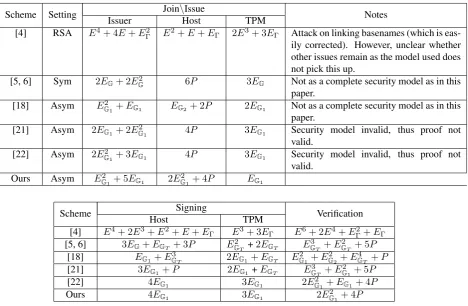
In Table 1 we show how our scheme compares to existing schemes from the literature. The notation used in the table is as follows: E denotes (modular) exponentiation;En denotesnsimultaneous exponentiations, i.e. computing sayab1
1 · · ·a
bn
n , which is faster to implement than doingnseparate exponentiations; when we write EG, we mean the exponentiation is in groupG;P is short for pairing evaluations. The cost of verification does not include the extra checks used to detect if the signature is by a rouge TPM. For each scheme we say whether it is based on RSA, symmetric or assymetric pairings. Please note that RSA groups are not directly comparable to elliptic curves; and for the scheme from [4] we useEfor a group exponentiation modnwherenis the main RSA modulus andEΓ for an exponentiation modΓ, an additional parameter of the scheme. A concrete comparison of [4] and [22] can be found in [22], and this can be used to infer a more concrete comparison between the RSA based scheme of [4] and all of the pairing based schemes. From the table it is clear our scheme is the most efficient with respect to the computations of the TPM, and is comparable to almost all the other schemes in other respects. This comes with the added gaurantee of fully worked out security models and proofs.
2
Issues in existing security models for DAA
[image:5.595.73.542.69.375.2]maintained by an issuer, by executing a join protocol. We assume that the execution of the protocol takes place over an authentic channel; in particular, there is no notion of a user public key. However, each user has a secret key and the result of the joining protocol is some sort of credential associated to this secret key, to be used later as a signing key. In practice, one expects that a user would generate a distinct secret key for each group he joins. How the distinct secret keys and authentic channels are provided in practice is dealt with in Section 5.
Once the user has joined, he can produce signatures on behalf of the group, much like in group signatures. These signatures should generally be unlinkable, so as to guarantee anonymity. However, a form of user-controlled linkability is provided. In particular, there is a parameterbsn(forbasename) passed to the sign and verify algo-rithms, which controls linking of signatures. Ifbsn=⊥then the resulting signature should be unlinkable to any other; but ifbsn6=⊥then signatures from thesamesigner with thesamebsnshould be linkable. Unlike for group signatures, there is no group opener who can revoke the anonymity of a signer. However, the current TCG spec-ification requires that it be possible to locally detect if a signature has been produced by a user whose secret key has been compromised. We interpret this as essentially requiring that it be possible to identify if signatures were produced by a TPM with a given secret key. This mirrors the use of a so-calledRogueListin DAA schemes and the variant of Verifier-Local Revocation (VLR) [11] in group signature schemes. However, the data entries used to determine a compromised user are the long-term user private keys, and not some information which can be linked back to the user’s identity as for VLR. Note that the issuer has no control over who is placed on theRogueList, as the issuer does not have access to the underlying keys, and hence a pre-DAA scheme is simpler than a standard VLR group signature in this regard. In some sense a user is the only person able to revoke his own secret key.
In the following we argue that all of the existing models for DAA fail to capture one or more of the security properties desired by the TCG. The focus of this paper is on new models and constructions, so we only devote space to [4] for which we describe in detail one problem.
2.1
Simulation-based models
The original security model for DAA [4] is based on simulation (in the sense of universal composability (UC)). In line with the TPM standard, the ideal functionality designed to capture the security of the protocol allows (and in fact demands) for the signing/verification process to be interactive. As explained above, transactions of a TPM with the same basename and secret key should be linkable via a “linking” algorithm. The ideal function-ality captures this requirement only indirectly: when a transaction occurs, the ideal adversary is provided with a pseudonym for the TPM involved in that transaction and this pseudonym can later be used to link with other transactions of the same TPM.
A crucial observation is that granting thesimulatorthe capability of linking transactions (via an extra operation on his interface to the ideal functionality) has no implications on the linkability of an actual implementation of the protocol! Indeed, nothing prevents a simulator from enjoying capabilities not present in the real protocol; granting the simulator (but not the environment, via honest parties) extra capabilities can only make an actual realisation easier to achieve.
The problem stems from the fact that the interface of the ideal functionality does not allow the environment explicit access to a linking algorithm, and thus the ideal functionality does not capture any security requirements on such an algorithm. As further evidence for this assertion, consider some protocol that realises the ideal func-tionality of [4]. Then the same proof of security still applies if one adds to the protocol specification an arbitrary linking algorithm, even one that links all transactions or one that links none. The obvious conclusion is therefore that the way in which the functionality of [4] captures controlled linkability (as demanded by the standard) is un-fortunately flawed. Later attempts to rectify this problem [20, 19, 21] failed. For the particular ideal functionality defined in [21] it is trivial to distinguish between the ideal and the real world. This succession of failures led authors to consider game-based models.
This problem is not just of academic interest: the currently deployed DAA protocol from [4] is based on this flawed model of linking. Security engineers often refer to DAA as providing a signature functionality, but when interpreted in this way, the scheme from [4] suffers from an attack which we describe below. We also explain that the attack may not exist in other execution scenarios where DAA is interpreted as an authentication process. We show how to fix the protocol to completely avoid the attack. However, the attack is due to the underspecification of the execution model on which the security definition of [4] relies, so clearly a precise security model for DAA protocols is needed.
In essence the simulation-based model in [4] is a model of an authentication protocol, not of asignature
protocol. Indeed, if the verifier maintains sessions, uses nonces as session identifiers and fixes a single basename at the start of each session that he expects a signature for, we will never be able to “replay” a signature. However, if the signatures are generated and verified interactively what does it mean for signatures to be linkable? Since interaction implies that linkability is relative to a given verifier at a given point in time. Yet one can imagine many situations in which a signer may want to link signatures to a number of verifiers, but if signatures are not long lived it is hard to see what this means.
Indeed, if the resulting scheme from [4] is used in a situation where the signatures are not verified interactively then there is an attack against the linkability: A signature for a non-empty basename will still verify if submitted for verification with the empty basename. This means we can produce a valid signature on a message/basename pair without a user’s secret key even though the user never signed this pair. The scheme could very easily be modified to defend against this attack: The basename could be added to the input of the hash used in the signature proof of knowledge. It would even suffice to add a bit that is0for an empty basename and1otherwise. Interestingly, the basename is hashed in this way in later schemes such as that of [6].
We pause at this point to stress this point: The existing DAA scheme deployed in millions of computers around the world does not meet the intuitive security guarantees one would expect of a DAA scheme. This point was not picked up in the original paper because the security model was not able to sufficiently capture the linkability requirements. This is partly due to the ambiguity over whether a DAA scheme is an authentication protocol or a signature scheme. Whilst this point may be easy for cryptographers to grasp, we do not feel the difference is sufficient for security engineers using DAA. After all if a bit-string can be intuitively used as a signature, then engineers will use it as such. This is themajormotivation for the work in this paper; to both define the security requirements correctly and simply; to ensure the outputs can be used as signatures with controlled linkability, and to also present a scheme which provably meets our formal requirements.
Although the simulation-based model of [4] is not universally composable (UC) [15], it is instructive to look at signatures in a UC setting. Following the paper of Canetti [14] on the subject, we note that in a first attempt, a signature functionality could be viewed simply as a registration functionality: The honest signer can register messages as “signed” and verifiers can query if a message was registered. Such a model is too simplistic and does not cover all applications of digital signatures; indeed in any implementation of a signature scheme, signatures can be processed in many ways: Transmitted, encrypted, even signed. It is necessary to model the signature itself as an object of some kind.
For a signature protocol to UC-securely implement a signature functionality, the outputs of the two must be indistinguishable. In other words, the signatures from the functionality must have the same distribution as those in the protocol, which at first glance looks impossible as the functionality cannot depend on an implementation of itself. This problem is overcome by letting the functionality ask theadversaryto produce either the signatures [14] or a signature algorithm [15]. While this works fine for standard signature schemes, it poses a new problem for pre-DAA as the signature must bind to a user identity (more precisely: to a secret key) yet still be anonymous. Can we give a simulation-based proof following the current UC framework? The answer is no in the plain model, for the following reason. In [25] a proof is given that UC-secure bit commitment is impossible, more specifically that given any UC functionality for bit commitment, no protocol can UC-securely implement it without further setup assumptions. Such a protocol would have to be both information-theoretically hiding and binding which is known to be impossible. This impossibility result extends to any functionality from which commitment could be derived; one of the examples given in the paper is group signatures.
A pre-DAA scheme produces signatures that are anonymous (hiding the signer) yet revocable or openable (binding to the signer). Therefore, if bit commitment could be built generically from such pre-DAA schemes then it is impossible to construct, in the plain model, a UC-secure pre-DAA functionality. Now it is easy to see that, given a pre-DAA scheme we can implement bit commitment: Let the committer pick two keyssk0 andsk1and play the role of these users. Let the verifier play the role of the issuer. The committer runs theJoinprotocol twice, first withsk0 then withsk1 in that order. The verifier saves the transcripts. To commit to a bitb, the committer signs any message and basename withskbusing the blind signature obtained while joining and gives the verifier
this signature, who checks that it verifies correctly. To revealb, the committer publishes both secret keys. The verifier identifies both transcripts, using the order they were created in to determine which key issk0and which is
sk1. Then he checks which of the two keys the signature identifies to, obtainingb.
Thus if eventually one wishes to construct DAA protocols in the plain model (i.e. with no random oracles or CRSs) then one will need to restrict to game based definitions (or at least non-UC simulation based definitions).
capturing the security gaurantees needed in our work. For example simulation based signature functionalities are known to be complex. In addition we need to capture complex linkability requirements for such signature functionalities. Thus the complexity of defining a simulation based security notion for DAA schemes is likely to be overly complex, to produce proofs which are hard to verify, and for which verifying whether the ideal functionality actually captures the intuitive security notions may be non-trivial. We are thus moved to consider game based models.
2.2
Game-based models
More recent attempts at security models for DAA resort to cryptographic games [6, 18]. As usual, such games attempt to capture (typically, one-by-one) the different security properties required by the TPM specification. These attempts also failed. Our model provides a number of advantages over the previous game-based models. Indeed, our model captures a number of attack modes and security properties which arenot coveredby the previous game-based models. We outline these below:
In the equivalent game-based DAA models of [6, 18] the issue of identification of dishonest TPMs within the model is skirted around by assuming that all adversarially controlled users have their secret keys already exposed via theRogueList. The identity of the adversarial user is then assumed to be uniquely associated with the value exposed inRogueList. However, this does not capture an attack in which an adversary can engage in a number of
(Join,Iss)protocols with an honest issuer, and then produce another dishonest user for which signatures verify. In particular, the model makes no mention of how such a dishonest user could ever be traced, even if its identity, i.e. its secret key, is eventually disclosed. Hence, the previous models assume a very strong form of static corruption in that not only the dishonest users are statically corrupted at the start, but also no new dishonest users can be created. This last point is a problem as there is no overarching PKI which is used to authenticate users as in group signatures. It is in part to deal with this last issue that we introduce our notion of uniquely identifiable transcript, so as to be able to define the identity of a user unambiguously.
In [6, 18] the game for correctness does not assume that a valid signature can be correctly identified. Hence, the models in [6, 18] are not able to argue about the correctness of theRogueTagprocess. In contrast, we will require for correctness that a valid transcript can always be validly identified. Bar these changes, the correctness definition in [6, 18] and our own one are essentially the same.
In [6, 18] there is only one game for traceability/non-frameability: The adversary wins the game if it can output a signature for an honest user which has not been the output of a signature query (a property captured by our non-frameability game), or if the adversary can come up with two signatures which should be linked but which are not (a property captured by our traceability game). The games in [6, 18] do not capture attacks in which the adversary produces two signatures which are linked, but should not be (e.g. a linking algorithm which always outputs one is correct in the model of [6, 18]). In addition, it does not capture an attack in which an adversary outputs a signature which cannot be traced when the valueskiis revealed, a feature due to the corruption model mentioned
above. Finally, in [6] the game for user-controlled traceability requires that a test is made to determine whether a signature is “associated with the same identity and basename” without defining formally what this means or how it is done.
In summary, our game-based model improves over the previous one by capturing the following notions: sig-natures should be correctly identified by theRogueTagprocess, signatures which are not linked should not be linkable, and signatures must be traceable to a specific instance of a(Join,Iss)protocol.
3
Security models for pre-DAA
We first discuss syntax and then go on to defining the security games. We present game-based security notions for pre-DAA schemes which combine notions from the game-based security models for group signatures [12] and the game-based definitions for DAA [6, 18].
3.1
Syntax
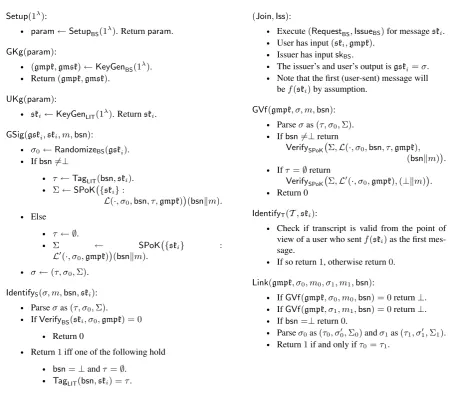
A pre-DAA scheme is given by the tuple of algorithms
pre-DAA= (Setup,GKg,UKg,Join,Iss,GSig,GVf,IdentifyT,IdentifyS,Link) .
• Setup(1λ): This probabilistic setup algorithm takes a security parameter1λand outputs a descriptionparam
of any system parameters (e.g. underlying abelian groups etc). It also sets up a public listRogueListwhich is initially set to be empty.
• GKg(param): This outputs a public/secret key pair(gmpk,gmsk)for the issuerM.
• UKg(param): This is a probabilistic algorithm to generate user private keys. When run by useriit outputs the user’s secret keyski. Unlike for group signatures, there is no notion of a corresponding user public key.
• (Join,Iss): This is an interactive protocol between a new group memberiand the issuerM. Each of the algorithms takes as input a state and a message and produces a new state and a message plus a decision in {accept,reject,cont}. The initial state ofJoinisgmpkand the private key of the userski, whilst that ofIss
is(gmpk,gmsk). The final state ofJoinis assigned togski. The issuer outputsacceptorreject. We assume that the protocol starts with a call toJoin.
• GSig(gski,ski, m,bsn): This is a probabilistic signing algorithm that takes as input a group signing key gski, a user secret keyski, a messagemand a basenamebsn, and returns a signatureσ.
• GVf(gmpk, σ, m,bsn): This deterministic verification algorithm takes as input the group public keygmpk, a signatureσ, a messagem, and a basenamebsn. It returns 1 or 0 indicating acceptance or rejection.
• IdentifyT(T,ski): This outputs1if the transcriptT corresponding to an execution of the(Join,Iss)protocol
corresponds to a valid run with the secret keyski. (Further requirements that we impose on a protocol ensure
that the result of this procedure is well-defined).
• IdentifyS(σ, m,bsn,ski): This outputs1if the signatureσcould have been produced with the keyski.
• Link(gmpk, σ, m, σ0, m0,bsn): This returns 1if and only if the two signatures verify with respect to the basenamebsn, which must be different from⊥, andσandσ0were produced by the same user.
In our security model for non-frameability a dishonest issuer will be able to accessgskivia an oracle query, thus
user security rests solely on secrecy ofski. This creates the knock-on effect of theGSigalgorithm to require both gski andski in the above syntax. This change from the standard syntax and security of group signatures is to
enable our later division of this algorithm between a TPM and a host computer in Section 4; looking ahead, the TPM will controlskiand the Host will controlgski.
Identities and pre-DAA schemes. In our security model for pre-DAA schemes we would like the users to be anonymous even in the presence of an adversarially controlled issuer, just as in the case of group signatures. However, the user identity must be linkable to signatures when passed to theIdentifySalgorithm. Yet, users have
no public keys which are bound to their identities. In standard group signatures the user private key is associated with a (certified) public key, and hence identities are a well defined notion. The problem arises in that there could be a scheme which enables a user to engage in a Join protocol using one key, but to use the obtained credential to sign with a different one, making the credential a credential on both keys in some sense. In defining security for adversarially controlled issuers this is not a problem, the problem arises when dealing with dishonest users, and trying to define security notions for revocation.
To deal with this problem we need to be able to associate a unique identity/secret key to each execution (even if the user is malicious). In brief, we ask that the joining protocol is such that if the issuer is honest and accepts after a given run of the protocol then there exists a unique secret key for the user which could have led to the given transcript, if the user had followed the protocol. We decree that key to be the key associated to the particular transcript (even if the user may not have followed the protocol). We define a notion of uniquely identifiable transcriptsto formally capture this notion.
We then require that the(Join,Iss)protocol of a (pre-)DAA scheme has uniquely identifying transcripts, so that we can associate a unique identity to each valid run, namelyski. Without such a requirement, it is hard to
envision a way to define rigorously, let alone enforce, the property (specified by the standards) that if an identity is exposed via leaking ofskiof a TPM then one can revoke signatures of that TPM. Indeed, in this situation the
secret key of a malicious TPM is not a well-defined notion. From this perspective, the transcript of the(Join,Iss)
3.2
Security definitions
In this subsection we detail our security games. All oracles (and the underlying experiments) maintain the fol-lowing global lists: a listHUof initially honest users, a listCUof corrupted users which are controlled by the adversary, a listBUof “bad” users which have been compromised (these are previously honest users which have since been corrupted), a listSLof queries to the signing oracle, and a listCLof queries to the challenge oracle. All the lists are assumed to be initially empty. The listsCLandSLare used to restrict the two relevant oracles so that one cannot trivially win the anonymity or non-frameability games respectively.
To define formally our notion of identifying an identity with a transcript we use the following notation. We writeT =T(ski, rU,gmsk, rI)for the transcript of an honest execution of the(Join,Iss)protocol by a user with secret keyskiand random coinsrUwith an issuer with secret keygmskand random coinsrI. We letGskbe the set
of all possible issuer secret keys,Uskthe set of all possible user secret keys,RU the space of randomness used by
the user in the(Join,Iss)protocol, andRIthe space of randomness used by the issuer in the(Join,Iss)protocol.
Definition 1. We say that(Join,Iss)hasuniquely identifying transcriptsif there exists a predicate
CheckT :{0,1}∗×Gsk×Usk×RI ×RU → {0,1} such that
• if both parties are honest and run(Join,Iss), with input(sk, rU)and (gmsk, rI)respectively, to produce transcriptT thenCheckT(T,gmsk,sk, rI, rU) = 1;
• for all protocolsJoin0interacting with an honest issuer protocolIss, which has input(gmsk, rI), producing
transcriptT, if at the end of the protocol the issuer accepts then there is at most one valuesk ∈Usk(but possibly many values ofrU) such thatCheckT(T,gmsk,sk,rI, rU) = 1.
Notice that the above definition does not imply thatskican be efficiently extracted from the protocol (e.g. via
some knowledge extractor), but only that there is at most one solution. Also note that we do not preclude that a different value ofskiis associated with each different transcript, i.e. it is not that theskiis unique globally, only
that each transcript has a uniqueskiassociated with it.
The abilities of an adversary are modeled by a series of oracles as follows:
• AddU(i): The adversary can use this oracle to create a new honest useri.
• CrptU(i): The adversary can use this oracle to create a new corrupt useri.
• InitU(i): The adversary can use this oracle to create a group signing key for honest useri.
• SndToI(i, M): The adversary can use this oracle to impersonate useriand engage in the group-join protocol with the honest issuer that executesIss.
• SndToU(i, M): This oracle models the situation that the adversary has corrupted the issuer. The adversary can use this oracle to engage in the group-join protocol with the honest user that executesJoin.
• GSK(i): Calling this oracle enables the adversary to obtain the group signing keygskiof useri. The user remains honest.
• USK(i): The adversary can call this oracle to obtain the secret keys of useri. Here, the adversary obtains the long-term private key in addition to the group signing key. This corresponds to the Corrupt query in the model of [6, 18]. After calling this oracle, control of partyipasses to the adversary.
• Sign(i,gsk, m,bsn): This oracle allows the adversary to obtain signatures from an honest group member, using a possibly adversarially chosengsk. It takes as input the identity of the group memberi, the group signing keygsk, a messagemand a basenamebsn. It outputs a signature of memberion this data.
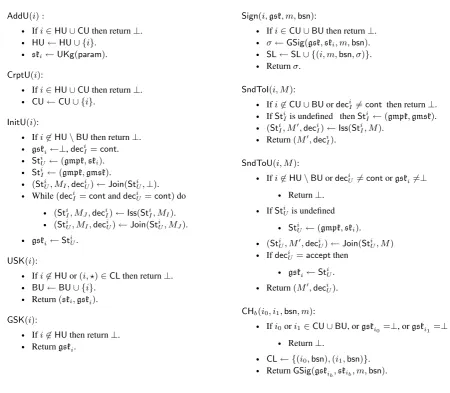
AddU(i) :
• Ifi∈HU∪CUthen return⊥. • HU←HU∪ {i}.
• ski←UKg(param).
CrptU(i):
• Ifi∈HU∪CUthen return⊥. • CU←CU∪ {i}.
InitU(i):
• Ifi6∈HU\BUthen return⊥. • gsk
i←⊥,dec i I=cont.
• Sti
U←(gmpk,ski).
• StiI←(gmpk,gmsk). • (Sti
U, MI,dec i
U)←Join(St i U,⊥).
• While(deciI =contanddeciU=cont)do
• (Sti
I, MJ,dec i
I)←Iss(St i I, MI).
• (StiU, MI,deciU)←Join(StiU, MJ).
• gsk
i←St i U.
USK(i):
• Ifi6∈HUor(i, ?)∈CLthen return⊥. • BU←BU∪ {i}.
• Return(ski,gsk
i).
GSK(i):
• Ifi6∈HUthen return⊥. • Returngsk
i.
Sign(i,gsk, m,bsn):
• Ifi∈CU∪BUthen return⊥. • σ←GSig(gsk,ski, m,bsn). • SL←SL∪ {(i, m,bsn, σ)}. • Returnσ.
SndToI(i, M):
• Ifi6∈CU∪BUordeciI6=cont then return⊥. • IfSti
Iis undefined thenStiI ←(gmpk,gmsk).
• (Sti
I, M
0
,deciI)←Iss(St i I, M).
• Return(M0,deciI).
SndToU(i, M):
• Ifi6∈HU\BUordeci
U6=contorgski6=⊥
• Return⊥.
• IfSti
Uis undefined
• StiU←(gmpk,ski).
• (Sti
U, M
0
,deciU)←Join(St i U, M)
• IfdeciU=acceptthen
• gsk
i←St i U.
• Return(M0,deciU).
CHb(i0, i1,bsn, m):
• Ifi0ori1∈CU∪BU, orgsk
i0 =⊥, orgski1=⊥
• Return⊥.
• CL← {(i0,bsn),(i1,bsn)}. • ReturnGSig(gsk
[image:11.595.71.522.62.455.2]ib,skib, m,bsn).
Figure 1: Oracles defining user registration in the security games for a pre-DAA scheme
Note that apart from the primitive-specific changes to the security model from [12] already mentioned, we have split theAddUoracle from [12] into two oraclesAddUandInitU. This is purely for ease of exposition.
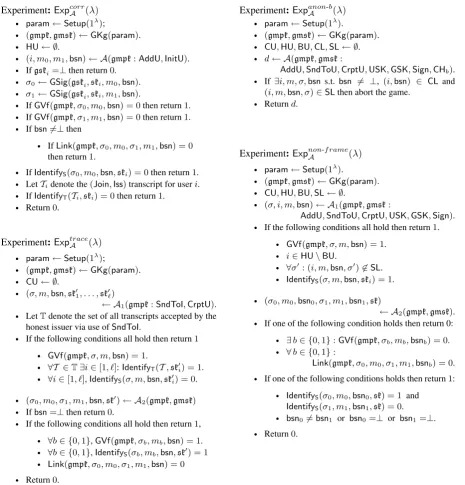
We now proceed to define our security notions for pre-DAA schemes. We contrast our notions with those for group signatures [12] and existing ones for DAA [6, 18]. We define security and correctness by means of four games: correctness, anonymity, traceability and non-frameability. In [6, 18] these are called correctness, user-controlled anonymity and user-user-controlled traceability, with a rather complicated game for the latter property. We simplify this into four games, which is more consistent with the security models for group signatures. The main difference between our model and those of [6, 18] is that we assume a user is a single entity and is not split into a Host and a TPM. This assumption simplifies the exposition and descriptions.
Using the above oracles the security games are formalised in Figure 2. The experiments manage listsStU,StI,
as well asdecI anddecU, the entries of the two latter being initially set to cont. The underlying “code” of the
various oracles available to the adversary are given in Figure 1.
Correctness. We require that signatures produced by honest users are accepted by verifiers and that a user who produces a valid signature can be traced correctly. In addition, we require that two signatures produced by the same user with the same basename are linked. To formalise this we associate to the pre-DAA scheme, any adversaryA and anyλ∈Nthe experimentExpcorrA (λ)defined in Figure 2. We defineAdv
corr
A (λ) = Pr [Exp corr
A (λ) = 1]and
we say that the scheme iscorrectifAdvcorrA (λ) = 0for all adversariesAand allλ∈N. We reiterate that unlike in the case of group signatures [12], we require that two signatures are linked if they are produced with the same
bsnandbsn6=⊥.
Experiment:ExpcorrA (λ)
• param←Setup(1λ);
• (gmpk,gmsk)←GKg(param). • HU← ∅.
• (i, m0, m1,bsn)← A(gmpk:AddU,InitU). • Ifgsk
i=⊥then return0.
• σ0←GSig(gsk
i,ski, m0,bsn).
• σ1←GSig(gsk
i,ski, m1,bsn).
• IfGVf(gmpk, σ0, m0,bsn) = 0then return1. • IfGVf(gmpk, σ1, m1,bsn) = 0then return1. • Ifbsn6=⊥then
• IfLink(gmpk, σ0, m0, σ1, m1,bsn) = 0 then return1.
• IfIdentifyS(σ0, m0,bsn,ski) = 0then return1. • LetTidenote the(Join,Iss)transcript for useri. • IfIdentifyT(Ti,ski) = 0then return1.
• Return0.
Experiment:ExptraceA (λ)
• param←Setup(1λ);
• (gmpk,gmsk)←GKg(param). • CU← ∅.
• (σ, m,bsn,sk01, . . . ,sk0
`)
← A1(gmpk:SndToI,CrptU).
• LetTdenote the set of all transcripts accepted by the honest issuer via use ofSndToI.
• If the following conditions all hold then return1
• GVf(gmpk, σ, m,bsn) = 1. • ∀T ∈T∃i∈[1, `]:IdentifyT(T,sk0
i) = 1.
• ∀i∈[1, `],IdentifyS(σ, m,bsn,sk0i) = 0.
• (σ0, m0, σ1, m1,bsn,sk0)← A2(gmpk,gmsk) • Ifbsn=⊥then return0.
• If the following conditions all hold then return1,
• ∀b∈ {0,1},GVf(gmpk, σb, mb,bsn) = 1. • ∀b∈ {0,1},IdentifyS(σb, mb,bsn,sk0) = 1 • Link(gmpk, σ0, m0, σ1, m1,bsn) = 0 • Return0.
Experiment:ExpanonA -b(λ)
• param←Setup(1λ).
• (gmpk,gmsk)←GKg(param). • CU,HU,BU,CL,SL← ∅. • d← A(gmpk,gmsk:
AddU,SndToU,CrptU,USK,GSK,Sign,CHb).
• If∃i, m, σ,bsns.t. bsn 6= ⊥, (i,bsn) ∈ CL and
(i, m,bsn, σ)∈SLthen abort the game. • Returnd.
Experiment:ExpnonA -f rame(λ)
• param←Setup(1λ).
• (gmpk,gmsk)←GKg(param). • CU,HU,BU,SL← ∅.
• (σ, i, m,bsn)← A1(gmpk,gmsk:
AddU,SndToU,CrptU,USK,GSK,Sign). • If the following conditions all hold then return1.
• GVf(gmpk, σ, m,bsn) = 1. • i∈HU\BU.
• ∀σ0: (i, m,bsn, σ0)6∈SL. • IdentifyS(σ, m,bsn,ski) = 1.
• (σ0, m0,bsn0, σ1, m1,bsn1,sk)
← A2(gmpk,gmsk).
• If one of the following condition holds then return 0:
• ∃b∈ {0,1}:GVf(gmpk, σb, mb,bsnb) = 0. • ∀b∈ {0,1}:
Link(gmpk, σ0, m0, σ1, m1,bsnb) = 0.
• If one of the following conditions holds then return1:
• IdentifyS(σ0, m0,bsn0,sk) = 1 and IdentifyS(σ1, m1,bsn1,sk) = 0.
[image:12.595.71.537.68.554.2]• bsn06=bsn1 or bsn0=⊥ or bsn1=⊥. • Return0.
Figure 2: Security experiment for correctness, anonymity, traceability and non-frameability
given signature, or to link two supposedly unlinkable signatures. This is formalised by requiring the adversary to guess the bitbused by the oracleCHb, which returns a signature by the userib. As in the case of group signatures,
the adversary has access to the issuer’s secret key; thus, not even a dishonest issuer should be able to break the anonymity of the scheme. However, as opposed to the models in [10, 12], in (pre-) DAA schemes users can trivially identify signatures produced under their own key due to the functionalityIdentifyS. The adversary can
thus only query a challenge signature for users it has neither corrupted nor queried theUSKoracle for. Moreover, the adversary is not allowed to query the signing and challenge oracle for the same useriand basenamebsn6=⊥, as it could then link the two signatures usingLink.
In the anonymity experiment, the adversary can access the oraclesAddU,SndToU,CrptU,USK,GSKandSign
CHb oracle at one point in the game, and his goal is to guess the bitb. WithExpanonA -b for an adversaryAand b∈ {0,1}as detailed in Figure 2, we define
AdvAanon(λ) =Pr[ExpAanon-1(λ) = 1]−Pr[ExpanonA -0(λ) = 1]
and we say that the scheme hasanonymityifAdvanonA (λ)is negligible inλfor any polynomial-time adversaryA.
Traceability. The traceability game consists of two subgames, neither of which the adversary should be able to win. The first one formalises the requirement that no adversary should be able to produce a signature which cannot be traced to a secret key stemming from a run of the group-join protocol. The second subgame guarantees that no adversary can produce two signatures under the same secret key and for the same basename that do not link.
In the first subgame we assume an honest issuer, just as in the case for traceability of group signatures. (This is necessary, as a dishonest issuer could always register dummy users that would be untraceable.) The adversary is given access to the oraclesSndToI andCrptU (oracles simulating honest users would be redundant, as the adversary can simulate them on his own). TheSndToI oracle allows the adversary to interact with the honest issuer and theCrptUoracle is required to “register” corrupted users.
It is in this game that our notion of identifying users by their transcripts comes to the fore. After interacting with the issuer, the adversary must output all the identities (i.e. secret keys) associated to the runs of the protocol
(Join,Iss)which the issuer accepted. His goal is then to produce a signature that verifies but is not identifiable to any of the secret keys. This implies that the adversary cannot combine the information obtained from many
(Join,Iss)runs to produce a group member who has not run the issuing protocol.
In the second game the adversary impersonates the issuer as well as all users. No oracles are required, as there are no honest parties. The adversary’s goal is to produce two valid signatures for the same basename for one user which do not link. (That is, both signatures should be traced to the same secret key viaIdentifyS, butLinkoutputs
0 on input these signatures.) Hence, the two games capture the two notions of traceability: users can be traced via their secret keys or via linkable signatures. Traceability thus establishes completeness ofIdentifySandLink(i.e.
they output 1 when they should).
LetAbe an adversary performing the traceability experiment given in Figure 2. We define
AdvtraceA (λ) = Pr[ExptraceA (λ) = 1] ,
and we say that the scheme hastraceabilityifAdvtraceA (λ)is a negligible function ofλfor any polynomial-time adversaryA.
Non-Frameability.As for traceability, there are two types of non-frameability, since users can be framed via their secret key or via the basename. Again, we define two subgames. In the first one the adversary’s goal is to output a signature which can be traced to a specific useri, but which is for a message/basename pair that userihas never signed. In this experiment the adversary has access to the secret key of the issuer and it can access the oracles
AddU,SndToU,CrptU,USK,GSKandSignto interact with or corrupt honest users.
While in the first subgame the adversary tries to frame honest users, in the second subgame we give the adversary control over all users (and the issuer). His goal is to output signatures that link although they should not: they are from different users, the basenames are different, or one the basenames is⊥. Note that by granting the adversary full control over the issuer and all users, this notion is stronger than requiring only that the adversary cannot frame anhonestuser viaLink.
While the first subgame guarantees soundness ofIdentifyS (it only outputs1for signatures that were indeed
produced with the respective key), the second subgame guarantees soundness of Link: it only outputs 1if the signatures stem from the same signer, the basenames are identical and different from⊥.
LetAbe an adversary performing the non-frameability experiment given in Figure 2. We define
AdvnonA -f rame(λ) = Pr[ExpnonA -f rame(λ) = 1] ,
and we say that the scheme hasnon-frameabilityif the advantageAdvnonA -f rame(λ)is a negligible function ofλ
for any polynomial-time adversaryA.
4
From pre-DAA to full DAA schemes
The major difference between a DAA scheme and our pre-DAA scheme is that in a DAA scheme the user is split between a trusted device which has a small amount of memory and limited computing power (namely the TPM), and a more powerful, but untrusted, machine called the Host. In addition, the user can register with a number of Issuers, and each time he registers he uses adifferentunderlying secret keyski. He may also register with the
same issuer a number of times, and obtain a number of distinct group signing keysgskion different underlying
keysski. However, the TPM has very little memory which means that it cannot hold a large number of secret keys ski, nor can it store a large number of group signing keysgski. Moreover, it cannot store both of these items on
the Host as the Host is untrusted.
Of course the TPM could store the data on the host by encrypting it. In existing DAA solutions the TPM does not do this, it simply regenerates theski as and when needed, via the use of a pseudo-random function (PRF)
applied to a fixed secret (usually calledDAASeed), the issuer identifier (ID), and a counter value(cnt). It is this solution which we follow in our construction below. This leaves the issue of what to do with the value ofgski. We have specifically designed the security model for the pre-DAA scheme so that the value ofgskican be stored in the clear on the host; as will be explained below.
The signing operation GSig(gski,ski, m,bsn) becomes an interactive protocol between the TPM and the Host. We denote the pair of interactive protocols by(GSigTPM,GSigHost). The input to GSigTPM is the value ofDAASeed, whilst the input toGSigHostare the values ofcnt,ID,gski, plus the message to be signedmand the value ofbsn. The output of this interactive protocol is the DAA signature.
Finally, we note that the signing operation of a DAA protocol is often an interactive operation between the user (TPM and Host) and the verifier, in that the verifier introduces some random nonce into the signing process at the start of the computation. However this situation is easily handled by adding this nonce to the message to be signed.
Following this discussion it is clear how to define a DAA protocol from a pre-DAA scheme.
• DAA-Setup(1λ): This runs the setup algorithmSetupof the pre-DAA scheme.
• Issuer-Kg(param): It takes as inputparamand outputs secret-public key pair(gmsk,gmpk)for the issuer obtained by callingGKg(param). Each issuer is assumed to have a unique identifying stringIDi.
• TPM-Kg(param): This algorithm generates a secret keyDAASeed∈ {0,1}λ, which is stored in the TPM.
• Host-Setup(param): The Host maintains a list of group signing keys obtained from the issuer, initially set to the empty list. Each group signing key will be stored as a tuple(ID,cnt,cred)which says thatcredis the
cnt’th group signing key obtained from the issuer identified byID.
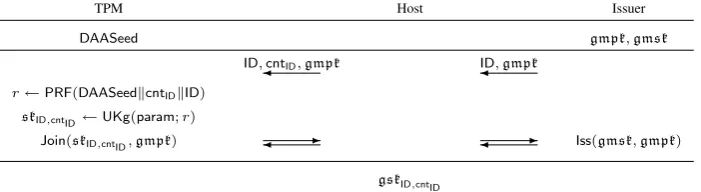
• (DAA-Join,DAA-Iss): This is an interactive protocol between the TPM, the Host and the Issuer. See Fig-ure 3 for a description of this protocol, which uses the (Join,Iss)protocol of the pre-DAA scheme run between the TPM and the Issuer, with the host acting mainly as a router. Note that the Host needs to inform the TPM of the name of the issuer as well as the counter value it has got to for this issuer, since the TPM has restricted long term memory. At the end of the protocol the Host should learn the value of the group signing key, which should become the value(ID,cnt,gskID,cnt)held in its table. Whether this value is sent
to the Host by the TPM or the Issuer is immaterial.
• (DAA-SigTPM,DAA-SigHost,DAA-Vf): This is a protocol between the TPM, the Host and a possibly inter-active verifier.
• An online verifier produces a nonce which is appended to the messagembeing signed.
• The Host informs the TPM of the counter valuecntand issuerIDwhich it wants to be used for the signature. It also (depending on the nature of the signing protocol) informs the TPM of the basename
bsnand the messagembeing signed.
• The TPM recovers the random coinsrfor theUKgalgorithm by computing, for some Pseudo-Random FunctionPRF, the valuer=PRF(DAASeedkcntkID).
• The TPM callsUKg(param)with randomnessrto recover the keyskID,cnt.
TPM Host Issuer
DAASeed gmpk,gmsk
ID,cntID,gmpk
ID,gmpk
r←PRF(DAASeedkcntIDkID)
skID,cntID←UKg(param;r)
Join(skID,cntID,gmpk) - - Iss(gmsk,gmpk)
[image:15.595.124.475.74.170.2]gskID,cntID
Figure 3: The DAA Join Protocol
• The verifier checks the signature by using the functionGVf(gmpk, σ, m,bsn).
• DAA-Identify(σ, m,bsn,ski)is simplyIdentifyS which outputs1if the signatureσcould have been
pro-duced with the keyski.
• DAA-Link(gmpk, σ, m, σ0, m0,bsn)runsLinkwhich returns1if and only ifσandσ0verify with respect to the basenamebsnand whenbsn6=⊥we also have thatσandσ0were produced by the same user.
Note that using ourIdentifyS andGVf algorithms we can create the functionality of using theRogueListin a
DAA protocol:RogueTagadds a value ofskitoRogueListand if the verifier passes aRogueListtoDAA-Vfthen
we modifyDAA-Vfto additionally callIdentifyS for all ski ∈ RogueList; rejecting the signature if any call to
IdentifySreturns1.
The security games for our DAA protocol then follow immediately from the equivalent security games of the pre-DAA scheme as soon as one deals with the corruption model for the Host. First we assume that an honest (resp. corrupt or broken) user in the pre-DAA model corresponds to an honest (resp. corrupt or broken) TPM in the DAA security model, and an honest (resp. dishonest) issuer in the pre-DAA model corresponds to an honest (resp. dishonest) issuer in the DAA model. This leaves us to consider solely the issue of whether the host is honest or dishonest in the various security games. The only interesting cases being ones in which the honesty of the host is different from the honesty of the pre-DAA user.
• For the anonymity game, a dishonest host can always determine whether or not its embedded TPM was involved in some signature production protocol, since the Host controls all communication with the TPM. Thus, a dishonest Host with an honest TPM can trivially win the anonymity game; to exclude this possibility the anonymity game only makes sense when the TPM under attack is embedded in an honest host. Thus, for the anonymity game for DAA we translate the equivalent pre-DAA anonymity game and assume that an honest TPM is always embedded in an honest Host.
• For the traceability game, there are no honest users, and hence no honest TPMs and Hosts and the issue of whether the TPM under attack is in an honest host does not arise.
• For non-frameability, we can make no assumptions as to the honesty of the Hosts. Thus, the only security game in which there could be an interesting mismatch between the honesty of the host and the honesty of the TPM is that of non-frameability. Our pre-DAA security model translates directly in this case, since we have assumed that the group signing keygskiin the pre-DAA scheme is available to a dishonest issuer.
This means that the following “trivial” solution to producing a DAA scheme from a pre-DAA scheme is available: One implements the above construction of a DAA scheme from a pre-DAA scheme in which theDAA-SigTPM
algorithm simply regenerates the user secret keyskiand then executes theGSigalgorithm on its own.
5
Adding authentication to a DAA scheme
The final part of the jigsaw in deriving a fully fledged DAA scheme is to determine how the TPM authenticates itself to the issuer in the Join protocol, or equivalently how the user authenticates itself to the issuer in our DAA scheme above. The standard way for this to be done in group signature schemes is for the users initial secret key to be associated to a public key. The public key is then authenticated by some PKI, and the communication from the user to the issuer is then authenticated, via digital signatures say, using the public key. For various reasons, which we discuss below, this isnotthe preferred option of the TCG group.
For DAA protocols, there are a number of methods in the literature to authenticate the user, all of which make use of so calledendorsement key. It is for this reason that we examine the authentication of users as a separate operation in our presentation, so we can mix-and-match different authentication mechanisms. We assume the TPM upon manufacture is embedded with the private keyeskof some public key algorithm, the associated public keyepkbeing certified by some authority, and the resulting certificate(cert,epk)pair being stored by the Host.
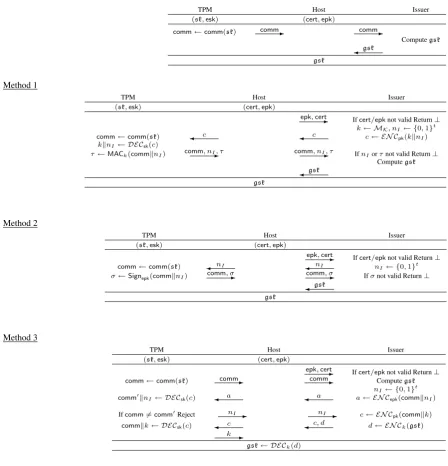
There are a number of proposals in the literature for the use of the endorsement key. We highlight three propos-als, all of which provide the necessary authentication, but all of which have different drawbacks and advantages. The three methods are summarised in Figure 4, where we assume a simple one-round issuing protocol (as for example in Figure 15). The generalisation of all four methods to more complex Join protocols is immediate. In the first two protocols we protect against replays by the issuer requiring the TPM to authenticate a specific nonce
nI. Most notation that we use in the figure is self-explanatory. The notationcommstands for a commitment to the secret key; notice that these are not necessarily cryptographic commitments but only some one-way function ofsk.
Method 1. In [4] the endorsement key is a public key encryption key, with which the issuer encrypts a one-time authentication key (i.e. a MAC key) to the user. The user then authenticates his part of the issuing protocol by means of this authentication key. In [4], and in the deployed RSA based DAA protocol, this is done by computing a hash over the data and the authentication key, clearly a better solution would be to use a specially designed message authentication code, as in [22].
Method 2. In [21] the endorsement key is used in a different way; in particular, the endorsement key is the key for a public key signature algorithm. In this proposal the TPM signs the transcript using the signing key.
Method 3. In [23] the endorsement key is the key for a public encryption scheme. The idea is that before the issuer produces a certificate on the public key it runs a challenge-response protocol with the user to check that it is interacting with a valid TPM. If this part of the protocol terminates successfully, the issuer sends a hybrid encryption of the resulting group signing key under the endorsement key. The KEM part is forwarded by the Host to the TPM which decrypts it to reveal the symmetric encryption key for the DEM part, which he then sends to the Host. The Host obtains the group signing key in the obvious way.
All three of these proposals obtain the same effect, but with distinct side effects which we now discuss: The industrial group, TCG, behind the deployment of the DAA protocol prefer the encrypt followed by MAC solution as they are worried about the publicly verifiability of the signature variant enabling third parties to link different issuing protocols. Essentially, the Method 1 forms adeniable authentic channelfrom the TPM to the Issuer. Method 2 replaces the authentication via a MAC with authentication via a digital signature scheme, but unfortunately this clearly destroys deniability. Finally, Method 3 is close to Method 1 (with which it shares the overall structure) with the added advantage that its implementation is extremely simple (using the current set of TPM commands): it only requires two calls to the same TPM instruction. The protocol is also deniable: an execution of the protocol can be simulated by the issuer itself. The simplicity comes at the expense of a loss of anonymity: a curious issuer, or collusion of curious issuers, can still violate the anonymity in the issuing protocol using the encryption variant by maintaining information as to which authentication key was sent to which user. Nevertheless, this last method seems to be favoured by the TCG group for its TPM.Next specification.
6
Building blocks
Basic Un-Authenticated Protocol
TPM Host Issuer
(sk,esk) (cert,epk)
comm←comm(sk) comm- comm
-Computegsk gsk
gsk
Method 1
TPM Host Issuer
(sk,esk) (cert,epk)
epk,cert
- Ifcert/epknot valid Return⊥ k← MK,nI← {0,1}t
comm←comm(sk) c c c← EN Cpk(kknI)
kknI← DECsk(c)
τ←MACk(commknI) comm, n-I, τ comm, n-I, τ IfnIorτnot valid Return⊥
Computegsk gsk
gsk
Method 2
TPM Host Issuer
(sk,esk) (cert,epk)
epk,cert
- Ifcert/epknot valid Return⊥ comm←comm(sk) nI
nI nI← {0,1}t
σ←Signepk(commknI) comm-, σ comm-, σ Ifσnot valid Return⊥
gsk
gsk
Method 3
TPM Host Issuer
(sk,esk) (cert,epk)
epk,cert
- Ifcert/epknot valid Return⊥
comm←comm(sk) comm- comm- Computegsk
nI← {0,1}t
comm0knI← DECsk(c) a a a← EN Cepk(commknI)
Ifcomm6=comm0Reject nI
- nI- c← EN Cpk(commkk)
commkk← DECsk(c) c c, d d← EN Ck(gsk)
k
[image:17.595.69.518.81.548.2]-gsk← DECk(d)
Figure 4: Three methods for authenticating the TPM
6.1
Randomizable Weakly Blind Signatures
We start by giving a variant of a blind signature scheme in which a signer outputs a signature on a blinded message, but never gets to see the message he signed. Such a scheme will be the basis of our registration protocols, as the issuer will never see the user’s secret key she signs. We also require that signatures can berandomized. Two example instantiations of this primitive can be found in Section 8.4.
Syntax. A randomizable blind signature schemeBS(with a two-move signature request phase) consists of six probabilistic polynomial-time algorithms
BS= (SetupBS,KeyGenBS,RequestBS,IssueBS,VerifyBS,RandomizeBS) .
• SetupBS(1λ)takes as input a security parameterλand outputs a parameter setparam, assumed to contain a
description of the key and message spaces forBS.
• KeyGenBS(param)takes as input the system parameters and outputs a pair(pkBS,skBS)of public/private
keys for the signer.
• (Request0BS,Issue1BS,Request1BS)is an interactive protocol run between a user and a signer. The user goes first by callingRequest0BS(m,pkBS)to obtain a valueρ0and some state informationSt0R(which is assumed
to containm). Then the signer and user execute, respectively,
(β1,St1I)←Issue
1
BS(ρ0,skBS) and (σ,St1R)←Request
1
BS(β1,St0R) ,
whereσis a signature on the original messagem(or the abort symbol⊥). We write
σ← RequestBS(m,pkBS)⇐⇒IssueBS(skBS)
for the output of correctly running this interactive protocol on the given inputs.
• VerifyBS(m, σ,pkBS)is the public signature verification algorithm, which outputs1ifσis a valid signature onmand0otherwise.
• RandomizeBS(σ)is given a signatureσon an unknown messagemand produces another valid signatureσ0
on the same message.
The blind signature scheme iscorrectif signatures verify when both parties behave honestly, i.e. for all parameter sets output bySetupBSwe have
Pr [ (pkBS,skBS)←KeyGenBS(1
λ), m← M,
σ←(RequestBS(m,pkBS)⇐⇒IssueBS(skBS)) :VerifyBS(m, σ,pkBS) = 1 ] = 1 .
In addition, randomizing a signature should result in a valid signature, i.e. for all parameter sets output bySetupBS
and key pairs(pkBS,skBS)output byKeyGenBSwe have for allmandσ
VerifyBS(m, σ,pkBS) = 1 =⇒ VerifyBS(m,RandomizeBS(σ),pkBS) = 1 .
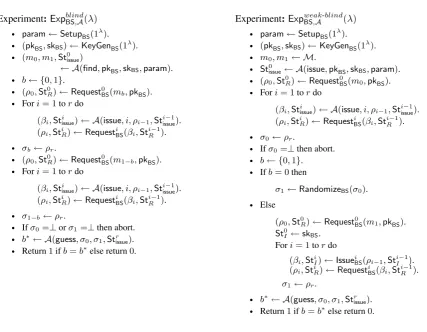
Security. The standard security model for blind signatures [31, 34] consists of two properties: blindness and unforgeability. In the traditional security model blindness states that an adversarial signer, who can choose two messagesm0andm1, cannot tell in which order the messages were asked to be signed, when presented with the final signatures. More formally, we consider an adversaryAwhich has three modesfind,issueandguess, running in the experimentEx