• No results found

Nursing Practice Program in the School of Nursing.

N/A
N/A
Protected

Academic year: 2020

Share "Nursing Practice Program in the School of Nursing. "

Copied!
89
0
0

Loading.... (view fulltext now)

Full text

(1)

CONTRACEPTIVE PRACTICES OF ADVANCED PRACTICE REGISTERED NURSES IN OUTPATIENT SETTINGS

Emily Elizabeth Radford Ryan

A project submitted to the faculty at the University of North Carolina at Chapel Hill in partial fulfillment of the requirements for the degree of Doctor of Nursing Practice in the Doctor of

Nursing Practice Program in the School of Nursing.

Chapel Hill 2017

Approved by:

SeonAe Yeo

Noreen Esposito

Angela Walling

(2)

© 2017

Emily Elizabeth Radford Ryan

ALL RIGHTS RESERVED

(3)

ABSTRACT

Emily Elizabeth Radford Ryan: Contraceptive Practices of Advanced Practice Registered Nurses in Outpatient Settings

(Under the direction of SeonAe Yeo)

Long-acting reversible contraception methods (LARCs) are considered the most

efficacious methods on the market but despite pervasive endorsements as first-line contraception from leading healthcare institutions, LARC use in the US remains low. The literature postulates provider behaviors and their individual contraceptive clinical practice may create difficulty accessing LARC methods for their patients, specifically when healthcare providers lack the knowledge and training required to insert or council patients on choosing LARC methods. This project aims to examine whether contraceptive clinical practice (CCP) pattern varies by graduate practice program preparation of the provider and explore factors related to routine counseling of LARC methods by providers.

Using a convenience sample of advanced practice registered nurses, identified through a

data request made to The North Carolina Board of Nursing, and a modified version of the

National Pregnancy and HIV/STI Prevention Survey, responses from 810 participants were

analyzed. There were statistically significant differences among the CCP of primary care

providers as compared to women’s health providers across a variety of measures all of which

both individually and collectively have the potential to affect the quality of contraceptive

counseling and services provided.

(4)

While some paradigm shifts in healthcare occur rapidly, it is clear that the adoption of LARC methods in the primary care setting has had slower trajectory toward full incorporation.

Despite that, we remain encouraged by the changes we have seen and the interest expressed by

participants in learning more about LARC methods.

(5)

To Shane.

(6)

ACKNOWLEDGEMENTS

I want to extend the deepest gratitude and acknowledgments to my committee, Dr.

SeonAe Yeo, Dr. Noreen Esposito, and Ms. Angela Walling, who were more than generous with their time, expertise, and encouragement. A special thanks to Dr. SeonAe Yeo, my committee chair, who spent countless hours helping me to develop my research question, fine-tune the data collection, and read the many drafts of this paper. I want to also extend my gratitude to Dr. Steve Marron, Chuchu Yuan, and Heather Ba for their work on the statistical analysis portion of this project. I am so very grateful for the time and energy each of them put toward helping me make sense of the data.

I would like to thank Dr. Cynthia Harper for her generosity in allowing me to use and modify the survey tool used for data collection. She is a passionate advocate for women’s health and LARC methods and her work continues to inspire me.

There are not enough words to adequately thank my family for the support they have shown me through this degree and those that came before. My parents, Mary Ann and Thurmon Radford, have been my strongest cheerleaders from my kindergarten graduation through to this one. They have always encouraged my curiosity and never once deterred me from my

educational path just because it was getting hard. My husband, Shane Ryan, has been steadfast in

his support of this project and me. He has been infinitely patient through the late nights writing

and the lack of social life that comes with the pursuit of a doctoral degree. He inspires me every

day to be the best version of myself and he is the best doubles partner in the world.

(7)

TABLE OF CONTENTS

LIST OF TABLES ... ix

LIST OF FIGURES ... x

LIST OF ABBREVIATIONS ... xiii

CHAPTER 1: INTRODUCTION ... 1

Unintended Pregnancy in North Carolina ... 2

Potential Issues ... 2

The Role of the Nurse Practitioner ... 3

Project Purpose ... 5

CHAPTER 2: LITERATURE REVIEW ... 6

Consequences of High Unintended Pregnancy Rates ... 7

Contraceptive Trends ... 8

Long Acting Reversible Contraception Methods ... 9

Historical Perspective of LARC Use in the US ... 13

Modern Barriers to Access ... 15

Misconceptions Influencing Clinical Practice ... 16

Progress Through Training Programs ... 18

(8)

CHAPTER 3: METHODOLOGY ... 23

Subjects ... 23

Process ... 24

Approach to Analysis ... 25

CHAPTER 4: RESULTS ... 27

Demographics ... 27

Variation of CCP Pattern by Graduate Practice Preparation ... 29

Routine Discussion of LARC Methods ... 30

Consideration of LARC Methods ... 31

Provider Concerns Affecting IUD Recommendation ... 32

Assessment of MEC Understanding ... 33

CHAPTER 5: DISCUSSION ... 35

Future Directions ... 37

Project Limitations ... 38

Conclusions ... 39

APPENDIX A: Summary Chart of U.S. Medical Eligibility Criteria for Contraceptive Use ... 53

APPENDIX B: Contraceptive Clinical Practice Survey ... 57

REFERENCES ... 69

(9)

LIST OF TABLES

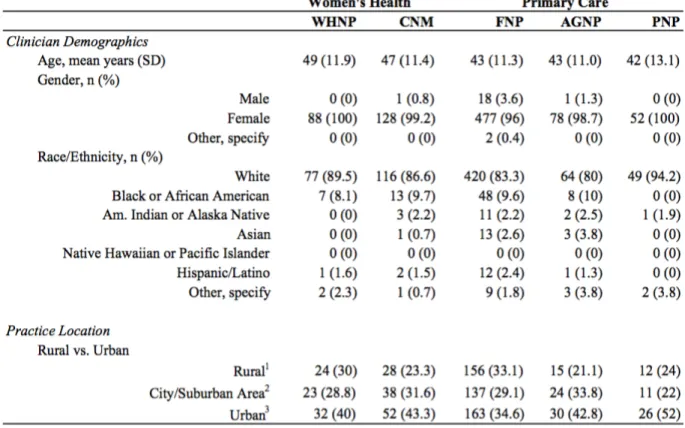
Table 1. Provider Demographics ... 40

(10)

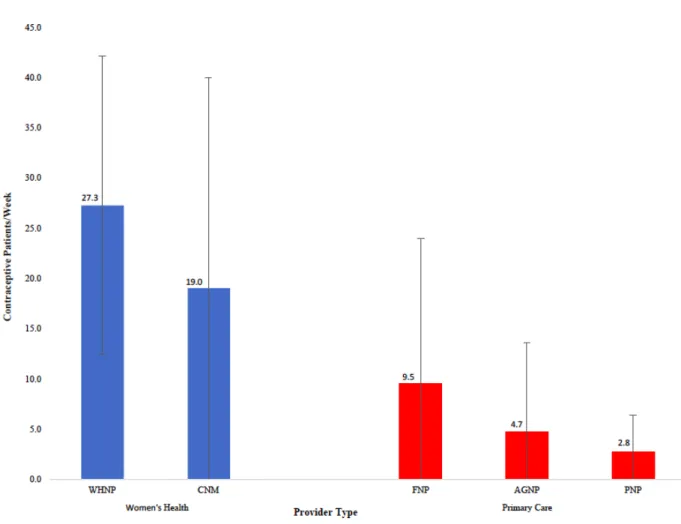
LIST OF FIGURES Figure 1. Average number of patients seen per week requiring

contraceptive counseling and services by provider type. ... 41

Figure 2. Reported time, in minutes, available to providers for contraceptive counseling and provider satisfaction with time

available by provider type ... 42

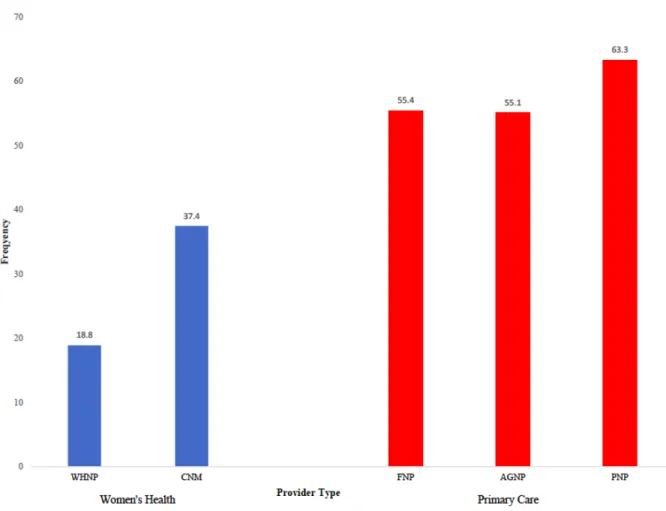
Figure 3. Providers reporting working in clinics where those with prescriptive authority (MD, NP, PA) are solely responsible

for contraceptive counseling. ... 43

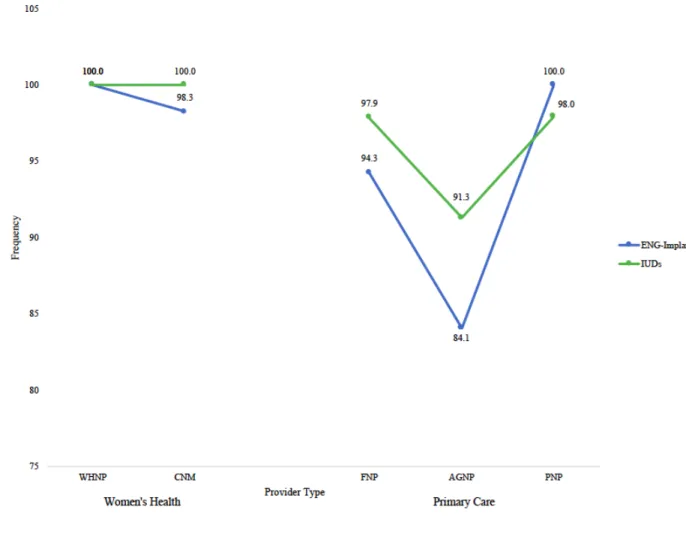
Figure 4. Provider perception of safety of LARC methods. ... 44

Figure 5. Provider perception of patient receptiveness to learning

about LARC methods during contraceptive counseling. ... 45

Figure 6. Contraceptive methods discussed during contraceptive

counseling versus in-clinic availability of same methods by provider type. ... 46

Figure 7. Routine discussion of LARC methods during contraceptive

counseling by provider type. ... 47

Figure 8. Effect of selected patient conditions on recommendation

of IUD during contraceptive counseling by provider type. ... 48

Figure 9. Reported level of provider concern as to selected patient

conditions when recommending an IUD during contraceptive counseling by provider type. ... 49

Figure 10. Effect of provider knowledge of appropriate IUD use for

selected patient conditions by provider type. ... 50

Figure 11. Expanded graph of the effect of provider knowledge of

appropriate IUD use for selected patient conditions on provider ecommendation of the Cu-IUD

(11)

Figure 12. Expanded graph of the effect of provider knowledge

of appropriate IUD use for selected patient conditions on provider recommendation of the Cu-

IUD during contraceptive counseling by provider type. ... 52

(12)

LIST OF ABBREVIATIONS AAP American Academy of Pediatrics

ACA Affordable Care Act

ACOG American College of Obstetricians and Gynecologists AGNP Adult/Geriatric Nurse Practitioner

CCP Contraceptive Clinical Practice

CDC Centers for Disease Control and Prevention

CNM Certified Nurse Midwife

Cu-IUD Copper IUD (Paragard)

DOI Diffusion of Innovation

ENG-Implant Etongestrel-Implant (Nexplanon)

FNP Family Nurse Practitioner

IUC Intrauterine Contraception

LARC Long Acting Reversible Contraception

LNG-IUS Levonorgestrel Intrauterine System (Mirena, Skyla, Liletta, and Kyleena) MEC Medical Eligibility Criteria

NC North Carolina

NP Nurse Practitioner

ODUM Howard W. Odum Institute for Research in Social Science PNP Pediatric Nurse Practitioner

QSEN Quality and Safety Education for Nurses Initiative

WHO World Health Organization

(13)

CHAPTER 1 INTRODUCTION

Long-acting reversible contraception methods (LARCs) are considered the most efficacious methods on the market but utilization among American women remains low, estimated at 11.6% compared to 25.9% for the pill and 15.3% for male condoms, while 10%

used no method at all (Guttmacher Institute, 2016). In the United States, roughly half of all pregnancies each year are unintended; defined as a pregnancy that is either mistimed— where the woman did not wish to become pregnant but desires pregnancy in the future— or unwanted at the time of conception (Guttmacher Institute, 2015). Unintended pregnancies are divided into mistimed (27% of pregnancies) and unwanted (18% of pregnancies) (Guttmacher Institute, 2016). Mistimed pregnancies are those that are unplanned but occur in women reporting a desire to become pregnant in the future (Guttmacher Institute, 2016). Unwanted pregnancies are

unplanned pregnancies that occur in women who report neither desiring pregnancy now or at any point in the future (Guttmacher Institute, 2016). Consequences of unintended pregnancies range from the increased risk of delaying prenatal care and related poor outcomes for mother and child, to economic concerns where unplanned pregnancies are known to cost federal and state

taxpayers between $9.6 and $12.6 billion annually (Guttmacher Institute, 2015; Pickle, Wu, &

Burbank-Schmitt, 2014). Despite pervasive endorsements as first-line contraception from leading healthcare institutions, LARC use in the US remains low (ACOG, 2011; ACOG, 2012;

CDC, 2010; Ott & Sucato, 2014). Data from 2012, the most recent available, measuring the

(14)

most effective method of contraception used in the last month by women at risk for unintended pregnancy—those who are sexually active, not currently pregnant, postpartum, or otherwise infertile—lists LARC use at 11.6% compared to 25.9% for the pill and 15.3% for male condoms, while 10% used no method at all (Guttmacher Institute, 2016).

Unintended Pregnancy in North Carolina

The unintended pregnancy rate in North Carolina (NC) in 2010, the most recent data available, was 54% (Kost, 2015). In the same year, 74.8% of these unplanned births were publically funded through programs such as Medicaid, Children’s Health Insurance Program, or Indian Health Services, again exceeding the national average of 68% (Kost, 2015). Furthermore, of the $858.3 million in expenditures, paid for by both the federal and state government, for unintended pregnancies, the state was responsible for covering $214.7 million (Sonfield & Kost, 2015). It is estimated the prevention or reduction of unintended pregnancies in North Carolina could save the state upward of $448 million dollars (Sonfield & Kost, 2015).

Potential Issues

Provider Behavior. While the specifics of provider behaviors as to contraceptive clinical practice in North Carolina have not yet been elucidated, and are in fact the particular concern of this project, there is ample data from various other state and national sources indicating providers may in many instances act as a barrier to LARC access. The literature postulates provider

behaviors and their individual contraceptive clinical practice may create difficulty accessing

LARC methods for their patients, specifically when healthcare providers lack the knowledge and

training required to insert or council patients on choosing LARC methods (Dehlendorf, Levy,

Ruskin, & Steinauer, 2010; Harper et al., 2012; Harper et al., 2008). Further presentation of

evidence is put forth in the discussion of the available literature.

(15)

Rural vs. Urban Access. Of particular concern, studies have shown differences in LARC availability by rural and urban delineations in states such as Illinois and Wisconsin, where a survey of 862 rural primary care physicians found that many did not have training in IUD (87%) and implant (41%) placement (Lunde et al., 2014). In Texas, a survey of family planning providers at Title X clinics revealed that urban providers self-reported they were well trained in LARC insertion at higher rates than their rural counterparts (75% versus 57%) (Vaaler,

Kalanges, Fonseca, & Castrucci, 2012). Rates of LARC use were also higher for patients seen at the urban clinics versus the rural clinics for IUDS, 7% vs. 5%, and implants, 1% vs. <1% (Vaaler et al., 2012). This led the authors to conclude that there is a disparity in access to LARC

methods between rural and urban clinics and that these findings demonstrate both importance of LARC training for providers and also the potential impact provider’s knowledge and attitudes about LARCs may have on patients choosing LARC methods (Lunde et al., 2014; Vaaler et al., 2012). Data such as this is relevant to the discussion of LARC access in NC since the 2010 census, the most recent data available, NC was classified as having the second largest rural population in the nation and in the 2014 census estimate, 80 of is 99 counties are classified as rural by having a population density of less than 250 people per square mile or less (Gray, 2015;

U.S. Census Bureau, 2012).

The Role of the Nurse Practitioner

In NC, it has been estimated that 58% of NPs work in primary care settings (Spetz,

Fraher, Li, & Bates, 2015). Furthermore, NPs, particularly those working in publicly funded

clinics, which are known to serve populations at highest risk for unintended pregnancy, have

been identified as essential providers of contraceptive services (Landry, Wei, & Frost, 2008).

(16)

Nurse practitioners have been identified as providing quality, primary care services equal to and in some measures exceeding that of physicians as measured by physiologic outcome measures, patient satisfaction, and cost (Swan, Ferguson, Chang, Larson, & Smaldone, 2015).

Under the Quality and Safety Education for Nurses Initiative (QSEN) and the Core Competencies for Nurse Practitioners developed by the National Organization of Nurse

Practitioner Faculties, both of which strongly emphasize the importance of possessing analytic skills for evaluating and providing evidence-based care, there is an expectation to perpetually improve one’s practice (Cronenwett et al., 2007; Thomas et al., 2012). To meet this competency expectation, NPs must consistently work to grow their knowledge base and practice through the addition of new skills and adoption of new protocols and guidelines.

Providers & Contraceptive Counseling. The CDC recommends to counsel all patients about the full range and effectiveness of contraceptive options for which they are medically eligible”

by their providers (CDC, 2013). In conjunction with the U.S. Office of Population Affairs in 2014, and updated in 2016, they released report called “Providing Quality Family Planning Services” (Gavin et al., 2014; Gavin & Pazol, 2016). This guidance is for all providers who provide contraceptive services- from primary care providers to OB/GYNs. In the report, is the recommendation that providers use a tiered approach when discussing contraceptive methods by starting with the most effective and first-line recommended methods first and working their way down to the least effective method (Gavin et al., 2014). In this way, the comprehensive

contraception counseling aims to give women the information they need to choose the most

appropriate contraception method for them based on a variety of factors including health history,

lifestyle, and personal attitudes regarding potential side effects among others (Dehlendorf,

Krajewski, & Borrero, 2014). A unique clinical situation is created by the intersection and

(17)

interaction of medical science with patient preference and personal beliefs due to the very personal nature of choosing contraception. This is not seen to the same degree, when providers counsel patients on medication options for blood pressure management where JNC-8 guidelines leave far less leeway in the treatment modality recommendations than the CDC MEC for

contraception does. Provider’s limited adherence to evidence-based guidelines regarding LARC methods has been implicated as a potential reason for their lower rates of use in the U.S. (Harper et al., 2013). The impact of contraceptive counseling is evident in multiple studies describing how selection of a new contraceptive method is largely influenced by provider behaviors, specifically mentioning or not mentioning certain methods, or directly recommending others (Bitzer et al., 2013; Dehlendorf et al., 2010; Harper, Brown, Foster-Rosales, & Raine, 2010).

Contraceptive counseling is most effective when provided with evidence based

recommendations, non-judgment, and clarity through which women may be empowered to choose the method which is most effective and easy for her for successful family planning.

Project Purpose

This project aims to identify contraceptive clinical practice trends among nurse practitioners in the North Carolina. Specifically, the objectives of the project are to identify clinician practice patterns and attitudes toward contraceptive care in the following ways:

1. To examine whether contraceptive clinical practice (CCP) pattern varies by graduate practice program preparation of the provider.

2. Explore factors related to routine counseling of LARC methods by providers.

The answers to these questions will also serve as an early needs assessment in evaluating

current CCP among providers as to contraceptive counseling, current skill level for LARC

insertion technique, and provider interest in receiving further training in LARC methods.

(18)

CHAPTER 2 LITERATURE REVIEW

Healthy People 2020, a public health initiative focused on reducing health disparities among Americans, made family planning one of its strategic objectives (Healthy People 2020, 2015). Goals include increasing the overall proportion of pregnancies that are planned and reducing the percentage of women who become pregnant despite using reversible forms of contraception (Healthy People 2020, 2015). In response to the widespread health and economic effects of unintended pregnancies, Healthy People 2020 (2015) lists improving pregnancy planning, spacing, and preventing unintended pregnancies as a goal

.

There is no better phrasing than that used by Pace et al., …“family planning protects the health of women, children and communities, [and] it is a quintessential primary care service” (Pace, Cohen, & Schwarz, 2011).

LARC’s superior effectiveness, shown in study after study, gives us a chance to use an upstream solution—access to the highest efficacy contraception—to address downstream problem,

unintended pregnancy. This leads us to an inevitable, and proven conclusion—unintended pregnancies would be much less common if rates of LARC use were to increase among

American women (Harper et al., 2015). Therefore, it is important to ask the question—what role can primary care providers (PCPs) play in a women’s decision to use contraception and the receipt of family planning services among their patients?

To understand role LARC availability in primary care can play in reaching these goals,

we have to first understand the sheer number of unintended pregnancies that occur while women

(19)

are using other methods of birth control and the lasting effects of these unintended pregnancies.

This literature review will therefore first address the consequences of unintended pregnancies, public health and economic, then examine the historical context of LARC use in America which led to its decline in popularity and contributed to many of the pervasive misunderstandings providers still have about LARC use. Then we will present findings on LARC training rates among providers, provider behaviors that negatively impact LARC availability, and a possible solution to low training rates and provider misconceptions about LARC use—increasing attendance at post graduate training programs—and how the proposed project will provide data to help further this goal.

Consequences of High Unintended Pregnancy Rates

Public Health. Unintended pregnancies are a public health problem, which affect approximately 3 million pregnancies in the U.S. each year (Pickle et al., 2014). Studies show that women who have unplanned pregnancies are at increased risk of delaying prenatal care, experiencing maternal depression, and suffering physical violence during pregnancy (Joyce, Kaestner, & Korenman, 2000; Pickle et al., 2014). Meanwhile, their infants are more likely to have low birth weights and are at higher risk for birth defects (D'Angelo, Gilbert, Rochat, Santelli, & Herold, 2004; Kaye, 2012; Pickle et al., 2014). As these children grow, they are also more likely to live in poverty, experience adverse physical and psychological outcomes, and have lower educational attainment than their peers (Ng & Kaye, 2012; Pickle et al., 2014).

Economic. Simply stated, unintended pregnancies are expensive and taxpayers primarily shoulder this economic burden. Two separate economic studies estimated that unintended pregnancies cost taxpayers in excess of 11 billion dollars annually (Monea & Thomas, 2011;

Sonfield, Kost, Gold, & Finer, 2011). A third attributes 2.5 billion of that total directly to

(20)

unintended pregnancies resulting from imperfect adherence to contraceptive methods (Trussell, 2007). It is estimated that if a little as 10% of women aged 20-29 switched from oral

contraceptives to LARC methods the total savings would be $288 million per year (Monea &

Thomas, 2011; Trussell et al., 2013).

Contraceptive Trends

Increasingly, primary care providers are providing contraceptive services to their patients in the U.S.—there were 11.5 million visits to primary care providers for contraceptive services in 2010 (Pickle et al., 2014). This number is expected to increase with the ACA and the mandate to cover contraception, though more recent numbers have not been available. In selecting

contraceptive methods, providers and patients commonly select the pill, the patch, the vaginal ring, and male condoms. All of these methods have high typical-use, first year failure rates ranging from 18% for male condom to 9% for the pill (CDC, 2014). Of the unintended pregnancies, each year, only 5% of these occur in women using birth control consistently and correctly at each and every sexual encounter (Daniels, Daugherty, & Jones, 2014; Guttmacher Institute, 2015; Kavanaugh, Jerman, Ethier, & Moskosky, 2013). High typical-use failure rates are concerning because many women remain unaware that they are not using their chosen birth control methods in a way that would meet the definition of consistently and correctly.

Statistically, in any given year, approximately 70% of the nearly 61 million U.S. women of

childbearing age, 15-44 years, are at risk of experiencing an unintended pregnancy (Guttmacher

Institute, 2015). In other words, there are 43 million women in need of adequate contraceptive

counseling and services each year (Guttmacher Institute, 2016). Among these women, 18% will

use contraceptive inconsistently and will make up 41% of unintended pregnancies, 14% will not

use contraception at all or will have a gap in use that lasts for 1 months or longer and these

(21)

women will account for 54% of the unintended pregnancies that year (Guttmacher Institute, 2016). It is precisely the issue of inconsistent or intermittent use that puts women at risk and short acting reversible contraceptive methods such as the pill, patch, and vaginal ring allow for intermittent and inconsistent use by their very design and nature.

Long Acting Reversible Contraception Methods

When discussing LARC methods, it is important to clarify that the title describes two forms of intrauterine devices, non-hormonal and hormonal, and one type of hormonal implant.

Collectively, LARC methods are known to provide highly effective, non-user dependent contraception (CDC, 2014). These methods include the non-hormonal Copper T 380A (Cu- IUD), the hormonal levonorgestril intrauterine systems (LNG-IUS), and the etonogestrel implant (ENG-Implant), Nexplanon. All of which have exceedingly low first year typical-use failure rates (CDC, 2014). Rates vary by LARC method, but each are considered as effective as permanent options, such as sterilization, but are reversible with rapid return to fertility upon discontinuation—0.05% for Nexplanon, 0.2% for LNG-IUS, and 0.8% for Cu-IUD (CDC, 2014).

As such, current guidelines for contraceptives including ones by CDC, ACOG, and AAP

universally promote LARC as the first-line contraceptive recommendation for almost all women excluding those with distorted uterine cavities (LNG-IUS and Cu-IUD), current breast cancer (LNG-IUS, Nexplanon), Cervical cancer awaiting treatment (LNG-IUS and Cu-IUD),

endometrial cancer (LNG-IUS and Cu-IUD), gestational trophoblastic disease (LNG-IUS and Cu-IUD), and AIDS (LNG-IUS and Cu-IUD) (ACOG, 2012; CDC, 2010; Ott & Sucato, 2014).

These recommendations are meant to guide contraceptive counseling such that women are

presented with the most effective methods first and foremost, not dictate that all women must use

choose to use these methods.

(22)

Intrauterine Contraception

Currently in the U.S there are five intrauterine contraception (IUC) devices available.

These include the sole non-hormonal method, the Copper T 380A (Paraguard), and four levonorgestril secreting intrauterine systems (LNG-IUS): Mirena, Skyla, Liletta, and Kyleena (Bayer, 2016a; Bayer, 2016b; Bayer, 2016c; Merck, 2016; Odyssea Pharma, 2016; Teva

Women's Health, 2014). Each of these methods may be placed by a trained health care provider in an outpatient setting and require minimal additional clinic expenditure for supplies beyond those already required for routine pelvic examinations.

Copper T 380A. The Copper T 380A IUD, approved for use for up to 10 years, is a non-

hormonal, 32mm wide and 36mm tall polyethylene T-shaped copper-containing device made radio-opaque with the addition of barium sulfate (Teva Women's Health, 2014). The device has approximately 176mg of copper wire coiled along the vertical stem and an additional 68.7mg collar on each of the horizontal arms providing a total copper surface area of 380 ± 23mm

2

(Teva Women's Health, 2014). The mechanism of contraception action is disruption of sperm

transport, fertilization, and prevention of implantation through the continuous release of copper ions into the uterine cavity (Teva Women's Health, 2014). The Copper T 380A is the one LARC method that may also be used as emergency contraception within five days of unprotected sexual intercourse (Teva Women's Health, 2014).

LNG-IUSs. Currently there are four types of LNG-IUSs on the market: Mirena, Skyla,

Liletta, and the most recent, Kyleena, approved in October 2016 (Bayer, 2016a; Bayer, 2016b;

Bayer, 2016c; Odyssea Pharma, 2016). The mechanism of contraception action of each is

similar whereby the IUS releases a slowly diminishing rate of levonorgestril over the approved

period of use and this prevents pregnancy through a several mechanisms: thickening the cervical

(23)

mucus to prevent passage of sperm into the uterus, inhibition of sperm capacitation or survival, and alteration of the endometrium to prevent implantation. The variation in each of the LNG- IUSs available comes from the and FDA approved duration of use, size of the device, the initial volume of LNG contained in the device, and the in vivo amount of levonorgestril released over time. Each of these methods may be removed at any point after insertion but must be removed by the end of their approved duration of use time frame. The LNG-IUSs also provide non-

contraceptive benefits for some women by reducing painful or heavy menstrual cycles and many women report either stark reduction in menstrual flow or complete cessation of menstrual cycles while the device is in place (Rodriguez & Darney, 2010). Therefore, unlike the Copper T 380A, the LNG-IUS devices offer secondary benefits beyond contraception.

Mirena. Mirena was the first, of the LNG-IUSs approved for use in the U.S. Like many of the others, Bayer HealthCare Pharmaceuticals Inc. manufactures it, and it’s basic T-shaped design with the vertical stem acting as a drug reservoir served as the prototype for the various LNG-IUSs that followed (Bayer, 2016b). The polyethylene frame measures 32 mm wide and 32 mm long and the drug reservoir holds 52 mg LNG(Bayer, 2016b). The initial LNG release rate is 20 mcg/day up to day 90 and then falls to 18 mcg/day after 1 year and finally reaches 10 mcg/day after 5 years. A stable serum concentration between 150 – 200 pg/mL of LNG is maintained throughout the 5-year duration of use (Bayer, 2016b).

Skyla. Skyla has been approved for use for up to 3 years for pregnancy prevention. The

frame measures 28mm wide by 30mm long and the drug reservoir contains 13.5mg of LNG

(Bayer, 2016c). The approximate release rate is 14 mcg at 24 days, 10mcg/day after 60 days,

and 5 mcg/day at 3 years. Bayer (2016c)estimates the average LNG in vivo release rate to be

approximately 6 mcg/day over 3 years(Bayer, 2016c).

(24)

Liletta. Liletta has been approved for pregnancy prevention for up to 3 years (Odyssea Pharma, 2016). The frame measures 32 mm wide and 32 mm long and similar to the Mirena, the drug reservoir contains 52mg of LNG (Odyssea Pharma, 2016). The release rate of LNG starts at 18.5mcg/day and progressively declines to approximately 16.3 mcg/day at 1 year, 14.3 mcg/day at 2 years, and 12.6 mcg/day at 3 years (Odyssea Pharma, 2016).

Kyleena. Kyleena is the newest LNG-IUS to reach the market and has been approved for pregnancy prevention for up to 5 years (Bayer, 2016a). The frame measures 28 mm wide and 30 mm long and the drug reservoir contains 19.5 mg of LNG (Bayer, 2016a). The release rate of LNG starts at 17.5mcg/day after 24 days, and progressively declines to approximately 15.3 mcg/day after 60 days, to 9.8 mcg/day at 1 year, then 7.9 mcg/day at 3 years, and 7.4 mcg/day at 5 years (Bayer, 2016a). Bayer (2016a) estimates the average LNG in vivo rerelease rate to be 9 mcg/day over 5 years.

Etonogestrel Contraceptive Implant

The only etonogestrel contraceptive implant (ENG-Implant) on the market is Nexplanon, it is manufactured by Merck and is an improvement on the single rod system, Implanon, through the addition of a radiopaque material which allows the implant to be viewed on x-ray (Merck, 2016). The ENG-Implant is a sub dermal rod-shaped implant impregnated with 68mg

etonogestrel and approved for 3 years of use (Merck, 2016). The mechanism of contraceptive

action is similar to that of the LNG-IUS whereby absorption of the hormone causes suppression

of ovulation, thickening of cervical mucous to prevent sperm from entering the uterus, and

thinning of the endometrial lining to prevent implantation (Merck, 2016). Mean serum

concentrations of etonogestrel were 1200 (± 604) pg/mL at two weeks after insertion and

(25)

decreased gradually to 202 (±55) pg/mL at 1 year, 164 (±58) pg/mL at 2 years, and 138 (±43) pg/mL at 3 years (Merck, 2016).

Historical Perspective of LARC Use in the US

The Dalkon Shield’s Lasting Legacy. Encouraging providers to integrate LARC methods in their practice is made difficult by the troubled history many providers and patients associate with LARC. In the 1970’s the Dalkon shield IUD made national news when use was associated with cases of both pelvic inflammatory disease (PID) leading to infertility and death by septic shock (Hubacher, 2002; Strasser, Borkowski, Couillard, Allina, & Wood, 2016). The Dalkon shield was later removed from the market and the defect that led to these complications, a multifilament string, is not used in modern LARC methods (Cheng, 2000; Strasser et al., 2016).

The sustained fallout from this tragedy is visible today in the ubiquity of misconceptions among providers—the most common being that many LARC methods are inappropriate for nulliparous women or those who plan to have more children (Hubacher, 2002; Lewis, Darney, & Thiel de Bocanegra, 2013; Russo, Miller, & Gold, 2013). Despite extensive evidence documenting the safety of modern LARC methods, many providers are hesitant to recommend LARC or perform insertions for adolescents or nulliparous women (Greenberg, Makino, & Coles, 2013; Tanfer, Wierzbicki, & Payn, 2000). Additional reasons, cited in the literature, providers decline to offer LARC services, include inadequate reimbursement, lack of training, perceived low patient interest on the part of the provider, and provider concerns about procedure risk and litigation (Harper et al., 2008; Strasser et al., 2016).

Proven Safety. Substantial evidence intending to counter balance these fears, put

providers and patients at ease, and validate the safety and efficacy of modern LARC devices

exists. Over the past decade, many well-respected authorities have endorsed LARC methods

(26)

starting with the World Health Organization’s (WHO) Department of Reproductive Health and Research. The WHO released their practice recommendations in 2004 outlining LARC methods as safe and highly effective contraception options suitable for all women (WHO, 2004). Three years later, in 2007, the ACOG endorsed LARC use in nulliparous women including adolescents (ACOG, 2007). Shortly after, in 2010, the CDC released revised medical eligibility criteria for providers advising that LARC methods have very few contraindications for use in women of all ages, as described earlier (CDC, 2010). In 2012, the ACOG released a grounding breaking committee opinion endorsing LARC methods as first-line contraception for all women, meeting the CDC medical eligibility criteria, including adolescents (ACOG, 2012) (Appendix A).

Finally, in 2014, the AAP released a committee opinion encouraging pediatricians to educate patients about LARC methods and either acquire the skills to perform insertions themselves or be knowledgeable of providers available for referral (Ott & Sucato, 2014).

“Women don’t want LARC”. As discussed earlier, LARC use in the U.S. is

exceedingly low as compared to European and Asian counterparts, where rates are 17.1% and 27% respectively (Buhling, Zite, Lotke, & Black, 2014). Anecdotally this is explained by American women’s discomfort with these methods (L. A. Joel, personal communication, November 20, 2015). However, multiple studies have shown that American women embrace LARC use under certain, easily reproducible, conditions. The CHOICE Project, a prospective cohort study of 10,000 women aged 14-45 desiring to avoid pregnancy for greater than a year, provided standardized contraception counseling and free contraception to participants (Secura, Allsworth, Madden, Mullersman, & Peipert, 2010). They found when LARC was discussed as first-line contraception with every woman, every time and cost was eliminated, 67% of

participants chose LARC methods (95% CI, 65.3-69.0) (Secura et al., 2010). A study comparing

(27)

rates of LARC use between a convenience sample of 488 female family planning providers aged 25-44, including physicians and advance practice clinicians, and female respondents of the same age from the 2011-2013 National Survey of Family Growth (NSFG) showed LARC use varied widely between the NSFG respondents and the providers, 12.1% and 41.7% respectively (Stern et al., 2015). While beyond the scope of the study to definitively explain this difference, the authors attributed the variance to knowledge of LARC methods and access (Stern et al., 2015).

Modern Barriers to Access

As discussed previously, PCPs saw 11.5 million visits in 2010 for family planning and contraception acquisition (Pickle et al., 2014). This number is only expected to increase with the implementation of the Affordable Care Act, which includes a provision requiring full coverage for contraception counseling and services at no cost to the patient (Pickle et al., 2014; U.S.

Department of Health and Human Services, 2014). However, changes to this provision may be coming given the political flux around insurance coverage requirements and healthcare laws in the country. Regardless of the political direction, ideally, primary care providers are prepared to offer these women the same options for family planning they would receive from an obstetrician- gynecologist (OB-GYN) or women’s health NP (WHNP) but too often, this is not the case (Cheng, 2000; Harper et al., 2013; Vaaler et al., 2012). If the same holds true among NC NPs providing contraception services in primary care clinics, then these practitioners are a prime target for future practice improvement interventions such as LARC training programs to improve access.

Providers Lack Training. The small percentage of providers trained in LARC methods is cited countless times in the literature as a barrier to LARC access (Greenberg et al., 2013;

Harper et al., 2013; Nobiling & Drolet, 2012; Potter, Koyama, & Coles, 2015). Three major

(28)

studies have released data specific to the disparities on LARC education and provision between primary care providers and specialists. The first, a study of 816 physicians, NPs, and PAs working in the California Family Planning Program (CFPP) for low-income women found that among participants only 4% of OB-GYNs were untrained in LARC methods while rates for other physician specialties, and the advance practice clinicians, were substantially higher at 32% and 41% respectively (Harper et al., 2008). In the second study, a survey exclusively examining LARC training among 586 NPs, who routinely provide contraceptive care, 66% of WHNPs reported IUD training compared to 12% of primary care NPs (Harper et al., 2013). The trend continued for contraceptive implants with 42% of WHNPs trained in Nexplanon compared to 10% of family practice NPs (Harper et al., 2013). The final study of 249 physicians and advanced practice clinicians working in California’s Family Planning, Access, Care, and Treatment (Family PACT) program, examined the impact of a provider training session on participant knowledge and provision of LARCs found that 61% of participants received no training in LARC methods during their residency/core training (Lewis et al., 2013). These numbers make it very clear that there is room for improvement among primary care providers who provide contraception services, the exact population this project aims to survey.

Furthermore, as discussed earlier, there are proven differences between urban and rural

providers, in multiple states, as to training, comfort, and knowledge of LARC methods (Lunde et al., 2014; Vaaler et al., 2012).

Misconceptions Influencing Clinical Practice

Further research has identified pervasive misconceptions many providers have regarding

LARC methods, which have an effect the contraceptive counseling providers give patients and

therefore ultimately affect LARC access. In semi-structured interviews with 42 women,

(29)

participants indicated while the final decision making power over contraception choice was theirs, comprehensive counseling on all methods and a shared decision making process with their providers weighed heavily on their final choice (Dehlendorf, Levy, Kelley, Grumbach, &

Steinauer, 2013). When providers harbor these misconceptions, it affects the quality contraception counseling provided to patients and creates missed opportunities for LARC discussion with patients (Dehlendorf et al., 2013). Furthermore, the CHOICE project discussed earlier demonstrates the power of standardized contraception counseling highlighting LARC methods as first line on patient’s choices of contraception (Secura et al., 2010).

Patient Selection. Pervasive misconceptions surround criteria for appropriate patient selection; this is particularly concerning in light of the WHO, CDC, ACOG, and AAP

recommendations (ACOG, 2007; ACOG, 2009; CDC, 2010; Ott & Sucato, 2014; WHO, 2004).

A study of 635 office based providers and 1,324 Title X clinic providers (physicians, PAs, certified nurse midwifes, NPs, and nurses) showed 30% of percent of respondents had

misconceptions about the safety of IUDs in nulliparous women (Tyler et al., 2012). The CFPP survey showed providers had erroneous knowledge in appropriate patient selection based on comorbidities, 24% reported IUDs are inappropriate in women with diabetes, 66% reported they would not insert a levonorgestril-releasing IUD in a smoker, though neither of these are

contraindications for use in either population (Harper et al., 2008). Another survey of 137 providers, physician and advance practice clinicians, in Saint Louis showed 29% incorrectly believed IUD methods increased the risk of PID (Madden, Allsworth, Hladky, Secura, & Peipert, 2010). Increased provider knowledge of and positive attitudes toward LARC is correlated with increased comfort in recommending these methods (Postlethwaite, Shaber, Mancuso, Flores, &

Armstrong, 2007).

(30)

Progress Through Training Programs

A proven way to address provider misconceptions, increase provider knowledge and comfort with LARC methods, and teach insertion techniques is through attendance at training sessions. Multiple independent studies have proven the effectiveness of training programs in addressing the three key ways providers act as barriers to access: 1) lack trained providers, 2) use of overly stringent patient selection criteria, 3) failure discuss LARC options with patients (Branum & Jones, 2015; Lewis et al., 2013; Postlethwaite et al., 2007; Rubin, 2013). The Family PACT study, described earlier, found statistical significance after training in provider understanding of appropriate candidate selection (p<0.001), provision of IUDs in the 6 months after training compared to the 6 months prior (p<0.01), and participating sites saw an increase in IUD use compared to their nonparticipating comparison sites (p<0.01) (Lewis et al., 2013). A recent randomized trial of 40 reproductive health clinics across the U.S., which served 1,500 women during the study, showed that the intervention, an evidence-based training program in LARC insertion and contraception counseling was effective in changing clinical practice and impacting LARC provision as compared to the standard of care sites which received no training (Harper et al., 2015). The intervention proved to be successful in initiating practice change;

women seen at the interventional sites reported receiving counseling on LARC methods at higher rates, 71% vs. 39% (odds ratio 3.8, 95% CI 2.8-5.2), and more opted for LARC methods, 28%

vs. 17% (odds ratio 1.9; 95% CI 1.3-2.8) (Harper et al., 2015). The pregnancy rate 12 months

out was lower at interventional clinics than standard of care clinics and the authors attribute this

to the increase in LARC counseling and provision at the interventional clinics (Harper et al.,

2015).

(31)

As training programs, such as the “Beyond the Pill” program developed by Harper et al.

(2015), are shown to be effective in the literature, the widespread diffusion and sweeping implementation of these programs is key to initiating practice change for providers. However, these programs have only been studied in the context of participants recruited as part of larger research projects. In order to market these programs and recruit participants outside of research studies, an initial step is first determining the current CCP and educational needs of providers in the area.

Conceptual and Theoretical Framework Introduction to Diffusion of Innovation

The Diffusion of Innovation Theory (DOI), is a social science theory, which aims to

explain how, over time, an idea, product, or technology gains momentum and spreads through a

specific population finally resulting either in widespread adoption or failure (Rogers, 2003). The

theory postulates three basic clusters of influence affect the rate and spread of change (Berwick,

2003; Rogers, 2003). These are, perceptions of the innovation, characteristics of the people who

adopt or fail to adopt the innovation, and contextual factors such as location, leadership, and

management (Berwick, 2003; Rogers, 2003). Interventional strategies for the theory include the

creation of a change agent, who works to spread information and knowledge to others within

their sphere of influence and supplying resources to help addressing contextual factors impeding

adoption (Berwick, 2003; Dearing, 2009; Rogers, 2003). In healthcare, DOI has been used to

explain the adoption or failure of clinical behavior change including the introduction of new

treatment techniques, new medications, and new guidelines. It is being used here to understand

trends in CCP and the level to which practice change has been incorporated in light of the recent

changes to contraception guidelines discussed earlier.

(32)

Application. Among providers, the adoption of LARC methods, through participation in post-graduate training, in family practice has been slow as shown by the shortage of providers in primary care trained in insertion techniques (Harper et al., 2015; Lewis et al., 2013). The

majority of PCPs do not receive training in LARC method insertion during their graduate programs and therefore must seek out learning opportunities once they have started practicing (Lewis et al., 2013). This theory offers an explanation of the observed trajectory of adoption, and also discusses concepts that need to be addressed in interventions that aim to change that trajectory (Dearing, 2009; Fink, Thompson, & Bonnes, 2005; Moulding, Silagy, & Weller, 1999).

LARC & The DOI. It is important to acknowledge LARC methods as the innovation in

question. If the innovation itself is unacceptable to providers, diffusion will fail. There are five elements of an innovation that determine if adoption will occur: relative advantage,

compatibility, complexity, trialability, and observability (Rogers, 2003; Sanson-Fisher, 2004).

Relative advantage. Relative advantage is the degree to which an innovation is perceived as better than the idea it supersedes (Rogers, 2003; Sanson-Fisher, 2004). There is ample proof the literature that LARC methods are more effective than their short acting reversible

counterparts (CDC, 2014; Harper et al., 2013).

Compatibility. Compatibility describes the extent to which potential adopters’

perceptions of the innovation match their existing values, experiences, and needs (Rogers, 2003;

Sanson-Fisher, 2004). In the literature, providers often express the desire for additional training

in LARC methods, indicating an underlying acceptance of the innovation as compatible with

their needs (Harper et al., 2015).

(33)

Complexity. Complexity measures perceptions of difficulty associated with the

innovation (Rogers, 2003; Sanson-Fisher, 2004). While providers express a desire for training, incorporating this into clinical practice proves more complex, as it requires behavior change in all staffing levels. The proven success of many clinics in incorporating LARC methods in practice indicates this is a surmountable obstacle (Harper et al., 2015; Jeffreys & Clark, 2012;

Secura et al., 2010).

Trialability. Trialability describes the degree to which an intervention can be trialed and modified in practice (Rogers, 2003; Sanson-Fisher, 2004). There is very little individual

trialability to LARC methods, since training is binary; providers have either received training or they have not. However, providers are not mandated to insert LARC methods themselves just because they possess the skills to do so since there is also the concept of competency to consider, as providers who receive training are not immediately competent in insertion techniques. This is particularly true of the IUDs, as insertion requires a far more nuanced technique and skill than that of the LNG-Implant. Therefore, trialability exists in the sense that after training, providers may offer and insert LARC methods for a period of time before deciding that it is not feasible in their individual practice model. There also exists trialability in the way that providers who are not trained in insertion techniques may simply change their CCP to reflect inclusion of LARCs and later referring patients to providers who do perform insertions.

Observability. Observability describes the degree to which results of the innovation are

visible (Rogers, 2003; Sanson-Fisher, 2004). The potential to reduce rates of unintended

pregnancy with LARC methods were initially theoretical, but recent publications have shown

demonstrable rate reductions (Harper et al., 2015; Speidel, Harper, & Shields, 2008).

(34)

When looking at the balance of these five elements, it is clear that as an innovation, LARC methods pass the litmus test of acceptability for providers. This is further supported by the slow but continuous rise in use among American women, indicating that they too find it acceptable as an innovation (Branum & Jones, 2015).

The diffusion of innovation theory states that for early efforts to gain traction, they must have significant investment of resources or heavily dedicated early adopters (Rogers, 2003;

Sanson-Fisher, 2004). It is unknown if diffusion of LARC methods among clinicians in North

Carolina had either of these or a combination of the two to drive diffusion forward. However, 7

years have passed since the CDC first changed their MEC to reflect the safety of LARC use in

women of all ages, and 5 years have passed since the ACOG endorsed use of LARC methods as

first line contraception for all women, and this project will help to determine how readily these

recommendations have been embraced by practitioners and if practice change has diffused out

among primary care providers in the state such that their contraceptive clinical practice might

match that of their peers in women’s health. However, this is not reflected in the available

literature and therefore it is hypothesized that rapid diffusion has not yet occurred. It is expected

that the CCP pattern of providers will vary according to their graduate practice program and

providers who trained in graduate programs specific to women’s health (WHNP/OGNP or CNM)

will demonstrate a CCP pattern that most closely adheres to current guideline recommendations

for LARC use.

(35)

CHAPTER 3 METHODOLOGY

A modified the National Pregnancy and HIV/STI Prevention Survey (Harper et al., 2013) was distributed to the advanced practice nurses on the list-serve of North Carolina Board of Nursing between November 14

th

, 2016 and January 9

th

, 2017. The University of North Carolina, Chapel Hill Institutional Review Board and Office Human Research Ethics approved the study.

The results were analyzed in collaboration with (Yeun, Marron) and assistance from the Howard W. Odum Institute for Research in Social Science (ODUM).

Subjects

Participants were advanced practice registered nurses, identified through a data request made to The North Carolina Board of Nursing (NCBON) for the list of all licensed advance practice registered nurses in the state (NCBON, 2016). The list is publically available for a nominal fee and released by the NCBON for the specific purpose listed in the application. Data provided includes practitioner name, address, county, email address (where available), primary specialty, secondary specialty, and practice setting (NCBON, 2016). The database is updated in real time and contains all NPs in the state who are active and in good standing at the time of the request (personal communication, L. Fogel, February 11, 2016). Data provided was up-to-date as of October 10

th

, 2016.

Of the 6,622 NP names provided as part of the original data set, 41 did not have

associated email addresses and of the 308 CNM names provided, 7 did not have associated email

addresses. Therefore, the original mailing was sent to a total recipient list of 6,859 unique email

(36)

Process

First, an email introducing the study with a link to the survey was sent to the list-serve.

Participation was incentivized with entry to a drawing for a gift card, with varying amounts, upon survey completion with multiple winners (4) drawn from the participant pool. At weeks 3, 5, and 7 a reminder email was sent to the same list-serve which had been modified to remove emails of those who had already participated, as reflected by entering the drawing, or had opted out of participation through the opt-out link provided. The survey remained open for a total of 8 weeks with total data collection taking place between November 14

th

, 2016 and January 9

th

, 2017.

Data Collection. Survey data was collected and stored using Qualtrics Research Suite, an online survey tool available to students at The University of North Carolina- Chapel Hill.

Qualtrics allows for anonymous survey participation, easy data downloads to multiple formats for analysis, and has been approved by the UNC IRB for research activities.

Study Survey. A 40-item questionnaire tool was adapted from the “National Pregnancy and HIV/STI Prevention Survey” with permission from Dr. Cynthia Harper at The University of Southern California-San Francisco (Harper et al., 2013) (Appendix B). The original 65 survey questions were developed through 31 formative, qualitative interviews with clinicians including physicians, nurse practitioners, and physician assistants (Harper et al., 2013; Henderson, Sawaya, Blum, Stratton, & Harper, 2010). Question adaptation was performed with guidance from

ODUM faculty. Questions were modified to update current market availability of LARC methods, clarify questions to reflect differences between IUDs and Implants, and clarify the types of visits in which provision of contraceptive counseling practice was being asked.

Additional demographic questions were added to allow further investigation into differences

(37)

between rural and urban areas of the state. The original survey underwent reliability—

Cronbach’s alpha, with reliability coefficients of between 0.77 and 0.88, was used during scale creation—and validity tests as part of its initial development (Harper et al., 2008). The final survey has skip logic applied with the shortest logic path ending after a single question and the longest after 40 questions. Of the 40 questions, 10 are demographic questions inquiring about the provider’s age, educational background, practice setting, and patient population. Twenty- eight questions focus on CCP and LARCs. These questions evaluate provider prescriptive behavior, perception of patient interest in LARCs, contraception methods currently discussed when counseling patients, and provider decision making in discussing and recommending LARC methods to patients. One question assesses the participant’s current interest in receiving LARC training and one question allows participants to offer additional comments they may have relevant to the survey.

Approach to Analysis

To test the hypothesis that the CCP pattern of providers would vary according to their graduate practice program preparation, the primary predictor variable was educational

background and professional training received by participants (Family Nurse Practitioner, Women’s Health Nurse Practitioner/Obstetrics & Gynecology Nurse Practitioner,

Adult/Geriatric Nurse Practitioner, Pediatric Nurse Practitioner, or Certified Nurse Midwife).

Average visit times allocated to contraceptive counseling were calculated from free text answers.

Measurement of clinician knowledge was evaluated against the indications for LARC use as

determined by the CDC’s Medical Eligibility Criteria for Contraceptive Use (CDC, 2010)

(Appendix A). Adherence to the CDC’s MEC in answering these questions indicated a higher

level of understanding of and practicing to current evidence-based guidelines.

(38)

Statistical Analysis. Statistical analysis was performed with assistance from Chuchu Yuan and Steve Marron, PhD in the Department of Statistics and Operations Research at The University of North Carolina- Chapel Hill. Statistics performed included bivariate analysis using ordinal and logistic regressions. Heather Ba at the Odom Institute at The University of North Carolina- Chapel Hill provided additional assistance.

Data was initially downloaded from Qualtrics in a .CSV file, converted to excel, and then uploaded to Stata for early data analysis including frequencies and odds ratios for one question.

Early data analysis was performed with assistance from Heather Ba at ODUM. Data was then brought to Chuchu Yuan and Dr. Steve Marron for counseling to develop a final analysis plan for the two hypotheses. During a meeting including Dr. SeonAe Yeo, Chuchu Yuan, Dr. Steve Marron, and myself a detailed plan was outlined as to how the statistical analysis would be run and the survey question data needed. The raw data was then cleaned to create a new file including only the questions required for analysis and only those responses from eligible participants. Statistical analysis was then performed by Chuchu Yuan and returned, via email, with odds ratios and p values for each point outlined at the initial meeting.

(39)

CHAPTER 4 RESULTS

A total of 1,315 APRNs replied to the survey. Of those, 996 were judged initially eligible by an affirmative answer to the question of whether they had one or more occasions to provide contraceptive counseling to their patients in the past 12 months at their current position and by answering their graduate practice program preparation.

Demographics

Provider Demographics. A total of 810 responses served for the analyses. Final data was prepared from responses provided by 472 FNPs, 69 WHNP/OGNPs, 68 AGNPs, 49 PNPs, and 115 CNMs. There were 37 respondents who held dual degrees (10 FNP, WHNP; 8 FNP, AGNP; 2 FNP, PNP; 7 FNP, CNM; 2 WHNP, AGNP; 7 WHNP, CNM; 1 AGNP, PNP).

Overwhelmingly, across all provider types, the respondents were female (Table 1).

Those trained in women’s health, WHNP/OGNP and CNM, accounted for 25.6% of respondents.

Providers surveyed worked across all areas of the state with similar representation of urban (38.3%), regional/suburban cities (29.4%), and rural (29.7%) areas (Table 1). Of the 100

counties in North Carolina only 12 were not represented by at least one respondent in this study.

These 12 counties are all considered rural areas and include: Allegany, Anson, Camden,

Cherokee, Chowan, Clay, McDowell, Pamlico, Perquimans, Polk, Transylvania, and Washington

Counties.

(40)

Provider Practice Background. On average practitioners with graduate preparation specific to women’s health (WHNP/OGNP and CNM) saw nearly three times as many patients requiring contraception counseling per week, 27.3 ± 14.8 (mean [M] ± standard deviation [SD]), and 19 ± 21 respectively, compared to the FNPs who saw 9.5 ± 14.4 and the AGNPs who saw 4.7 ± 8.9, and more than ten times as many as the PNPs surveyed at 2.8 ± 3.6 (Figure 1). Overall,

providers reported having similar quantities of time available to provide contraceptive

counseling during a patient visit, on average, with FNPs reporting 9 ± 6 minutes (mean [M] ± standard deviation [SD]), WHNPs reporting 10 ± 5 minutes, AGNPs reporting 8 ± 8 minutes, PNPs reporting 8 ± 6 minutes, and CNMs reporting 10 ± 5 minutes (Figure 2).

In general, AGNPs excluded as they reported satisfaction at less then 50%, providers reported that they felt they had enough time to counsel their patients on the contraceptive options available to them, but those in primary care did so at lower frequencies than their women’s health peers (Figure 2). Specifically, among women’s health providers, WHNPs and CNMs, satisfaction rates were as high as 82.6% and 73.0%, respectively (Figure 2). Conversely, primary care providers reported lower rates as follows: FNP 68%, AGNP 50.7%, and PNP 55.1% (Figure 2).

Participants were asked to indicate if their clinics had anyone else, without prescriptive authority (i.e. registered nurses, licensed practical nurses, social workers, or peer counselors), available to counsel patients on their contraceptive options. Primary care providers reported working in settings without additional assistance to provide contraceptive counseling to patients at double the rate of their peers in women’s health, FNP 55.4%, AGNP 55.1%, and PNP 63.3%

versus 18.8% WHNP and 37.4% CNM (Figure 3). Overwhelmingly, all providers felt that

(41)

LARC methods were safe and that their patients were receptive to learning about LARC methods, both IUDs and Implants (Figure 4; Figure 5).

Variation of CCP Pattern by Graduate Practice Preparation

It was hypothesized that the CCP pattern of providers would vary according to their graduate practice program preparation and providers who trained in graduate programs specific to women’s health (WHNP/OGNP or CNM) would demonstrate a CCP pattern that most closely adheres to current guideline recommendations for LARC use. Responses from those providers trained in graduate programs specific to women’s health (WHNP/OGNP and CNM) were used as the standard to which all other provider’s responses were compared.

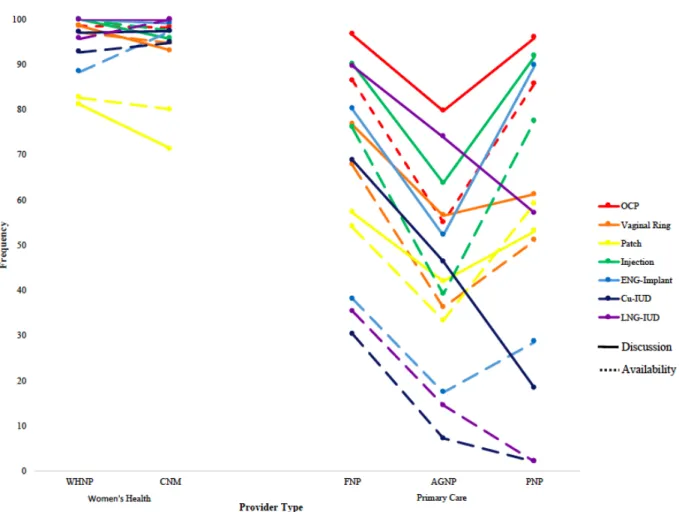
Discussion of vs. In Office Availability of Contraceptive Methods. Women’s health providers discussed all contraceptive methods at consistently high frequencies, as was the availability of these same methods (Figure 6). Conversely, among primary care providers we saw far more variation in both the discussion of contraceptive methods as well as the in-office availability of many methods (Figure 6). Of specific interest, LARC methods were discussed by women’s health providers at nearly perfect numbers with 100% of WHNPs and 99.1% of CNMs reporting discussing the ENG-Implant, 97.1% of WHNPs and 97.4% of CNMs reporting

disusing the Cu-IUD, and 100% of both WHNPs and CNMs reporting discussing the LNG-IUD with their patients (Figure 6). Frequencies were lower among primary care providers for

discussion of LARC methods. For the ENG-Implant, 80.1% of FNPs, 52.1% of AGNPs, and

89.8% of PNPs reported discussing this method with patients (Figure 6). Similarly low numbers

were seen for discussion of IUC methods among primary care providers. The Cu-IUD was

discussed by 68.9% of FNPs, 46.4% of AGNPs, and 18.4% of PNPs (Figure 6).

(42)

In-office availability of methods discussed during contraceptive counseling, specifically among the LARC methods, were found to be vastly different between women’s health providers as compared to primary care providers (Figure 6). Women’s health providers were again found to have LARC methods available to patients at consistently high frequencies. The ENG-Implant was available in-office with 88.4% of WHNPs and 100% of CNMs. Similarly, high frequencies were seen for the IUC methods with 92.7% and 95.6% of WHNPs reporting having the Cu-IUD and LNG-IUD available respectively. Rates for CNMs were similar at 94.7% and 100% for the Cu-IUD and LNG-IUD respectively. Comparatively, rates for in-office availability were much lower among primary care providers with only 38.1% of FNPs, 17.4% of AGNPs, and 28.6% of PNPs having the ENG-Implant available in-office. Even lower rates of in-office availability were seen for the IUC methods with 30.3% and 35.4% of FNPs reporting availability for the Cu- IUD and LNG-IUD respectively. Among AGNPs 7.2% reported having the Cu-IUD available in office and 14.9% reported the same for the LNG-IUD. The lowest rates of in-office availability were seen for the CU-IUD and LNG-IUD among PNPs with at only 2% for both methods.

Routine Discussion of LARC Methods

Further evaluation of contraceptive method discussion was done to determine if LARC methods were being routinely discussed with patients during contraceptive counseling.

Therefore providers were asked to report the frequency with which they discussed individual LARC methods. Routine discussion was defined as responses indicating providers discussed these methods with either “more than half, but not all” or “all” of their female patients to whom they had provided contraceptive counseling. Odds ratios were calculated to determine the

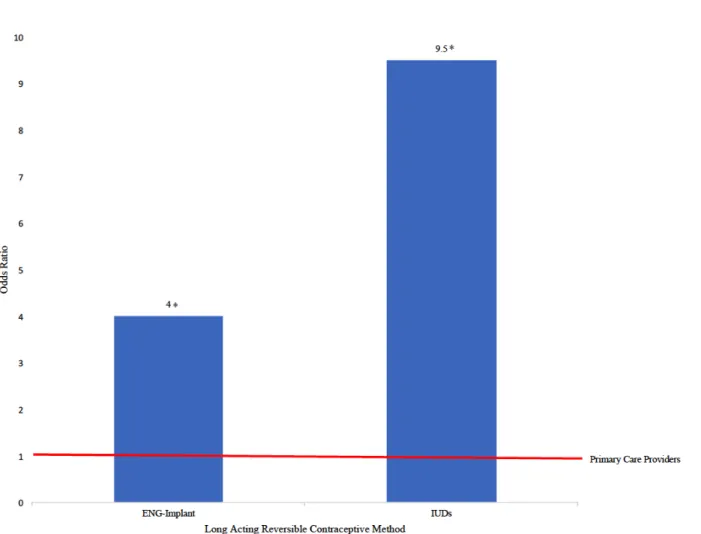
relative likelihood of LARC discussion during contraception counseling by provider type (Figure

7). Results were statistically significant (p=0.00) with women’s health providers four times

(43)

more likely to routinely discuss the ENG-Implant and 9.5 times more likely to routinely discuss the IUC methods with patients during contraceptive counseling than their peers in primary care.

Consideration of LARC Methods

Respondents were asked about their decision-making during contraceptive counseling as part of a well-woman exam (annual physical) or non-acute follow-up visit when recommending an IUD for patients with a variety of lifestyle choices or medical comorbidities. During analysis, combining responses “no” and “don’t know” as one category dichotomized responses. During analysis, provider types were grouped as primary care, FNP, AGNP, and PNP, and women’s health, WHNP and CNM (Figure 8).

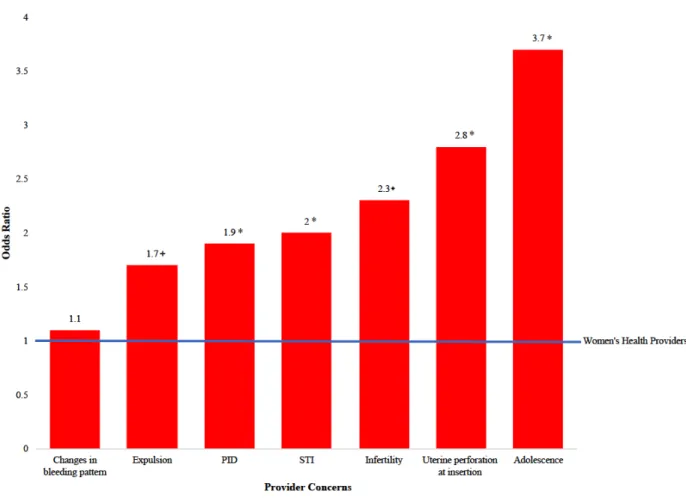
Again, vast differences were seen in the responses given by women’s health providers and those of the primary care providers. Significant differences (p= <.0001) were seen in the recommendation for an IUD to a nulliparous woman were Women’s health providers 7 times more likely to do so than were primary care providers. Adolescent women seeking an IUD are 9 times more likely to be recommended one if they see a women’s health provider than if they were to have seen a primary care provider, again, a significant result (p= <.0001).

Of particular interest were the results as to reccomndations for unmarried, cohabitating

versus unmarried, not cohabitating women. Essentially, these two populations are the same and

providers were not given any other information as to their sexual history or number of partners

when answering the question. However, unmarried, cohabitating women were 30 times more

likely to receive a recommendation for an IUD from a women’s health provider than a primary

care provider and unmarried, not cohabitating women were 10 times more likely to receive the

same. Data was statistically significant (p= <.0001) for both conditions.

Figure

Table 1. Provider Demographics
Figure 1. Average number of patients seen per week requiring contraceptive counseling and  services by provider type
Figure 2. Reported time, in minutes, available to providers for contraceptive counseling and  provider satisfaction with time available by provider type
Figure 3. Providers reporting working in clinics where those with prescriptive authority (MD,  NP, PA) are solely responsible for contraceptive counseling
+7

References

Related documents

diallylacetic acid rather than bismuth since in one case in which analysis was performed only minute amounts of bismuth were recovered, and there was, in his opinion, ‘ ‘no

mentees are related to youth depression, life satisfaction, and religious

Thanks are due to Oregon State University, the Oregon State University Extension publishing unit and Mark Anderson-Wilk for rapid dissemination of this document, the Oregon

SDMN is involved in grouping behaviour and so investigated brain activation in teleost fish in 72.. which shoaling conditions and social exposure can be readily manipulated

To address those questions theoretically, we will first adapt the classical Logistic model with closed/open seasonal harvest- ing which turns out to be a non-smooth Logistic model,

In the opinion of the BBA, Monarflex Ultra 250 and 300 Damp-proof Membranes, if installed, used and maintained in accordance with this Certificate, can satisfy or contribute

Two parameters affect the worst-case complexity of fac- tored planning: tree-width and minmax number of changes per factor (local depth, for factor=variable.) Thus, we need

Cabot, Cabot &amp; Forbes Industrial Park Comcast Center Mansfield Crossing T.P.C. Golf Club Norton Wheaton College Sensata Technologies Attleboro Crossing Wrentham Village