Is It Possible To Control An Arc To Glow
Transition For Practical Use In DC Low Voltage
Electrical Installations?
Miedzinski Bogdan, Kozłowski Artur
Institute of Innovative TechnologiesEMAG Katowice, Poland [email protected]
Wiśniewski Grzegorz
Wroclaw University of TechnologyPWr Wrocław, Poland
Kharin Stanislav
Kazakh-British Technical UniversityKBTU Almaty, Kazakhstan
Grechanyuk Nikolay
Institute of Material ScienceKiev, Ukraine
Nouri Hassan
University of the West of England UWE
Bristol, UK
Abstract—The paper presents and discusses investigated
results of the study of arc to glow transformation at breaking of DC inductive load of a low power (less than 10J) and low voltage (about 250V).The ratio in duration of arcing and glowing is investigated in dependence on circuit parameters, gas quenching medium and its pressure and in particular on contact material. The transition, to complete the study, was analyzed also by means of fast photography and radiation spectra measurements. On the basis of the results the conclusions on possibility of control of the arc to glow transformation, for practical use in low power contact switching devices, are formulated.
Keywords — switching dc arc; small power; low voltage; transition in glowing
I.
Introduction
The recently it is stated a growing interest in home installations DC due to increased use of direct current renewable energy sources (notably photovoltaic batteries), and possibilities to limit maintenance costs by eliminating additional power electronic converters. This is all the more important that on the market are available different types of receivers adapted for direct DC power including in particular LED light sources. It is therefore proposed, especially in residential buildings, the use of additional installation of a separate DC adapted to work with applied AC installation, as shown for example in [1]. The use of a DC, however, carries with it some technical inconvenience, resulting mainly from the inability of its transformation to a higher voltage levels and therefore, necessity of so current transmission with significant values as well as its effective commutation. Fast switching of DC loads needs the use of both special semiconductor and/or hybrid devices with the overvoltage
mathematical description of this effect based on the experimental results obtained [5].
The article presents and discusses the results of experimental studies of transition effect of switching DC arc in a glow discharge when interrupting a DC inductive current of low power (≤10J) and low voltage (≈250V). The study concerned the impact of such factors like pressure and type of quenching gas, current and voltage value, inductive energy of switching circuit and selected parameters of the switch like opening speed of the contact. Particular emphasis is placed on the selection of contact material. Based on the results of experimental study using, among other things, fast photography and spectroscopy both mathematical criteria have been formulated and practical lessons have been learned for the implementation of the arc to glow transition effect in selected contact switches of a low power and low voltage DC.
II.
Theoretical evaluation of
conditions of the arc instability
The study showed that a glow discharge appears in the time of unstable burning of the arc and can be initiated or almost immediately after the start of the opening the contact and/or after some time of the arc existence [6-10]. Approximate theoretical analysis of the arc in a glow discharge, for the electric circuit as shown in Fig1. is given in detail in [5,11]. On the basis of the investigated results [4,5,11] the process of contact opening, associated with arc to glow discharge, can be presented in four stages representing different phenomena [2,3,5,6,9-12] as illustrated in Fig.2. The stage I (pre-arcing) is related to the initial conditions for arc ignition in particular the values of current, voltage, density of evaporated metallic particles from contacts, length of contact gap, as well as electric field intensity that are important for further arc evaluation. According to different temperature value in the contact spot, one can distinguish here, three intervals as follows: first-from initial to softening temperature (elastic restitution); second-from softening to melting (plastic deformation) and third-from melting to boiling temperature (bridging) respectively. Since the first two parts are of a very short duration in our case (under consideration) thus, a liquid contact bridge is the most important factor for the further arc development. There are two existing mechanisms of the bridge formation and its dynamics strongly related to physical properties of contact material. The first one corresponds to a bridge formation due to melting of a micro-asperity on the contact surface, whereas the second is due to the extension of
a liquid drop from the melted area in the constriction zone [6].
This drop extension mechanism of the bridge formation is typical for low-melting point metals with high thermal conductivity like silver and its compositions. Therefore, for such contact materials the length and duration of the ruptured bridge (tb in Fig. 2) is large enough to provide thermal ionization of metal vapours needed for the arc ignition [7,8]. The further evaporation is also enough sufficient to maintain stable arc of a relatively long duration (extended stage II-Fig.2). Therefore, silver and its compositions are not suitable for the arc-to glow applications what was confirmed by experiment. On the contrary the micro-asperity genesis seems to be peculiar for more refractory metals such as nickel. The quantity of vapours of micro-asperity is not sufficient for stable arc ignition and its occurs because of field emission breakdown and/or air avalanches breakdown. The bridge is in such case significantly reduced or even invisible. Sometimes it may be accompanied by showering phenomena [12] and/or explosive electron emission (ecton process) [13]. As a result the arc duration at this mechanism of bridge formation is small and depends on the pressure according to Pashen’s law [2]. When the decreasing current reaches the certain critical value Icr at the critical time tcr the arc becomes unstable therefore, even a very small perturbation of current or voltage may cause the arc collapse (see Fig.2.). From mathematical point of view arc instability correlates with instability of the solution of the
R L
L
R W
W
C UA I
IA IC
[image:2.595.373.499.74.154.2]U0
Fig. 1. Electrical circuit diagram of the test rig (U0,I-supplied voltage and
load current, UA-arc voltage ,R,L,C-load resistance, inductance and circuit
capacity, LW,RW- wires inductance and resistance respectively)
I Icr
0tb
IG
UG
tt
t1 t2
U0
tb tA tG
tt
u(t)
i(t)
t
I II III IV
Fig. 2. Illustration of voltage current characteristics at contact opening ( tt,tG,tA,tb, tcr- total, glowing, arc discharge, bridge and
critical arc time respectively,U0,Ug-supply and glow voltage, Icr,
[image:2.595.332.552.225.381.2]differential equations for arc current and voltage corresponding to the electrical circuit from Fig1. Of course, the heat equation for the arc temperature that is related to arc thermal capacity, radius and length as well as with its electrical conductivity and anode, cathode and radiation losses have to be also taken under consideration [7]. When neglect LW and RW (2-5µH and 20-100Ω in our experiment) and use Lyapunov theory and Gurwitz criterion the conditions of arc instability can be written in the form [5,11];
1 1
0
A A
R
L C R k
1A 1A 1 A A 1 A A A1 A 1 0
R R R R
L C R k L C L C R k C R k L k LC R
A 1 0
R
R
A
A A
I U R
P
T V C
k A A A
A
where: RA arc resistance (4) and kA is the thermal heat constant (5) that is very important for the relation between arc duration tA and its of glowing tG (VA is the arc volume, TA– arc temperature, P-arc power) [14]. The criterion in form (1) defines the impossibility of the stationary arc existence; whereas, criteria according to (2) and (3) formulate addition conditions of the dynamic arc instability. Therefore, the solution of the non-linear (RA and kA parameters are non-linear) equation set (1)-(3) makes possible to find critical time tcr, critical arc power and critical current Icr (Fig 2.) for arc instability however, only for particular cases[5].
III.
Experimental study
A. Investigation procedure
In order to conduct research a special testing system equipped with a dismountable hermetic chamber with the contact system inside, controlled by a PC was designed and assembled [15]. Plain, round contacts (5mm in diameter and 1mm of thickness) operated in different gaseous medium (air, pure argon and N2+H2 5% mixture) under variable pressure from a few kPa up to about 300kPa. As a contact material were used different both refractory and non-refractory fine metals (like W, Mo, Ni, Ti, and Ta), selected fine powder tungsten-copper sinters (with some additives like Co 2%) and vapour deposited copper molybdenum and copper chromium compositions.
Contacts opening velocity was ranged from 0.04m/s up to about 0.4m/s at contact force from 0.6N up to around 40N. During the study with the use of fast photography (2200 frames per second) and radiation spectra measurements the length of contact gap was enlarged up to about 7mm (from 2.5mm). Due to the limitation of performance in transient of the selected fiber-optics spectrometer (time spectrum analysis about 200ms) the research of emission spectrum (in visible light range from 300nm to 750nm) was carried out for separately generated arc and glow discharges produced under the dc inductive load breaking. The investigations were performed for currents in the range of 0.5-3.0A at voltage from 48V to 250V and at a circuit time constant varied from 10ms up to 40ms (discharge energy less than 10J). The voltage, current, discharge power and the contact gap length variation were respectively recorded. To reduce the influence of surface contaminations, the contacts were preliminary mechanically and chemically cleaned and subjected to preliminary operation before testing. Ten samples for each contact material were selected and mean values and predicted ranges with 95% level of confidence were calculated after completed testing.
B. Results and discussion
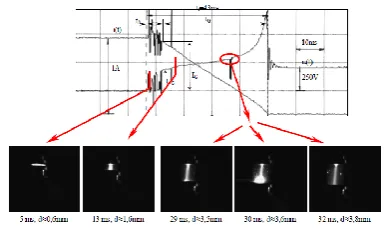
[image:3.595.332.525.64.178.2]The study showed that effect of transition of the arc discharge in a glowing is primarily dependent on contact material applied. However, it is noticeable for both refractory as well as non-refractory different materials under specified conditions of operation no less for materials such as silver and its alloys it is unattainable. It has been also found, that for consecutive switching under identical conditions, the transition is not identical but similar. It reveals that, some of the mechanisms depend on the probability of various events and therefore, the arc to glow transformation is not completely determined, but is subject to the lows of probability. The dc arc to glow transition can be attainable at the beginning of contact opening [11] however, usually it is generated due to transition from very unstable arc discharge (e.g. short arc ,showering arc) as it can be seen from Fig3. In these cases the discharge tends to lead to random arcing due to explosive erosion from the cathode (as seen from Fig.3 for 30ms and gap 3.6mm). This is related to sudden change of the cathode surface conditions with associated reinforced emission what
Fig. 3. The unstable arc to glow transition when use the fine nickel contacts (250V, 1A, 40ms, open air ≈100kPa) ( tt, tA, tG –total, arcing
and glow discharge time respectively, UG, -glow voltage ,IG –arc to
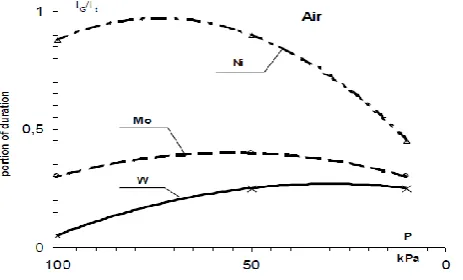
confirms the major role of this electrode. The best results if about transition efficiency were obtained for fine nickel as a contact material. Comparision of performance for different materials operating in open air is presented for example in Fig.4. It must be noted that the arc to glow transition can be initiated at a current value (IG) higher than so called ”minimum arcing” value (Icr) for applied contact material [2]. For the fine nickel the ratio IG/Icr is the highest up to about 2.5 [11]. Besides, just at the transition moment the anodic spot may be split into a few separate parts (three) [11] what, confirms the importance of the anode as well and complexity of the problem. For the contacts made of refractory materials like tungsten and/or molybdenum as well as their copper condensed compositions the arc to glow transition is also visible but with a small portion of glow duration [16]. Since the arc appearance for tungsten and molybdenum contacts does not vary significantly in pure argon (as a quenching medium) therefore, the increased oxidation of the contact surfaces in open air at an elevated temperature does not seem to be a major arc stimulating factor [11].
Because, with the additions of cobalt and/or titanium (1%) increases probability of the glow triggering (fig 4), which is not fully understood, and in turn the fine nickel provides the best conditions for the transformation, (what is also not repeatable), it was decided to carry out a similar comparing study for specially prepared, selected composite material copper-chromium type. A composite material was prepared in the form of sheets of appropriate thickness and of varying amounts of chromium and copper [17].
Samples of flat contact with a diameter of 5 mm and a thickness of 2.5mm for the test was respectively selected from the base material and formed, as shown for example in Fig. 5.
[image:4.595.324.552.61.214.2]Fig. 5. Selection of the composite base material for the preparation of contact samples (1 ... 4 example of samples number of different chromium content)
Fig. 4. Comparison of total discharge time and portion of the arc(tA) and
glow (tG) duration for tested contact materials when interrupt inductive
load DC (250V, 1.0A, 30ms) in open air under normal pressure (≈100kPa)
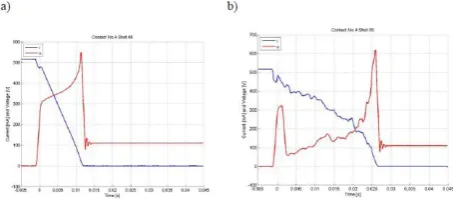
[image:4.595.61.296.292.540.2] [image:4.595.330.563.396.638.2]According to results of material examinations the chromium content (in weight) was ranged from about 0.6% up to about 80%, what can be seen from Fig.6. The surface structure of a new contact samples is in turn shown in Fig.7 and Fig.8 for example. Inspection of the state of the contact surfaces showed that the surfaces are not free from contaminations but the level of pollution like carbon and silicon for all samples is similar and does not exceed 10% for coal and 2% for silicon, respectively. Impurities of this kind can however, stimulate arcing although they are also (especially coal) quite easily removed from the contact surface during the arc burning [2]. During the research, under similar conditions as before, the value of the contact pressure force was fixed to about 0.58N, the average opening speed contact about 0.2 m /s and the length of the contact gap 2.4mm respectively. However, in order to limit the interference due to electromagnetic fields (during electrical discharge within contact gap area) on the results of the emission spectra was used a special low-pass filter(interference eliminator)during recording. It did not disturb basically the transformation effect of the arc to glow discharge, no fewer in recorded current and particularly voltage waveforms high harmonics content was found to be suppressed. Research has shown that regardless of the chromium content in the contact material the tendency for initiating a glow discharge occurs almost immediately at the moment of the opening process of the contact. It is manifested by sudden increase in the voltage value between contacts but the transition effect not always is successful (Fig.9) It is related to the conditions prevailing within the real contact area at a moment of current interruption which is also reflected in a contact resistance value. The contact resistance is typically
highest for the first switching and increases with the increase in a chromium content (from 0.3Ω to about 1.0 Ω at Cr 80%.). The switching arc duration is found to be the longest for the contacts made of smallest chromium content. Whereas, with the increase in the chromium amount is achieved not only the shortest arc time but increases significantly probability of glowing even immediately at the contact opening moment. The measuring results of the radiation spectra during electrical discharges at contact opening confirm the arc to glow transition phenomenon. The contribution of gaseous elements (when operated in open air) in arc radiation intensity is about 60% which indicates the existence of both metallic and gaseous arc phases. Whereas, intensity of the glowing radiation is about 10-times lower and exhibits an identical picture ,independently of the contact material. The contribution of electrodes material elements, which is found to be around 14%, results most probable from the fact that the metallic vapours are injected into the gap area just at the moment of bridge or protrusion explosion [11]. As a result of the glow generation ,the discharge energy within the contact area is dissipated at a much higher voltage level (UG is around 400V) and for current decreasing almost linearly with time.
[image:5.595.60.293.77.174.2] [image:5.595.57.295.230.323.2]Thus, both contacts erosion and switching overvoltages are reduced significantly. So, without the need to use additional external measures is provided the safe and long-lasting work of a switch. Due to the fact that transition effect is proposed to use in the hermetic structure of the auxiliary contact switches hence maximum speed of movement of the contacts does not practically exceed 0.4m/s (attenuation of a bellow) [15]. The research conducted for this limited speed range have shown that this effect is negligible. It was also found that the length of the contact gap , in this case, is no so important (≈2.5mm), particularly for immediate initiation of glow discharge. This impact occurs of course ,after a certain burning time of the arc. It is noted, however, that such an effect was observed for contacts made of a silver-alloy alloy (AgCdO). For higher (0.5m/s) opening velocity it was also found that, both velocity at contact separation as well as variation of acceleration can be important for the control of arc-to-glow transformation [5]. In the case of occurrence of the transition the inductive circuit energy to be dissipated (0.55J-2.2J under investigations) does not affect significantly Fig. 9. Voltage current waveforms at contact opening (110V,0.5A, 30ms) in open air under normal pressure for contacts of highest amount of chromium (…76%) at 48th (a),and 85th (b) consecutive breaking
Fig. 7. Surface structure of a new contact sample (No1) with the lowest (0.6%) content of chromium
[image:5.595.330.557.327.427.2]the duration of arc whereas, increases linearly the glow discharge time. With an increase in a supply voltage value the glowing time increases as well [4]. The transition is obviously significantly dependent on the interrupted current value hence, the thermal surface conditions of the applied contact material are of great importance. An important factor here is also the type of the protective (quenching) gas and its pressure [11]. It has been found however, that the optimum value of the pressure required for effective transition is related to the type of the contact material. For example, for the pure nickel the best effect was attainable for decreased pressure of pure argon or open air in the range of (50-75) kPa respectively, as shown in Fig.10. In pure argon however, the duration of the glow discharge is extended due to the decreased glowing voltage UG value [11].
The research of the surface topography and the erosion elements of the contacts surface after operation [11]showed, that in all cases of the glow discharge existence (regardless of the type of contact material) the erosion was less extensive. For example, for pure nickel the erosion extent of the contact surface (particularly the anode) after about 300 switching was found to be significantly smaller than after 40 switches with predominant arcing [4,11]. This is equivalent to an increase in electrical life of the switch.
IV.
Conclusions
The occurrence of glow discharge and/or transition of the switching arc in a glowing observed in inductive circuits of low voltage and low power (the most onerous category of utilization - DC-13) is an advantages because it decreases significantly erosion of the contact surfaces, thus extending the switch life, reducing simultaneously the voltage surge values.
Due to the complexity of mutually interacting phenomena greatly affected by the electrodes and their neighboring contraction regions the accurate control of transition effect of the DC switching arc in a glow discharge is particularly
difficult to achieve. It is almost impossible to keep the same conditions at both the electrode surfaces and within the contact gap area during subsequent switching cycles in particular under varying load conditions.
Theoretical conditions specifying the criteria to ensure the arc instability can be mathematically formulated for particular electrical circuit on the basis of non-linear differential equations of the circuit with electric arc.
The obtained test results can, however, for drawing practical conclusions if about designing of a low power, low voltage contact switch for specific applications .Thus, although repeatability of as current as well as and switching voltage waveforms at each successive cycle is not satisfied but, statistically the transition of arc in a glow discharge will be achieved. As a result the contact life time in the absence of dangerous surges will be met. However, the transition can be obtained for any low voltage and low power contact switch, operating even in open air, but it is particularly recommended for auxiliary encapsulated (hermetic) switches of a compact structure, in which many interfering effects such as oxidation, contamination etc. can be reduced or even eliminated.
References
[1] P. Meckler, f. Gerdinand, R.Weiss, U.Boeke, A. Mauer “Hybrid switches in protective devices for low-voltage DC grids at commercial used buildings” Proc.of 27th Int.Conf. on Electric Contacts, June 22-26,2014. Dresden Germany,pp.120-125
[2] R. Holm “ Electric contacts.Theory and applications” Marcel Dekker Ed.Basel, Switzerland,1999
[3] T.E.Browne “Circuit interruption. Theory and design” Marcel Dekker Ed,1984
[4] B. Miedzinski, A.Szymanski, G.Wisniewski, A.Grodzinski: „Transformation of low power arc to glowing under inductive load DC” Proc.Int. Conf. SAP 2001, Lodz, Poland, 17-20.09.2001, pp.117-120 [5] S.N.Kharin, H.Nouri, B.Miedzinski,G.Wisniewski:” Transient
phenomena of arc to glow discharge transformation at contact opening” Proc.of 21st Int.Conf.on Electric contacts, Zurich,Switzerland, 9-12.09.2002,pp.425-431
[6] S.N.Kharin:” Post bridge phenomena in electric contacts at the initial stage” IEEE Trans on Comp. Packaging and Man.Tech, partA,vol19,No3,1996,pp.313-319
[7] S.N. Kharin:” Mathematical model of the short arc phenomena at the initial stage” Proc.43rd IEEE Holm Conf. on Electric Contacts, Philadelphia,USA, 1997,pp.289-305
[8] S.N.Kharin:” Mathematical model of the arc evaluation from metallic phase to gaseous phase” Proc. 20th Int.Con. on Electric Contacts ,Stockholm,Sweden, 2000,pp.155-160
[9] A.E.Guile;” Arc –electrode phenomena” Proc IEE Reviews ,vol118, No 9R,September 1971,pp.1131-1154
[10] F. Llewellyn-Jones:” The glow discharge and an introduction to plasma physics” London-Methuen Co.Ltd. 1966
[11] H.Nouri, B.Miedzinski, S.N.Kharin, G.Wisniewski:” Analysis and investigations of arc to glow discharge transformation under DC inductive load” Mechanizacja i Automatyzacja Górnictwa MIAG,No8/439,2007,pp.7-22
[12] C.W. Mills:” The mechanism of the showering arc” IEEE Trans. on Parts,Hybrids and packaging, vol PMP-5, No1,1969,pp.47-55
[13] G.A.Mesyats:” Catodic spot at an ecton process” Proc. 41st IEEE Holm Conf, Montreal, Canada,1995,pp.247-251
[image:6.595.63.295.239.379.2][14] S.N. Kharin, H.Nouri, T.Davis:” Influence of inductance on the arc evaluation in AgMeO contacts” Proc.48th IEEE Holm Conf, Orlando,USA,2002,pp.108-119
[15] P. Bakowski, B. Miedzinski, S.Szkolka, H.Poniewierski:” System for material testing of hermetic switches” Proc SAP-93 Conf., Lodz,1993, pp.301-304
[16] B. Miedzinski, G.Wisniewski, V.N.Shoffa, N.I.Grechanyuk:” Performance of copper-molybdenum contacts when used for inductive DC load” Electrical Contacts and Electrodes, Institute of material Science 2004,pp.19-23

![Fig.4. It must be noted that the arc to glow transition can be initiated at a current value (I”minimum arcing” value (IG) higher than so called ) for applied contact material [2]](https://thumb-us.123doks.com/thumbv2/123dok_us/611201.561457/4.595.330.563.396.638/transition-initiated-current-minimum-higher-applied-contact-material.webp)