A Hybrid Model for Grammatical Error Correction
Yang Xiang, Bo Yuan, Yaoyun Zhang
*, Xiaolong Wang
†,
Wen Zheng, Chongqiang Wei
Intelligent Computing Research Center, Key Laboratory of Network Oriented Intelligent
Computation, Computer Science and technology Department,
Harbin Institute of Technology Shenzhen Graduate School,
Shenzhen, Guangdong, 518055, P.R. China
{windseedxy, yuanbo.hitsz, xiaoni5122, zhengwen379, weichongqiang}@gmail.com [email protected]†
Abstract
This paper presents a hybrid model for the CoNLL-2013 shared task which focuses on the problem of grammatical error correction. This year’s task includes determiner, preposition, noun number, verb form, and subject-verb agreement errors which is more comprehen-sive than previous error correction tasks. We correct these five types of errors in different modules where either machine learning based or rule-based methods are applied. Pre-processing and post-Pre-processing procedures are employed to keep idiomatic phrases from be-ing corrected. We achieved precision of 35.65%, recall of 16.56%, F1 of 22.61% in the
official evaluation and precision of 41.75%, recall of 20.29%, F1 of 27.3% in the revised
version. Some further comparisons employing different strategies are made in our experi-ments.
1
Introduction
Automatic Grammatical Error Correction (GEC) for non-native English language learners has at-tracted more and more attention with the devel-opment of natural language processing, machine learning and big-data techniques.The CoNLL-2013 shared task focuses on the problem of GEC in five different error types including determiner, preposition, noun number, verb form, and sub-ject-verb agreement which is more complicated and challenging than previous correction tasks. Other than most previous works which concen-trate most on determiner and preposition errors, more error types introduces the possibility of correcting multiple interacting errors such as
Corresponding author
terminer vs. noun number and preposition vs. verb form.
Generally, for GEC on annotated data such as the NUCLE corpus (Dahlmeier et al., 2013) in this year’s shared task which contains both origi-nal errors and human annotations, there are two main types of approaches. One of them is the employment of external language materials. Alt-hough there are minor differences on strategies, the main idea of this approach is to use frequen-cies as a filter, such as n-gram counts, and take those phrases that have relatively high frequen-cies as the correct ones. Typical works are shown in (Yi et al., 2008) and (Bergsma et al., 2009). Similar methods also exist in HOO shared tasks1 such as the web 1TB n-gram features used by Dahlmeier and Ng (2012a) and the large-scale n-gram model described by Heilman et al. (2012). The other type is machine learning based ap-proach which considers most on local context including syntactic and semantic features. Han et al. (2006) take maximum entropy as their classi-fier and apply some simple parameter tuning methods. Felice and Pulman (2008) present their classifier-based models together with a few rep-resentative features. Seo et al. (2012) invite a meta-learning approach and show its effective-ness. Dahlmeier and Ng (2011) introduce an al-ternating structure optimization based approach.
Most of the works mentioned above focus on determiner and preposition errors. Besides, Lee and Seneff (2008) propose a method to correct verb form errors through combining the features of parse trees and n-gram counts. To our knowledge, no one focused on noun form errors in specific researches.
In this paper, we propose a hybrid model to solve the problem of GEC for five error types.
1
http://clt.mq.edu.au/research/projects/hoo/hoo2012
Machine learning based methods are applied to solve determiner (ArtOrDet), preposition (Prep) and noun form (Nn) problems while rule-based methods are proposed for subject-verb agreement (SVA) and verb form (Vform) problems. We treat corrections of errors in each type as indi-vidual sub problems the results of which are combined through a result combination module. Solutions on interacting error corrections were considered originally but dropped at last because of the bad effects brought about by them such as the accumulation of errors which lead to a very low performance. We perform feature selection and confidence tuning in machine learning based modules which contribute a lot to our perfor-mance. Also, pre-processing and post-processing procedures are employed to keep idiomatic phrases from being corrected.
Through experiments, we found that the result of the system was affected by many factors such as the selection of training samples and features, and the settings of confidence parameters in clas-sifiers. Some of the factors make the whole sys-tem too sensitive that it can easily be trapped into a local optimum. Some comparisons are shown in our experiments section.
No other external language materials are in-cluded in our model except for several NLP tools which will be introduced in §5.2. We achieved precision of 35.65%, recall of 16.56% and F1 of
22.61% in the official score of our submitted re-sult. However, it was far from satisfactory main-ly due to the ill settings of confidence parameters. Trying to find out a set of optimal confidence parameters, our model is able to reach an upper bound of precision of 34.23%, recall of 25.56% and F1 of 29.27% on the official test set. For the
revised version, we achieved precision of 41.75%, recall of 20.29%, and F1 of 27.3%.
The remainder of this paper is arranged as fol-lows. The next section introduces our system architecture. Section 3 describes machine learn-ing based modules. Section 4 shows rule based modules. Experiments and analysis are arranged in Section 5. Finally, we give our discussion and conclusion in Section 6 and 7.
2
System Architecture
Initially, we treat errors of each type as individu-al sub problems. Machine learning based meth-ods are applied to solve ArtOrDet, Prep and Nn problems where similar problem solving steps are shared: sample generation, feature extraction, training, confidence tuning in development data,
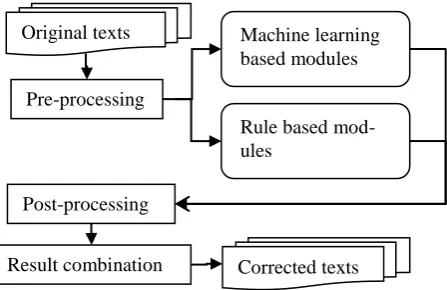
and testing. We apply some hand-crafted heuris-tic rules in solving subject-verb agreement (SVA) and verb form (Vform) problems. Finally, results from different modules are combined together. The whole architecture of this GEC system is described in Figure 1.
[image:2.595.303.527.406.551.2]A pre-processing and a post-processing filter are utilized which include filters for some idio-matic phrases extracted from the training dataset. The Frequent Pattern Growth Algorithm (FP-Growth) is widely used for frequent pattern min-ing in machine learnmin-ing. In pre-processmin-ing, we firstly apply FP-Growth to gather the frequent items in the training set. Through some manual refinements, a few idiomatic phrases are re-moved from the candidate set to be corrected. In post-processing, the idiomatic phrase list is used to check whether a certain collocation is still grammatical after several corrections are per-formed. There are 996 idiomatic phrases in our list which is composed by mainly patterns from the training set and a series of hand-crafted ones. Typical phrases we extracted are in general, have/need to be done, on the other hand, a large/big number/amount of, at the same time, in public, etc.
Figure 1. Architecture of our GEC system.
3
Machine Learning Based Modules
For the error types ArtOrDet, Prep and Nn, we choose machine learning based methods because we consider there is not enough evidence to di-rectly determine which word or form to be used. Moreover, it is impossible to transfer all the cas-es we encounter into rulcas-es. In this section, we describe our processing ideas for each error type respectively and then specifically introduce our feature selection and confidence tuning approach.
3.1 Determiners
Determiners in the error type “ArtOrDet” contain articles a/an, the and other determiners such as
Original texts
Pre-processing
Machine learning based modules
Rule based mod-ules
Post-processing
this, those, etc. This type of error accounts for a large proportion which is of great impact on the final result. We consider only articles since the other determiners are rarely used and the usages of them are sometimes ambiguous. Like ap-proaches described in some previous works (Dahlmeier and Ng, 2012a; Felice and Pulman, 2008), we assign three types a/an, the and empty for each article position and build a multi-class classifier.
For training, developing and testing, all noun phrases (NPs) are chosen as candidate samples to be corrected. For NPs whose articles have been annotated in the corpus, the correct ones are their target categories, and for those haven’t been an-notated, the target categories are their observed article types. Samples we make use of can be divided into two basic types in each category: with and without a wrong article. Two examples are shown below:
with: a/empty big apples ~ empty category
without: the United States ~ the category For each category in a, the, and empty, we use the whole with data and take samples of without ones from the set of correct NPs to make up training instances of one category. The reason why we make samples of the without ones is for the consideration that the classifier would always predicts the observed article and never proposes any corrections if given too many without sam-ples, the case of which is mentioned in (Dahl-meier and Ng, 2012a). However, we found that the ratio of with-without shows little effect in our model. The article a is regulated to a or an ac-cording to pronunciation.
Syntactic and semantic features are considered in feature extraction with the help of WordNet and the “.conll” file provided. We adopt syntac-tic features such as the surface word, phrase, part-of-speech, n-grams, constituent parse tree, dependency parse tree and headword of an NP; semantic features like noun category and hyper-nym. Some expand operations are also done based on them (reference to Dahlmeier and Ng, 2012a; Felice and Pulman, 2008). After feature extraction, we apply a genetic algorithm to do feature subset selection in order to reduce dimen-sionality and filter out noisy features which is to be described in §3.4.
Maximum Entropy (ME) has been proven to behave well for heterogeneous features in natural language processing tasks and we adopt it to train our model. We have also tried several other classifiers including SVM, decision tree, Naïve Bayes, and RankSVM but finally find ME
per-forms well and stably. It provides confidence scores for each category which we will make use of downstream.
3.2 Prepositions
Preposition error correction task is similar to the previous one except the different categories and corresponding features. Since there are 36 com-mon prepositions listed by the shared task, origi-nally, we assign 37 types including 36 preposi-tions and empty for each preposition position and build a multi-class classifier. For training, devel-oping and testing, each preposition as well as the empty position directly after a verb is considered as a candidate. Syntactic and semantic features extracted are similar to those in article error cor-rection except for some specific cases for prepo-sitions such as the verbs related to prepoprepo-sitions and the dependency relations. Similarly, we treat those preposition phrases with and without a cer-tain preposition as the two types of samples in training (as described in §3.1). Two examples are listed below:
with: on/in the 1860s~ in category
without: have to be done ~ to category Through statistics on the training data, we found that most prepositions have very few sam-ples which may not contribute to the perfor-mance at all and even bring about noise when assigned to wrong categories. After several rounds of experiments, we finally adopt a classi-fier with seven prepositions which are frequently used in the whole corpus. They are on, of, in, at, to, with and for. As to the classifier, ME also outperforms the others.
3.3 Noun Form
Noun form may be interacting with determiners and verbs which may also have errors in the orig-inal text. So errors may occur in the context fea-tures extracted from the original text. However, if we use the context features that have been cor-rected, more errors would be employed due to the low performance of the previous steps. Through statistics, we found that co-occurrence between two types of errors such as SVA and ArtOrDet only accounts for a small proportion. After a few experiments, we decided to give up interacting errors so as to avoid accumulated er-rors.
head noun form such as the countability, Word-Net type, name entity and whether there some specific dependency relations including det, amod etc.
ME also outperforms other classifiers.
3.4 Feature Selection Using Genetic Algo-rithm
Features we extracted are excessive and sparse after binarization. They bring noise in quality as well as complexity in computation and need to be selected a priori. In our work, it is a wrapper feature selection task. That is, we have to select a combination of features that perform well to-gether rather than make sure each of them be-haves well. This GEC task is interesting in fea-ture selection because word surface feafea-tures that are observed only once are also effective while we think that they overfit. Genetic algorithm (GA) has been proven to be useful in selecting wrapper features in classification (ElAlami, 2009; Anba-rasi et al, 2010). We used GA to select fea-tures as well as reduce feature dimensionality.
We convert the features into a binary sequence in which each character represents one sion. Let “1” indicates that we keep this dimen-sion while “0” means that we drop it, we use a binary sequence such as “0111000…100” to de-note a combination of feature dimensions. GA functions on the feature sequences and finally decides which features should be kept. The fit-ness function we used is the evaluation measure F1 described in §5.3.
3.5 Confidence Tuning
The Maximum Entropy classifier returns a confi-dence score for each category given a testing sample. However, for different samples, the dis-tribution of predicted scores varies a lot. For some samples, the classifier may have a very high predicted score for a certain category which means the classifier is confident enough to per-form this prediction. But for some other samples, two or more categories may share close scores, the case of which means the classifier hesitates when telling them apart.
We introduce a confidence tuning approach on the predicted results through a comparison be-tween the observed category and the predicted category which is similar to the “thresholding” approach described in Tetreault and Chodorow (2008). The main idea of the confidence tuning algorithm is: the choice between keep and drop is based on the difference between the confidence scores of the predicted category and the observed
category. If this difference goes beyond a thresh-old t, the prediction is kept while if it is under t, we won’t do any corrections. We believe this tuning strategy is especially appropriate in this task since to distinguish whether the observed category is correct or not affects a lot to the pre-dicted result.
The confidence threshold for each category is generated through a hill climbing algorithm in the development data aimed at maximizing F1
-meaure of the result.
4
Rule-based Modules
A few hand-crafted rules are applied to solve the verb related corrections including SVA and Vform. In these cases, the verb form is only re-lated to some specific features as described by Lee and Seneff (2008).
4.1 SVA
SVA (Subject-verb-agreement) is particularly related to the noun subject that a verb determines. In the dependency tree, the number of the noun which has a relation nsubj with the verb deter-mines the form of this verb. Through observation, we find that the verbs to be considered in SVA contain only bes (including am, is, are, was, were) and the verbs in simple present tense whose POSs are labeled with VBZ (singular) or VBP(plural).
To pick out the noun subject is easy except for the verb that contained in a subordinate clause. We use semantic role labeling (SRL) to help solve this problem in which the coordinated can be extracted through a trace with the label “R-Argument”. The following Figure is an example generated by the SRL toolkit mate-tools (Bernd Bohnet, 2010)2.
Figure 2. SRL for the demo sentence “Jack, who will show me the way, is very tall.” The subject of the verb show can be traced through R-A0 -> A0.
However, the performance of this part is partly correlated with the noun form that may have er-rors in the original text and the wrong SRL result brought about because of wrong sentence gram-mars.
2
4.2 Verb Form
The cases are more complicated in the verb form error correction task. Modal, aspect and voice are all forms that should be considered for a verb. And sometimes, two or more forms are com-bined together to perform its role in a sentence. For example, in the sentence:
He has been working in this position for a long time.
The bolded verb has been working is a com-bination of the active voice work, the progressive aspect be+VBG and the perfect aspect has+VBN. It is a bit difficult for us to take all cases into consideration, so we just apply several simple rules and solve a subset of problems for this type. Some typical rules are listed below:
1. The verb that has a dependency relation aux to preposition to is modified to its base form.
2. The verb that has a dependency relation pcomp to preposition by is modified to its past form.
3. The verb related to other prepositions (ex-cept to and by) is modified to ~ing form.
4. The verb depends on auxiliary do and mod-al verb (including its inflections and negative form) is modified to its base form.
We have also tried to use SRL and transitivity of a verb to determine the active and passive voice but it didn’t work well.
5
Experiments and Analysis
5.1 Data Description
The NUCLE corpus introduced by NUS (Nation-al University of Singapore) contains 1414 essays written by L2 students with relatively high profi-ciency of English in which grammatical errors have been well annotated by native tutors. It has a small proportion of annotated errors which is much lower than other similar corpora (Dahl-meier et al., 2013). In our experiments, we divide the whole corpus into 80%, 10% and 10% for training, developing and testing. And we use 90% and 10% for training and developing for the final test.
5.2 External tools and corpora
External tools we used include WordNet (Fell-baum, 1998) for word base form and noun cate-gory generation, Morphg (Minnen et al., 2000)3 to generate inflections of nouns and verbs, mate-tools (Bohnet, 2010) for SRL, Stanford-ner
3
http://www.informatics.sussex.ac.uk/research/groups/nlp /carroll/morph.html
(Finkel et al., 2005)4 for name entity extraction and Longman online dictionary5 for generation of noun countability and verb transitivity.
We didn’t employ any external corpora in our system.
5.3 Experiments
The performance of each machine learning mod-ule is affected by the selection of training sam-ples, features and confidence tuning for the max-imum entropy classifier. All these factors con-tribute more or less to the final performance and need to be carefully developed. In our experi-ments, we focus on machine learning based modules and make comparisons on sample selec-tion, confidence tuning and feature selection and list a series of results before and after applying our strategies.
In our experiment, the performance is meas-ured with precision, recall and F1-measure where
1
2
precision recall
F
precision recall
Precision is the amount of predicted correc-tions that are also corrected by the manual anno-tators divided by the whole amount of predicted corrections. Recall has the same numerator as precision while its denominator is the amount of manually corrected errors. They are in accord-ance with those measurements generated by the official m2scorer (Dahlmeier and Ng, 2012c) to a great extent and easily to be integrated in our program.
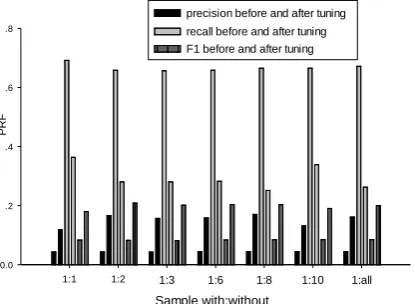
As we have mentioned in Section 3, we don’t employ all samples but make use of all with (with errors and annotations) instances and sam-ple the without ones (without errors) for training. And the sampling for without type is totally ran-dom without loss of generality. We apply the same strategy in all of these three error types (ArtOrDet, Prep and Nn) and try several ratios of with-without to find out whether this ratio has great impact on the final result and which ratio performs best. We use the 80%-10%-10% data (mentioned in §5.1) for our experiments and make comparisons of different ratios on develop-ing data. The experimental results are described in detail in Figure 3.
Confidence tuning is applied in all these three error types which contributes most to the final performance in our model. We compare the re-sults before and after tuning in all sample ratios
4
http://www-nlp.stanford.edu/software/CRF-NER.shtml 5
that we designed and they are also depicted in Figure 3.
Sample with:without
1:1 1:2 1:3 1:6 1:8 1:10 1:all
P
RF
0.0 .2 .4 .6 .8
precision before and after tuning recall before and after tuning F1 before and after tuning
Figure 3-1. Comparisons before and after tuning in ArtOrDet. 1:all means to use the whole without
samples.
Sample with:without
1:1 1:2 1:3 1:6 1:8 1:10 1:all
P
R
F
0.0 .1 .2 .3 .4 .5 .6
[image:6.595.74.282.100.252.2]presision before and after tuning recall before and after tuning F1 before and after tuning
Figure 3-2. Comparisons before and after tuning in Prep.
1:1 1:2 1:3 1:6 1:8 1:10 1:all
P
R
F
0.0 .2 .4 .6 .8
1.0 precision before and after tuning
recall before and after tuning F
1 before and after tuning
Sample with:without
Figure 3-3. Comparisons before and after tuning in Nn.
From the three groups of data in Figure 3, we notice that the ratio of samples has little impact on F1. This phenomenon shows that our
conclu-sion goes against the previous work by Dahl-meier and Ng (2012a). We believe it is mainly due to our confidence tuning which makes the parameters vary much under different sample
ratios, that is, if given the same parameters, the effect of sample ratio selection may become ob-vious. Unfortunately, we didn’t do such a sys-tematic comparison in our work. The improve-ment under confidence tuning can be seen clearly in all ratios of with-without samples. The confi-dence tuning algorithm employed in our work is better than the traditional tuning methods that assign a fixed threshold for each category or for all categories (about 1%~2% better measured by F1).
However, although we are able to pick out the training data with a high F1 through confidence
tuning for the developing data, it is difficult for us to choose a set of confidence parameters that also fits the test data well. Given several close F1s, the numerical values of denominators and
numerators which determine the precision and recall can vary a lot. For example, one set that has a high precision and low recall may share the similar F1 with another set that has a low
preci-sion and high recall. Our work lacked of the de-velopment on how to control the number of pro-posed errors to make leverage on the perfor-mance between developing set and testing set. It resulted in that the developing set and the testing set were not balanced at all, and our model was not able to keep the sample distribution as the training set. This is the main factor that leads to a low performance in our submitted result which can be clearly seen in Table 1. The upper bound performance of our system achieves precision of 34.23%, recall of 25.56% and F1 of 29.27%, in
which the F1 goes 7% beyond our submitted
sys-tem. We notice that results of all metrics of the three error types where machine learning algo-rithms are applied improve with the simultaneous increase of numerators and denominators. This is especially noticeable in Prep.
For the other two types SVA and Vform, we just apply several heuristic rules to solve a subset of problems and the case of Vform has not been solved well such as tense and voice.
downstream computational complexity. However, the improvement contributed by GA after dence tuning is not obvious as that before confi-dence tuning. We think it is partly because of the bad initialization of GA which is to be improved in our future work. The unfixed parameters may also lead to such a result which we didn’t discuss enough in our work. The comparison before and after GA is described in Figure 4.
Our submission% Upper bound%
P(Det) 41.38(168/406) 36.44(254/697)
R(Det) 24.35(168/690) 36.81(254/690)
F1(Det) 30.66 36.63
P(Prep) 13.79(4/29) 26.12(35/134)
R(Prep) 1.29(4/311) 11.25(35/311)
F1(Prep) 2.35 15.73
P(Nn) 24.81(65/262) 27.27(102/374)
R(Nn) 16.41(65/396) 25.76(102/396)
F1(Nn) 19.76 26.49
P(SVA)
R(SVA) F1(SVA)
24.42(21/86)
16.94(21/124) 20.00
24.42(21/86)
16.94(21/124) 20.00
P(Vform)
R(Vform) F1(Vform)
19.35(6/31)
4.92(6/122) 7.84
19.35(6/31)
4.92(6/122) 7.84
P(all) 35.65(272/763) 34.23(420/1227)
R(all) 16.56(272/1643) 25.56(420/1643)
F1(all) 22.61 29.27
Table 1. Different performances according to dif-ferent confidence parameters. Det stands for Ar-tOrDet.
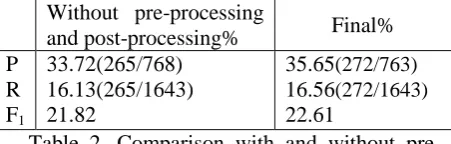
Pre-processing and post-processing we pro-pose also contribute to some extent which we could see from Table 2. Some idiomatic phrases are excluded from being corrected in pre-processing which enhances precision while some are being modified in post-processing to improve recall.
Without pre-processing
and post-processing% Final% P
R F1
33.72(265/768) 16.13(265/1643) 21.82
35.65(272/763)
16.56(272/1643)
22.61
Table 2. Comparison with and without pre-processing and post-pre-processing.
We didn’t do much on the interacting errors problem since we didn’t work out perfect plans to solve it. So, in the result combination module, we just simply combine the result of each part together.
Sample positive:negative
1:1 1:2 1:3 1:6
F1
0.00 .05 .10 .15 .20 .25 .30
ME ME+GA
[image:7.595.311.520.85.241.2]ME+Tuning ME+GA+Tuning
Figure 4. Comparisons before and after Genet-ic Algorithm on ArtOrDet error type. ME, GA, and Tuning stand for Maximum Entropy, Ge-netic Algorithm and confidence tuning.
In the revised version, under further correc-tions for the gold annotacorrec-tions, our model achieves precision of 41.75%, recall of 20.19% and F1 of 27.3%.
6
Discussion
Which factor contributes most to the final result in the problem of grammatical error correction? Since we didn’t include any external corpora, we discuss it here only according to the local classi-fiers and context features.
Based on our experiments, we find that, in our machine learning based modules, a tiny modifi-cation of confidence parameter setting for each category, no matter which type of error, can have great impact on the final result. It results in that our model is much too sensitive to parameters which may easily lead to a poor behavior. Per-haps a sufficient consideration of how to keep the distribution of samples, such as cross-validation, may be helpful. In addition, the selec-tion of classifiers, features and training samples all have effect on the result more or less, but not as obvious as that of the confidence threshold setting.
7
Conclusion
[image:7.595.68.294.585.657.2]to parameters. How to keep the distribution of training samples needs to be further developed.
Acknowledgement
This work is supported in part by the National Natural Science Foundation of China (No. 612-72383 and 61173075).
References
Bernd Bohnet. Top Accuracy and Fast Depend-ency Parsing is not a Contradiction. In Pro-ceedings ofCOLING,2010.
C. Fellbaum. WordNet: An Electronic Lexical Data-base. MIT Press. 1998.
Daniel Dahlmeier, and Hwee Tou Ng. Grammat-ical error correction with alternating structure optimization. In Proceedings of ACL. Associa-tion for ComputaAssocia-tional Linguistics, 2011.
Daniel Dahlmeier, Hwee Tou Ng, and Eric Jun Feng Ng. NUS at the HOO 2012 Shared Task. In Proceedings of the Seventh Workshop on Building Educational Applications Using NLP. Association for Computational Linguistics, 2012a.
Daniel Dahlmeier and Hwee Tou Ng. A beam-search decoder for grammatical error correc-tion. In Proceedings of the EMNLP. Associa-tion for ComputaAssocia-tional Linguistics, 2012b.
Daniel Dahlmeier and Hwee Tou Ng. Better Evaluation for Grammatical Error Correction. In Proceedings of NAACL, Association for Computational Linguistics, 2012c.
Daniel Dahlmeier, Hwee Tou Ng and Siew Mei Wu. Building a Large Annotated Corpus of Learner English: The NUS Corpus of Learner English. In Proceedings of the 8th Workshop on Innovative Use of NLP for Building Educa-tional Applications (BEA), 2013.
De Felice, Rachele and Stephen G. Pulman. A classifier-based approach to preposition and determiner error correction in L2 English. In Proceedings of COLING. Association for Computational Linguistics, 2008.
G. Minnen, J. Carroll and D. Pearce. Robust, applied morphological generation. In Proceed-ings of the 1st International Natural Language Generation Conference, 2000.
Jenny Rose Finkel, Trond Grenager, and Chris-topher Manning. Incorporating Non-local In-formation into InIn-formation Extraction Systems
by Gibbs Sampling. In Proceedings of ACL , 2005.
Joel R. Tetreault and Martin Chodorow. The ups and downs of preposition error detection in ESL writing. In Proceedings of COLING, As-sociation for Computational Linguistics, 2008.
John Lee and Stephanie Seneff. Correcting mis-use of verb forms. In Proceedings of ACL: HLT, 2008.
M Anbarasi, E Anupriya, and NC Iyengar. En-hanced prediction of heart disease with feature subset selection using genetic algorithm. In-ternational Journal of Engineering Science and Technology,Vol.2(10),2010: 5370-5376.
ME ElAlami. A filter model for feature subset selection based on genetic algorithm. Knowledge-Based Systems,Vol.22(5), 2009: 356-362.
Michael Heilman, Aoife Cahill, and Joel Tetreault. Precision isn't everything: a hybrid approach to grammatical error detection. In Proceedings of the Seventh Workshop on Building Educational Applications Using NLP. Association for Computational Linguistics, 2012.
Hongsuck Seo et al. A meta learning approach to grammatical error correction. In Proceedings of ACL. Association for Computational Lin-guistics, 2012.
N.R. Han, M. Chodorow, and C. Leacock. 2006. Detecting errors in English article usage by non-native speakers. Natural Language Engi-neering, Vol.12(02):115-129.
S. Bergsma, D. Lin, and R. Goebel. 2009. Web-scale ngram models for lexical disambiguation. In Proceedings of IJCAI.2009.