Linked data schemata: fixing unsound
foundations
Kevin Chekov Feeney, Gavin Mendel Gleason, and Rob Brennan
Knowledge and Data Engineering Group & ADAPT Centre, School of Computer Science & Statistics, Trinity College Dublin, Ireland
Abstract. This paper describes our tools and method for an evaluation of the practical and logical implications of combining common linked data vocabularies into a single local logical model for the purpose of reasoning or performing quality evalua-tions. These vocabularies need to be unified to form a combined model because they reference or reuse terms from other linked data vocabularies and thus the definitions of those terms must be imported. We found that strong interdependencies between vocabularies are common and that a significant number of logical and practical problems make this model unification inconsistent. In addition to identifying problems, this paper suggests a set of recommendations for linked data ontology design best practice. Finally we make some suggestions for improving OWL’s support for distributed authoring and ontology reuse.
Keywords: Linked Data, Reasoning, Data Quality
1.Introduction
One of the central tenets of the linked data move-ment is the reuse of terms from existing well-known vocabularies [1] when developing new schemata or datasets. The Semantic Web infrastructure and the RDF, RDFS and OWL languages support this with their inherently distributed and modular nature. Linked data schemata which reuse vocabularies con-stitute a knowledge model based on multiple, inde-pendently devised ontologies that often exhibit vary-ing definitional semantics [2]. In order to reason about linked data datasets – for example to validate that a dataset correctly uses a term from another vo-cabulary, a basic requirement is the ability to create a unified knowledge model which combines the refer-enced ontologies and vocabularies. For example, the Asset Description Metadata Schema (adms) ontology contains the triple:
adms:Asset rdfs:subClassOf dcat:Dataset
In order to validate any dataset which uses the adms:Asset term we must combine the adms ontolo-gy and the dcat ontoloontolo-gy in order to ensure that dcat:Dataset is a valid class.
There are, however, significant theoretical and practical problems in creating a sound and consistent
logical model from the vocabularies typically used in linked data. For example, linked data often freely mixes references to ontologies defined in OWL and vocabularies defined in RDFS. As OWL is a syntac-tic but not semansyntac-tic extension of RDF, there are well-known problems in creating any unification between RDF models and OWL models [3]. Beyond the theo-retical problems, there are significant practical prob-lems in any system where components are developed independently from one another and later combined [4]. For example the well-known ontology hijacking problem (defined by Hogan et al as the redefinition of external classes/properties in a local ontology) is often caused by misuse of OWL’s equivalence state-ments [5].
Although such problems are well known in theory, there has been little work in systematically assessing their practical manifestations in published linked data. This is largely a consequence of the lack of tools which can help to identify the problems, especially given the permissiveness of the OWL open world semantics applied in standard reasoners.
the distribution of logical or syntactical schemata errors present in the current Web of Data?
To address such questions we have constructed a reasoner as part of the Dacura Quality Service1, which is designed to consume OWL and RDF linked data schemata and identify potential problems in their specifications. This reasoner uses a much less per-missive interpretation than that of standard OWL to find issues which are likely to stem from specifica-tion errors, even in cases where they produce valid OWL models. This tool is integrated into a general purpose ontology analysis framework in the Dacura platform [6] which identifies structural dependencies between ontologies and highlights instances of ontol-ogy hijacking.
The contribution of this paper is an identification of the challenges present when combining the models of linked data schemata observed in the current Web of Data for validation, a description of the Dacura Quality Service approach to model combination, an extensive quality evaluation of linked data vocabular-ies in use for logical and syntactical errors and finally a set of recommendations on best practice for con-structing linked data vocabularies that will produce unified logical models without errors in the distribut-ed authoring environment of the web.
The structure of the rest of this paper is as follows: in Section 2 we discuss the challenges for linked data schema validation, in Section 3 we discuss related work, in Section 4 there is a description of the ap-proach and validation capabilities of the Dacura Quality Service, Section 5 describes the methodology used for a wide-scale validation of linked data vo-cabularies conducted with the Dacura Quality Ser-vice, then the results of this evaluation are presented in Section 6. In Section 7 we present a set of recom-mendations for best practice in linked data vocabu-lary design and specification, and finally Section 8 describes our conclusions and discusses future work.
2.Challenges for Linked Data Schemata Validation
We define a linked data schema as the formal de-scription of the structure of a linked data dataset, expressed in RDF, RDFS and/or OWL vocabularies or ontologies, which is sufficiently complete that all individuals in the dataset are described in terms of a
1 Source code available at
https://github.com/GavinMendelGleason/dacura
consistent logical model of their classes, properties or datatypes. Thus, there are no unspecified terms used in the schema and it is possible to combine all the definitions into a single logical model that respects the specification semantics of the component vocabu-laries without resorting to an empty schema as a valid model. The schema must be coherent (i.e., have no necessarily unsatisfiable classes), consistent when combined with the data at hand, and mention each of the classes, properties and datatypes present in the data.
According to ISO 9001, validation is the confirma-tion, through objective evidence, that requirements for a specific intended use or application have been fulfilled [7]. This highlights the central role of evi-dence, assessment and intended use. The Dictionary of Computing [8] defines data validation as “the pro-cess of checking that data conforms to specification”. A linked data schema thus enables validation: all terms used must be defined, the definitions must not lead to inconsistency and for some use cases the def-initions form the basis for integrity constraints on data described by the schema. In the Dacura ap-proach, validation is the act of rejecting schemata that have no possible models along with the provi-sion of evidence in the form of witness statements that identify the terms that prevent model formation (see Section 4 for details). The purpose of validation is to identify syntactic or logical errors that are often unintended consequences of the ontology engineering process.
2.1.Challenge 1: Heterogeneous Use of RDF, RDFS, OWL and others
deter-mining whether the referenced ontologies are them-selves consistent and complete.
If linked data was limited to the use of RDFS or OWL DL, or perhaps even some extension of OWL DL which could encompass elements of OWL Full (such as predication over classes and properties) then consistent model checking would be possible. How-ever the problematic historical unification of RDF and OWL as OWL Full has led to an interpretative fissure between it and OWL DL [11]. OWL DL pro-vides a clear model theoretic semantics which allows one to decidably determine whether a given OWL ontology, potentially coupled with instance data, is consistent. By contrast, OWL Full attempts to mix in the very loose syntactic rules of RDF to arrive at a compromise between OWL and RDF and is not de-cidable due to mixing logical and metalogical sym-bols. In fact the full unification of RDF and OWL was dropped as a requirement for OWL Full in OWL2 [12].
Two very problematic deficiencies that are en-countered when interpreting RDF/RDFS ontologies as OWL for the purpose of model unification are the use of primitive RDF collection types and predication. The primitive RDF properties rdf:first, and rdf:next are seen in the wild but these are used as internal syntactic symbols of OWL. This means that they cannot be used by properties and classes without leading to inconsistency.
The second problem which arises in the wild is the question of predication. In OWL DL, one may not refer to classes of classes, or properties whose do-mains are themselves classes or properties. This was done in order both to ensure decidability and to avoid well known “Russell-type” paradoxes such as this one derived from [13].
ex:noResources a owl:Restriction . ex:noResources owl:onProperty rdf:type ; ex:noResources owl:onClass
ex:hasAResource ; ex:noResources
owl:maxQualifiedCardinality "0"^^xsd:nonNegativeInteger ; ex:hasAResource owl:oneOf
( ex:noResources ) .
This particular OWL description is satisfied only when it is not, and vice versa. The difficulty arises from the ability to quantify naively over the rdf:type property itself. This is very similar to Russell's use of the set of all sets. There are methods, well known to logicians [14], of allowing predication over classes and predicates by introducing some sort of
stratifica-tion to the quantificastratifica-tion, but no syntax to do so is present in OWL.
In summary the heterogeneity of linked data schemata means that OWL Full is insufficient for validation and the incompatibilities between RDF and OWL DL mean that even if a single model could be constructed, OWL Full would be undecidable and/or incomplete.
2.2.Challenge 2: Linked Data Import and Referencing Semantics
In linked data schemata there are two ways that other ontologies/vocabularies are referenced, either by explicitly including them using owl:imports, or implicitly by making reference to URIs of properties and classes in an external namespace. The meaning of the first is given a precise semantics under OWL DL (which is not unproblematic in its own right as we will see later) and the entire imported ontology is unioned with the current one during reasoning. The second is a widely used convention that URIs are referred to without importation, for example see [15]. This leads to the question of how to validate over such opaque references. This is a serious problem as one could potentially be referring to an instance as a class, or a class as an instance, one could have refer-ences to a class which refers to a third ontology which is shared and does not allow sound subsump-tion, or any number of other such problematic mixing of meanings without any way of checking for cor-rectness.
2.3.Challenge 3: The Impact of Distributed Authoring and Publication
ex-tremely primitive – the import statement unifies models into a common model that has a global scope. To understand why ontology hijacking is a prob-lem, consider the following example. Vocabulary A imports vocabulary B and changes the definition of class X within it with the owl:equivalentClass predi-cate. Vocabulary C also imports ontology B and uses class X, then imports vocabulary A to use an unrelat-ed term within it. Unless the author of C carefully checks the definition of A, they will find themselves unknowingly using a modified version of class X which may render vocabulary C as invalid. This is closely analogous to the situation where a software library modifies the behavior of other libraries – a situation which has been widely recognized as break-ing good software engineerbreak-ing practices since the 1970s: software libraries should not have external side effects.
Of course if A, B and C are subsequently unified into a single model, then logical inconsistencies can become apparent. Due to the complexity of OWL, these inconsistencies may only be detectable by rea-soner and despite the prevalence of OWL terms in linked data vocabularies it is evident from our find-ings that many creators of these vocabularies do not perform reasoner-based checks.
Linked data’s focus on the reuse of independently developed and maintained ontologies introduces oth-er significant practical problems. Ontologies that reuse other ontologies are vulnerable to these refer-enced ontologies becoming unavailable over time, or changing in ways that render them incompatible [10]. This highlights the weaknesses in OWL and especial-ly RDFS’s ontology or vocabulary lifecycle support and the variety of practices observed makes automat-ed approaches untenable for the open Web of Data where many core vocabularies predate even OWL2’s limited versioning metadata. Given the wide diversity of contexts in which they have been developed – and the cost and difficulty in maintaining them – there is a significant risk of ontologies degenerating over time due to changes in the availability or structure of their dependent ontologies.
The OWL API [17] is one approach to addressing this problem – it supports locality of information al-lowing one to only treat assertions made in a speci-fied or local context. However, this depends upon all concerned ontologies using this mechanism correctly and ontologies being well structured.
2.4.Challenge 4: Permissivity of OWL and RDFS
OWL and RDFS are an extremely permissive lan-guages – reasoners will create a valid model wher-ever possible, inferring many elements automatically [18]. Thus a number of OWL and RDFS descriptions which are formally correct contain human errors not intended by the ontology designer, and yet will pro-duce valid models. For example, the following asser-tions:
ex:name rdfs:domain ex:Bear, ex:Pig; ex:peter a ex:Man;
ex:peter ex:name “Peter”.
These will create Peter as an instance of a “Man-BearPig” due to OWL and RDFS allowing inference of class axioms that would produce a valid model. This is counter-intuitive to software engineers who assume a class structure that must be declared in ad-vance. Thus, such specification errors are common in practice yet they are not detected by standard reason-ers.
3.Related work and how it differs from our work
There is a wide variety of existing research that is relevant to our work but we categorize it here under three main headings: (1) frameworks and approaches for assessing linked data quality, (2) theoretical stud-ies on the unification of RDF and OWL and (3) rea-soning and consuming linked data. Each of these is discussed in turn in the subsections below.
3.1.Frameworks and approaches for assessing linked data quality
The underlying framework for current linked data quality assessment has been defined by Zalveri et al. [23]. In terms of their quality framework our current work addresses mainly intrinsic dimensions of the schema – syntactic validity, semantic accuracy (in terms of misuse of properties) and consistency. How-ever we also address the contextual dimension of understandability by checking for human-readable labelling of properties and classes.
Iso-lated, Durable) triple-store for validation and data integrity enforcement. This new component, the Dacura Quality Service, is built in SWI-Prolog on ClioPatria [20] and is described in the next section. An earlier version of the Dacura Quality Service which covered a much smaller set of OWL features was described in a paper at the 2nd Workshop on Linked Data Quality [19]. That paper has been ex-tended here to also include a discussion of the new Dacura Schema Management service, our experi-mental validation of linked data schemata in the wild and new recommendations for best practice when constructing new linked data vocabularies.
The RDFUnit methodology for test-driven quality assessment by Kontokostas et al. [21] is a SPARQL-based approach to validating linked data schemata and datasets. RDFUnit is very close to being a union of SPIN and the Stardog2 ICV approach to validation, which is itself the successor to Pellet ICV [22]. RDFUnit is described by Zaveri et al. [23] as being able to detect intrinsic data quality dimensions for syntactic and semantic accuracy but in common with all SPARQL-based approaches the lack of reasoning ability means that it is difficult to detect consistency problems that may be present. For a specific dataset it is possible to manually generate specific SPARQL-based tests that could detect these errors but the effort required is probably prohibitive and is brittle in the presence of schemata change over time. Similar ap-proaches have been taken with SPARQL and SPIN (SPARQL Inferencing Notation) [24] and the Pellet Integrity Constraint Validator (ICV) [22].
Since 2014, the W3C’s Data Shapes Working Group has been working on SHACL (Shapes Con-straint Language) to describe structural conCon-straints and validate RDF instance data against those. In-stance data validation, (except where the data is part of the schema for example when using owl:oneOf to define a class), is outside the scope of this paper. However it is possible that suitable SHACL con-straints could be used to validate RDF graphs de-scribing schemata. As with the basic SHACL-based approach to data validation it is unclear why re-stating a specification in another formalism (SHACL) is a good approach to validation – see also [25] for further remarks on the applicability of de-scription logics to constraints.
Luzzu [26] is a stream-oriented linked data quality assessment framework that focuses on data instance centric measurement of user-defined baskets of
2
Stardog, http://stardog.com/
ty metrics. Although the metrics are expressed in a domain specific language that is described as exten-sible it would be necessary for the user to write java code to implement the necessary checks. This is not feasible for most users, even knowledge engineers: the user would have to write an OWL reasoner to detect the logical errors in the unified dependency tree of a linked data schema which Dacura identifies. The framework is potentially of great practical use to users of linked data datasets that wish to assess their quality based on a custom basket of measures, but provides very little assistance when assessing the logical soundness of the schema. One innovation of Luzzu is the specification of a Quality Report Ontol-ogy to provide machine-readable quality assessment results. Dacura has a similar ontology defined for reporting reasoning errors, the Reasoning Violations Ontology3.
Much closer to our Dacura schema validation ser-vice is Suárez-Figueroa et al.’s OntOlogy Pitfall Scanner, OOPS! [27]. This is a web-based tool for ontology evaluation. It is aimed at detecting ontology anomalies or “worst practices” as a form of automat-ed ontology evaluation. It is basautomat-ed on evaluation of an input ontology against a catalogue of common errors or pitfalls seen in ontologies. There is very little overlap between the 41 pitfalls currently detect-ed by OOPS! and the set of errors detectdetect-ed by Dacura due to the lack of OWL reasoning or model combina-tion in OOPS. There are some easy to detect “best practice” pitfalls such as “P08 Missing annotations” which Dacura does not currently detect but which are simple extensions of our current best practice rules and will be added in future work. It is interesting to note that in their extensive analysis of current ontol-ogies and the ontology engineering community, OOPS decided, like us, to define class cycles as a potential source of errors in linked data schemata, despite being legal in many cases in OWL 2. The implementation of OOPS! as a restful web service is very attractive and useful for integration into both a basic public webpage for checking and as a service called by other ontology engineering tools.
3
3.2.Theoretical studies on the unification of RDF and OWL
The challenges for reasoning caused by the unifi-cation of RDF and OWL has been extensively dis-cussed in the literature, for example see Patel-Schneider and Fensel [28] where, even before OWL was standardized, these incompatibilities were sum-marized as “defining the model theory of OWL as an extension of the model theory of RDF and represent-ing OWL constructs syntactically in RDF leads to paradoxical situations, i.e., ill-defined model theories for OWL”. The authors’ five approaches to layering OWL over RDF, including identifying the presence of Russell-type paradox if OWL is directly layered over RDFS as a same-syntax solution. Nonetheless this was the approach adopted in OWL-Full. The ramifications of these decisions live on today in our challenge 1 for validating linked data schemata.
Later, when the OWL standard was agreed, the principal authors of the OWL Semantics documented the “difficult trade-offs” that they made during the design of OWL version 1 [29]. Horrocks et al. identi-fy four broad classes of problems: syntactic, semantic, expressive power and computational problems. While the latter two categories seem less relevant for our current work it was in fact the computational overheads introduced by allowing the use of classes as instances that led to the exclusion of this feature from OWL-DL and as will be seen in our experi-mental work, under the title of impredicativity, this causes many observed issues in linked data. In Sec-tion 6.2 of that paper the soluSec-tion proposed for deal-ing with malformed OWL syntax expressed in RDF leads to the creation of additional anonymous classes despite them being “almost certainly not what was intended by the user”. This is an example of our chal-lenge 4 (permissivity of OWL) that leads to standard reasoners being unable to detect these issues in linked data schemata without human inspection of the resultant reasoned ontology. In contrast our ap-proach highlights these potential errors and presents them to the user or validator for verification. Finally in the discussion on future extensions despite the admission that the import of ontologies by other is likely to be the norm in the Semantic Web (as we now see in linked data) the OWL import facility is described as “very trivial” and this underpins our challenges 2 and 3 for linked data schemata valida-tion. Both the closed world and unique name assump-tions are identified as being desirable in some situa-tions despite being outside the scope of the general
OWL model. Our approach to schemata validation and the experimental evidence we have collected demonstrate the practical applicability of these as-sumptions for validation, even on the open web.
When the OWL standard was revised as OWL2 in 2008, the process was again documented by some of the principal authors [30]. Grau et al. identified addi-tional issues with OWL1 ontology specifications, including an additional complication in the import semantics whereby two (or more) ontologies written in the same OWL species can interact in unpredicta-ble and unintuitive ways when one ontology imports the other, leading to a new ontology that is contained in a different species. OWL 2 introduces the idea of declaration consistency which means all types must be declared, although not syntactically necessary, this forms the basis for additional validation checks to catch mistyping of entity terms. However this ap-proach is not applicable to linked data that is not written in OWL 2. The validation checks performed by our approach can detect such trivial typing errors in general linked data schemata e.g. misspelt names of classes. OWL 2 also improves support for imports by tightening the specification of ontology name URIs as both name and published location of the on-tology on the web. However, as our experimental results show (section 6) not all commonly imported ontologies in the current Web of Data are at their stated locations. Ontology versioning management support is also added, but this is still primitive and the species or profile impacts of imports is still unin-tuitive and unpredictable (challenge 2).
Most recently, as the success of the open linked data movement has become apparent, with billions of triples published, the question of data quality and hence validation has come to the fore [31], [32]. Pa-tel-Schneider [25] discusses the issues and approach-es to applying dapproach-escription logic to validation, attack-ing the claim that closed world or unique name inter-pretations have no place in the description logic world (and hence within OWL/RDFS) and can be applied to linked data for validation. Although Patel-Schneider focuses on RDFS and a SPARQL-based approach to validation of linked data, our approach adopts some of the same assumptions about closed worlds and unique names in our custom reasoner. 3.3.Reasoning and consuming linked data
Data and so reasoning over it has naturally been tack-led by several researchers, see for example [34], [35] and [10]. Given the divergence of linked data from the Semantic Web ideal, a wide variety of non-standard reasoning approaches have been applied from probabilistic techniques [35] to rule-based ap-proaches [34]. Given our interest in RDFS and OWL-based schemata validation we focus here on ap-proaches that support the RDFS and OWL standards. The challenges for applying reasoning to linked data as laid out by Polleres et al. may be summarized as data scale, data heterogeneity (mixing of OWL DL, OWL Full and RDFS), data inconsistency, data dy-namics and extending inference beyond RDFS and OWL. Data scale is less of an issue for our work since we focus on schemata and thus primarily TBox assertions, although some linked data schemata (e.g OpenCyc – see section 6) include instance data which render them very large. Nonetheless the focus of open web reasoning work on operating on billions of triples largely addresses challenges which are out of scope for our validator. Tackling heterogeneity is also a focus of our work (challenge 1) but whereas we aim to identify inconsistent or incomplete sche-mata in order to fix them and improve their quality, the approach of the reasoning over linked data com-munity is to try and do the best possible with the tri-ples available. While appropriate for their use case, it often leads to strategies that weaken consistency or soundness constraints to make the problem tractable, silently discard problematic triples or conservatively reduce the materialisation of inferred triples com-pared to completely applying the OWL Direct Se-mantics [10]. Although there are points of similarity, in general these approaches would produce weaker validation results than our approach since they are not sound and less complete.
4.Linked Data Schemata Validation in the Dacura Quality Service
To meet the challenges of linked data schemata validation, we have developed the Dacura Quality Service (DQS) and the Dacura Schema Manager. Both are integrated into our Dacura platform for data curation described elsewhere [6]. The Dacura Sche-ma Manager (fig. 1) acts as the user interface for loading new linked data schemata into the system. It recursively loads all the implicitly or explicitly im-ported vocabularies or ontologies from web, creates the master schema based on the union of all
refer-enced terms, gathers statistics and performs some basic quality checks. The validation view of the Dacura Schema Manager allows a user to select spe-cific reasoner-based validation checks, call the DQS through its API to perform the checks and renders the results in human-readable form.
Figure 1: Screenshot of the Dacura Schema Manager
The DQS as an ACID triplestore for the storage of OWL ontologies and instance data. We treat con-sistency as internal concon-sistency of the OWL ontology as well as consistency of instance data with respect to this ontology. In this way we have produced a triple-store in which triple-stored information always respects the ontology as it is impossible to perform updates which are not consistent. If the schema changes, the in-stance data must also change in a fashion conformant to the new schema. The DQS is built in SWI Prolog in the ClioPatria Semantic Web infrastructure [36]. The source code is available online under a GPL2 license.
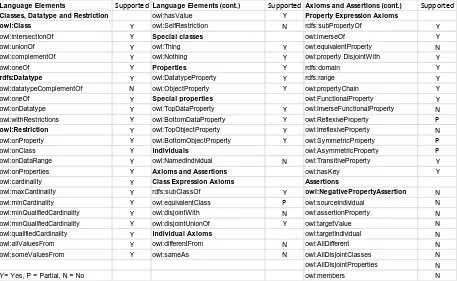
To do this, we have built a custom reasoner as part of the DQS which treats all ontologies which are used as a relatively large but custom fragment of OWL DL (see table 1 for the OWL 2 features im-plemented so far) subject to additional constraints that increase the ability of the reasoner to deal with the unification of OWL and RDF/RDFS in linked data schemata (challenge 1, challenge 2), detect like-ly validation errors (challenge 3, challenge 4) and improve efficiency. This fragment of OWL DL has also been shaped by the modelling requirements of ontology development for the Seshat:Global History Databank [37] which is our initial use case, as well as the OWL 2 vocabularies we found most often used in linked data schemata on the Web of Data. The range of support for OWL 2 constructs is substantially in-creased from our earlier paper [19] which focused on RDFS. It is anticipated that we will continue to ex-tend the support for further OWL 2 features in future work.
have a possible model or which are incompletely specified without inferring new classes (as these are often caused by user errors) under a closed world assumption. Due to the ontology import actions of the Dacura Schema Manager, the closed world in this case corresponds to the whole of the Web of Data, at the level of schema specification. We do not claim that the reasoner is sound or complete under OWL DL, just that it is capable of detecting many errors in linked data schemata, including errors undetectable by standard reasoning. Our approach is supported by building a subsumption prover in SWI Prolog. Due to the complexity of performing subsumption computa-tions with equivalences, we have opted in DQS to ignore non definitional equivalence, hence we do support owl:equivalentClass in one direction but not as a symmetric property. This is because OWL does not distinguish between the definitional and judg-mental use of this assertion. In practice this allows users to define a class as a formula of other classes but does not allow them to provide an assertion of two classes being equivalent. In the wild we see the first case used extensively and the second only rarely and when it is it is often problematic (see Table 5 Ontology Hijacking) or recommended to be avoided by ontology engineering best practice (this case is listed as pitfall number P02 in the OOPs catalogue of common pitfalls4). Hence we term this as partial sup-port by Dacura for owl:equivalentClass in Table 1.
Dacura does not currently support owl:disjointWith assertions but this only limits the range of validation errors that can be detected rather than introducing false positives so it does not give reason to doubt the errors detected. It is also the case that these assertions are much more important when validating instance data than when validating sche-mata. Typically we wish to ensure that instance data respects disjointness, not schemata – which is the focus of the work presented here.
It should be noted, however, that in both cases, our dependency analysis tool does correctly recognize that both predicates introduce dependencies between ontologies – however the analysis of the validity of the specified relationships is limited to one-directional equivalence.
We also require that there are no cycles in the de-clared subsumption of classes or predicates. This again does not give us the full power of OWL DL, however it was very rare that we found any actual intended use of cycles in practice.
4
Table 1 OWL 2 vocabulary features supported by DQS Reasoner
DQS provides an interface to a triple store via HTTP using a simple JSON format for updates (both inserts and deletes) of triples, and of both instance and ontology data. The service responds to updates either with a success message stating that the inser-tion is consistent, or a message describing the precise reason for failure of consistency according to the reasoner. The reasoner ensures that it builds up a witness of failure which demonstrates the counter-example to consistency satisfaction which can then
[image:9.595.70.527.165.446.2]be used by the client to come up with a suitable strat-egy for dealing with the failure. The results of our evaluation of linked data schemata (see Sections 5 and 6) were compiled by loading ontologies in the Dacura Schema Manager, and then testing them against the Dacura Quality Service, and then looking at the error reports provided. Next we examine the specific solutions implemented in the Dacura Schema Manager and Dacura Quality Service to address the challenges of linked data schemata validation
Table 2 – OWL/RDF/RDFS terms that create structural dependencies between ontologies
Language Elements Supported Language Elements (cont.) Supported Axioms and Assertions (cont.) Supported
Classes, Datatype and Restriction owl:hasValue Y Property Expression Axioms
owl:Class Y owl:SelfRestriction N rdfs:subPropertyOf Y
owl:intersectionOf Y Special classes owl:inverseOf Y
owl:unionOf Y owl:Thing Y owl:equivalentProperty N
owl:complementOf Y owl:Nothing Y owl:property DisjointWith Y
owl:oneOf Y Properties Y rdfs:domain Y
rdfs:Datatype Y owl:DatatypeProperty Y rdfs:range Y
owl:datatypeComplementOf N owl:ObjectProperty Y owl:propertyChain Y
owl:oneOf Y Special properties owl:FunctionalProperty Y
owl:onDatatype Y owl:TopDataProperty Y owl:InverseFunctionalProperty N
owl:withRestrictions Y owl:BottomDataProperty Y owl:ReflexiveProperty P
owl:Restriction Y owl:TopObjectProperty Y owl:IrreflexiveProperty N
owl:onProperty Y owl:BottomObjectProperty Y owl:SymmetricProperty P
owl:onClass Y Individuals owl:AsymmetricProperty P
owl:onDataRange Y owl:NamedIndividual N owl:TransitiveProperty Y
owl:onProperties Y Axioms and Assertions owl:hasKey Y
owl:cardinality Y Class Expression Axioms Assertions
owl:maxCardinality Y rdfs:subClassOf Y owl:NegativePropertyAssertion N
owl:minCardinality Y owl:equivalentClass P owl:sourceIndividual N
owl:minQualifiedCardinality Y owl:disjointWith N owl:assertionProperty N
owl:minQualifiedCardinality Y owl:disjointUnionOf Y owl:targetValue N
owl:qualifiedCardinality Y Individual Axioms owl:targetIndividual N
owl:allValuesFrom Y owl:differentFrom N owl:AllDifferent N
owl:someValuesFrom Y owl:sameAs N owl:AllDisjointClasses N
owl:AllDisjointProperties N
Y= Yes, P = Partial, N = No owl:members N
Namespace Term
rdf type
rdfs range, domain, subPropertyOf, subClassOf, member
4.1.Overcoming Challenge 1 (Heterogeneity)
As discussed in the background section, the free mixing of RDF, RDFS and OWL triples gives rise to different interpretations. Our approach is to deliber-ately misinterpret as OWL the RDF/RDFS classes and properties that are normally outside the scope of OWL-DL when there is no immediate conflict in doing so, e.g. a rdfs:class is treated as equivalent to an owl:class. This doesn't present an insurmountable difficulty for reasoning. Similarly rdf:Property is treated at an equivalent level to owl:DatatypeProperty and owl:ObjectProperty and no overlap is allowed between them. All domains and ranges that are asserted are checked to ensure they support subsumption. Misuse of language features and low level RDF syntax with reserved meaning in OWL such as rdf:List is detected as an error.
This approach is applicable in situations where the data is going to be published only for the combined ontology, or used only internally to a system which interprets the instance data as OWL. This is in line with common practice for linked data but presents potential problems for interoperability of the pro-duced linked data since OWL reasoners might deem it inconsistent due to the fact that we still allow a mix RDFS and OWL and hence are not a proper subset of OWL DL. However, as our experimental results will show, this is necessary for dealing with the common-ly used vocabularies on the Web of Data today. 4.2.Overcoming Challenge 2 (Imports)
Since there are a range of ways that linked data schemata reference or import each other, it was nec-essary to define a mechanism to construct the com-posite ontology defined by a linked data schemata to enable validation under a closed world assumption. For this reason, we have treated all dependencies to external namespaces as implicit owl:imports.
Dependencies between ontologies were defined as either property dependence or structural dependence: Property dependence: if an ontology A uses a property from another ontology B, then A is consid-ered to have a dependence on B.
Structural dependence: if an ontology A contains a statement which defines its classes or properties in terms of entities in ontology B, then A is considered to have a structural dependence on B. Table 2 shows the specific OWL terms which we consider create structural links between ontologies.
Other references to external URIs in a schema were ignored.
Having defined what we considered to amount to the class of dependencies between ontologies, the Dacura Schema Manager tool implements these rules to analyse any given ontology and recursively create its dependency tree, fetch the constituent ontologies or vocabularies and create a union between them for checking by the DQS.
4.3.Overcoming Challenge 3 (Distributed Authoring)
The Dacura Schema Manager detects all depend-encies between ontologies as described in the last section. This forms the basis for detecting references to missing or unavailable ontologies. Similarly it can detect namespace violations such as ontology hijack-ing when they occur in input ontologies. The logical consequences of building unified models from many ontologies are detected by the DQS, especially when local work-arounds have been made that render the unified model inconsistent.
4.4.Overcoming Challenge 4 (OWL Permissivity)
By applying the closed world assumption to the full graph imported from the Web of Data that speci-fies a linked data schema it is possible to detect or-phan classes. These are rejected as incompletely specified (similar to the use of declarations in OWL 2 but without the need to augment existing ontologies with these new declarations). In addition, the detec-tion of subsumpdetec-tion failures and cycles in class or property declarations allows us to detect potential misuse of OWL features.
5.Evaluation Methodology
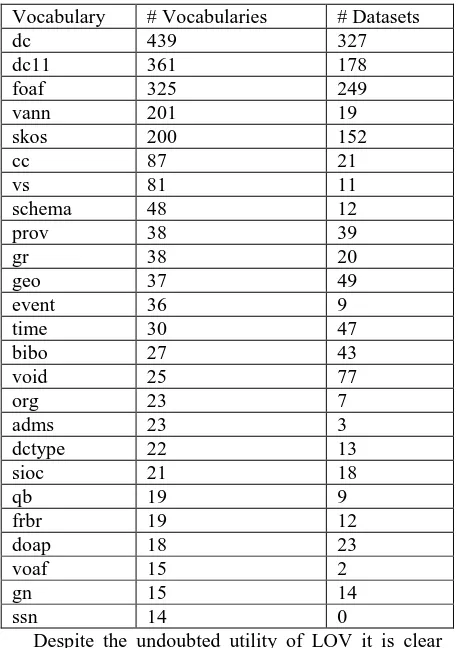
In order to evaluate the interoperability of the var-ious ontologies and vocabularies which are common-ly used by linked data documents, it is first necessary to establish which ontologies or vocabularies are the most common, and by what measure(s) in the Web of Data today. In order to do this we rely on the exten-sive literature that catalogs the development and makeup of the Web of Data and the live reports from the Linked Open Vocabularies (LOV) site5 [38]. At
5
the time of writing LOV reported hosting 542 vocab-ularies.
Table 3: Top 20 Vocabulary Popularity as Reported by LOV, March 2016
Vocabulary # Vocabularies # Datasets
dc 439 327
dc11 361 178
foaf 325 249
vann 201 19
skos 200 152
cc 87 21
vs 81 11
schema 48 12
prov 38 39
gr 38 20
geo 37 49
event 36 9
time 30 47
bibo 27 43
void 25 77
org 23 7
adms 23 3
dctype 22 13
sioc 21 18
qb 19 9
frbr 19 12
doap 18 23
voaf 15 2
gn 15 14
ssn 14 0
Despite the undoubted utility of LOV it is clear that it services a specific community of users and so we looked for a wider base of evidence. The ranking in terms of vocabulary reuse is also arguable, com-pared to the proliferation of a vocabulary’s terms in data.
[image:11.595.62.291.172.496.2] [image:11.595.305.525.437.661.2]Schmachtenberg et al. in 2014 [39] provided a survey of the results of an extensive crawl of the Web of Data (over 8 million resources were visited) based on the vocabularies registered with datahub.io. This study, as a follow-up to a 2011 baseline, showed an increased reliance by linked data publishers on a small set of core vocabularies compared to 2011. In table 5 of that paper they provide the list of the most often encountered vocabularies in terms of the 18 vocabularies that are used by more than 5% of all datasets. Their list is shown in our Table 4.
Table 4: Most Popular Vocabularies in Linked Data in April 2014 (Schmachtenberg et al.)
Vocabulary % Vocabulary %
rdf 98.22 void 13.51
rdfs 72.58 bio 12.32
foaf 69.13 qb 11.24
dc 56.01 rss 9.76
owl 36.49 odc 8.48
geo 25.05 w3con 7.6
sioc 17.65 doap 6.41
admin 15.48 bibo 6.11
skos 14.11 dcat 5.82
In addition, they report that of the nearly 1000 da-tasets visited that only 23% used local vocabularies that are not used in any other dataset while nearly all datasets use vocabularies common to multiple datsets. This shows the consolidation of the Web of Data towards fewer vocabularies as in 2011 64.11% of datasets were found to use local vocabularies not used elsewhere.
Finally in 2011 Hogan et al. surveyed the state of the Web of Data with a crawl of approximately 4 million RDF/XML documents and 1 billion quads [40]. Their Table 2, provided here in abbreviated form as Table 5, shows the top 25 most popular vo-cabularies, based on the number of instances of each namespace within their analysis dataset.
Table 5: Most Frequently Occurring Vocabularies in Linked Data 2011 (Hogan et al.)
Vocab Instances Vocab Instances foaf 615,110,022 dc11 6,400,202 rdfs 219,205,911 b2rns 5,839,771 rdf 213,652,227 sioc 5,411,725 b2r 43,182,736 vote 4,057,450 lldpub
med
27,944,794 gn 3,985,276 lldegen
e
22,228,436 skipin-ions
3,466,560 skos 19,870,999 dbo 3,299,442 fb 17,500,405 uniprot 2,964,084 owl 13,140,895 eatoc 2,630,198
opium-field
11,594,699 lldlifeski m
2,603,123 mo 11,322,417 ptime 2,519,543 dc 9,238,140 dbpedia 2,371,396 estoc 9,175,574
Note that both entry 25 (dbp) and 20 (dbo) are DBpedia vocabularies.
[image:11.595.306.525.438.666.2]From these studies of vocabulary usage, we identi-fied the top 50 most commonly used vocabularies and ontologies in use. However, in order to validate these ontologies, we also need to include all of their dependencies.
5.1.Identifying Dependencies
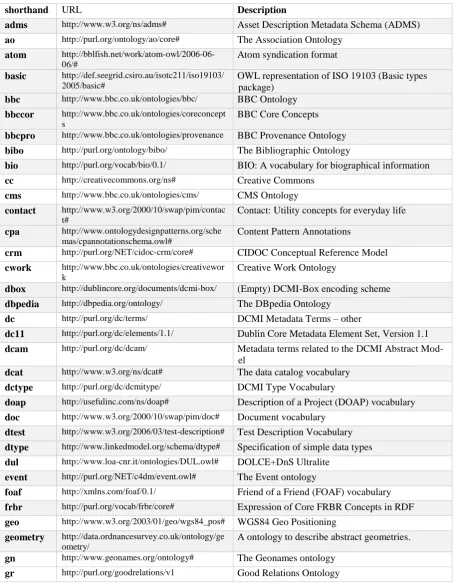
We applied the Dacura Schema Manager depend-encies tool to all of the top 50 ontologies identified. The output of this tool (fig 1) was used to identify the set of ontologies and vocabularies that each ontology depends on directly, then we included these ontolo-gies, identifying the set of ontologies needed by these included ontologies, including them and continuing until all of the dependencies were included or were deemed to be impossible to include. This produced a breadth-first dependency tree for each ontology. This increased the number of ontologies in our analysis set to 91 – shown in Table 6. We then analyzed all these ontologies with the DQS tool to identify to what ex-tent they exhibited problems in terms of creating a unified knowledge model that incorporated them. It should be noted that the ontologies that were includ-ed through this dependency analysis are almost all due to the inclusion of the most two most common vocabularies (dc and foaf) and thus most of the de-pendency tree shown here is common to virtually all linked data vocabularies.
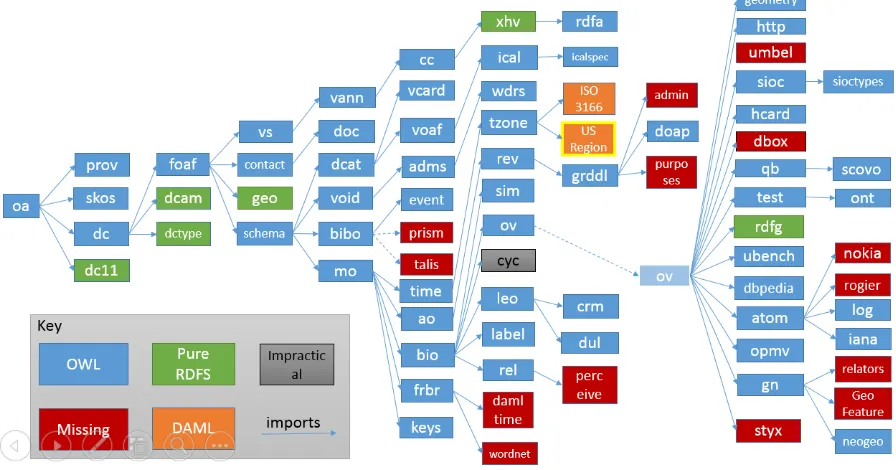
Figure 2 gives an example of the dependency tree for one ontology: Open Annotation [41]. This de-pendency tree covers 22 of the top 25 vocabularies rated as most popular by LOV in terms of vocabulary reuse (incoming links) as seen in Table 3. This ontol-ogy was selected as an example for both practical and theoretical reasons. Practically, we wished to imple-ment a system for the Seshat: Global Hostory Data-bank in which users could annotate content at a varie-ty of scopes and we wanted to be able to validate instance data which was expressed according to the ontology. Theoretically, it represented a good exam-ple of a linked data schema in the wild, as is shown by the analysis above, – it has been constructed by a W3C community group according to the linked data principles, using well known third party vocabularies and ontologies and it is in use in practice. It is ranked by LOV as the 32rd most popular linked data vocabu-lary overall (from 542 vocabularies) and its depend-ency tree, as discovered by Dacura, includes 25 of the 31 vocabularies rated as more popular than it by LOV.
Our dependency analysis terminated whenever we came to an ontology that we could not retrieve, either because we discovered that the ontology no longer existed (e.g. WordNet), or because we proved unable to locate a machine-readable version of the ontology on the internet, after approximately 8 hours of effort in searching. In one case our dependency tree brought us to an ontology that was simply too big for our tools to handle – OpenCyc (rdf/xml file: 246 MB) due to insufficient memory on our test computer. There was only two structural links to this ontology from the rest, so the omission can be considered to be relatively minor. In two cases dependent ontologies were written in DAML, a predecessor of OWL and these ontologies were not automatically analyzed as our tools were not capable of interpreting them. Manual analysis of both revealed that they had no further dependencies.
5.2.Schema Validation
Table 6. Ontologies analyzed as part of this work.
shorthand URL Description
adms http://www.w3.org/ns/adms# Asset Description Metadata Schema (ADMS)
ao http://purl.org/ontology/ao/core# The Association Ontology
atom http://bblfish.net/work/atom-owl/2006-06-06/#
Atom syndication format
basic http://def.seegrid.csiro.au/isotc211/iso19103/ 2005/basic#
OWL representation of ISO 19103 (Basic types package)
bbc http://www.bbc.co.uk/ontologies/bbc/ BBC Ontology
bbccor http://www.bbc.co.uk/ontologies/coreconcept s
BBC Core Concepts
bbcpro http://www.bbc.co.uk/ontologies/provenance BBC Provenance Ontology
bibo http://purl.org/ontology/bibo/ The Bibliographic Ontology
bio http://purl.org/vocab/bio/0.1/ BIO: A vocabulary for biographical information
cc http://creativecommons.org/ns# Creative Commons
cms http://www.bbc.co.uk/ontologies/cms/ CMS Ontology
contact http://www.w3.org/2000/10/swap/pim/contac t#
Contact: Utility concepts for everyday life
cpa http://www.ontologydesignpatterns.org/sche mas/cpannotationschema.owl#
Content Pattern Annotations
crm http://purl.org/NET/cidoc-crm/core# CIDOC Conceptual Reference Model
cwork http://www.bbc.co.uk/ontologies/creativewor k
Creative Work Ontology
dbox http://dublincore.org/documents/dcmi-box/ (Empty) DCMI-Box encoding scheme
dbpedia http://dbpedia.org/ontology/ The DBpedia Ontology
dc http://purl.org/dc/terms/ DCMI Metadata Terms – other
dc11 http://purl.org/dc/elements/1.1/ Dublin Core Metadata Element Set, Version 1.1
dcam http://purl.org/dc/dcam/ Metadata terms related to the DCMI Abstract
Mod-el
dcat http://www.w3.org/ns/dcat# The data catalog vocabulary
dctype http://purl.org/dc/dcmitype/ DCMI Type Vocabulary
doap http://usefulinc.com/ns/doap# Description of a Project (DOAP) vocabulary
doc http://www.w3.org/2000/10/swap/pim/doc# Document vocabulary
dtest http://www.w3.org/2006/03/test-description# Test Description Vocabulary
dtype http://www.linkedmodel.org/schema/dtype# Specification of simple data types
dul http://www.loa-cnr.it/ontologies/DUL.owl# DOLCE+DnS Ultralite
event http://purl.org/NET/c4dm/event.owl# The Event ontology
foaf http://xmlns.com/foaf/0.1/ Friend of a Friend (FOAF) vocabulary
frbr http://purl.org/vocab/frbr/core# Expression of Core FRBR Concepts in RDF
geo http://www.w3.org/2003/01/geo/wgs84_pos# WGS84 Geo Positioning
geometry http://data.ordnancesurvey.co.uk/ontology/ge ometry/
A ontology to describe abstract geometries.
gn http://www.geonames.org/ontology# The Geonames ontology
grddl http://www.w3.org/2003/g/data-view# GRDDL Gleaning Resource Descriptions
gsp http://www.opengis.net/ont/geosparql OGC GeoSPARQL
hcard http://purl.org/uF/hCard/terms/ HCard Vocabulary
http http://www.w3.org/2006/http# A namespace for describing HTTP messages
iana http://www.iana.org/assignments/relation/ Link Relations
ical http://www.w3.org/2002/12/cal/ical# RDF Calendar
icalspec http://www.w3.org/2002/12/cal/icalSpec# ICAL specifications
infreal http://www.ontologydesignpatterns.org/cp/ow l/informationrealization.owl#
Information Realization ontology
irw http://www.ontologydesignpatterns.org/ont/w eb/irw.owl#
The Identity of Resources on the Web ontology
keys http://purl.org/NET/c4dm/keys.owl# Musical keys
label http://purl.org/net/vocab/2004/03/label# Term definitions for singular and plural label prop-erties
leo http://linkedevents.org/ontology/ Linking Open Descriptions of Events
log http://www.w3.org/2000/10/swap/log# Logic Ontology
mo http://purl.org/ontology/mo/ The Music Ontology
neogeo http://geovocab.org/spatial# A vocabulary for describing topological relations
between features
nrl http://www.semanticdesktop.org/ontologies/2 007/08/15/nrl#
NEPOMUK Representational Language
oa http://www.w3.org/ns/oa# Open Annotation Data Model
obo http://purl.obolibrary.org/obo/obi.owl Ontology for Biomedical Investigations
ont http://www.w3.org/2006/gen/ont# An Ontology for Relating Generic and Specific Information Resources
opmv http://purl.org/net/opmv/ns# The Core OPMV Vocabulary
org http://www.w3.org/ns/org# Core Organization Ontology
ov http://open.vocab.org/terms/ Open Vocabulary
prv http://purl.og/net/provenance/ns# Provenance Vocabulary Core Ontology
prov http://www.w3.org/ns/prov# W3C PROVenance Interchange Ontology
qb http://purl.org/linked-data/cube# The data cube vocabulary
qudt http://qudt.org/schema/qudt Quantities, Units, Dimensions and Types
rdaa http://rdaregistry.info/Elements/a/ RDA Agent properties
rdac http://rdaregistry.info/Elements/c/ RDA Classes
rdae http://rdaregistry.info/Elements/e/ RDA Expression Properties
rdai http://rdaregistry.info/Elements/i/ RDA Item Properties
rdam http://rdaregistry.info/Elements/m/ RDA Manifestation Properties
rdau http://rdaregistry.info/Elements/u/ RDA Unconstrained Properties
rdaw http://rdaregistry.info/Elements/w/ RDA Work Properties
rdfa http://www.w3.org/ns/rdfa# RDFA specification
rdfg http://www.w3.org/2004/03/trix/rdfg-1/ RDF Graph
rev http://purl.org/stuff/rev# RDF Review Vocabulary
schema http://schema.org/ Schema.org (converted to OWL by TopQuadrant)
scovo http://purl.org/NET/scovo# The Statistical Core Vocabulary (SCOVO)
sim http://purl.org/ontology/similarity/ The Similarity Ontology
sioc http://rdfs.org/sioc/ns# Semantically Interlinked Online Communities
sioctypes http://rdfs.org/sioc/types# SIOC Types Ontology
skos http://www.w3.org/2004/02/skos/core# SKOS Vocabulary
ssn http://www.w3.org/2005/Incubator/ssn/ssnx/s sn
Semantic Sensor Network Ontology
time http://www.w3.org/2006/time# An OWL Ontology of Time (OWL-Time)
timezone http://www.w3.org/2006/timezone# A time zone ontology
ubench http://swat.cse.lehigh.edu/onto/univ-bench.owl#
An university ontology for benchmark tests
vaem http://www.linkedmodel.org/schema/vaem# Vocabulary for Attaching Essential Metadata
vann http://purl.org/vocab/vann/ Vocabulary for annotating vocabulary descriptions
vcard http://www.w3.org/2006/vcard/ns# Vcard vocabulary
voaf http://purl.org/vocommons/voaf# Vocabulary of a Friend
void http://rdfs.org/ns/void# Vocabulary of Interlinked Datasets (VoID)
vs http://www.w3.org/2003/06/sw-vocab-status/ns#
SemWeb Vocab Status ontology
wdrs http://www.w3.org/2007/05/powder-s# POWDER-S Vocabulary
[image:15.595.81.529.468.703.2]xhv http://www.w3.org/1999/xhtml/vocab# XHTML specification
Table 7: References to missing or unavailable dependencies detected
6.Validation Results
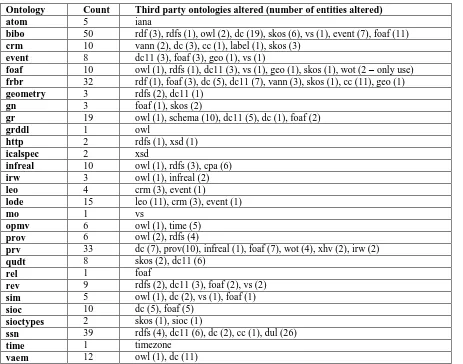
Our analysis of the 91 ontologies revealed that 30 ontologies (33%) contained ontology hijacking viola-tions (making asserviola-tions about entities defined in other ontologies with global scope). 11 ontologies contained dependencies on a total of 14 missing on-tologies (12%). 3 onon-tologies contained basic errors that were categorized as typos (3.3%). 15 ontologies (16.5%) contained statements that are illegal in OWL DL due to them being impredicative – predicating over classes or properties which is illegal in first or-der logic entirely - and basic misuses of language constructs (e.g subclassing owl:differentFrom and expecting its semantics to be retained). One ontology (1%) contained both property and class cycles – and in both cases manual analysis revealed that they were, as anticipated, highly likely to be the result of speci-fication errors rather than obtuse ways of defining a single class or property. The detailed validation re-sults are presented in the tables below.
6.1.References to Missing Ontologies
As is to be expected in the evolving Web of Data a number of the referenced ontologies were no longer available (at least they are not currently available at the advertised URL and we were unable to find them
elsewhere) - Table 7. The linked data community should be aware of the implication of this for linked data quality – if schema specifications are going to be rendered incomplete due to changes in the availabil-ity of imported ontologies or terms then it places a limit on the degree of validation that can be per-formed – terms from such vocabularies become sim-ple untyped variable names with zero semantics as-sociated with them.
6.2.Ontology hijacking
A widespread pattern observed in the ontologies under analysis was the presence of assertions de-signed to support interoperability of ontologies. For example, a very common pattern was to specify that certain properties from imported ontologies were defined to be of type owl:AnnotationProperty – to allow them to be processed by standard OWL tools which do not know how to deal with properties de-fined as rdf:Property. The basic problem with this pattern is that this amounts to non-coordinated in-teroperability on a library scope – each ontology at-tempts to handle interoperability for its own scope, but when these ontologies are combined together, each piecemeal attempt at interoperability is com-bined into a common model and the union of these piecemeal attempts at library level interoperability
Ontology Missing (or unavailable) Dependencies
atom property: http://eulersharp.sourceforge.net/2004/04test/rogier#productProperty (1 use) atom:scheme rdfs:range http://sw.nokia.com/WebArch-1/InformationResource atom:src rdfs:range http://sw.nokia.com/WebArch-1/InformationResource
_:atom31 rdf:type file:///Users/hjs/Programming/sommer/www/atom/2006-06-06/AtomOwl.n3#update _:atom37 rdf:type file:///Users/hjs/Programming/sommer/www/atom/2006-06-06/AtomOwl.n3#rel
doap doap:Project rdfs:subClassOf http://xmlns.com/wordnet/1.6/Project
frbr frbr:Work rdfs:subClassOf http://xmlns.com/wordnet/1.6/Work~2
frbr:Event rdfs:subClassOf http://www.isi.edu/~pan/damltime/time-entry.owl#Event
gn gn:Feature owl:equivalentClass
http://www.mindswap.org/2003/owl/geo/geoFeatures20040307.owl#GeographicFeature
grddl Properties: http://www.rddl.org/purposes#normative-reference (3 uses) & http://webns.net/mvcb/generatorAgent (1 use)
neogeo http://geovocab.org/spatial owl:imports http://geovocab.org/mappings/spatial
qudt VOAG ontology only retrievable as invalid turtle file
qudt: http://voag.linkedmodel.org/schema/voag#withAttributionTo qudt:NASA-ARC-Attribution qudt: http://voag.linkedmodel.org/schema/voag#hasLicenseType voag:CC-SHAREALIKE_3PT0-US
rda* All RDA ontologies use terms from missing ontologies http://metadataregistry.org/uri/profile/regap/ and http://metadataregistry.org/uri/profile/rdakit/
timezone timezone owl:imports http://www.daml.org/2001/09/countries/iso-3166-ont timezone owl:imports http://www.daml.ri.cmu.edu/ont/USRegionState.daml
dbox Ontology is empty – contains no classes
cwork http://www.bbc.co.uk/ontologies/tagging/ ontology does not exist
without any facilities for modularity leads to incon-sistency.
The second major category of ontology hijacking observed in the data are illegal assertions that serve to silently kill error reporting in tools. For example the assertion: rdfs:Class a owl:Class is used in two separate ontologies – it declares that an RDFS class is an instance of an OWL class – an interpretation that is not true under OWL DL or Full but it manages to successfully silence error checking in a number of tools. These type of assertions are particularly un-wise because they make the knowledge model incon-sistent. They also break the robustness principle by deliberately producing malformed specifications ra-ther than compensating for real-world variation and noise at input.
Finally, in a certain number of cases, ontologies knowingly and explicitly change other ontologies for
convenience in utilizing external class definitions. This type of usage is most pointedly described in the bibo ontology:
dc:Agent a owl:Class ;
owl:equivalentClass foaf:Agent ;
[image:17.595.62.525.357.721.2]An editorial note in the ontology states: “BIBO as-sert that a dcterms:Agent is an equivalent class to foaf:Agent. This means that all the individuals be-longing to the foaf:Agent class also belongs to the dcterms:Agent class. This way, dcterms:contributor can be used on foaf:Person, foaf:Organization, foaf:Agent and foaf:Group. Even if this link is not done in neither the FOAF nor the DCTERMS ontolo-gies this is a wide spread fact that is asserted by BIBO.” In such cases it would be more appropriate to use local sub-classing to achieve the equivalent effect without over-writing the definitions in external namespaces.
Table 8: Ontology hijacking violations detected
Ontology Count Third party ontologies altered (number of entities altered)
atom 5 iana
bibo 50 rdf (3), rdfs (1), owl (2), dc (19), skos (6), vs (1), event (7), foaf (11)
crm 10 vann (2), dc (3), cc (1), label (1), skos (3)
event 8 dc11 (3), foaf (3), geo (1), vs (1)
foaf 10 owl (1), rdfs (1), dc11 (3), vs (1), geo (1), skos (1), wot (2 – only use)
frbr 32 rdf (1), foaf (3), dc (5), dc11 (7), vann (3), skos (1), cc (11), geo (1)
geometry 3 rdfs (2), dc11 (1)
gn 3 foaf (1), skos (2)
gr 19 owl (1), schema (10), dc11 (5), dc (1), foaf (2)
grddl 1 owl
http 2 rdfs (1), xsd (1)
icalspec 2 xsd
infreal 10 owl (1), rdfs (3), cpa (6)
irw 3 owl (1), infreal (2)
leo 4 crm (3), event (1)
lode 15 leo (11), crm (3), event (1)
mo 1 vs
opmv 6 owl (1), time (5)
prov 6 owl (2), rdfs (4)
prv 33 dc (7), prov(10), infreal (1), foaf (7), wot (4), xhv (2), irw (2)
qudt 8 skos (2), dc11 (6)
rel 1 foaf
rev 9 rdfs (2), dc11 (3), foaf (2), vs (2)
sim 5 owl (1), dc (2), vs (1), foaf (1)
sioc 10 dc (5), foaf (5)
sioctypes 2 skos (1), sioc (1)
ssn 39 rdfs (4), dc11 (6), dc (2), cc (1), dul (26)
time 1 timezone
6.3.Typos
Three ontology were found to contain basic errors which were interpreted as typos – the predicate rdfs:ramge appears twice in contact (rather than rdfs:range). In dcat, the property name foaf:Page is used, whereas foaf:page (without capitalization) is the correct property name, while in nrl, 3 incorrect URLs are used to refer to classes and properties in rdfg (the correct URLs use ‘/’ rather than ‘#’ as an element prefix). The presence of such errors in long established and public ontologies highlights the lack of tool support for ontology validation – they are simple and obvious errors but they will not be identi-fied by standard OWL reasoners.
6.4.Impredicativity / misuse of language constructs
Since OWL DL is a first order theory, it is not possible to quantify over classes and predicates. Yet no such restriction exists in RDF. This leads to a
number of problems when using OWL ontologies which reference RDF ontologies which make use of higher-order and impredicative features.
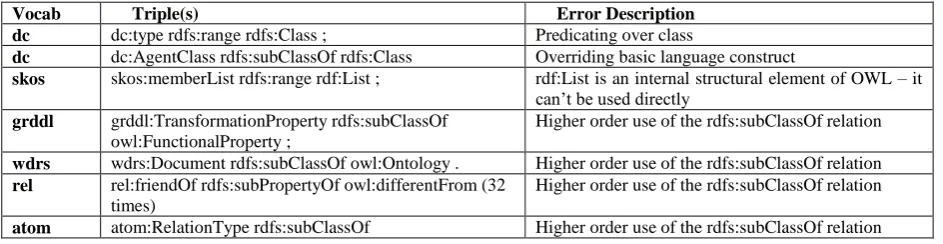
In the very widely used dc ontology, the rdf:type relation is given a range of rdfs:Class. This is imme-diately problematic as rdfs:Class is the class of all classes and such impredicative statements cannot be made in OWL DL but are dangerous regardless, due to the very real threat of paradox. Similarly the rdf:subClassOf relation is used to derive a subclass of the class of classes. This again is higher order reason-ing, without any guarantee of predicativity.
[image:18.595.62.526.409.486.2]In skos we see the use rdf:List as a range, but rdf:List is an internal syntactic element of OWL. Free mixing of rdf:first and rdf:next would leave reasoners unable to distinguish what is intended as a property and what is intended to be syntax of the language itself. While this problem has been described thor-oughly [11], it also has not been stamped out in the wild, and skos is a very widely used ontology pur-porting to be OWL.
Table 9: Typos detected
Ontology Typos (underlined)
contact contact:assistant rdfs:ramge foaf:Agent contact:participant rdfs:ramge foaf:Agent dcat dcat:landingPage rdfs:subPropertyOf foaf:Page
nrl nrl:subGraphOf rdfs:subPropertyOf http://www.w3.org/2004/03/trix/rdfg-1#subGraphOf nrl:Graph rdfs:subClassOf http://www.w3.org/2004/03/trix/rdfg-1#Graph
nrl:equivalentGraph rdfs:subPropertyOf http://www.w3.org/2004/03/trix/rdfg-1#equivalentGraph In gn, log, void, qb, wdrs, atom, voaf we see the
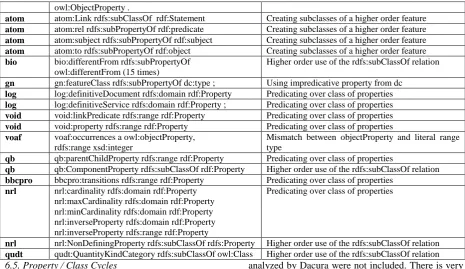
very common use of higher order logic, with sub-classing of class, properties, and assignation of rang-es over propertirang-es and classrang-es. In most of thrang-ese casrang-es the statements were probably unnecessary. However higher order reasoning may sometimes be useful and we will discuss later how such things can be achieved without stepping into undecidability.
In atom there is an even more unusual metalogical statement, making a statement about statements
themselves! Without some sort of stratification such logic is dubious at best. Atom additionally makes use of inference facilities that are not themselves part of OWL. Utilizing ontologies of this form requires a tool chain which is capable of making these infer-ences, which is something which is not widely avail-able.
Table 10: Instances of impredicativity/misuse of reserved language constructs detected
Vocab Triple(s) Error Description
dc dc:type rdfs:range rdfs:Class ; Predicating over class
dc dc:AgentClass rdfs:subClassOf rdfs:Class Overriding basic language construct
skos skos:memberList rdfs:range rdf:List ; rdf:List is an internal structural element of OWL – it can’t be used directly
grddl grddl:TransformationProperty rdfs:subClassOf owl:FunctionalProperty ;
Higher order use of the rdfs:subClassOf relation
wdrs wdrs:Document rdfs:subClassOf owl:Ontology . Higher order use of the rdfs:subClassOf relation rel rel:friendOf rdfs:subPropertyOf owl:differentFrom (32
times)
Higher order use of the rdfs:subClassOf relation
[image:18.595.62.534.614.736.2]owl:ObjectProperty .
atom atom:Link rdfs:subClassOf rdf:Statement Creating subclasses of a higher order feature atom atom:rel rdfs:subPropertyOf rdf:predicate Creating subclasses of a higher order feature atom atom:subject rdfs:subPropertyOf rdf:subject Creating subclasses of a higher order feature atom atom:to rdfs:subPropertyOf rdf:object Creating subclasses of a higher order feature bio bio:differentFrom rdfs:subPropertyOf
owl:differentFrom (15 times)
Higher order use of the rdfs:subClassOf relation
gn gn:featureClass rdfs:subPropertyOf dc:type ; Using impredicative property from dc log log:definitiveDocument rdfs:domain rdf:Property Predicating over class of properties log log:definitiveService rdfs:domain rdf:Property ; Predicating over class of properties void void:linkPredicate rdfs:range rdf:Property Predicating over class of properties void void:property rdfs:range rdf:Property Predicating over class of properties voaf voaf:occurrences a owl:objectProperty,
rdfs:range xsd:integer
Mismatch between objectProperty and literal range type
qb qb:parentChildProperty rdfs:range rdf:Property Predicating over class of properties
qb qb:ComponentProperty rdfs:subClassOf rdf:Property Higher order use of the rdfs:subClassOf relation bbcpro bbcpro:transitions rdfs:range rdf:Property Predicating over class of properties
nrl nrl:cardinality rdfs:domain rdf:Property nrl:maxCardinality rdfs:domain rdf:Property nrl:minCardinality rdfs:domain rdf:Property nrl:inverseProperty rdfs:domain rdf:Property nrl:inverseProperty rdfs:range rdf:Property
Predicating over class of properties
nrl nrl:NonDefiningProperty rdfs:subClassOf rdfs:Property Higher order use of the rdfs:subClassOf relation qudt qudt:QuantityKindCategory rdfs:subClassOf owl:Class Higher order use of the rdfs:subClassOf relation 6.5.Property / Class Cycles
Table 11 presents the class or property cycles de-tected in the crm ontology. The first example, asserts that a legal body is equivalent to a group, which seems highly questionable, though it would require the crm authors to confirm. The second looks more likely, but still questionable, where they establishing an equivalence between “bearing a feature” and “be-ing composed of”.
We have also noticed that many statements of equivalence were between classes in different ontol-ogies, establishing a link between an element in one place, and that in another. However, these equiva-lences were often coupled with additional qualifica-tions. Such behavior completely negates the capacity to use linked data in an interoperable fashion, as the original publisher of the ontologies data may very well have instance data which is deemed invalid when read, by the second publisher, and vice versa. This “ontology hijacking” [5] should be highly dis-couraged.
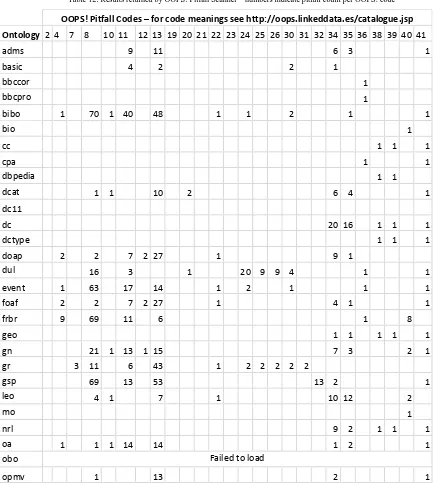
6.6.Comparison to OOPS!
The 50 most commonly used vocabularies were al-so analysed with OOPS! (OntOlogy Pitfall Scanner) [27] for comparison (although four failed to load).A this tool analyzes ontologies in isolation without loading any dependencies, the dependent ontologies
[image:19.595.63.529.126.395.2]