Proceedings of the 2019 EMNLP Workshop W-NUT: The 5th Workshop on Noisy User-generated Text, pages 34–41
34
Exploiting BERT for End-to-End Aspect-based Sentiment Analysis
∗Xin Li
1, Lidong Bing
2, Wenxuan Zhang
1and Wai Lam
11
Department of Systems Engineering and Engineering Management
The Chinese University of Hong Kong, Hong Kong
2
R&D Center Singapore, Machine Intelligence Technology, Alibaba DAMO Academy
{
lixin,wxzhang,wlam
}
@se.cuhk.edu.hk
[email protected]
Abstract
In this paper, we investigate the modeling power of contextualized embeddings from pre-trained language models, e.g. BERT, on the E2E-ABSA task. Specifically, we build a series of simple yet insightful neural base-lines to deal with E2E-ABSA. The experimen-tal results show that even with a simple lin-ear classification layer, our BERT-based archi-tecture can outperform state-of-the-art works. Besides, we also standardize the comparative study by consistently utilizing a hold-out de-velopment dataset for model selection, which is largely ignored by previous works. There-fore, our work can serve as a BERT-based benchmark for E2E-ABSA.1
1
Introduction
Aspect-based sentiment analysis (ABSA) is to
dis-cover the users’ sentiment or opinion towards an
aspect, usually in the form of explicitly
men-tioned aspect terms (
Mitchell et al.
,
2013
;
Zhang
et al.
,
2015
) or implicit aspect categories (
Wang
et al.
,
2016
), from user-generated natural language
texts (
Liu
,
2012
). The most popular ABSA
bench-mark datasets are from SemEval ABSA
chal-lenges (
Pontiki et al.
,
2014
,
2015
,
2016
) where a
few thousand review sentences with gold standard
aspect sentiment annotations are provided.
Table
1
summarizes three existing research
problems related to ABSA. The first one is the
original ABSA, aiming at predicting the
senti-ment polarity of the sentence towards the given
aspect. Compared to this classification problem,
the second one and the third one, namely,
Aspect-oriented Opinion Words Extraction (AOWE) (
Fan
∗
The work described in this paper is substantially sup-ported by a grant from the Research Grant Council of the Hong Kong Special Administrative Region, China (Project Code: 14204418).
1Our code is open-source and available at: https://
github.com/lixin4ever/BERT-E2E-ABSA
et al.
,
2019
) and End-to-End Aspect-based
Sen-timent Analysis (E2E-ABSA) (
Ma et al.
,
2018a
;
Schmitt et al.
,
2018
;
Li et al.
,
2019a
;
Li and Lu
,
2017
,
2019
), are related to a sequence tagging
problem. Precisely, the goal of AOWE is to
ex-tract the aspect-specific opinion words from the
sentence given the aspect. The goal of E2E-ABSA
is to jointly detect aspect terms/categories and the
corresponding aspect sentiments.
Many neural models composed of a
task-agnostic pre-trained word embedding layer and
task-specific neural architecture have been
pro-posed for the original ABSA task (i.e. the
aspect-level sentiment classification) (
Tang et al.
,
2016
;
Wang et al.
,
2016
;
Chen et al.
,
2017
;
Liu and
Zhang
,
2017
;
Ma et al.
,
2017
,
2018b
;
Majumder
et al.
,
2018
;
Li et al.
,
2018
;
He et al.
,
2018
;
Xue and Li
,
2018
;
Wang et al.
,
2018
;
Fan et al.
,
2018
;
Huang and Carley
,
2018
;
Lei et al.
,
2019
;
Li et al.
,
2019b
)
2, but the improvement of these
models measured by the accuracy or F1 score
has reached a bottleneck. One reason is that the
task-agnostic embedding layer, usually a linear
layer initialized with Word2Vec (
Mikolov et al.
,
2013
) or GloVe (
Pennington et al.
,
2014
), only
provides context-independent word-level features,
which is insufficient for capturing the complex
se-mantic dependencies in the sentence. Meanwhile,
the size of existing datasets is too small to train
sophisticated task-specific architectures.
Thus,
introducing a context-aware word embedding
3layer pre-trained on large-scale datasets with deep
LSTM (
McCann et al.
,
2017
;
Peters et al.
,
2018
;
Howard and Ruder
,
2018
) or Transformer (
Rad-ford et al.
,
2018
,
2019
;
Devlin et al.
,
2019
;
Lample
2Due to the limited space, we can not list all of the existing
works here, please refer to the survey (Zhou et al.,2019) for more related papers.
3In this paper, we generalize the concept of “word
Sentence: <Great> [food]P but the [service]:::::: Nis <:::::::::::dreadful>.
Settings Input Output
1. ABSA sentence, aspect aspect sentiment
2. AOWE sentence, aspect opinion words
[image:2.595.308.536.60.254.2]3. E2E-ABSA sentence aspect, aspect sentiment
Table 1: Different problem settings in ABSA. Gold standard aspects and opinions are wrapped in[]and
<>respectively. The subscripts N and P refer to aspect sentiment. Underline:* or * indicates the association between the aspect and the opinion.
and Conneau
,
2019
;
Yang et al.
,
2019
;
Dong et al.
,
2019
) for fine-tuning a lightweight task-specific
network using the labeled data has good potential
for further enhancing the performance.
Xu et al.
(
2019
);
Sun et al.
(
2019
);
Song et al.
(
2019
);
Yu and Jiang
(
2019
);
Rietzler et al.
(
2019
);
Huang and Carley
(
2019
) have conducted some
initial attempts to couple the deep contextualized
word embedding layer with downstream neural
models for the original ABSA task and establish
the new state-of-the-art results. It encourages us
to explore the potential of using such
contextual-ized embeddings to the more difficult but
practi-cal task, i.e. E2E-ABSA (the third setting in
Ta-ble
1
).
4Note that we are not aiming at developing
a task-specific architecture, instead, our focus is
to examine the potential of contextualized
embed-ding for E2E-ABSA, coupled with various simple
layers for prediction of E2E-ABSA labels.
5In this paper, we investigate the modeling power
of BERT (
Devlin et al.
,
2019
), one of the most
popular pre-trained language model armed with
Transformer (
Vaswani et al.
,
2017
), on the task
of E2E-ABSA. Concretely, inspired by the
inves-tigation of E2E-ABSA in
Li et al.
(
2019a
), which
predicts aspect boundaries as well as aspect
sen-timents using a single sequence tagger, we build
a series of simple yet insightful neural baselines
for the sequence labeling problem and fine-tune
the task-specific components with BERT or deem
BERT as feature extractor. Besides, we
standard-ize the comparative study by consistently
utiliz-ing the hold-out development dataset for model
selection, which is ignored in most of the existing
4Both of ABSA and AOWE assume that the aspects in a
sentence are given. Such setting makes them less practical in real-world scenarios since manual annotation of the fine-grained aspect mentions/categories is quite expensive.
5Hu et al. (2019) introduce BERT to handle the
E2E-ABSA problem but their focus is to design a task-specific architecture rather than exploring the potential of BERT.
The AMD Turin Processor seems to perform better than Intel
E1 E2 E3 E4 E5 E6 E7 E8 E9 E10
Ex1 Ex2 Ex3 Ex4 Ex5 Ex6 Ex7 Ex8 Ex9 Ex10
EA EA EA EA EA EA EA EA EA EA
Position Embedding Segment Embedding
Token Embedding
1-st Transformer Layer
L-th Transformer Layer
⋯ hL
1 hL2 hL3 hL4 hL5 hL6 hL7 hL8 hL9 hL10
BERT
E2E-ABSA Layer
O B-POS I-POS E-POS O O O O O S-NEG
[image:2.595.73.292.64.131.2]X y
Figure 1: Overview of the designed model.
ABSA works (
Tay et al.
,
2018
).
2
Model
In this paper, we focus on the aspect
term-level End-to-End Aspect-Based Sentiment
Analy-sis (E2E-ABSA) problem setting. This task can
be formulated as a sequence labeling problem.
The overall architecture of our model is depicted
in Figure
1
.
Given the input token sequence
x
=
{x
1,
· · ·
, x
T}
of length
T
, we firstly
em-ploy BERT component with
L
transformer
lay-ers to calculate the corresponding contextualized
representations
H
L=
{h
L1
,
· · ·
, h
LT} ∈
R
T×dimh
for the input tokens where
dim
hdenotes the
di-mension of the representation vector. Then, the
contextualized representations are fed to the
task-specific layers to predict the tag sequence
y
=
{y
1,
· · ·
, yT
}
. The possible values of the tag
yt
are
B
-
{
POS,NEG,NEU
}
,
I
-
{
POS,NEG,NEU
}
,
E
-
{
POS,NEG,NEU
}
,
S
-
{
POS,NEG,NEU
}
or
O
,
denoting the beginning of aspect, inside of aspect,
end of aspect, single-word aspect, with positive,
negative or neutral sentiment respectively, as well
as outside of aspect.
2.1
BERT as Embedding Layer
the combination of the token embedding, position
embedding and segment embedding
correspond-ing to the input token
xt
. Then
L
transformer
layers are introduced to refine the token-level
fea-tures layer by layer. Specifically, the
representa-tions
H
l=
{h
l1
,
· · ·
, h
lT}
at the
l
-th (
l
∈
[1
, L
])
layer are calculated below:
H
l=
Transformer
l(
H
l−1)
(1)
We regard
H
Las the contextualized
representa-tions of the input tokens and use them to perform
the predictions for the downstream task.
2.2
Design of Downstream Model
After obtaining the BERT representations, we
de-sign a neural layer, called E2E-ABSA layer in
Figure
1
, on top of BERT embedding layer for
solving the task of E2E-ABSA. We investigate
several different design for the E2E-ABSA layer,
namely, linear layer, recurrent neural networks,
self-attention networks, and conditional random
fields layer.
Linear Layer
The obtained token
representa-tions can be directly fed to linear layer with
soft-max activation function to calculate the
token-level predictions:
P
(
y
t|x
t) =
softmax(
W
oh
Lt+
b
o)
(2)
where
Wo
∈
R
dimh×|Y|is the learnable
parame-ters of the linear layer.
Recurrent Neural Networks
Considering its
sequence labeling formulation, Recurrent Neural
Networks (RNN) (
Elman
,
1990
) is a natural
so-lution for the task of E2E-ABSA. In this paper,
we adopt GRU (
Cho et al.
,
2014
), whose
superior-ity compared to LSTM (
Hochreiter and
Schmid-huber
,
1997
) and basic RNN has been verified
in
Jozefowicz et al.
(
2015
). The computational
formula of the task-specific hidden representation
h
Tt∈
R
dimhat the
t
-th time step is shown below:
rt
zt
=σ(LN(WxhLt) +LN(WhhTt−1))
nt=tanh(LN(WxnhLt) +rt∗LN(Whnh T t−1)) hTt = (1−zt)∗nt+zt∗h
T t−1
(3)
where
σ
is the sigmoid activation function and
r
t,
z
t,
n
trespectively denote the reset gate,
up-date gate and new gate.
Wx, Wh
∈
R
2dimh×dimh,
W
xn, W
hn∈
R
dimh×dimhare the parameters of
GRU. Since directly applying RNN on the
out-put of transformer, namely, the BERT
represen-tation
h
Lt, may lead to unstable training (
Chen
et al.
,
2018
;
Liu
,
2019
), we add additional
layer-normalization (
Ba et al.
,
2016
), denoted as L
N,
when calculating the gates. Then, the predictions
are obtained by introducing a softmax layer:
p
(
y
t|x
t) =
softmax(
W
oh
Tt+
b
o)
(4)
Self-Attention Networks
With the help of self
attention (
Cheng et al.
,
2016
;
Lin et al.
,
2017
),
Self-Attention Network (
Vaswani et al.
,
2017
;
Shen et al.
,
2018
) is another effective feature
ex-tractor apart from RNN and CNN. In this
pa-per, we introduce two SAN variants to build
the task-specific token representations
H
T=
{h
T1,
· · ·
, h
TT}
.
One variant is composed of a
simple self-attention layer and residual
connec-tion (
He et al.
,
2016
), dubbed as “SAN”. The
com-putational process of SAN is below:
H
T=
L
N(
H
L+
S
LF-A
TT(
Q, K, V
))
Q, K, V
=
H
LW
Q, H
LW
K, H
LW
V(5)
where S
LF-A
TTis identical to the self-attentive
scaled dot-product attention (
Vaswani et al.
,
2017
).
Another variant is a transformer layer
(dubbed as “TFM”), which has the same
archi-tecture with the transformer encoder layer in the
BERT. The computational process of TFM is as
follows:
ˆ
H
L=
L
N(
H
L+
S
LF-A
TT(
Q, K, V
))
H
T=
L
N( ˆ
H
L+
F
FN( ˆ
H
L))
(6)
where F
FNrefers to the point-wise feed-forward
networks (
Vaswani et al.
,
2017
). Again, a linear
layer with softmax activation is stacked on the
de-signed SAN/TFM layer to output the predictions
(same with that in Eq(
4
)).
Conditional Random Fields
Conditional
Model LAPTOP REST
P R F1 P R F1
Existing Models
(Li et al.,2019a)\ 61.27 54.89 57.90 68.64 71.01 69.80
(Luo et al.,2019)\ - - 60.35 - - 72.78
(He et al.,2019)\ - - 58.37 - -
-LSTM-CRF
(Lample et al.,2016)] 58.61 50.47 54.24 66.10 66.30 66.20
(Ma and Hovy,2016)] 58.66 51.26 54.71 61.56 67.26 64.29
(Liu et al.,2018)] 53.31 59.40 56.19 68.46 64.43 66.38
BERT Models
BERT+Linear 62.16 58.90 60.43 71.42 75.25 73.22 BERT+GRU 61.88 60.47 61.12 70.61 76.20 73.24 BERT+SAN 62.42 58.71 60.49 72.92 76.72 74.72
BERT+TFM 63.23 58.64 60.80 72.39 76.64 74.41 BERT+CRF 62.22 59.49 60.78 71.88 76.48 74.06
Table 2: Main results. The symbol\ denotes the numbers are officially reported ones. The results with] are retrieved fromLi et al.(2019a).
Dataset Train Dev Test Total
LAPTOP # sent 2741 304 800 4245
# aspect 2041 256 634 2931
REST # sent 3490 387 2158 6035
[image:4.595.327.492.277.408.2]# aspect 3893 413 2287 6593
Table 3: Statistics of datasets.
probable tag sequence. Specifically, the
sequence-level scores
s
(
x
,
y
)
and likelihood
p
(
y
|
x
)
of
y
=
{y
1,
· · ·
, yT
}
are calculated as follows:
s
(
x
,
y
) =
TX
t=0
M
yAt,yt+1+
TX
t=1
M
t,yPtp
(
y
|
x
) =
softmax(
s
(
x
,
y
))
(7)
where
M
A∈
R
|Y|×|Y|is the randomly initialized
transition matrix for modeling the dependency
be-tween the adjacent predictions and
M
P∈
R
T×|Y|denote the emission matrix linearly transformed
from the BERT representations
H
L. The softmax
here is conducted over all of the possible tag
se-quences. As for the decoding, we regard the tag
sequence with the highest scores as output:
y
∗= arg max
y
s
(
x
,
y
)
(8)
where the solution is obtained via Viterbi search.
3
Experiment
3.1
Dataset and Settings
We conduct experiments on two review datasets
originating from SemEval (
Pontiki et al.
,
2014
,
2015
,
2016
) but re-prepared in
Li et al.
(
2019a
).
The statistics are summarized in Table
3
.
We
use the pre-trained “bert-base-uncased” model
6,
6https://github.com/huggingface/transformers
0 500 1000 1500 2000 2500 3000
Steps
0.40 0.45 0.50 0.55 0.60 0.65 0.70
F1 score
BERT-GRU BERT-TFM BERT-CRF
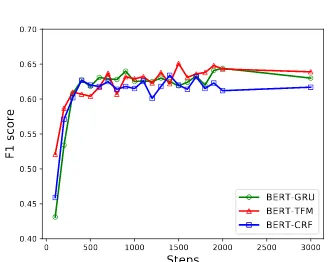
Figure 2: Performances on the Dev set ofREST.
where the number of transformer layers
L
= 12
and the hidden size
dim
his 768. For the
down-stream E2E-ABSA component, we consistently
use the single-layer architecture and set the
dimen-sion of task-specific representation as
dim
h. The
learning rate is 2e-5. The batch size is set as 25 for
LAPTOP
and 16 for
REST
. We train the model up
to 1500 steps. After training 1000 steps, we
con-duct model selection on the development set for
very 100 steps according to the micro-averaged F1
score. Following these settings, we train 5 models
with different random seeds and report the average
results.
We compare with
Existing Models
, including
tailor-made E2E-ABSA models (
Li et al.
,
2019a
;
Luo et al.
,
2019
;
He et al.
,
2019
), and competitive
LSTM-CRF
sequence labeling models (
Lample
et al.
,
2016
;
Ma and Hovy
,
2016
;
Liu et al.
,
2018
).
3.2
Main Results
BERT-GRU BERT-TFM BERT-CRF 0
20 40 60 80 100
F1 score 46.58
51.83
47.64 73.24 74.41 74.06
[image:5.595.90.271.64.200.2]w/o fine-tuning w/ fine-tuning
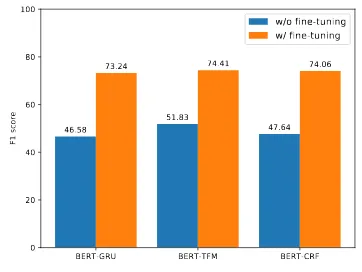
Figure 3: Effect of fine-tuning BERT.
works without using BERT, suggesting that BERT
representations encoding the associations between
arbitrary two tokens largely alleviate the issue of
context independence in the linear E2E-ABSA
layer. It is also observed that slightly more
pow-erful E2E-ABSA layers lead to much better
per-formance, verifying the postulation that
incorpo-rating context helps to sequence modeling.
3.3
Over-parameterization Issue
Although we employ the smallest pre-trained
BERT model, it is still over-parameterized for the
E2E-ABSA task (110M parameters), which
natu-rally raises a question: does BERT-based model
tend to overfit the small training set? Following
this question, we train BERT-GRU, BERT-TFM
and BERT-CRF up to 3000 steps on
REST
and
ob-serve the fluctuation of the F1 measures on the
de-velopment set. As shown in Figure
2
, F1 scores on
the development set are quite stable and do not
de-crease much as the training proceeds, which shows
that the BERT-based model is exceptionally robust
to overfitting.
3.4
Finetuning BERT or Not
We also study the impact of fine-tuning on the
fi-nal performances. Specifically, we employ BERT
to calculate the contextualized token-level
repre-sentations but kept the parameters of BERT
com-ponent unchanged in the training phase.
Fig-ure
3
illustrate the comparative results between
the BERT-based models and those keeping BERT
component fixed. Obviously, the general purpose
BERT representation is far from satisfactory for
the downstream tasks and task-specific fine-tuning
is essential for exploiting the strengths of BERT to
improve the performance.
4
Conclusion
In this paper, we investigate the effectiveness of
BERT embedding component on the task of
End-to-End Aspect-Based Sentiment Analysis
(E2E-ABSA). Specifically, we explore to couple the
BERT embedding component with various
neu-ral models and conduct extensive experiments on
two benchmark datasets. The experimental results
demonstrate the superiority of BERT-based
mod-els on capturing aspect-based sentiment and their
robustness to overfitting.
References
Jimmy Lei Ba, Jamie Ryan Kiros, and Geoffrey E Hin-ton. 2016. Layer normalization. arXiv preprint arXiv:1607.06450.
Mia Xu Chen, Orhan Firat, Ankur Bapna, Melvin Johnson, Wolfgang Macherey, George Foster, Llion Jones, Mike Schuster, Noam Shazeer, Niki Parmar, Ashish Vaswani, Jakob Uszkoreit, Lukasz Kaiser, Zhifeng Chen, Yonghui Wu, and Macduff Hughes. 2018. The best of both worlds: Combining recent advances in neural machine translation. In ACL, pages 76–86.
Peng Chen, Zhongqian Sun, Lidong Bing, and Wei Yang. 2017. Recurrent attention network on mem-ory for aspect sentiment analysis. InEMNLP, pages 452–461.
Jianpeng Cheng, Li Dong, and Mirella Lapata. 2016. Long short-term memory-networks for machine reading. InEMNLP, pages 551–561.
Kyunghyun Cho, Bart van Merri¨enboer, Caglar Gul-cehre, Dzmitry Bahdanau, Fethi Bougares, Holger Schwenk, and Yoshua Bengio. 2014. Learning phrase representations using RNN encoder–decoder for statistical machine translation. InEMNLP, pages 1724–1734.
Jacob Devlin, Ming-Wei Chang, Kenton Lee, and Kristina Toutanova. 2019. BERT: Pre-training of deep bidirectional transformers for language under-standing. InNAACL, pages 4171–4186.
Li Dong, Nan Yang, Wenhui Wang, Furu Wei, Xiaodong Liu, Yu Wang, Jianfeng Gao, Ming Zhou, and Hsiao-Wuen Hon. 2019. Unified language model pre-training for natural language understanding and generation. arXiv preprint arXiv:1905.03197.
Jeffrey L Elman. 1990. Finding structure in time. Cog-nitive science, 14(2):179–211.
Zhifang Fan, Zhen Wu, Xin-Yu Dai, Shujian Huang, and Jiajun Chen. 2019. Target-oriented opinion words extraction with target-fused neural sequence labeling. InNAACL, pages 2509–2518.
Kaiming He, Xiangyu Zhang, Shaoqing Ren, and Jian Sun. 2016. Deep residual learning for image recog-nition. InCVPR, pages 770–778.
Ruidan He, Wee Sun Lee, Hwee Tou Ng, and Daniel Dahlmeier. 2018. Exploiting document knowledge for aspect-level sentiment classification. In ACL, pages 579–585.
Ruidan He, Wee Sun Lee, Hwee Tou Ng, and Daniel Dahlmeier. 2019. An interactive multi-task learning network for end-to-end aspect-based sentiment anal-ysis. InACL, pages 504–515.
Sepp Hochreiter and J¨urgen Schmidhuber. 1997. Long short-term memory. Neural computation, 9(8):1735–1780.
Jeremy Howard and Sebastian Ruder. 2018. Universal language model fine-tuning for text classification. In
ACL, pages 328–339.
Minghao Hu, Yuxing Peng, Zhen Huang, Dongsheng Li, and Yiwei Lv. 2019. Open-domain targeted sen-timent analysis via span-based extraction and classi-fication. InACL, pages 537–546.
Binxuan Huang and Kathleen Carley. 2018. Parameter-ized convolutional neural networks for aspect level sentiment classification. In EMNLP, pages 1091– 1096.
Binxuan Huang and Kathleen M Carley. 2019. Syntax-aware aspect level sentiment classification with graph attention networks. arXiv preprint arXiv:1909.02606.
Zhiheng Huang, Wei Xu, and Kai Yu. 2015. Bidirec-tional lstm-crf models for sequence tagging. arXiv preprint arXiv:1508.01991.
Rafal Jozefowicz, Wojciech Zaremba, and Ilya Sutskever. 2015. An empirical exploration of recur-rent network architectures. InICML, pages 2342– 2350.
John D Lafferty, Andrew McCallum, and Fernando CN Pereira. 2001. Conditional random fields: Prob-abilistic models for segmenting and labeling se-quence data. InICML, pages 282–289.
Guillaume Lample, Miguel Ballesteros, Sandeep Sub-ramanian, Kazuya Kawakami, and Chris Dyer. 2016. Neural architectures for named entity recognition. InNAACL, pages 260–270.
Guillaume Lample and Alexis Conneau. 2019. Cross-lingual language model pretraining. arXiv preprint arXiv:1901.07291.
Zeyang Lei, Yujiu Yang, Min Yang, Wei Zhao, Jun Guo, and Yi Liu. 2019. A human-like semantic cog-nition network for aspect-level sentiment classifica-tion. InAAAI, pages 6650–6657.
Hao Li and Wei Lu. 2017. Learning latent sentiment scopes for entity-level sentiment analysis. InAAAI, pages 3482–3489.
Hao Li and Wei Lu. 2019. Learning explicit and implicit structures for targeted sentiment analysis.
arXiv preprint arXiv:1909.07593.
Xin Li, Lidong Bing, Wai Lam, and Bei Shi. 2018. Transformation networks for target-oriented senti-ment classification. InACL, pages 946–956.
Xin Li, Lidong Bing, Piji Li, and Wai Lam. 2019a. A unified model for opinion target extraction and target sentiment prediction. InAAAI, pages 6714–6721.
Zheng Li, Ying Wei, Yu Zhang, Xiang Zhang, and Xin Li. 2019b. Exploiting coarse-to-fine task transfer for aspect-level sentiment classification. InAAAI, pages 4253–4260.
Zhouhan Lin, Minwei Feng, Cicero Nogueira dos San-tos, Mo Yu, Bing Xiang, Bowen Zhou, and Yoshua Bengio. 2017. A structured self-attentive sentence embedding. InICLR.
Bing Liu. 2012. Sentiment analysis and opinion min-ing. Synthesis lectures on human language tech-nologies, 5(1):1–167.
Jiangming Liu and Yue Zhang. 2017. Attention mod-eling for targeted sentiment. InEACL, pages 572– 577.
Liyuan Liu, Jingbo Shang, Xiang Ren, Frank F Xu, Huan Gui, Jian Peng, and Jiawei Han. 2018. Em-power sequence labeling with task-aware neural lan-guage model. InAAAI, pages 5253–5260.
Yang Liu. 2019. Fine-tune bert for extractive summa-rization. arXiv preprint arXiv:1903.10318.
Huaishao Luo, Tianrui Li, Bing Liu, and Junbo Zhang. 2019. DOER: Dual cross-shared RNN for aspect term-polarity co-extraction. In ACL, pages 591– 601.
Dehong Ma, Sujian Li, and Houfeng Wang. 2018a. Joint learning for targeted sentiment analysis. In
EMNLP, pages 4737–4742.
Dehong Ma, Sujian Li, Xiaodong Zhang, and Houfeng Wang. 2017. Interactive attention networks for aspect-level sentiment classification. In IJCAI, pages 4068–4074.
Yukun Ma, Haiyun Peng, and Erik Cambria. 2018b. Targeted aspect-based sentiment analysis via em-bedding commonsense knowledge into an attentive lstm. InAAAI.
Navonil Majumder, Soujanya Poria, Alexander Gel-bukh, Md. Shad Akhtar, Erik Cambria, and Asif Ek-bal. 2018. IARM: Inter-aspect relation modeling with memory networks in aspect-based sentiment analysis. InEMNLP, pages 3402–3411.
Bryan McCann, James Bradbury, Caiming Xiong, and Richard Socher. 2017. Learned in translation: Con-textualized word vectors. InNeurIPS, pages 6294– 6305.
Tomas Mikolov, Ilya Sutskever, Kai Chen, Greg S Cor-rado, and Jeff Dean. 2013. Distributed representa-tions of words and phrases and their compositional-ity. InNeurIPS, pages 3111–3119.
Margaret Mitchell, Jacqui Aguilar, Theresa Wilson, and Benjamin Van Durme. 2013. Open domain tar-geted sentiment. InEMNLP, pages 1643–1654.
Jeffrey Pennington, Richard Socher, and Christopher Manning. 2014. Glove: Global vectors for word representation. InEMNLP, pages 1532–1543.
Matthew Peters, Mark Neumann, Mohit Iyyer, Matt Gardner, Christopher Clark, Kenton Lee, and Luke Zettlemoyer. 2018. Deep contextualized word rep-resentations. InNAACL, pages 2227–2237.
Maria Pontiki, Dimitris Galanis, Haris Papageorgiou, Ion Androutsopoulos, Suresh Manandhar, Moham-mad AL-SMoham-madi, Mahmoud Al-Ayyoub, Yanyan Zhao, Bing Qin, Orph´ee De Clercq, V´eronique Hoste, Marianna Apidianaki, Xavier Tannier, Na-talia Loukachevitch, Evgeniy Kotelnikov, Nuria Bel, Salud Mar´ıa Jim´enez-Zafra, and G¨uls¸en Eryi˘git. 2016. SemEval-2016 task 5: Aspect based senti-ment analysis. InSemEval, pages 19–30.
Maria Pontiki, Dimitris Galanis, Haris Papageorgiou, Suresh Manandhar, and Ion Androutsopoulos. 2015. SemEval-2015 task 12: Aspect based sentiment analysis. InSemEval, pages 486–495.
Maria Pontiki, Dimitris Galanis, John Pavlopoulos, Harris Papageorgiou, Ion Androutsopoulos, and Suresh Manandhar. 2014. SemEval-2014 task 4: Aspect based sentiment analysis. InSemEval, pages 27–35.
Alec Radford, Karthik Narasimhan, Tim Salimans, and Ilya Sutskever. 2018. Improving language
under-standing by generative pre-training.
Alec Radford, Jeffrey Wu, Rewon Child, David Luan, Dario Amodei, and Ilya Sutskever. 2019. Language models are unsupervised multitask learners. OpenAI Blog, 1(8).
Alexander Rietzler, Sebastian Stabinger, Paul Opitz, and Stefan Engl. 2019. Adapt or get left behind: Domain adaptation through bert language model finetuning for aspect-target sentiment classification.
arXiv preprint arXiv:1908.11860.
Martin Schmitt, Simon Steinheber, Konrad Schreiber, and Benjamin Roth. 2018. Joint aspect and polar-ity classification for aspect-based sentiment analysis with end-to-end neural networks. InEMNLP, pages 1109–1114.
Tao Shen, Tianyi Zhou, Guodong Long, Jing Jiang, Shirui Pan, and Chengqi Zhang. 2018. Disan: Di-rectional self-attention network for rnn/cnn-free lan-guage understanding. InAAAI.
Youwei Song, Jiahai Wang, Tao Jiang, Zhiyue Liu, and Yanghui Rao. 2019. Attentional encoder network for targeted sentiment classification. arXiv preprint arXiv:1902.09314.
Chi Sun, Luyao Huang, and Xipeng Qiu. 2019. Uti-lizing BERT for aspect-based sentiment analysis via constructing auxiliary sentence. InNAACL, pages 380–385.
Duyu Tang, Bing Qin, and Ting Liu. 2016. Aspect level sentiment classification with deep memory net-work. InEMNLP, pages 214–224.
Yi Tay, Luu Anh Tuan, and Siu Cheung Hui. 2018. Learning to attend via word-aspect associative fu-sion for aspect-based sentiment analysis. In Thirty-Second AAAI Conference on Artificial Intelligence.
Ashish Vaswani, Noam Shazeer, Niki Parmar, Jakob Uszkoreit, Llion Jones, Aidan N Gomez, Łukasz Kaiser, and Illia Polosukhin. 2017. Attention is all you need. InNeurIPS, pages 5998–6008.
Shuai Wang, Sahisnu Mazumder, Bing Liu, Mianwei Zhou, and Yi Chang. 2018. Target-sensitive mem-ory networks for aspect sentiment classification. In
ACL, pages 957–967.
Yequan Wang, Minlie Huang, Xiaoyan Zhu, and Li Zhao. 2016. Attention-based LSTM for aspect-level sentiment classification. In EMNLP, pages 606–615.
Hu Xu, Bing Liu, Lei Shu, and Philip Yu. 2019. BERT post-training for review reading comprehension and aspect-based sentiment analysis. InNAACL, pages 2324–2335.
Wei Xue and Tao Li. 2018. Aspect based sentiment analysis with gated convolutional networks. InACL, pages 2514–2523.
Jianfei Yu and Jing Jiang. 2019. Adapting bert for target-oriented multimodal sentiment classification. InIJCAI, pages 5408–5414.
Meishan Zhang, Yue Zhang, and Duy-Tin Vo. 2015. Neural networks for open domain targeted senti-ment. InEMNLP, pages 612–621.
![Table 1: Different problem settings in ABSA. Goldstandard aspects and opinions are wrapped in [] and<> respectively](https://thumb-us.123doks.com/thumbv2/123dok_us/1343245.666042/2.595.308.536.60.254/different-problem-settings-goldstandard-aspects-opinions-wrapped-respectively.webp)