Introduction to the CoNLL-2005 Shared Task:
Semantic Role Labeling
Xavier Carreras and Llu´ıs M`arquez
TALP Research Centre
Technical University of Catalonia (UPC)
{carreras,lluism}@lsi.upc.edu
Abstract
In this paper we describe the CoNLL-2005 shared task on Semantic Role La-beling. We introduce the specification and goals of the task, describe the data sets and evaluation methods, and present a general overview of the 19 systems that have con-tributed to the task, providing a compara-tive description and results.
1 Introduction
In the few last years there has been an increasing interest in shallow semantic parsing of natural lan-guage, which is becoming an important component in all kind of NLP applications. As a particular case, Semantic Role Labeling (SRL) is currently a well-defined task with a substantial body of work and comparative evaluation. Given a sentence, the task consists of analyzing the propositions expressed by some target verbs of the sentence. In particular, for each target verb all the constituents in the sentence which fill a semantic role of the verb have to be rec-ognized. Typical semantic arguments include Agent, Patient, Instrument, etc. and also adjuncts such as Locative, Temporal, Manner, Cause, etc.
Last year, the CoNLL-2004 shared task aimed at evaluating machine learning SRL systems based only on partial syntactic information. In (Carreras and M`arquez, 2004) one may find a detailed review of the task and also a brief state-of-the-art on SRL previous to 2004. Ten systems contributed to the task, which was evaluated using the PropBank cor-pus (Palmer et al., 2005). The best results were
around 70 in F1 measure. Though not directly
com-parable, these figures are substantially lower than the best results published up to date using full parsing as input information (F1 slightly over 79). In
addi-tion to the CoNLL-2004 shared task, another evalua-tion exercise was conducted in the Senseval-3 work-shop (Litkowski, 2004). Eight systems relying on full parsing information were evaluated in that event using the FrameNet corpus (Fillmore et al., 2001). From the point of view of learning architectures and study of feature relevance, it is also worth mention-ing the followmention-ing recent works (Punyakanok et al., 2004; Moschitti, 2004; Xue and Palmer, 2004; Prad-han et al., 2005a).
Following last year’s initiative, the CoNLL-2005
shared task1 will concern again the recognition of
semantic roles for the English language. Compared to the shared task of CoNLL-2004, the novelties in-troduced in the 2005 edition are:
• Aiming at evaluating the contribution of full
parsing in SRL, the complete syntactic trees given by two alternative parsers have been pro-vided as input information for the task. The rest of input information does not vary and cor-responds to the levels of processing treated in the previous editions of the CoNLL shared task, i.e., words, PoS tags, base chunks, clauses, and named entities.
• The training corpus has been substantially
en-larged. This allows to test the scalability of
1
The official CoNLL-2005 shared task web page, in-cluding data, software and systems’ outputs, is available at
http://www.lsi.upc.edu/∼srlconll.
learning-based SRL systems to big datasets and to compute learning curves to see how much data is necessary to train. Again, we concen-trate on the PropBank corpus (Palmer et al., 2005), which is the Wall Street Journal part of the Penn TreeBank corpus enriched with predicate–argument structures.
• In order to test the robustness of the
pre-sented systems, a cross-corpora evaluation is performed using a fresh test set from the Brown corpus.
Regarding evaluation, two different settings were devised depending if the systems use the informa-tion strictly contained in the training data (closed
challenge) or they make use of external sources
of information and/or tools (open challenge). The closed setting allows to compare systems under strict conditions, while the open setting aimed at ex-ploring the contributions of other sources of infor-mation and the limits of the current learning-based systems on the SRL task. At the end, all 19 systems took part in the closed challenge and none of them in the open challenge.
The rest of the paper is organized as follows. tion 2 describes the general setting of the task. Sec-tion 3 provides a detailed descripSec-tion of training, development and test data. Participant systems are described and compared in section 4. In particular, information about learning techniques, SRL strate-gies, and feature development is provided, together with performance results on the development and test sets. Finally, section 5 concludes.
2 Task Description
As in the 2004 edition, the goal of the task was to develop a machine learning system to recognize ar-guments of verbs in a sentence, and label them with their semantic role. A verb and its set of arguments form a proposition in the sentence, and typically, a sentence contains a number of propositions.
There are two properties that characterize the structure of the arguments in a proposition. First, ar-guments do not overlap, and are organized sequen-tially. Second, an argument may appear split into a number of non-contiguous phrases. For instance, in the sentence “[A1 The apple], said John, [C−A1
is on the table]”, the utterance argument (labeled with typeA1) appears split into two phrases. Thus, there is a set of non-overlapping arguments labeled with semantic roles associated with each proposi-tion. The set of arguments of a proposition can be seen as a chunking of the sentence, in which chunks are parts of the semantic roles of the proposition predicate.
In practice, number of target verbs are marked in a sentence, each governing one proposition. A system has to recognize and label the arguments of each target verb. To support the role labeling task, sentences contain input annotations, that consist of syntactic information and named entities. Section 3 describes in more detail the annotations of the data.
2.1 Evaluation
Evaluation is performed on a collection of unseen test sentences, that are marked with target verbs and contain only predicted input annotations.
A system is evaluated with respect to precision,
recall and the F1 measure of the predicted
argu-ments. Precision (p) is the proportion of arguments predicted by a system which are correct. Recall (r) is the proportion of correct arguments which are
pre-dicted by a system. Finally, the F1 measure
com-putes the harmonic mean of precision and recall, and is the final measure to compare the performance of systems. It is formulated as:Fβ=1 = 2pr/(p+r).
For an argument to be correctly recognized, the words spanning the argument as well as its semantic role have to be correct.2
As an exceptional case, the verb argument of each proposition is excluded from the evaluation. This ar-gument is the lexicalization of the predicate of the proposition. Most of the time, the verb corresponds to the target verb of the proposition, which is pro-vided as input, and only in few cases the verb par-ticipant spans more words than the target verb. Ex-cept for non-trivial cases, this situation makes the verb fairly easy to identify and, since there is one verb with each proposition, evaluating its recogni-tion over-estimates the overall performance of a sys-tem. For this reason, the verb argument is excluded from evaluation.
2
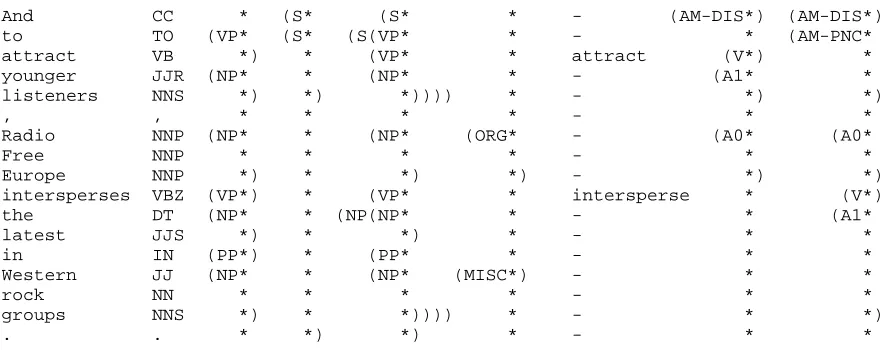
And CC * (S* (S* * - (AM-DIS*) (AM-DIS*)
to TO (VP* (S* (S(VP* * - * (AM-PNC*
attract VB *) * (VP* * attract (V*) *
younger JJR (NP* * (NP* * - (A1* *
listeners NNS *) *) *)))) * - *) *)
, , * * * * - * *
Radio NNP (NP* * (NP* (ORG* - (A0* (A0*
Free NNP * * * * - * *
Europe NNP *) * *) *) - *) *)
intersperses VBZ (VP*) * (VP* * intersperse * (V*)
the DT (NP* * (NP(NP* * - * (A1*
latest JJS *) * *) * - * *
in IN (PP*) * (PP* * - * *
Western JJ (NP* * (NP* (MISC*) - * *
rock NN * * * * - * *
groups NNS *) * *)))) * - * *)
[image:3.612.82.527.53.228.2]. . * *) *) * - * *
Figure 1: An example of an annotated sentence, in columns. Input consists of words (1st column), PoS tags (2nd), base chunks (3rd), clauses (4th), full syntactic tree (5th) and named entities (6th). The 7th column marks target verbs, and their propositions are found in remaining columns. According to the
PropBank Frames, forattract(8th), the A0annotates the attractor, and theA1the thing attracted; for
intersperse(9th),A0is the arranger, andA1the entity interspersed.
2.2 Closed Challenge Setting
The organization provided training, development and test sets derived from the standard sections of the Penn TreeBank (Marcus et al., 1993) and Prop-Bank (Palmer et al., 2005) corpora.
In the closed challenge, systems have to be built strictly with information contained in the training sections of the TreeBank and PropBank. Since this collection contains the gold reference annotations of both syntactic and predicate-argument structures, the closed challenge allows: (1) to make use of any preprocessing system strictly developed within this setting, and (2) to learn from scratch any annotation that is contained in the data. To support the former, the organization provided the output of state-of-the-art syntactic preprocessors, described in Section 3.
The development set is used to tune the parame-ters of a system. The gold reference annotations are also available in this set, but only to evaluate the per-formance of different parametrizations of a system, and select the optimal one. Finally, the test set is used to evaluate the performance of a system. It is only allowed to use predicted annotations in this set. Since all systems in this setting have had access to the same training and development data, the evalua-tion results on the test obtained by different systems are comparable in a fair manner.
3 Data
The data consists of sections of the Wall Street Jour-nal part of the Penn TreeBank (Marcus et al., 1993), with information on predicate-argument structures extracted from the PropBank corpus (Palmer et al., 2005). In this edition of the CoNLL shared task, we followed the standard partition used in syntactic parsing: sections 02-21 for training, section 24 for development, and section 23 for test. In addition, the test set of the shared task includes three sections of the Brown corpus (namely, ck01-03). The predicate-argument annotations of the latter test material were kindly provided by the PropBank team, and are very valuable, as they allow to evaluate learning systems on a portion of data that comes from a different source than training.
We first describe the annotations related to argu-ment structures. Then, we describe the preprocess-ing systems that have been selected to predict the input part of the data. Figure 1 shows an example of a fully-annotated sentence.
3.1 PropBank
• Numbered arguments (A0–A5, AA): Argu-ments defining verb-specific roles. Their se-mantics depends on the verb and the verb us-age in a sentence, or verb sense. The most
frequent roles areA0andA1and, commonly,
A0stands for the agent andA1corresponds to
the patient or theme of the proposition. How-ever, no consistent generalization can be made across different verbs or different senses of the same verb. PropBank takes the definition of verb senses from VerbNet, and for each verb and each sense defines the set of possible roles for that verb usage, called the roleset. The def-inition of rolesets is provided in the PropBank
Frames files, which is made available for the
shared task as an official resource to develop systems.
• Adjuncts (AM-): General arguments that any verb may take optionally. There are 13 types of adjuncts:
AM-ADV: general-purpose AM-MOD: modal verb
AM-CAU: cause AM-NEG: negation marker
AM-DIR: direction AM-PNC: purpose
AM-DIS: discourse marker AM-PRD: predication
AM-EXT: extent AM-REC: reciprocal
AM-LOC: location AM-TMP: temporal
AM-MNR: manner
• References (R-): Arguments representing ar-guments realized in other parts of the sentence. The role of a reference is the same as the role of the referenced argument. The label is anR-tag prefixed to the label of the referent, e.g.R-A1.
• Verbs (V): Argument corresponding to the verb of the proposition. Each proposition has exa-clty one verb argument.
We used PropBank-1.0. Most predicative verbs were annotated, although not all of them (for exam-ple, most of the occurrences of the verb “to have” and “to be” were not annotated). We applied proce-dures to check consistency of propositions, looking for overlapping arguments, and incorrect semantic role labels. Also, co-referenced arguments were an-notated as a single item in PropBank, and we au-tomatically distinguished between the referent and the reference with simple rules matching
pronomi-nal expressions, which were tagged asRarguments.
Train. Devel. tWSJ tBrown Sentences 39,832 1,346 2,416 426 Tokens 950,028 32,853 56,684 7,159 Propositions 90,750 3,248 5,267 804
Verbs 3,101 860 982 351
Arguments 239,858 8,346 14,077 2,177
A0 61,440 2,081 3,563 566
A1 84,917 2,994 4,927 676
A2 19,926 673 1,110 147
A3 3,389 114 173 12
A4 2,703 65 102 15
A5 68 2 5 0
AA 14 1 0 0
AM 7 0 0 0
AM-ADV 8,210 279 506 143
AM-CAU 1,208 45 73 8
AM-DIR 1,144 36 85 53
AM-DIS 4,890 202 320 22
AM-EXT 628 28 32 5
AM-LOC 5,907 194 363 85
AM-MNR 6,358 242 344 110
AM-MOD 9,181 317 551 91
AM-NEG 3,225 104 230 50
AM-PNC 2,289 81 115 17
AM-PRD 66 3 5 1
AM-REC 14 0 2 0
AM-TMP 16,346 601 1,087 112
R-A0 4,112 146 224 25
R-A1 2,349 83 156 21
R-A2 291 5 16 0
R-A3 28 0 1 0
R-A4 7 0 1 0
R-AA 2 0 0 0
R-AM-ADV 5 0 2 0
R-AM-CAU 41 3 4 2
R-AM-DIR 1 0 0 0
R-AM-EXT 4 1 1 0
R-AM-LOC 214 9 21 4
R-AM-MNR 143 6 6 2
R-AM-PNC 12 0 0 0
[image:4.612.321.531.59.469.2]R-AM-TMP 719 31 52 10
Table 1: Counts on the data sets.
A total number of 80 propositions were not compli-ant with our procedures (one in the Brown files, the rest in WSJ) and were filtered out from the CoNLL data sets.
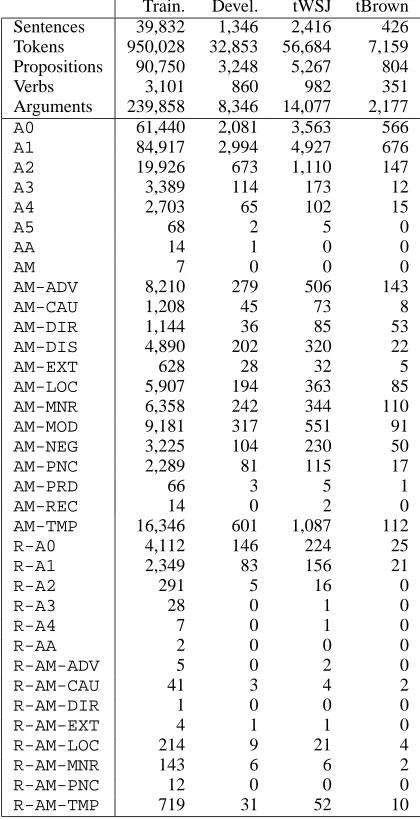
Table 1 provides counts of the number of sen-tences, tokens, annotated propositions, distinct verbs, and arguments in the four data sets.
3.2 Preprocessing Systems
allowed to use any processor developed within the same WSJ partition.
The preprocessors correspond to the following state-of-the-art systems:
• UPC processors, consisting of:
– PoS tagger: (Gim´enez and M`arquez, 2003), based on Support Vector Machines, and trained on WSJ sections 02-21.
– Base Chunker and Clause Recognizer:
(Carreras and M`arquez, 2003), based on Voted Perceptrons, trained on WSJ sec-tions 02-21. These two processors form a coherent partial syntax of a sentence, that is, chunks and clauses form a partial syn-tactic tree.
• Full parser of Collins (1999), with ”model 2”.
Predicts WSJ full parses, with information of the lexical head for each syntactic constituent. The PoS tags (required by the parser) have been computed with (Gim´enez and M`arquez, 2003).
• Full parser of Charniak (2000). Jointly predicts PoS tags and full parses.
• Named Entities predicted with the
Maximum-Entropy based tagger of Chieu and Ng (2003). The tagger follows the CoNLL-2003 task set-ting (Tjong Kim Sang and De Meulder, 2003), and thus is not developed with WSJ data. How-ever, we allowed its use because there is no available named entity recognizer developed with WSJ data. The reported performance on
the CoNLL-2003 test is F1 = 88.31, with
Prec/Rec. at 88.12/88.51.
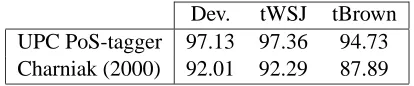
Tables 2 and 3 summarize the performance of the syntactic processors on the development and test sets. The performance of full parsers on the WSJ test is lower than that reported in the correspond-ing papers. The reason is that our evaluation fig-ures have been computed in a strict manner with re-spect to punctuation tokens, while the full parsing community usually does not penalize for
punctua-tion wrongly placed in the tree.3 As it can be
ob-3
Before evaluating Collins’, we raised punctuation to the highest point in the tree, using a script that is available at the shared task webpage. Otherwise, the performance would have Prec./Recall figures below 37.
Dev. tWSJ tBrown
UPC PoS-tagger 97.13 97.36 94.73
[image:5.612.323.530.57.100.2]Charniak (2000) 92.01 92.29 87.89
Table 2: Accuracy (%) of PoS taggers.
served, the performance of all syntactic processors suffers a substantial loss in the Brown test set. No-ticeably, the parser of Collins (1999) seems to be the more robust when moving from WSJ to Brown.
4 A Review of Participant Systems
Nineteen systems participated in the CoNLL-2005 shared task. They approached the task in several ways, using different learning components and la-beling strategies. The following subsections briefly summarize the most important properties of each system and provide a qualitative comparison be-tween them, together with a quantitative evaluation on the development and test sets.
4.1 Learning techniques
Up to 8 different learning algorithms have been ap-plied to train the learning components of partici-pant systems. See the “ML-method” column of ta-ble 4 for a summary of the following information. Log–linear models and vector-based linear classi-fiers dominated over the rest. Probably, this is due to the versatility of the approaches and the availability of very good software toolkits.
In particular, 8 teams used the Maximum En-tropy (ME) statistical framework (Che et al., 2005; Haghighi et al., 2005; Park and Rim, 2005; Tjong Kim Sang et al., 2005; Sutton and McCallum, 2005; Tsai et al., 2005; Yi and Palmer, 2005; Venkatapathy et al., 2005). Support Vector Machines (SVM) were used by 6 teams. Four of them with the standard polynomial kernels (Mitsumori et al., 2005; Tjong Kim Sang et al., 2005; Tsai et al., 2005; Pradhan et al., 2005b), another one using Gaussian kernels (Oz-gencil and McCracken, 2005), and a last group using tree-based kernels specifically designed for the task (Moschitti et al., 2005). Another team used also a re-lated learning approach, SNoW, which is a Winnow-based network of linear separators (Punyakanok et al., 2005).
Devel. Test WSJ Test Brown
P(%) R(%) F1 P(%) R(%) F1 P(%) R(%) F1
UPC Chunker 94.66 93.17 93.91 95.26 94.52 94.89 92.64 90.85 91.73
UPC Clauser 90.38 84.73 87.46 90.93 85.94 88.36 84.21 74.32 78.95
Collins (1999) 85.02 83.55 84.28 85.63 85.20 85.41 82.68 81.33 82.00
[image:6.612.98.516.56.139.2]Charniak (2000) 87.60 87.38 87.49 88.20 88.30 88.25 80.54 81.15 80.84
Table 3: Results of the syntactic parsers on the development, and WSJ and Brown test sets. Unlike in full parsing, the figures have been computed on a strict evaluation basis with respect to punctuation.
by Ponzetto and Strube (2005), who used C4.5. Ensembles of decision trees learned through the AdaBoost algorithm (AB) were applied by M`arquez et al. (2005) and Surdeanu and Turmo (2005). Tjong Kim Sang et al. (2005) applied, among others, Memory-Based Learning (MBL).
Regarding novel learning paradigms not applied in previous shared tasks, we find Relevant Vector Machine (RVM), which is a kernel–based linear dis-criminant inside the framework of Sparse Bayesian Learning (Johansson and Nugues, 2005) and Tree Conditional Random Fields (T-CRF) (Cohn and Blunsom, 2005), that extend the sequential CRF
model to tree structures. Finally, Lin and Smith
(2005) presented a proposal radically different from the rest, with very light learning components. Their approach (Consensus in Pattern Matching, CPM) contains some elements of Memory-based Learning and ensemble classification.
From the Machine Learning perspective, system combination is another interesting component ob-served in many of the proposals. This fact, which is a difference from last year shared task, is explained as an attempt of increasing the robustness and cover-age of the systems, which are quite dependent on in-put parsing errors. The different outin-puts to combine are obtained by varying input information, chang-ing learnchang-ing algorithm, or considerchang-ing n-best solu-tion lists. The combinasolu-tion schemes presented in-clude very simple voting-like combination heuris-tics, stacking of classifiers, and a global constraint satisfaction framework modeled with Integer Linear Programming. Global models trained to re-rank al-ternative outputs represent a very interesting alter-native that has been proposed by two systems. All these issues are reviewed in detail in section 4.2.
4.2 SRL approaches
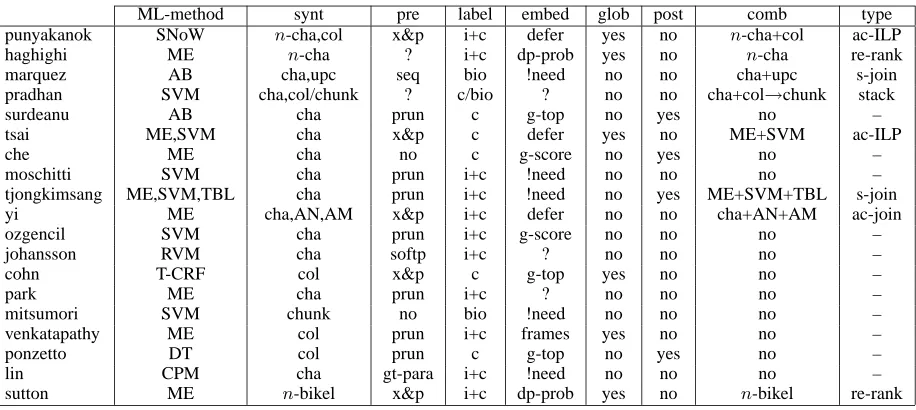
SRL is a complex task, which may be decomposed into a number of simpler decisions and annotating schemes in order to be addressed by learning tech-niques. Table 4 contains a summary of the main properties of the 19 systems presented. In this sec-tion we will explain the contents of that table by columns (from left-to-right).
One first issue to consider is the input structure to navigate in order to extract the constituents that will form labeled arguments. The majority of sys-tems perform parse tree node labeling, searching for a one–to–one map between arguments and parse constituents. This information is summarized in the “synt” column of Table 4. “col”, “cha”, “upc” stand for the syntactic parse trees (the latter is partial) pro-vided as input by the organization. Additionally,
some teams used lists ofn-best parsings generated
by available tools (“n-cha” by Charniak parser; “n -bikel” by Bikel’s implementation of Collins parser). Interestingly, Yi and Palmer (2005) retrained Rat-naparkhi’s parser using the WSJ training sections enriched with semantic information coming from PropBank annotations. These are referred to as AN and AM parses. As it can be seen, Charniak parses were used by most of the systems. Collins parses were used also in some of the best performing sys-tems based on combination.
ML-method synt pre label embed glob post comb type punyakanok SNoW n-cha,col x&p i+c defer yes no n-cha+col ac-ILP
haghighi ME n-cha ? i+c dp-prob yes no n-cha re-rank
marquez AB cha,upc seq bio !need no no cha+upc s-join
pradhan SVM cha,col/chunk ? c/bio ? no no cha+col→chunk stack
surdeanu AB cha prun c g-top no yes no –
tsai ME,SVM cha x&p c defer yes no ME+SVM ac-ILP
che ME cha no c g-score no yes no –
moschitti SVM cha prun i+c !need no no no –
tjongkimsang ME,SVM,TBL cha prun i+c !need no yes ME+SVM+TBL s-join
yi ME cha,AN,AM x&p i+c defer no no cha+AN+AM ac-join
ozgencil SVM cha prun i+c g-score no no no –
johansson RVM cha softp i+c ? no no no –
cohn T-CRF col x&p c g-top yes no no –
park ME cha prun i+c ? no no no –
mitsumori SVM chunk no bio !need no no no –
venkatapathy ME col prun i+c frames yes no no –
ponzetto DT col prun c g-top no yes no –
lin CPM cha gt-para i+c !need no no no –
[image:7.612.79.537.55.260.2]sutton ME n-bikel x&p i+c dp-prob yes no n-bikel re-rank
Table 4: Main properties of the SRL strategies implemented by the participant teams, sorted by F1
per-formance on the WSJ+Brown test set. synt stands for the syntactic structure explored; pre stands for pre-processing steps; label stands for the labeling strategy; embed stands for the technique to ensure non-embedding of arguments; glob stands for global optimization; post stands for post-processing; comb stands for system output combination, and type stands for the type of combination. Concrete values appearing in the table are explained in section 4.1. The symbol “?” stands for unknown values not reported by the system description papers.
In general, the presented systems addressed the SRL problem by applying different chained pro-cesses. In Table 4 the column “pre” summarizes pre-processing. In most of the cases this corresponds to a pruning procedure to filter out constituents that are not likely to be arguments. As in feature develop-ment, the related bibliography has been followed for pruning. For instance, many systems used the prun-ing strategy described in (Xue and Palmer, 2004) (“x&p”) and other systems used the soft pruning rules described in (Pradhan et al., 2005a) (“softp”). Remarkably, Park and Rim (2005) parametrize the pruning procedure and then study the effect of be-ing more or less aggressive at filterbe-ing constituents. In the case of M`arquez et al. (2005), pre-processing corresponds to a sequentialization of syntactic hier-archical structures. As a special case, Lin and Smith (2005) used the GT-PARA analyzer for converting parse trees into a flat representation of all predicates including argument boundaries.
The second stage, reflected in column “label” of Table 4, is the proper labeling of selected candi-dates. Most of the systems used a two-step proce-dure consisting of first identifying arguments (e.g.,
with a binary “null” vs. “non-null” classifier) and then classifying them. This is referred to as “i+c” in the table. Some systems address this phase in a sin-gle classification step by adding a “null” category to the multiclass problem (referred to as “c’). The methods performing a sequential tagging use a BIO tagging scheme (“bio”). As a special case, Mos-chitti et al. (2005) subdivide the “i+c” strategy into four phases: after identification, heuristics are ap-plied to assure compatibility of identified arguments; and, before classifying arguments into roles, a pre-classification into core vs. adjunct arguments is per-formed. Venkatapathy et al. (2005) use three labels instead of two in the identification phase : “null”, “mandatory”, and “optional”.
constituents (“g-score”), or selecting the arguments that are first reached in a top-down exploration (“g-top”). Some probabilistic systems include the non-embedding constraints within the dynamic program-ming inference component, and thus calculate the most probable coherent labeling (“dp-prob”). The “defer” value means that this is a combination sys-tem and that coherence of the individual syssys-tem pre-dictions is not forced, but deferred to the later com-bination step. As a particular case, Venkatapathy et al. (2005) use PropBank subcategorization frames to force a coherent solution. Note that tagging-based systems do not need to check non-embedding con-straints (“!need” value).
The “glob” column of Table 4 accounts for the lo-cality/globality of the process used to calculate the output solution given the argument prediction candi-dates. Systems with a “yes” value in that column de-fine some kind of scoring function (possibly proba-bilistic) that applies to complete candidate solutions, and then calculate the solution that maximizes the scoring using an optimization algorithm.
Some systems use some kind of postprocessing to improve the final output of the system by correct-ing some systematic errors, or treatcorrect-ing some types of simple adjunct arguments. This information is in-cluded in the “post” column of Table 4. In most of the cases, this postprocess is performed on the basis of simple ad-hoc rules. However, it is worth men-tioning the work of Tjong Kim Sang et al. (2005) in which spelling error correction techniques are adapted for improving the resulting role labeling. In that system, postprocessing is applied before system combination.
Most of the best performing systems included a combination of different base subsystems to increase robustness of the approach and to gain coverage and independence from parse errors. Last 2 columns of Table 4 present this information. In the “comb” col-umn the source of the combination is reported. Basi-cally, the alternative outputs to combine can be gen-erated by different input syntactic structures or n -best parse candidates, or by applying different learn-ing algorithms to the same input information.
The type of combination is reported in the last col-umn. M`arquez et al. (2005) and Tjong Kim Sang et al. (2005) performed a greedy merging of the ar-guments of base complete solutions (“s-join”). Yi
and Palmer (2005) did also a greedy merging of ar-guments but taking into account not complete so-lutions but all candidate arguments labeled by base systems (“ac-join”). In a more sophisticated way, Punyakanok et al. (2005) and Tsai et al. (2005) per-formed global inference as constraint satisfaction using Integer Linear Programming, also taking into account all candidate arguments (“ac-ILP”). It is worth noting that the generalized inference applied in those papers allows to include, jointly with the combination of outputs, a number of linguistically-motivated constraints to obtain a coherent solution.
Pradhan et al. (2005b) followed a stacking ap-proach by learning a chunk-based SRL system in-cluding as features the outputs of two syntax-based systems. Finally, Haghighi et al. (2005) and Sut-ton and McCallum (2005) performed a different ap-proach by learning a re-ranking function as a global model on top of the base SRL models. Actually, Haghighi et al. (2005) performed a double selection step: an inner re-ranking ofn-best solutions coming from the base system on a single tree; and an outer selection of the final solution among the candidate
solutions coming fromn-best parse trees. The
re-ranking approach allows to define global complex features applying to complete candidate solutions to train the rankers.
4.3 Features
Looking at the description of the different systems, it becomes clear that the general type of features used in this edition is strongly based on previous work on the SRL task (Gildea and Jurafsky, 2002; Surdeanu et al., 2003; Pradhan et al., 2005a; Xue and Palmer, 2004). With no exception, all systems have made intensive use of syntax to extract features. While most systems work only on the output of a parser —Charniak’s being the most preferred— some sys-tems depend on many syntactic parsers. In the latter situation, either a system is a combination of many individual systems (each working with a different parser), or a system extracts features from many dif-ferent parse trees while exploring the nodes of only one parse tree. Most systems have also considered named entities for extracting features.
sources argument verb arg–verb p
synt ne at aw ab ac ai pp sd v sc rp di ps pv pi sf as
punyakanok cha,col,upc + + h + t + + · + + + c + · + + ·
haghighi cha · + h + p,s · + + + + + t + + · · +
marquez cha,upc + + h + t + · + + + + w,c + + · + ·
pradhan cha,col,upc + + h,c + p,s,t + + · + + + c,t + + + + ·
surdeanu cha + + h,c + p,s + · + + + + w,t + + + · ·
tsai cha,upc + + h + p,s,t · · · + + + w + · · · ·
che cha + + h + · · + · + + + t + + · · ·
moschitti cha · + h + p + + · + + + t + + · + ·
tjongkimsang cha + + · + p,t · + · + + + w,t + + + · ·
yi cha,an,am · + h,c · p,s · + · + + + w + · · + ·
ozgencil cha · + h · p · · · + + + · + + · · ·
johansson cha,upc + + h · · · + + + · + + · · ·
cohn col · + h + p,s · + · + + + w + · + + ·
park cha · + h,c · p · · · + + + · + · + · ·
mitsumori upc,cha + + · + t · · + + · + c,t · + · · ·
venkatapathy col + + h + · · · · + · + · + · · · ·
ponzetto col,upc + + h + · + · · + · · w,c,t · · + · ·
lin cha · + h + · · · · + · + w · · · · ·
sutton bik · + h + p,s · · · + · + · + · · · +
Table 5: Main feature types used by the 19 participating systems in the CoNLL-2005 shared task, sorted by performance on the WSJ+Brown test set. Sources: synt: use of parsers, namely Charniak (cha), Collins (col), UPC partial parsers (upc), Bikel’s Collins model (bik) and/or argument-enriched parsers (an,am); ne: use of named entities. On the argument: at: argument type; aw: argument words, namely the head (h) and/or content words (c); ab: argument boundaries, i.e. form and PoS of first and/or last argument words; ac: argument context, capturing features of the parent (p) and/or left/right siblings (s), or the tokens surrounding the argument (t); ai: indicators of the structure of the argument (e,g., on internal constituents, surround-ing/boundary punctuation, governing category, etc.); pp: specific features for prepositional phrases; sd: semantic dictionaries. On the verb: v: standard verb features (voice, word/lemma, PoS); sc: subcatego-rization. On the arg-verb relation: rp: relative position; di: distance, based on words (w), chunks (c) or the syntactic tree (t); ps: standard path; pv: path variations; pi: scalar indicator variables on the path (of chunks, clauses, or other phrase types), common ancestor, etc.; sf: syntactic frame (Xue and Palmer, 2004);
On the complete proposition: as: sequence of arguments of a proposition.
argument; (2) Features describing properties of the target verb predicate; (3) Features that capture the relation between the verb predicate and the con-stituent under consideration; and (4) Global features describing the complete argument labeling of a pred-icate. The rest of the section describes the most com-mon feature types in each category. Table 5 summa-rizes the type of features exploited by systems.
To represent an argument itself, all systems make use of the syntactic type of the argument. Almost all teams used the heuristics of Collins (1999) to ex-tract the head word of the argument, and used fea-tures that capture the form, lemma and PoS tag of the head. In the same line, some systems also use features of the content words of the argument, using the heuristics of Surdeanu et al. (2003). Very gen-erally also, many systems extract features from the
first and last words of the argument. Regarding the syntactic elements surrounding the argument, many systems working on full trees have considered the parent and siblings of the argument, capturing their
syntactic type and head word. Differently, other
gen-eral the use of specific features that apply when the constituent is a prepositional phrase, such as look-ing for the head word of the noun phrase within it. A few systems have also built semantic dictionaries from training data, that collect words appearing fre-quently in temporal, locative or other arguments.
To represent the predicate, all systems have used features codifying the form, lemma, PoS tag and voice of the verb. It is also of general use the subcat-egorization feature, capturing the syntactic rule that expands the parent of the predicate. Some systems captured statistics related to the frequency of a verb in training data (not in Table 5).
Regarding features related to an argument-verb pair, almost all systems use the simple feature
de-scribing the relative position between them. To
a lesser degree, systems have computed distances from one to the other, based on the number of words or chunks between them, or based on the syntactic tree. Not surprisingly, all systems have extracted the path from the argument to the verb. While almost all systems use the standard path of (Gildea and Ju-rafsky, 2002), many have explored variations of it. A common one consists of the path from the argu-ment to the lowest common ancestor of the verb and the argument. Another variation is the partial path, that is built of chunks and clauses only. Indicator features that capture scalar values of the path are also common, and concentrate mainly on looking at the common ancestor, capturing the difference of clausal levels, or looking for punctuation and other linguistic elements in the path. In this category, it is also noticeable the use of the syntactic frame feature, proposed by Xue and Palmer (2004).
Finally, in this edition two systems apply learn-ing at a global context (Haghighi et al., 2005; Sut-ton and McCallum, 2005) and, consequently, they are able to extract features from a complete labeling of a predicate. Basically, the central feature in this context extracts the sequential pattern of predicate arguments. Then, this pattern can be enriched with syntactic categories, broken down into role-specific indicator variables, or conjoined with the predicate lemma.
Apart from basic feature extraction, combination of features has also been explored in this edition. Many of the combinations depart from the manually selected conjunctions of Xue and Palmer (2004).
4.4 Evaluation
A baseline rate was computed for the task. It
was produced using a system developed in the past shared task edition by Erik Tjong Kim Sang, from the University of Amsterdam, The Netherlands. The baseline processor finds semantic roles based on the following seven rules:
• Tag target verb and successive particles asV.
• Tag not and n’t in target verb chunk as
AM-NEG.
• Tag modal verbs in target verb chunk as
AM-MOD.
• Tag firstNPbefore target verb asA0.
• Tag firstNPafter target verb asA1.
• Tagthat,whichandwhobefore target verb asR-A0.
• SwitchA0andA1, andR-A0andR-A1if the
target verb is part of a passiveVP chunk. A
VP chunk is considered in passive voice if it
contains a form of to be and the verb does
not end ining.
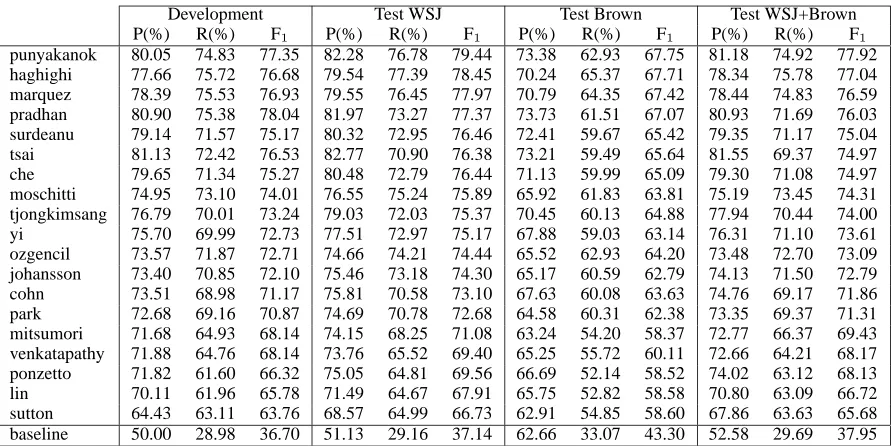
Table 6 presents the overall results obtained by the nineteen systems plus the baseline, on the de-velopment and test sets (i.e., Dede-velopment, Test WSJ, Test Brown, and Test WSJ+Brown). The sys-tems are sorted by the performance on the combined WSJ+Brown test set.
As it can be observed, all systems clearly outper-formed the baseline. There are seven systems with a final F1performance in the 75-78 range, seven more
with performances in the 70-75 range, and five with a performance between 65 and 70. The best perfor-mance was obtained by Punyakanok et al. (2005),
which almost reached an F1 at 80 in the WSJ test
set and almost 78 in the combined test. Their results on the WSJ test equal the best results published so far on this task and datasets (Pradhan et al., 2005a), though they are not directly comparable due to a different setting in defining arguments not perfectly matching the predicted parse constituents. Since the evaluation in the shared task setting is more strict, we believe that the best results obtained in the shared task represent a new breakthrough in the SRL task.
Development Test WSJ Test Brown Test WSJ+Brown
P(%) R(%) F1 P(%) R(%) F1 P(%) R(%) F1 P(%) R(%) F1
[image:11.612.84.532.55.278.2]punyakanok 80.05 74.83 77.35 82.28 76.78 79.44 73.38 62.93 67.75 81.18 74.92 77.92 haghighi 77.66 75.72 76.68 79.54 77.39 78.45 70.24 65.37 67.71 78.34 75.78 77.04 marquez 78.39 75.53 76.93 79.55 76.45 77.97 70.79 64.35 67.42 78.44 74.83 76.59 pradhan 80.90 75.38 78.04 81.97 73.27 77.37 73.73 61.51 67.07 80.93 71.69 76.03 surdeanu 79.14 71.57 75.17 80.32 72.95 76.46 72.41 59.67 65.42 79.35 71.17 75.04 tsai 81.13 72.42 76.53 82.77 70.90 76.38 73.21 59.49 65.64 81.55 69.37 74.97 che 79.65 71.34 75.27 80.48 72.79 76.44 71.13 59.99 65.09 79.30 71.08 74.97 moschitti 74.95 73.10 74.01 76.55 75.24 75.89 65.92 61.83 63.81 75.19 73.45 74.31 tjongkimsang 76.79 70.01 73.24 79.03 72.03 75.37 70.45 60.13 64.88 77.94 70.44 74.00 yi 75.70 69.99 72.73 77.51 72.97 75.17 67.88 59.03 63.14 76.31 71.10 73.61 ozgencil 73.57 71.87 72.71 74.66 74.21 74.44 65.52 62.93 64.20 73.48 72.70 73.09 johansson 73.40 70.85 72.10 75.46 73.18 74.30 65.17 60.59 62.79 74.13 71.50 72.79 cohn 73.51 68.98 71.17 75.81 70.58 73.10 67.63 60.08 63.63 74.76 69.17 71.86 park 72.68 69.16 70.87 74.69 70.78 72.68 64.58 60.31 62.38 73.35 69.37 71.31 mitsumori 71.68 64.93 68.14 74.15 68.25 71.08 63.24 54.20 58.37 72.77 66.37 69.43 venkatapathy 71.88 64.76 68.14 73.76 65.52 69.40 65.25 55.72 60.11 72.66 64.21 68.17 ponzetto 71.82 61.60 66.32 75.05 64.81 69.56 66.69 52.14 58.52 74.02 63.12 68.13 lin 70.11 61.96 65.78 71.49 64.67 67.91 65.75 52.82 58.58 70.80 63.09 66.72 sutton 64.43 63.11 63.76 68.57 64.99 66.73 62.91 54.85 58.60 67.86 63.63 65.68 baseline 50.00 28.98 36.70 51.13 29.16 37.14 62.66 33.07 43.30 52.58 29.69 37.95 Table 6: Overall precision, recall and F1rates obtained by the 19 participating systems in the CoNLL-2005
shared task on the development and test sets. Systems sorted by F1score on the WSJ+Brown test set.
best individual system on the task is that of
Sur-deanu and Turmo (2005), which obtained F1=75.04
on the combined test set, about 3 points below than the best performing combined system. On the de-velopment set, that system achieved a performace of 75.17 (slightly below than the 75.27 reported by Che et al. (2005) on the same dataset). Accord-ing to the description papers, we find that other individual systems, from which the combined sys-tems are constructed, performed also very well. For instance, Tsai et al. (2005) report F1=75.76 for a
base system on the development set, M`arquez et al.
(2005) report F1=75.75, Punyakanok et al. (2005)
report F1=74.76, and Haghighi et al. (2005) report
F1=74.52.
The best results in the CoNLL-2005 shared task are 10 points better than those of last year edition. This increase in performance should be attributed to a combination of the following factors: 1) training sets have been substantially enlarged; 2) predicted parse trees are available as input information; and 3) more sophisticated combination schemes have been implemented. In order to have a more clear idea of the impact of enriching the syntactic information, we refer to (M`arquez et al., 2005), who developed an individual system based only on partial parsing (“upc” input information). That system performed
F1=73.57 on the development set, which is 2.18
points below the F1=75.75 obtained by the same
ar-chitecture using full parsing, and 4.47 points below the best performing combined system on the devel-opment set (Pradhan et al., 2005b).
Comparing the results across development and WSJ test corpora, we find that, with two exceptions, all systems experienced a significant increase in
per-formance (normally between 1 and 2 F1 points).
This fact may be attributed to the different levels of difficulty found across WSJ sections. The linguistic processors and parsers perform slightly worse in the development set. As a consequence, the matching between parse nodes and actual arguments is lower.
Regarding the evaluation using the Brown test set, all systems experienced a severe drop in
perfor-mance (about 10 F1 points), even though the
im-portantly, this results impose (again) a severe criti-cism on the current pipelined architecture for Natu-ral Language Processing. Error propagation and am-plification through the chained modules make the fi-nal output generalize very badly when changing the domain of application.
5 Conclusion
We have described the CoNLL-2005 shared task
on semantic role labeling. Contrasting with the
CoNLL-2004 edition, the current edition has in-corporated the use of full syntax as input to the SRL systems, much larger training sets, and
cross-corpora evaluation. The first two novelties have
most likely contributed to an improvement of re-sults. The latter has evinced a major drawback of natural language pipelined architectures.
Nineteen teams have participated to the task, con-tributing with a variety of learning algorithms, la-beling strategies, feature design and experimenta-tion. While, broadly, all systems make use of the same basic techniques described in existing SRL literature, some novel aspects have also been ex-plored. A remarkable aspect, common in the four top-performing systems and many other, is that of combining many individual SRL systems, each working on different syntactic structures. Combin-ing systems improves robustness, and overcomes the limitations in coverage that working with a sin-gle, non-correct syntactic structure imposes. The best system, presented by Punyakanok et al. (2005),
achieves an F1 at 79.44 on the WSJ test. This
per-formance, of the same order than the best reported in literature, is still far from the desired behavior of a natural language analyzer. Furthermore, the per-formance of such SRL module in a real application will be about ten points lower, as demonstrated in the evaluation on the sentences from Brown.
We conclude with two open questions. First, what semantic knowledge is needed to improve the qual-ity and performance of SRL systems. Second, be-yond pipelines, what type of architectures and lan-guage learning methodology ensures a robust per-formance of processors.
Acknowledgements
Authors would like to thank the following people and institu-tions. The PropBank team, and specially Martha Palmer and Benjamin Snyder, for making available PropBank-1.0 and the prop-banked Brown files. The Linguistic Data Consortium, for issuing a free evaluation license for the shared task to use the TreeBank. Hai Leong Chieu and Hwee Tou Ng, for running their Named Entity tagger on the task data. Finally, the teams contributing to the shared task, for their great enthusiasm.
This work has been partially funded by the European Com-munity (Chil - IP506909; PASCAL - IST-2002-506778) and the Spanish Ministry of Science and Technology (Aliado, TIC2002-04447-C02).
References
Xavier Carreras and Llu´ıs M`arquez. 2003. Phrase recog-nition by filtering and ranking with perceptrons. In Proceedings of RANLP-2003, Borovets, Bulgaria.
Xavier Carreras and Llu´ıs M`arquez. 2004. Introduction to the CoNLL-2004 Shared Task: Semantic Role La-beling. In Proceedings of CoNLL-2004.
Eugene Charniak. 2000. A maximum-entropy inspired parser. In Proceedings of NAACL-2000.
Wanxiang Che, Ting Liu, Sheng Li, Yuxuan Hu, and Huaijun Liu. 2005. Semantic role labeling system using maximum entropy classifier. In Proceedings of CoNLL-2005.
Hai Leong Chieu and Hwee Tou Ng. 2003. Named en-tity recognition with a maximum entropy approach. In Proceedings of CoNLL-2003, Edmonton, Canada.
Trevor Cohn and Philip Blunsom. 2005. Semantic role labelling with tree conditional random fields. In Pro-ceedings of CoNLL-2005.
Michael Collins. 1999. Head-driven Statistical Models for Natural Language Parsing. Ph.D. thesis, Univer-sity of Pennsylvania.
Charles J. Fillmore, Charles Wooters, and Collin F. Baker. 2001. Building a large lexical databank which provides deep semantics. In Proceedings of the Pa-cific Asian Conference on Language, Informa tion and Computation, Hong Kong, China.
Daniel Gildea and Daniel Jurafsky. 2002. Automatic la-beling of semantic roles. Computational Linguistics, 28(3):245–288.
Aria Haghighi, Kristina Toutanova, and Christopher Manning. 2005. A joint model for semantic role la-beling. In Proceedings of CoNLL-2005.
Richard Johansson and Pierre Nugues. 2005. Sparse bayesian classification of predicate arguments. In Pro-ceedings of CoNLL-2005.
Chi-San Lin and Tony C. Smith. 2005. Semantic role labeling via consensus in pattern-matching. In Pro-ceedings of CoNLL-2005.
Ken Litkowski. 2004. Senseval-3 task: Automatic label-ing of semantic roles. In Proceedlabel-ings of the Senseval-3 ACL-SIGLEX Workshop.
Mitchell P. Marcus, Beatrice Santorini, and Mary Ann Marcinkiewicz. 1993. Building a large annotated cor-pus of English: the Penn Treebank. Computational Linguistics, 19.
Llu´ıs M`arquez, Pere Comas, Jes ´us Gim´enez, and Neus Catal`a. 2005. Semantic role labeling as sequential tagging. In Proceedings of CoNLL-2005.
Tomohiro Mitsumori, Masaki Murata, Yasushi Fukuda, Kouichi Doi, and Hirohumi Doi. 2005. Semantic role labeling using support vector machines. In Proceed-ings of CoNLL-2005.
Alessandro Moschitti, Ana-Maria Giuglea, Bonaventura Coppola, and Roberto Basili. 2005. Hierarchical se-mantic role labeling. In Proceedings of CoNLL-2005.
Alessandro Moschitti. 2004. A study on convolution kernel for shallow semantic parsing. In Proceedings of the 42nd Annual Conference of the Association for Computational Linguistics (ACL-2004).
Necati Ercan Ozgencil and Nancy McCracken. 2005. Semantic role labeling using libSVM. In Proceedings of CoNLL-2005.
Martha Palmer, Daniel Gildea, and Paul Kingsbury. 2005. The proposition bank: An annotated corpus of semantic roles. Computational Linguistics, 31(1).
Kyung-Mi Park and Hae-Chang Rim. 2005. Maximum entropy based semantic role labeling. In Proceedings of CoNLL-2005.
Simone Paolo Ponzetto and Michael Strube. 2005. Se-mantic role labeling using lexical statistical informa-tion. In Proceedings of CoNLL-2005.
Sameer Pradhan, Kadri Hacioglu, Valerie Krugler, Wayne Ward, James Martin, and Daniel Jurafsky. 2005a. Support vector learning for semantic argu-ment classification. Machine Learning. Special issue on Speech and Natural Language Processing. To ap-pear.
Sameer Pradhan, Kadri Hacioglu, Wayne Ward, James H. Martin, and Daniel Jurafsky. 2005b. Semantic role chunking combining complementary syntactic views. In Proceedings of CoNLL-2005.
Vasin Punyakanok, Dan Roth, Wen-Tau Yih, and Dav Zi-mak. 2004. Semantic role labeling via integer lin-ear programming inference. In Proceedings of the In-ternational Conference on Computational Linguistics (COLING).
Vasin Punyakanok, Peter Koomen, Dan Roth, and Wen tau Yih. 2005. Generalized inference with multi-ple semantic role labeling systems. In Proceedings of CoNLL-2005.
Mihai Surdeanu and Jordi Turmo. 2005. Semantic role labeling using complete syntactic analysis. In Pro-ceedings of CoNLL-2005.
Mihai Surdeanu, Sanda Harabagiu, John Williams, and Paul Aarseth. 2003. Using predicate-argument struc-tures for information extraction. In Proceedings of ACL 2003, Sapporo, Japan.
Charles Sutton and Andrew McCallum. 2005. Joint parsing and semantic role labeling. In Proceedings of CoNLL-2005.
Erik F. Tjong Kim Sang and Fien De Meulder. 2003. In-troduction to the CoNLL-2003 shared task: Language-independent named entity recognition. In Proceedings of CoNLL-2003.
Erik Tjong Kim Sang, Sander Canisius, Antal van den Bosch, and Toine Bogers. 2005. Applying spelling er-ror correction techniques for improving semantic role labelling. In Proceedings of CoNLL-2005.
Tzong-Han Tsai, Chia-Wei Wu, Yu-Chun Lin, and Wen-Lian Hsu. 2005. Exploiting full parsing information to label semantic roles using an ensemble of me and svm via integer linear programming. In Proceedings of CoNLL-2005.
Sriram Venkatapathy, Akshar Bharati, and Prashanth Reddy. 2005. Inferring semantic roles using sub-categorization frames and maximum entropy model. In Proceedings of CoNLL-2005.
Nianwen Xue and Martha Palmer. 2004. Calibrating features for semantic role labeling. In Proceedings of the Conference on Empirical Methods in Natural Lan-guage Processing (EMNLP).