Covington Variations
Svetoslav Marinov
School of Humanities and Informatics, University College Sk¨ovde, 54128 Sk¨ovde & GSLT, G¨oteborg University, 40530 G¨oteborg,
Sweden
Abstract
Three versions of the Covington algorithm for non-projective dependency parsing have been tested on the ten different languages for the Multilingual track of the CoNLL-X Shared Task. The results were achieved by using only information about heads and daughters as features to guide the parser which obeys strict incrementality.
1 Introduction
In this paper we focus on two things. First, we in-vestigate the impact of using different flavours of Covington’s algorithm (Covington, 2001) for non-projective dependency parsing on the ten differ-ent languages provided for CoNLL-X Shared Task (Nivre et al., 2007). Second, we test the perfor-mance of a pure grammar-based feature model in strictly incremental fashion. The grammar model re-lies only on the knowledge of heads and daughters of two given words, as well as the words themselves, in order to decide whether they can be linked with a certain dependency relation. In addition, none of the three parsing algorithms guarantees that the output dependency graph will be projective.
2 Covington’s algorithm(s)
In his (2001) paper, Covington presents a “funda-mental” algorithm for dependency parsing, which he claims has been known since the 1960s but has, up to his paper-publication, not been presented systematically in the literature. We take three of its flavours, which enforce uniqueness (a.k.a.
single-headedness) but do not observe projectivity. The algorithms work one word at a time and attempt to build a connected dependency graph with only a single left-to-right pass through the input. The three flavours are: Exhaustive Search, Head First with Uniqueness (ESHU), Exhaustive Search Dependents First with Uniqueness (ESDU) and List-based search with Uniqueness (LSU).
ESHU ESDU
for i = 1 to n for i = 1 to n
for j = i-1 downto 0 for j = i-1 downto 0 if HEAD?(j,i) if HEAD?(i,j)
LINK(j,i) LINK(i,j)
if HEAD?(i,j) if HEAD?(j,i)
LINK(i,j) LINK(j,i)
The yes/no function HEAD?(w1,w2), checks whether a word w1 can be a head of a word w2 ac-cording to a grammar G. It also respects the single-head and no-cycle conditions. The LINK(w1,w2) procedure links word w1 as the head of word w2 with a dependency relation as proposed by G. When traversing Headlist and Wordlist we start with the last word added. (Nivre, 2007) describes an op-timized version of Covington’s algorithm imple-mented in MaltParser (Nivre, 2006) with a running timec(n2
2 − n
2) for ann-word sentence, wherecis some constant time in which the LINK operation can be performed. However, due to time constraints, we will not bring this version of the algorithm into focus, but see some preliminary remarks on it with respect to our parsing model in 6.
LSU1 Headlist := [] Wordlist := []
while (!end-of-sentence)
W := next input word;
foreach D in Headlist if HEAD?(W,D)
LINK(W,D);
delete D from Headlist; end
foreach H in Wordlist if HEAD?(H,W)
LINK(H,W);
terminate this foreach loop; end
if no head for W was found then
Headlist := W + Headlist;
end
Wordlist := W + Wordlist;
end
3 Classifier as an Instant Grammar
The HEAD? function in the algorithms presented in 2, requires an “instant grammar” (Covington, 2001) of some kind, which can tell the parser whether the two words under scrutiny can be linked and with what dependency relation. To satisfy this requirement, we use TiMBL - a Memory-based learner (Daelemans et al., 2004) - as a classifier to predict the relation (if any) holding between the two words.
Building heavily on the ideas of History-based parsing (Black et al., 1993; Nivre, 2006), training the parser means essentially running the parsing al-gorithms in a learning mode on the data in order to gather training instances for the memory-based learner. In a learning mode, the HEAD? function has access to a fully parsed dependency graph. In the parsing mode, the HEAD? function in the algo-rithms issues a call to the classifier using features from the parsing history (i.e. a partially built depen-dency graphP G).
Given wordsiandj to be linked, and aP G, the call to the classifier is a feature vectorΦ(i,j,P G) = (φ1,. . . ,φm) (cf. (Nivre, 2006; Nivre, 2007)). The
1
Covington adds W to the Wordlist as soon as it has been seen, however we have chosen to wait until after all tests have been completed.
classifier then attempts to map this feature vector to any of predefined classes. These are all the depen-dency relations, as defined by the treebank and the class “NO” in the cases where no link between the two words is possible.
4 The Grammar model
The features used in our history-based model are re-stricted only to the partially built graphP G. We call this model a pure grammar-based model since the only information the parsing algorithms have at their disposal is extracted from the graph, such as the head and daughters of the current word. Preceding words not included in theP Gas well as words following the current word are not available to the algorithm. In this respect such a model is very restrictive and suffers from the pitfalls of the incremental process-ing (Nivre, 2004).
The motivation for the chosen model, was to ap-proximate a Data Oriented Parsing (DOP) model (e.g. (Bod et al., 2003)) for Dependency Gram-mar. Under DOP, analyses of new sentences are pro-duced by combining previously seen tree fragments. However, the tree fragments under the original DOP model are static, i.e. we have a corpus of all possi-ble subtrees derived from a treebank. Under our ap-proach, these tree fragments are built dynamically, as we try to parse the sentence. Because of the cho-sen DOP approximation, we have not included in-formation about the preceding and following words of the two words to be linked in our feature model.
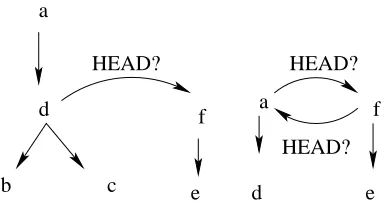
To exemplify our approach, (1) shows a partially build graph and all the words encountered so far and Fig. 1 shows two examples of the tree-building op-erations for linking wordsf andd, andf anda.
(1) a b c d e f . . .
Given two words i and j to be linked with a dependency relation, such that word j precedes word i, the following features describe the models on which the algorithms have been trained and tested:
Word form:i,j,ds(i),ds(j),h(j/i),h(h(j/i))
HEAD? a
d
b c
f
e
HEAD? HEAD?
a
d
f
[image:3.612.311.545.60.354.2]e
Figure 1: Application of the HEAD? function on an input from theP Gin (1)
Part-of-Speech:i,j,ds(i),ds(j),h(j/i),h(h(j/i))
Dependency type: i, j, ds(i), ds(j), h(j/i), h(h(j/i))
Features (if available): i, j, ds(i), ds(j), h(j/i), h(h(j/i))
ds(i) means any two daughters (if available) of word i, h(i/j) refers to the head of word i or word j, depending on the direction of applying the HEAD? function (see Fig 1) and h(h(i/j))stands for the head of the head of wordior wordj.
The basic model, which was used for the largest training data sets of Czech and Chinese, includes only the first four features in every category. A larger model used for the datasets of Catalan and Hungarian adds theh(j/i)feature from every cate-gory. The enhanced model used for Arabic, Basque, English, Greek, Italian and Turkish uses the full set of features. This tripartite division of models was motivated only by time- and resource-constraints. The simplest model is for Chinese and uses only 5 features while the enhanced model for Arabic for ex-ample uses a total of 39 features.
5 Results and Setup
Table 1 summarizes the results of testing the three algorithms on the ten different languages.
The parser was written in C#. Training and testing were performed on a MacOSX 10.4.9 with 2GHz Intel Core2Duo processor and 1GB mem-ory, and a Dell Dimension with 2.80GHz Pentium 4 processor and 1GB memory running Mepis Linux. TiMBL was run in client-server mode with default settings (IB1 learning algorithm, extrapolation from the most similar example, i.e. k = 1, initiated with the command “Timbl -S <portnumber> -f
ESHU ESDU LSU
Arabic LA: 53.72 LA: 54.00 LA: 53.86 UA: 63.58 UA: 63.76 UA: 63.78 Basque LA: 49.52 LA: 50.20 LA: 51.24 UA: 56.83 UA: 57.81 UA: 58.53 Catalan LA: 69.56 LA: 69.80 LA: 69.42 UA: 74.32 UA: 74.46 UA: 74.22 Chinese LA: 47.57 LA: 50.61 LA: 49.82 UA: 53.46 UA: 56.75 UA: 56.02 Czech LA: 44.41 LA: 53.66 LA: 53.47 UA: 49.20 UA: 60.01 UA: 59.55 English LA: 51.05 LA: 51.35 LA: 52.11 UA: 53.41 UA: 53.65 UA: 54.33 Greek LA: 54.68 LA: 54.62 LA: 55.02 UA: 61.55 UA: 61.45 UA: 61.80 Hungarian LA: 44.34 LA: 45.11 LA: 44.57 UA: 50.12 UA: 50.78 UA: 50.46 Italian LA: 61.60 LA: 60.95 LA: 61.52 UA: 67.01 UA: 66.25 UA: 66.39 Turkish LA: 55.57 LA: 57.01 LA: 56.59 UA: 62.13 UA: 63.77 UA: 63.17
Table 1: Test results for the 10 languages. LA is the Labelled Attachment Score and UA is the Unla-belled Attachment Score
<training file>”). Additionally, we attempted to use Support Vector Machines (SVM) as an alter-native classifier. However, due to the long training time, results from using SVM were not included but training an SVM classifier for some of the languages has started.
6 Discussion
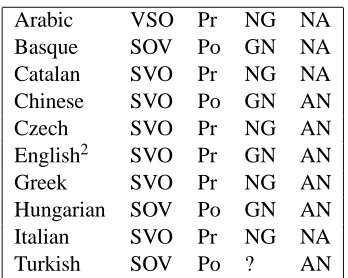
Before we attempt a discussion on the results pre-sented in Table 1, we give a short summary of the ba-sic word order typology of these languages accord-ing to (Greenberg, 1963). Table 2 shows whether the languages are SVO (subject-verb-object) or SOV (subject-object-verb), or VSO (verb-subject-object); contain Pr (prepositions) or Po (postpositions); NG (noun precedes genitive) or GN (genitive precedes noun); AN (adjective precedes noun) or NA (noun precedes adjective).
2
[image:3.612.90.285.61.165.2]Arabic VSO Pr NG NA
Basque SOV Po GN NA
Catalan SVO Pr NG NA
Chinese SVO Po GN AN
Czech SVO Pr NG AN
English2 SVO Pr GN AN
Greek SVO Pr NG AN
Hungarian SOV Po GN AN
Italian SVO Pr NG NA
[image:4.612.99.273.60.199.2]Turkish SOV Po ? AN
Table 2: Basic word order typology of the ten lan-guages following Greenberg’s Universals
Looking at the data in Table 1, several obser-vations can be made. One is the different perfor-mance of languages from the same language fam-ily, i.e. Italian, Greek and Catalan. However, the head-first (ESHU) algorithm presented better than the dependents-first (ESDU) one in all of these lan-guages. The SOV languages like Hungarian, Basque and Turkish had preference for the dependent’s first algorithms (ESDU and LSU). The ESDU algorithm also fared better with the SVO languages, except for Italian.
However, the Greenberg’s basic word order ty-pology cannot shed enough light into the perfor-mance of the three parsing algorithms. One ques-tion that pops up immediately is whether a differ-ent feature-model using the same parsing algorithms would achieve similar results. Can the different performance be attributed to the treebank annota-tion? Would another classifier fare better than the Memory-based one? These questions remain for fu-ture research though.
Finally, for the Basque data we attempted to test the optimized version of the Covington algo-rithm (Nivre, 2007) against the three other ver-sions discussed here. Additionally, since our fea-ture vectors differed from those described in (Nivre, 2007), head-dependent-features vs. j-i-features, we changed them so that all the four algorithms send a similar feature vector,j-i-features, to the classifier. The preliminary result was that Nivre’s version was the fastest, with fewer calls to the LINK procedure and with the smallest training data-set. However, all the four algorithms showed about 20% decrease in
LA/UA scores.
Our first intuition about the results from the tests done on all the 10 languages was that the classifi-cation task suffered from a highly skewed class dis-tribution since the training instances that correspond to a dependency relation are largely outnumbered by the “NO” class (Canisius et al., 2006). The recall was low and we expected the classifier to be able to predict more of the required links. However, the re-sults we got from additional optimizations we per-formed on Hungarian, following recommendation from the anonymous reviewers, may lead to a differ-ent conclusion. The chosen grammar model, relying only on connecting dynamically built partial depen-dency graphs, is insufficient to take us over a certain threshold.
7 Conclusion
In this paper we showed the performance of three flavours of Covington’s algorithm for non-projective dependency parsing on the ten languages provided for the CoNLL-X Shared Task (Nivre et al., 2007). The experiment showed that given the grammar model we have adopted it does matter which version of the algorithm one uses. The chosen model, however, showed a poor performance and suffered from two major flaws - the use of only partially built graphs and the pure incremental processing. It remains to be seen how these parsing algorithms will perform in a parser, with a much richer feature model and whether it is worth using different flavours when parsing different languages or the differences among them are insignificant.
Acknowledgements
References
A. Abeill´e, editor. 2003. Treebanks: Building and Using Parsed Corpora. Kluwer.
I. Aduriz, M. J. Aranzabe, J. M. Arriola, A. Atutxa, A. Diaz de Ilarraza, A. Garmendia, and M. Oronoz. 2003. Construction of a Basque dependency treebank. In Proc. of the 2nd Workshop on Treebanks and Lin-guistic Theories (TLT), pages 201–204.
Ezra Black, Frederick Jelinek, John D. Lafferty, David M. Magerman, Robert L. Mercer, and Salim Roukos. 1993. Towards history-based grammars: Using richer models for probabilistic parsing. In Meeting of the As-sociation for Computational Linguistics, pages 31–37.
R. Bod, R. Scha, and K. Sima’an, editors. 2003. Data Oriented Parsing. CSLI Publications, Stanford Uni-versity, Stanford, CA, USA.
A. B¨ohmov´a, J. Hajiˇc, E. Hajiˇcov´a, and B. Hladk´a. 2003. The PDT: a 3-level annotation scenario. In Abeill´e (Abeill´e, 2003), chapter 7, pages 103–127.
Sander Canisius, Toine Bogers, Antal van den Bosch, Jeroen Geertzen, and Erik Tjong Kim Sang. 2006. Dependency Parsing by Inference over High-recall Dependency Predictions. In CoNLL-X Shared Task on Multitlingual Dependency Parsing.
K. Chen, C. Luo, M. Chang, F. Chen, C. Chen, C. Huang, and Z. Gao. 2003. Sinica treebank: Design criteria, representational issues and implementation. In Abeill´e (Abeill´e, 2003), chapter 13, pages 231–248.
Michael A. Covington. 2001. A Fundamental Algo-rithm for Dependency Parsing. In Proceedings of the 39th Annual ACM Southeast Conference, pages 95– 102, Athens, Georgia, USA.
D. Csendes, J. Csirik, T. Gyim´othy, and A. Kocsor. 2005. The Szeged Treebank. Springer.
Walter Daelemans, Jakub Zavrel, Ko van der Sloot, and Antal van den Bosch. 2004. Timbl: Tilburg memory based learner, version 5.1, reference guide. Techni-cal report, ILK TechniTechni-cal Report 04-02, available from http://ilk.uvt.nl/downloads/pub/papers/ilk0402.pdf.
Joseph H. Greenberg. 1963. Universals of Language. London: MIT Press.
J. Hajiˇc, O. Smrˇz, P. Zem´anek, J. ˇSnaidauf, and E. Beˇska. 2004. Prague Arabic dependency treebank: Develop-ment in data and tools. In Proc. of the NEMLAR In-tern. Conf. on Arabic Language Resources and Tools, pages 110–117.
R. Johansson and P. Nugues. 2007. Extended constituent-to-dependency conversion for English. In Proc. of the 16th Nordic Conference on Computational Linguistics (NODALIDA).
M. Marcus, B. Santorini, and M. Marcinkiewicz. 1993. Building a large annotated corpus of English: the Penn Treebank. Computational Linguistics, 19(2):313–330.
M. A. Mart´ı, M. Taul´e, L. M`arquez, and M. Bertran. 2007. CESS-ECE: A multilingual and multilevel annotated corpus. Available for download from: http://www.lsi.upc.edu/∼mbertran/cess-ece/.
S. Montemagni, F. Barsotti, M. Battista, N. Calzolari, O. Corazzari, A. Lenci, A. Zampolli, F. Fanciulli, M. Massetani, R. Raffaelli, R. Basili, M. T. Pazienza, D. Saracino, F. Zanzotto, N. Nana, F. Pianesi, and R. Delmonte. 2003. Building the Italian Syntactic-Semantic Treebank. In Abeill´e (Abeill´e, 2003), chap-ter 11, pages 189–210.
J. Nivre, J. Hall, S. K¨ubler, R. McDonald, J. Nils-son, S. Riedel, and D. Yuret. 2007. The CoNLL 2007 shared task on dependency parsing. In Proc. of the CoNLL 2007 Shared Task. Joint Conf. on Em-pirical Methods in Natural Language Processing and Computational Natural Language Learning (EMNLP-CoNLL).
Joakim Nivre. 2004. Incrementality in Deterministic Dependency Parsing. In Incremental Parsing: Bring-ing EngineerBring-ing and Cognition Together, Workshop at ACL-2004, pages 50–57, Barcelona, Spain, July, 25.
Joakim Nivre. 2006. Inductive Dependency Parsing. Springer.
Joakim Nivre. 2007. Incremental Non-Projective Depen-dency Parsing. In Proceedings of NAACL-HLT 2007, Rochester, NY, USA, April 22–27.
K. Oflazer, B. Say, D. Zeynep Hakkani-T¨ur, and G. T¨ur. 2003. Building a Turkish treebank. In Abeill´e (Abeill´e, 2003), chapter 15, pages 261–277.