Modeling and Performance Analysis of Current
Source Inverter Fed Induction Motor Drive
P. Satish Kumar and K. Satyanarayana
Abstract: A dynamic model for current controlled induction motor drive is developed, and a time response approach for analyzing transient behavior is formulated by means of d-q variables in the synchronously rotating reference frame. A well damped closed loop response is possible if slip frequency and current magnitude control are imposed by proper tuning of control elements of PI controller.
Key words: Induction motor modeling, closed loop CSI, tuning of PI controller.
I. NOMENCLATURE
In general, subscripts have the following meaning
O Steady state quantity as in Idro1e, d or q equivalent 2-phase transformed variable as in idse ,
b base quantity as in
ω
b e electrical quantity as inω
eF smoothing choke parameter as in RF1 I inverter quantity as in V1,
M mutual value as in xm
l leakage quantity,
r rotor quantity as in xr, R rectifier quantity as in VR s stator quantity as in xs, sl slip quantity as in
ω
sl.Superscripts have the following meaning * command value as in
ω
r*
,, rotor quantity referred to the stator or as noted in text,
e quantities in synchronously rotating reference frame
Manuscript received December 14,2007. This work was supported in part by the Department of Electrical Engineering, University college of Engineering (A), Osmania University. A.P.INDIA under Grant TEQIP.
P. Satish Kumar is with the Department of Electrical Engineering, University College of Engineering (A), Osmania University A.P. INDIA-500 007, ( phone:+9140-27098628; fax: +9140-27682382; e-mail:
K. Satyanarayana is with the Department of Electrical and Electronics Engineering, Pragati Engineering College, A.P. INDIA (e-mail:
Variables have the following meaning
Δ perturbation variable,
T voltage regulator zero location,
ω angular velocity,
V dc voltage,
J system inertia,
Ksp speed regulator gain, Ksl slip channel gain,
KC compensator gain,
p differential operator d/dt
P machine poles,
Q output of integral controller.
II. INTRODUCTION
A v/f controlled induction motor drive can exhibit self-sustained oscillations about a steady-state point[1]. These oscillations are actual instantaneous rotor speed changed caused by variations in out torque, motor current and input power. This paper presents an analytical design technique for finding the better performance by tuning the PI controller. The CSI is a very rugged supply capable of recovery from short circuits or commutation faults. It offers inherent over current protection when current feedback is used. It is a simple circuit when current feedback is used. It is a simple circuit which does not require fast turnoff thyristors. The CSI is capable of full regeneration with 12 SCR’s and 6 diodes. While it produces a square wave current supply, the motor voltage and hence flux is quasi sinusoidal. These numerous advantages have results in increasing use of the CSI for motor drives[2].
III. D-Q MODEL FOR CSI FED I.M. DRIVE
When supplied from a current-controlled inverter the motor phase currents are not sinusoidal but are rectangular
in nature and flow for only 1200 of each
half-cycle(neglecting commutation effects). If IR is the magnitude of the current in the dc link, these stepped currents exciting the three stator phases can be represented by the Fourier series expansion given by
⎥⎦ ⎤ ⎢⎣
⎡ ω − ω + ω − ω +
π
= cos11et ...
11 1 t e 7 cos 7 1 t e 5 cos 5 1 t e cos R I 3 2 as
i …. (1)
⎥⎦ ⎤ ⎢⎣
⎡ ω − π− ω + π+ ω − π
π
= )...
3 2 t e 7 cos( 7 1 ) 3 2 t e 5 cos( 5 1 ) 3 2 t e cos( R I 3 2 bs
⎥⎦ ⎤ ⎢⎣
⎡ ω + π− ω − π+ ω + π
π = )... 3 2 t e 7 cos( 7 1 ) 3 2 t e 5 cos( 5 1 ) 3 2 t e cos( R I 3 2 as
i …(3)
Fig (1)
When performing stability or transfer function analyses, it is convenient to view the system in a reference frame that rotates around the air gap in synchronism with the stator MMF at a speed corresponding to stator excitation frequency, Machine voltage, flux, and current variables become constant quantities during steady-state operation, These system equations represented in the synchronous rotating frame can thus be readily linear zed around a particular steady-state operating point. Using the notation of Krause and Thomas [4]
⎥ ⎥ ⎥ ⎥ ⎥ ⎥ ⎥ ⎥ ⎦ ⎤ ⎢ ⎢ ⎢ ⎢ ⎢ ⎢ ⎢ ⎢ ⎣ ⎡ ⎥ ⎥ ⎥ ⎥ ⎥ ⎥ ⎥ ⎥ ⎥ ⎥ ⎦ ⎤ ⎢ ⎢ ⎢ ⎢ ⎢ ⎢ ⎢ ⎢ ⎢ ⎢ ⎣ ⎡ + − − + − + − + = ⎥ ⎥ ⎥ ⎥ ⎥ ⎥ ⎦ ⎤ ⎢ ⎢ ⎢ ⎢ ⎢ ⎢ ⎣ ⎡ e dr i e qr i e ds i e qs i r b p r r r b sl m b p m b sl r b sl r b p r r m b sl m b p m x b p m b e s b p s r s b e m b e m b p s b e s b p s r e ds e qs 1 1 1 1 1 1 1 1 0 0 χ ω χ ω ω χ ω χ ω ω χ ω ω χ ω χ ω ω χ ω ω χ ω ω χ ω χ ω ω χ ω ω χ ω χ ω ω χ ω ν
ν … (4)
In these equations, the superscript e is employed to denote that the d-q-axes are synchronously rotating. A p denotes the operator d/dt. All reactance values are referred to base frequency such that the operator p/ωb always appears. Although six equations are generally required to completely define the machine response, the two zero-sequence equations have been omitted since the sum of stator as well as rotor currents are zero. Also, in (4), ωb is the base electrical angular velocity used to obtain the per unit machine parameters, ωr is the equivalent electrical angular velocity of the rotor and ωsl = ωe – ωr is the slip angular frequency. The parameters rs and rr are stator, and referred rotor resistance referred to the stator. The quantities xsl xm and xr1 are the stator self, mutual, and rotor self-reactance referred to the stator, respectively.
Using (1)=(3) and applying the proper equations of transformation [4], the corresponding q-and d-axis currents in the synchronously rotating reference frame are
...) 12 cos 143 24 6 cos 35 2 1 ( 3
2 − − −
= I t t
i e R e e
as π ω ω
……. (5) ...) 12 sin 143 24 6 sin 35 12 1 ( 3
2 − − −
= I t t
idse π R ωe ωe
……. (6)
Fig (2)
In (5) and (6) the q and the as-axes are assumed aligned at time t=0. For convenience, these currents can be expressed as
e qs R e
qs I g
i = 1 …………. (7)
,
1 e
qs R e ds I g
i = ………… (8)
Where gqse and gdse are the switching or g functions defined as ) 9 ...( 12 cos 143 2 6 cos 35 2
1− − −
= t t
g e e e
qs ω ω
... t 12 sin 143 12 t 6 sin 35 12
g e e e
ds = − ω − ω −
…….(10) A nd , I 3 2
I 1 R
R = π
….(11)
It is important to note that (7) and (8) are valid even if IR is not constant
Assuming no power loss in the inverter, the power into and out of the inverter is identical, so that
) (
2 3 R
1 dse
e ds e qs e
qs i i
i
v = υ +υ …………..(12)
The inverter voltage can be obtained by combining (7), (8), and (12) as
) g g ( 3 3 V e ds e ds e qs e qs
1 = π υ + υ …….(13)
Or simply , g g v e ds e ds e qs e qs
1 = υ + υ ………(14)
Where I 1 1 V 3 3
V = π ……(15)
normalized quantities as.
R 1
F b 1 F 1 1 1
R X )I
p R ( V V
ω + +
= ……….(16)
Where it has been convenient to define new normalized link parameters
F 2 1
F R
18
R = π ………(17)
F 2 1
F X
18
X = π ……….(18)
R 1
R V
3 3
V = π ……….(19)
Equations (4), (7),(8),(14), and (16) form the basic system equations in the synchronously rotating reference frame and can be used to form the system equivalent circuit and subsequently it is assumed that the time derivative operator is (p/ωb).
Although the actual system operates with rectangular-wave excitation from a high equivalent impedance source, it is well-known that machine stability is determined primarily by the fundamental components of machine variables. If the effects of harmonics are ignored, the g functions become simply.
0 . 1 g e
qs ≅ …….(20)
, 0 g e
ds ≅ ………(21)
Whereby, from (7) and (8)
1 R e qs
i
i
=
……….(22)1 . 0 e ds
i
=
………(23)Because of the normalization employed, the current in the stator q-axis, IR1, corresponds to the peak value of the fundamental component of motor phase current. The d-axis stator current is identically zero during both steady-state and transient conditions due to the positioning of the synchronously rotating reference frame axes. From (14), orientation of the d-q axes also results in the identity that
, V
v 1
1 e
qs = ………(24)
With assuming the open-circuit value resulting from mutual coupling.
e ds
v
Neglecting harmonics, the detailed equivalent circuit Equations (7) and (8) can be combined with the equations of the induction machine in the synchronously rotating reference frame to yield the corresponding system equations, (22) and (23). Note that the ds equation in(23) has been omitted since
i
dseis identically zero.⎥ ⎥ ⎥ ⎥ ⎥
⎦ ⎤
⎢ ⎢ ⎢ ⎢ ⎢
⎣ ⎡
×
⎥ ⎥ ⎥ ⎥ ⎥ ⎥ ⎥ ⎥
⎦ ⎤
⎢ ⎢ ⎢ ⎢ ⎢ ⎢ ⎢ ⎢
⎣ ⎡
+ −
− +
+ + +
= ⎥ ⎥ ⎥
⎦ ⎤
⎢ ⎢ ⎢
⎣ ⎡
e dr
e qr
e qs
r b r r b sl m b sl
r b sl r b r m b
m b e m b F s b F s
R
i i i
x p r x x
x x p r x p
x x p X x p R r V
1 1
1 1 1
1 1 1
1 1
1
) (
0 0
ω ω
ω ω ω
ω ω ω ω
ω ω ω ω
) 25 ...( ... 2
4
3 1
r L
e dr e qs m b
e p
P J T i i x P
T ω
ω = +
=
IV CLOSED-LOOP CONTROL
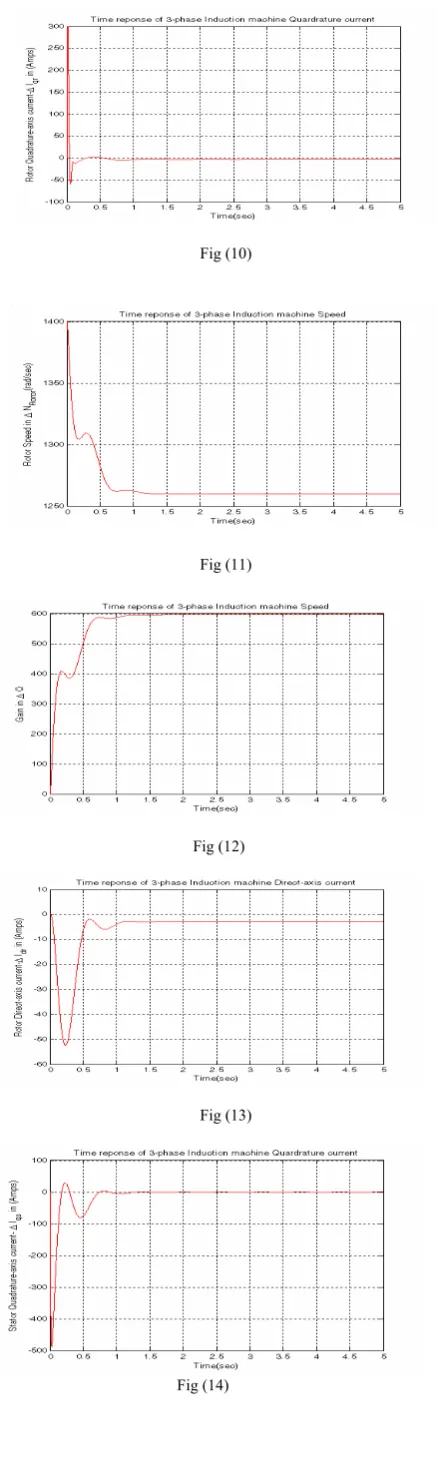
These system inputs are the rectifier voltage and the frequency command to the inverter. An elementary closed-loop control which results in stable operation for full motoring and regenerative operation is the independent current magnitude and slip frequency control shown in Fig.6.
With slip frequency control, incremental changes in rotor speed are related to incremental changes in electrical frequency by the constraint.
sl r
e
=
Δ
ω
+
Δ
ω
ω
Δ
….. (26)Slip frequency control forces electrical frequency to change in response to rotor speed, which tends to maintain a constant angular displacement between rotor and stator MMF’s during both steady-state and transient conditions. Although this type of control has a stabilizing effect, it is not capable of ensuring stable operation under all operating conditions. To obtain steady-state current control along with improved system transient response, the rectifier voltage must be constrained to respond to the error between a commanded value and the actual value of the dc link current. An integral plus proportional controller is used to give a satisfactory speed of response with zero steady-state error.
p ) p 1 ( K ) I * I (
V C
1 R 1
R 1
R = + τ
Δ − Δ
Δ ……….. (27)
To include the compensator in the analysis, a fifth state variable must be defined. ΔQ is defined to be the output of the integral controller, that is
) I * I ( p K
Q 1
R 1
R
C Δ −Δ
=
Δ ……….. (28)
The rectifier voltage can then be expressed as )
p 1 ( Q V1
R = Δ + τ
Δ ……….. (29)
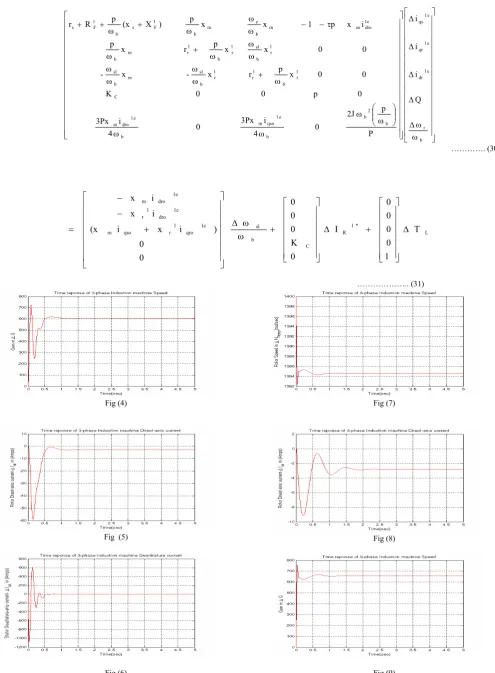
⎥ ⎥ ⎥ ⎥ ⎥ ⎥ ⎥ ⎥ ⎥ ⎥ ⎥ ⎥ ⎥ ⎥ ⎥ ⎦ ⎤ ⎢ ⎢ ⎢ ⎢ ⎢ ⎢ ⎢ ⎢ ⎢ ⎢ ⎢ ⎢ ⎢ ⎢ ⎢ ⎣ ⎡ ω ω Δ Δ Δ Δ Δ ⎥ ⎥ ⎥ ⎥ ⎥ ⎥ ⎥ ⎥ ⎥ ⎥ ⎥ ⎥ ⎥ ⎥ ⎥ ⎦ ⎤ ⎢ ⎢ ⎢ ⎢ ⎢ ⎢ ⎢ ⎢ ⎢ ⎢ ⎢ ⎢ ⎢ ⎢ ⎢ ⎣ ⎡ ⎟⎟ ⎠ ⎞ ⎜⎜ ⎝ ⎛ ω ω ω ω ω + ω ω ω ω ω ω ω + ω − − + + + b r e 1 dr e 1 qr e 1 qs b 2 b b e 1 qso m b e 1 dro m C 1 r b 1 r 1 r b sl m b sl 1 r b sl 1 r b 1 r m b 1e dro m m b e m b 1 F s b 1 F s Q i i i P p 2J 0 4 i 3Px 0 4 i 3Px 0 p 0 0 K 0 0 x p r x x 0 0 x x p r x p i x τp 1 x ω ω x ω p ) X (x ω p R r …………. (30) L * 1 R C b sl 1e qro 1 r qso m 1e dro 1 r 1e dro m T 1 0 0 0 0 I 0 K 0 0 0 0 0 ) i x i (x i x i x Δ ⎥ ⎥ ⎥ ⎥ ⎥ ⎥ ⎦ ⎤ ⎢ ⎢ ⎢ ⎢ ⎢ ⎢ ⎣ ⎡ + Δ ⎥ ⎥ ⎥ ⎥ ⎥ ⎥ ⎦ ⎤ ⎢ ⎢ ⎢ ⎢ ⎢ ⎢ ⎣ ⎡ + ω ω Δ ⎥ ⎥ ⎥ ⎥ ⎥ ⎥ ⎥ ⎦ ⎤ ⎢ ⎢ ⎢ ⎢ ⎢ ⎢ ⎢ ⎣ ⎡ + − − = ……….. (31)
Fig (4) Fig (7)
Fig (5) Fig (8)
[image:4.595.47.543.89.763.2]
Fig (10)
Fig (11)
Fig (12)
Fig (13)
Fig (14)
V .TUNING OF CONTROLLER
Tuning methods are used to determine appropriate values of controller parameters. Since during the induction motor installing and commissioning do not have a ling time to tune the systems. Consequently, a number of systems use the default parameters may not be appropriate. Induction motor systems are non-linear and time varying. Thus, fixed-gain controllers may be properly tuned some of the time even if they were properly tuned when they were installed. Control loops in induction motor systems may require retuning during the year for the processes that have non-linear characteristics that are dependent upon the load. If a feedback control loop is not retuned, the control response may be poor. (The closed loop response for the controlled variable is oscillatory).
APPENDIX
Nameplate motor data Motor and filter parameters
18.6kW rS = 0.0788Ω
4-pole rr = 0.0408Ω
3-phase Y-connected xs= 5.7518Ω
b
ω
= 377 rad/sec xr = 6.0028ΩJTOTAL= 0.31 Kg-m2 xm = 5.54Ω Vrated = 230 V rms XF = 5.50Ω I rated = 64 A rms RF = 0.091Ω
REFERENCES
[1]. T.A. Lipo and P.C. Krause, ‘Stability analysis of rectifier inverter induction motor drive”, IEEE Trans. On power apparatus and systems. Vol.PAS-87, No.1, January 1968, pp. 227-234.
[2]. E. Ward, “Invertor suitable for operation over arrange of frequency”, Proceedings of IEE, Vol. III, no 8, August 1964 pp 1423-1434.
[3]. Linos J. Jacovides,”Analysis of Induction Motor Drives with a Non-Sinusoidal Supply Voltage Using Fourier analysis”,IEEE Trans. Ind. Appl., vol. 1A-9, pp. 741-747, Nov/Dec. 1973.
[4]. T.A. Lipo and A.B. Plunkett,”A Novel Approach to Induction Motor Transfer Functions”, IEEE Trans. Ind. Appl., pp. 1410-1418, March 18, 1974.
[5]. T.A. Lipo and E.P. Cornell, “State-Variable Steady-State Analysis of a Controlled Current Induction Motor Drive”, IEEE Trans. Ind. Appl., Vol.1A-11, pp. 704-712, Nov./Dec. 1975.
[6]. Edward P. Cornell and T.A. Lipo “Modelling and Design of Controlled Curremt Induction Motor Drive Systems”, IEEE Trans. Ind. Appl.,Vol. 1A-13, pp.321-330, July/ Aug.1977.
[7]. Duo Deng and Thomas A.Lipo “ A Modified Control Method for Fast-Response Current Source Inverter Drives”, IEEE Trans.Ind.Appl. vol. I A-22, No.4, July/Aug .1986.
[image:5.595.50.269.67.797.2][9]. Yuexin Yin and Alex Y. Wu, “ A Low- Harmonic Electric Drive System Based on Current-Source Inverter”, IEEE Tran.Ind.Appl, vol .34, No. 1 , Jan/Feb 1998.
Engineering (Autonomous), Osmania University, Hyderabad,INDIA He is presently pursuing Doctoral degree from J.N.T.U, Hyderabad. His research interests include Power Electronics Drives and Multilevel
P. Satish Kumar was born in
Karimnagar, Andhra Pradesh, INDIA in 1974. He obtained the B.Tech degree in electrical engineering from JNTU College of Engineering, Kakinada, A.P., INDIA in 1996 and the M.Tech degree in power electronics from JNTU College of engineering, Hyderabad in 2003. He worked in various Private Engineering Colleges in Andhra Pradesh for more than eleven years as Associate Professor in the Department of Electrical and Electronics Engineering. Presently he is Assistant Professor in the
Department of Electrical Engineering, University College of inverters.
K. Satyanarayana (M’06) was born in Kakinada, India in 1972. He