Abstract—In this paper, we propose the use of dynamic compilation of web services to support workflow management. Web services related to work practices belong to an organization will be designed, built and stored in a web services repository. These web services can be shared with multiple functional units within the organization via the intranet or the internet. Work practice services that were selected will be compiled logically and optimally using the proposed dynamic compilation platform. The final outcome will be presented as a web application. The web application can be compiled and recompiled as often as needed whenever changes to the requirements occurr. This dynamic platform for workflow management (DPWFM) has integrated the decision making process of workflow management with information technologies to provide facilities to each functional units of an organization to customize the workflow requirements that will suit their needs.
Index Terms—Workflow Management System, Web Services, Work Practices.
I. INTRODUCTION
With manufacturing and automation technologies introduced in the early part of last century, we have witnessed progress of modern manufacturing facilities that can mass-produce and deliver products to mass audiences in an unprecedented manner and speed. Although this progress can be attributed to the development of telecommunication and advanced intelligent information technologies, developing an optimal working environment and managing the required amount of work in an efficient manner are still the major challenge for most businesses today. This is due largely to the unstructured and unpredictable nature of demand and supply, which exists in most businesses [3]. Workflow Management (WFM) [7] or Business Process Management (BPM) [16] exists as a problem ever since the industrial revolution. Managing the amount of work flowing through the work force and allowing people to work in an optimal environment to producing maximum output is the focus of most successful businesses today [13].
Recently, organizations have been using expensive tools or sophisticated software to organize workflows. Most of these tools are difficult to use and often can not meet the specific requirements of a specific organization [3]. In addition, it is generally very difficult to modify
Manuscript received December 8, 2008.
N. Prinyapol is with the Faculty of Informatics, University of Wollongong, NSW Australia 2500 (e-mail: [email protected])
J. Fan is with the Graduate School of Business, University of Wollongong, NSW Australia 2500 (e-mail: [email protected])
S. K. Lau is with the Faculty of Informatics, University of Wollongong, NSW Australia 2500 (e-mail: [email protected]).
decision-making rules and procedures in these software packages, and the cost of maintenance is also very high [14]. In this paper, we propose the use of a dynamic compilation of web services to support workflow management (DPWFM). In our DPWFM design, web services related to work practices of an organization are designed, built and stored in a web services repository [2], using current industry standard tools and techniques such as IBM’s SNOBASE [1], Java 2 Platform, Enterprise Edition (J2EE) for developing Model Driven Architecture (MDA) [18], Business Process Execution Language (BPEL) [12][15]. Furthermore, these web services can be shared with multiple functional units within the organization via the intranet or the Internet. Information related to each work practice service will be published from the server that houses the web services repository and users are able to select the work practice services required via a custom built web interface. Selected work practice services are compiled logically and optimally using the proposed dynamic compilation platform. The final outcome is presented as a web application, which can be compiled and recompiled as often as needed or whenever work practice requirements change. Confidentiality and security can be designed and incorporated into the final web application.
We have chosen to demonstrate the advantages of DPWFM in the domain of healthcare, as it is one of the most demanding and yet critical business process. The importance of good workflow management in the healthcare sector has prompted the Australian healthcare sector to look for better developed information systems [9]. According to CRN Australia [11], the South Australian Government has committed to spend $17 million in helping to improve information systems and business process management for the healthcare sector.
In the next section, section II, we present the background of business activities. Sections III and IV describe the hospital scenario, and following with, the proposed conceptual model of our platform respectively. Finally, in section V, a development environment has been addressed, and section VI described an application scenario.
II. BUSINESS BACKGROUND
A business process is a series of business activities describing how organizations produce and deliver special services to particular users, customers, or markets [10]. Management, operations and supporting processes are three major logical components that serve to plan and control workflows of business activities in an organization, as well as supporting different workflows that work together.
WFM is the way to manage flow of activities or events,
A Dynamic Platform for Workflow Management
using Web Services: a Hospital Scenario
pass to appropriate partners to produce the required products or services. It is an effective way of decreasing risks of costly amendments, time delays, insufficient resources and human errors. However, traditional WFM concepts are difficult to implement without the assistance of information technologies [5]. Hence, ‘WFM system’ is a system that defines, creates and controls a workflow by running it through a workflow engine. It consists of a process design, a system configuration and a process enactment [8].
Better workflow customization can facilitate easy documentation of reiterated work processes, and at the same time reduce work redundancy and stress levels of nursing staff in the healthcare sector. Reiner et al [13] show that using workflow optimization in a radiology department can reduce time-consuming steps and reduce workloads. As shown in their results, productivity has increased and error rates have also reduced.
However, not all organizations have reached optimal control of their workflow with high satisfaction. For example, in recent times, many organizations have relied on expensive tools or sophisticated software to organize business flows. Although, these expensive tools or software work quite well, the users had also resisted adding computer technologies to their familiar tasks, as they feel it adds complication to their current work processes.
III. HOSPITAL SCENARIO
Different hospitals have different patient care procedures for their workflow processes. Generally, the majority of information flow and the communication media in each ward of hospitals are quite the same; although there may exist slight differences depending on the work procedures involved and the organization culture.
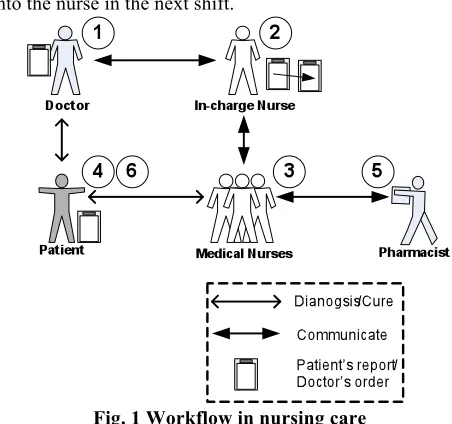
Nursing care usually involved face-to-face and paper-based communication. Fig. 1 shows a sample step-by-step workflow of nursing care in a ward. First, when a doctor diagnoses a patient as shown Fig. 1(1), he writes his orders by hand on the paper worksheet (called “chart”) that is clipped on an aluminum clipboard, which is placed at each patient’s bedside. His orders are included with his diagnosis, the drugs required, and how to treat the patient. The doctor then passes the orders to an in-charge nurse (or a nurse supervisor). After that, the in-charge nurse organizes the nursing care schedule according to the doctor’s orders, and may distributes and re-writes the original orders into separate tasks/functions, to be allocated to individual medical nurses (on nurse charts) as shown in Fig. 1(2).
The in-charge nurse has the responsibility to manage the schedule for nursing care of each patient in accordance to doctor orders. They are also required to liaise between nursing staff (medical nurses) and a nursing management (an in-charge nurse) in different shifts, and to create spirit of collaboration between them. In-charge nurses also assign tasks/functions to each medical nurse in her ward as shown in Fig. 1(3). Once medical nurses receive the orders from the in-charge nurse, they take care of their respective patients as shown in Fig. 1(4). Medical nurses will record all vital signs such as weigh, blood pressure, respiration rate, body temperature and write them by hand into the patient’s report, which is attached with the same chart as the doctor’s orders. Subsequently, that patient’s report will be passed
[image:2.595.312.538.55.267.2]onto the nurse in the next shift.
Fig. 1 Workflow in nursing care
During each nurse shift, pharmacists have to dispense drugs to the medical nurses for each patient according to the in-charge order chart (Fig. 1(5)), which is hand-written by the nurses. Finally, medical nurses provide medicines for each patient in the frequency rearranged by the in-charge nurse (Fig. 1(6)).
Once a day-shift is finished, afternoon-shift nurses come to care for the patients in the ward. Information about the patients from day-shift nurses is transferred to the nurse in the afternoon-shift via the nursing office. The workflow will be repeated once again in the night-shift, which will then hand over the patients’ reports to the next day-shift nurses. This process is repeated every day.
The communication in the nursing care workflow generally uses paper-based media: doctor passes orders to in-charge nurse, in-charge nurse organizes tasks for each medical nurse, medical nurses obtain drugs from the pharmacists; all transactions involve papers. Reading hand-written notes correctly is often important for accuracy to ensure the communication. Therefore, inaccurate interpretation of these texts can lead to missing or incorrect information, and at best cause delays until information is cross checked with the doctor.
This nursing routine needs to be error-free and efficient in order to diagnose and treat patients successfully. In order to do this, communication and information flow between the different actors in a ward need to be reliable, accurate and systematically controlled. This control will need to be applied by a member of the hospital staff or by an automatic executor.
However, the additional requirement for medical staff to work more carefully and precisely is likely to increase the amount of stress and consequently the number of mistakes they make. These mistakes can occur in the transactions between medical nurses within each shift, or in the information flow between the shifts.
IV. PROPOSED CONCEPTUAL MODEL OF DPWFM
To develop the Dynamic Platform for Workflow Management, we propose to use dynamic compilation of web services related to work practices into workflow web applications. In this case, a workflow web application is a compilation of web services selected from a web services repository. All the web services developments will be done using current industry standard tools and techniques such as BPEL [12], MDA [18], Service Oriented Architecture (SOA) and IBM’s SNOBASE [1]. Most of these web services are reusable [4]. The workflow web applications are designed to characterize the business processes or the tasks that the employees need to carry out within an organization. Selecting the web services related to the work specifications of an employee are based on the criteria of the supervisor/manager, job descriptions, process enactments, and the requirements to link to any real-time processes. In section IV(A), we will provide explanation of the services platform and in following section V a development environment.
[image:3.595.53.252.302.455.2]A. Service Platform
Fig. 2 DPWFM architecture
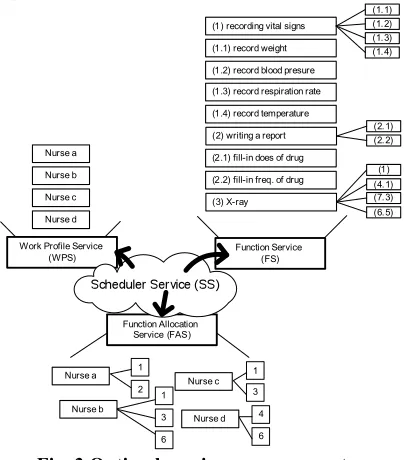
Fig. 2 shows the DPWFM architecture of Function Service (FS) analyzes and manages web services. FS provides web service descriptions and communicates information to Universal Description, Discovery, and Integration (UDDI). FS collects functions and sub-functions which are the collections of tasks for each complete function. For example, the function service ‘writing report’ for patient ‘A’, may consists of four or five sub-tasks such as ‘recording vital signs of the patient’, ‘fill-in dose of drug’, ‘fill-in frequency of drug provided’, or ‘special requirements’. These sub-tasks can be modified to be reuse again in other function services.
The next module, job descriptions of the staffs are stored and described in a Work Profile Service (WPS). It includes career positions, main responsibilities, routine tasks, minor tasks, extra tasks, and ad hoc tasks. Supervisors/managers will determine which FSs are suitable for each employee. Generally, one staff can have more than one job function in a ward, one general nurse is also ‘a medical nurse’. At the same time, she can be assigned as ‘an in-charge nurse’ for a particular shift. WPS can also be used to describe special projects, major and minor responsibilities.
In a Function Allocation Service (FAS), the DPWFM gathers decisions of supervisors (selected web services). Simple user-interface is used to allow supervisors/managers to assign specific tasks to each employee, for example by simply using the checkboxes when selecting their prefer
FSs. FAS handles the electronic scheduling tasks, customise suitable tasks for each staff, and this can reduce confusion in interpretation of the tasks assign to individual staff.
Templates can be designed and used for routine assignments, which provide standard sets of web services and work specifications. Supervisors/managers of each functional unit can take full control in customizing the workflow schedules and the deliverables require for each of their subordinates. In addition, FAS can also allow changes and modifications upon the supervisor requests. This will provide more flexibility and better control in organizing work schedules in the function unit.
The Scheduler Service (SS) will perform as the following steps:
1) SS will first carry out the matching function between FS and FAS with WPS, then
2) SS will cross check information with WPS for assigning a matched FS to a designated employee, after that 3) SS will perform a dynamic compilation of all the
selected web services from FS into a web application which will schedule all the selected business processes in a logical and well scheduled order for the designed employee.
4) During the compilation, SS is capable of calculating the best schedule based on the real-time requirements from FASs.
[image:3.595.331.533.400.630.2]5) SS can also allow tasks/activities be enabled or disabled using either automatic setting or custom setting during compilation
Fig. 3 Optimal services management
these can be work as sub-FS.
These web services were designed to comply with the organization work practices requirements during the design-build-store process. Finally, FAS contains the desire job functions that allocate to every individual medical nurse in the organization. At run-time, nurse supervisors in each ward or department can assign new tasks or modify previous assignments whenever it is necessary. The system will recompile the changes into the best schedule based on working functions required and provide the newly arranged customizes tasks to the staff.
V. DEVELOPMENT ENVIRONMENT
The DPWFM is designed to dynamically compile workflow web applications over the Intranet/Internet. The development is centered on using open source resources. Hence, it can communicate seamlessly with any operating platforms. End users can use difference operating platforms in difference functional departments.
The DPWFM uses standard XML to incorporate web services and to retrieve information intelligently. The retrieval services can interpret XML information from any operating platform
A. Web Services Development
The purpose of developing the DPWFM using web services technology is to provide a standard platform for interoperability among difference software and applications. In addition, web services are best suited to work across multiple platforms/ frameworks [17] that aid to avoid investment costs of changing infrastructure. In order to avoid propriety technologies differences from different vendors, web services development will be using the current industry standard tools and techniques. Most of these tools and techniques are available as open source and can be used freely for development. The major requirements from any organizations are to design business logics that can be implemented in the web services to facilitating business functions.
In general, communication between different platforms requires more resources especially when using complex software applications. Due to limited resources, budgetary constraints, and high investment cost, it is less likely that an existing organization will be able to replace their operating environment easily and frequently. There are also numerous difficulties encountered in transferring information from one platform to another platform without cost. Unusual tasks lead to possible human errors when employees face with some duplicated steps or jobs. In this case, the DPWFM will perform comprehensive database operations by compiling dynamically into workflow web application. Information on the application will be displayed in XML/HTML format. As a result, the DPWFM will facilitate better communication in the whole organization and particularly the communication between management of each functional department and their employees/users.
Using open source development tools to develop our platform will generally reduce the cost of investment. Our dynamic platform is using Apache as the web server, MySQL as the database server, PHP, and AJAX as web design languages. The implementation will try to utilize the
current hardware resource of the organization by incorporating open source information technologies.
B. Features of Dynamic Platform
The DPWFM is a platform that allows the cooperation of human decision making combined with the use of information and communication technologies to dynamically compile optimized workflow solutions. According to Deng [6], business process was divided into dynamic, adaptive and flexible processes depending on the aspects of workflow. The DPWFM has the advantages of adapting web services dynamically and allow human decision to manipulate and customize any levels of details related to business process specifications. It is designed for more flexible and simple to manage, control, monitor and use.
The workflow web application, compiled by the DPWFM, provides the facilities to tailor for individual operating requirements and to allow customization of web user-interface that will cater for different skill levels of employees/users. In addition, it uses different templates to standardize on consistent user interface and work specifications. This will greatly reduce the necessity for excessive training involving each individual employees/users.
Generally, the organizations use drop-in sessions to answer users questions related to the usage of the workflow web applications compiled from the DPWFM. Due to the fact that, every workflow web applications compiled from the DPWFM are either on an intranet or internet, users can access to their applications anywhere and anytime as long as their computers are connected to the internet.
1) User Management
The DPWFM has classified the users into three basic categories based on their usage, security clearance level, and their function tasks in an organization. The first category is the administration staff that initial installs, configures, supports and maintains the DPWFM system. The second category is a supervisor, manager, head of unit/department, and IT support staff of the department. Their responsibilities are to manage the flow of business functions, assign tasks, control information and accessibility of the system for each employee. Finally, the third category is the end-users, who are the majority staff in each unit.
User management policy of the DPWFM is designed to incorporate any security measure to protect private information and assignment of security clearance to any users.
The goals of the DPWFM are to help end-users to work faster with more efficient and make less error as compared to the traditional ad-hoc workflow arrangements.
2) Interface Design
Fig. 4 The interface design of nurse supervisor
Fig. 5 The interface design of nurse staff
Fig. 4 shows a user interface designed for the nurse supervisor. The system will present related function services to the nurse supervisor. After the services were selected, the system will recompile and customize function allocation service to each medical nurse. Fig. 5 is a representation of the user interface for a medical nurse (a). Each medical nurse will receive a slightly different work schedule based on the urgency of the assignment and any additional requirements given by the nurse supervisor.
In term of security measures, each employee will be assigned with a security clearance level whenever the workflow web application is compiled. Supervisors/managers can alter the security clearance level based on the requirements of the final business process web application. The security measures will allow employees to complete their assigned responsibilities and at the same instance will provide necessary protections to the integrity of the overall system. Supervisors/managers can use the DPWFM to monitor the performances of employees by tracking the progress of their workflow assignments. Any information collected in the DPWFM application can be tracked using the update and change data logs and transaction history logs.
The DPWFM has integrated the decision making process of business process management with information technologies to provide facilities to each functional units of an organization to tailor make the workflow requirements that will suit users’ needs. Users are given access, control, and facilities to customize their workflow requirements that will comply with each organization standard and policies.
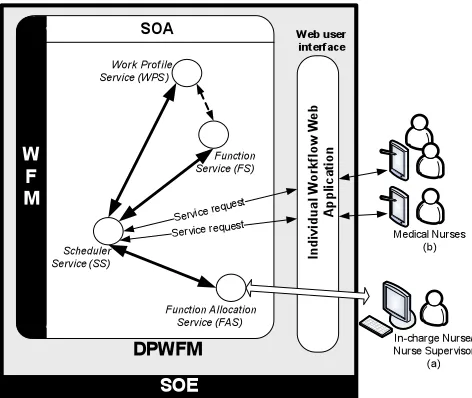
The environment for workflow web application interacting with the users is as shown in Fig. 6. The dynamic compilations are carried out as the back-end operations. For the front-end, employees/users can simply complete their workflow requirements by interacting with their respective the DPWFM web applications.
Fig. 6 An interactive web applications environment for: (a) supervisor and (b) end-users.
As shown in Fig. 6, an in-charge nurse or nurse supervisor (Fig. 6(a)) can assign the workflow requirements based on the web services in FS to their subordinates in FAS. The supervisors or managers can access and modify the assignments at any time. Employees or end-users (e.g. the medical nurses) can access the system with their own username and password (Fig. 6(b)).
The workflow web applications compiled from the DPWFM can provide guidance to users/employees as to what assignments they are given and how they should follow the optimized schedule provided to complete the workflow assignments
VI. ADVANTAGES OF DPWFM
The keys of promoting business processes are to offer efficient and effective services to customers and to reduce the transaction costs. Therefore, employers in an organization are the keys to provide those best services to potential customers. DPWFM workflow optimization can provide a better managed workplace for an organization, improves efficiency in workflow schedules, and reduces human errors from ambiguity.
Consequently, an organization can deliver better productivities to satisfy customer requirements. A well organized and well managed working environment for employee to carry out their responsibilities will return better value to the organization. Employees required sufficient resources to carry out their work responsibilities and accurate information and well formed workflow procedures are crucial to their success.
[image:5.595.49.290.241.408.2]nurses not only need to carry out their daily jobs to care for their patients, they are also required to submit reports to their employer with respect to the outcome of their work. Each patient’s report can be different due to the different requirements in the patients care. Information related to a patient is highly confidential and required high degree of accuracy. This information will be accessed by doctors and various units within the hospital for different patient treatments. Hence, it is adamant that nurses will be given an accurate workflow schedule daily by their supervisors so that they will be able to carry out and complete their jobs based on an optimized workflow schedule. DPWFM is used to dynamically compile these workflow schedules using web services stored in a repository into different workflow web applications, nurses can follow their respective workflow web application to carry out their daily work and to fill and submit required reports as prescribed by the workflow web application. The DPWFM not only streamline the process of collecting patient information from nurses and reduces confusion and unnecessary errors in carry out patients care. DPWFM has also facilitated easy information exchange and information sharing when nurses change shifts. Communications and transitions of works between shifts have become more efficient.
VII. CONCLUSIONS AND FURTHER STUDY
This research has proposed the DPWFM framework that allows web services related to work practices to be dynamically compiled into workflow web applications. These applications are then assign to staff/employees/users in an organization. The DPWFM has integrated the decision making process of business process management with information technologies to provide facilities to each functional unit of an organization to tailor make the workflow requirements that will suit their needs. Staff/Employees/users in an organization are given access, control, and facilities to customize their workflow requirements that will comply with individual organization standards and policies.
Our next immediate goal is to evaluate the effectiveness of the DPWFM. For this, we are currently conducting surveys and interviews with staff of Port Kembla Hospital, NSW Australia. Preliminary observations show that the DPWFM able to provide significantly improvement in workflow performance for healthcare providers.
In future stages of our research, we will implement and demonstrate the framework/platform of the DPWFM prototype in the hospital. Finally, we will continue improving the back-end facilities of the DPWFM, and apply the DPWFM in education and government sectors.
REFERENCES
[1] V. Agarwal, K. Dasgupta, N. Karnik, A. Kumar, A. Kundu, S. Mittal and B. Srivastava, "A Service Creation Environment Based on End to End Composition of Web Services" in the 14th International Conference on World Wide Web, Chiba, Japan, 2005.
[2] E. Al-Masri and Q. H. Mahmoud, "WSCE: A Crawler Engine for Large-Scale Discovery of Web Services" in IEEE International Conference on Web Services, ICWS2007, Salt Lake City, UT, 2007, pp. 1104-1111.
[3] J. Chen, D. He and W. Anquan, "e-Commerce and Innovation Business Process Reengineering" in the Portland International Conference on Management of Engineering and Technology (PICMET '01), Coll. of Manage., Zhejiang Univ., Hangzhou, China, 2001, pp. 163-164.
[4] U. Chukmol, "A Framework for Web Service Discovery: Service's Reuse, Quality, Evolution and User's Data Handling" in the 2nd SIGMOD PhD Workshop on Innovative Database Research, Vancouver, Canada, 2008, pp. 13-18.
[5] C. Combi and G. Pozzi, "Architectures for a Temporal Workflow Management System" in The 2004 ACM Symposium on Applied Computing, Nicosia, Cyprus, 2004, pp. 659-666.
[6] S. Deng, Z. Yu, Z. Wu and L. Huang, "Enhancement of Workflow Flexibility by Composing Activities at Run-time" in the ACM Symposium on Applied Computing, Nicosia, Cyprus, 2004, pp. 667-673.
[7] L. Fischer, 2007 BPM and Workflow Handbook, Lighthouse Point, Florida, Future Strategies, 2007.
[8] L. Fischer, Workflow handbook 2003, Lighthouse Point, Florida, Future Strategies, 2003.
[9] R. Gedda. SA Health gets Web-Based Patient Records: Central Records should avoid MisDiagnosis [Online]. Available: http://www.computerworld.com.au/index.php/id;1302744744 [10] U. J. Gelinas, S. G. Sutton and J. Fedorowicz, Business processes and
information technology, Cincinnati, Ohio, South-Western/Thomson Learning, 2004.
[11] L. Guan. Australian Healthcare Lags in IT, Service Providers Critical [Online]. Available: http://www.crn.com.au/News/72047,australian-healthcare-lags-in-it-s ervice-providers-critical.aspx
[12] P. Inverardi and M. Tivoli, "A Reuse-Based Approach to the Correct and Automatic Composition of Web-Services" in International Workshop on Engineering of Software Services for Pervasive Environments: in Conjunction with the 6th ESEC/FSE joint meeting, Dubrovnik, Croatia, 2007, pp. 29-33.
[13] B. Reiner, E. Siegel and J. A. Carrino, "Workflow Optimization: Current Trends and Future Directions," Journal of Digital Imaging, vol. 15, 2002, pp. 141-152.
[14] D. L. Schafer, "Lowering the cost of legacy systems upgrades" in AUTOTESTCON Proceedings, 2000 IEEE, Anaheim, CA, 2000, pp. 239-242.
[15] M. A. Talib, Z. Yang and Q. M. Ilyas, "A Framework Towards Web Services Composition Modeling and Execution" in the IEEE EEE05 International Workshop on Business Services Networks, Hong Kong, 2005.
[16] W. M. P. van der Aalst, A. H. M. t. Hofstede and M. Weske, "Business Process Management: A Survey," LNCS, vol. 2678, 2003, pp. 1-12.
[17] W3C. (2007, November 12). Web Services Architecture [Online]. Available: http://www.w3.org/TR/2004/NOTE-ws-arch-20040211/ [18] L. Zhu, I. Gorton, Y. Liu and N. B. Bui, "Model Driven Benchmark