73
A Case Study on Neural Headline Generation for Editing Support
Kazuma Murao∗†, Ken Kobayashi∗†, Hayato Kobayashi†‡,
Taichi Yatsuka†, Takeshi Masuyama†, Tatsuru Higurashi†, Yoshimune Tabuchi† †Yahoo Japan Corporation ‡RIKEN AIP
{kmurao,kenkoba,hakobaya}@yahoo-corp.jp
{tyatsuka,tamasuya,thiguras,yotabuch}@yahoo-corp.jp
Abstract
There have been many studies on neural head-line generation models trained with a lot of (article, headline) pairs. However, there are few situations for putting such models into practical use in the real world since news articles typically already have corresponding headlines. In this paper, we describe a practi-cal use case of neural headline generation in a news aggregator, where dozens of profes-sional editors constantly select important news articles and manually create their headlines, which are much shorter than the original head-lines. Specifically, we show how to deploy our model to an editing support tool and report the results of comparing the behavior of the edi-tors before and after the release.
1 Introduction
A news-aggregator is a website or mobile appli-cation that aggregates a large amount of web con-tent, e.g., online newspapers provided by differ-ent publishers. The main purpose of such a ser-vice is to help users obtain important news out of vast amounts of information quickly and easily. Therefore, it is critical to consider how to com-pactly show news, as well as what type of news to select, to improve service quality. In fact, the news-aggregator of Yahoo! JAPAN1, the largest Japanese portal site, is supported by dozens of pro-fessional editors who constantly select important news articles and manually create their new head-lines called short titles, which are much shorter than the original headline, to construct a news-topic list. Note that we use the term “title” to avoid confusion with the original news headline, although they are similar concepts.
∗Both authors contributed equally to this work.
1https://www.yahoo.co.jp/
(a) List of news topics in-cluding short titles.
[image:1.595.310.521.219.414.2](b) Page of news entry in-cluding headline and lead.
Figure 1: News-aggregator of Yahoo! JAPAN.
Figure 1 shows screenshots of the news-aggregator of Yahoo! JAPAN, where the English translations of the short title, headline and lead are listed in Table 1. The left figure (a) shows the list of news topics (important news articles), which in-cludes short titles, and the right figure (b) shows the entry page of the first topic in the list, which consists of a headline and lead. The lead is a short version of the article and can be used by users to decide whether to read the whole article. The ed-itors’ job is to create a short title from news con-tent including the headline and lead. A short title has two advantages over a normal headline; one is quick understandability of the content and the other is saving display space by using a single line. This means that short titles can increase a user’s chances of reaching interesting articles. Since the click-through rate of news articles is directly re-lated to ad revenue, even a small improvement in short titles has a significant impact on business.
Japanese English translation
Short title 首相 忖度ないと言い切れず The prime minister cannot say that there is no surmise. Headline 忖度なかったと言い切ることはできない=加
計問題で安倍首相
It cannot be said that there is no “sontaku (surmise)” with absolute certainty. The prime minister Abe said about the problem of “Kake Gakuen (Kake school)”.
Lead 安倍晋三首相は14日午後行われた参院予算
委員会の集中審議で、加計疑惑などを巡り、 官僚側から首相に対する忖度(そんたく)が あったのではとの指摘に対して「忖度があっ たかどうか、忖度される側には分かりにくい
面もある」と述べた。「忖度がなかったと言
い切ることはできない」としつつ、「ごまを
するための忖度は求めていない」などと説明 した。塚田一郎委員(自民)への答弁。
Prime Minister Shinzo Abe said, in an intensive delib-eration with the House of Councilors Budget Commit-tee held on the afternoon of the 14th, as an answer to a question about whether bureaucrats surmised to the prime minister regarding the Kake suspicion, “It is difficult to understand whether there is a sontaku (surmise)”. He said “It cannot be said that there was nothing wrong,” while explaining that “I do not need to be obsequious”. An an-swer to Ichiro Tsukada (LDP).
Table 1: Short title, headline, and lead in Figure 1(b) with English versions.
editorial process. Our task is a variant of news-headline generation, which has been extensively studied, as described in Section 6. A clear differ-ence between their task and ours is that we need to generate short titles from news content includ-ing headlines. Thus, we formulate our task as an abstractive summarization from multiple informa-tion sources, i.e., headlines and leads, based on an encoder-decoder model (Section 2).
There are roughly three approaches for handling multiple information sources. The first approach is to merge all sources with some weights based on the importance of each source, which can be achieved by a weighted average of the context vec-tors, as in multimodal summarization (Hori et al., 2017). This is the most general approach since the other two can also be regarded as special cases of the weighted average. The second approach is to use one source as the main source and oth-ers as secondary ones. This is effective when the main source can be clearly determined, such as query-focused summarization (Nema et al., 2017), where the target document is main and a query is secondary. The third approach is to find the salient components of the sources. This is suitable when there are many sources including less infor-mative ones (redundant sources), such as lengthy-document summarization that outputs a multi-sentence summary (Tan et al., 2017), where each sentence can be regarded as one source. We ad-dressed an extension of the weighted average ap-proach and compared our proposed model with a multimodal model (Hori et al., 2017) from the first approach and a query-based model (Nema et al., 2017) from the second approach, as well as the normal encoder-decoder model. Since we have only two sources (headlines and leads), where the
headline source is clearly salient for generating a short title, the third approach can be reduced to the normal encoder-decoder model.
Our contributions are as follows.
• We report on a case study of short-title gen-eration of news articles for a news aggregator as a real-world application of neural headline generation. This study supports previous stud-ies based on the encoder-decoder model from a practical standpoint since most real-world news articles basically already have headlines, which means that there has been little direct applica-tion of these previous studies.
• We propose an encoder-decoder model with multiple encoders for separately encoding news headlines and leads (Section 3). Our compara-tive experiments with several baselines involv-ing evaluations done by crowdsourcinvolv-ing work-ers showed the effectiveness of our model, es-pecially using the “usefulness” measure (Sec-tion 4).
• We describe how to deploy our model to an editing support tool and show the results of comparing the editors’ behavior before and af-ter releasing the tool (Section 5), which imply that the editors began to refer to generated titles after the release.
2 Encoder-Decoder Model
calcu-late the following conditional likelihood
p(y|x) =
T∏−1
t=1
p(yt+1 |y≤t, x) (1)
with respect to each pair (x, y) of an input se-quence x = x1· · ·xS and output sequence y = y1· · ·yT, wherey≤t=y1· · ·yt, and maximize its mean. The modelp(y |x)in Eq. (1) is computed by a combination of two recurrent neural networks (RNNs): an encoder and decoder. The encoder reads an input sequencexto recognize its content, and the decoder predicts an output sequencey cor-responding to the content.
More formally, an encoder calculates a hidden state hs for each element xs in a x by using the state transition functionfencof the encoder: hs = fenc(xs, hs−1). In a similar fashion, a decoder
cal-culates a hidden stateˆht for each elementytin a yby using the state transition functionfdecof the
decoder after setting the last hidden state of the en-coder as the initial state of the deen-coder (hˆ0 =hS):
ˆ
ht =fdec(yt,ˆht−1). Then, a prediction of outputs
for eachˆhtis calculated using the output function gdecwith an attention mechanism:
p(yt+1|y≤t, x) =gdec(ˆht, ct), (2)
wherectis a weighted average of the encoder hid-den states{h1,· · · , hS}, defined by
ct= S
∑
s=1
at(s)hs, (3)
whereat(s)represents a weight of an encoder hid-den statehswith respect to a decoder hidden state
ˆ
ht. ct represents a soft alignment (or attention weight) to the source sequence at the target po-sitiont, so it is called acontext.
3 Proposed Method
We propose an encoder-decoder model with mul-tiple encoders. For simplicity, we describe our model assuming two encoders for news headlines and leads. Let dt and d′t be contexts calculated with Eq. (3) with the headline encoder and lead en-coder, respectively. Our model combines the two context vectors inspired by a gating mechanism in long-short term memory networks (Hochreiter and Schmidhuber, 1997) as follows:
wt=σ(W[dt;d′t; ˆht]), (4)
w′t=σ(W′[dt;d′t; ˆht]), (5)
ct=wt⊙dt+w′t⊙d′t, (6)
where functionσrepresents the sigmoid function, i.e.,σ(x) = 1/(1 +e−x), and the operator⊙ rep-resents the element-wise product. Eq. (4) calcu-lates a gating weight wt for dt, where W repre-sents a weight matrix for a concatenated vector [dt;d′t; ˆht]. Similarly, Eq. (5) calculates a gating weightw′tford′t. Eq. (6) calculates a mixed con-text ct made from the two contexts, dt and d′t. Finally, the output function in our model is con-structed by substitutingctwithctin Eq. (2).
Our model can be regarded as an extension of the multimodal fusion model (Hori et al., 2017), where multiple contexts are mixed using scalar weights, i.e., ct = αdt +βd′t, where α and β are positive scalar weights calculated using an at-tention mechanism such asat(s)in Eq. (3). Our model can obtain a more sophisticated mixed con-text than their model since that model only takes into account which encoder to weigh at a time step, while our model adjusts weights on the el-ement level.
4 Experiments
4.1 Dataset
We prepared a dataset extracted from the news-aggregator of Yahoo! JAPAN by Web crawling. The dataset included 263K (headline, lead, short title) triples, and was split into three parts, i.e., for training (90%), validation (5%), and testing (5%). We preprocessed them by separating char-acters for training since our preliminary experi-ments showed that character-based training clearly performed better than word-based training.
Hyper-parameter Value # of layers (RNN, CNN) 3 # of units (embedding) 200 # of units (RNN, CNN) 400 # of units (context) 400 Window width of CNN 7 Dropout rate 0.3 Learning rate 0.05 Momentum rate 0.8 Learning decay rate 0.85
# of epochs 20
Batch size 64
[image:4.595.119.245.62.204.2]Beam width 5
Table 2: Hyper-parameter settings.
4.2 Training
We implemented our model on the OpenNMT2 toolkit. We used a convolutional neural network (CNN) (Kim, 2014), instead of an RNN, to con-struct the lead encoder since leads are longer than headlines and require much more computational time. Since the CNN encoder outputs all hidden states for an input sequence in the same format as the RNN encoder, we can easily apply these states to Eq. (3). Our headline encoder still re-mains as an RNN (i.e., bidirectional LSTM) for fair comparison with the default implementation. We used a stochastic gradient descent algorithm with Nesterov momentum (Nesterov, 1983) as an optimizer, after initializing parameters by uniform sampling on(−0.1,0.1). Table 2 lists the details of the hyper-parameter settings in our experiment. Other settings were basically the same as the de-fault implementation of OpenNMT.
4.3 Evaluation
We conducted two crowdsourcing tasks to sepa-rately measure readability and usefulness. The readability task asked ten workers how readable each short title was on a four-point scale (higher is better), while the usefulness task asked them how useful the short title was compared to the cor-responding article. The score of each generated short title was calculated by averaging the scores collected from the ten workers.
4.4 Compared Models
We prepared four models, our modelGateFusion and three baselines MultiModal, QueryBased, and OpenNMT, listed below. We implemented the fusion mechanisms of MultiModal and
2https://github.com/OpenNMT/OpenNMT-py
Readablity Usefulness Average
Editor 3.62 3.18 3.40
Prefix 2.72 2.38 2.55
OpenNMT 3.53 3.16 3.35
MultiModal 3.51 3.12 3.32
QueryBased 3.52 3.11 3.32
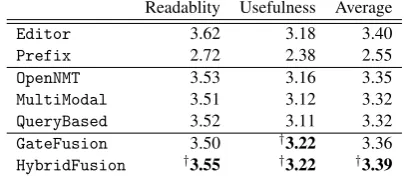
GateFusion 3.50 †3.22 3.36
[image:4.595.314.519.64.152.2]HybridFusion †3.55 †3.22 †3.39
Table 3: Mean scores of readability (r), usefulness (u), and their average r+2u based on crowdsourcing. The “†” mark shows a statistical significance from all three baselinesOpenNMT,MultiModal, andQueryBasedon a one-tailed, paired t-test (p <0.01).
QueryBased on OpenNMT using an RNN en-coder for headlines and CNN enen-coder for leads (see Appendix A for detailed definitions).
• GateFusion: Our model with a gating mech-anism described in Section 3. This is a fusion based on vector weights.
• MultiModal: A multimodal model proposed by (Hori et al., 2017), which can handle multi-modal information such as image and audio as well as text by using separate encoders. The model combines contexts obtained from the encoders via an attention mechanism such as at(s)in Eq. (3). This is a fusion based on scalar weights.
• QueryBased: A query-based model proposed by (Nema et al., 2017), which can finetune the attention on a document by using a query for query-focused summarization. We regard a headline as a document and a lead as a query since the headline is more similar to its short title. Specifically, the model finetunes an atten-tion weightat(s)for calculating a headline con-textdtby using a pre-computed lead contextd′t. This is a fusion based on cascade connection.
• OpenNMT: An encoder-decoder model with a single encoder implemented in OpenNMT, whose input is a headline only, because a vari-ant using a lead did not perform better than this setting.
4.5 Results
and a naive model using the first 13.5 Japanese characters3, respectively. The middle and bottom blocks represent the three baselines and our mod-els, respectively. We explain our hybrid model HybridFusion later. Each model was prepared as an ensemble of ten models by random ini-tialization, aiming for robust performance. Our GateFusion clearly performed better than the three baselines regarding usefulness and interest-ingly outperformed even Editor. This implies that GateFusion tends to aggressively copy el-ements from source sequences. However, this seemed to result in complicated expressions; thus, GateFusionperformed the worst with respect to readability. To overcome this weakness, we de-veloped a hybrid modelHybridFusionthat con-sists of GateFusion and another fusion model QueryBased, which performed relatively well in terms of readability. The results indicate that HybridFusion performed the best regard-ing readability and usefulness. It can be consid-ered that QueryBased helps GateFusion gen-erate headline-style outputs since QueryBased mainly uses the headline source.
Table 4 lists output examples generated by the best modelOpenNMTfrom the three baselines and our best model HybridFusion(see Appendix C for more examples). In this case, the difference between OpenNMT and HybridFusion is easily comprehensible. The former selected “進化 (evo-lution)”, and the latter selected “ダルビッシュ
(Darvish)” from the headline. In Japanese head-lines, the last word tends to be important, so using the last word is basically a good strategy. How-ever, the lead indicates that “Darvish” is more im-portant than “evolution” (actually, there is no word “evolution” in the lead); thus,HybridFusionwas able to correctly select the long name “Darvish” and abbreviate it to “ダル (Dar)”. In addition, it forcibly changed the style to the short title’s style by putting the name into the forefront to eas-ily get users’ attention. This suggests that our neural-headline-generation modelHybridFusion can successfully work even in this real-world ap-plication.
5 Deployment to Editing Support Tool
We deployed our short-title-generation model to an editing support tool in collaboration with the
313.5 is the limit in the news-aggregator, where space,
[image:5.595.307.526.61.149.2]numbers, and alphabet characters are counted as 0.5.
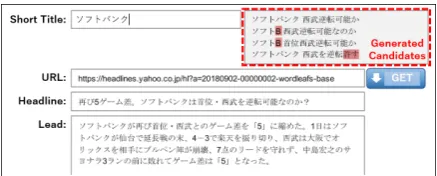
Figure 2: Screenshot of editing support tool displaying generated candidates for creating a short title.
news service, as shown in Figure 2. In the tool, when an editor enters the URL of an article, the tool can automatically fetch the headline and lead of the article and display up to five candidates next to the edit form of a short title, as shown in the dotted box in the figure. These candidates are hy-potheses (with high probabilities) generated by the beam search based on the model. Then, the edi-tor can effectively create a short title by referring to the generated candidates. This supporting fea-ture is expected to be useful especially for inexpe-rienced editors since the quality of short titles is heavily dependent on editors’ experience.
From now on, we briefly describe three features of the tool to improve its usability when display-ing candidates: cutoff of unpromisdisplay-ing candidates, skipping redundant candidates, and highlighting unknown characters. After that, we discuss the effect of the deployment analyzing user behavior before and after releasing the tool.
5.1 Cutoff of Unpromising Candidates
Input and generated title (Japanese) English translation
Headline 逆境をチャンスに変えたダルビッシュの進化 Evolution of Darvish; turning adversity into opportunity.
Lead レンジャーズのダルビッシュ有(29)が28
日、本拠地で行われたパイレーツ戦で[...]
Yu Darvish (29) in Rangers took a mound for the first time in 1 year and 9 months with Pirates [...]
Editor 術前より進化 ダルの肉体改造 Dar sculpted his body better than before surgery.
OpenNMT 逆境をチャンスに変えた進化 Evolution; turning adversity into opportunity.
[image:6.595.78.528.62.140.2]HybridFusion ダル 逆境をチャンスに変えた Dar turned adversity into opportunity.
Table 4: Examples of generated titles.HeadlineandLeaddenote headline and lead as input.Editoris reference title created by an editor.OpenNMTandHybridFusionare the OpenNMT model and our hybrid model.
5.2 Skipping Redundant Candidates
The purpose of the tool is to give editors some new ideas for creating short titles, so it is not use-ful to display redundant candidates similar to oth-ers. Therefore, we skip candidates whose edit dis-tance (Levenshtein, 1966) to the other candidates is lower than a threshold when selecting hypothe-ses in descending order of probability. Formally, the edit distance between two texts is defined as the minimum number of single-character edits (in-sertions, deletions, or substitutions) required to change one text into the other. We set the threshold to 2 so as to restrict variations of Japanese particles as there are many particles with a similar meaning in Japanese4, e.g., “は(ha)” and “が(ga)”. Al-though we used a unit cost for the edit distance, we can adjust the cost of each edit operation so that the tool can ignore variations of prepositions if we want to use English texts.
5.3 Highlighting Unknown Characters
One difficulty of neural models is that there is a possibility of generating incorrect or fake titles, which do not correspond to the article. This is a serious issue for news editing support since dis-played candidates can mislead editors. For exam-ple, if the tool displays “藤波(Fujinami)” for the news about “藤浪(Fujinami)”, where they are dif-ferent names with the same pronunciation, editors might choose the incorrect one. As a simple so-lution, we highlighted unknown characters that do not appear in both headline and lead in red. In Figure 2, two phrases (“B” and “許す”) are high-lighted since they do not appear in the headline and lead. When a candidate includes highlighted characters, editors can carefully check if the can-didate is semantically correct. Note that we did not exclude candidates with unknown characters so that the model can aggressively generate para-phrases and abbreviations. For example, the tool
4https://en.wikipedia.org/wiki/
Japanese_particles
ROUGE-L (±SE) # articles Before 52.71% (±0.56) 1773 After 57.65% (±0.53) 1959
Table 5: Sequence matching rates (ROUGE-L) of edi-tors’ titles and generated titles, which are averaged over articles over three weeks before/after releasing tool.
suggests “ソフトB(Soft B.)” as an abbreviation of “ソフトバンク(Softbank)” in the figure.
5.4 Effect of Deployment
To investigate the effect of the deployment, we compared the sequence matching rates between editors’ correct titles and generated candidates be-fore and after releasing the tool. The sequence matching rate is basically calculated by ROUGE-L (ROUGE-Lin, 2004), which is defined as the rate of the length of the longest common subsequence be-tween two sequences, i.e., a correct title and a gen-erated candidate. Because we have multiple can-didates for each article, we calculate the sequence matching rate as the maximum of their ROUGE-L scores, assuming that editors may refer to the most promising candidate. Note that the candi-dates were filtered by the aforementioned features, so we omitted a few articles without candidates.
6 Related Work
We briefly review related studies from three as-pects: news headline generation, editing support, and application of headline generation. In sum-mary, our work is the first attempt to deploy a neural news-headline-generation model to a real-world application, i.e., news editing support tool.
News-headline-generation tasks have been ex-tensively studied since early times (Wang et al., 2005; Soricut and Marcu, 2006; Woodsend et al., 2010; Alfonseca et al., 2013; Sun et al., 2015; Col-menares et al., 2015). In this line of research, Rush et al. (2015) proposed a neural model to generate news headlines and released a bench-mark dataset for their task, and consequently this task has recently received increasing attention (Chopra et al., 2016; Takase et al., 2016; Kiyono et al., 2017; Zhou et al., 2017; Suzuki and Nagata, 2017; Ayana et al., 2017; Raffel et al., 2017; Cao et al., 2018; Kobayashi, 2018). However, their approaches were basically based on the encoder-decoder model, which is trained with a lot of (ar-ticle, headline) pairs. This means that there are few situations for putting their models into the real world because news articles typically already have corresponding headlines, and most editors create a headline before its content (according to a senior journalist). Therefore, our work can strongly sup-port their approaches from a practical perspective. Considering technologies used for editing sup-port, there have been many studies for various purposes, such as spelling error correction (Farra et al., 2014; Hasan et al., 2015; Etoori et al., 2018), grammatical error correction (Dahlmeier and Ng, 2012; Susanto et al., 2014; Choshen and Abend, 2018), fact checking (Baly et al., 2018; Thorne and Vlachos, 2018; Lee et al., 2018), fluency eval-uation (Vadlapudi and Katragadda, 2010; Heilman et al., 2014; Kann et al., 2018), and so on. How-ever, when we consider their studies on our task, they are only used after editing (writing a draft). On the other hand, the purpose of our tool is dif-ferent from theirs since our tool can support edi-tors before or during editing. The usage of (inter-active) machine translation systems (Denkowski et al., 2014; Gonz´alez-Rubio et al., 2016; Wuebker et al., 2016; Ye et al., 2016; Takeno et al., 2017) for supporting manual post-editing are similar to our purpose, but their task is completely different from ours. In other words, their task is a trans-lation without information loss, whereas our task
is a summarization that requires information com-pression. We believe that a case study on sum-marization is still important for the sumsum-marization community.
There have been several studies reporting case studies on headline generation for different real services: (a) question headlines on question an-swering service (Higurashi et al., 2018), (b) prod-uct headlines on e-commerce service (Wang et al., 2018), and (c) headlines for product curation pages (Mathur et al., 2018; Camargo de Souza et al., 2018). The first two (a) and (b) are extrac-tive approaches, and the last one (c) is an abstrac-tive approach, where the input is a set of slot/value pairs, such as “color/white.” That is, our task is more difficult to use in the real-world. In addition, application to news services tends to be sensitive since news articles contain serious contents such as incidents, accidents, and disasters. Thus, our work should be valuable as a rare case study ap-plying a neural model to such a news service.
7 Conclusion
We addressed short-title generation from news ar-ticles for a news aggregator to support the edi-torial process. We proposed an encoder-decoder model with multiple encoders for separately en-coding multiple information sources, i.e., news headlines and leads. Comparative experiments us-ing crowdsourcus-ing showed that our hybrid model performed better than the baselines, especially us-ing the usefulness measure. We deployed our model to an editing support tool and empirically confirmed that professional editors began to refer to the generated titles after the release. Future re-search will include verifying how much our head-line generation model can affect practical perfor-mance indicators, such as click-through rate. In this case, we need to develop a much safer model since our model sometimes yields erroneous out-puts or fake news titles, which cannot be directly used in the commercial service.
Acknowledgements
References
Enrique Alfonseca, Daniele Pighin, and Guillermo Garrido. 2013. HEADY: News headline abstrac-tion through event pattern clustering. In Proceed-ings of the 51st Annual Meeting of the Association for Computational Linguistics (ACL 2013), pages 1243–1253. Association for Computational Linguis-tics.
Ayana, Shi-Qi Shen, Yan-Kai Lin, Cun-Chao Tu, Yu Zhao, Zhi-Yuan Liu, and Mao-Song Sun. 2017. Recent Advances on Neural Headline Gener-ation. Journal of Computer Science and Technology, 32(4):768–784.
Dzmitry Bahdanau, Kyunghyun Cho, and Yoshua Ben-gio. 2015. Neural machine translation by jointly learning to align and translate. In Proceedings of the 3rd International Conference on Learning Rep-resentations (ICLR 2015).
Ramy Baly, Mitra Mohtarami, James Glass, Llu´ıs M`arquez, Alessandro Moschitti, and Preslav Nakov. 2018. Integrating Stance Detection and Fact Check-ing in a Unified Corpus. InProceedings of the 2018 Conference of the North American Chapter of the Association for Computational Linguistics: Human Language Technologies (NAACL-HLT 2018)), pages 21–27. Association for Computational Linguistics.
Ziqiang Cao, Furu Wei, Wenjie Li, and Sujian Li. 2018. Faithful to the Original: Fact Aware Neural Abstrac-tive Summarization. InProceedings of the Thirty-Second AAAI Conference on Artificial Intelligence (AAAI 2018), pages 4784–4791. AAAI Press.
Sumit Chopra, Michael Auli, and Alexander M. Rush. 2016. Abstractive Sentence Summarization with At-tentive Recurrent Neural Networks. In Proceed-ings of the 2016 Conference of the North American Chapter of the Association for Computational Lin-guistics: Human Language Technologies (NAACL-HLT 2016), pages 93–98. Association for Computa-tional Linguistics.
Leshem Choshen and Omri Abend. 2018. Automatic Metric Validation for Grammatical Error Correc-tion. InProceedings of the 56th Annual Meeting of the Association for Computational Linguistics (ACL 2018), pages 1372–1382. Association for Computa-tional Linguistics.
Carlos A. Colmenares, Marina Litvak, Amin Mantrach, and Fabrizio Silvestri. 2015. HEADS: Headline Generation as Sequence Prediction Using an Ab-stract Feature-Rich Space. In Proceedings of the 2015 Conference of the North American Chapter of the Association for Computational Linguistics: Hu-man Language Technologies (NAACL-HLT 2015), pages 133–142. Association for Computational Lin-guistics.
Daniel Dahlmeier and Hwee Tou Ng. 2012. Better Evaluation for Grammatical Error Correction. In Proceedings of the 2012 Conference of the North
American Chapter of the Association for Computa-tional Linguistics (NAACL-HLT 2012), pages 568– 572. Association for Computational Linguistics.
Michael Denkowski, Alon Lavie, Isabel Lacruz, and Chris Dyer. 2014. Real Time Adaptive Machine Translation for Post-Editing with cdec and Tran-sCenter. In Proceedings of the EACL 2014 Work-shop on Humans and Computer-assisted Transla-tion, pages 72–77. Association for Computational Linguistics.
Pravallika Etoori, Manoj Chinnakotla, and Radhika Mamidi. 2018. Automatic Spelling Correction for Resource-Scarce Languages using Deep Learning. In Proceedings of ACL 2018, Student Research Workshop, pages 146–152. Association for Compu-tational Linguistics.
Noura Farra, Nadi Tomeh, Alla Rozovskaya, and Nizar Habash. 2014. Generalized Character-Level Spelling Error Correction. In Proceedings of the 52nd Annual Meeting of the Association for Com-putational Linguistics (ACL 2014), pages 161–167. Association for Computational Linguistics.
Jes´us Gonz´alez-Rubio, Daniel Ortiz Martinez, Fran-cisco Casacuberta, and Jose Miguel Benedi Ruiz. 2016. Beyond Prefix-Based Interactive Translation Prediction. In Proceedings of The 20th SIGNLL Conference on Computational Natural Language Learning (CoNLL 2016), pages 198–207. Associa-tion for ComputaAssocia-tional Linguistics.
Saˇsa Hasan, Carmen Heger, and Saab Mansour. 2015. Spelling Correction of User Search Queries through Statistical Machine Translation. In Proceedings of the 2015 Conference on Empirical Methods in Nat-ural Language Processing (EMNLP 2015), pages 451–460. Association for Computational Linguis-tics.
Michael Heilman, Aoife Cahill, Nitin Madnani, Melissa Lopez, Matthew Mulholland, and Joel Tetreault. 2014. Predicting Grammaticality on an Ordinal Scale. InProceedings of the 52nd Annual Meeting of the Association for Computational Lin-guistics (ACL 2014), pages 174–180. Association for Computational Linguistics.
Tatsuru Higurashi, Hayato Kobayashi, Takeshi Ma-suyama, and Kazuma Murao. 2018. Extractive headline generation based on learning to rank for community question answering. In Proceedings of the 27th International Conference on Computational Linguistics (COLING 2018), pages 1742–1753. As-sociation for Computational Linguistics.
Sepp Hochreiter and J¨urgen Schmidhuber. 1997. Long short-term memory. Neural Computation, 9(8):1735–1780.
Katharina Kann, Sascha Rothe, and Katja Filippova. 2018. Sentence-Level Fluency Evaluation: Refer-ences Help, But Can Be Spared! In Proceedings of the 22nd Conference on Computational Natural Language Learning (CoNLL 2018), pages 313–323. Association for Computational Linguistics.
Yoon Kim. 2014. Convolutional neural networks for sentence classification. InProceedings of the 2014 Conference on Empirical Methods in Natural Lan-guage Processing (EMNLP), pages 1746–1751. As-sociation for Computational Linguistics.
Shun Kiyono, Sho Takase, Jun Suzuki, Naoaki Okazaki, Kentaro Inui, and Masaaki Nagata. 2017. Source-side Prediction for Neural Headline Genera-tion .CoRR, abs/1712.08302.
Hayato Kobayashi. 2018. Frustratingly Easy Model Ensemble for Abstractive Summarization. In Pro-ceedings of the 2018 Conference on Empirical Methods in Natural Language Processing (EMNLP 2018), pages 4165–4176. Association for Computa-tional Linguistics.
Nayeon Lee, Chien-Sheng Wu, and Pascale Fung. 2018. Improving Large-Scale Fact-Checking using Decomposable Attention Models and Lexical Tag-ging. In Proceedings of the 2018 Conference on Empirical Methods in Natural Language Processing (EMNLP 2018), pages 1133–1138. Association for Computational Linguistics.
Vladimir Iosifovich Levenshtein. 1966. Binary Codes Capable of Correcting Deletions, Insertions and Re-versals. Soviet Physics Doklady, 10(8):707–710.
Chin-Yew Lin. 2004. ROUGE: A Package for Auto-matic Evaluation of Summaries. InProceedings of the ACL Workshop on Text Summarization Branches Out.
Prashant Mathur, Nicola Ueffing, and Gregor Leusch. 2018. Multi-lingual neural title generation for e-Commerce browse pages. In Proceedings of the 2018 Conference of the North American Chapter of the Association for Computational Linguistics: Hu-man Language Technologies (NAACL-HLT 2018), pages 162–169. Association for Computational Lin-guistics.
Preksha Nema, Mitesh M. Khapra, Anirban Laha, and Balaraman Ravindran. 2017. Diversity driven atten-tion model for query-based abstractive summariza-tion. InACL, pages 1063–1072.
Yurii Nesterov. 1983. A method of solving a con-vex programming problem with convergence rate o(1/k2).Soviet Mathematics Doklady, 27.
Colin Raffel, Minh-Thang Luong, Peter J. Liu, Ron J. Weiss, and Douglas Eck. 2017. Online and Linear-Time Attention by Enforcing Monotonic Align-ments. In Proceedings of the 34th International Conference on Machine Learning (ICML 2017), pages 2837–2846.
Alexander M. Rush, Sumit Chopra, and Jason We-ston. 2015. A Neural Attention Model for Abstrac-tive Sentence Summarization. InProceedings of the 2015 Conference on Empirical Methods in Natural Language Processing (EMNLP 2015), pages 379– 389. Association for Computational Linguistics.
Radu Soricut and Daniel Marcu. 2006. Stochastic Language Generation Using WIDL-Expressions and its Application in Machine Translation and Sum-marization. In Proceedings of the 21st Interna-tional Conference on ComputaInterna-tional Linguistics and 44th Annual Meeting of the Association for Com-putational Linguistics (COLING-ACL 2006), pages 1105–1112. Association for Computational Linguis-tics.
Jos´e G. Camargo de Souza, Michael Kozielski, Prashant Mathur, Ernie Chang, Marco Guerini, Mat-teo Negri, Marco Turchi, and Evgeny Matusov. 2018. Generating E-Commerce Product Titles and Predicting their Quality. In Proceedings of the 11th International Conference on Natural Language Generation, pages 233–243. Association for Com-putational Linguistics.
Rui Sun, Yue Zhang, Meishan Zhang, and Donghong Ji. 2015. Event-Driven Headline Generation. In Proceedings of the 53rd Annual Meeting of the Association for Computational Linguistics and the 7th International Joint Conference on Natural Lan-guage Processing (ACL-IJCNLP 2015), pages 462– 472. Association for Computational Linguistics.
Raymond Hendy Susanto, Peter Phandi, and Hwee Tou Ng. 2014. System Combination for Grammatical Error Correction. InProceedings of the 2014 Con-ference on Empirical Methods in Natural Language Processing (EMNLP 2014), pages 951–962. Associ-ation for ComputAssoci-ational Linguistics.
Jun Suzuki and Masaaki Nagata. 2017. Cutting-off re-dundant repeating generations for neural abstractive summarization. In Proceedings of the 15th Con-ference of the European Chapter of the Association for Computational Linguistics (EACL 2017), pages 291–297. Association for Computational Linguis-tics.
Sho Takase, Jun Suzuki, Naoaki Okazaki, Tsutomu Hi-rao, and Masaaki Nagata. 2016. Neural Headline Generation on Abstract Meaning Representation. In Proceedings of the 2016 Conference on Empirical Methods in Natural Language Processing (EMNLP 2016), pages 1054–1059. Association for Computa-tional Linguistics.
Jiwei Tan, Xiaojun Wan, and Jianguo Xiao. 2017. Ab-stractive Document Summarization with a Graph-Based Attentional Neural Model. InProceedings of the 55th Annual Meeting of the Association for Com-putational Linguistics (ACL 2017), pages 1171– 1181. Association for Computational Linguistics.
James Thorne and Andreas Vlachos. 2018. Automated Fact Checking: Task Formulations, Methods and Future Directions. InProceedings of the 27th Inter-national Conference on Computational Linguistics (COLING 2018), pages 3346–3359. Association for Computational Linguistics.
Ravikiran Vadlapudi and Rahul Katragadda. 2010. On Automated Evaluation of Readability of Summaries: Capturing Grammaticality, Focus, Structure and Co-herence. In Proceedings of the NAACL HLT 2010 Student Research Workshop, pages 7–12. Associa-tion for ComputaAssocia-tional Linguistics.
Jingang Wang, Junfeng Tian, Long Qiu, Sheng Li, Jun Lang, Luo Si, and Man Lan. 2018. A Multi-Task Learning Approach for Improving Product Ti-tle Compression with User Search Log Data. In Pro-ceedings of the Thirty-Second AAAI Conference on Artificial Intelligence (AAAI 2018), pages 451–458.
Ruichao Wang, John Dunnion, and Joe Carthy. 2005. Machine Learning Approach to Augmenting News Headline Generation. In Proceedings of the Sec-ond International Joint Conference on Natural Lan-guage Processing (IJCNLP 2005). Association for Computational Linguistics.
Kristian Woodsend, Yansong Feng, and Mirella Lap-ata. 2010. Title Generation with Quasi-Synchronous Grammar. InProceedings of the 2010 Conference on Empirical Methods in Natural Language Pro-cessing (EMNLP 2010), pages 513–523. Associa-tion for ComputaAssocia-tional Linguistics.
Joern Wuebker, Spence Green, John DeNero, Sasa Hasan, and Minh-Thang Luong. 2016. Models and Inference for Prefix-Constrained Machine Transla-tion. InProceedings of the 54th Annual Meeting of the Association for Computational Linguistics (ACL 2016), pages 66–75. Association for Computational Linguistics.
Na Ye, Guiping Zhang, and Dongfeng Cai. 2016. Interactive-predictive machine translation based on syntactic constraints of prefix. In Proceedings of the 26th International Conference on Computational Linguistics (COLING 2016), pages 1797–1806. The COLING 2016 Organizing Committee.