Syntactic Parse Fusion
Do Kook Choe Brown University
Providence, RI [email protected]
David McClosky IBM Research Yorktown Heights, NY [email protected]
Eugene Charniak Brown University
Providence, RI [email protected]
Abstract
Model combination techniques have con-sistently shown state-of-the-art perfor-mance across multiple tasks, including syntactic parsing. However, they dramat-ically increase runtime and can be diffi-cult to employ in practice. We demon-strate that applying constituency model combination techniques ton-best lists in-stead ofndifferent parsers results in sig-nificant parsing accuracy improvements. Parses are weighted by their probabilities and combined using an adapted version of Sagae and Lavie (2006). These accu-racy gains come with marginal computa-tional costs and are obtained on top of ex-isting parsing techniques such as discrim-inative reranking and self-training, result-ing in state-of-the-art accuracy: 92.6% on WSJ section 23. On out-of-domain cor-pora, accuracy is improved by 0.4% on average. We empirically confirm that six well-known n-best parsers benefit from the proposed methods across six domains.
1 Introduction
Researchers have proposed many algorithms to combine parses from multiple parsers into one fi-nal parse (Henderson and Brill, 1999; Zeman and ˇZabokrtsk`y, 2005; Sagae and Lavie, 2006; Now-son and Dale, 2007; Fossum and Knight, 2009; Petrov, 2010; Johnson and Ural, 2010; Huang et al., 2010; McDonald and Nivre, 2011; Shindo et al., 2012; Narayan and Cohen, 2015). These new parses are substantially better than the originals: Zhang et al. (2009) combine outputs from mul-tiple n-best parsers and achieve an F1 of 92.6% on the WSJ test set, a 0.5% improvement over their best n-best parser. Model combination ap-proaches tend to fall into the following categories:
hybridization, where multiple parses are combined into a single parse; switching, which picks a sin-gle parse according to some criteria (usually a form of voting); grammar mergingwhere gram-mars are combined before or during parsing; and stacking, where one parser sends its prediction to another at runtime. All of these have at least one of the caveats that (1) overall computation is increased and runtime is determined by the slowest parser and (2) using multiple parsers in-creases the system complexity, making it more difficult to deploy in practice. In this paper, we describe a simple hybridization extension (“fu-sion”) which obtains much of hybridization’s ben-efits while using only a single n-best parser and minimal extra computation. Our method treats each parse in a single parser’s n-best list as a parse from n separate parsers. We then adapt parse combination methods by Henderson and Brill (1999), Sagae and Lavie (2006), and Fos-sum and Knight (2009) to fuse the constituents from the n parses into a single tree. We empir-ically show that six n-best parsers benefit from parse fusion across six domains, obtaining state-of-the-art results. These improvements are com-plementary to other techniques such as rerank-ing and self-trainrerank-ing. Our best system obtains an F1 of 92.6% on WSJ section 23, a score pre-viously obtained only by combining the outputs from multiple parsers. A reference implementa-tion is available as part of BLLIP Parser athttp: //github.com/BLLIP/bllip-parser/
2 Fusion
Henderson and Brill (1999) propose a method to combine trees frommparsers in three steps: pop-ulate a chart with constituents along with the num-ber of times they appear in the trees; remove any constituent with count less than m/2 from the chart; and finally create a final tree with all the remaining constituents. Intuitively their method
constructs a tree with constituents from the ma-jority of the trees, which boosts precision signif-icantly. Henderson and Brill (1999) show that this process is guaranteed to produce a valid tree. Sagae and Lavie (2006) generalize this work by reparsing the chart populated with constituents whose counts are above a certain threshold. By adjusting the threshold on development data, their generalized method balances precision and recall. Fossum and Knight (2009) further extend this line of work by usingn-best lists from multiple parsers and combining productions in addition to con-stituents. Their model assigns sums of joint proba-bilities of constituents and parsers to constituents. Surprisingly, exploitingn-best trees does not lead to large improvement over combining1-best trees in their experiments.
Our extension takes the n-best trees from a parser as if they are 1-best parses fromnparsers, then follows Sagae and Lavie (2006). Parses are weighted by the estimated probabilities from the parser. Given n trees and their weights, the model computes a constituent’s weight by sum-ming weights of all trees containing that con-stituent. Concretely, the weight of a constituent spanning fromith word tojth word with label`is
c`(i→j) = n
X
k=1
W(k)Ck
`(i→j) (1)
whereW(k)is the weight ofkth tree andCk `(i→
j)is one if a constituent with label`spanning from
itojis inkth tree, zero otherwise. After populat-ing the chart with constituents and their weights, it throws out constituents with weights below a set thresholdt. Using the thresholdt= 0.5emulates the method of Henderson and Brill (1999) in that it constructs the tree with the constituents in the majority of the trees. The CYK parsing algorithm is applied to the chart to produce the final tree.
Note that populating the chart is linear in the number of words and the chart contains substan-tially fewer constituents than charts in well-known parsers, making this a fast procedure.
2.1 Score distribution over trees
We assume thatn-best parsers provide trees along with some kind of scores (often probabilities or log probabilities). Given these scores, a natural way to obtain weights is to normalize the prob-abilities. However, parsers do not always provide accurate estimates of parse quality. We may obtain
better performance from parse fusion by altering this distribution and passing scores through a non-linear function, f(·). The kth parse is weighted:
W(k) = Pnf(SCORE(k))
i=1f(SCORE(i)) (2) whereSCORE(i) is the score ofith tree.1 We
ex-plore the family of functionsf(x) =xβwhich can smooth or sharpen the score distributions. This in-cludes a tunable parameter,β ∈R+
0:
W(k) = PnSCORE(k)β
i=1SCORE(i)β (3) Employing β < 1 flattens the score distribution overn-best trees and helps over-confident parsers. On the other hand, havingβ >1skews the distri-bution toward parses with higher scores and helps under-confident parsers. Note that settingβ = 0 weights all parses equally and results in majority voting at the constituent level. We leave develop-ing other nonlinear functions for fusion as future work.
3 Experiments
Corpora: Parse fusion is evaluated on British National Corpus (BNC), Brown, GENIA, Ques-tion Bank (QB), Switchboard (SB) and Wall Street Journal (WSJ) (Foster and van Genabith, 2008; Francis and Kuˇcera, 1989; Kim et al., 2003; Judge et al., 2006; Godfrey et al., 1992; Mar-cus et al., 1993). WSJ is used to evaluate in-domain parsing, the remaining five are used for out-of-domain. For divisions, we use tune and test splits from Bacchiani et al. (2006) for Brown, Mc-Closky’s test PMIDs2for GENIA, Stanford’s test
splits3 for QuestionBank, and articles 4000–4153
for Switchboard.
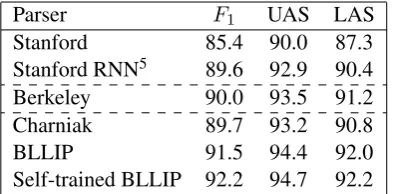
Parsers: The methods are applied to six widely used n-best parsers: Charniak (2000), Stanford (Klein and Manning, 2003), BLLIP (Charniak and Johnson, 2005), Self-trained BLLIP (McClosky et al., 2006)4, Berkeley (Petrov et al., 2006), and
Stanford RNN (Socher et al., 2013). The list of parsers and their accuracies on the WSJ test set is reported in Table 1. We convert to Stanford
1For parsers that return log probabilities, we turn these
into probabilities first.
2http://nlp.stanford.edu/˜mcclosky/
biomedical.html
3http://nlp.stanford.edu/data/
QuestionBank-Stanford.shtml
Parser F1 UAS LAS Stanford 85.4 90.0 87.3 Stanford RNN5 89.6 92.9 90.4
[image:3.595.315.517.60.133.2]Berkeley 90.0 93.5 91.2 Charniak 89.7 93.2 90.8 BLLIP 91.5 94.4 92.0 Self-trained BLLIP 92.2 94.7 92.2
Table 1: Six parsers along with their 1-best F1 scores, unlabeled attachment scores (UAS) and la-beled attachment scores (LAS) on WSJ section 23.
Dependencies (basic dependencies, version 3.3.0) and provide dependency metrics (UAS, LAS) as well.
Supervised parsers are trained on the WSJ train-ing set (sections 2–21) and use section 22 or 24 for development. Self-trained BLLIP is self-trained using two million sentences from Giga-word and Stanford RNN uses Giga-word embeddings trained from larger corpora.
Parameter tuning:There are three parameters for our fusion process: the size of then-best list (2< n≤50), the smoothing exponent from Section 2.1 (β ∈[0.5,1.5]with 0.1 increments), and the mini-mum threshold for constituents (t∈[0.2,0.7]with 0.01 increments). We use grid search to tune these parameters for two separate scenarios. When pars-ing WSJ (in-domain), we tune parameters on WSJ section 24. For the remaining corpora (out-of-domain), we use the tuning section from Brown. Each parser is tuned separately, resulting in 12 different tuning scenarios. In practice, though, in-domain and out-of-domain tuning regimes tend to pick similar settings within a parser. Across parsers, settings are also fairly similar (n is usu-ally 30 or 40, tis usually between 0.45 and 0.5). While the smoothing exponent varies from 0.5 to 1.3, settingβ = 1does not significantly hurt ac-curacy for most parsers.
To study the effects of these parameters, Fig-ure 1 shows three slices of the tuning surface for BLLIP parser on WSJ section 24 around the op-timal settings (n = 30, β = 1.1, t = 0.47). In each graph, one of the parameters is varied while the other is held constant. Increasingn-best size improves accuracy until aboutn= 30where there seems to be sufficient diversity. For BLLIP, the
5Socher et al. (2013) report anF1 of 90.4%, but this is
the result of using an ensemble of two RNNs (p.c.). We use a single RNN in this work.
Parser WSJ Brown
BLLIP 90.6 85.7
+ Fusion 91.0 86.0
+ Majority voting (β = 0) 89.1 83.8 + Rank-based weighting 89.3 84.1 Table 2:F1of a baseline parser, fusion, and base-lines on development sections of corpora (WSJ section 24 and Brown tune).
smoothing exponent (β) is best set around 1.0, with accuracy falling off if the value deviates too much. Finally, the threshold parameter is empiri-cally optimized a little below t = 0.5(the value suggested by Henderson and Brill (1999)). Since score values are normalized, this means that con-stituents need roughly half the “score mass” in or-der to be included in the chart. Varying the thresh-old changes the precision/recall balance since a high threshold adds only the most confident con-stituents to the chart (Sagae and Lavie, 2006).
Baselines: Table 2 gives the accuracy of fusion and baselines for BLLIP on the development cor-pora. Majority voting sets n = 50, β = 0, t = 0.5 giving all parses equal weight and results in constituent-level majority voting. We explore a rank-based weighting which ignores parse prob-abilities and weight parses only using the rank:
Wrank(k) = 1/(2k). These show that accu-rate parse-level scores are critical for good perfor-mance.
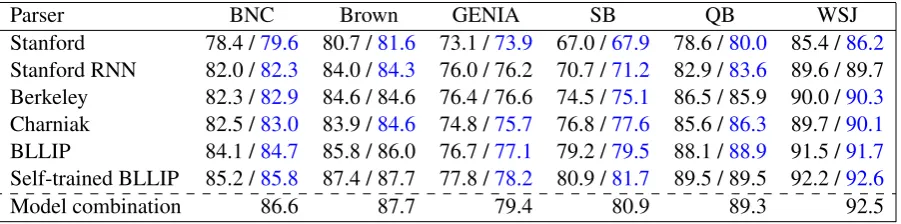
Final evaluation: Table 3 gives our final re-sults for all parsers across all domains. Rere-sults in blue are significant at p < 0.01 using a ran-domized permutation test. Fusion generally im-provesF1 for in-domain and out-of-domain pars-ing by a significant margin. For the self-trained BLLIP parser, in-domain F1 increases by 0.4% and out-of-domain F1 increases by 0.4% on av-erage. Berkeley parser obtains the smallest gains from fusion since Berkeley’s n-best lists are or-dered by factors other than probabilities. As a re-sult, the probabilities from Berkeley can mislead the fusion process.
[image:3.595.84.281.62.159.2]Figure 1: Tuning parameters independently for BLLIP and their impact onF1for WSJ section 24 (solid purple line). For each graph, non-tuned parameters were set at the optimal configuration for BLLIP (n= 30,β= 1.1,t= 0.47). The dashed grey line represents the 1-best baseline at 90.6%F1.
Parser BNC Brown GENIA SB QB WSJ
Stanford 78.4 /79.6 80.7 /81.6 73.1 /73.9 67.0 /67.9 78.6 /80.0 85.4 /86.2
Stanford RNN 82.0 /82.3 84.0 /84.3 76.0 / 76.2 70.7 /71.2 82.9 /83.6 89.6 / 89.7 Berkeley 82.3 /82.9 84.6 / 84.6 76.4 / 76.6 74.5 /75.1 86.5 / 85.9 90.0 /90.3
Charniak 82.5 /83.0 83.9 /84.6 74.8 /75.7 76.8 /77.6 85.6 /86.3 89.7 /90.1
BLLIP 84.1 /84.7 85.8 / 86.0 76.7 /77.1 79.2 /79.5 88.1 /88.9 91.5 /91.7
Self-trained BLLIP 85.2 /85.8 87.4 / 87.7 77.8 /78.2 80.9 /81.7 89.5 / 89.5 92.2 /92.6
Model combination 86.6 87.7 79.4 80.9 89.3 92.5
Table 3: Evaluation of the constituency fusion method on six parsers across six domains. x/yindicates theF1from the baseline parser(x)and the baseline parser with fusion(y)respectively. Blue indicates a statistically significant difference between fusion and its baseline parser(p <0.01).
performs better than fusion on BNC and GENIA, but surprisingly fusion outperforms model com-bination on three of the six domains (not usually not by a significant margin). With further tuning (e.g., specific weights for each constituent-parser pair), the benefits from model combination should increase.
Multilingual evaluation:We evaluate fusion with the Berkeley parser on Arabic (Maamouri et al., 2004; Green and Manning, 2010), French (Abeill´e et al., 2003), and German (Brants et al., 2002) from the SPMRL 2014 shared task (Seddah et al., 2014) but did not observe any improvement. We suspect this has to do with the same ranking issues seen in the Berkeley Parser’s English results. On the other hand, fusion helps the parser of Narayan and Cohen (2015) on the German NEGRA tree-bank (Skut et al., 1997) to improve from 80.9% to 82.4%.
Runtime:As discussed in Section 2, fusion’s run-time overhead is minimal. Reranking parsers (e.g., BLLIP and Stanford RNN) already need to per-form n-best decoding as input for the reranker. Using a somewhat optimized implementation fu-sion in C++, the overhead over BLLIP parser is
less than 1%.
Discussion: Why does fusion help? It is possible that a parser’sn-list and its scores act as a weak approximation to the full parse forest. As a result, fusion seems to provide part of the benefits seen in forest reranking (Huang, 2008).
Results from Fossum and Knight (2009) imply that fusion and model combination might not be complementary. Both n-best lists and additional parsers provide syntactic diversity. While addi-tional parsers provide greater diversity,n-best lists from common parsers are varied enough to pro-vide improvements for parse hybridization.
[image:4.595.75.526.236.348.2]predic-tions from model combination (stacking) were worse than baseline performance. The difference is that novel predictions with fusion better incor-porate model confidence whereas when stacking, a novel prediction is less trusted than those pro-duced by one or both of the base parsers.
Preliminary extensions: Here, we summarize two extensions to fusion which have yet to show benefits. The first extension explores applying fusion to dependency parsing. We explored two ways to apply fusion when starting from con-stituency parses: (1) fuse constituents and then convert them to dependencies and (2) convert to dependencies then fuse the dependencies as in Sagae and Lavie (2006). Approach (1) does not provide any benefit (LAS drops between 0.5% and 2.4%). This may result from fusion’s artifacts in-cluding unusual unary chains or nodes with a large number of children — it is possible that adjusting unary handling and the precision/recall tradeoff may reduce these issues. Approach (2) provided only modest benefits compared to those from con-stituency parsing fusion. The largest LAS increase for (2) is 0.6% for the Stanford Parser, though for Berkeley and Self-trained BLLIP, dependency fu-sion results in small losses (-0.1% LAS). Two pos-sible reasons are that the dependency baseline is higher than its constituency counterpart and some dependency graphs from then-best list are dupli-cates which lowers diversity and may need special handling, but this remains an open question.
While fusion helps on top of a self-trained parser, we also explored whether a fused parser can self-train (McClosky et al., 2006). To test this, we (1) parsed two million sentences with BLLIP (trained on WSJ), (2) fused those parses, (3) added the fused parses to the gold training set, and (4) retrained the parser on the expanded training. The resulting model did not perform better than a self-trained parsing model that didn’t use fusion.
4 Conclusions
We presented a simple extension to parse hy-bridization which adapts model combination tech-niques to operate over a single parser’sn-best list instead of across multiple parsers. By weight-ing each parse by its probability from the n-best parser, we are able to better capture the confidence at the constituent level. Our best configuration ob-tains state-of-the-art accuracy on WSJ with anF1 of 92.6%. This is similar to the accuracy obtained
from actual model combination techniques but at a fraction of the computational cost. Additionally, improvements are not limited to a single parser or domain. Fusion improves parser accuracy for six
n-best parsers both in-domain and out-of-domain. Future work includes applying fusion ton-best dependency parsers and additional (parser, lan-guage) pairs. We also intend to explore how to bet-ter apply fusion to converted dependencies from constituency parsers. Lastly, it would be interest-ing to adapt fusion to other structured prediction tasks wheren-best lists are available.
Acknowledgements
We are grateful to Shay Cohen and Shashi Narayan who gave us early access to their parser’s German results. We would also like to thank Mo-hit Bansal, Yoav Goldberg, Siddharth Patward-han, and Kapil Thadani for helpful discussions and our anonymous reviewers for their insightful com-ments and suggestions.
References
Anne Abeill´e, Lionel Cl´ement, and Franc¸ois Toussenel. 2003. Building a treebank for french. InTreebanks, pages 165–187. Springer.
Michiel Bacchiani, Michael Riley, Brian Roark, and Richard Sproat. 2006. Map adaptation of stochastic grammars. Computer speech & language, 20(1):41– 68.
Sabine Brants, Stefanie Dipper, Silvia Hansen, Wolf-gang Lezius, and George Smith. 2002. The tiger treebank. InProceedings of the workshop on tree-banks and linguistic theories, volume 168.
Eugene Charniak and Mark Johnson. 2005. Coarse-to-fine n-best parsing and MaxEnt discriminative reranking. InProceedings of the 43rd Annual Meet-ing of the Association for Computational LMeet-inguis- Linguis-tics (ACL’05), pages 173–180, Ann Arbor, Michi-gan, June. Association for Computational Linguis-tics.
Eugene Charniak. 2000. A
maximum-entropy-inspired parser. In Proceedings of the 1st North American chapter of the Association for Computa-tional Linguistics conference, pages 132–139. Asso-ciation for Computational Linguistics.
Jennifer Foster and Josef van Genabith. 2008. Parser evaluation and the BNC: Evaluating 4 constituency parsers with 3 metrics. InProceedings of the Sixth International Conference on Language Resources and Evaluation (LREC’08). European Language Re-sources Association (ELRA).
Winthrop Nelson Francis and Henry Kuˇcera. 1989.
Manual of information to accompany a standard corpus of present-day edited American English, for use with digital computers. Brown University, De-partment of Linguistics.
John J. Godfrey, Edward C. Holliman, and Jane Mc-Daniel. 1992. Switchboard: Telephone speech cor-pus for research and development. In Acoustics, Speech, and Signal Processing, 1992. ICASSP-92., 1992 IEEE International Conference on, volume 1, pages 517–520. IEEE.
Spence Green and Christopher D Manning. 2010. Bet-ter arabic parsing: Baselines, evaluations, and anal-ysis. InProceedings of the 23rd International Con-ference on Computational Linguistics, pages 394– 402. Association for Computational Linguistics. John C. Henderson and Eric Brill. 1999. Exploiting
diversity in natural language processing: Combin-ing parsers. In Proceedings of the Joint SIGDAT Conference on Empirical Methods in Natural Lan-guage Processing and Very Large Corpora, pages 187–194, College Park, MD, June. Association for Computational Linguistics.
Zhongqiang Huang, Mary Harper, and Slav Petrov. 2010. Self-training with products of latent vari-able grammars. In Proceedings of the 2010 Con-ference on Empirical Methods in Natural Language Processing, pages 12–22. Association for Computa-tional Linguistics.
Liang Huang. 2008. Forest reranking: Discrimina-tive parsing with non-local features. InProceedings of ACL-08: HLT, pages 586–594, Columbus, Ohio, June. Association for Computational Linguistics. Mark Johnson and Ahmet Engin Ural. 2010.
Rerank-ing the berkeley and brown parsers. InHuman Lan-guage Technologies: The 2010 Annual Conference of the North American Chapter of the Association for Computational Linguistics, pages 665–668. As-sociation for Computational Linguistics.
John Judge, Aoife Cahill, and Josef van Genabith. 2006. Questionbank: Creating a corpus of parse-annotated questions. InProceedings of the 21st In-ternational Conference on Computational Linguis-tics and 44th Annual Meeting of the Association for Computational Linguistics, pages 497–504, Sydney, Australia, July. Association for Computational Lin-guistics.
J-D Kim, Tomoko Ohta, Yuka Tateisi, and Junichi Tsu-jii. 2003. Genia corpus—a semantically annotated corpus for bio-textmining. Bioinformatics, 19(suppl 1):i180–i182.
Dan Klein and Christopher D. Manning. 2003. Ac-curate unlexicalized parsing. InProceedings of the 41st Annual Meeting of the Association for Com-putational Linguistics, pages 423–430, Sapporo, Japan, July. Association for Computational Linguis-tics.
Mohamed Maamouri, Ann Bies, Tim Buckwalter, and Wigdan Mekki. 2004. The penn arabic treebank: Building a large-scale annotated arabic corpus. In
NEMLAR conference on Arabic language resources and tools, pages 102–109.
Mitchell P. Marcus, Mary Ann Marcinkiewicz, and Beatrice Santorini. 1993. Building a large anno-tated corpus of english: The penn treebank. Compu-tational linguistics, 19(2):313–330.
David McClosky, Eugene Charniak, and Mark John-son. 2006. Effective self-training for parsing. In
Proceedings of the Human Language Technology Conference of the NAACL, Main Conference, pages 152–159, New York City, USA, June. Association for Computational Linguistics.
David McClosky, Sebastian Riedel, Mihai Surdeanu, Andrew McCallum, and Christopher D. Manning. 2012. Combining joint models for biomedical event extraction. BMC Bioinformatics, 13(Suppl 11):S9. Ryan McDonald and Joakim Nivre. 2011. Analyzing
and integrating dependency parsers. Computational Linguistics, 37(1):197–230.
Shashi Narayan and Shay B. Cohen. 2015. Diversity in spectral learning for natural language parsing. In
Proceedings of EMNLP.
Scott Nowson and Robert Dale. 2007.
Chart-ing democracy across parsers. In Proceedings of the Australasian Language Technology Workshop, pages 75–82.
Slav Petrov, Leon Barrett, Romain Thibaux, and Dan Klein. 2006. Learning accurate, compact, and interpretable tree annotation. In Proceedings of the 21st International Conference on Computational Linguistics and 44th Annual Meeting of the Associa-tion for ComputaAssocia-tional Linguistics, pages 433–440, Sydney, Australia, July. Association for Computa-tional Linguistics.
Slav Petrov. 2010. Products of random latent vari-able grammars. InHuman Language Technologies: The 2010 Annual Conference of the North Ameri-can Chapter of the Association for Computational Linguistics, pages 19–27. Association for Computa-tional Linguistics.
Djam´e Seddah, Sandra K¨ubler, and Reut Tsarfaty. 2014. Introducing the spmrl 2014 shared task on parsing morphologically-rich languages. In Pro-ceedings of the First Joint Workshop on Statisti-cal Parsing of MorphologiStatisti-cally Rich Languages and Syntactic Analysis of Non-Canonical Languages, pages 103–109, Dublin, Ireland, August. Dublin City University.
Hiroyuki Shindo, Yusuke Miyao, Akinori Fujino, and Masaaki Nagata. 2012. Bayesian symbol-refined tree substitution grammars for syntactic parsing. In Proceedings of the 50th Annual Meeting of the Association for Computational Linguistics: Long Papers-Volume 1, pages 440–448. Association for Computational Linguistics.
Wojciech Skut, Brigitte Krenn, Thorsten Brants, and Hans Uszkoreit. 1997. An annotation scheme for free word order languages. In Proceedings of the fifth conference on Applied natural language pro-cessing, pages 88–95. Association for Computa-tional Linguistics.
Richard Socher, John Bauer, Christopher D. Manning, and Ng Andrew Y. 2013. Parsing with composi-tional vector grammars. InProceedings of the 51st Annual Meeting of the Association for Computa-tional Linguistics (Volume 1: Long Papers), pages 455–465, Sofia, Bulgaria, August. Association for Computational Linguistics.
Daniel Zeman and Zdenˇek ˇZabokrtsk`y. 2005. Improv-ing parsImprov-ing accuracy by combinImprov-ing diverse depen-dency parsers. InProceedings of the Ninth Interna-tional Workshop on Parsing Technology, pages 171– 178. Association for Computational Linguistics. Hui Zhang, Min Zhang, Chew Lim Tan, and Haizhou