Proceedings of the 2011 Conference on Empirical Methods in Natural Language Processing, pages 1269–1280,
Lateen EM: Unsupervised Training with Multiple Objectives,
Applied to Dependency Grammar Induction
Valentin I. Spitkovsky
Computer Science Department Stanford University and Google Inc.
Hiyan Alshawi
Google Inc.
Mountain View, CA, 94043, USA [email protected]
Daniel Jurafsky
Departments of Linguistics and Computer Science Stanford University, Stanford, CA, 94305, USA
Abstract
We present new training methods that aim to mitigate local optima and slow convergence in unsupervised training by using additional im-perfect objectives. In its simplest form, lateen
EM alternates between the two objectives of
ordinary “soft” and “hard” expectation max-imization (EM) algorithms. Switching objec-tives when stuck can help escape local optima. We find that applying a single such alternation already yields state-of-the-art results for En-glish dependency grammar induction. More elaborate lateen strategies track both objec-tives, with each validating the moves proposed by the other. Disagreements can signal earlier opportunities to switch or terminate, saving it-erations. De-emphasizing fixed points in these ways eliminates some guesswork from tuning EM. An evaluation against a suite of unsu-pervised dependency parsing tasks, for a vari-ety of languages, showed that lateen strategies significantly speed up training of both EM al-gorithms, and improve accuracy for hard EM.
1 Introduction
Expectation maximization (EM) algorithms (Demp-ster et al., 1977) play important roles in learning latent linguistic structure. Unsupervised techniques from this family excel at core natural language pro-cessing (NLP) tasks, including segmentation, align-ment, tagging and parsing. Typical implementations specify a probabilistic framework, pick an initial model instance, and iteratively improve parameters using EM. A key guarantee is that subsequent model instances are no worse than the previous, according to training data likelihood in the given framework.
Another attractive feature that helped make EM instrumental (Meng, 2007) is its initial efficiency: Training tends to begin with large steps in a param-eter space, sometimes bypassing many local optima at once. After a modest number of such iterations, however, EM lands close to an attractor. Next, its convergence rate necessarily suffers: Disproportion-ately many (and ever-smaller) steps are needed to finally approach this fixed point, which is almost in-variably a local optimum. Deciding when to termi-nate EM often involves guesswork; and finding ways out of local optima requires trial and error. We pro-pose several strategies that address both limitations. Unsupervised objectives are, at best, loosely cor-related with extrinsic performance (Pereira and Sch-abes, 1992; Merialdo, 1994; Liang and Klein, 2008,
inter alia). This fact justifies (occasionally)
devi-ating from a prescribed training course. For exam-ple, since multiple equi-plausible objectives are usu-ally available, a learner could cycle through them, optimizing alternatives when the primary objective function gets stuck; or, instead of trying to escape, it could aim to avoid local optima in the first place, by halting search early if an improvement to one objec-tive would come at the expense of harming another.
We test these general ideas by focusing on non-convex likelihood optimization using EM. This set-ting is standard and has natural and well-understood objectives: the classic, “soft” EM; and Viterbi, or “hard” EM (Kearns et al., 1997). The name “la-teen” comes from the sea — triangular lateen sails can take wind on either side, enabling sailing ves-sels to tack (see Figure 1). As a captain can’t count on favorable winds, so an unsupervised learner can’t rely on co-operative gradients: soft EM maximizes
Figure 1: A triangular sail atop a traditional Arab sail-ing vessel, the dhow (right). Older square sails permitted sailing only before the wind. But the efficient lateen sail worked like a wing (with high pressure on one side and low pressure on the other), allowing a ship to go almost directly into a headwind. By tacking, in a zig-zag pattern, it became possible to sail in any direction, provided there was some wind at all (left). For centuries seafarers ex-pertly combined both sails to traverse extensive distances, greatly increasing the reach of medieval navigation.1
likelihoods of observed data across assignments to hidden variables, whereas hard EM focuses on most likely completions.2 These objectives are plausible, yet both can be provably “wrong” (Spitkovsky et al., 2010a,§7.3). Thus, it is permissible for lateen EM to maneuver between their gradients, for example by tacking around local attractors, in a zig-zag fashion.
2 The Lateen Family of Algorithms
We propose several strategies that use a secondary objective to improve over standard EM training. For hard EM, the secondary objective is that of soft EM; and vice versa if soft EM is the primary algorithm.
2.1 Algorithm #1: Simple Lateen EM
Simple lateen EM begins by running standard EM to convergence, using a user-supplied initial model, primary objective and definition of convergence. Next, the algorithm alternates. A single lateen al-ternation involves two phases: (i) retraining using the secondary objective, starting from the previ-ous converged solution (once again iterating until convergence, but now of the secondary objective);
1
Partially adapted from http://www.britannica.com/ EBchecked/topic/331395, http://allitera.tive.org/ archives/004922.html and http://landscapedvd.com/ desktops/images/ship1280x1024.jpg.
2
See Brown et al.’s (1993,§6.2) definition of Viterbi train-ing for a succinct justification of hard EM; in our case, the cor-responding objective is Spitkovsky et al.’s (2010a,§7.1)θˆVIT.
and (ii) retraining using the primary objective again, starting from the latest converged solution (once more to convergence of the primary objective). The algorithm stops upon failing to sufficiently improve the primary objective across alternations (applying the standard convergence criterion end-to-end) and returns the best of all models re-estimated during training (as judged by the primary objective).
2.2 Algorithm #2: Shallow Lateen EM
Same as algorithm #1, but switches back to optimiz-ing the primary objective after a soptimiz-ingle step with the secondary, during phase (i) of all lateen alternations. Thus, the algorithm alternates between optimizing a primary objective to convergence, then stepping away, using one iteration of the secondary optimizer.
2.3 Algorithm #3: Early-Stopping Lateen EM
This variant runs standard EM but quits early if the secondary objective suffers. We redefine con-vergence by “or”-ing the user-supplied termination criterion (i.e., a “small-enough” change in the pri-mary objective) with any adverse change of the sec-ondary (i.e., an increase in its cross-entropy). Early-stopping lateen EM does not alternate objectives.
2.4 Algorithm #4: Early-Switching Lateen EM
Same as algorithm #1, but with the new definition of convergence, as in algorithm #3. Early-switching lateen EM halts primary optimizers as soon as they hurt the secondary objective and stops secondary op-timizers once they harm the primary objective. This algorithm terminates when it fails to sufficiently im-prove the primary objective across a full alternation.
2.5 Algorithm #5: Partly-Switching Lateen EM
Same as algorithm #4, but again iterating primary objectives to convergence, as in algorithm #1; sec-ondary optimizers still continue to terminate early.
3 The Task and Study #1
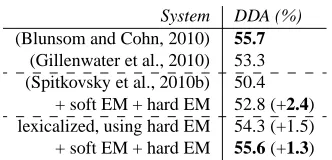
System DDA (%) (Blunsom and Cohn, 2010) 55.7
(Gillenwater et al., 2010) 53.3 (Spitkovsky et al., 2010b) 50.4
[image:3.612.103.269.69.149.2]+ soft EM + hard EM 52.8 (+2.4) lexicalized, using hard EM 54.3 (+1.5) + soft EM + hard EM 55.6 (+1.3)
Table 1: Directed dependency accuracies (DDA) on Sec-tion 23 of WSJ (all sentences) for recent state-of-the-art systems and our two experiments (one unlexicalized and one lexicalized) with a single alternation of lateen EM.
Algorithm #1) improve our recent publicly-available system for English dependency grammar induction. In study #2, we introduced a more sophisticated methodology that uses factorial designs and regres-sions to evaluate lateen strategies with unsupervised dependency parsing in many languages, after also controlling for other important sources of variation.
For study #1, our base system (Spitkovsky et al., 2010b) is an instance of the popular (unlexicalized) Dependency Model with Valence (Klein and Man-ning, 2004). This model was trained using hard EM on WSJ45 (WSJ sentences up to length 45) until suc-cessive changes in per-token cross-entropy fell be-low2−20bits (Spitkovsky et al., 2010b; 2010a,§4).3 We confirmed that the base model had indeed con-verged, by running 10 steps of hard EM on WSJ45 and verifying that its objective did not change much. Next, we applied a single alternation of simple la-teen EM: first running soft EM (this took 101 steps, using the same termination criterion), followed by hard EM (again to convergence — another 23 it-erations). The result was a decrease in hard EM’s cross-entropy, from 3.69 to 3.59 bits per token (bpt), accompanied by a 2.4% jump in accuracy, from 50.4 to 52.8%, on Section 23 of WSJ (see Table 1).4
Our first experiment showed that lateen EM holds promise for simple models. Next, we tested it in a more realistic setting, by re-estimating lexicalized models,5 starting from the unlexicalized model’s
3http://nlp.stanford.edu/pubs/
markup-data.tar.bz2:dp.model.dmv
4
It is standard practice to convert gold labeled constituents from Penn English Treebank’s Wall Street Journal (WSJ) por-tion (Marcus et al., 1993) into unlabeled reference dependency parses using deterministic “head-percolation” rules (Collins, 1999); sentence root symbols (but not punctuation) arcs count towards accuracies (Paskin, 2001; Klein and Manning, 2004).
5
We used Headden et al.’s (2009) method (also the approach
parses; this took 24 steps with hard EM. We then applied another single lateen alternation: This time, soft EM ran for 37 steps, hard EM took another 14, and the new model again improved, by 1.3%, from 54.3 to 55.6% (see Table 1); the corresponding drop in (lexicalized) cross-entropy was from 6.10 to 6.09 bpt. This last model is competitive with the state-of-the-art; moreover, gains from single applications of simple lateen alternations (2.4 and 1.3%) are on par with the increase due to lexicalization alone (1.5%).
4 Methodology for Study #2
Study #1 suggests that lateen EM can improve gram-mar induction in English. To establish statistical sig-nificance, however, it is important to test a hypothe-sis in many settings (Ioannidis, 2005). We therefore use a factorial experimental design and regression analyses with a variety of lateen strategies. Two re-gressions — one predicting accuracy, the other, the number of iterations — capture the effects that la-teen algorithms have on performance and efficiency, relative to standard EM training. We controlled for important dimensions of variation, such as the un-derlying language: to make sure that our results are not English-specific, we induced grammars in 19 languages. We also explored the impact from the quality of an initial model (using both uniform and ad hoc initializers), the choice of a primary objective (i.e., soft or hard EM), and the quantity and com-plexity of training data (shorter versus both short and long sentences). Appendix A gives the full details.
4.1 Data Sets
We use all 23 train/test splits from the 2006/7 CoNLL shared tasks (Buchholz and Marsi, 2006; Nivre et al., 2007),6 which cover 19 different lan-guages.7 We splice out all punctuation labeled in the data, as is standard practice (Paskin, 2001; Klein and Manning, 2004), introducing new arcs from grand-mothers to grand-daughters where necessary, both in train- and test-sets. Evaluation is always against the
taken by the two stronger state-of-the-art systems): for words seen at least 100 times in the training corpus, gold part-of-speech tags are augmented with lexical items.
6These disjoint splits require smoothing; in the WSJ setting,
training and test sets overlapped (Klein and Manning, 2004). 7We down-weigh languages appearing in both years —
entire resulting test sets (i.e., all sentence lengths).8
4.2 Grammar Models
In all remaining experiments we model grammars via the original DMV, which ignores punctuation; all models are unlexicalized, with gold part-of-speech tags for word classes (Klein and Manning, 2004).
4.3 Smoothing Mechanism
All unsmoothed models are smoothed immediately prior to evaluation; some of the baseline models are also smoothed during training. In both cases, we use the “add-one” (a.k.a. Laplace) smoothing algorithm.
4.4 Standard Convergence
We always halt an optimizer once a change in its ob-jective’s consecutive cross-entropy values falls be-low2−20bpt (at which point we consider it “stuck”).
4.5 Scoring Function
We report directed accuracies — fractions of cor-rectly guessed (unlabeled) dependency arcs, includ-ing arcs from sentence root symbols, as is standard practice (Paskin, 2001; Klein and Manning, 2004). Punctuation does not affect scoring, as it had been removed from all parse trees in our data (see§4.1).
5 Experiments
We now summarize our baseline models and briefly review the proposed lateen algorithms. For details of the default systems (standard soft and hard EM), all control variables and both regressions (against final accuracies and iteration counts) see Appendix A.
5.1 Baseline Models
We tested a total of six baseline models, experiment-ing with two types of alternatives: (i) strategies that perturb stuck models directly, by smoothing, ignor-ing secondary objectives; and (ii) shallow applica-tions of a single EM step, ignoring convergence.
Baseline B1 alternates running standard EM to convergence and smoothing. A second baseline,B2, smooths after every step of EM instead. Another shallow baseline, B3, alternates single steps of soft
8With the exception of Arabic ’07, from which we discarded
a single sentence containing 145 non-punctuation tokens.
and hard EM.9Three such baselines begin with hard EM (marked with the subscript h); and three more start with soft EM (marked with the subscripts).
5.2 Lateen Models
Ten models,A{1,2,3,4,5}{h,s}, correspond to our
la-teen algorithms #1–5 (§2), starting with either hard or soft EM’s objective, to be used as the primary.
6 Results
Soft EM Hard EM
Model ∆a ∆i ∆a ∆i
Baselines B3 -2.7 ×0.2 -2.0 ×0.3 B2 +0.6 ×0.7 +0.6 ×1.2
B1 0.0 ×2.0 +0.8 ×3.7
[image:4.612.325.531.199.317.2]Algorithms A1 0.0 ×1.3 +5.5 ×6.5 A2 -0.0 ×1.3 +1.5 ×3.6 A3 0.0 ×0.7 -0.1 ×0.7 A4 0.0 ×0.8 +3.0 ×2.1 A5 0.0 ×1.2 +2.9 ×3.8
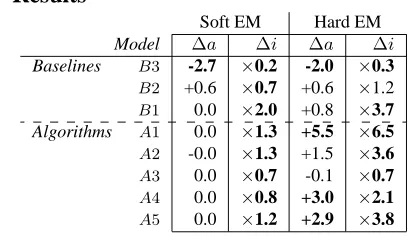
Table 2: Estimated additive changes in directed depen-dency accuracy (∆a) and multiplicative changes in the number of iterations before terminating (∆i) for all base-line models and lateen algorithms, relative to standard training: soft EM (left) and hard EM (right). Bold en-tries are statistically different (p < 0.01) from zero, for
∆a, and one, for∆i(details in Table 4 and Appendix A).
Not one baseline attained a statistically significant performance improvement. Shallow modelsB3{h,s},
in fact, significantly lowered accuracy: by 2.0%, on average (p≈7.8×10⁻⁴), forB3
h, which began with hard EM; and down 2.7% on average (p≈6.4×10⁻⁷), forB3s, started with soft EM. They were, however, 3–5x faster than standard training, on average (see Table 4 for all estimates and associated p-values; above, Table 2 shows a preview of the full results).
6.1 A1{h,s}— Simple Lateen EM
A1hruns 6.5xslower, but scores 5.5% higher, on av-erage, compared to standard Viterbi training;A1s is only 30% slower than standard soft EM, but does not impact its accuracy at all, on average.
Figure 2 depicts a sample training run: Italian ’07 withA1h. Viterbi EM converges after 47 iterations,
9
50 100 150 200 250 300 3.0
3.5 4.0 4.5
3.39
3.26
(3.42)
(3.19) 3.33
3.23
(3.39)
(3.18) 3.29
3.21 (3.39)
(3.18) 3.29
3.22 bpt
iteration
[image:5.612.71.299.68.144.2]cross-entropies (in bits per token)
Figure 2: Cross-entropies for Italian ’07, initialized uni-formly and trained on sentences up to length 45. The two curves are primary and secondary objectives (soft EM’s lies below, as sentence yields are at least as likely as parse trees): shaded regions indicate iterations of hard EM (pri-mary); and annotated values are measurements upon each optimizer’s convergence (soft EM’s are parenthesized).
reducing the primary objective to 3.39 bpt (the sec-ondary is then at 3.26); accuracy on the held-out set is 41.8%. Three alternations of lateen EM (totaling 265 iterations) further decrease the primary objec-tive to 3.29 bpt (the secondary also declines, to 3.22) and accuracy increases to 56.2% (14.4% higher).
6.2 A2{h,s} — Shallow Lateen EM
A2h runs 3.6xslower, but scores only 1.5% higher, on average, compared to standard Viterbi training; A2s is again 30% slower than standard soft EM and also has no measurable impact on parsing accuracy.
6.3 A3{h,s} — Early-Stopping Lateen EM
BothA3h andA3s run 30% faster, on average, than standard training with hard or soft EM; and neither heuristic causes a statistical change to accuracy.
Table 3 shows accuracies and iteration counts for 10 (of 23) train/test splits that terminate early with
A3s(in one particular, example setting). These runs
are nearly twice as fast, and only two score (slightly) lower, compared to standard training using soft EM.
6.4 A4{h,s} — Early-Switching Lateen EM
A4h runs only 2.1x slower, but scores only 3.0% higher, on average, compared to standard Viterbi training;A4sis, in fact, 20% faster than standard soft EM, but still has no measurable impact on accuracy.
6.5 A5{h,s} — Partly-Switching Lateen EM
A5h runs 3.8x slower, scoring 2.9% higher, on
av-erage, compared to standard Viterbi training;A5sis
20% slower than soft EM, but, again, no more accu-rate. Indeed,A4strictly dominates bothA5variants.
CoNLL Year Soft EM A3s
& Language DDA iters DDA iters Arabic 2006 28.4 180 28.4 118 Bulgarian ’06 39.1 253 39.6 131 Chinese ’06 49.4 268 49.4 204
Dutch ’06 21.3 246 27.8 35
Hungarian ’07 17.1 366 17.4 213 Italian ’07 39.6 194 39.6 164 Japanese ’06 56.6 113 56.6 93 Portuguese ’06 37.9 180 37.5 102 Slovenian ’06 30.8 234 31.1 118 Spanish ’06 33.3 125 33.1 73
Average: 35.4 216 36.1 125
Table 3: Directed dependency accuracies (DDA) and iter-ation counts for the 10 (of 23) train/test splits affected by early termination (setting: soft EM’s primary objective, trained using shorter sentences and ad-hoc initialization).
7 Discussion
Lateen strategies improve dependency grammar in-duction in several ways. Early stopping offers a clear benefit: 30% higher efficiency yet same perfor-mance as standard training. This technique could be used to (more) fairly compare learners with radically different objectives (e.g., lexicalized and unlexical-ized), requiring quite different numbers of steps (or magnitude changes in cross-entropy) to converge.
The second benefit is improved performance, but only starting with hard EM. Initial local optima dis-covered by soft EM are such that the impact on ac-curacy of all subsequent heuristics is indistinguish-able from noise (it’s not even negative). But for hard EM, lateen strategies consistently improve accuracy — by 1.5, 3.0 or 5.5% — as an algorithm follows the secondary objective longer (a single step, until the primary objective gets worse, or to convergence).
Our results suggest that soft EM should use early termination to improve efficiency. Hard EM, by con-trast, could use any lateen strategy to improve either efficiency or performance, or to strike a balance.
8 Related Work
8.1 Avoiding and/or Escaping Local Attractors
[image:5.612.322.531.71.216.2]step. Unlike generalized (GEM) variants (Neal and Hinton, 1999), lateen EM uses multiple objectives: it sacrifices the primary in the short run, to escape local optima; in the long run, it also does no harm, by construction (as it returns the best model seen).
Of the meta-heuristics that use more than a stan-dard, scalar objective, deterministic annealing (DA) (Rose, 1998) is closest to lateen EM. DA perturbs objective functions, instead of manipulating solu-tions directly. As other continuation methods (All-gower and Georg, 1990), it optimizes an easy (e.g., convex) function first, then “rides” that optimum by gradually morphing functions towards the difficult objective; each step reoptimizes from the previous approximate solution. Smith and Eisner (2004) em-ployed DA to improve part-of-speech disambigua-tion, but found that objectives had to be further “skewed,” using domain knowledge, before it helped (constituent) grammar induction. (For this reason, we did not experiment with DA, despite its strong similarities to lateen EM.) Smith and Eisner (2004) used a “temperature” βto anneal a flat uniform dis-tribution (β = 0) into soft EM’s non-convex objec-tive (β = 1). In their framework, hard EM corre-sponds toβ −→ ∞, so the algorithms differ only in theirβ-schedule: DA’s is continuous, from 0 to 1; la-teen EM’s is a discrete alternation, of 1 and+∞.10
8.2 Terminating Early, Before Convergence
EM is rarely run to (even numerical) convergence. Fixing a modest number of iterations a priori (Klein, 2005,§5.3.4), running until successive likelihood ra-tios become small (Spitkovsky et al., 2009,§4.1) or using a combination of the two (Ravi and Knight, 2009, §4, Footnote 5) is standard practice in NLP. Elworthy’s (1994,§5, Figure 1) analysis of part-of-speech tagging showed that, in most cases, a small number of iterations is actually preferable to conver-gence, in terms of final accuracies: “regularization by early termination” had been suggested for image deblurring algorithms in statistical astronomy (Lucy, 1974, §2); and validation against held-out data — a strategy proposed much earlier, in psychology (Lar-son, 1931), has also been used as a halting crite-rion in NLP (Yessenalina et al., 2010, §4.2, 5.2).
10One can think of this as a kind of “beam search” (Lowerre,
1976), with soft EM expanding and hard EM pruning a frontier.
Early-stopping lateen EM tethers termination to a
sign change in the direction of a secondary objective,
similarly to (cross-)validation (Stone, 1974; Geisser, 1975; Arlot and Celisse, 2010), but without splitting data — it trains using all examples, at all times.11,12
8.3 Training with Multiple Views
Lateen strategies may seem conceptually related to co-training (Blum and Mitchell, 1998). However, bootstrapping methods generally begin with some labeled data and gradually label the rest (discrimina-tively) as they grow more confident, but do not opti-mize an explicit objective function; EM, on the other hand, can be fully unsupervised, relabels all exam-ples on each iteration (generatively), and guarantees not to hurt a well-defined objective, at every step.13 Co-training classically relies on two views of the data — redundant feature sets that allow different al-gorithms to label examples for each other, yielding “probably approximately correct” (PAC)-style guar-antees under certain (strong) assumptions. In con-trast, lateen EM uses the same data, features, model and essentially the same algorithms, changing only their objective functions: it makes no assumptions, but guarantees not to harm the primary objective.
Some of these distinctions have become blurred with time: Collins and Singer (1999) introduced an objective function (also based on agreement) into co-training; Goldman and Zhou (2000), Ng and Cardie (2003) and Chan et al. (2004) made do without redundant views; Balcan et al. (2004) re-laxed other strong assumptions; and Zhou and Gold-man (2004) generalized co-training to accommodate three and more algorithms. Several such methods have been applied to dependency parsing (Søgaard and Rishøj, 2010), constituent parsing (Sarkar,
11We see in it a milder contrastive estimation (Smith and
Eis-ner, 2005a; 2005b), agnostic to implicit negative evidence, but caring whence learners push probability mass towards training examples: when most likely parse trees begin to benefit at the expense of their sentence yields (or vice versa), optimizers halt.
12
For a recently proposed instance of EM that uses cross-validation (CV) to optimize smoothed data likelihoods (in learn-ing synchronous PCFGs, for phrase-based machine translation), see Mylonakis and Sima’an’s (2010,§3.1) CV-EM algorithm.
13
2001) and parser reranking (Crim, 2002). Funda-mentally, co-training exploits redundancies in unla-beled data and/or learning algorithms. Lateen strate-gies also exploit redundancies: in noisy objectives. Both approaches use a second vantage point to im-prove their perception of difficult training terrains.
9 Conclusions and Future Work
Lateen strategies can improve performance and effi-ciency for dependency grammar induction with the DMV. Early-stopping lateen EM is 30% faster than standard training, without affecting accuracy — it reduces guesswork in terminating EM. At the other extreme, simple lateen EM is slower, but signifi-cantly improves accuracy — by 5.5%, on average — for hard EM, escaping some of its local optima.
It would be interesting to apply lateen algorithms to advanced parsing models (Blunsom and Cohn, 2010; Headden et al., 2009, inter alia) and learn-ing algorithms (Gillenwater et al., 2010; Cohen and Smith, 2009, inter alia). Future work could explore other NLP tasks — such as clustering, sequence la-beling, segmentation and alignment — that often employ EM. Our meta-heuristics are multi-faceted, featuring aspects of iterated local search, determin-istic annealing, cross-validation, contrastive estima-tion and co-training. They may be generally useful in machine learning and non-convex optimization.
Appendix A. Experimental Design
Statistical techniques are vital to many aspects of computational linguistics (Johnson, 2009; Charniak, 1997; Abney, 1996, inter alia). We used factorial designs,14 which are standard throughout the natu-ral and social sciences, to assist with experimental design and statistical analyses. Combined with or-dinary regressions, these methods provide succinct and interpretable summaries that explain which set-tings meaningfully contribute to changes in depen-dent variables, such as running time and accuracy.
14
We used full factorial designs for clarity of exposition. But many fewer experiments would suffice, especially in regression models without interaction terms: for the more efficient frac-tional factorial designs, as well as for randomized block designs and full factorial designs, see Montgomery (2005, Ch. 4–9).
9.1 Dependent Variables
We constructed two regressions, for two types of de-pendent variables: to summarize performance, we predict accuracies; and to summarize efficiency, we predict (logarithms of) iterations before termination. In the performance regression, we used four dif-ferent scores for the dependent variable. These in-clude both directed accuracies and undirected accu-racies, each computed in two ways: (i) using a best parse tree; and (ii) using all parse trees. These four types of scores provide different kinds of informa-tion. Undirected scores ignore polarity of parent-child relations (Paskin, 2001; Klein and Manning, 2004; Schwartz et al., 2011), partially correcting for some effects of alternate analyses (e.g., systematic choices between modals and main verbs for heads of sentences, determiners for noun phrases, etc.). And integrated scoring, using the inside-outside al-gorithm (Baker, 1979) to compute expected accu-racy across all — not just best — parse trees, has the advantage of incorporating probabilities assigned to individual arcs: This metric is more sensitive to the margins that separate best from next-best parse trees, and is not affected by tie-breaking. We tag scores using two binary predictors in a simple (first order, multi-linear) regression, where having multiple rel-evant quality assessments improves goodness-of-fit. In the efficiency regression, dependent variables are logarithms of the numbers of iterations. Wrap-ping EM in an inner loop of a heuristic has a mul-tiplicative effect on the total number of models re-estimated prior to termination. Consequently, loga-rithms of the final counts better fit the observed data.
9.2 Independent Predictors
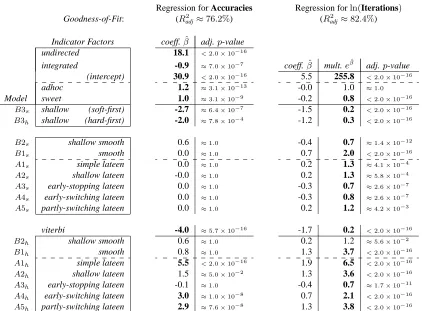
All of our predictors are binary indicators (a.k.a. “dummy” variables). The undirected and integrated factors only affect the regression for accuracies (see Table 4, left); remaining factors participate also in the running times regression (see Table 4, right). In a default run, all factors are zero, corresponding to the intercept estimated by a regression; other estimates reflect changes in the dependent variable associated with having that factor “on” instead of “off.”
• adhoc — This setting controls initialization.
Regression for Accuracies Regression forln(Iterations)
Goodness-of-Fit: (R2
adj≈76.2%) (R2adj≈82.4%)
Indicator Factors coeff.βˆ adj.p-value
undirected 18.1 <2.0×10⁻¹⁶
integrated -0.9 ≈7.0×10⁻⁷ coeff.βˆ mult.eβˆ adj.p-value (intercept) 30.9 <2.0×10⁻¹⁶ 5.5 255.8 <2.0×10⁻¹⁶
adhoc 1.2 ≈3.1×10⁻¹³ -0.0 1.0 ≈1.0
Model sweet 1.0 ≈3.1×10⁻⁹ -0.2 0.8 <2.0×10⁻¹⁶
B3s shallow (soft-first) -2.7 ≈6.4×10⁻⁷ -1.5 0.2 <2.0×10⁻¹⁶
B3h shallow (hard-first) -2.0 ≈7.8×10⁻⁴ -1.2 0.3 <2.0×10⁻¹⁶
B2s shallow smooth 0.6 ≈1.0 -0.4 0.7 ≈1.4×10⁻¹²
B1s smooth 0.0 ≈1.0 0.7 2.0 <2.0×10⁻¹⁶
A1s simple lateen 0.0 ≈1.0 0.2 1.3 ≈4.1×10⁻⁴
A2s shallow lateen -0.0 ≈1.0 0.2 1.3 ≈5.8×10⁻⁴
A3s early-stopping lateen 0.0 ≈1.0 -0.3 0.7 ≈2.6×10⁻⁷
A4s early-switching lateen 0.0 ≈1.0 -0.3 0.8 ≈2.6×10⁻⁷
A5s partly-switching lateen 0.0 ≈1.0 0.2 1.2 ≈4.2×10⁻³
viterbi -4.0 ≈5.7×10⁻¹⁶ -1.7 0.2 <2.0×10⁻¹⁶
B2h shallow smooth 0.6 ≈1.0 0.2 1.2 ≈5.6×10⁻²
B1h smooth 0.8 ≈1.0 1.3 3.7 <2.0×10⁻¹⁶
A1h simple lateen 5.5 <2.0×10⁻¹⁶ 1.9 6.5 <2.0×10⁻¹⁶
A2h shallow lateen 1.5 ≈5.0×10⁻² 1.3 3.6 <2.0×10⁻¹⁶
A3h early-stopping lateen -0.1 ≈1.0 -0.4 0.7 ≈1.7×10⁻¹¹
A4h early-switching lateen 3.0 ≈1.0×10⁻⁸ 0.7 2.1 <2.0×10⁻¹⁶
[image:8.612.90.512.69.380.2]A5h partly-switching lateen 2.9 ≈7.6×10⁻⁸ 1.3 3.8 <2.0×10⁻¹⁶
Table 4: Regressions for accuracies and natural-log-iterations, using 86 binary predictors (allp-values jointly adjusted for simultaneous hypothesis testing;{langyear}indicators not shown). Accuracies’ estimated coefficientsβˆthat are statistically different from 0 — and iteration counts’ multiplierseβˆsignificantly different from 1 — are shown in bold.
on, we use Klein and Manning’s (2004) “ad-hoc” harmonic heuristic, bootstrapped using sentences up to length 10, from the training set. • sweet — This setting controls the length
cut-off. By default, we train with all sentences con-taining up to 45 tokens; when it is on, we use Spitkovsky et al.’s (2009) “sweet spot” cutoff of 15 tokens (recommended for English, WSJ). • viterbi — This setting controls the primary
ob-jective of the learning algorithm. By default, we run soft EM; when it is on, we use hard EM. • {langyeari}22i=1— This is a set of 22 mutually-exclusive selectors for the language/year of a train/test split; default (all zeros) is English ’07.
Due to space limitations, we exclude langyear pre-dictors from Table 4. Further, we do not explore (even two-way) interactions between predictors.15
15This approach may miss some interesting facts, e.g., that
the adhoc initializer is exceptionally good for English, with soft
9.3 Statistical Significance
Our statistical analyses relied on the R package (R Development Core Team, 2011), which does not, by default, adjust statistical significance (p-values) for multiple hypotheses testing.16 We corrected this using the Holm-Bonferroni method (Holm, 1979), which is uniformly more powerful than the older (Dunn-)Bonferroni procedure; since we tested many fewer hypotheses (44 + 42 — one per inter-cept/coefficientβˆ) than settings combinations, its ad-justments to thep-values are small (see Table 4).17
EM. Instead it yields coarse summaries of regularities supported by overwhelming evidence across data and training regimes.
16Since we would expectp%of randomly chosen hypotheses to appear significant at thep%level simply by chance, we must take precautions against these and other “data-snooping” biases.
17
CoNLL Year A3s Soft EM A3h Hard EM A1h
& Language DDA iters DDA iters DDA iters DDA iters DDA iters
Arabic 2006 28.4 118 28.4 162 21.6 19 21.6 21 32.1 200
’7 – – 26.9 171 24.7 17 24.8 24 22.0 239
Basque ’7 – – 39.9 180 32.0 16 32.2 20 43.6 128
Bulgarian ’6 39.6 131 39.1 253 41.6 22 41.5 25 44.3 140
Catalan ’7 – – 58.5 135 50.1 48 50.1 54 63.8 279
Chinese ’6 49.4 204 49.4 268 31.3 24 31.6 55 37.9 378
’7 – – 46.0 262 30.0 25 30.2 64 34.5 307
Czech ’6 – – 50.5 294 27.8 27 27.7 33 35.2 445
’7 – – 49.8 263 29.0 37 29.0 41 31.4 307
Danish ’6 – – 43.5 116 43.8 31 43.9 45 44.0 289
Dutch ’6 27.8 35 21.3 246 24.9 44 24.9 49 32.5 241
English ’7 – – 38.1 180 34.0 32 33.9 42 34.9 186
German ’6 – – 33.3 136 25.4 20 25.4 39 33.5 155
Greek ’7 – – 17.5 230 18.3 18 18.3 21 21.4 117
Hungarian ’7 17.4 213 17.1 366 12.3 26 12.4 36 23.0 246
Italian ’7 39.6 164 39.6 194 32.6 25 32.6 27 37.6 273
Japanese ’6 56.6 93 56.6 113 49.6 20 49.7 23 53.5 91
Portuguese ’6 37.5 102 37.9 180 28.6 27 28.9 41 34.4 134
Slovenian ’6 31.1 118 30.8 234 – – 23.4 22 33.6 255
Spanish ’6 33.1 73 33.3 125 18.2 29 18.4 36 33.3 235
Swedish ’6 – – 41.8 242 36.0 24 36.1 29 42.5 296
Turkish ’6 – – 29.8 303 17.8 19 22.2 38 31.9 134
’7 – – 28.3 227 14.0 9 10.7 31 33.4 242
Average: 37.4 162 37.0 206 30.0 26 30.0 35 37.1 221
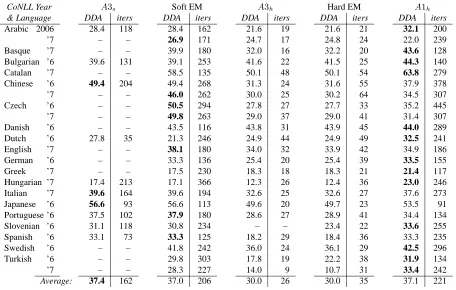
Table 5: Performance (directed dependency accuracies measured against all sentences in the evaluation sets) and efficiency (numbers of iterations) for standard training (soft and hard EM), early-stopping lateen EM (A3) and simple lateen EM with hard EM’s primary objective (A1h), for all 23 train/test splits, with adhoc and sweet settings on.
[image:9.612.78.534.70.360.2]9.4 Interpretation
Table 4 shows the estimated coefficients and their (adjusted)p-values for both intercepts and most pre-dictors (excluding the language/year of the data sets) for all 1,840 experiments. The default (English) sys-tem uses soft EM, trains with both short and long sentences, and starts from an uninformed uniform initializer. It is estimated to score 30.9%, converging after approximately 256 iterations (both intercepts are statistically different from zero:p <2.0×10⁻¹⁶).
As had to be the case, we detect a gain from
undi-rected scoring; integrated scoring is slightly (but
significantly: p≈ 7.0×10⁻⁷) negative, which is re-assuring: best parses are scoring higher than the rest and may be standing out by large margins. The
ad-hoc initializer boosts accuracy by 1.2%, overall (also
significant: p ≈ 3.1×10⁻¹³), without a measurable impact on running time (p ≈ 1.0). Training with fewer, shorter sentences, at the sweet spot gradation, adds 1.0% and shaves 20% off the total number of it-erations, on average (both estimates are significant).
We find the viterbi objective harmful — by 4.0%, on average (p≈5.7×10⁻¹⁶) — for the CoNLL sets. Spitkovsky et al. (2010a) reported that it helps on WSJ, at least with long sentences and uniform ini-tializers. Half of our experiments are with shorter sentences, and half use ad hoc initializers (i.e., three quarters of settings are not ideal for Viterbi EM), which may have contributed to this negative result; still, our estimates do confirm that hard EM is sig-nificantly (80%,p <2.0×10⁻¹⁶) faster than soft EM.
9.5 More on Viterbi Training
The overall negative impact of Viterbi objectives is a cause for concern: On average, A1h’s estimated
gain of 5.5% should more than offset the expected 4.0% loss from starting with hard EM. But it is, nev-ertheless, important to make sure that simple lateen EM with hard EM’s primary objective is in fact an improvement over both standard EM algorithms.
CoNLL Year A3s Soft EM A3h Hard EM A1h
& Language DDA iters DDA iters DDA iters DDA iters DDA iters
Arabic 2006 – – 33.4 317 20.8 8 20.2 32 16.6 269
’7 18.6 60 8.7 252 26.5 9 26.4 14 49.5 171
Basque ’7 – – 18.3 245 23.2 16 23.0 23 24.0 162
Bulgarian ’6 27.0 242 27.1 293 40.6 33 40.5 34 43.9 276
Catalan ’7 15.0 74 13.8 159 53.2 30 53.1 31 59.8 176
Chinese ’6 63.5 131 63.6 261 36.8 45 36.8 47 44.5 213
’7 58.5 130 58.5 258 35.2 20 35.0 48 43.2 372
Czech ’6 29.5 125 29.7 224 23.6 18 23.8 41 27.7 179
’7 – – 25.9 215 27.1 37 27.2 64 28.4 767
Danish ’6 – – 16.6 155 28.7 30 28.7 30 38.3 241
Dutch ’6 20.4 51 21.2 174 25.5 30 25.6 38 27.8 243
English ’7 – – 18.0 162 – – 38.7 35 45.2 366
German ’6 – – 24.4 148 30.1 39 30.1 44 30.4 185
Greek ’7 25.5 133 25.3 156 – – 13.2 27 13.2 252
Hungarian ’7 – – 18.9 310 28.9 34 28.9 44 34.7 414
Italian ’7 25.4 127 25.3 165 – – 52.3 36 52.3 81
Japanese ’6 – – 39.3 143 42.2 38 42.4 48 50.2 199
Portuguese ’6 35.2 48 35.6 224 – – 34.5 21 36.7 143
Slovenian ’6 24.8 182 25.3 397 28.8 17 28.8 20 32.2 121
Spanish ’6 – – 27.7 252 – – 28.3 31 50.6 130
Swedish ’6 27.9 49 32.6 287 45.2 22 45.6 52 50.0 314
Turkish ’6 – – 30.5 239 30.2 16 30.6 24 29.0 138
’7 – – 48.8 254 34.3 24 33.1 34 35.9 269
Average: 27.3 161 27.3 225 33.2 28 33.2 35 38.2 236
Table 6: Performance (directed dependency accuracies measured against all sentences in the evaluation sets) and efficiency (numbers of iterations) for standard training (soft and hard EM), early-stopping lateen EM (A3) and simple lateen EM with hard EM’s primary objective (A1h), for all 23 train/test splits, with setting adhoc off and sweet on.
Viterbi training: adhoc and sweet on. AlthoughA1h
scores 7.1% higher than hard EM, on average, it is only slightly better than soft EM — up 0.1% (and worse thanA1s). Without adhoc (i.e., using uniform
initializers — see Table 6), however, hard EM still improves, by 3.2%, on average, whereas soft EM drops nearly 10%; here,A1h further improves over
hard EM, scoring 38.2% (up 5.0), higher than soft EM’s accuracies from both settings (27.3 and 37.0). This suggests thatA1h is indeed better than both
standard EM algorithms. We suspect that our exper-imental set-up may be disadvantageous for Viterbi training, since half the settings use ad hoc initializ-ers, and because CoNLL sets are small. (Viterbi EM works best with more data and longer sentences.)
Acknowledgments
References
S. Abney. 1996. Statistical methods and linguistics. In J. L. Klavans and P. Resnik, editors, The Balancing
Act: Combining Symbolic and Statistical Approaches to Language. MIT Press.
E. L. Allgower and K. Georg. 1990. Numerical
Contin-uation Methods: An Introduction. Springer-Verlag.
S. Arlot and A. Celisse. 2010. A survey of cross-validation procedures for model selection. Statistics
Surveys, 4.
J. K. Baker. 1979. Trainable grammars for speech recog-nition. In Speech Communication Papers for the 97th
Meeting of the Acoustical Society of America.
M.-F. Balcan, A. Blum, and K. Yang. 2004. Co-training and expansion: Towards bridging theory and practice. In NIPS.
T. Berg-Kirkpatrick, A. Bouchard-Cˆot´e, J. DeNero, and D. Klein. 2010. Painless unsupervised learning with features. In NAACL-HLT.
A. Blum and T. Mitchell. 1998. Combining labeled and unlabeled data with co-training. In COLT.
P. Blunsom and T. Cohn. 2010. Unsupervised induction of tree substitution grammars for dependency parsing. In EMNLP.
P. F. Brown, V. J. Della Pietra, S. A. Della Pietra, and R. L. Mercer. 1993. The mathematics of statistical machine translation: Parameter estimation.
Computa-tional Linguistics, 19.
S. Buchholz and E. Marsi. 2006. CoNLL-X shared task on multilingual dependency parsing. In CoNLL. J. Chan, I. Koprinska, and J. Poon. 2004. Co-training
with a single natural feature set applied to email clas-sification. In WI.
M.-W. Chang, L. Ratinov, and D. Roth. 2007. Guiding semi-supervision with constraint-driven learning. In
ACL.
E. Charniak. 1997. Statistical techniques for natural lan-guage parsing. AI Magazine, 18.
S. B. Cohen and N. A. Smith. 2009. Shared logistic normal distributions for soft parameter tying in unsu-pervised grammar induction. In NAACL-HLT. M. Collins and Y. Singer. 1999. Unsupervised models
for named entity classification. In EMNLP.
M. Collins. 1999. Head-Driven Statistical Models for
Natural Language Parsing. Ph.D. thesis, University
of Pennsylvania.
J. Crim. 2002. Co-training re-rankers for improved parser accuracy.
S. Dasgupta, M. L. Littman, and D. McAllester. 2001. PAC generalization bounds for co-training. In NIPS. A. P. Dempster, N. M. Laird, and D. B. Rubin. 1977.
Maximum likelihood from incomplete data via the EM
algorithm. Journal of the Royal Statistical Society.
Se-ries B, 39.
I. S. Dhillon, Y. Guan, and J. Kogan. 2002. Iterative clustering of high dimensional text data augmented by local search. In ICDM.
D. Elworthy. 1994. Does Baum-Welch re-estimation help taggers? In ANLP.
S. Geisser. 1975. The predictive sample reuse method with applications. Journal of the American Statistical
Association, 70.
J. Gillenwater, K. Ganchev, J. Grac¸a, F. Pereira, and B. Taskar. 2010. Posterior sparsity in unsupervised dependency parsing. Technical report, University of Pennsylvania.
S. Goldman and Y. Zhou. 2000. Enhancing supervised learning with unlabeled data. In ICML.
W. P. Headden, III, M. Johnson, and D. McClosky. 2009. Improving unsupervised dependency parsing with richer contexts and smoothing. In NAACL-HLT. S. Holm. 1979. A simple sequentially rejective multiple
test procedure. Scandinavian Journal of Statistics, 6. J. P. A. Ioannidis. 2005. Why most published research
findings are false. PLoS Medicine, 2.
M. Johnson. 2009. How the statistical revolution changes (computational) linguistics. In EACL:
In-teraction between Linguistics and Computational Lin-guistics: Virtuous, Vicious or Vacuous?
M. Kearns, Y. Mansour, and A. Y. Ng. 1997. An information-theoretic analysis of hard and soft assign-ment methods for clustering. In UAI.
D. Klein and C. D. Manning. 2004. Corpus-based induc-tion of syntactic structure: Models of dependency and constituency. In ACL.
D. Klein. 2005. The Unsupervised Learning of Natural
Language Structure. Ph.D. thesis, Stanford
Univer-sity.
S. C. Larson. 1931. The shrinkage of the coefficient of multiple correlation. Journal of Educational
Psychol-ogy, 22.
P. Liang and D. Klein. 2008. Analyzing the errors of unsupervised learning. In HLT-ACL.
D. C. Liu and J. Nocedal. 1989. On the limited memory BFGS method for large scale optimization.
Mathemat-ical Programming. Series B, 45.
B. T. Lowerre. 1976. The HARPY Speech Recognition System. Ph.D. thesis, CMU.
L. B. Lucy. 1974. An iterative technique for the recti-fication of observed distributions. The Astronomical
Journal, 79.
X.-L. Meng. 2007. EM and MCMC: Workhorses for sci-entific computing (thirty years of EM and much more).
Statistica Sinica, 17.
B. Merialdo. 1994. Tagging English text with a proba-bilistic model. Computational Linguistics, 20. D. C. Montgomery. 2005. Design and Analysis of
Exper-iments. John Wiley & Sons, 6th edition.
M. Mylonakis and K. Sima’an. 2010. Learning prob-abilistic synchronous CFGs for phrase-based transla-tion. In CoNLL.
R. M. Neal and G. E. Hinton. 1999. A view of the EM algorithm that justifies incremental, sparse, and other variants. In M. I. Jordan, editor, Learning in Graphical
Models. MIT Press.
V. Ng and C. Cardie. 2003. Weakly supervised natural language learning without redundant views. In
HLT-NAACL.
K. Nigam and R. Ghani. 2000. Analyzing the effective-ness and applicability of co-training. In CIKM. J. Nivre, J. Hall, S. K¨ubler, R. McDonald, J.
Nils-son, S. Riedel, and D. Yuret. 2007. The CoNLL 2007 shared task on dependency parsing. In
EMNLP-CoNLL.
M. A. Paskin. 2001. Grammatical bigrams. In NIPS. F. Pereira and Y. Schabes. 1992. Inside-outside
reesti-mation from partially bracketed corpora. In ACL. R Development Core Team, 2011. R: A Language and
Environment for Statistical Computing. R Foundation
for Statistical Computing.
S. Ravi and K. Knight. 2009. Minimized models for un-supervised part-of-speech tagging. In ACL-IJCNLP. K. Rose. 1998. Deterministic annealing for clustering,
compression, classification, regression and related opt-mization problems. Proceedings of the IEEE, 86. A. Sarkar. 2001. Applying co-training methods to
statis-tical parsing. In NAACL.
R. Schwartz, O. Abend, R. Reichart, and A. Rappoport. 2011. Neutralizing linguistically problematic annota-tions in unsupervised dependency parsing evaluation. In ACL.
N. A. Smith and J. Eisner. 2004. Annealing techniques for unsupervised statistical language learning. In ACL. N. A. Smith and J. Eisner. 2005a. Contrastive estimation: Training log-linear models on unlabeled data. In ACL. N. A. Smith and J. Eisner. 2005b. Guiding unsupervised grammar induction using contrastive estimation. In
IJ-CAI: Grammatical Inference Applications.
A. Søgaard and C. Rishøj. 2010. Semi-supervised de-pendency parsing using generalized tri-training. In
COLING.
V. I. Spitkovsky, H. Alshawi, and D. Jurafsky. 2009. Baby Steps: How “Less is More” in unsupervised de-pendency parsing. In NIPS: Grammar Induction,
Rep-resentation of Language and Language Learning.
V. I. Spitkovsky, H. Alshawi, D. Jurafsky, and C. D. Man-ning. 2010a. Viterbi training improves unsupervised dependency parsing. In CoNLL.
V. I. Spitkovsky, D. Jurafsky, and H. Alshawi. 2010b. Profiting from mark-up: Hyper-text annotations for guided parsing. In ACL.
M. Stone. 1974. Cross-validatory choice and assessment of statistical predictions. Journal of the Royal
Statisti-cal Society. Series B, 36.
A. Yessenalina, Y. Yue, and C. Cardie. 2010. Multi-level structured models for document-Multi-level sentiment classification. In EMNLP.