J. Software Engineering & Applications, 2009, 2: 103-110
doi:10.4236/jsea.2009.22015 Published Online July 2009 (www.SciRP.org/journal/jsea)
Autonomic Software Component QoS Matchmaking
Algorithm Based on Fidelity Factor in Agent-Based
Autonomic Computing System
KunZhang1,2, Manwu Xu2, Hong Zhang1
1
School of Computer Science & Technology, Nanjing University of Science & Technology, Nanjing, China; 2State Key Laboratory for Novel Software, Nanjing University, Nanjing, China.
Email: [email protected]
Received December 8th, 2008; revised March 20th, 2009; accepted March 31st, 2009.
ABSTRACT
Autonomic software component (ASC) QoS matchmaking problem for autonomic element has been taken as one of the
most important issue in field of autonomic computing based on agent. Aimed at overcoming drawbacks such as subjec-tiveness and unfairness, and improving the self-configuration capability for autonomic element, we introduce evalua-tion mechanism of confidence of individual QoS attributes during ASC QoS matchmaking, i.e., fidelity factor for each attribute, and propose an ASC QoS matchmaking algorithm based on fidelity factor. Simulation experiments demon-strate that our proposed algorithm performs best performance in terms of QoS than other existing algorithms, and has better compromise between attribute quality and users’ evaluation when selecting ASC.
Keywords: Autonomic Software Component, QoS Matchmaking, Fidelity Factor, Autonomic Computing, Autonomic Element
1. Introduction
In mid-October 2001, aimed at the problem of looming software complexity crisis, IBM Company innovatively proposed autonomic computing [1] technology – com-puting systems that can manage themselves given high-level objectives from administrators. An autonomic software component (ASC, or element, in IBM parlance) [1] is—
“The fundamental atom of autonomic applications and systems—a modular unit of composition with contractu-ally specified interfaces, explicit context dependencies, and mechanisms for self management, responsible for providing its own services, constraints (e.g., system re-source requirements, performance requirements, etc.), managing its own behavior in accordance with context, rules, and policies, and interacting with other autonomic components. [1]”
Autonomic software components will have complex life cycles, continually carrying on multiple threads of activity, and continually sensing and responding to the environment in which they are situated. Autonomy, pro-activity, and goal-directed interactivity with their envi-ronment are distinguishing characteristics of software agents. Viewing autonomic software components as agents and autonomic systems as multi-agent systems makes
it clear that agent-oriented architectural concepts will be critically important [2].
In order to efficiently accomplish the self-configurati- on and self-management between ASCs, one of the most important issues is how to design an efficient autonomic software component matchmaking algorithm to find ap-propriate provider(s) for a consumer according to the providers’ advertising description.
algorithms didn’t be considered the user’s feeling and satisfaction.
Aimed at overcoming the above difficulties, we intro-duce evaluation mechanism of confidence of individual QoS attributes during ASC QoS matchmaking, i.e., fidel-ity factor for each attribute, and propose an ASC QoS matchmaking algorithm based on fidelity factor, which will improve the facility and fairness concerned with QoS attributes, and objectively select optimal ASC with QoS performance.
The rest of the paper is organized as follows. Some of the existing work related to this paper is described in Section 2. Section 3 gives our proposed ASC match-making algorithm in detail. A case study and simulation results are presented in Section 4. Section 5 concludes the paper.
2. Related Work
In recent years, much research has been devoted to the development of software component matchmaking algo-rithms for agent or autonomic element [3,4,5,6,7,8]. Wickler [3] addressed the problem of capability broker-ing agent, and proposed a new capability description language (CDL) for the representation of agent capabili-ties. Sycara [4] defined a language called LARKS for agent advertisements and requests, and presented a flexi-ble and efficient matchmaking process that used LARKS. LARKS performed both syntactic and semantic matching, and in addition allowed the specification of concepts (local ontologies) via ITL, a concept language. The es-tablishment for semantic distance consumed much workload, so that their matching algorithm had limita-tions on practicability and reliability. Arisha et al. [5] provided approximate software agent service match-making by using semantic distance. Whereas, the algo-rithm could not support definition of data type and de-script software component efficiently. However, neither of the above algorithms considered the factors of qual-ity-of-service attribution, such as cost, time, and reliabil-ity. Zhang [6] and Jiang [7] analyzed the drawbacks in previous papers, i.e., the matchmaking was only based on the advertised capabilities of provider agents or soft-ware components. They considered the matchmaking influenced by QoS of software components, and indi-vidually presented software components matchmaking algorithm based on QoS. In [6], it was argued that the practical performance of provider agents had a signifi-cant impact on the matchmaking outcomes of middle agents. The authors’ proposed algorithm could pick up the provider agents based on the history information in accomplishing similar tasks in the past rather than choosing randomly. At the launching of an agent system, the proposed algorithm provided initial values of the
track records. With agents’ history information and the initial values of the track records, the quality of match-making algorithms could be improved significantly, and the returned results were more accurate and reasonable. Jiang [7] pointed out that there were two drawbacks us-ing the track records in [6], i.e., the value of track re-cords was too subjective, and track record model is too simple to judge agent services’ performance more accu-rately. So, the authors in [7] presented QoS-driven matchmaking algorithm, which aimed at matching the best satisfying agent for user. It is pity for the above two algorithms that the authors didn’t consider the user’s feeling and satisfaction when selecting agents or soft-ware components. The authors in [8] studied agent ser-vice selection and matchmaking in manufacturing indus-try field. They applied the idea of rough sets theory and fuzzy information filter to reclaim agent selection prob-lem and realized reasonable evaluation for recycling quotient. Their algorithm was easy to select optimum reclaiming agent for manufacturer. However, their method belonged to specific field and non-universal.
Autonomic Software Component QoS Matchmaking Algorithm Based on Fidelity 105 Factor in Agent-Based Autonomic Computing System
process. However, they didn’t offer useful results for over-constrained demands. In addition, although they were capable of, they did not perform semantic QoS metric matching. Guo et al. [13] proposed three-dimen-sional QoS model of web services, and designed a web services selection algorithm. In their algorithm, the con-cept and measure method of web service effectiveness were proposed, and then a web service ranking algorithm based on the effectiveness of web service was designed. The comprehensive experiment showed their proposed model possessed high precision, high response rate and better influence on the load balance of web service. Li-ang Kai-jian [14] studied QoS support problem in Ser-vice-oriented Grid system, and presented a new parame-ter called GSQN(Grid Service Quality Number) to depict the profile of qualitative characteristics of a grid service. Based on this idea, the author proposed a strategy of matchmaking with a price model to match grid service.
3. Our Proposed Matchmaking Algorithm
3.1 Problem Description
Definition 1. Autonomic software component
match-making based on QoS problem. Given the set of ASC
providers , an ASC
re-quester rasc, autonomic software component match-making based on QoS problem is to find an ASC such that their QoS level is maximized.
1, 2,..., nPASC pasc pasc pasc
3.2 QoS Model for Autonomic Software Component
Definition 2. Autonomic software component QoS mod-
el for autonomic element is a 6-tuple as follows:
_ _ ( , , , , ,
qos model asc t c rel m rep fid)
(1)
where t is ASC response time from sending request to receiving result, including process time and transmission delay time, i.e., qtime(asc) = Tprocess(asc) + Ttrans(asc); c is
ASC cost, and represents the expenses paid by users to ASC provider; rel is a metric of reliability, denoting the probability of ASC providing its registered software component; rel is a technical measure related to hard-ware and/or softhard-ware configuration of ASCs and the net-work connections between the ASC requesters and pro-viders. m denotes the probability of accurate mainte-nance when an exception occurs for an ASC; rep is a measure of ASCs’ trustworthiness or satisfaction degree, and denotes users’ (or requesters’) satisfaction to ASC.
rep mainly depends on end user’s experiences of using the ASC. Different end users may have different opin-ions or satisfaction degree on the same ASC. Usually, the end users or requesters are given a range to rank or
score ASCs, for example, in Amazon.com, the range is [0,5]. In this paper, the range is [0,1].
The first four QoS attributes are often published by ASC providers themselves, and describe the basic QoS performance of an ASC, so most of the authors took them as quality criteria for an ASC. However, such crite-rion is too subjective to reflect actual quality of ASC. In this paper, we introduce attribute “reputation” to meas-ure users’ satisfaction degree. On the other hand, fidelity
vector is added to the QoS model to improve the impar-tiality and objectivity. Fidelity is treated as a vector composed of fidelity attributes. Each fidelity attribute refers to the confidence or fidelity of above first four QoS attributes, i.e.,
, , ,
t c rel m
fid fid fid fid fid (2)
3.3 Matchmaking Algorithm Description
In our proposed QoS matchmaking algorithm, the draw-backs in [6] and [7] such as subjectiveness and unfair-ness are overcame through introducing evaluation mechanism of confidence of individual QoS attributes, i.e., fidelity factor for each attribute, which can improve the self-configuration capability for autonomic element.
The basic idea of our algorithm is as follows: firstly, normalizing each attribute in QoS description to range [0,1] for each ASC in initial set; then fidelity of each attribute is considered to evaluate QoS overall perform-ance for every ASC comprehensively and objectively; finally, an ASC whose total QoS value is maximal is picked out from all candidates.
Concretely, suppose that there is a set of ASC pro-viding a certain software function, i.e. PASC
pasc pasc1, 2,...,pascn
. By merging the quality vectors of all these candidates, a matrix
i j,
is built according with Definition 2, in which each row
Qj corresponds to an ASC pasci while each column
corresponds to a QoS attribute value. Let a matrix ,1
Q i
Q n,1 j 5
fidi j, ,1 i n,1 j 4
F denote confidence fidelity of the first four QoS attributes for pasci. There are two
phases as follows: 1) Scaling phase.
Some of the QoS attributes could be negative, i.e., the higher the value, the lower the quality, such as time, cost. Other QoS attributes are positive, i.e., the higher the value, the higher the quality, such as reliability,
main-tainability, and reputation. For negative attributes,
ues are scaled according to (3). For positive criteria, val-ues are scaled according to (4).
max
, max min
max min
,
max min
0 , 1,
1 0
j i j
j j
j j
i j
j j
Q Q
if Q Q
Q Q
M j
if Q Q
min
, max min
max min
,
max min
, 0
, 3, 4,
1 0
i j j
j j
j j
i j
j j
Q Q
if Q Q
Q Q
M
if Q Q
5
j (4)
In the above equations, and are the maxi-mal and minimaxi-mal value of the jth QoS attribute, respec-tively. Let i j, be
normaliz-ing matrix accordnormaliz-ing to Q, where i j, max
j
Q
,1
min
j
Q
M ,1 i n j 5
M
M denotes nor-malizing value of the jth QoS attribute for ASC provider
pasci.
Proof. In scaling phase, the time complexity of getting
normalizing matrix for all attributes is O(kn), where k is the number of attributes (constant), in this work, k=5. Then, weighting phase takes O(n). So, the worst time of algorithm is O(n).
4. Simulation Results
4.1 A Case Study
A case study of our proposed matchmaking algorithm will be given for explaining the effect of our proposed algorithm. The following experiment method will be used to select the most satisfactory ASC. Suppose the initial providers have 10 ASCs, i.e., PASC
pasc pasc1, 2,,pasc10
. It means that these ten ASCscan provide the same or closely similar capabilities. 2) Weighting phase.
The following formula is used to calculate the overall quality score of ASC provider pasci.
4
, , 5
1
( i) ( j i j i j) i j
qos pasc w M fid w M
,51
(5)
The QoS values of 10 ASCs are generated through the following simulation. Assume that there are 50 similar tasks (or ASC requests). For each request, we randomly delegate it to an ASC, pasci, from PASC, and randomly
generate QoS attribute values and their fidelity values, denoting QoS value of pasci in this request. In these
at-tributes, t is randomly distributed between 70 and 100 ms;
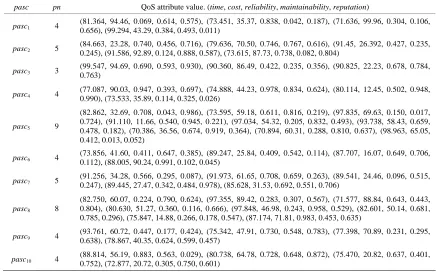
c is uniformly distributed [10, 100] $; rel, m, rep is ran-domly generated in [0,1]. The fidelity for the first four attributes is in [0,1]. The QoS values of 10 ASCs for 50 requests are shown in Table 1, where pn denotes pro-vided ASC number of pasci for all requests.
where, is the weight value of the jth QoS attribute,
. End users express their
prefer-ences regarding QoS by providing values for the weight wj.
j
w
0w 1
5
1
,
j j
j w
3.4 Algorithm Analysis
Theorem 1. In worse case, the time complexity of our
[image:4.595.78.518.442.716.2]proposed algorithm is O(n), where n is the total number of ASC providers.
Table 1. The QoS values of 10 ASCs for 50 request
pasc pn QoS attribute value. (time, cost, reliability, maintainability, reputation)
pasc1 4 (81.364, 94.46, 0.069, 0.614, 0.575), (73.451, 35.37, 0.838, 0.042, 0.187), (71.636, 99.96, 0.304, 0.106, 0.656), (99.294, 43.29, 0.384, 0.493, 0.011)
pasc2 5
(84.663, 23.28, 0.740, 0.456, 0.716), (79.636, 70.50, 0.746, 0.767, 0.616), (91.45, 26.392, 0.427, 0.235, 0.245), (91.586, 92.89, 0.124, 0.888, 0.587), (73.615, 87.73, 0.738, 0.082, 0.804)
pasc3 3 (99.547, 94.69, 0.690, 0.593, 0.930), (90.360, 86.49, 0.422, 0.235, 0.356), (90.825, 22.23, 0.678, 0.784,
0.763)
pasc4 4 (77.087, 90.03, 0.947, 0.393, 0.697), (74.888, 44.23, 0.978, 0.834, 0.624), (80.114, 12.45, 0.502, 0.948,
0.990), (73.533, 35.89, 0.114, 0.325, 0.026)
pasc5 9
(82.862, 32.69, 0.708, 0.043, 0.986), (73.595, 59.18, 0.611, 0.816, 0.219), (97.835, 69.63, 0.150, 0.017, 0.724), (91.110, 11.66, 0.540, 0.945, 0.221), (97.034, 54.32, 0.205, 0.832, 0.493), (93.738, 58.43, 0.659, 0.478, 0.182), (70.386, 36.56, 0.674, 0.919, 0.364), (70.894, 60.31, 0.288, 0.810, 0.637), (98.963, 65.05, 0.412, 0.013, 0.052)
pasc6 4
(73.856, 41.60, 0.411, 0.647, 0.385), (89.247, 25.84, 0.409, 0.542, 0.114), (87.707, 16.07, 0.649, 0.706, 0.112), (88.005, 90.24, 0.991, 0.102, 0.045)
pasc7 5 (91.256, 34.28, 0.566, 0.295, 0.087), (91.973, 61.65, 0.708, 0.659, 0.263), (89.541, 24.46, 0.096, 0.515, 0.247), (89.445, 27.47, 0.342, 0.484, 0.978), (85.628, 31.53, 0.692, 0.551, 0.706)
pasc8 8
(82.750, 60.07, 0.224, 0.790, 0.624), (97.355, 89.42, 0.283, 0.307, 0.567), (71.577, 88.84, 0.643, 0.443, 0.804), (80.630, 51.27, 0.360, 0.116, 0.666), (97.848, 46.98, 0.243, 0.958, 0.529), (82.601, 50.14, 0.681, 0.785, 0.296), (75.847, 14.88, 0.266, 0.178, 0.547), (87.174, 71.81, 0.983, 0.453, 0.635)
pasc9 4 (93.761, 60.72, 0.447, 0.177, 0.424), (75.342, 47.91, 0.730, 0.548, 0.783), (77.398, 70.89, 0.231, 0.295,
0.638), (78.867, 40.35, 0.624, 0.599, 0.457)
pasc10 4
(88.814, 56.19, 0.883, 0.563, 0.029), (80.738, 64.78, 0.728, 0.648, 0.872), (75.470, 20.82, 0.637, 0.401, 0.752), (72.877, 20.72, 0.305, 0.750, 0.601)
Autonomic Software Component QoS Matchmaking Algorithm Based on Fidelity 107 Factor in Agent-Based Autonomic Computing System
The QoS values in matrix Q and the confidence fidel-ity matrix of the first four QoS attributes for ASC pasci
are the mean value of the results produced by its pro-vided software component number, respectively. The QoS values matrix Q, confidence fidelity matrix F, and normalizing matrix M are as follows.
81.44, 68.27, 0.40, 0.31, 0.36 84.19, 60.16, 0.56, 0.49, 0.59 93.58, 67.80, 0.60, 0.54, 0.68 76.41, 45.65, 0.64, 0.62, 0.58 86.27, 49.76, 0.47, 0.54, 0.43 84.70, 43.44, 0.62, 0.50, 0.16 89.57, 35.88, 0.48
Q
, 0.50, 0.46 84.47, 59.18, 0.46, 0.50, 0.58 81.34, 54.97, 0.51, 0.40, 0.58 79.47, 40.63, 0.64, 0.59, 0.56
(6)
0.34, 0.15, 0.41, 0.40
0.68, 0.47, 0.81, 0.36
0.54, 0.53, 0.41, 0.62
0.41, 0.76, 0.38, 0.26
0.51, 0.69, 0.43, 0.65
0.35, 0.30, 0.46, 0.48
0.60, 0.18, 0.66, 0.67
0.51, 0.42, 0.37, 0.46
0.42, 0.65, 0.50, 0.47
F
0.51, 0.65, 0.45, 0.47
(7)
0.71, 0.00, 0.00, 0.00, 0.37
0.55, 0.25, 0.65, 0.55, 0.83
0.00, 0.01, 0.83, 0.72, 1.00
1.00, 0.70, 0.99, 1.00, 0.81
0.43, 0.57, 0.31, 0.73, 0.51
0.52, 0.77, 0.90, 0.60, 0.00
0.23, 1.00, 0.34, 0.60, 0.56
0. M
53, 0.28, 0.26, 0.61, 0.81
0.71, 0.41, 0.46, 0.29, 0.79
0.82, 0.85, 1.00, 0.89, 0.77
(8)
Suppose that weight values of each QoS attribute de-fined by users are: w1=0.15, w2=0.2, w3=0.2, w4=0.15 and w5=0.3. The overall quality scores of each ASC pro-vider by using Formula (5) are shown in Table 2.
It is easy to see from Table 1 that pasc10 has maximal QoS score among all ASCs, and this ASC will be se-lected as optimal one with QoS performance.
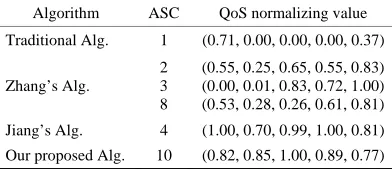
The matchmaking result ASCs and their normalizing matrix are shown in Table 3 by using traditional algo-rithm, Zhang’s algorithm [6] and Jiang’s algorithm [7], respectively.
In traditional matchmaking algorithm, the first ASC is usually selected as match result, i.e., pasc1. In Zhang’s algorithm, the track records concept is equivalent to the fifth QoS attribute in our algorithm, i.e., reputation. So, the result QoS scores of each agent are: -1, 1.33, 1.33, 0.67, -1.33, -3.33, -1, 1.33, 0.67, 1. As a result, pasc2, or
pasc3, or pasc8 with maximal value (1.33) will be se-lected. Finally, Jiang’s algorithm will be compared with our proposed algorithm, and fidelity factor is not consid-ered by Jiang’s algorithm. The overall QoS scores of each ASC by using their algorithm are: 0.218, 0.594, 0.576, 0.880, 0.503, 0.501, 0.562, 0.521, 0.562, 0.858. Obviously, pasc4 (score is 0.880) is optimal ASC.
[image:5.595.319.525.536.602.2]We can see from normalizing matrix M in Table 2, QoS performance (0.82, 0.85, 1.00, 0.89, 0.77) of pasc10 gives slightly worse than performance (1.00, 0.70, 0.99, 1.00, 0.81) of pasc4. But, fidelity performance of QoS attributes of pasc10 (0.51, 0.65, 0.45, 0.47) is evidently better than that of pasc4 (0.41, 0.76, 0.38, 0.26). This phenomenon shows that some ASC providers usually claim their higher QoS attribute performance like pasc4, but if the confidence fidelity or users’ feeling degree is also considered when selecting ASC, the overall quality or performance for these ASCs is not necessarily optimal. This point accords with the practical situation on Internet, such as e-business, online shopping, in which, people have always compromised selection need software func-tion between quality and users’ evaluafunc-tion. Therefore, our proposed QoS matchmaking algorithm is effective and reasonable.
Table 2. The QoS score for each ASC provider
ASC overall QoS ASC overall QoS
1 0.147 6 0.200 2 0.463 7 0.332 3 0.437 8 0.368 4 0.525 9 0.402
5 0.363 10 0.558
Table 3. Results by using different algorithms
Algorithm ASC QoS normalizing value
Traditional Alg. 1 (0.71, 0.00, 0.00, 0.00, 0.37)
Zhang’s Alg.
2 3 8
(0.55, 0.25, 0.65, 0.55, 0.83) (0.00, 0.01, 0.83, 0.72, 1.00) (0.53, 0.28, 0.26, 0.61, 0.81)
Jiang’s Alg. 4 (1.00, 0.70, 0.99, 1.00, 0.81)
[image:5.595.326.522.628.713.2]4.2 Simulation Experiment
To evaluate the impact of fidelity on the final match-making results, we conduct the following simulations and compare the matchmaking results of our algorithm with Jiang’s algorithm.
For the sake of simple, suppose that there are 10 initial ASCs. At each experiment, we randomly generate QoS attributes and fidelity values of each ASC according to the following strategy: t is randomly distributed between 10 and 100 ms; c is uniformly distributed [70, 100] $; rel,
m, rep is randomly generated in [0,1]. The fidelity for the first four attributes is in [0,1]. At each experiment point, we record average values M of normalizing matrix M
and average fidelity values F of matrix F of selected ASC with highest score by using Jiang’s algorithm and our algorithm, respectively, i.e.,
5 4
, ,
1
( ) , ( )
5 4
i j i j
j j 1
M fid
M i F i
(9)
where, i is numbering of ASC with highest QoS per-formance selected by using Jiang’s algorithm or our al-gorithm. Let Qei(i) in Formula (10) denote QoS
evalua-tion index for current algorithm, in order to measure final QoS evaluation of selected ASC. The higher the Qei, the
greater the comprehensive quality performance. In which,
1
and 2 are evaluation weight for QoS attribute and
fidelity factor.
1 2
( ) ( ) ( )
ei
Q i M i F i (10)
Simulations are divided into three groups for different weight values of the QoS attributes in Formula (5) con-sidering different users’ quality preference.
Group 1: , denoting un-
biasedness;
1 2 3 4 5 0.2
w w w w w
Group 2: , showing
preference for t and c;
1 2 0.35, 3 4 5 0.1
w w w w w
Group 3: 1 2 showing
preference for other attributes.
3 4 5
0.125, 0.25,
w w w w w
For each group, we run the experiments for different evaluation weights pair, i.e., 1 from 0.9 down to 0.1,
while 2 from 0.1 up to 0.9. We record average value
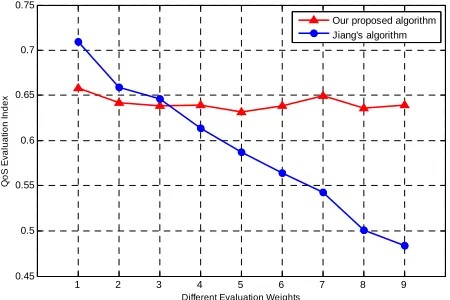
of QoS evaluation index for 100 times in each point. The simulation results are shown in Figure 1, Figure 2, and Figure 3, respectively.
It can be seen from three figures that our algorithm gives higher QoS evaluation index performance than Jiang’s algorithm in most cases for every group. More-over, we observe from all figures that the performance of our algorithm is more stable, and the performance of
Jiang’s algorithm decreases as 1 decreases. This is
because that Jiang’s algorithm depends too much upon QoS values themselves, whereas QoS values and users’ confidence fidelity are better compromised in our algo-rithm.
1 2 3 4 5 6 7 8 9 0.45
0.5 0.55 0.6 0.65 0.7 0.75
Different Evaluation Weights
Q
oS
E
v
aluat
ion
In
dex
[image:6.595.312.537.166.316.2]Our proposed algorithm Jiang's algorithm
Figure 1. QoS evaluation index vs weights for Group1
1 2 3 4 5 6 7 8 9 0.45
0.5 0.55 0.6 0.65 0.7 0.75
Different Evaluation Weights
Q
oS
E
v
al
ua
ti
o
n I
n
de
x
[image:6.595.315.537.357.508.2]Our proposed algorithm Jiang's algorithm
Figure 2. QoS evaluation index vs weights for Group2
1 2 3 4 5 6 7 8 9 0.45
0.5 0.55 0.6 0.65 0.7 0.75
Different Evaluation Weights
Q
oS
E
v
a
luat
ion
Ind
ex
Our proposed algorithm Jiang's algorithm
[image:6.595.312.537.547.698.2]Autonomic Software Component QoS Matchmaking Algorithm Based on Fidelity Factor in Agent-Based Autonomic Computing System
109
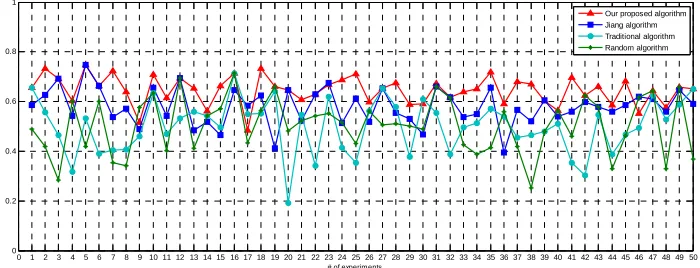
To evaluate the effect of our proposed algorithm fur-ther, we conduct the following simulations and compare the QoS evaluation index of our algorithm with Jiang’s algorithm, Traditional algorithm and Random algorithm. In traditional algorithm, the first ASC is selected as match result, i.e., pasc1. Random algorithm randomly
selects ASC. The simulations are also divided into three groups for different weight values of the QoS attributes as above. In each group, we assume there are 50 similar tasks (or ASC requests) and 10 ASC providers. At each experiment point, we record final QoS evaluation of
selected ASC by using four algorithms, respectively. The simulation results for three groups are shown in Figure 4, Figure 5, and Figure 6, respectively.
It can be seen from above three figures that our algo-rithm gives best QoS performance among compared four algorithms. In almost all experiment request point, the QoS evaluation index of selected optimal ASC by using our algorithm is higher than other three algorithms. The simulation results demonstrate better compromised se-lection between quality and users’ evaluation in our al-gorithm.
0 1 2 3 4 5 6 7 8 9 10 11 12 13 14 15 16 17 18 19 20 21 22 23 24 25 26 27 28 29 30 31 32 33 34 35 36 37 38 39 40 41 42 43 44 45 46 47 48 49 50 0
0.2 0.4 0.6 0.8 1
# of experiments
Q
oS
E
v
al
uat
ion I
ndex
[image:7.595.125.475.224.358.2]Our proposed algorithm Jiang algorithm Traditional algorithm Random algorithm
Figure 4. A comparison on QoS evaluation index of selected optimal ASC for Group1
0 1 2 3 4 5 6 7 8 9 10 11 12 13 14 15 16 17 18 19 20 21 22 23 24 25 26 27 28 29 30 31 32 33 34 35 36 37 38 39 40 41 42 43 44 45 46 47 48 49 50 0.2
0.4 0.6 0.8 1
# of experiments
Q
oS
E
v
al
uat
io
n
Ind
ex
[image:7.595.119.479.389.529.2]Our proposed algorithm Jiang algorithm Traditional algorithm Random algorithm
Figure 5. A comparison on QoS evaluation index of selected optimal ASC for Group2
0 1 2 3 4 5 6 7 8 9 10 11 12 13 14 15 16 17 18 19 20 21 22 23 24 25 26 27 28 29 30 31 32 33 34 35 36 37 38 39 40 41 42 43 44 45 46 47 48 49 50 0
0.2 0.4 0.6 0.8 1
# of experim ents
Q
o
S
E
v
a
lu
at
ion
I
nde
x
[image:7.595.122.479.557.704.2]Our proposed algorithm Jiang algorithm Traditional algorithm Random algorithm
5. Conclusions
In this paper, we discuss the autonomic software com-ponent QoS matchmaking problem for autonomic ele-ment, which has been taken as one of the most important issue in field of autonomic computing, especially in agent-based autonomic computing system. A QoS model for ASC is built, and on basis of which, an ASC QoS matchmaking algorithm based on fidelity factor is pro-posed. Main work in this paper has following character-istics:
1) Our proposed QoS model for ASC is simple and effective, and it does not limit type, amount, and value of QoS attributes, which shows better scalability and flexi-bility.
2) During ASC matchmaking process, we introduce evaluation mechanism of confidence of individual QoS attributes, i.e., fidelity factor for each attribute, which can overcome drawbacks such as subjectiveness and unfairness, and improve the self-configuration capability for autonomic element.
3) Simulation experiments demonstrate the effective and correction of our algorithm for matchmaking, and perform best performance in terms of QoS than other existing algorithms.
4) Simulations show also that our algorithm has better compromise between attribute quality and users’ evalua-tion when selecting ASC. Our proposed algorithm is suitable for many situations on Internet, such as e-business, online shopping, in which, people have al-ways compromised selection need software function between quality and users’ evaluation.
6. Acknowledgements
This work is supported by the National Natural Science Foundation of China under Grant No. 90718021.
REFERENCES
[1] J. Kephart and D. Chess, “The vision of autonomic com-puting,” IEEE Computer Society, No. 1, pp. 41-59, 2003. [2] N. R. Jennings, “On agent-based software engineering,”
Artificial Intelligence, Vol. 177, No. 2, pp. 277-296, 2000. [3] G. J. Wickler, “Using expressive and flexible action rep-resentations to reason about capabilities for intelligent agent cooperation,” PhD Thesis, University of Edinburgh, Edinburgh, UK, 1999.
[4] K. Sycara, S. Widoff, M. Klusch, et al., “LARKS: Dy-namic matchmaking among heterogenous software agents in cyberspace,” Autonomous Agents and MultiAgent Systems, Vol. 5, No. 2, pp. 173-203, 2002.
[5] K. Arisha, S. Kraus, F. Ozcan, et al., “IMPACT: The interactive Maryland platform for agents collaborating together,” IEEE Intelligent Systems, Vol. 14, No. 2, pp. 64-72, 1999.
[6] Z. L. Zhang and C. Q, Zhang, “An improvement to match-making algorithms for middle agents,” in AAMAS’02: Proceedings of the First International Joint Conference on Autonomous Agents and Multiagent Systems, Bologna, Italy, pp. 1340-1347, 2002.
[7] Y. C. Jiang and Z. Z. Shi, “Quality of service driven agent service matchmaking,” Mini-Micro Systems, Vol. 26, No. 4, pp. 687-692, 2005.
[8] R. J. Wang, Y. H. Ru, and X. X. Zhu, “Study on reclaim-ing agent selection models and approaches,” in IEEE SOLI’08: Proceedings of IEEE Service Operations and Logistics, and Informatics, Beijing, China, Vol. 1, pp. 1262-1267, 2008.
[9] Q. Ma, H. Wang, Y. Li, et al., “A semantic QoS-aware discovery framework for web services,” in IEEE ICWS’08: Proceedings of IEEE International Conference on Web Services, Beijing, China, pp. 129-136, 2008. [10] R. Hu, J. X. Liu, Z. H. Liao, et al., “A web service
matchmaking algorithm based on an extended QoS model,” in IEEE ICNSC’08: Proceedings of IEEE Inter-national Conference on Networking, Sensing and Control, Sanya, China, pp. 1565-1570, 2008.
[11] L. L. Wei, C. L. Chi, M. C. Kuo, et al., “Consumer-centric QoS-aware selection of web services,” Journal of Com-puter and System Sciences archive, Vol. 74, No. 2, pp. 211-231, 2008.
[12] E. Giallonardo and E. Zimeo, “More semantics in QoS matching,” in IEEE SOCA’07: In Proceedings of Interna-tional Conference on Service-Oriented Computing and Applications, Newport Beach, USA, pp. 163-171, 2007. [13] D. K. Guo, Y. Ren, H. H. Chen, et al., “A web services
selection and ranking model with QoS constraints,” Jour-nal of Shanghai JiaoTong University, Vol. 41, No. 6, pp. 870-875, 2007.