____________________________________________________________________
Cite as:
Oesterle, S., Liljedahl, P., Nicol, C., & Allan, D. (Eds.). (2014). Proceedings of the 38th Conference of the International Group for the Psychology of Mathematics Education and the 36th Conference of the North American Chapter of the Psychology of Mathematics Education (Vol. 3). Vancouver, Canada: PME.
or
Oesterle, S., Liljedahl, P., Nicol, C., & Allan, D. (Eds.). (2014). Proceedings of the Joint Meeting of PME 38 and PME-NA 36 (Vol. 3). Vancouver, Canada: PME.
Website: http://www.pme38.com/
The proceedings are also available via http://www.igpme.org Copyrights © 2014 left to the authors
All rights reserved ISSN 0771-100X
Vol. 3 ISBN 978-0-86491-363-0 Set ISBN: 978-0-86491-360-9
Cover Design: Kirsty Robbins, University of British Columbia
Salmon Design: Haida artist, William (Billy) NC Yovanovich Jr. Ts’aahl Formatting Assistance: Robert Browne, Jacky McGuire
2014. In Oesterle, S., Liljedahl, P., Nicol, C., & Allan, D. (Eds.) Proceedings of the Joint Meeting 3 - 97 of PME 38 and PME-NA 36,Vol. 3, pp. 97-104. Vancouver, Canada: PME.
MATHEMATICAL KNOWLEDGE FOR TEACHING PROBLEM
SOLVING: LESSONS FROM LESSON STUDY
Colin Foster, Geoff Wake, Malcolm Swan School of Education, University of Nottingham
Although the importance of mathematical problem solving is now widely recognised, relatively little attention has been given to the conceptualisation of mathematical processes such as representing, analysing, interpreting and communicating. The construct of Mathematical Knowledge for Teaching (Hill, Ball & Schilling, 2008) is generally interpreted in terms of mathematical content, and in this paper we describe our initial attempts to broaden MKT to include mathematical process knowledge (MPK) and pedagogical process knowledge (PPK). We draw on data from a problem-solving-focused lesson-study project to highlight and exemplify aspects of the teachers’ PPK and the implications of this for our developing conceptualisation of the mathematical knowledge needed for teaching problem solving.
INTRODUCTION AND BACKGROUND
There is currently much interest in attempts to describe and measure the kinds of teacher knowledge that underpin the teaching of school mathematics (Rowland, Huckstep & Thwaites, 2005; Hill, Ball & Schilling, 2008). Central to this in the work of Ball and colleagues is the construct of Mathematical Knowledge for Teaching
(MKT), which is formulated in terms of mathematical content knowledge (MCK) and
pedagogical content knowledge (PCK). There is also a growing awareness of the
importance of problem solving in the learning of mathematics (NCTM, 2000) and the need to emphasise mathematical processes such as representing, analysing,
interpreting and communicating. Our attention is, therefore, drawn to how frameworks
such as those for MKT ostensibly omit to describe and analyse mathematical process
knowledge. Even in studies of student knowledge, such as PISA (OECD, 2003), where there is a focus on applications, the mathematical processes often remain implicit rather than explicit.
For instance, we might ask what it looks like for a student to make progress in mathematical communication in a problem-solving context and what pedagogical knowledge would assist a teacher in supporting learners to improve in this. Answers to such questions are necessary to inform the basis of mathematical knowledge for teaching problem solving. A robust conceptualisation of mathematical process
knowledge (MPK) and pedagogical process knowledge (PPK) would assist in
supporting mathematics teachers to improve their skills in teaching mathematical problem solving.
Foster, Wake, Swan
3 - 98 PME 2014
mathematical problem solving, it is perhaps not surprising that PPK is underemphasised in classroom activity. In this paper, we describe our first steps in interpreting MKT more broadly to include the teaching of mathematical processes as an important part of mathematical activity. We report on a UK lesson-study project involving nine secondary schools (age 11-18) focused on improving the teaching of problem solving in mathematics lessons (Wake, Foster & Swan, 2013). We describe how teachers’ knowledge of processes and students, of processes and teaching, and of processes and the curriculum can be facilitated by a carefully designed lesson-study programme.
MATHEMATICAL KNOWLEDGE FOR TEACHING
Shulman (1987) precipitated considerable work in the area of knowledge for teaching with his claim that such knowledge is distinct from the content being taught. He outlined seven categories of knowledge for teaching, including pedagogical content knowledge (PCK), which he defined as:
the blending of content and pedagogy into an understanding of how particular topics, problems, or issues are organized, represented, and adapted to the diverse interests and abilities of learners, and presented for instruction. (p. 8)
More recently, Ball and colleagues (Hill, Ball & Schilling, 2008) have developed their construct of mathematical knowledge for teaching (MKT), which divides initially into subject matter knowledge and PCK, and then further within these two categories. Other conceptualisations of mathematical pedagogical knowledge, such as the ‘Knowledge Quartet’, due to Rowland, Huckstep and Thwaites (2005), are also framed predominantly around mathematical concepts. Ball and colleagues present their categorisation of MKT as a domain map, and it is fruitful to consider how this diagram looks if we simply replace every occurrence of the word ‘content’ with the words ‘concepts and processes’ (Figure 1). We do not suggest that process and content are dichotomous; on the contrary, we take the view that concepts and processes together constitute the content. We believe, however, that mathematical processes have been relatively neglected, and we seek through our modification of Ball and colleagues’ diagram to place them more prominently within the consciousness of the mathematics education community. Knowledge of concepts and processes and curriculum Knowledge of concepts and processes and teaching Specialised concept and process knowledge Knowledge of concepts and processes and students Common concept and process knowledge Horizon concept and process knowledge
CONCEPT AND PROCESS
KNOWLEDGE PEDAGOGICAL CONCEPT AND PROCESS KNOWLEDGE
Foster, Wake, Swan
PME 2014 3 - 99
In order to exemplify and illustrate PPK, we turn now to our case study and our observations of teachers who were participating in a research and development project in which teaching processes was an essential focus.
CASE STUDY
At the time of writing, we have worked for just over a year with 3-4 teachers at each of nine schools, using a lesson-study model of teacher professional development with a strong focus on mathematical problem solving. Here, a mathematical problem is defined as a task for which a solution method is not known in advance by the solver (NCTM, 2000). A consequence of this definition is that a particular learner’s mathematical background is as important as the task itself in determining whether they will experience that task on a particular occasion as ‘problematic’. For example, a problem that might be categorised by one learner as a routine exercise in simultaneous linear equations might constitute a mathematical problem for another learner who fails to make that connection or who has no concept of simultaneous linear equations on which to draw.
We adopted a case-study methodology in order to obtain rich, contextual data, which consists of video recordings of the planning meetings, research lessons and post-lesson discussions and audio recordings of interviews with the teachers.
Focusing the lesson-study groups on problem solving added a complexity beyond the ‘iconic’ Japanese model of lesson study as practised and developed since the nineteenth century (Fernandez & Yoshida, 2004). The participation and support of Japanese colleagues from the IMPULS project at Tokyo Gakugei University (www.impuls-tgu.org/en/) was critical in bringing their extensive knowledge of the lesson-study process, as well as their interest in learning more about problem solving. On three occasions during the year, experienced Japanese colleagues assisted us in enacting a more authentically Japanese model of lesson study than would have been otherwise possible.
Lesson study involves a community of teachers and ‘knowledgeable other(s)’ collaborating in a cyclical process that involves planning a ‘research lesson’, joint observation of the lesson and critical reflection in a detailed post-lesson discussion. This process may lead to the collaborative development of a revised version of the lesson plan and progression once more around the cycle. At the beginning of our project, revising the lesson and re-teaching as another research lesson was rare, as the teachers were eager to try a wide variety of different tasks. However, as expertise developed through the project, the desire grew to refine and retry the same lesson in a subsequent research lesson. This paper reports on a problem-solving lesson which was revised and retaught publicly once within the project, although the school also trialled other versions of the same lesson outside the research of the project.
Foster, Wake, Swan
3 - 100 PME 2014
post-lesson discussions. A key element of our role was to maintain the focus on problem solving. All of the teachers in our study were adept at planning concept-focused lessons addressing discrete elements of mathematical content: the challenge was to plan lessons centred on the learning of mathematical processes.
PEDAGOGICAL PROCESS KNOWLEDGE (PPK) Planning for the first lesson
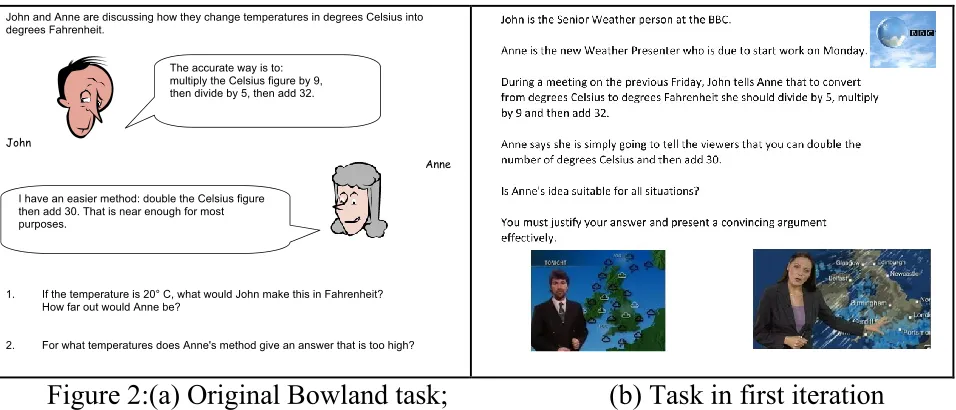
The case study reported here focuses on two research lessons that highlighted communication as the key mathematical process. The task ‘Hot under the collar’ (Figure 2a) was adapted from Bowland Maths resources (www.bowlandmaths.org.uk). In its original version, the task attempts to involve all four key processes of representing, analysing, interpreting and evaluating, and communicating and reflecting. In seeking to focus the learning in the research lesson on just one process – communicating – and to take account of a particular class of students, the task was adapted (Figure 2b). The planning team elected to introduce the familiar context of TV weather reporting, with a more experienced weather presenter offering what was previously described as ‘the accurate way’ and the ‘new’ weather presenter opting for the ‘easier method’. The scaffolding of converting 20 Celsius to the Fahrenheit scale using both methods and calculating the error was removed. The question ‘For what temperatures does Anne’s method give an answer that is too high?’ was replaced by the more open question ‘Is Anne’s idea suitable for all situations?’, together with a request to ‘justify your answer and present a convincing argument effectively’. These changes were intended to place the task in a potentially authentic context and to emphasise the communication element.
[image:6.595.65.543.469.674.2]Foster, Wake, Swan
PME 2014 3 - 101
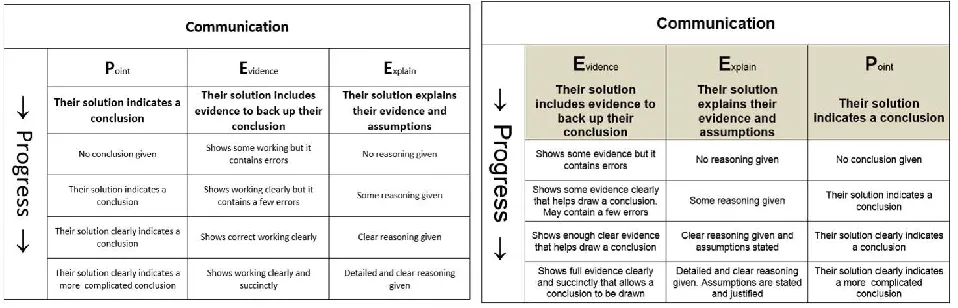
[image:7.595.61.540.108.262.2]in the teaching of English language (DfES, 2005) (Figure 3) to assist students with developing a reasoned argument in their writing.
Figure 3: PEE grid in (a) first iteration; (b) second iteration
The first iteration of the lesson
The PEE progression grid was shared with students (Year 10, n = 30) at the beginning of the first iteration lesson. Students had encountered PEE in other subject areas, so this structure was not new to them. Pairs of students were given time after working on the problem during the lesson to present their answers on large sheets of paper, and were reminded to use the PEE structure to do this. At the end of the lesson, in a plenary, students compared two pieces of work that the teacher had selected from the class. One of these contained a table of values showing integer temperatures from 1°C to 10°C, with John’s and Anne’s values for each, along with the difference between them. The other piece of work showed three typical values for each of the four UK seasons and looked at the errors for just these three temperatures. In the ensuing whole-class discussion, the first piece of work was seen to have no explicit conclusion (‘point’) and the second was considered to be weak in the ‘evidence’ strand.
Post-lesson discussion for the first lesson
During the post-lesson discussion, there was much debate about the advantages and disadvantages of PEE as a way of supporting students’ development of written mathematical communication. Several participants felt that the order might be changed to make it more appropriate for mathematics and advocated EEP instead, believing that having the ‘point’ at the end was more in harmony with the practice of mathematical solutions, which tend to culminate in an ‘answer’. (There was no consensus on a preferred ordering of ‘evidence’ and ‘explain’.) However, some participants felt that arriving at the answer at the end reflected the experience of working on the problem but did not dictate how a final solution might be presented to others, where PEE might be clearer for a particular solution and a particular audience. Mathematics students are frequently expected to communicate ‘what they are doing’ rather than the outcome or
conclusion of what they have done.
Foster, Wake, Swan
3 - 102 PME 2014
done. There was little indication in the students’ work that they were marshalling evidence strategically to support an argument. It was suggested in the post-lesson discussion that effective mathematical communication is assisted by having a clear purpose and audience in mind, so that students know who it is that they need to inform and convince by their argument.
The second iteration of the lesson
Several changes were made to the lesson for its second iteration. The question ‘Is Anne’s idea suitable for all situations?’ in the task was replaced by ‘How accurate is Anne’s approximation?’ In the first case, a student could answer that it is only ‘suitable’ on one occasion (10°C, where the two Fahrenheit values obtained are identical), whereas the second version was intended to force students to focus on accuracy, potentially leading to very different communications, particularly in students’ explanations.
The other big change to the lesson was to modify the PEE structure to revise the order to evidence-explain-point (EEP). The statements of progression for evidence were also modified so as to tighten the link between ‘evidence’ and its purpose in supporting a conclusion, in order to attempt to combat the ‘more evidence the better’ problem seen in the first lesson.
Post-lesson discussion for the second lesson
Participants discussed the advantages and disadvantages of a generic PEE or EEP scheme and whether a structure perhaps needed to be adapted to the details of each particular task. No consensus was reached on these matters, but the view was expressed that the preferred order might depend on whether the intention is to communicate working or conclusions.
DISCUSSION
We now briefly describe and exemplify three elements of pedagogical process knowledge (PPK) observed during the course of this iterative lesson-study cycle.
Teachers’ knowledge of processes and students (KPS)
Foster, Wake, Swan
PME 2014 3 - 103
Teachers’ knowledge of processes and teaching (KPT)
We see KPT as relating to knowing and being able to use effective strategies for teaching problem-solving processes. The debate over the virtues of PEE versus EEP as a scaffold for developing mathematical communication is a good example of the sort of thinking that lies within this domain. We found that this aspect of MKT for problem solving is particularly underdeveloped in the teachers with whom we have worked in our project.
Teachers’ knowledge of processes and the curriculum (KPC)
We see KPC as knowledge that enables teachers to select and sequence suitable tasks to facilitate a coherent development in students’ process skills. The idea of designing a sequence of lessons to develop a single process, such as communication, represents a certain kind of KPC, as does choosing tasks which provide suitable opportunities for specific process learning. Moving beyond this to develop a coherent, sustained approach to the learning of problem solving over time provides a challenge beyond the scope of our work to date.
Watson (2008) warns that identifying types of knowledge can be unhelpful and lead to a fragmentary sense of what is relevant. Various attempts at schematising the mathematical problem-solving process, such as RUCSAC (read, understand, choose, solve, answer, check) (www.tes.co.uk/ResourceDetail.aspx?storyCode=3007537), are widely thought to detract from the authentic experience of problem solving. Does PEE/EEP perhaps come into this category? Student mathematical actions are driven by the task and inevitably require them to draw on concepts as well as processes following their individual understanding of the context. Coherent mathematical activity requires a subtle blending of engagement with mathematical content, mathematical competencies and context (Wake, 2014). Consequently, we believe that it is important to recognise the interdependency of content, context and processes.
CONCLUSION
In conclusion, we are not surprised that an empirical approach to the conceptualisation of MKT has not so far identified knowledge of mathematical processes as fundamental to everyday classroom practice. We know that problem solving is often not given the attention it deserves in day-to-day teaching. Teachers’ understanding of process skills and what it means to make progress in learning processes is currently significantly underdeveloped.
Foster, Wake, Swan
3 - 104 PME 2014
In this paper, we have drawn on our findings to suggest aspects of PPK that might be given greater attention. In subsequent work we seek to extend our characterisations and develop the conceptualisation of MKT to emphasise further the mathematical practices in problem solving.
Acknowledgements
The research that informed this paper was funded by the Bowland Charitable Trust (www.bowland.org.uk). We would like to thank all of the teachers involved for their participation and their many insights, and particularly our Japanese colleagues from the IMPULS project at Tokyo Gakugei University (www.impuls-tgu.org/en/).
References
DfES. (2005). Key stage 3 national strategy. Leading in learning: Exemplification in English. London: DfES.
Fernandez, C., & Yoshida, M. (2004). Lesson study: A Japanese approach to improving
mathematics teaching and learning. Mahwah, NJ: Lawrence Erlbaum Associates.
Hill, H. C., Ball, D. L., & Schilling, S. G. (2008). Unpacking pedagogical content knowledge: Conceptualizing and measuring teachers’ topic-specific knowledge of students. Journal
for Research in Mathematics Education, 39(4), 372-400.
National Council of Teachers of Mathematics (NCTM). (2000). Principles and standards for
school mathematics. Reston, VA: NCTM.
OECD (Organisation for Economic Co-operation and Development). (2003). The PISA 2003 assessment framework – Mathematics, reading, science and problem solving knowledge
and skills. Paris: OECD.
Rowland, T., Huckstep, P., & Thwaites, A. (2005). Elementary teachers’ mathematics subject knowledge: The knowledge quartet and the case of Naomi. Journal of Mathematics
Teacher Education, 8(3), 255-281.
Sfard, A. (2007). Commognition: Thinking as communicating: The case of mathematics. Cambridge: Cambridge University Press.
Shulman, L. S. (1987). Knowledge and teaching: Foundations of the new reform. Harvard
Educational Review, 57(1), 1-23.
Wake, G. (2014). Making sense of and with mathematics: The interface between academic mathematics and mathematics in practice. Educational Studies in Mathematics. doi: 10.1007/s10649-014-9540-8
Wake, G., Foster, C., & Swan, M. (2013). A theoretical lens on lesson study: Professional learning across boundaries. In A. M. Lindmeier & A. Heinze (Eds.), Proc. 37th Conf. of the
Int. Group for the Psychology of Mathematics Education (Vol. 4, pp. 369-376). Kiel,
Germany: PME.
Watson, A. (2008). Developing and deepening mathematical knowledge in teaching: Being
and knowing. Paper presented at MKiT 6, Nuffield Seminar Series, University of