Introduction
Migraine headache often starts as a dull pain in the fron-totemporal region, upper neck or occipital area and becomes pulsatile in character only as the severity of the attack increases. Because of the throbbing quality of the pain, con-spicuous dilatation of extracranial arteries in some instances and the known pain sensitivity of cranial vessels, migraine has long been considered to be a “vascular headache”. Mu-scle contraction may add a non-vascular component to headache [1].
Blau [2] reported various postures during migraine at-tacks. Postures were aimed to lessen the headache and
accompanying symptoms [2]. The role of applying pressure to the temporal artery was investigated by Blau and Dexter [3] and Drummond and Lance [4]. During a migraine attack, some patients tend to elevate the head while lying compared to painless period [2]. Giving extension posture to the head is a method to reduce muscle contractions in the neck [5].
It seems that the quality of the headache and accompa-nying symptoms determine the postures that migraineurs adopt during the attacks. This study was especially designed for patients who lie down during their migraine attacks, because the measures taken by patients to cope with pain that originates from cranial vasculature and extracranial muscles while lying gives unusual and stereotypic postures compared to the headache-free period such as night sleep.
Patients’ postures during migraine attacks
H.M. Selekler () •H. Can •F. Budak Department of Neurology,
Faculty of Medicine, Kocaeli University, Kocaeli, Turkey
e-mail: [email protected] Tel.: +90-532-474-8025
Fax:+90-242-247-0947
H. Macit Selekler Hafize Can Faik Budak
AbstractThe aim of this study was to determine postures adopted by patients during migraine attack. A total of 199 migraine patients were questioned about their postures dur-ing the migraine attack. Of these, 92 patients did not choose a specific lying position, 22 could not lie down during the attack because of the increase in pain, while 6 avoided lying due to scalp tenderness. During the attack, 19 patients preferred holding their heads up (compared to painless period) with a few pillows and 41 applied pressure on the aching side; 15 lay with their necks extended and 15 lay face downward. Various combinations of these pos-tures were also reported. Pain may arise from extracranial muscles as well as vessels during a migraine
attack. The posture chosen during attack is a reflection of vascular and muscle pains that provoke symp-toms. The postures that patients chose were aimed to lessen the severity of symptoms of their migraine attacks. Patients know the position they adopt and do not need to be told by a doctor, but they come to consultations to be understood, to learn that others behave in the same way, and in some, to obtain reasons for their posture. The existence of a specific lying posture can be an advantage for the physician in terms of approaching the patient and selecting an appropriate therapy.
KeywordsMigraine •Attack • Posture
Received: 12 November 2002
Materials and methods
The study was carried out at Kocaeli University Medical Faculty, in the Neurology Department’s outpatient headache clinic between 3 July 2001 and 27 September 2002. Our sample consisted of 199 patients: 183 women and 16 men. Patients were questioned with a standard form that was specifically developed for headache patients. Headache duration, attack frequency, attack duration, qual-ity, laterality and severity of headache, aggravation with daily activ-ities, accompanying symptoms to headache such as photophobia, phonophobia, nausea and vomiting, the usual course of attacks (e.g. where headache starts and spreads) and drug regime were ques-tioned by means of a semistructured interview. Patients meeting International Headache Society “migraine” criteria [6] on one digit level were included in the study.
Patients were asked if they lie down during migraine attacks; if not, the reason why they could not was asked. Patients who admit-ted lying down during migraine attacks were questioned about their posture while lying. Patients who adopted different and stereotyp-ical postures while lying during moderate to severe headaches that inhibited or prohibited daily activities compared to the headache-free period (like night sleep) were chosen and each patient’s pos-ture was noted in detail. An explanation about why they chose their own posture was required from the patients. All patients admitted that the lying posture that they chose during the migraine attack eased their head pain.
The patients who reported inability to lie down or sit up during the attacks were not included in the statistical analysis because the study was originally planned for those patients who preferred to lie down during the attacks. As “avoiding lying” during the attacks was accepted as a particular attitude, the reasons reported by the patients who avoided lying are also mentioned in the article.
“Patients who give extension to their neck” and “patients who lie with their face downward” were combined into one group because “lying face downward” was accepted as a different method of giving extension to the neck. In statistical analysis, patients were grouped as “patients with neck extension”, “patients lying with head propped up” and “patients applying pressure to the head”.
Age, headache duration, attack frequency, attack duration were determined as numerical variables, while gender, throbbing quali-ty, migraine pain spreading to the neck and migraine pain spread-ing from the neck were determined as categorical variables. Mean and standard deviation values of numerical variables were calcu-lated. Distribution of categorical variables such as throbbing qual-ity, migraine pain spreading to the neck, migraine pain spreading from the neck in the groups of patients with neck extension, patients lying with head propped up and patients applying pressure to head was worked out using Pearson’s chi-square test. Patients were also grouped as those with more than 15 migraine headaches per month and those with less than 15 migraine headaches per month, and the distribution of previously described categorical variables and postures such as neck extension, lying with head propped up and applying pressure to head was also worked out with Pearson’s chi-square test. Statistical analysis of avoiding lying between these two groups was also made. The significance level was determined as 0.05. Statistical analysis of the study was car-ried out using the Statistical Package for the Social Sciences (SPSS), version 10.
Results
Of the 199 patients whose postures were questioned during migraine attacks, 92 patients did not choose a specific pos-ture while lying during the attack, 79 patients reported spe-cial postures during moderate to severe pain that inhibited or prohibited daily activities, while 28 patients reported that they avoided lying and sat up during the attack because of the increase in pain.
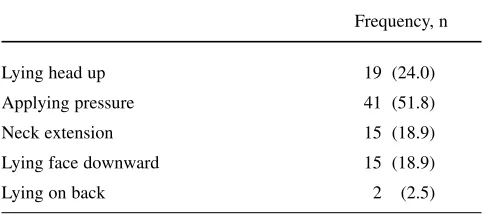
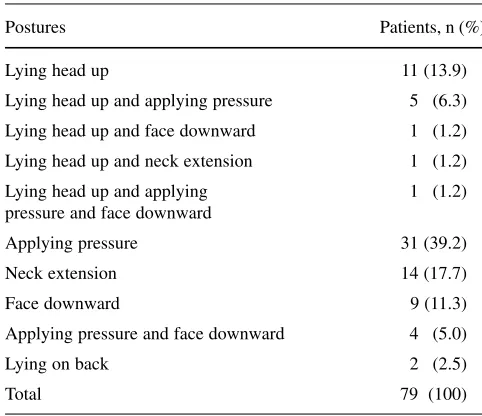
Of these 107 patients, 97 were women and 10 were men. Mean age was 37.16 years (SD=13.03 years). A total of 52 were house-wives, 14 were government officers, 12 were retired people, 14 were students, 9 were teachers, 4 were nurses and 2 were self-employed. Mean duration of suffering from headache was 13.09 years (SD=11.86 years). Mean number of days per month with migraine headache was 12.66 (SD=12.01) and mean attack duration was 20.42 hours (SD=13.29 hours). A total of 38 patients had migraine attacks more than 15 times per month. While 7 patients were on pro-phylactic therapy, 79 patients were only using analgesics, 12 patients were using both anti-migraine drugs (such as triptans and ergotamine tartrate) and analgesics for their migraine attacks; 9 patients reported they did not use any medication. While lying, 19 patients preferred holding their heads up (compared to painless period) which was possible by using multiple pillows during the attack (Table 1). Among these patients, 2 of them preferred to lie on the aching side in order to apply pressure, 2 applied pressure on the temple and tem-poral region, 1 lay face downward, and 1 extended the neck at the same time. While lying on the aching side, one patient applied pressure to her temple and one patient, while lying face downward, applied pressure to the aching side’s temple and temporal region with her hand simultaneously (Table 2). The rest of the patients lay with their heads up only.
A total of 41 patients applied pressure on their head to ease the pain, and the height of their head was the same as the height during the painless period (Table 1). While 11 patients lay solely on the aching side, the other 28 patients applied pressure to the aching side’s temple and temporal
Table 1Frequency of postures adopted by the 79 patients during moderate to severe pain
Frequency, n
Lying head up 19 (24.0)
Applying pressure 41 (51.8)
Neck extension 15 (18.9)
Lying face downward 15 (18.9)
region by various methods as well. Pressure was provided by lying on the hand (pressing with fingers, 14 patients) or arm (1 patient); 9 patients provided pressure with both hands on both temples and temporal region while 1 patient applied pressure with one hand. Two patients wrapped their head with a bandage for pressure (Table 2). Two patients lying on painful side while keeping their head up were mentioned in the previous paragraph.
During the attack, 2 patients put a pillow under their neck while lying, 5 patients gave extension posture to their neck by means of any method, and 3 patients gave slight extension to their neck only by lying without a pillow. Other 5 patients preferred to lay their head low (Table 1). One patient also applied pressure on both temples with her hands. One patient lay keeping her head high while apply-ing pressure to her temple and temporal region (Table 2).
A total of 15 patients reported that they would lie face downward during the attack (Table 1). While 9 patients lay solely face downward, 4 patients applied pressure on their temple and temporal region on each side with both hands, 1 patient lay with her head propped up and applied pressure on her temple and temporal region with her hand, and one patient preferred lying with her head propped up (Table 2). Three patients explained that they chose this posture “to avoid the light”, while 12 patients could not give an expla-nation but admitted that this posture relieved their pain. Two patients lay on their backs and tried to keep their heads fixed because shaking made the pain worse.
Ten patients reported scalp soreness; 6 of these could not lie down because of soreness of their scalp. Of these patients, one could lie on the side of painless hemicranium which was not sore. One patient preferred lying without a
pillow to reduce the contact area with scalp. Two patients used softer pillows than they generally used during the pain-less period. Another 22 patients who could not lie down did not give any further explanation other than intensification of the pain.
No statistical difference was found between the patients who had more than 15 migraine headache days per month and those who had less than 15 regarding the throbbing quality of headache, migraine pain spreading to the neck, migraine pain spreading from the neck, the postures that were adopted and avoiding lying during the attacks. There were no statistical differences between throbbing quality of pain and postures (lying with head propped up, pressure to head and neck extension) and migraine pain spreading to the neck and the postures either. The only statistical difference was found between migraine pain spreading from the neck and extension posture of the head (Pearson’s χ2=6.806; p=0.009).
Discussion
The often pulsating character of pain and worsening during physical activity, bending down, coughing and straining are key symptoms in migraine and part of the International Headache Society’s classification. They clinically indicate an involvement of the cranial vasculature [7]. Lying down accentuating headaches suggests an intracranial venous com-ponent [2]. Tilting also causes increase in the common carotid artery diameter which indicates that tilting causes an increase in the extracranial and intracranial blood volumes in cluster headache patients [8]. The effect of extracranial vas-culature on migraine headache was proposed by several researchers [1, 3, 4]. Also, pain from muscle contraction may add a non-vascular component to migraine headache [1].
In our group, 19 patients tended to keep their head high-er than in the painless phigh-eriod while lying. Probably these patients were trying to prevent the increasing blood flow to the cerebrum by not lying down.
Graham and Wolff [9] recorded the pulsation of branches of the superficial temporal artery during migraine headache and observed that amplitude of the pulse wave declined as the intensity of headache diminished after the injection of the ergotamine tartrate. The concept of migraine being an “extracranial vascular headache” appeared to be strength-ened by studies of Tunis and Wolff [10] who reported that the mean amplitude of temporal artery pulsations was greater during headache than during periods of freedom.
Sakai and Meyer [11] found that extracranial blood flow increased by about 20% on the side affected by headache. Blau and Dexter [1, 3] assessed the contribution of extracra-nial arteries to migraine headache by inflating a sphygmo-Table 2Postures adopted by 79 patients during moderate to severe
pain
Postures Patients, n (%)
Lying head up 11 (13.9)
Lying head up and applying pressure 5 1(6.3)
Lying head up and face downward 1 1(1.2)
Lying head up and neck extension 1 1(1.2)
Lying head up and applying 1 1(1.2) pressure and face downward
Applying pressure 31 (39.2)
Neck extension 14 (17.7)
Face downward 9 (11.3)
Applying pressure and face downward 4 1(5.0)
Lying on back 2 1(2.5)
manometer cuff around the patient’s head. Of 47 patients, only 21 experienced relief from headache after inflation of the pericranial cuff whereas the majority complained that their headaches were aggravated by coughing, jolting or holding their breath, indicating an intracranial component to head pain. Drummond and Lance [4] compared the pulse amplitude of the superficial temporal artery and its main frontotemporal branch with the intensity of pain felt in the temple while the ipsilateral common carotid and temporal arteries were compressed alternately. Of 62 patients, select-ed only by the presence a unilateral migrainous headache, the pain appeared to have an extracranial vascular origin in about one-third, was of mainly intracranial vascular origin in one-third, and had no detectable vascular component in the remaining one-third [4].
In our group, while 30 patients applied pressure on the aching side’s temple and temporal region by various meth-ods, 11 patients lay solely on the aching side probably to provide pressure only by means of the weight of the head. As the patients in this group could lie down at the same level during the painless period and get relief from temporal artery pressure, extracranial vasculature contribution to the head pain is greater than the intracranial vasculature. In other words, pain originating from the extracranial vascular component dominates the headache.
Excessive contraction of temporal, masseter and neck muscles is common in migraine patients, more so than in patients with “tension headache”, and becomes evident just before the headache reaches its maximum. The sites of muscle contraction in migraine correlate with spatial dis-tribution of pain and tenderness, suggesting that it is a sec-ondary phemenon but one that nonetheless contributes to headache [1]. Patients take action to reduce the neck symp-toms, typically by massaging the muscles or stretching the neck backwards [5].
The total number of the patients who gave extension posture to their neck with any method was 15. Probably in these patients, contribution of the neck muscles to head pain was greater than the vascular component’s contribution to headache. Because as the patients get relief from spasm of the neck muscles with this posture, cerebral blood flow could increase due to keeping the head down. One patient applied pressure on both temples with her hands at the same time. Maybe in this patient neck muscles and extracranial vasculature were responsible for the major part of the head pain. Pain originating from intracranial vasculature and neck muscles may predominate the pain in one patient who extends the neck and keeps it high while lying.
In Blau’s study of 50 migraineurs’ postures during the attack, no patient reported a face-downward position [2]. However, this lying position was not infrequently reported by 15 patients. This posture is likely to give the head an extension by means of the pillow which holds the head up
as well, because solely giving extension to neck causes downward head tilting which could increase cerebral blood flow and consequently the headache. None of the patients lay in a low position or without a pillow which could be interpreted as the patients’ unconscious tendency to give extension to their neck while keeping their head high in order to lessen muscle spasm and prevent increase in the cerebral blood flow. This posture seems to also prevent the patients from light.
Neck muscle spasm and pain originating from cranial vasculature could form the major part of the head pain in patients who kept their head high and in extension posture. In the rest of the patients who preferred lying face down-ward on a pillow, contribution of the cranial vasculature to head pain could not be disregarded.
Among the patients lying with their heads up, 3 lay on the aching side, 3 applied pressure to the temporal artery and 1 lay on aching side and applied pressure to the temporal artery; these observations show that both intracranial and extracranial components play a role in headache. For these patients, lying high is not enough for relief because they also applied pressure to the temporal artery. Since holding the head high decreases blood volume to extracranial and intracranial vasculatures, only lying with the head high could not decrease the pain that is supposed to originate from the extracranial vasculature. In this situation, predom-inance of extracranial vasculature to head pain could be taken into consideration. Especially the extracranial vascu-lature but also the cranial vascular components and neck muscle spasms were important in one patient who lay head up and extended and also applied pressure on the temporal artery.
At the onset of headache, scalp tissues in the affected region were sensitive to applied pressure and as the headache progressed, scalp tenderness intensified and became more widespread. Drummond found that scalp tissues were ten-derer in headache patients than in controls, both during headache and several days after headache had subsided [12]. This may be due to a defect in pain control mechanisms localized to the affected area [1]. However, scalp tenderness is unlikely to be the primary source of pain [12].
Ten patients had complaints about scalp tenderness. Of these, 6 patients with severe complaints could not lie down during the attack due to this tenderness, 2 patients adjusted their lying postures according to the scalp tenderness and the other 2 patients required soft pillows. One patient, while lying without a pillow in order to decrease the contact area of her scalp, also gave slight extension posture to her neck. In this patient, scalp tenderness and neck muscles seemed to form the posture. The reason why the other 22 patients were unable to lie down because of an increase in pain could be an increased blood flow to the cranial vasculature.
reflec-tion of vascular pain that contributed to the headache. In sta-tistical analysis, there was no significant relationship between throbbing and inability to lie, throbbing and lying with head propped up, and throbbing and applying pressure to head. This could be due to high prevalence of throbbing quality of pain (94.9%) in the patients who reported postures during moderate to severe migraine headaches. It is difficult to prove solely on clinical grounds the part of our hypothe-sis regarding pain arising from cranial vasculature and adopted postures while lying. In the future, this hypothesis should be evaluated with systematic studies.
There was a statistically significant relationship between migraine pain spreading from the neck and neck extension, but not between migraine pain spreading to the neck and neck extension. According to our findings, patients who have neck pain as a premonitory symptom of migraine attack are more prone to extend their necks during the attacks.
Waelkens [13] discovered that neck stiffness or pain can be premonitory symptoms that begin several hours before the onset of other symptoms and thus herald a migraine
episode. Blau and MacGregor [5] proposed that migraine attacks can be triggered by neck pain which extends down the spine, indicating extracerebral involvement of the migraine process to include the hindbrain and the upper cer-vical cord. Early involvement of hindbrain and upper cervi-cal cord could be an operative mechanism in “neck exten-ders” during the migraine attacks.
Patients know the position they adopt and do not need to be told by a doctor, but they come to consultations to be understood, to learn that others behave in the same way, and in some, to obtain reasons for their posture. Migraineurs choose their postures while lying according to the predomi-nant symptoms of their attacks. The posture chosen during an attack is a reflection of vascular and muscle pains that provoke symptoms. The existence of a specific lying posture in a patient can be an advantage for the physician in terms of approaching the patient and selecting appropriate therapy.
Acknowledgements This study was not supported by any institu-tion or company.
References
1. Lance JW,Goadsby PJ (1998) Migraine: pathophysiology. In: Lance JW,Goadsby PJ (eds) Mechanisms and Management of Headache. 6th Edition. Oxford: Butterworth-Heinemann 79–115
2. Blau JN (1993) A note on migraineurs’ postures during attack. Headache 33:501–501
3. Blau JN, Dexter SL (1980) The site of pain origin during migraine attacks. Cephalalgia 1:143–147
4. Drummond PD, Lance JW (1983) Extracranial vascular changes and the source of pain in migraine headache. Ann Neurol 13:32–37
5. Blau JN, Mac Gregor EA (1994) Migraine and the neck. Headache 34:88–90
6. – (1988) Classification and diagnostic criteria for headache disorders, cranial neuralgia and facial pain. Headache Classification Committee of the International Headache Society. Cephalalgia 8[Suppl 7]:1–96 7. Kaube H, Hoskin KL, Goadsby PJ
(1992) Activation of the trigeminovas-cular system by mechanical distension of the superior sagittal sinus in cat. Cephalalgia 12:133–136
8. Hannerz J, Jogestrand T (1995) Effects of increasing the intracranial blood volume in cluster headache patients and controls. Cephalalgia 15:499–503 9. Graham JR, Wolff HG (1938)
Mechanism of migraine headache and action of ergotamine tartrate. Arch Neurol Psychiatry 39:737–763
10. Tunis MM, Wolff HG (1953) Long term observations of the reactivity of the cranial arteries in subjects with vas-cular headache of migraine type. Arch Neurol Psychiat 70:551–557
11. Sakai F, Meyer JS (1978) Regional cerebral hemodynamics during migraine and cluster headaches mea-sured by the 133Xe inhalation method. Headache 18:122–132
12. Drummond PD (1987) Scalp tender-ness and sensitivity to pain in migraine and tension headache. Headache 27:45–50