1
Genetics and livestock breeding in the UK: co-constructing technologies and
heterogeneous biosocial collectivities
Abstract
Cattle and sheep breeders in the UK and elsewhere are increasingly being encouraged to use
a variety of genetic technologies to help them make breeding decisions. The technology of
particular interest here is ‘classical’ statistical genetics, which use a series of measurements
taken from animals’ bodies to provide an estimate of their ‘genetic merit’ known as
Estimated Breeding Values (EBVs). Drawing on empirical research with the representatives
of national cattle breed societies and individual cattle breeders the paper explores the
complex ways in which they are engaging with genetic breeding technologies. The concept of
‘heterogeneous biosocial collectivity’ is mobilised to inform an understanding of processes of
co-construction of breeding technologies, livestock animals and humans. The paper presents
case studies of livestock breeding collectivities at different scales, arguing that the ways in
which the ‘life’ of livestock animals is problematised is specific to different scales, and varies
too between different collectivities at the same scale. This conceptualisation problematises
earlier models of innovation-adoption that view farmers as either ‘adopters’ or ‘non-adopters’
of technologies and in which individual attitudes alone are seen as determining the decision
to adopt or not adopt. Instead, the paper emphasises the particularity and specificity of
co-construction, and that the co-construction of collectivities and technologies is always in
process.
Keywords: Genetic breeding technologies, Estimated Breeding Values, livestock animals,
heterogeneous biosocial collectivities, ‘life’, co-construction
1. Rural studies and genetic technologies in agriculture
An established tradition of research in rural studies on genetic technologies in agriculture
(e.g. Goodman et al. 1987; Kloppenburg, 1990) has been extended in recent years by further
research on the political economy and also the gendered dimensions of these phenomena
(Bryant and Pini, 2006; Pechlaner and Otero, 2008). A more emergent scholarship has begun
to consider the farm level implications of genetically modified organisms (GMO) (e.g. Lane
et al. 2007; Lassen and Sandoe, 2009; Oreszczyn et al. 2010) reflecting a wider call within
the social sciences for more attention to be paid to “the purchase of ... biotechnologies and
2
Whatmore, 2001, pp.140-1). Given the high profile and on-going nature of the debate about
genetically modified (GM) crops within Europe (e.g. Seifert, 2008) it is understandable that
popular and academic attention has been focused on genetic technologies within the context
of plant based agriculture. However, the corollary is a relative lack, at least until very
recently, of rural social scientific interest in the ways in which livestock agriculture is being
influenced by genetic technologies (Holloway and Morris, 2008; Morris and Holloway, 2009;
Holloway et al. 2009; Twine, 2010). This might be explained in part by the absence of
controversy in this context. In the UK, for example, there has been some media interest in
cloned cattle and genetically modified pigs and chickens, but debates about the legitimacy of
such technologies appear to be largely confined to specialist, scientific arenas (Marris et al.
2001). However, although attracting relatively limited public attention, cattle and sheep
breeders in the UK and elsewhere are increasingly being encouraged to use a variety of
genetic technologies to help them make breeding decisions with the aim of producing ‘better’
animal bodies. Such breeding technologies are layered on to and compete with more
established breeding knowledge-practices notably visual assessment and the use of pedigree
records which remain significant, albeit to varying extents both between and within breed
societies, in breeding decisions and in the sale of livestock (Holloway and Morris, 2008,
2012).
The most well developed examples of genetic breeding technologies are: genetic markers,
which are identifiable genetic material supposedly related to particular phenotypic qualities
such as enhanced productivity or reduced disease susceptibility; and ‘classical’ statistical
genetics, used to provide an estimate of an animal’s ‘genetic merit’ known as Estimated
Breeding Values (EBVs). The latter technology currently has the most widespread practical
impact and relevance to the livestock breeding community and is integral to a geneticising
discourse in agriculture (Holloway and Morris, 2008). EBVs thus provide the empirical focus
of this paper. EBVs involve the production of a set of figures derived statistically from a set
of measurements of the animal body, for example its weight at particular points since its
birth, and the depths of fat and muscle in particular places. A statistical algorithm is used to
calculate an individual animal’s ‘breeding value’ for each characteristic based on its own data
and data from its relatives. These values can be used by breeders to indicate the relative
breeding strengths and weaknesses of any animal, and to select animals for breeding in
accordance with a particular breeding objective. The calculation of population average EBVs
3
can be compared - favourably or not - with these averages.“It can thus be suggested that
animals or populations should embody particular statistical or genetic characteristics, and
their conformity to or deviation from such norms are easily measured” (Holloway and
Morris, 2012, p.65).EBV data are produced by organisations (e.g. publicly funded research
institutes and commercial organisations such as breeding companies1) typically located ‘at a
distance’ from the livestock animals themselves and the farms on which they are born and
reared. Scrutiny of the subsequent results by breeders can take place electronically for
example ‘on screen’ in a farm office where the animal itself is not present. Increasingly,
however, EBV data are presented alongside the individual animal they represent at
agricultural shows and sales (Holloway, 2005).
The emerging array of genetic breeding technologies has been described by their proponents
as contributing to a ‘genetics revolution’ in livestock agriculture (Bulfield, 2000; Kues and
Niemann, 2004; Outlook on Agriculture, special issue: Genomics and Genetic Engineering
for the Meat Industry, December 2003). Although mobilisation of the dramatic concept of
‘revolution’ may indicate the over-hyping that often accompanies the introduction of new
technologies (Brown, 2003) it is apparent that active efforts, both within the public and
private sectors, are being made to construct a genetic agenda in this field (Holloway and
Morris, 2008, 2012). For example, although EBVs have been in circulation for several
decades consistent attempts, in the form of articles in the farming press and training events
hosted by organisations such as the English Beef and Lamb Executive (EBLEX)2, are being
made to enrol breeders into their use. This entails responsiveness to user needs through the
invention of new ways of presenting EBV data to enhance their accessibility and visual
intuitiveness. Such promotional activities point to the efforts of technology designers to
configure “the identity of putative users” (Woolgar, 1991, p.59), with livestock breeders who
use these genetic breeding technologies being defined as confident, progressive and
contributing to the current and future profitability of the livestock industry. On the other
hand, those who resist use of the technologies can be represented as problematic obstacles to
the modernization of livestock breeding (Holloway and Morris, 2012).
1 In the UK, Signet is the major company producing EBVs, while ABRI is an Australian equivalent used by
some UK breed societies.
2EBLEX is part of England’s Agriculture and Horticulture Development Board, and is funded by a levy paid on
4
The purpose of this paper is to move beyond the claims made by those involved in the
development of breeding technologies, to try to make sense of what is actually happening ‘on
the ground’ as livestock breeders encounter these technologies within the practices of
breeding. As such, the paper is in part a response to the call, by Greenhough and Roe (2006,
p.417), for investigation into “non-expert (sic), micro-scale knowings” of biotechnology as it
insinuates itself increasingly in everyday life (see also Michael, 2006), in this case, the lives
of livestock breeders and their animals. It is also a response to and questioning of the
continuing circulation, within policy and scientific domains, of the notion of ‘innovation
adoption’ that tends to view farmers as either ‘adopters’ or ‘non-adopters’ of innovations, i.e.
with identities that are coherent and singular in relation to a particular technology or policy
initiative,3 and in which the attributes and attitudes of individual humans alone are seen as
determining the decision to adopt or not adopt. More specifically, our aim is to develop a
conceptualisation of the use of genetic breeding technologies within livestock breeding that
goes beyond a focus on the human ‘users’ or ‘non-users’ that is characteristic of past research
in rural studies that has a technology focus, including in particular work on
innovation-adoption. To do this we work with the idea of ‘heterogeneous biosocial collectivity’
(Holloway et al. 2009; Holloway and Morris, 2012), relating it specifically to the use /
non-use of technologies within this context, exploring also the relationships between and the
co-construction of these collectivities and breeding technologies. This paper is distinct from our
previous work in that it develops the concept of a heterogeneous biosocial collectivity,
arguing that particular collectivities associated with different breeds but also identified at
different scales within a breed afford different possibilities for the use, and co-construction,
of breeding technologies.
In the subsequent sections of the paper we first provide further context by discussing
approaches to technology and socio-technical change in rural studies and science and
technology studies before elaborating the concept of heterogeneous biosocial collectivity and
technology use. The methodology employed to produce data on livestock breeders’
engagement with genetic breeding technologies will be described before four illustrative case
3 For example, within the research that provides the empirical basis of this paper, animal scientist members of
5
studies are presented of collectivities associated with beef cattle breeding at different scales.
These cases reveal the considerable complexities, ambivalences and ambiguities in
engagements with genetic breeding technologies. These are produced because as technologies
are encountered on particular farms, by particular breeders with distinct sets of experiences,
skills and knowledge-practices, and working with particular groups of animals, a wide range
of responses and outcomes are evident. In conclusion we reflect on what our case studies
reveal about the co-construction of technologies and heterogeneous biosocial collectivities,
both in relation to the specific example of beef cattle breeding but also more widely in
relation to technological interventions in agriculture
2. Rural research, technology use and heterogeneous biosocial collectivities
The study of technology and socio-technical change has a strong tradition in rural studies,
notably in the form of innovation-adoption research (e.g. Taylor and Miller, 1978; Rogers,
1983). As Padel (2001, p. 40) explains, the innovation-adoption model describes “the
diffusion of an innovation into a community. It attempted to predict the adoption behaviour
of individuals by looking at their personal characteristics, the time factor and the
characteristics of the innovation itself”. In spite of its considerable popularity as a research
focus within the rural social sciences from the 1950s to the 1970s, and its practical relevance
to agricultural extension workers and other change agents who – it is claimed - found the
model “exceedingly useful in their educational programmes with farmers” (Ruttan, 1996,
p.56), the innovation-adoption approach had largely gone out of fashion by the 1980s
(Ruttan, op cit), although see Padel (2001) for a more recent application. Meanwhile, work in
other fields continued to explore technological change, developing a variety of new ways of
thinking about the relationships between ‘users’ (cf. ‘adopters’) and technology (e.g.
Oudshoorn and Pinch, 2003; von Hippel 1976, 2005). To take one ‘rural’ example, Kline and
Pinch’s (1996) work on the social construction of the early automobile in North America is in
part concerned with how farmers innovated with them so that they could run farm machinery.
Such farmer-led innovation and adaptation is part of the history of agricultural
mechanisation. This kind of work informs the analysis in this paper because it takes seriously,
and places at the centre of analysis, the users (and non-users) of technology, the
co-constructed agency of these groups and their roles in the development of technology. More
specifically, and following Oudshoorn and Pinch (op cit), one of the questions we seek to
answer in this paper is: how do livestock breeders encounter, engage with, employ,
6
this from earlier studies of innovation-adoption, we are interested in the co-construction of
livestock breeders and genetic breeding technologies. In other words, we explore how
breeders shape and adapt genetic breeding technologies, and in turn examine what these
technologies do to users, in terms of their identities and social relationships. As such the
paper moves “beyond technologically deterministic views of technology and essentialist
views of users’ identities” (Oudshoorn and Pinch, op cit, p.3).
However, we also seek to develop this research which tends to neglect the role of the
non-human in shaping the use and non-use of technology. In particular, we argue that there is a
need to pay attention to the animals enrolled within the practices of livestock breeding. Here
we draw inspiration from work that has discussed the agential capacities of non-humans (e.g.
Jones, 2003; Buller and Morris, 2007; Holloway, 2007). As Jones (2003, p.292) asserts:
“the cows that produce milk or meat, the hens that produce eggs, the boars and sows that produce meat and
other pigs for meat, the horse that learns to jump, the dog that learns to control sheep, or hunt, and so on are in relation with humans, technology, information and science, productive actants who contribute vital affordances to achievements of one kind or another emanating from networks. These are important conceptualisations which begin to place animals more visibly and precisely in these achievements” (Jones, 2003 p.292, emphasis added).
By conceptualising animals in this way further questions are raised about their role in the use
and non-use of genetic breeding technologies and, by implication, how they too are
reconfigured through the use of these technologies. The use / non-use of genetic breeding
technologies can therefore begun to be understood as a heterogeneous process, encompassing
not only relationships between breeders, a variety of other human actors and the technical
artefacts that constitute the breeding technologies, but also relationships between breeders,
technologies and animals (e.g. Latour, 1999; Whatmore, 2002). In approaching the use of
breeding technologies in this way, as heterogeneous and relational, we acknowledge the
influence of a ‘co-constructionist’ perspective developed by various scholars within and
beyond science and technology studies (see Bingham, 1996; Murdoch, 2001). Importantly,
co-construction is about more than just association between diverse actants, both human and
non-human, it is also concerned with the modification of these actants through their
7
To explore these issues further we draw on the concept of biosocial collectivity. Following
Rabinow (1990 and Rabinow and Rose (2006) we have argued elsewhere (Holloway et al.
2009: 397; Holloway and Morris, 2012) that biosocial collectivities are intentional groupings
that come together because members have a shared concern for a fundamentally biological
issue4. That is, what is at stake is a problem of ‘life itself’ (Franklin 2000), and how that
problem is defined and responded to. We have suggested that biosocial collectivities do not
need to be limited in their membership to humans and that nonhuman animals can also be
regarded as members making it possible to conceptualise biosocial collectivities as
heterogeneous. We have also suggested in our previous work (although not worked through
in empirical detail) that such heterogeneous biosocial collectivities can emerge at different
scales across which livestock breeding as a process and sets of practices takes place. For the
commercially and numerically very significant Limousin cattle breed, for example, there is
the International Limousin Council, the national scale British Limousin Cattle Society,
several regional and local groupings of breeders working together to develop the breed (e.g.
as so-called sire reference groups), and numerous individual farm-scale collectivities where
actual matings take place and animal bodies are reproduced materially. In the sense that
individuals can be, simultaneously, members of collectivities at more than one scale the
scales can be said to overlap. Crucially, however, subjectivities are constructed differently in
relation to collectivities at different scales. An individual breeder, for example, in a
farm-scale collectivity consisting of themselves and the animals in their herd, might express a
subjectivity vis a vis a breeding technology which is different to their subjectivity when
acting as a representative of the larger-scale collectivity of a national breed society.
In the context of livestock breeding it is possible to identify a number of different problems
of life itself concerning, for example, issues surrounding biosecurity, health and welfare.
However, key to the practices of breeding is the relationships between the definition of what
the ‘good animal’ is in theory, and the identification in practice of a ‘good animal’ from
which to breed, and it is on this particular problem that we focus in this paper. As such, we
are interested in both the ‘reality’ of life itself as a set of biological processes (in our case, for
example, combinations of genotype and phenotype) and a particular means of understanding
and intervening in life processes e.g. the breeding technology of EBVs along with other
4 It is because of the specific provenance of the term collectivity in the work of Rabinow and Rose that we use
8
breeding knowledge-practices mobilised by breeders and breed societies. Crucial to the
argument we are developing here is that the problem of life itself in livestock breeding
emerges differently in different collectivities. For different collectivities, at different scales
(e.g. the breed society or the farm), how the ‘good animal’ is specified will vary, and is
determined partly in terms of what in the abstract are desirable characteristics (e.g. colour,
size, growth rate, maternal ‘instinct’, or calving ease), and partly in terms of the biological
problem in practice of attempting to breed for several different and perhaps incommensurate
characteristics simultaneously (a process that can sometimes produce unexpected outcomes,
reflecting and reinforcing the indeterminacy of life itself ). We argue that this biological
issue, at the heart of the heterogeneous biosocial collectivities that are constitutive of
livestock breeding at various scales, is central to understanding the use / non-use of genetic
breeding technologies. As such, rather than simply focusing on individual users of
technologies we are interested in the relationality of use within heterogeneous collectivities.
Further, because this biological issue or problem of life itself becomes conceptualised
differently for different collectivities, this particularity will necessarily shape the relationship
between and co-construction of the collectivity and technology. Thus, for example, the
particular conceptualisations which pertain at the ‘larger’ scale of a national breed society
might be different to those which pertain at the ‘smaller’ farm scale of individual breeders
and their herds, and indeed, different breed society collectivities, and different farm-scale
collectivities within the same breed, might be constituted around different constructions of
the problem of life itself. As such, particular collectivities (comprising a unique combination
of human and non-human components) at different scales afford distinctive possibilities in
relation to breeding technologies. The construction of both the collectivity and the breeding
technology will be specific and different in each particular case. In order to demonstrate this
conceptualisation, the sections subsequent to the next on methodology present empirical
materialin the form of detailed case studies of collectivities associated with the breeding of
beef cattle5.
3. Methodological points
5 Although it is acknowledged that there is considerable variation within this category, not least associated with
9
The empirical material in this paper derives from a larger research project that sought to
explore the ways in which genetic knowledge-practices are reconfiguring livestock breeding
in the UK. The project involved interviews with a committee member from each of 21 breed
societies6 representing the range of types of beef cattle and sheep in the UK. A Consultation
Panel of eight members, with expertise in different aspects of the livestock sector, informed
selection of interviewees. Breed society representatives identified breeder members for
follow-up interviews and these interviewees suggested other breeders to whom we might
speak. Interviews with 21 ‘pedigree’ (nine beef cattle and 12 sheep) and five ‘commercial’
(two beef cattle and three sheep) livestock breeders in the UK were conducted. These
interviews included breeders who were deeply engaged with genetic technologies and others
who knew about them, and even used them, but were deeply sceptical, making a
straightforward quantification of ‘use’ at this scale very difficult. Interviews with breeders
were semi-structured and explored how breeding was planned on each farm, and of the role
of genetic breeding technologies. Interviews explored the benefits and limitations of genetic
technologies, breeders’ knowledge and experience of the technologies, the extent to which
they were used, the particular farm contexts which influenced how genetic technologies were
engaged with in practice, and breeders’ assessments of the future of genetic technologies.
Interviews were fully transcribed and analysed thematically.
In order to develop and demonstrate our theoretical point four case studies are used. The
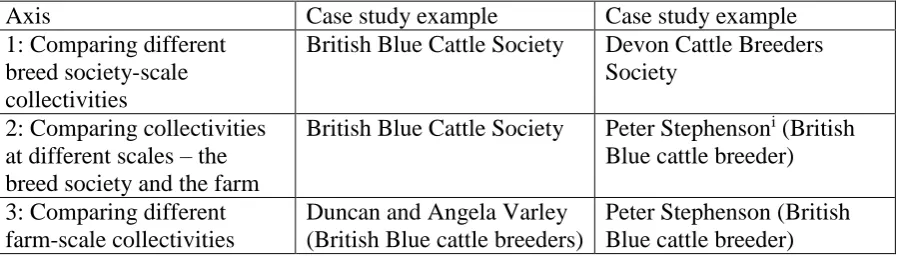
selection of these cases is justified in relation to three axes of comparison (see Figure 1). The
first of these is between heterogeneous biosocial collectitivies at the same scale; the scale of
national breed societies. A breed society can be understood as a collectivity operating at a
national scale since it associates diverse members – both human and nonhuman – distributed
across the UK. It is constituted around a particular set of biological issues and problems that
contribute to defining and producing collectivity-specific ‘good animals’ and which in turn
afford possibilities in terms of the use of EBVs. Two beef cattle breed societies are selected –
the British Blue and North Devon - because they express differences both in terms of the
biological ‘problem(s)’ associated with their respective breeds of cattle and in terms of the
nature and extent of their engagement with EBVs. The second axis of comparison is between
collectivities at different scales and to illustrate this we present a case study of a farm scale
6 Breed societies are responsible for recording the animals which are legitimate members of their particular
10
collectivity associated with the same breed as one of the breed society collectivities – the
British Blue. Here we explore how the particular ways in which life is problematised at this
scale have distinctive implications for technology use when compared with the breed society
scale. A third axis of comparison is similar to the first, in that it explores heterogeneous
biosocial collectivities at the same scale but here the focus is on comparing two farm scale
collectivities associated with the same breed, the British Blue, where differences in the
[image:10.595.75.524.269.397.2]problematisations of life afford particular possibilities for technology use.
Figure 1. Axes of comparison
Axis Case study example Case study example
1: Comparing different breed society-scale collectivities
British Blue Cattle Society Devon Cattle Breeders
Society
2: Comparing collectivities at different scales – the breed society and the farm
British Blue Cattle Society Peter Stephensoni (British
Blue cattle breeder)
3: Comparing different farm-scale collectivities
Duncan and Angela Varley (British Blue cattle breeders)
Peter Stephenson (British Blue cattle breeder)
The following questions were used to develop the case studies and were shaped by our
conceptualisation of heterogeneous biosocial collectivities and informed by the literature on
technology use. First, how is the problem of life specified in this particular collectivity?
Second, what are the specific characteristics or particularities of the collectivity – in terms of
the ways that the problem of life itself is specified - that afford, or not, possibilities for use of
breeding technology? Third, how are the collectivity and the breeding technology
co-constructed: how do they change in relation to each other?
4. Specifying the problem of life within national-scale heterogeneous biosocial
collectivities: comparing breed societies
In this first case study we discuss two national breed society collectivities, based principally
on the interviews with their committee members, in terms of how they problematise life and
what these problematisations mean for the use of breeding technology. The first is focused on
breeding British Blue and the second North Devon cattle. Each collectivity is discussed in
11
Initially a multipurpose breed in Belgium in the 19th century, the Belgian Blue was
subsequently developed as a dairy breed, and then in the latter parts of the 20th century
Belgian scientists and breeders selected for doubling muscling to produce a heavily muscled
‘carcass animal’. The breed was imported into the UK in 1983 and it has since been
developed by British breeders for various markets both domestic and international. Efforts
have been made to address some of the mobility and calving problems associated with the
Belgian version of the breed. In 2000 discussion commenced around ‘branding’ the cattle as a
British type of Blue, a process that culminated in a formalised rebranding of the British Blue
in 2009. The colour of the breed varies considerably from white to black and it is claimed that
the breed produces “a quality carcass” that has a very high meat yield in excess of eighty five
percent. There are now approximately 650 members of the British Blue cattle society in the
UK, of which about 90 use EBVs.
A number of biological issues contribute to defining and producing collectivity-specific
‘good animals’ within the British Blue breed society. First, there is double muscling, the
result of a particular genetic mutation that represses the myostatin protein and which leads to
augmented muscle growth. Second, there is the issue of meat quality and quantity, both
within the breed and also in terms of what a British Blue sire imparts to commercial suckler
cows or to dairy cows. That British Blues are celebrated by their breeders for their high
‘killing out percentage’7 is a specified biological issue, signalling that this particular breed
offers something that others do not or cannot (e.g. it is claimed that the bulls can even father a
‘meaty’ calf from a notoriously bony Holstein dairy cow). Third, there is the welfare issue.
The Belgian version of the breed is widely known for welfare problems created by breeding
for double muscling which can compromise calving ease and cause mobility problems. In
breeding British Blue cattle particular efforts have been made within the breed society to
resolve the tension between selection for double muscling and selection for calving ease.
Specifying the British Blue, as against the Belgian Blue in these terms shows how a ‘new’
(British) collectivity defines the biological issue in different ways to the longer-standing
Belgian collectivity.
12
In terms of the relationship between the breed society collectivity and breeding technologies,
performance recording began in the 1990s through the Meat and Livestock Commission8 but
in the early 2000s the society moved to the BreedPlan system which is run by the Australian
company ABRI. An active effort has been made by the breed society to use EBVs to shift the
biological ground of the breed i.e. to reconstitute the breed at the scale of the breed society
collectivity through the application of breeding technology. It is doing this by emphasising
breeding for calving ease in an attempt to dispel the reputation of the breed for difficult
calvings and the associated need to use caesarean-sections. Crucially, as well as the use of
EBVs as a practical tool for selection with respect to this biological problem, EBV data are
also being used to provide evidence that calving ease is improving. The breed society
representative commented that the breed is now close to the “bovine norm for c-sections”,
and this can be clearly demonstrated through EBVs. What is also apparent from our empirical
evidence is that for some breeders this third, biological problem of welfare is less of an issue
and high rates of c-section are acceptable if the key issue for them is maintaining high meat
yields tied to more ‘extreme’ double muscling. Within farm scale collectivities, then, the
resolution of the biological issue can be specified in quite different ways, as we discuss in
more detail in sections 5 and 6.
The Breed Society has been particularly active in working with both the Roslin Institute and
geneticists at Breed Plan to modify the breeding technology, by suggesting changes to the
algorithm used to calculate EBVs i.e. to alter the weighting of different variables used in the
calculations to better suit the breed and the society’s breed improvement objectives. As the
breed society representative explained:
“…when we joined this BreedPlan [EBV system] … they [ABRI] told us at the time that we could alter it
to our, make it what we wanted like I said, the Blue is a different breed from other breeds with heavy muscle and if we lose … our muscle, we haven’t got a breed any more [...] I wanted it, a few of us
wanted it weighting more to muscle than growth, than weight you know, it just goes off weight like, but everything that we’ve asked them to do up to now they’ve come back and said that’s not possible”
The fact that this attempt failed does not invalidate it as an example of the potential for
co-construction of the technology. Rather, it illustrates that there are ongoing processes of
negotiating how the technology is to work. The particular characteristics of this breed society
13
collectivity may be limiting its agency in relation to this process of (co)construction.
Specifically, British Blues tend to be bred in small herds and so, it is claimed, the amount of
statistical data being fed into the EBV system is insufficient to make it reliable.
We turn now to discussion of a second breed society scale collectivity which contrasts with
the first both in terms of the history and biological ‘character’ of the breed and also the nature
of the engagement with EBVs. North Devon cattle are a well established British breed, with
the first herd book published in 1851 and the society formed in 1884. Traditionally, many
farmers in the south west region kept North Devons and used them both for milk and meat
but the breed went out of fashion in the 1970s, being seen as undesirable by the supermarkets
probably because it produces a relatively small carcass compared to the Continental breeds
that were in the ascendancy at that time. However, the breed has undergone something of a
revival during the last decade and there are currently 550 registered breeding herds,
representing approximately four and half to five thousand breeding females.
The biological issues and problems that contribute to making a ‘good animal’ in the context
of this breed society collectivity afford a very different set of possibilities for the use of EBVs
compared with the British Blue case. First, the breed has a number of qualities that make it
desirable. As the breed society representative explained, “(t)hey are very fertile. They are
very long lived, thirteen, fourteen calves with an annual calving is the normal…They are very
milky. They are [also] very docile.” Also significant is the ability to reach slaughter weight
solely on grass, without the need for concentrates, including from relatively low quality
grazing. “They are very, very efficient converters of forage and the cows will live on not the best forage. They suit organic systems”. As such, the breed has attracted the interest of
environmental organisations for use within ‘conservation grazing’ programmes which often
entail management of grazing areas that, in the terms of agricultural productivism, would
typically be regarded as low quality. Second, as with the British Blue collectivity, claims are
made for this breed’s meat quality and quantity, albeit associated with rather different
biological properties. The breed society representative claimed that the North Devon
“produces a premium product because it’s naturally marbled meat. It is an early maturing breed so you get full taste in meat in twenty four months old… They are a medium sized carcass and a premium product”. The ‘manageable’ size of the carcass makes the breed
attractive to small butchers and producers who want to retail their own meat. The
14
“And they produce really good, really good crosses, and they are…they are demanded by high street
butchers, a little bit more superior fleshing....And nice carcass weight, a lot of the Continental, Blonde and Simmental9 particularly, especially when they are purebred, carcasses are too heavy for normal
butchers”.
Unlike the British Blues, North Devon cattle are not regarded as having any characteristics
that pose major difficulties for the breed’s reputation. Nevertheless, breed society policy is to
“make the breed slightly heavier within its own genetic base”. Further, the Society’s breed
improvement committee has identified a couple of biological problems with the breed:
“And I would say that if the breed has any faults, they have two faults. They tend to have too much brisket and some of…because of, you know, the period that they were out of favour, they did lose a bit of quality of feet, so we are hoping to improve the feet on them. ...It’s easily sorted. But I would say
probably, as we sit here now, twenty five to thirty percent of the breed suffer from one of those two problems”.
In neither case, however, were these ‘faults’ regarded as a significant concern for the breed
and there was no indication given that genetic breeding technologies might be helpful in their
resolution. Rather, there was an implicit acknowledgement of a role for ‘traditional’ methods
of selective breeding.
In terms of the relationship between the breed society collectivity and breeding technologies,
the breed society encourages its members to performance record through Signet10. However,
only a small number - approximately 25 breeders - actually use this system. The reason given
for this limited engagement with performance recording was as follows:
“I think the reason that is, is we don’t sell a lot of crossing bulls on fast growth and muscling, and basically your EBV’s are based on that….Now that is changing, Signet are changing and ABRI are
changing the goal posts on that, so we are going through a period of review…But historically we sold crossing bulls because of their docility and their fertility…And their ability to pass on this marbling to progeny”.
9 The Blonde d’Aquitaine and Simmental are two further ‘Continental’ breeds.
10 The inclination to engage with performance recording at the scale of the breed society was not entirely clear
15
EBVs then are seen as a ‘poor fit’ with the desirable and proven biological characteristics of
the North Devon breed at least as these are identified and promoted by the breed society. In
particular, the breed society representative characterised the North Devons as a ‘female
breed’, whereas EBVs tend to be associated with what are regarded as the ‘male’
characteristics of growth rate and size. The low take-up of EBVs is seen, therefore, to relate
to the ‘femaleness’ of the breed:
“Signet only recently have been doing female traits, and a lot of our members haven’t bought into that…They still have this traditional view that EBV’s are [for] fast growth, heavy muscles…Which is what it has been up until the last four or five years really”
Currently, therefore, there is little evidence that EBVs are reconstituting the breed at the scale
of the breed society collectivity. Nevertheless, its representatives have not ruled out the
possibility as evidenced in the efforts by the breed improvement committee tomeet with the
producers of this genetic knowledge, to discuss with them the opportunities for developing
EBVs that are more breed appropriate: “We are going to ABRI [in Australia] to sit down for
half a day and talk to them about things that we need, and that’s being spearheaded by the
Breed Improvement Committee”.
As with the British Blues, the breed society collectivity envisages the potential at least for
co-constructing the technology. However, in his reflections on what the future of the breed is
likely to hold, the breed society representative could not imagine how it would be possible to
develop EBVs that would usefully inform breeders about some of the other ‘essential’ –
biological – characteristics of their breed (in this case ‘foraging ability’); qualities that are
well-known, widely established and readily demonstrated without the use of performance
recording:
“I’m not clever enough to be able to work out how they are going to have an EBV for foraging ability…I think it’s, you know, it’s…our future is on what we tell people and what we can show them. I mean, the breed’s been around since the 1500’s, you know, Sinclair and his first documentation of livestock in the UK talks about Devons. Everyone knows about Devons”.
At the scale of national breed societies then, it is apparent that the biological problem of life
16
‘good animal’ for the British Blue breed society is quite distinct from the North Devon case and this particularity matters in terms of the nature of these collectivities’ engagements with
EBVs. Although the ‘policy’ of both breed societies is to engage with performance recording
the depth of this engagement and degree of enthusiasm is much more pronounced in the case
of the British Blues where the opportunities to develop better animals through the use of
EBVs are perceived to be much greater and appear to have been already actively employed in
reconstituting the collectivity at this scale. However, there are limits to the use of EBVs in the
context of both collectivities, albeit for rather different reasons, principally the typically small
size of herd in the case of British Blue and key aspects of breed ‘character’ in the case of the
North Devons. In both cases attempts have been made to ‘co-construct’ the technology
through breed society level discussions with scientists at ABRI and Signet although to date
with limited success. Nevertheless, the potential for co-construction is demonstrated.
5. Re-specifying the problem of life at different scales: breed society and farm
collectivities
In this second case study we return to the British Blue breed but address the use of EBVs
within a biosocial collectivity at the farm scale. In particular, we consider how, at this scale
as opposed to the scale of the breed society, life is specified in ways that present different
possibilities for technology use. The pedigree beef breeder who represents this collectivity is
Peter Stephenson11, a dairy farmer in the north of England. A secondary enterprise is a
pedigree breeding herd of 23 or 24 British Blue cattle. Superficially at least this collectivity is
engaging very positively with EBVs as the breeder sees them as very important to his
breeding strategy. And yet there are more complex layers to the engagement with EBVs.
A first key point, and one that reflects the problematisation of life at the scale of the breed
society, is that Peter was anxious about the British Blues’ reputation for difficult calvings.
However he was also concerned about worsening the bodily conformation of the breed if too
much emphasis is placed on ‘easy calving’. Here, then, is an instance at the scale of the farm
collectivity of ‘translation’ of the particular biological issues specified at the scale of the
breed society collectivity. In this particular farm scale collectivity, the biological issues are
respecified in a distinctive way as here the biological problem concerns the balance between
17
bodily conformation and calving ease. Peter was thus cautious about the precise aims of any
breeding strategy;
“When you go for easy calving, to go for easy calving, pedigree ones, it’s a very fine line. You can lose your
shape... and all your conformation and that’s what sells your animal.... or you can go too far and you can add too much birth weight, you know, too much hot blood in as I call it and you can start to get added birth weight, which, when you try to calve these animals you don’t really want ... So it’s a very fine line, you’ve got to keep adding little bits in and taking little bits away”
This illustrates the process of constituting the farm scale collectivity in practice in relation to
the biological issue which it centres around: the collectivity is or embodies a process which is
seen very much in terms of how bodies are represented (‘hot blood’) and known in relation to
each other. ‘Adding bits’ and ‘taking bits’ is a practice which is oriented towards the abstract
ideal of the ‘good animal’, but is dependent on making judgements about what is good or
poor about real animals. In this case what is also emphasised is that dealing with biology
requires balance and carefulness within an overall breeding strategy:
“I’m sort of middle of the road I would like to say. There are those that are above and those below ... I like to produce an animal that calves naturally, doesn’t have too much stress on the cow during calving. She can
recover and get back in calf quickly. She has enough milk to raise that calf to a certain extent and that animal to go on and grow and sell well”.
What Peter considers to be a good animal, therefore, is particular to this collectivity and
shapes the collectivity’s relationship with EBVs. Peter’s engagement with this technology has
evolved over time. He referred to his earliest experiences of buying cattle using ‘traditional’
visual assessment and pedigree records, before becoming gradually enrolled into using EBVs
through the promotional efforts of the breed society. In response to a question about his
earliest breeding selections, Peter said, “(w)ell, that was before figures. It was just visual
appearance. We spent a couple of years going round sales, just trying to look for the right
animal”. At this stage, in relation to ‘figures’ (i.e. EBVs), “we weren’t taking any notice of them anyway ... we hadn’t learned enough about them, because just visual appearance and learning a little bit about past pedigrees ...” But later, via ‘the society’, and in particular its
Chair who is a powerful advocate of EBVs within the organisation, Peter became more
interested. He now considers the use of figures as ‘progressive’ and something which will
18
“Anybody down at the market, an old farmer would say that he only uses his eye. The next generation is starting to look at figures. We’re ahead of the game, we’ve got the figures in place as a breed and we’re
ready to meet that head on which I think can only be good”.
Peter argues that EBVs already add something to the practice of breeding and will add more
in the future. The effects of EBVs on the identity of the farm scale collectivity but also the
breed scale collectivity are clear: not only will the technology enhance their commercial
potential, they will also be identified as more advanced or progressive. The use of EBVs will
simultaneously affect the material constitution of the collectivity: the influence on specific
breeding selections of favouring particular EBVs (e.g. privileging calving ease or weight
gain) will be to shift the conformation and performance of the bodies of the bovine members
of the collectivity. And yet, at the same time, there are limits to the transformative potential
of EBVs in this context, bringing us to our third point concerning the biological issue of
breeding for the ‘good animal’ which is central to the constitution of this farm scale
collectivity.
In discussing his selection of new bulls, Peter’s first reference point is visual assessment,
looking not only at the bull itself but also at its offspring.
“I prefer to see what the bull has done for others ... And I like to go and have a look at the farm, where he’s been used and see if it’s thrown [i.e. sired] anything bad”
Peter’s valorisation of visual inspection is, perhaps, related to his role as an official breed
society inspector, which involves, on behalf of the society, inspecting and approving bulls to
be sold at breed society sales, and as such, being in an authoritative position to guide the
‘improvement’ of the breed in particular directions.
“ ... when you do that [inspection] you start to appreciate why an animal needs to be correct and probably because of that, I’m a little over cautious at going for over-muscling [...] it can at times restrict mobility and with that extra birth weight it can increase birth weights [causing calving problems]”
The ‘good animal’ from which to breed must look right – it must embody particular qualities
- and this visual knowledge cannot be overridden by the genetic knowledge produced by
19
technologies, mirroring his attempt to balance the biological challenges of calving ease and
bodily conformation. His argument is that neither takes priority in his breeding decisions;
instead both can represent the value of a good bull and as such either can represent an
appropriate solution to the biological problem posed by the demand to breed future
generations of ‘good animals’. At the same time, ‘good’ visual appearance should be
complemented by ‘good’ figures; both ‘answers’ to the problem should coincide. He would not select a bull which was weak by either set of criteria, even if the other set represented the
bull very positively. Talking about a particular bull, he said that;
Peter: The EBV was very good on that. It was physical. It was the way he presented himself, it just happened he was very good on figures as well.
Interviewer: If you had bad figures, but good appearance ...?
Peter: It wouldn’t have been as attractive. We probably wouldn’t have bought him.
Interviewer: Right. So you put a lot of trust in the figures?
Peter: We do when it’s coupled to something with a good physical appearance, oh yes ...
Interviewer: Right, ok. So have you bought on bad figures, but good appearance before?
Peter: No.
Interviewer: The other way round?
Peter: No, I wouldn’t.
Interviewer: Right. So it’s got to be both.
Peter: For me yes, because 12-13 years work into getting good figures on my cattle, I don’t want to ruin that, just on a gamble really.
Here, the requirement for a match between visual and genetic value is clearly expressed, and
in the final sentence of the excerpt, it is apparent that engagement with EBVs is at this stage
strong enough to suggest to Peter that making breeding decisions without taking EBVs into
20
other members, the technology of EBVs can therefore be seen to be making a difference to -
co-constructing - this heterogeneous biosocial collectivity through its deployment in notions
of herd ‘improvement’. However, the visual appearance of the animals continues to shape
breeding decisions and the likely future evolution of the collectivity.
Although there is clearly some measure of correspondence here with the problematisation of
life within the breed society collectivity there is, nevertheless, evidence that biological issues
at this particular farm scale collectivity are respecified in a distinctive way, notably with
respect to a perceived need to ‘balance’ calving ease and bodily conformation. Also, because
the good animal is, in the context of this specific farm scale collectivity, specified in terms of
its visual character this makes a difference to EBV use. Although EBVs are enthusiastically
engaged with and have already begun to reconstitute this farm scale collectivity, they need to
align with the aesthetic qualities of an animal and the associated judgements concerning that
animal’s suitability for breeding. This is not to say that the visual qualities of an animal are
not important at the scale of the breed society which is revealed by the following statement
from the society’s website concerning the ‘ideal’ British Blue animal:
“A large long bodied animal with a straight back and sloping rump, hidden hips and very muscular
hindquarters, strong legs with a fine bone... Coat colour can be from white through to black. If they are
marked they are either a blue roan or black and white”
However, at this scale the visual is important in a more abstract sense. At the scale of the
farm collectivity it is an ideal that has to negotiate the reality of trying to choose or breed
actual good animals in practice.
6. Specifying the problem of life in different farm-scale collectivities
In this final empirical section comparison is made between different farm scale collectivities,
and how the particular ways in which the problem of life is specified at this scale shape the
use and co-construction of the breeding technology. In order to do this we present a second
farm scale collectivity that breeds British Blue cattle and compare it with the farm scale
collectivity discussed in section 5. A husband and wife (Duncan and Angela Varley12)
represent this collectivity which is located on a farm in the north of England. Unlike the
21
British Blue breeder in the previous section, Duncan and Angela express a quite negative
attitude towards the use of EBVs on their 12 cow pedigree herd. However, to characterise this
collectivity as an example of ‘non-use’ of this breeding technology is too simplistic; there are
subtle layers of engagement with different breeding technologies here based on the breeders’
specific breeding strategy and on their quite lengthy experience of cattle breeding.
A ‘good animal’ here is a particular type of British Blue cattle. Resisting what they represent
as the current fashion for taller bulls, these breeders continue to breed a more ‘traditional’,
heavily muscled type of cattle. They argue that there is a market for bulls of this type, and
that they breed that kind of bull in order to exploit that market. Partly as a result, Duncan and
Angela accept that a very high proportion of the births on their farm (75%) are by caesarean
section. In part this is because the heavily double muscled animals they breed tend to have a
high rate of difficult calvings anyway, and in part it is due to the fact that they use expensive
embryo transfer techniques to breed between 50 and 60% of their calves and feel that
caesarean section reduces the risk of losing such an expensively produced calf. Their
approach to breeding, they recognise, causes other potential welfare problems for the cattle
and as such represents a further way in which the problem of life is specified in this particular
context. For example, they acknowledge that breeding for particularly muscular ‘back ends’
can lead to cattle having difficulties with their legs:
“We tend to try to get as much back end as we can, but that tends to just push the legs under them a little bit and makes them a little bit what we call sickle ... it just pushes the back legs forward” (Duncan)
The specification of a good animal here is being driven by the needs of a particular market.
Duncan and Angela commented that the people who purchase their bulls are themselves
using them to breed animals for a specific export market in Italy; this export market demands
these more heavily muscled animals and as such Duncan and Angela’s breeding strategy, and
their resistance to the fashion for taller bulls (Duncan refers to these as more ‘showy’
animals), is strongly linked to their perception of their market.
“there is a farmer that’s looking for a fancy, a real fancy show bull and you’ll get a commercial man looking for our sort of bulls ... they don’t need to be showy, but they need to be heavily muscled and lean”
22
Duncan and Angela put a high value on their own experience and knowledge in making
breeding decisions i.e. in identifying a ‘good animal’ in practice; their comments on this
process indicate how they attempt to negotiate between different breeding demands very
much on an experiential basis.
“... you know if you put a bull, on the mother, you know roughly what you’d get ...” (Duncan)
“We go to Belgium at least once a year to see calves and, well we like to see progeny up to 12 months old from a particular bull, just to see how they’ve grown and the height for age and weight for age, and style
with them and shape obviously, and legs ... critical on legs, if we see two or three calves with bad legs from a bull we won’t use it at all” (Duncan)
In making their breeding selection decisions, then, Duncan and Angela focus on a
combination of what they see in front of them (an aesthetic sense of the animal’s ‘style’ along
with more objective assessments of bodily conformation such as weight at a certain age) and
their extensive experience of breeding particular cattle in the past.
What possibilities for technology use are afforded by the particular problematisations of life
expressed within this collectivity? Duncan and Angela do submit data on their animals using
the breed society’s contract with ABRI. As such they have been at least partially enrolled into the breed society’s policy of active engagement with EBVs. Despite their involvement with
the process of data collection and EBV calculation, however, Duncan and Angela express
rather negative views on this genetic technology. This is informed by at least two
considerations. First, they argue from the experience of seeing others breed with the aim of
improving particular figures, and in particular those EBVs for traits such as size and growth
rate, that EBVs have had a detrimental effect on what they define as a good animal:
“generally speaking, anyone that has followed EBVs, and looking for growth is probably the one part of it that people pick out time and time again, any pedigree breeder that has just bred for the highest EBV all the time, has generally finished up with a tall, plain animal with not a lot of muscle on it” (Duncan)
Animals produced within other farm scale collectivities literally embody the limits of or
problems with the technologies, according to these breeders. In fact, these are only revealed
through this embodiment. Second, they are clear that the particular market sector they are
23
market. A condition of more intensive engagement with EBVs would thus be that the market
demanded this:
“So, like I said before, our market is Carlisle auction and again, generally speaking, a very good bull with
poorer figures and a very good bull with very good figures won’t, there won’t be much difference in price. People, most commercial men, aren’t switched on about EBVs ... we consider it a waste of money because people, most of the commercial men, actually don’t take any notice of them like, and even if you have a bull with good figures, if he doesn’t look, if he’s not a good bull, he won’t, he’ll only, he’ll sell poorly like”
(Duncan)13
Here then, for Duncan the ‘good bull’ is defined in terms of appearance, with the EBV data
unable to contribute to a process of defining ‘goodness’ – even good figures will be
disregarded. The market is only interested in the animal’s body (in terms of what it looks
like), not its EBVs which are therefore doing no work at the present time in reconfiguring this
particular collectivity and, crucially, the animals that are the majority of its members.
It would be easy to dismiss this perspective as simply negative. However, other comments
from Duncan suggested that his attitude towards EBVs was rather more nuanced. He argued
that the financial and time costs and hazards of collecting the data are not worthwhile.
However, he also argued that there actually needs to be more intensive engagement at the
breed society level with EBVs, and that the society ought to be able to have more of an input
into how EBVs are calculated (i.e. more, not less, co-construction is needed) and used in
relation to the specific breed. His present relative disengagement from EBVs, defined earlier in terms of the negative experience of others and the lack of market demand, is also in part,
then, conditional on the limitations of what is represented as an inflexible EBV structure,
geared, he argues, towards the needs of large ‘ranch’ scale farming operations rather than
towards the needs of what is, inevitably, a niche breed (the British Blues) bred in small herds.
Duncan’s conclusion from this experience is that “it’s not worth anybody being in it [...] we’re [the Breed Society] thinking of pulling out of ABRI”. Duncan himself is considering
abandoning EBVs altogether, although at the same time this is not a straightforward rejection.
13 The term ‘commercial’ breeding is used to refer to breeding with the objective of supplying animals to the
24
For example, he is supportive of EBLEX attempts to ‘educate’ breeders, including his
commercial customers, about the potential benefits of EBVs:
“anything to help the commercial man understand breeding values is bound to do good, like, and I think as
younger farmers keep coming through, as I said before, it’s the younger farmers that are more, they understand it better, the younger ones than the older ones. But like I said, with our own breed Blues ... because there isn’t enough information going into the system it isn’t as reliable as it should be and you see a big bull at Carlisle and he’ll have bad figures and to us that shouldn’t happen ... and the bull used has to look
the part, he has to look what his figures are as well or people won’t take any notice of them” (Duncan)
So despite the sense at the start of this comment that EBVs should have much to offer
breeders (at least in principle), Duncan’s experience is that good EBVs do not always
coincide with what he regards as a good bull and as such his view is that they are unreliable;
a condition of using them more intensively would be a higher degree of reliability of the
match between EBV data and a subjectively-defined ‘good’ bull. Again, the aesthetic
judgement of the animal takes precedence, for Duncan and, he suggests, for his customers.
The good animal in this particular farm scale collectivity is different, albeit by degrees, to the
good animal that is specified within other farm scale collectivities associated with the same
breed. As a result the constitution of this farm scale collectivity will differ from other farm
scale collectivities associated with this breed, both in terms of the definition of the biological
issue at stake and the bodies of the animals which form the collectivity in association with the
breeder. A good animal is, in this collectivity, a heavily muscled animal that bears strong
comparison with the British Blue’s Belgian ancestors, not a ‘tall’ or ‘showy’ animal.
Associated with this is the acceptance that caesarean sections are almost routine in the herd
and that the breeding objective should be centred on conformation characteristics which
maximise valuable meat even if that is at the expense of calving ease and animal welfare.
This stands in contrast to the collectivity in the previous case study where a more ‘balanced’
breeding strategy was the aim, and has clear implications for the use of EBVs which, as
currently configured to emphasise weight gain, do not enable enough emphasis to be placed
on the quality of the animal which is most valued within this collectivity. Instead, the
breeders themselves and their customers prioritise the ‘look’ of the animal which makes
EBVs, as a strategy for assessing a good animal, much less relevant than in the previous case
study where EBVs were used alongside and in relation to visual assessment. Interestingly the
25
breed society’s efforts to engage with EBVs and also to negotiate with ABRI the calculation
of EBVs i.e. processes of co-construction of the breeding technology. However, this breeder
is clearly frustrated by the lack of progress here in recalculating EBVs so that they better
serve this farm scale collectivity’s particular problematisation of life.
7. Conclusions
Building on a tradition of research into socio-technical change in rural areas, specifically
work on genetic technologies in agriculture, and also work in science and technology studies
and other fields such as management studies, that focus on technology use this paper has
argued that understanding the use / non-use of new genetic breeding technologies in livestock
agriculture requires a relational and heterogeneous approach that takes into account the
animals involved in breeding. In order to achieve this we have drawn on the work of
Rabinow (1999) and Rabinow and Rose (2006) and our own previous work (Holloway et al.
2009; Holloway and Morris 2012), to develop the concept of heterogeneous biosocial
collectivity. We have deliberately selected and worked with this concept because it focuses
on the idea of ‘life itself’ and how this is problematised differently in specific collectivities.
This has been illustrated through the use of case studies of beef cattle breeding. In this
context we have suggested that the problem of life itself is associated with negotiating the
identification of a ‘good animal’ in theory and in practice. The different problematisations of
life that are expressed by particular collectivities in turn afford different possibilities for the
use (and co-construction) of breeding technologies. Further, we have suggested that this is the
case between breeds and at different scales within a breed. Farm scale collectivities or
national breed society collectivities are differently constituted, they are associated with
different specifications of the problem of life itself as well as with different ‘actual’ animal
bodies and people; and as such the technology becomes co-constructed differently in the
context of particular collectivities even when overlaps exist in the membership of
collectivities at different scales. The same argument could be extended to different species
since similar breeding technologies are also used, for example, by sheep breeders. A key
conclusion arising from our specific case, then, is that in making sense of technology use it is
necessary to take account of difference, particularity and specificity. This was not
characteristic of earlier work on innovation-adoption in agriculture which tended to smooth
out these differences in its attempts to identify over-generalised categories of adopters and
26
The case studies reveal the ways in which breeding technologies are beginning to reconstitute
the collectivities associated with beef cattle breeding, involving changes to the bodies of the
animal members and the identities and practices of breeders. Whether this amounts to the
‘revolutionary’ change that is claimed for genetic technologies by their proponents seems
questionable, however, particularly given their partial use in association with existing
methods of selecting ‘good animals’. In this respect the paper has also been concerned to
explore how the technologies themselves are constructed through engagement and use by
collectivities, thereby recognising and reiterating that ‘users matter’ (Oudshoorn and Pinch,
2005; von Hippel 2005) in studies of socio-technical change. Again, the case studies provide
evidence of at least attempts by breeders and breed societies to co-construct the breeding
technologies. It is sometimes the case that an individual breeder or breed society acts to try to
change the way EBVs are calculated, ‘out there’ away from the farm or the offices of the
breed society (as was suggested in sections 4 and 5 in particular), through negotiations with
the organisations that produce EBVs. However, at the same time the technology is always
and already transformed for the particular collectivity at the moment at which it is engaged with. For instance the technology becomes something other than what it was (for example
when it ‘left’ the office of ABRI) as it has to negotiate, in a way which is specific to a
farm-scale collectivity, other (e.g. visual) means of evaluating an animal. So it is not that the
technology is only re-constituted ‘out there’, it becomes re-constituted ‘in here’ as far as a
particular collectivity is concerned. At the farm scale, the possibilities afforded by the
technology have different effects in different collectivities, and as such ‘the technology’ stops
being a definite externally derived ‘thing’ and becomes something different (a particular set
of knowledge-practices) in association with a particular collectivity.
As such, another key conclusion to be derived from our specific case is that we cannot simply
accept a technology as a ‘thing’ that is just imported into a situation and has effects without
being changed itself. First, a technology is associated with a set of knowledges, expectations,
and limits; a point that has also been demonstrated by Friese (2010) in the context of creating
chimeras through somatic cell nuclear transfer for the purposes of endangered species
conservation in US zoos. Second, and more important, the technology itself is transformed by
or co-constructed with the other things in the situation in which it is engaged with – in our
example farmers, their customers, beef cattle, beef consumers etc. Third, the process of