EXPERIMENTAL STUDIES OF
HUMAN SOCIAL LEARNING AND ITS EVOLUTION
Thomas J.H. Morgan
A Thesis Submitted for the Degree of PhD at the
University of St Andrews
2014
Full metadata for this item is available in St Andrews Research Repository
at:
http://research-repository.st-andrews.ac.uk/
Please use this identifier to cite or link to this item:
http://hdl.handle.net/10023/4443
This item is protected by original copyright
Experimental Studies of
Human Social Learning and its Evolution
Thomas J. H. Morgan
This thesis is submitted in partial fulfilment to the University of St. Andrews for the degree of
Doctor of Philosophy
Candidate’s declarations:
I, Thomas Morgan, hereby certify that this thesis, which is approximately 50,000 words in length, has been written by me, that it is the record of work carried out by me and that it has not been submitted in any previous application for a higher degree. I was admitted as a research student in September, 2009 and as a candidate for the degree of Doctor of Philosophy in September, 2009; the higher study for which this is a record was carried out in the University of St Andrews between 2009 and 2013.
Date: 7/10/2013, signature of candidate:
Supervisor’s declaration:
I hereby certify that the candidate has fulfilled the conditions of the Resolution and Regulations appropriate for the degree of Doctor of Philosophy in the University of St Andrews and that the candidate is qualified to submit this thesis in application for that degree.
Date: 7/10/2013, signature of supervisor:
Permission for electronic publication:
In submitting this thesis to the University of St Andrews I understand that I am giving permission for it to be made available for use in accordance with the regulations of the University Library for the time being in force, subject to any copyright vested in the work not being affected thereby. I also understand that the title and the abstract will be published, and that a copy of the work may be made and supplied to any bona fide library or research worker, that my thesis will be electronically accessible for personal or research use unless exempt by award of an embargo as requested below, and that the library has the right to migrate my thesis into new electronic forms as required to ensure continued access to the thesis. I have obtained any third-party copyright permissions that may be required in order to allow such access and migration, or have requested the appropriate embargo below.
The following is an agreed request by candidate and supervisor regarding the electronic publication of this thesis:
Embargo on both all of printed copy and electronic copy for the same fixed period of 2 years on the grounds that publication would be commercially damaging to the researcher, or to the supervisor, or the University.
Date 7/10/2013, signature of candidate
Contributions: Chapters 1 and 2:
Some of this work is available as a published manuscript:
Morgan, T. J. H., and Laland, K. N. (2012). The Biological Bases of Conformity. Front. Neurosci. 6, 1–7.
Chapter 3:
This work was carried out with Prof. Kevin Laland, Dr. Luke Rendell, Dr. William Hoppitt and Dr. Micke Ehn. LR wrote the code for experiment 3.1, ME provided assistance with the coding of the remainder of the experiments and WH provided assistance with the analysis of the data. Experimental sessions were run by myself, LR and ME. All other work was carried out by myself. This work is available as a
published manuscript:
Morgan, T., Rendell, L., Ehn, M., Hoppitt, W., and Laland, K. (2011). The evolutionary basis of human social learning. Proceedings of the Royal Society B: Biological Sciences.
Chapter 4:
This work was carried out with Prof. Paul Harris and Prof. Kevin Laland. PH provided advice concerning experimental design, both KL and PH offered input on interpretation and preparation of a manuscript. All other work was carried out by myself.
Chapter 5:
This work was carried out with Dr. Natalie Uomini, Dr. Luke Rendell, Laura Thuly, Sally Street, Dr. Hannah Lewis, Dr. Catherine Cross, Cara Evans, Ronan Kearney, Dr. Ignacio de la Torre, Prof. Andrew Whiten and Prof. Kevin Laland. NU, LR, IdlT and KL provided input on experimental design, NU and LR assisted with carrying-out two pilot studies, NU, LR, LT, SS, HL, CC and CE assisted with carrying-out the
experiment, IdlT and NU triple coded flakes, RK coded the videos and all authors offered input on interpretation and preparation of a manuscript. All other work was carried out by myself.
Acknowledgements
Foremost I would like to thank my supervisor Kevin Laland for the mix of
encouragement and scrutiny that separated the scientific wheat from my mental chaff. I would also like to thank my co-supervisor Luke Rendell for advice and assistance on numerous fronts, occasional devils advocacy and a disturbing interest in raw data. I have also received valuable council from several other individuals and in particular I would like to thank Natalie Uomini for advice and assistance throughout the stone knapping project. In addition I would like to thank Paul Harris for assisting
throughout the child project and for allowing me the opportunity to spend time with his group. I would also like to thank Andrew Whiten and Ignacio de la Torre for their input into the stone knapping project.
I would also like to thank Katherine Meacham for the innumerable forms of help she offered during my time in the Laland Lab, both with experiments, but also in
minimising the pain and confusion caused by having to fill out forms.
Several members of the Laland lab have helped me tremendously during my time in St Andrews. I would like to thank Kate Cross for informal supervision, help with experiments, tea and chocolate; Will Hoppitt for his patience as he watched me wrap my head around BUGS; Micke Ehn for the same with java; Sally Street, Cara Evans, Hannah Lewis and Laura Chouinard-Thuly for helping run experiments; and all above along with Alice Cowie, Riva Riley, Camille Troisi, Michal Arbilly, Sarah Benson-Amram, Neeltje Boogert, Glenna Evans, Stuart Murray, Ana Navarette, Mike Webster, Nicola Atton, Laurel Fogarty, Lewis Dean and Theoni Photopoulou for being part of a wonderful working environment. Although only informally part of the Laland Lab, I would like to thank Ronan Kearney for giving up too much of his time to watch videos of apes bashing rocks together.
I would also like to thank the Media Lab staff of the Bute Building and the Discovery Centre staff at the Boston Museum of Science for giving me a space in which to carry out experiments; Darko Odic, Justin Halberda and Lisa Feigensen for advice on how to create numerical discrimination tasks and John & Val Lord for driving 2 tonnes of flint to Scotland and teaching us to knap.
Summary
Contents
1 - Introduction 0
1.1 - An introduction to strategic social learning 1 1.2 - Social psychology & conformity 2 1.3 - Developmental psychology and trust 5 1.4 - Cultural evolution and social learning 6 1.4.1 - Pure social and asocial learning 7 1.4.2 - Critical and conditional social learning 9
1.4.3 - Uncertainty 10
1.4.4 - Payoff-, prestige- and reliability-biased social learning 12 1.4.5 - Dominance-, age-, size- and kin-biased social learning 16
1.4.6 - Unbiased transmission 20
1.5 - Neurological studies 21
1.6 - Summary 24
2 - An Overview of Conformist Transmission 25
2.1 - Introduction to conformist transmission 26
2.2 - Cultural evolution modelling 28
2.2.1 - Anti-conformist and unbiased transmission 30 2.3 - Cultural evolution experiments 34 2.3.1 - Social psychological studies 36
2.4 - Animal experimentation 37
2.5 - The development of conformist transmission 39 2.6 - The neurobiology of conformist transmission 40
2.7 - Conclusions 41
3 - An Empirical Study of Social Learning Strategies in Adults 43
3.1 - Introduction 45
3.2 - Methods 47
3.2.1 - General methods 47
3.2.1.1 - Participants and apparatus 48
3.2.1.2 - Procedure 49
3.2.1.3 - General design 49
3.2.1.4 - Methods of information presentation 50
3.2.2 - The tasks 51
3.2.2.1 - The foraging task 51
3.2.2.2 - The mental rotation task 52 3.2.2.3 - The length estimation task 53
3.2.2.4 - Audio tasks 53
3.2.3 - Types of social information 55
3.2.4 - The experiments 56
3.2.4.1 - Experiment 3.1 56
3.2.4.2 - Experiment 3.2 57
3.2.4.3 - Experiment 3.3 57
3.2.4.4 - Experiment 3.4 58
3.3 - Analyses 59
3.3.1 - Experiment 3.1 60
3.3.2 - Experiment 3.2 61
3.3.4 - Experiment 3.4 63
3.4 - Results 64
3.4.1 - Experiment 3.1 64
3.4.2 - Experiment 3.2 64
3.4.3 - Experiment 3.3 70
3.4.4 - Experiment 3.4 71
3.5 - Discussion 72
3.5.1 - The number of demonstrators 72
3.5.2 - Participant confidence 73
3.5.3 - The cost of asocial information 74 3.5.4 - Changes in social learning across trials 74
3.5.5 - Different tasks 75
3.5.6 - Payoff-biased copying 76
3.5.7 - Frequency dependent copying & conformist transmission 78 3.5.8 - A bias against social information 79
3.5.9 - Conclusions 81
4 - An Empirical Study of Social Learning Strategies in Young Children 82
4.1 - Introduction 84
4.1.1 - Copy-when-uncertain 84
4.1.2 - Conformist transmission 85
4.1.3 - Outstanding questions 86
4.2 - Methods 88
4.2.1 - General methods 88
4.2.2 - Subjects & apparatus 89
4.2.3 - The task 89
4.2.4 - The social information 91
4.2.5 - Procedure 91
4.3 - Analysis 92
4.3.1 - Priors 95
4.4 - Results 96
4.5 - Discussion 101
4.5.1 - Consensus and conformist transmission 101 4.5.2 - Confidence and information quality 103 4.5.3 - The adaptive value of children's social learning 105
4.5.4 - Asocial performance 106
4.5.5 - Conclusions 107
5 - An Empirical Case-Study of the Social Transmission of Oldowan Lithic
Flaking Technology 109
5.1 - Introduction 111
5.2 - Methods 113
5.2.1 - General methods 113
5.2.2 - Apparatus & set-up 114
5.2.3 - Procedure 115
5.2.4 - Learning conditions 117
5.2.5 - Participant payment 119
5.2.6 - Recorded variables 121
5.3 - Coding 121
5.3.1 - Individual flakes 121
5.3.2 - Videos 126
5.4 - Analyses 131
5.4.1 - General analyses 131
5.4.2 - Individual flakes 131
5.4.3 - Aggregate flakes 132
5.4.4 - Flake identification 133
5.4.5 - Core remaining 133
5.4.6 - Videos 134
5.4.7 - Language 135
5.5 - Results 136
5.5.1 - General results 136
5.5.2 - Individual flakes 137
5.5.3 - Aggregate flakes 141
5.5.4 - Flake identification 149
5.5.5 - Core remaining 152
5.5.6 - Videos 154
5.5.7 - Language 162
5.6 - Discussion 177
5.6.1 - Aggregate flakes 177
5.6.2 - Core remaining 179
5.6.3 - Videos 180
5.6.4 - Language 181
5.6.5 - Flake identification 182
5.6.6 - Individual flakes 183
5.6.7 - Effects of position along chains 184
5.6.8 - Effects of core mass 186
5.6.9 - General Discussion 187
5.6.9.1 - The importance of teaching 187 5.6.9.2 - The co-evolution of stone tools and communication 190 5.6.9.3 - Implications for Oldowan stasis and the appearance of
Acheulean technology 192
5.6.10 - Extensions and improvements 193
5.6.11 - Conclusions 194
6 - General Discussion 196
6.1 - Introduction 197
6.2 - Summary of findings 197
6.3 - Broader considerations 200
6.3.1 - The status of adaptive learning rules 200
6.3.2 - Conformist transmission 201
6.3.3 - Gene-culture co-evolution 203
6.4 - Further work 204
6.4.1 - The evolved basis of learning rules 204 6.4.2 - The neural basis of learning rules 206 6.4.3 - Normative motivations for copying 206 6.4.4 - A quantitative mechanism for social learning 207
Chapter 1
Chapter 1 - Introduction 1
1.1 – An introduction to strategic social learning
Chapter 1 - Introduction 2
combined, referred to as "social learning strategies" (Laland, 2004; Rendell et al., 2011) or "transmission biases" (Boyd and Richerson, 1985; Henrich and McElreath, 2003). The investigation of such rules need not assume they are genetically specified, indeed, it is perfectly possible that they are themselves products of learning. However, due to the fitness consequences of such rules, it is likely that natural selection would have fashioned their operation, regardless of the extent to which such rules are genetically underpinned (Laland, 2004; Morgan et al., 2011). In the sections that follow I first summarise three fields of relevant investigations into the use of social and asocial information, namely, social psychology, developmental psychology and cultural evolution. For the rest of this chapter I describe in more detail many of the studied learning rules, highlighting multi-disciplinary support and outstanding questions.
1.2 - Social psychology & conformity
Chapter 1 - Introduction 3
Chapter 1 - Introduction 4
conflicting empirical findings and where effects were found they were typically of a very low magnitude (Mullen, 1986; Jackson, 1986; Mullen, 1985). Furthermore, social psychology does not typically operate within an evolutionary framework. One ramification of this is that these theories were largely based on studies involving the adoption of arbitrary or bizarre group decisions. As a result the ability of these studies to explain social influence more generally, particularly in the context of evolution, is limited. Accordingly, the ambitions of theories of social influence from social psychology, although valuable contributions to the study of social learning, were never fully realised.
Chapter 1 - Introduction 5
the group decisions. An alternative explanation is that, even when apparently isolated, individuals may find normative tendencies hard to resist.
1.3 - Developmental psychology and trust
There have also been many studies of social learning in children, referred to as "trust", from developmental psychology (Harris, 2007, 2012), which have attempted to understand under what conditions children will rely on the testimony of other individuals. Like social psychology, developmental psychology does not operate within an evolutionary framework and so does not typically consider the adaptive value of such behaviour. Arguably, this is potentially less of a problem for studies of young children because the predictions of evolutionary models may not apply to the behaviour of children which may still be developing. However, this is contentious and many behavioural adaptations specific to childhood are thought to exist. For example, it has been argued that children show a special sensitivity to adult cues that signify an intent to communicate relevant knowledge such that children learn effectively (Gergely et al., 2007).
Either way, researchers can still make predictions about the behaviour of young children, and there are at least three reasons to anticipate that developmental changes in social learning may occur. Firstly, cognitive and behavioural strategies that are adaptive for adults may not be for children, in which cases adaptive age-specific social learning strategies may have been favoured by selection. For example, children
Chapter 1 - Introduction 6
effective . Secondly, if the development of social learning strategies is contingent on experience of social interactions, we should expect strategy usage to change as a child's social horizon expands. This is because, being part of a larger social group will lead to a greater variety of social interactions. Thirdly, very young children may be incapable of some forms of computation necessary to implement adaptive social learning strategies (e.g. computing the majority behavior which is a requisite for conformist transmission, see Chapter 2), rendering their decision making suboptimal prior to passing a threshold developmental stage. The three cases described above offer different (although not mutually exclusive) explanations for changes in behavior across development; in the first case alternative strategies have been selected, in the second they emerge depending on relevant experience, whilst in the third case they are explained by the presence/absence of other cognitive processes.
1.4 - Cultural evolution and social learning
Starting in the 1970s, biologists interested in the possibility of evolved learning rules, and operating within an evolutionary framework, began to study not only the existence, but also the adaptive value, of social learning under the name of “transmission biases” and “social learning strategies” (Boyd and Richerson, 1985;
Chapter 1 - Introduction 7
impact upon genetic evolution. In this case, social transmission becomes the means of heritability for the cultural system, the equivalent of genetic inheritance for genetic evolution. For much of the history of cultural evolution and gene-culture co-evolution a theoretical approach was adopted, with mathematical models being developed to investigate the evolution and persistence of transmission biases. However more recently empirical studies have begun to test the predictions of these models. For the rest of this chapter I will now describe the various forms of social learning biases that have been considered and illustrate the support for these derived from theoretical models and experiments with adults, children and non-human animals. One particular learning rule – conformist transmission – is of sufficient complexity and importance to my thesis that rather than deal with it here I dedicate the entire second chapter to its consideration.
1.4.1 – Pure social and asocial learning
Chapter 1 - Introduction 8
Chapter 1 - Introduction 9
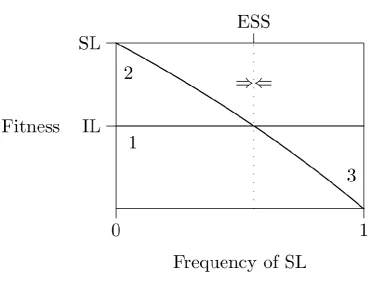
Figure 1.1
Figure taken from Rogers (1988). As the frequency of social learning (SL) increases it's fitness decreases. Meanwhile, the fitness of asocial, or individual, learning (IL) does not depend on the frequency of social learning. At the ESS the fitness of the two strategies is equal, and the same as a population consisting only of asocial learners.
1.4.2 – Critical and conditional social learning
Two examples of such strategies are "critical" and "conditional" social learning (Enquist et al., 2007). Critical social learners first learn socially, taking advantage of the relatively cheap cost of social information. However, unlike Rogers’ pure social
Chapter 1 - Introduction 10
learning, is the inverse of critical social learning, where asocial learning is the default and social learning only used if the former fails. Enquist et al. (2007) found that this evolves in opposite regions of parameter space to critical social learning – where asocial learning is cheaper than social learning, although these areas are perhaps less typical of natural environments. Although these strategies do lead to an increase in overall population fitness beyond that of pure asocial learners, an outcome that was not possible in Rogers’ model, a difficulty comes with the means by which
individuals are able to evaluate the quality of any information they receive. Such investigation might be regarded as itself a form of asocial learning, and so any critical social learner who sticks with the decision of the social information cannot be considered a pure social learner. However, more problematic is whether such evaluation is at all possible in the real world. For many decisions, for example deciding which type of crop to plant, it is not possible to evaluate the quality of the decision without having fully committed to it (i.e., planting a crop and seeing how it goes), by which point it is no longer possible to gather some more information and reverse your decision.
1.4.3 - Uncertainty
Conditional social learning bears a great similarity to the social learning strategy “copy-when-uncertain” by which individuals are more likely to adopt the decisions of
Chapter 1 - Introduction 11
Chapter 1 - Introduction 12
patch was rich more consistently. After this, trained fish were shown a group of fish foraging at the two patches, but where the patch that had most frequently been rich during training was now poor. Finally, the observer fish were required to make a decision again. van Bergen et al. (2004) found that fish given reliable asocial information showed a strong preference towards the patch that was typically reliable during training. However, when the prior information had been unreliable this preference was greatly reduced and the fish were influenced to a greater extent by the social information. Given this, it seems plausible that confidence guided social learning is likely to be a part of human social learning, indeed, this finding is reported in Chapter 3.
1.4.4 – Payoff-, prestige- and reliability-biased social learning
Payoff biased social learning refers to any form of selective social learning where an individual’s social learning is guided by the payoffs to themselves or to other
individuals (Schlag, 1998; Kendal et al., 2009). Game-theoretic analyses have indicated that strategies where an individual’s use of social information is guided by
their own pay-off (“proportional reservation”), the pay-off to demonstrators (“proportional observation”), or the difference between the two (“proportional imitation”) can all be highly effective (Schlag, 1998, 1999). Indeed, there is good
Chapter 1 - Introduction 13
participants were found to selectively copy the design of the individual who was performing the best in the group (Mesoudi and O’Brien, 2008). However, although the value of payoff-biased copying seems clear in a general sense, which form it takes in humans or other species remains unclear with current data insufficient to resolve between the possibilities mentioned above. More generally, payoff-biased social learning suffers from a similar problem to the quality investigation required by critical social learning, in that precise information of payoffs may not be available to individuals until well after decisions are made, if at all. Given this, although they are certainly successful strategies in models and experiments where such information is available, and while there will certainly be some circumstances where payoffs are immediately visible, it remains unclear how often such strategies are a possibility in real populations.
“Prestige” is defined as noncoerced, interindividual, within-group human status
Chapter 1 - Introduction 14
non-human species (see section 1.4.5), such claims do not meet Henrich & Gil-White's definition. Prestige develops across multiple interactions that may be significantly separated in time and space, and requires individuals to monitor each other's long term success, which may be beyond the cognitive capacities of most non-human animals.
Chapter 1 - Introduction 15
Chapter 1 - Introduction 16
distrust of individuals who seem unreliable on the basis that they were a lone dissenter against a group of other informants who were in agreement (Corriveau et al., 2009a), and children are also more likely to adopt someone's opinions when they are endorsed by other individuals (Fusaro and Harris, 2008).
In addition to these studies with humans there is also evidence for payoff-guided social learning from other species. For example, nine-spined sticklebacks have been observed to copy the foraging patch decisions of more successful fish (Pike et al., 2010). This study even had the necessary precision to distinguish between Schlag’s (1998) three learning rules and found that stickleback behaviour matched “proportional observation”. Given the above, payoff-guided learning, at least in some
form, may be a widespread phenomenon.
1.4.5 - Dominance-, age-, size- and kin-biased social learning
Chapter 1 - Introduction 17
achieved through alliances (e.g., Maestripieri, 2007; Engh et al., 2000) in which case dominant individual may provide good information concerning who to form alliances with, although not necessarily concerning other decisions. Evidence from both birds and monkeys suggests dominance-biased copying may be widespread as an indirect result of the behaviour of low-ranking individuals being inhibited by others (Drea and Wallen, 1999; Nicol and Pope, 1994). Thus, if low ranking individuals are unable to provide social information then it will come disproportionately from higher ranking individuals.
In addition to becoming socially dominant, successful individuals are likely to grow to a larger size than unsuccessful individuals due to the increased access to resources that their success affords them. Thus, again, we might predict a bias to copy larger individuals might guide observers towards adaptive outcomes. Data for such a bias can be seen in the guppy (Duffy et al., 2009), where fish were more likely to adopt the foraging decisions of larger demonstrator individuals than smaller demonstrator individuals (although in this study size and age were confounded).
Chapter 1 - Introduction 18
were by the decisions of younger conspecific females (see also Duffy et al., 2009). There is also evidence for such a bias in humans, for example, in the case of the Fijian population, although yalewa vuku or wise-women were particularly influential, to a lesser extent, so were qase - non-specific elders (Henrich and Henrich, 2010). Other studies have found that young birds (Biondi et al., 2010) and chimpanzees (Biro et al., 2003, 2006) are more reliant on social information than older conspecifics.
Chapter 1 - Introduction 19
interact most frequently. Thus, even unbiased social learning might be expected to lead to a greater cultural transmission between parent-offspring pairs than between other members of the population.
Chapter 1 - Introduction 20
speaker, coming from the local area, is likely well informed about local conditions. Mirroring this, Chen et al. (2013) found that 4- to 7-year-old children prefer the information provided by an informant of the same race as themselves. However, the authors found that, children would ignore the advice of an informant of the same race as themselves if that individual was the lone dissenter against a consensus of a different racial composition.
1.4.6 - Unbiased transmission
Chapter 1 - Introduction 21
Future work with these methods will help identify the extent to which unbiased transmission is useful to understand cultural traits at the population level.
1.5 - Neurological studies
Chapter 1 - Introduction 22
marked, whilst activity in the caudate coded the valence of the social marking. These findings suggest that it is through the integration of activity in these two areas that individuals distinguish between positively and negatively socially marked stimuli.
Chapter 1 - Introduction 23
been involved. However, the activity was only seen when the information came from humans, indicative of a normative aspect. Berns et al. (2010) found similar activity in the insula, an area associated with anxiety and ostracism, whilst Campbell-MeikleJohn et al. (2010) found activity in the lateral prefrontal cortex, an area linked with reputation management, this activity also predicted subsequent behavioural adjustments to the group norm. The similarities between the response to human and computer decisions could be interpreted as subjects anthropomorphising the computers, or alternatively treating human demonstrators as machines. Such findings imply that if researchers are to understand social information use, including conformity and conformist transmission, at the behavioural level it may be insufficient to consider it in light of either informational or normative influence in isolation as they may not be distinct processes at the neural level. A more complete theory of social decision making may need to include both informational and normative influences, with variable payoffs associated with getting the correct answer and fitting in with group mates. Experiments where both are included and their relative strengths manipulated could help our understanding of how the two interact. From this perspective, social decision making typically involves a maximisation of reward, taking into account the information provided by others on the group norm and the level consensus behind it, the expected cost of deviating from such a consensus, the individual’s own information concerning the task, the information provided by
Chapter 1 - Introduction 24
1.6 – Summary
Chapter 2
2 - Conformist Transmission 26
2.1 - Introduction to conformist transmission
In 1963, ethologist Niko Tinbergen argued that to fully understand behaviour in biology it is necessary to consider it from four different perspectives, that of its history, ontogeny, function and causation. Whilst heuristics such as these have the potential to constrain research as much as assist it (Laland et al., 2011) the realisation of answers to Tinbergen’s four questions is often a very helpful target for research,
2 - Conformist Transmission 27
[image:37.595.94.484.198.543.2]on a broadly disciplinary basis, but draws attention to which of Tinbergen’s questions is being addressed in each case.
Figure 2.1
2 - Conformist Transmission 28
2.2 - Cultural evolution modelling
2 - Conformist Transmission 29
successfully at much greater frequencies within a population. This highlights a feature of conformist transmission in that it can be an obstacle to the spread of innovations when rare (Eriksson et al., 2007). As new ideas must initially start at very low frequencies the prevalence of conformist transmission can act to block their spread. This is particularly problematic in temporally variable environments where the discovery and spread of new behaviours is essential to success (Eriksson et al., 2007; Nakahashi et al., 2012; Kandler and Laland, 2013). As weak conformist transmission hinders the spread of innovations less than strong conformist transmission, Kandler & Laland (2013) argue that conformist transmission is likely to be weak. Thus the extent to which conformity is expected to be adaptive is contested, but the evidence from theoretical models on balance leads us to expect a broad range of conditions under which it will be utilised.
2 - Conformist Transmission 30
its own modal behaviour, which may well vary across groups due to chance or because of differences in environmental conditions (Boyd and Richerson, 1985). The end result of this process will be the emergence of cultural differences between groups of individuals. Once established, such group differences potentially allow a process of cultural group selection to occur (Boyd and Richerson, 1985; Richerson and Boyd, 2005; Henrich, 2004a). By this process, stable cultural differences between groups that lead to differential group success and cause groups possessing the most favourable cultural traits to out compete other groups that lack these traits, lead to the overall population becoming dominated by groups exhibiting favourable cultural traits. This process is more plausible than genetic group selection which is hampered by invasion of successful groups by individuals possessing genes that benefit the individual, but not the group. This is because, with cultural group selection, migrating individuals can adopt the culture of their new group thereby preserving group differences (Boyd and Richerson, 1985; Henrich, 2004a). As a result, cultural group selection has been argued to be behind the high levels of cooperation exhibited by human populations (Boyd and Richerson, 1985; Richerson and Boyd, 2005; Henrich, 2004a).
2.2.1 - Anti-conformist and unbiased transmission
2 - Conformist Transmission 31
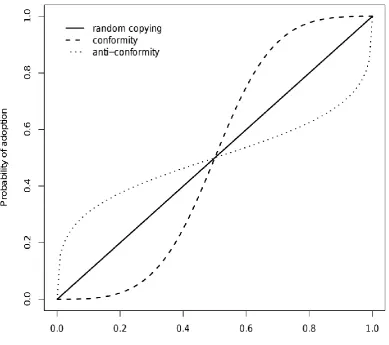
out of 10 demonstrators supporting option A, an anti-conformist individual would have a less than 70% chance of choosing option A (see Fig. 2.2).
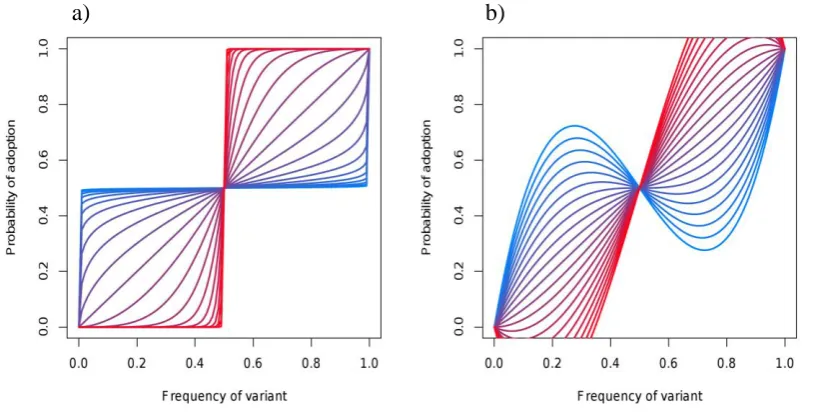
[image:41.595.90.497.128.337.2]a) b)
Figure 2.2
Two alternative forms of conformist transmission, where lines corresponding to conformist transmission are in red and anti-conformist transmission in blue. (a) Is calculated such that:
p = qs/(qs+(1-q)s),
where p is the probability of adoption, q is the frequency of the variant and s (s ≥ 0) is the shape parameter that dictates whether the curve is conformist or anti-conformist. A benefit of this function is that it is constrained to produce plausible values. However, it does not allow for anti-conformist transmission strong enough to favour minority variants to the extent that they can become majority variants. (b) Shows the formulation used by Boyd & Richerson (1985) and Kendal et al. (2009) such that:
p = q + d*p*(1-p)*(2*p-1)
where p is the probability of adoption, q is the frequency of the variant and d dictates whether the curve is conformist or anti-conformist. This form can allow minority variants to be preferred to majority variants, but has the disadvantage that it is also capable of producing impossible adoption probabilities as shown by many of the red lines going outside the range 0-1.
2 - Conformist Transmission 32
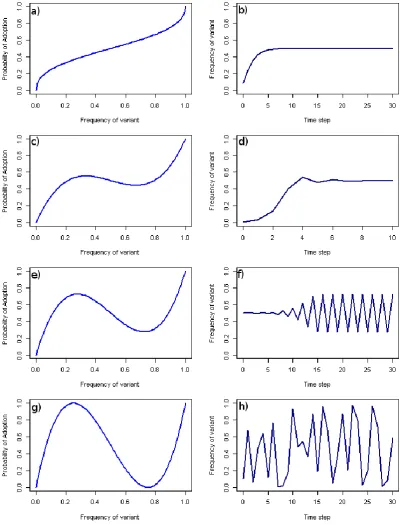
A in the hypothetical example, whilst <70%, is >50%, see Fig. 2.2a), the population will tend to a state of equal mixing with all options equally prevalent (see Fig. 2.3a and b). However, when minority opinions can be favoured over majority opinions (i.e., the probability of choosing option A in the hypothetical example is <50%), as has been considered theoretically (Kendal et al., 2009), several outcomes can result. A small bias towards the minority still results in equal mixing (see Fig. 2.3c and d). A stronger bias can result in looping oscillations where although fixation or equal mixing are metastable, dynamic switching between two mixed states is the only long-term outcome (see Fig. 2.3e and f). Finally, if the bias towards the minority is sufficiently powerful then chaotic dynamics can ensue (see Fig. 2.3g and h). As one of the strengths of conformist transmission was its specific population level outcome, the current grouping of these multiple different population level outcomes under the single term of anti-conformist transmission is ambiguous. Researchers would be well advised to bear in mind and make clear the population effects of any anti-conformist transmission they study.
2 - Conformist Transmission 33
Figure 2.3
2 - Conformist Transmission 34
2.3 - Cultural evolution experiments
Given the predictions made by evolutionary models concerning the success of conformist transmission as a learning rule, several experiments on adult human participants have been carried out with the required precision to distinguish a disproportionate tendency to adopt the majority decision from other rules that lack the same population level consequences. In the context of Tinbergen’s four questions,
these studies combine the study of function (investigating the adaptive value of conformist tansmission) with the study of mechanism (investigating the contexts that elicit conformist transmission). Efferson, et al. (2008) carried out an experiment in which, over many rounds, participants repeatedly chose between two “technologies”.
The participants knew the alternative technologies had different expected payoffs, but did not know which was the better technology. Half of the participants were constrained to be asocial learners and were given feedback concerning the payoffs of their decisions, the other participants were constrained to be social learners and were only given information on the decisions of the asocial learners, but were not informed of their payoffs. Although conformist transmission was found to be an effective strategy for the social learners, Efferson et al. (2008) found that only the behaviour of some participants in the social learning condition, notably those that self-defined as conformist, could be well explained with a conformist model. The behaviour of the other participants, who did not describe their behaviour as conformist, could not. Efferson et al. (2008) characterise this difference in terms of a mixed population of conformists and “mavericks”, the latter representing individuals typically reliant on
2 - Conformist Transmission 35
be an appropriate interpretation. Rather, the data imply that individuals vary in the extent to which they utilise social information and/or are conformist.
In a similar experiment McElreath et al. (2005) used a two-armed bandit design where participants were required to choose between planting two types of crop 20 times at each of 6 different farms (totalling 120 decisions). The two crops were noisily associated with different payoffs and on some of the farms the payoffs could change over time. After each decision they could choose to see the decisions made by all other individuals playing at the same time as them (participants played in groups of 4-7 individuals). Although participants did show evidence a conformist response, they were better characterised by unbiased transmission when the environment was stable across time, a result at odds with theory that suggests environmental stability over time favours conformist transmission (Nakahashi et al., 2012). In addition to this, Toelch et al. (2010) found that subjects track variant popularity over time and in effect anticipate a future majority choice by favouring variants that show increasing popularity. This makes sense in the context of possible environmental change and the risks of the cultural inertia created by conformist transmission as such behaviour may allow individuals rapidly to take advantage of emerging technologies and overcome the cultural inertia that conformist transmission imposes.
2 - Conformist Transmission 36
2.3.1 - Social Psychological Studies
2 - Conformist Transmission 37
expected in cases where the observing individual is naïve (Boyd and Richerson, 1985). This means that the Asch paradigm is unsuitable to investigate conformist transmission as the exposure to, and simplicity of, the task used meant that the subjects were far from naïve when listening to the decisions of the confederates. Instead, asocial information must be controlled for, either experimentally, by using a design such that subjects genuinely are in a state of naïvety, or statistically, such that a measure of asocial information is taken and can be used in analyses to separate the effects of asocial and social information.
2.4 - Animal experimentation
As cultural evolution takes an explicitly evolutionary approach, studies employing the comparative method are of value. Such studies provide further insights into the third of Tinbergen’s questions, evolutionary history, as through a consideration of the
2 - Conformist Transmission 38
2 - Conformist Transmission 39
evolutionary history of the human capability for conformist transmission and its phylogenetic distribution.
2.5 - The development of conformist transmission
The fourth of Tinbergen’s questions, ontogeny, is one area that the study of
2 - Conformist Transmission 40
consensus it would be highly illustrative with regards to the ontogeny of conformity. Indeed, there is already evidence that learning rules vary over time. For example, children of different ages show a shift in sensitivity to reliability assessment that may be experientially triggered (Clement et al., 2004).
2.6 – The neurobiology of conformist transmission
Whilst there are a small number of studies investigating the neurobiology of social information use (see Chapter 1, section 1.7), there are no studies that have directly investigated the neurobiology of conformist transmission. However, there are some neurological studies that are of relevance. For subjects to be employing a conformist learning bias it might be expected that parts of the brain would be identified that evaluate levels of consensus amongst demonstrators. Whilst no data exists for studies using sufficiently large groups of demonstrators with varying levels of consensus, there are nonetheless hints of the existence of such a mechanism in the brain. A music choice experiment (Campbell-Meiklejohn et al., 2010) found that along with activity in the insula cortex and right tempoparietal junction, areas associated with monitoring the decisions of others, anterior insula activity increased when the two “expert”
2 - Conformist Transmission 41
demonstrators caused activity in several areas known to be involved with more general error and conflict processing such as the rostral cingulate zone (Botvinick et al., 2004) and depressed activity in reward centres such as the nucleus acumbens in the ventral striatum. Thus, brain areas that evaluate object value, such as the ventral striatum in the music choice task (Campbell-Meiklejohn et al., 2010), also seem to play a role in rewarding the subject for being in agreement with others. Furthermore the magnitude of the change in activation of these areas predicted changes in subsequent subject behaviour (Campbell-Meiklejohn et al., 2010; Klucharev et al., 2009).
2.7 - Conclusions
From the above it can be seen that Tinbergen’s four questions of history, ontogeny,
function and causation are effective in identifying areas in which current understanding of conformist transmission is well developed, and others where it still needs work. With large amounts of theoretical and empirical data on the topic, researchers are beginning to identify the circumstances under which individuals will conform, and with further careful non-human experimental work they will soon be able to understand the current taxonomic distribution of such a bias. However, there is still much work to be done on understanding the contexts in which conformist transmission is displayed by humans and the findings of theory and experiment need to be reconciled.
2 - Conformist Transmission 42
Chapter 3
An Empirical Study of
Abstract
3 - Social Learning Strategies in Adults 45
3.1 – Introduction
Despite the large body of theoretical and empirical work described in the previous two chapters there are still several outstanding questions concerning adult human social learning that need to be addressed. In particular, the existence of conformist transmission (see Chapter 2) is far from clear. Whilst theoretical work has generally found conformist transmission to be a successful strategy, this has not been replicated empirically and more detailed data is needed to evaluate this apparent discrepancy. Additionally, the nature of payoff biased social learning (see Chapter 1, section 1.8) is also under question. Whilst it is favoured theoretically and supported empirically, there are several forms that such a rule could take (Schlag, 1998) and as yet there is not data capable of discerning between these different possibilities.
3 - Social Learning Strategies in Adults 46
factors and prevents a full understanding of social learning. Another limitation is that empirical work is typically limited to a single experimental task. The result being, that although social learning biases are typically described as general features there is as yet very little data with which to directly evaluate this hypothesis. Although evolutionary theory suggests these rules should be broadly adaptive, and thus be in use across a range of tasks, supporting this simplification, it still requires testing. A final limitation is the paucity of empirical data on whether the strategies individuals use are employed adaptively in the sense that they aid successful decision making (a notable exception being Henrich and Henrich, 2010). Most studies, being among the first of the kind, have aimed simply to document the existence of such strategies. This, however, ignores a central prediction of the cultural evolutionary models - that such learning biases should be adaptive. Indeed, were such learning biases to be documented, and their effects to be observed to be generally maladaptive, this would be as much a problem for the theoretical literature as for the biases to not be observed at all.
3 - Social Learning Strategies in Adults 47
Richerson, 1988). Factors considered are the number of demonstrators (+), demonstrator consensus (+), subject confidence (-), task difficulty (+), the cost of asocial learning (+), task familiarity (-), demonstrator (+) and subject (-) performance, and their difference (+), where + and - signs indicate a prediction for a positive or negative relationship with social learning. Additionally, the use of multiple tasks allows a test of the previously implicit assumption that social learning strategies are deployed consistently across diverse contexts and sensory modalities, whilst investigating numerous factors allows a test of whether individuals are limited to using a single strategy at a time or if such factors can interact. Furthermore, by setting social information use in a task-solving context we are able to investigate the adaptiveness of participants' behaviour by measuring participants' success in the tasks. Thus, the work presented here aims to provide a comprehensive empirical test of the adaptive learning strategies predicted by evolutionary models, to provide new data particularly concerning current areas of debate such as pay-off and frequency dependent social learning and to extend existing work by examining the simultaneous use of multiple strategies.
3.2 - Methods
3.2.1 - General Methods
3 - Social Learning Strategies in Adults 48
mean access to the task itself, whereas social information provides information concerning the decisions of other individuals (henceforth "demonstrators") who themselves had had direct access to the task. Experimental sessions lasted for 60 minutes. Participants were paid £5 for taking part, plus a bonus of up to £5 dependent on their performance during the experiment.
3.2.1.1 - Participants and Apparatus
In total, 99 participants took part in the first experiment (45 in the first instance and a further 54 when it was repeated), 57 in experiment 2, 38 in experiment 3 and 61 in experiment 4. Participants' ages ranged from 18 to 58 (mean=22, s.d.=4); 83 were male, 172 were female and all but 9 were students of the University of St Andrews.
3 - Social Learning Strategies in Adults 49
3.2.1.2 - Procedure
On arrival, the experimenter read participants a briefing and gave them the opportunity to ask any questions. The experimenter then went to an adjoining room and remotely started the experiment program on the participants' computers. The connecting door was kept open so that the experimenter could hear if any participants communicated, but no instances of between-participant communication were observed. When all participants had completed the experiment the experimenter returned to debrief the participants who were then free to collect payment and leave.
3.2.1.3 - General Design
3 - Social Learning Strategies in Adults 50
together, rather than each in turn, so as to avoid repetition and to consider the results as a whole.
3.2.1.4 - Methods of Information Presentation
3 - Social Learning Strategies in Adults 51
In the second protocol, termed the parallel protocol, participants chose between either social or asocial information. Whichever information source they chose, they did not receive any information from the other source, i.e., a participant choosing social information would receive no asocial information and so would not have direct access to the task on that trial. Before making this decision participants were informed of some specifics of the trial, the nature of which differed across experiments and are detailed below (Section 3.2.4). After receiving their chosen source of information participants were required to make a single decision. Using this protocol it is always clear which information source participants are using and participants were considered to have used social information when they chose to view social over asocial information. Under this protocol direct access to the task (i.e., asocial information) is optional and participants were able to determine the duration or number of presentations of the task stimulus. In this case a cost was levied on asocial information use that was directly proportional to number of presentations or presentation duration.
3.2.2 - The Tasks
3.2.2.1 - The foraging task
3 - Social Learning Strategies in Adults 52
et al., 2003, 2005; van Bergen et al., 2004). Participants were shown two possible foraging sites, represented as squares side-by-side on the participants' screen. Participants subsequently received 10 visual presentations of a number of apples on each of the two sites, totalling 20 presentations in all. The true values of the sites were either 8 and 4, or 6 and 2, with which site was the most profitable randomised across trials. The number of apples shown in each presentation was independently drawn from a Poisson distribution with a mean equal to the true distribution of the site. However, to add further uncertainty, for one of the ten apple presentations at each site the number of apples shown was drawn from the distribution of the other site. The apple presentations were given in a random order and each lasted 500ms. The location of each apple on its site was randomised for each apple and for each presentation.
3.2.2.2 - The mental rotation task
3 - Social Learning Strategies in Adults 53
and allows trials of different difficulty to be generated as trial difficulty is related to the angle by which shapes have been rotated relative to each other.
3.2.2.3 - The length-estimation task
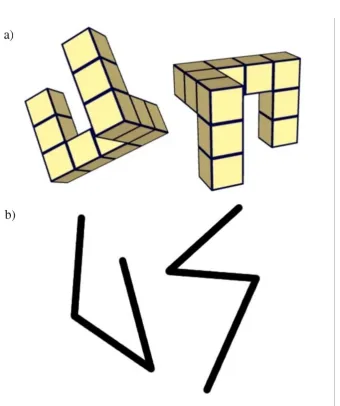
Participants were required to decide which of two irregular lines was longest (see Fig. 3.lb). In each trial, participants received a single visual presentation of an image of two lines, the duration of which varied as detailed below. This task was chosen as it is hard to solve through visual observation alone and so all responses will be associated with some degree of uncertainty.
3.2.2.4 - Audio tasks
Three different audio tasks were used. Across the three, participants were required to decide which of two tones was (i) higher in pitch (the “pitch task”), (ii) greater in intensity (the “intensity task”) or (iii) whether a single tone was increasing or decreasing in pitch (the “pitch-modulation task”). These tasks were chosen to provide
3 - Social Learning Strategies in Adults 54
[image:64.595.96.437.165.572.2]cost per playing, detailed below (see Section 3.2.4.4), that reduced their bonus payment.
Figure 3.1
3 - Social Learning Strategies in Adults 55
3.2.3 - Types of Social Information
3 - Social Learning Strategies in Adults 56
lottery was used, participant feedback, collected following the experiment, was used to identify participants who had failed to understand this procedure and their data was excluded from analysis.
3.2.4 - The experiments
3.2.4.1 - Experiment 3.1
3 - Social Learning Strategies in Adults 57
3.2.4.2 - Experiment 3.2
Subjects completed 24 trials of the mental-rotation task, using the linear protocol and manipulated social information, presented in a random order. The shape images were presented for a fixed time of 4s. I manipulated (i) the number of demonstrators and (ii) the level of consensus in the social information as in Experiment 1 (see Section 3.2.4.1).
3.2.4.3 - Experiment 3.3
Participants completed 60 trials using the parallel protocol and battery social information. The trials were arranged into 4 groups of 15, the 1st and 3rd groups used the mental-rotation task and the 2nd and 4th, the length-estimation task. This structure was adopted to avoid participants becoming bored and not attending to trials. The order of trials within each group was randomised for each participant.
Prior to choosing between the two sources of information (as per the parallel protocol), participants were informed of question difficulty (‘very easy’, ‘easy’, ‘moderate’, ‘hard’, or ‘very hard’) and the number of demonstrators they would see
3 - Social Learning Strategies in Adults 58
got the question wrong following asocial information. Previous work has suggested that the angle of rotation predicts trial difficulty; however, I found this not to be the case. For the length-estimation task difficulty was negatively related to the Weber fraction of line length, such that:
difficulty α –(length of longer line / length of shorter line),
as this is typically a reliable measure of difficulty for perceptual tasks. Participants who chose asocial information were able to examine the relevant image indefinitely, but at a cost proportional to the time spent observing that reduced their possible bonus payment. Participants were informed of the cost incurred after each trial. Social information was free.
3.2.4.4 - Experiment 3.4
3 - Social Learning Strategies in Adults 59
batches of participants however. If a participant chose to copy an individual who was copying someone themselves, the participant received only a message informing them of this, and therefore had to guess.
Prior to choosing a source of information, in trials using the pitch task participants were informed of the number of demonstrators available (1, 3 or 5) and the cost incurred each time they played a tone (10, 20 or 30% of maximum pay-off). In trials using the intensity task, the social information was always from a group of four demonstrators and participants were informed of the degree (but not direction) of consensus amongst the demonstrators (0, 0.5 or 1), whilst the cost per playing of the tones was held constant and participants were informed at the end of each trial of the cost incurred. In the pitch-modulation task participants were ranked on their performance, assayed by summing their pay-off across all pitch-modulation trials irrespective of the source of information participants had used, and were informed of their own rank and the rank of their single potential demonstrator at the start of each trial.
3.3 - Analyses
3 - Social Learning Strategies in Adults 60
backwards elimination, removing variables for which the 90% central credible interval included 0 from a model containing all predictors and second-order interactions in addition to baseline values and individual level effects. Parameter values were estimated using a sample of at least 3000 iterations, after a suitable burn-in period and thburn-innburn-ing to remove autocorrelations. Prelimburn-inary analyses were carried out to establish whether factors should be modelled as linear or categorical.
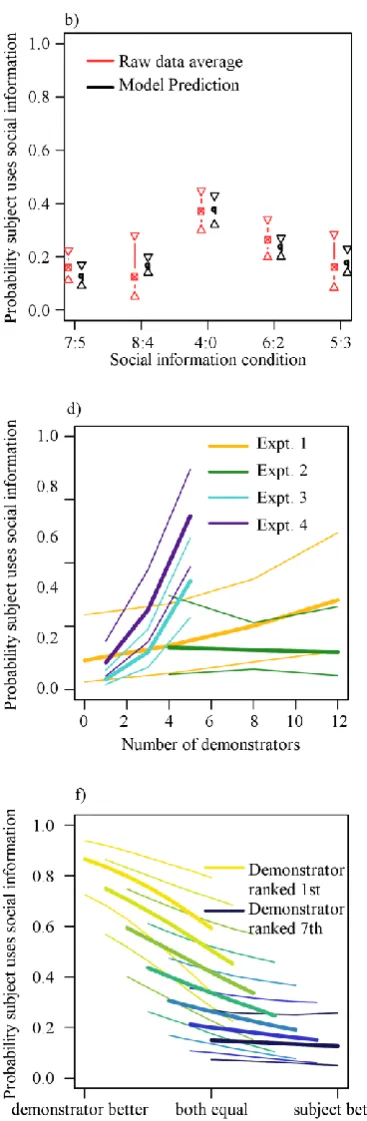
Unless otherwise stated, all figures show the median of posterior samples from the fitted models, as estimates of parameter values. Plots of the posterior parameter estimates are preferred to raw data because they directly illustrate the marginal effect sizes associated with a given predictor while controlling for the effects of other predictors. See Figures 3.2a) and b) for a comparison of the raw data and model estimates.
3.3.1 - Experiment 3.1
3 - Social Learning Strategies in Adults 61
To investigate whether the use of social information was adaptive I separately modelled the probability a participants' initial, asocial, decision was correct as a function of participant confidence. To investigate whether the order of information presentation affected participant reliance on the two sources of information, I modelled the probability a participant favoured social information over asocial as a function of order of information presentation. In the case of participants who received social information first, it is hard to discriminate trials where the two sources of information disagreed, but participants stuck with the social information from trials where the two sources of information agreed. To get around this I assumed that asocial information was never misleading, in that if the majority of demonstrators were incorrect then the asocial information would always disagree with the social information.
3.3.2 - Experiment 3.2
3 - Social Learning Strategies in Adults 62
To investigate whether the use of social information was adaptive I separately modelled the probability a participants' initial, asocial, decision was correct as a function of participant confidence. To further investigate the nature of participants' response to consensus (i.e., whether it was conformist), two further analyses were carried out. Neither of these analyses required that data be limited to cases where the social information disagreed with the participant’s initial, asocial, decision. Firstly, I
modelled the probability a participant would change their decision as a function of demonstrator number, the proportion of demonstrators that disagreed with the participant, participant confidence in their initial decision. Secondly I modelled the probability that a participant's final decision would be that the shapes matched as a function of the number of demonstrators, the proportion of demonstrators deciding the shapes matched (which was separately modelled as both linear and categorical to avoid constraining the shape of the response), whether the participant initially decided the shapes matched, participant confidence in their initial decision, whether the shapes actually matched or not, and random trial effects. Interactions between these effects were included when proportion was modelled linearly, but when proportion was modelled as categorical interactions between proportion and the other effects could not be included.
3.3.3 - Experiment 3.3
3 - Social Learning Strategies in Adults 63
and the effects of trial difficulty, previous costs incurred, number of demonstrators, session and the interaction between demonstrator number and session.
To investigate whether the use of social information was adaptive I modelled the pay-off to participants on trials where they used asocial information (using a normal error structure and without a link function) as a function of task difficulty, trial group, and task.
3.3.4 - Experiment 3.4
For each of the three tasks I modelled the probability that an individual would choose social information instead of asocial information. In the pitch task this was as a function of demonstrator number and the cost to play the sounds, in the intensity task as a function of demonstrator consensus and costs incurred when using asocial information previously, and in the pitch-modulation task as a function of participant rank, demonstrator rank and the difference between the two. The final model for each of the three tasks contained a baseline level of social information use and a random individual effect. The final model for the “pitch task” also included the effect of demonstrator number and the cost to listen to the sounds. The “intensity task” final model contained the effect of demonstrator consensus whilst the “pitch modulation task” final model also included demonstrator rank, the difference in rank between
3 - Social Learning Strategies in Adults 64
To investigate whether the use of social information was adaptive I modelled the probability that a participant would make the correct decision on a trial for which they had chosen asocial information as a function of participant performance ranking.
3.4 - Results
3.4.1 - Experiment 3.1
Participants were increasingly likely to adopt a conflicting majority decision with decreasing confidence in their own decision (gradient of slope on the linear predictor: median = -0.48, 95% central credible interval: [-0.87, -0.13], Fig.3.2e), increasing demonstrator consensus (2.50, [1.23, 4.01], Fig. 3.2c), and increasing numbers of demonstrators (0.11, [0.00, 0.23], Fig. 3.2d). There were no interactions. Participant confidence predicted whether a participant was right or wrong, with low confidence predicting an incorrect answer (0.50, [0.19, 0.84], Fig. 3.2e). There was no effect of information presentation order (social/asocial first) on social information use (0.01, [-0.50, 0.49]). The minimal adequate model contained a baseline level of copying, a random subject effect and the effects of subject confidence, demonstrator number and consensus.
3.4.2 - Experiment 3.2
3 - Social Learning Strategies in Adults 65
predictor: median = 2.51, 95% central credible interval: [1.63, 3.41], Fig. 3.2c) and with decreasing confidence in their initial choice (-0.81, [-1.09, -0.56], Fig. 3.2e). However, there was no evidence for an effect of the number of demonstrators (-0.02, [-0.21, 0.14], Fig. 3.2d). Low participant confidence again predicted an incorrect answer (0.23, [0.11, 0.34], Fig. 3.2e). The minimal adequate model contained a baseline level of copying, a random subject effect and the effects of demonstrator consensus and subject confidence.
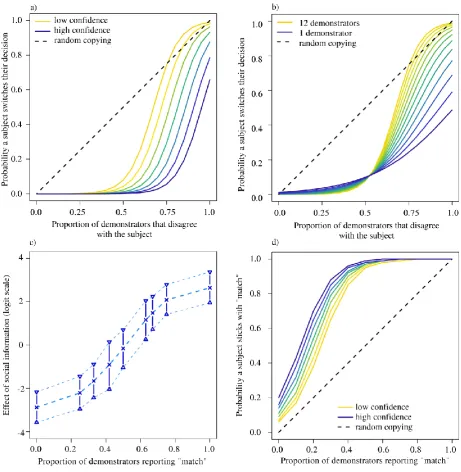
The first conformist transmission analysis showed that participants were increasingly likely to change their initial decision as the proportion of demonstrators that disagreed with them increased (5.12, [4.04, 6.44]). There was an interaction between demonstrator number and disagreement (0.44, [0.17, 0.76]), producing an S-shaped curve when demonstrator number was high and participant confidence was low (Fig. 3.3a, b).
The second conformist transmission analysis found that the likelihood a participant’s final decision was that the shapes matched co-varied with the proportion of demonstrators reporting that the shapes matched (8.30, [6.56, 10.45], Fig. 3.3d), an effect that increased with the number of demonstrators (i.e. a proportion x number interaction, 0.66, [0.34, 1.02], ‘proportion’ modelled as linear). There was another interaction between a participant’s initial decision and their confidence in that
3 - Social Learning Strategies in Adults 66
3 - Social Learning Strategies in Adults 67
Figure 3.2
3 - Social Learning Strategies in Adults 68
3 - Social Learning Strategies in Adults 69
Figure 3.3
3 - Social Learning Strategies in Adults 70
intermediate levels of consensus have a disproportionately large effect on decision making. The y-axis is the change to the linear predictor of the model, on which a change of magnitude 4 could alter the probability a participant decides the shapes match by as much as 76%. Accordingly, without other influences, social information is likely to have a dramatic effect on participant behaviour. (d) Participant behaviour, however, is also strongly affected by prior information and their confidence in it (the lines shown are for the case where participants already believe that the shapes match). Thus, although participant behaviour may not consistently be conformist, their response to the social information alone was conformist. The black dashed line portrays the expected result of random copying.
3.4.3 - Experiment 3.3