(Engaging or avoiding) Change through Reflexive Practices
Journal of Management Inquiry
Paul Hibbert
The University of St Andrews
Lisa Callagher* The University of Auckland
Frank Siedlok The University of Auckland
Charlotta Windahl The University of Auckland
Hee Sun Kim The University of Auckland
*Corresponding Author Details Dr Lisa Callagher
The University of Auckland
12 Grafton Road, Auckland 1142, New Zealand Private Bag 92019
Auckland, 1142, New Zealand +64 9 923 1738
(Engaging or avoiding) Change through Reflexive Practices
Abstract
In this paper, we explore the ways in which individuals deploy reflexive practices in order to avoid or engage with a call to change either oneself or the social context. We begin by developing a categorization of the modes of reflexive practice associated with avoidance or engagement. We go on to develop – through a relationally reflexive research process – three contributions that build on this. First, we build an understanding of what a repertoire of reflexive practices may include, and ‘what is going on’ in such reflexive practices. Second, we explain how reflexive practices can be mobilizing, thereby enabling shifts between avoidance and engagement modes, or fix action within a single mode. Third, we develop an understanding of the ways in which emotions and relationships influence how reflexive practices of either kind are deployed.
(Engaging or avoiding) Change through Reflexive Practices
Introduction
Reflexive practice has been recognized as an important element in enacting change in academic (Alvesson, Hardy, & Harley, 2008), managerial (Cunliffe, 2004; Paton, Chia, & Burt, 2014) and organizational (Gorli, Nicolini, & Scaratti, 2015; Nistelrooij & Caluwé, 2016) contexts. Yet, is not sufficient to recognize reflexivity as important. We need to understand how reflexivity relates to action and vice versa, otherwise our understanding of this dynamic remains limited (Antonacopoulou, 2004, 2010). Addressing the call for more understanding of dynamic reflexive practices, this paper brings new insights into our understanding of how reflexive practice enables or constrains responses to the need for change, in different modes of practice that embrace or avoid responsibility (Hibbert & Cunliffe, 2015; Paulsen, 2015).
& Jun, 2005; Hibbert, Coupland, & MacIntosh, 2010; Hibbert, Sillince, Diefenbach, & Cunliffe, 2014), and we consider that reflexivity is not just a rational process, but also intrinsically involves emotion (Brown & Graaf, 2013; Burkitt, 2012; Holmes, 2010).
By considering how these different kinds of critical- and self- oriented reflexivity, together with emotions, are involved in deciding how to act, we identify at least four modes of reflexive practice by individuals. To achieve this, we employ a relationally reflexive approach amongst an authorial team who assumed the roles of both researchers and practitioners (MacIntosh, Beech, Antonacopoulou, & Sims, 2012) in dialogue with prominent voices in the literature. Through this conversational to-and-fro, exploring the otherness presented to us and enacting connections with it (Hibbert et al., 2014), we develop our argument into a theory of reflexive change.
Key Aspects of Reflexive Practices
Outward and inward orientations: critical-reflexivity and self-reflexivity
Being struck does not, however, always directly lead to change and progress (Gorli et al., 2015; Nistelrooij & Caluwé, 2016). Instead, it can lead either to action that challenges the source of the discomfort or to self-interested disengagement; the latter may address the symptoms but not the causes of discomfort, and is focused on the search for desirable interpretations of such (in)action (Paharia, Vohs, & Deshpandé, 2013). For example, individuals may choose to “keep slacking” at work (Paulsen, 2015) if they have no ambition – or power – to change the context. Similarly, they may in order to re-configure their own practice to fit the context, they may reduce the scale and scope of their work activities (Wrzesniewski & Dutton, 2001). Alternately, they might re-craft the cognitive and relational boundaries of their job, changing the meaning of their work if not its actual content (ibid). However, such cognitive work may also emphasize a call to action; through deploying different theoretical and conceptual “lenses” to view the ongoing construction of the environment, individuals can bring to light the irresponsibility, irrationality and inequalities in the social order, that otherwise remain unexposed (Cairns, Śliwa, & Wright, 2010; Cunliffe, 2003, 2004; Cunliffe & Jun, 2005; Gorli et al., 2015; Hibbert, 2013; Myers, 2010).
The emotional entanglement of reflexivity
rational calculation (Gunia et al., 2012; Paharia et al., 2013). Furthermore, research has long recognized the importance of emotion in relation to understanding reflexivity and the choices individuals make, although early research tended to regard “feelings” as something that one should aim to set aside in reflexive practices (Mills & Kleinman, 1988). As Burkitt (2012, p. 458) has commented, “while emotion is considered in theories of reflexivity it is generally held at bay, being seen as a possible barrier to clear reflexive thought”.
However, recent research tends to see emotion as being more tightly bound to reflexivity, and that therefore understanding reflexive thought and practice requires a better understanding of the entangled role of emotions (Brown & Graaf, 2013; Burkitt, 2012; Davies, 2012; Holmes, 2010). Lines of inquiry in this area have opened up in three particular directions: attention to one’s own emotions in reflexive practice(s); emotions as key triggers or pivot points of change; and the ways in which negative or positive emotions impact differently on reflexive practices and individuals’ willingness to take positive action in difficult circumstances. We address each of these points in turn.
First, attention to one’s own emotions has been a focus of much recent debate amongst researchers, mainly in relation to reflexivity in the context of their research. In particular, it has been argued that by avoiding the typical suppression of emotion in the research process (c.f. Fineman, 2005) a richer and more informed account of the research context or phenomenon of interest can be developed:
with a related aversion to discussing this in later writing, and feelings of guilt upon departure”(Gilmore & Kenny, 2014, p. 71).
Gilmore and Kenny (2014) emphasize the value of this approach, but are similarly emphatic about how this was only fully enacted in the presence of engaged other(s). This is consistent with Burkitt’s (2012) arguments that “…we are emotionally engaged with others in our social interactions and these emotional engagements regularly motivate our reflexivity…” (p. 469) and that “reflexivity is not just rational and involves rationalization; it is also relational, dialogical and emotional” (p. 471). Thus, research has concluded that emotion and rationality are entangled in reflexive practice, even if one strives for rationality and neutral feelings, partly because of our unavoidable emotional entanglement with others (Blackman, 2007).
important pivot point for reflexive practice as they open up new understandings. For example, King (2006, p. 873) found, in her study of social activists, that “it was only by reflecting through and on their emotions that they were able to identify and change the processes through which they both participated in and challenged hegemonic constructions of the world”. Building on this, we concur with Gray (2008) about the impossibility of complete detachment from emotions: the question is not whether they are there, but how better awareness of them informs reflexive practice.
Third, therefore, while Holmes (2010) and King (2006) agree in general terms on the role of positive and negative emotions in enacting reflexive practice and taking action, there is more that can be said about the variations in emotions, practice and action. Goss et al. (2011, p. 214) provide a useful first level of insight, arguing that “emotional energy, conceived as a long-term “emotional tone” (ranging from an “up” tone of excitement and happiness to a “down” tone of depression and sadness), can be regarded as synonymous with motivation…”. They also highlight Summers-Effler’s (2002) insight that individual agency can be associated with emotions that break with the conventions of the social context, and whether these emotions are expressed or suppressed. Thus, there is a combination effect between positive or negative emotions and the perceived freedom to express them, in the context of reflexive practice. Nowhere is this combination effect more powerfully exemplified than in Brown and de Graaf’s (2013) study of terminal cancer patients.
difference seemed to be principally related to emotional disposition, or perhaps the ability to engage in “skillful emotional work”. They noticed that “being careful with how one thinks, seeking to change how one feels, or expressing certain emotions and expectations of futures and not others, were each apparent within participants’ accounts of their lived experiences” (p. 557). The key to making the most of an uncertain future was most strongly connected to the ability to maintain hope, in the face of uncertainty, and seeing freedom to act within the possibilities of this limited time.
Our conclusions on the role of emotion in reflexive practice are threefold: first, that it is unavoidable and has to be considered; second, that it involves the self in the social context, and that emotional engagement with others in this context provides a better understanding of the insights provided by one’s own emotions; and third, that differences in motivation towards reflexive action may be associated with emotional tone (positive and energizing, or negative and demotivating). Perhaps the most important aspect of the emotional tone is the presence of hope, which has been characterized as an anticipatory emotion that supports behaviors focused on bringing about a desired future (Bagozzi & Pieters, 1998; Pradies & DeJordy, 2016).
Reflexive Practices of Avoidance or Engagement
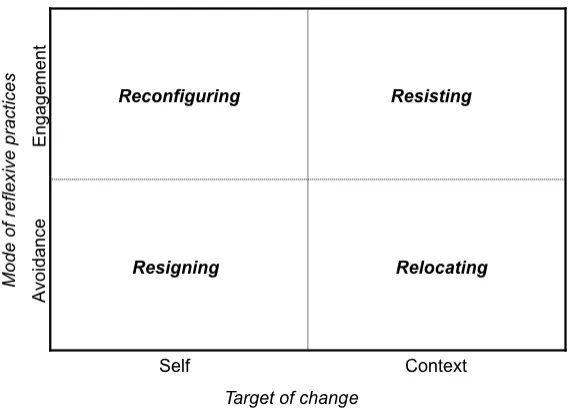
While individuals, to some degree, are always reflexive and always changing themselves in response to incoming perceptions (Archer, 2007; Giddens, 1990), reflexive practices can lead to two types of response. Firstly, it can help individuals to recognize that their responsibility, that is “to see themselves as agents and as authors of the organizations and institutions in which they live” (Gorli et al., 2015, p. 5), places a call for action on them. This call for action can be both rationally understood and emotionally experienced (and arguably, usually both) and this may involve some discomfort which suppresses action or some more positive stimulus, when the emotional tone involves hope. Thus a call to change that arises from “being struck” may lead to transformative action in some cases, but reflexive practices can also be oriented towards stasis in the face of transformative pressures (e.g. see Nistelrooij & Caluwé, 2016) that are experienced in an unhopeful emotional tone or driven by self-interest. Hence, reflexive practices can be deployed to avoid a call to change as well as to engage with it (Antonacopoulou, 2004, 2010; see also the examples discussed in Cunliffe, 2004; Hibbert et al., 2014; Wrzesniewski & Dutton, 2001).
<Figure 1 about here>
Resigning
Within the avoidance modality, one potential option is to resign oneself to the issues behind the call to change and ‘just go on’ as before, despite knowledge of the problematic nature of these issues. While avoidance is associated with a disconnection between reflecting and acting (c.f. Pless & Maak, 2011; Wilson, 2007), resigning still involves enacting reflexive practices that seek to diminish one’s sense of responsibility and involvement in order to ease discomfort while avoiding an active response to pressures to change (Nistelrooij & Caluwé, 2016). Nevertheless, this can be a discomforting situation. For example, the salespeople in the Mill’s “White Collar” case hate not only the job, managers and customers – but also themselves (Cederström & Fleming, 2012) for carrying out commercial activities that contradict their intrinsic beliefs and values. In this way, individuals reluctantly comply with the requirements of their work context, playing to the rules even though this feels uncomfortable to them (Antonacopoulou, 2010).
avoidance of grappling with a need for change. Alternately, individuals might direct blame towards “others”, or the context, as plausible explanations for the discomfort (Cunliffe, 2009), as we discuss below.
Relocating
An alternative option within the avoidance modality is relocating, in which one seeks to place oneself at some physical or mental distance to the issues that create discomfort. Instead of being present-yet-disengaged (as in the resigning mode discussed above), in this mode one seeks to dis-identify and distance oneself from the troublesome context (Thomas, 2009 in Courpasson, Dany, & Clegg, 2012). While this still avoids meeting a call to change head-on, there is less of a disconnection between reflecting and acting (c.f. Pless & Maak, 2011; Wilson, 2007). The reflexive practices deployed show some awareness of the challenge to change, but still seek to diminish the relevance of the challenge rather than engage with it. This can, for example, be achieved through an escape to the world of fantasy as a way of reconciling oneself to the current somewhat dire conditions (Adams, 2004) or by refocusing one’s attention on more meaningful activities in life that take place in other contexts (Parker & Weik, 2014).
Graaf, 2013; Burkitt, 2012). (Self-)disconnected from their feelings through escapist maneuvers of one kind or another, they are less likely to take action to change themselves or situations in their current contexts (Goss et al., 2011; Holmes, 2010; King, 2006). Essentially there is either a mental or physical move to a different context (at least for some of the time) to separate oneself from the call to change and thus reduce the emotional discomfort, without addressing the issue.
Resisting
Moving to the engaging modality, the first option is resisting, in which one seeks to change the current context to lessen, undermine or remove the presenting issue. Resisting is a way of responding through direct action to challenge organizational authority or dominant ideologies (Diefenbach, 2009; Nistelrooij & Caluwé, 2016). Resisting can take multiple forms of a discursive or physical kind, such as stereotyping others (Antonacopoulou, 2010), cynicism (Parker, 2001) or undermining the ideas or staging protests such as not attending formal events to display resistance to the change (Parker & Weik, 2014). There is a key emotional mix in this, with motivation driven by both positive and negative emotions (Goss et al., 2011; Summers-Effler, 2002), such as a combination of anger combined with hope that the situation can be changed, in similar ways to those described in King’s (2006) study of social activists.
resistance does not necessarily need to be always negative: it can also be both a productive and creative practice in organizations (Courpasson et al., 2012; Fisher, & Ashkanasy, 2015), depending on the nature of the ends that are sought by those interrupting the status quo and ‘business as usual’ through their resisting practices. Thus resisting can signify a reflexive awareness of one’s own role in the social construction of the situation but lead to actions of different kinds (Nistelrooij & Caluwé, 2016). These kinds of action address the context with the notion of benefiting the self, self-with-others or wider social groupings.
Reconfiguring
Finally, the most clearly self-oriented mode within the engaging modality is reconfiguring. This could involve seeking to deliberately transform oneself to fit with a desired picture or role model (such as those described in Archer's, 2007 account of ‘meta reflexives’; and Hibbert et al's., 2010 process of reflexive participation within a community that ‘speaks to one’s condition’). This position arises when individuals perceive that the flaws they become aware of when “being struck” are their own, and that they do not like the person that they are or are becoming, as described by Hibbert (2013).
“When I returned to the fieldwork I found to my surprise that this small intervention had inspired some of the young people to apply for jobs, seek new accommodation and try to gain access to college courses. This account remained part of the hidden ethnography because I was unsure how drinking with participants would be interpreted in the discipline, yet it had a major impact in establishing rapport. These young people had changed and held a new belief because I was emotionally committed to them.”
This kind of realization – of the desirability of a different way of being (with others) – leads to an interrupting and reconfiguring of the self (which may also lead to some downstream impacts on the organizational or social context). As Gorli et al. (2015) put it, there is a switch from ongoing authorship (the construction of the context through one’s practices) to a reflexive focus on authoring (understanding oneself as a constructor of the organization and changing how one practices in response to that). As such, it may not be about transforming oneself to resemble a positive role model, but instead be about avoiding becoming a negative one. A good example of this would be recognizing the existence of a toxic organizational culture and one’s own role in propagating it rather than interrupting it (see Hibbert & Cunliffe, 2015, for an example of this).
Exploring Reflexive Practices through a Reflexive Approach
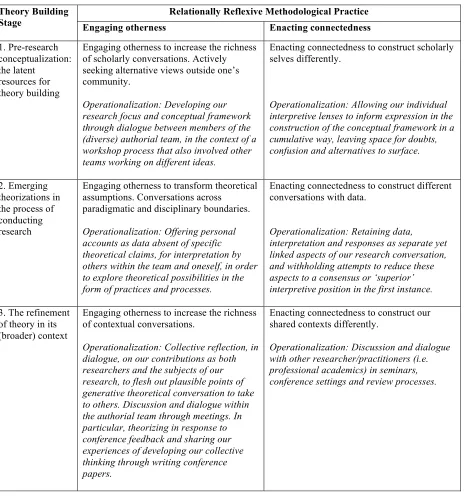
<Table 1 about here>
We began with a general interest in mutual exploration of reflexivity and reflexive practice and developed our initial ideas through a two-day workshop process involving academic participants from a range of business school disciplines. Our focus became reflexive practices in the context of academic career incidents. Consequently, we considered ourselves both as researchers and as practitioners in relation to this research paper. This allowed us to proceed in line with Shotter’s (2010) approach to dialogically generating knowledge between researchers and practitioners, signifying a move away from approaches based on the two groups continually translating for each other towards “a dialogue between practitioners of theory with different foci” (MacIntosh et al., 2012, p. 375). This kind of engagement is believed to help to bridge the theory-practice gap, and enact connectedness through the collective conversation (Hibbert et al., 2014; MacIntosh et al., 2012).
Despite its relatively small size, our five-member team incorporated considerable diversity: five nationalities, female and male, gay and straight, with an age range spanning mid-20s to over 50, and at different points in our respective academic careers. Such differences in authorial teams bring into relief cultural assumptions that can lead to new insights (Thomas, Tienari, Davies, & Meriläinen, 2009) but the differences also meant that there was some doubt, confusion and a range of interpretations about our emerging ideas in the first – theory conversation – “phase” of our research.
form. That is, we moved between texts and graphical representations in rounds of challenge and debate, iteratively developing a framework that captured our theoretically informed understandings in as simple as possible a form. Once we had developed a robust common understanding around a simple framework, we enacted our connectedness with the established literature through developing a richer account of it (while maintaining our novel, simple structure). These discussions and writing processes led to the development of the theoretical framework presented in Figure 1. Our approach, therefore, involved engaging otherness through the multiple interpretations offered by each team member (affording rich and generative conversations) and enacting connectedness between team members and the literature, as evidenced in our articulation of reflexive modes in the previous section, as we continually resolved our insights in a single text (Hibbert et al., 2014). This kind of process of engagement and enactment can enable meaning-making and change (Ripamonti, Galuppo, Gorli, Scaratti, & Cunliffe, 2016).
To maximize the range of interpretations and generativity, we sought stories that evidenced (from the author’s point of view) elements of this reflexive practice framework over any time scale – from a very defined incident that left a deep impression on the author immediately, to more gradual processual understandings evidenced in longer-term narratives and retrospective realizations. Thus the accounts acknowledged that being struck (Cunliffe, 2002a) is not necessarily always triggered by a critical event, but can build up over time towards the realization of arresting moments (Greig et al., 2013). More importantly, the focus on our own life stories allowed for rich conversations in which detailed, small-scale recollections and plausible meanings could be related to other discourses and meanings (Ripamonti et al., 2016), particularly those outlined in our initial conceptual framework.
interpretation and reaction to each account and gave finalized simple descriptive labels to each reflexive practice through collective discussion. Continuing our collective discussion and debate, we then connected the descriptive labels with the particular modes described in Figure 1. Thus phase two of our research involved engaging otherness in the form of multiple interpretations, discussion and debate and enacting connectedness through developing a shared lexicon of reflexive practices that were ‘anchored’ to the shared framework developed in the first phase. However, being open to empirical insights and interpretations showed that this lexicon included descriptive detail that added to our original framework. These additions were of two kinds: the particularities of varieties of practice within each mode, and the identification of key characteristics of practices that help to explain their role in enabling (or not) broader variations in reflexive practice. This phase potentiated new emotions among the participants, which in turn challenged the perceptions of the self, potentially steering future actions related to learning, but also engagement when faced with similar situation(s) (Antonacopoulou, 2004).
colleagues, presenting our ideas at internal seminars and conferences and, finally, engaging in textual conversation with reviewers and editors. In these layers of expanded dialogue, we engaged internally and externally in multiple ways as practitioners and researchers, and as vulnerable and distinctive individual voices, seeking to speak with a unified voice (MacIntosh et al., 2012). Indeed, “our stories of self and other became modified through the dialogic encounter as we picked up new experiences, reflected upon ourselves and acted into the future” (MacIntosh et al., 2012, p. 377). These interactions with peers beyond the authorial team enabled us to refine our ideas through continued processes that followed rounds of conversation which involved writing, reflecting and reviewing (Feldman, 2004), thereby enacting connectedness through refining our interpretations and theoretical implications into a written form that supported a widely-shared common understanding. We believe that the process of iterative conversation with others outside our team, interpretation and writing facilitated deeper personal engagement with our focal themes of reflexivity and responsibility and highlighted the hitherto unexplored role of emotions in the processes we describe. Thus, the development of the paper was intimately connected to our doing, learning and knowing (Antonacopoulou, 2004; MacIntosh et al., 2012)
section that follows below the description of reflexive practices. These understandings both underpin our contribution and are intended to stimulate further debate.
Exploring practices across the four modes
In this section, we draw illustrations of each mode of reflexive practice (see Figure 1) from our individual accounts, providing conceptual labels for particular practices within each of these modes. The particular practices we identify show that the framework presented as Figure 1 is a useful way of categorizing reflexive practices across four modes, but empirical engagement allows us to explore further levels of detail and distinctiveness. Through this exploration, we increase the complexity further in identifying two further distinct characteristics of reflexive practices, namely that they may be fixing or mobilizing. More specifically, using our framework to explore our accounts leads to insights about the ways that some practices support “moves” across reflexive modalities, affording possibilities for both avoidance and engagement and/or a change of focus between self and context. We have referred to these as mobilizing practices. In contrast, fixing practices maintain practice within a mode. As we illustrate reflexive practices of each kind, we briefly draw out the mobilizing or fixing characteristics of these practices; we develop our insights in relation to these characteristics in more depth in the discussion section that follows later.
personally and professionally sensitive narratives. We have taken rational and emotional risks in this article, and needed to set limits that all the authors agreed.
Exploring resigning practices
The first exploration of a resigning practice is from Chris’s account, providing a clear illustration of the use of alcohol as a way of dealing with the self-imposed career stress associated with ambition:
“There is only so much that you can do to work harder, and the glass(es) of wine at the end of the day became less of a reward for achievement and more and more a means of taking the edge off the pain.” (Chris)
In contrast, while originating in the resigning mode, the second illustration shows how the practices supported a move – from resigning to resisting practices. Initially, as the text below illustrates, Alex’s account shows that practice was originally situated in the resigning mode and resembles Chris’ dissolving practice.
“There was no way out – no posts elsewhere. […] Camaraderie developed in these ‘times of oppression’ and going to a pub after work became a norm – this did not exist before! […] A few beers down one evening we were plotting our revenge […] We wanted sophisticated ideas…”
Alex’s colleagues gathered in the context of resignation, in response to a perception that there was no possibility to take action in the situation. Yet, in the process of supporting each other, another kind of reflexive practice developed in the form of reinforcing relationships. While this was originally rooted in the resigning mode, the community, was changed towards social grouping, which enabled resistance. Alex was changed through relationships to this new community (c.f. Archer, 2007). Alex’s bonding times in a local bar, in which positive and nourishing relationships formed in response a difficult situation, illustrates this:
the car design. Looking around for the various ingredients. This felt good. We had a purpose again.”
It is clear that drinking alcohol at a bar after work was associated with the coming together of disaffected individuals to support one another through resistance to the context, which was achieved through “plotting revenge”. Consequently, Alex’s account is a mobilizing example originating in the resigning, and moving towards the resisting, mode. This mobilization seems to be enabled by the object of reinforcing relationships, which provided emotional support in a context in which non-serious talk allowed other alternatives to be imagined, whether realistic or not, and the group from which meaning and purpose was derived was changed.
Exploring relocating practices
Similarly, we found fixing and mobilizing examples connected to relocating practices. Individuals can relocate and thereby find comfort through exploring possibilities of other organizational arrangements, such as changing jobs or profession, and other social arrangements, such as social milieu. The practice of exploring possibilities sits within the mode of relocation, but does not need to be physically enacted and often can border on the world of fantasy (c.f. Adams, 2004). We highlight an example of this from our author accounts. In this excerpt, Chris is imagining a radical alternative way of life:
notional status there would be an acceptance that the best that you can be is simply: to be human, and be trying to do good. To be at the heart of a community…” (Chris)
Individuals often strive for an imaginative ideal; while this picture can act as a motivation and lead to changes in actual behaviors (Adams, 2004), this does not mean that those individuals are actually ready to “take the plunge”. In this case, the imaginative escape is a fantasy since a desired outcome is pictured without an engagement with the struggle necessary for realization; we will return to Chris’s story later to show how this played out.
However, in other situations, exploring possibilities can lead to action. This opens up a mode of reflexive practice that is concerned with self as well as context, in which the focus becomes a need for a means of achieving certainty. This need arises in the context of a difficult and troubling internal conversation that originally offers no prospect of resolution (c.f. Archer, 2007, on discussion of ‘fractured reflexives’); rather than an appealing fantasy, a struggle ensues. Thus in our accounts, there is some evidence of individuals seeking to go beyond imagining and exploring possibilities to enacting change, through effort directed towards a change of role or identity:
“Over the coming months I explored the first two options, ending up enrolling into a full-time PhD.” (Phil)
“I found it refreshing to have someone provide such straightforward options to what had turned into a less than straightforward problem” (Phil)
Therefore, whether relocating practices such as exploring possibilities lead to other forms of practice in modes of engagement or remain rooted in avoidance may depend on nuanced, entangled relationships between rationality and emotions (as also implied by Holmes, 2010).
Still within the relocation mode, there is also evidence for a practice that we describe as rebalancing time – in one’s patterns of work and life – such that the activity context is changed. This has been discussed in the literature in relation to involvement with other activities and altering the “work-life balance” (c.f. Parker & Weik, 2014), or by simply moderating the scale and scope of the job as the needs for control, positive image and connection can be met elsewhere in employees’ lives (Wrzesniewski & Dutton, 2001). In this practice, the author decides to “move away” from one kind of life and “towards” another, through changing the time committed to different aspects of life. For example:
“We went into automatic job mode: come in, teach, sneak back to the office, avoiding any contact with the ‘others’” (Alex)
Overall, we see the preceding examples of relocation mode reflexive practices as mobilizing – leading to different possibilities for (in)action – but the mobilization comes through entanglement between practices that differ in emotional tone.
In contrast, the following relocating example – a practice we label ridiculing has more of a fixed character. Jacky seeks relocation through mental distance from the context by directing humor towards the author’s own discomfort:
“Then the colleague mentioned with a concerned expression, “I feel so under dressed”, looking around at all the people in formal suits and dresses. I looked down at myself, wearing a pink skirt and a white blouse. Previously, I firmly believed that my outfit would be formal enough to attend such a casual conference. But now I felt embarrassed. I realized that I was not giving enough credit to this event, nor to the people attending it. I was under-estimating what an academic conference is supposed to be like—a gathering of important scholars well known in their field. These were people that I envied and could learn from, yet I had been treating the conference as something less significant. With the sudden realization, I joked to colleague, “do I look like one of those sexy Professors in Asian soap opera?” and tilted my body sideways to make a funny posture, attempting to emphasize my curves. Laughing at my awkward effort to turn the attention away from my concerns, it did provide me with a little comfort, but it also focused unintended attention towards me as well from bystanders.”
emotions in this case are entangled with reflexivity, however in this case the emotional tone does not lead to change. The author uses self-directed humor to create a distance from reality, to separate one’s self and the problem to provide temporary relief from the uncomfortable situation (Davis, 1979). Yet, by turning the humour on oneself to diminish a sense of guilt from the decision to avoid change, there is a negative emotional tone. Thus, the emotional entanglement (Blackman, 2007) in this case contributes to ridiculing as a fixing practice. However, as we shall indicate below, ridiculing was a complex practice that could be expressed in more than one reflexive mode and thus had a predominantly mobilizing character.
Exploring resisting practices
We have touched on the practice of ridiculing in the context of the relocating mode of reflexive practice above. However, as we have indicated, this practice was observed in more than one mode. In general, ridiculing practices appear when the author seeks to resist the dominating call to change from the organization by using humor to undermine authority (c.f. Courpasson et al., 2012), and call it to account (c.f. Manz, 2014). Thus in some situations, ridiculing fits into the resisting mode as it seems to be a part of a process of collectivization against a “ruling elite”. In such circumstances in-group humor acts as a medium to unify the “oppressed people” by mutually expressing their discomfort through humor (Graham, Papa, & Brooks, 1992), while dissolving stress caused by an authoritative body at the same time (Yovetich, Dale, & Hudak, 1990). This example from our accounts illustrates this point well:
sarcasm and humor were served on daily basis. Ridiculing the clique became part of the coping mechanism. More nicknames, more drawings…” (Alex)
However, there were also more straightforward examples of reflexive practices within the resisting mode. An example from our accounts of a resisting practice, which we label blocking, is provided by Phil:
“I did find myself becoming increasingly unwilling to accommodate her. Instead of travelling to the campus where she worked, which was the same distance from my home than the campus I worked, I’d insist that she’d have to travel to the campus where I worked.”
The author blocks “normal” patterns of action and interaction through refusing to engage in discussions and activities. This type of response can be triggered by the different perceptions of what is responsible action (Hibbert & Cunliffe, 2015; Paharia et al., 2013), especially when the organization engages in activities that are at odds with individuals’ values and beliefs (for example see Ashforth & Reingen, 2014). Other examples include collective actions such as strikes or attempts to “change the rules” through buyouts (Parry, 2003), or how individuals and groups may enact procedural justice in collaborative settings, where radical action involving the disengagement of dissatisfied participants or the collective exclusion of “unjust” partners (Siedlok, Hibbert, & Sillince, 2015).
around the pattern of avoidance. Additionally, the emotional tone is negative, since protest in any context is not necessarily associated with confidence that change will result, even if there may be some slim hope of that. There was no evident hope in Phil’s blocking practice, however. Thus, we see this as a fixing example, which does not necessarily enable different modes of reflexive practice by itself.
Overall we see that practices that fit within the resisting mode can be fixing or mobilizing in character, and again the emotional tone and/or connection with other practices seems to be important.
Exploring reconfiguring practices
As previously discussed, the reconfiguring practice involves changing one’s patterns of work and life such that one’s own role or identity is changed (c.f. Parker, 2004; Parker & Weik, 2014) through a reorientation of focus. In such cases, the individual is trying to change her/himself to better fit the situation through taking action, which, it seems to her/him, they must choose. For example, returning to Chris’s story from earlier we can see how her/his choices played out:
“I went with the head. I abandoned the ministry training and redoubled my research efforts, engaged in academic communities with all the energy I could muster and tried to develop as a teacher.” (Chris)
self-development. Thus, the negative emotional costs of the radical decision are subordinated to positive emotions.
Phil’s choices show a similar level of complexity. Once Phil’s practice of exploring possibilities in a relocating mode (as described earlier) had led to a choice that could be enacted, the final response to the call to change was also affected through the practice of reorientation of focus in a reconfiguring mode – from the context (and/or other) to the self. Phil’s response was therefore similar to that of the participants in Antonacopolou’s (2004) study who initially resisted and criticized the need for additional training then went on to acknowledge that it was their own fault for not to seeing the benefits of such training. In both the instances, exploring alternatives functions, through connecting with the reflexive practice reorientation of focus, as a mobilizing practice. This connection enables a shift between the relocating and reconfiguring modes, to provide a final resolution that involves a fundamental change directed towards the self. Overall, this shows another way in which practices can be mobilizing in combination.
However, another type of practice in the reconfiguring mode – that we label
recommitting – can relate to accepting the potential risks of the individual’s actions and taking responsibility for improvement in the situation or context as it currently is. In some ways, this connects with Archer’s (2007) characterization of “autonomous reflexives” – individuals that are self-confident and motivated towards success (and willing to take risks), as Jo’s example from our accounts illustrates:
work’” (Jo)
Recommitting practice also resonates with individuals and teams who are able to participate in the enhancement of organizational processes. Wrzesniewski and Dutton (2001) cite examples that span a wide range of organizational work, such as: cleaners through re-timing their tasks improving overall performance, but also starting to perceive themselves as being part of the healing process and health team; and engineers re-defining their power relationships to better fit the organization as a whole. Thus, this practice does not necessarily lead to different modes of practice, as the other examples of mobilizing practices, but it does involve an intensification of effort either towards engaging with the context or towards the self.
Fixing and mobilizing practices
We identified three particular fixing practices and there seem to be some interesting commonalities and differences in them when considered together. We characterized dissolving as a practice of (self-abusive) self-medication that was focused on “taking the edge off the pain”. This enables a disconnection and a way of going on in the same way, despite the call to change. We see this as an attempt to disconnect from emotion that nevertheless wallows in hopelessness, and therefore locks the individual into the current practice, context and idea of the self (c.f. Brown & Graaf, 2013; Goss et al., 2011). Interestingly, the practice of blocking (most particularly as demonstrated by Phil’s disengagement with a troublesome colleague) did not offer a resolution to the emotional situation either, but instead structured the individual’s life around the pattern of avoidance.
In distinct contrast, there was a hopeful (and fearful!) emotional engagement with risks of the situation as they were felt, but a disengagement from entertaining radical rational alternatives. Thus overall, we speculate that fixing practices are those where there is a lack of connection with either the emotional or rational perspectives on the situation (c.f. Holmes, 2010). In contrast, emotion and rationality in mobilizing practices played more dynamic and entangled role, as we shall discuss below.
practice that initially was focused on a resignation mode (and avoidance), became oriented towards a resisting mode (and engagement). A similar process was identified in Phil’s account in which the reinforcing relationships practice is mobilizing. Here is how Phil elaborated on this experience in the later stages of theorizing:
“Relationships were a central feature of the situation; however it wasn’t until others [in this authorial team] pointed this out to me that I realized how central they were. The situation arose because of an unhealthy relationship with a colleague; my initial blocking behavior was an attempt to resist other colleagues’ behavior with whom I also had relationships with. And, then it was another relationship with my then Department Head that prompted me to start looking for options to fix the situation. Initially, I looked into leaving the academy but this really wasn’t what I wanted because I like what I do – it might have been different if I had found something outside of the academy that I really wanted to pursue, but I didn’t. I did look at PhD programs at different universities here and overseas. I was interviewed and did get offers but it still felt like running away [from the difficult situation]. I’ve often believed that the relationships I have with a few close colleagues are what make the difference in the [teaching and research] work we do, but by seeing reinforcing relationships as a practice, I can see that those relationships provided a way for me to move out of a difficult space without leaving the organization … I kind of feel like I worked through it [the difficult situation] rather than running away from it.”
(avoidance) to a relocating mode (both variants of the avoidance modality) – and across modalities to a reconfiguring mode (which is a variant of the engagement modality).
Furthermore, both Alex’s and Phil’s accounts indicate the peripatetic and dynamic characteristics of some mobilizing practices. We characterize them as peripatetic to the extent that neither are they rooted a particular context, nor does their performance put the individual on some pre-determined path. Instead, it is the fact that individuals can fine-tune mobilizing practices that makes them dynamic; just as one might deploy a tool; one might also modify and adapt a tool to perform a different task. However, the ability to ‘fine tune’ this practice is not just simply a matter of making a rational choice about how to best address the situations with which one is faced. There is instead an entanglement of rationality and emotions. Some practices lead to a rational resolution of a situation, but it is the subsequent change in emotional tone that allows purposive action towards change to follow. In contrast, some practices support a change in emotional tone, which then allows choices to be examined rationally in a new way. These shifts are mobilizing either through enabling a change in the modality or focus of a current practice, or through exploiting an overlap with a different practice. For example, Alex’s reflection on another author’s interpretation of his account illustrates how overlapping practices collectively acted as mobilizing practices within the resigning mode:
became more prevailing. Then the plotting – a sort of escapism into a dreamland of sweet revenge – which was always underpinned by ridiculing. We started with making fun of ourselves – individually or as a group. The ‘plotting’ was backed up by cartoon names, laughing at the oppressors’ poor tastes (especially in cars!) and vivid descriptions of ‘what would it look like’ once the plan was implemented. The routine also became a way of rebalancing time – we were out of the building at 5pm.”
From Alex’s account it is evident that practices can overlap, with multiple practices occurring in a particular mode at any given time, and that these overlaps provide the (sometimes latent) potential for mobilization to another modality of reflexive practice or a different focus for change. Alex’s practice of reinforcing relationships overlapped with the practice of dissolving on some level; the former ‘leading’ to the latter. The “drink after 5” could still act as a way of dissolving, yet reinforcing relationships and ridiculing soon became more prominent.
resilience and allowed for rational purposive action to follow (c.f. Blackman’s 2007 experiences with disadvantaged groups). The possibilities for overlap between certain practices seems to allow for a degree of change that would not otherwise be possible if individuals were locked in to single fixing practices.
Overall, we have shown how reflexive thought and practice involves both rationality and emotions (Brown & Graaf, 2013; Burkitt, 2012; Davies, 2012; Holmes, 2010); emotion is intrinsic to the situations in which individuals are confronted with a call to change, but there is also potential for to-and-fro maneuvers between emotional and rational responses to such calls. We have thereby gone some way towards the intention of this study, to explore how engagement in or avoidance of action are enacted through reflexive practices, and what is “going on” in the different modes of practice associated with each of these modalities when focused on either the self or the context. Nevertheless, there are further theoretical and practical insights that follow from our findings and discussion. To conclude our discussion, we turn to those implications now.
Theoretical and Practical Implications
Theoretical implications
2010; Wrzesniewski & Dutton, 2001), changes from which individuals find it difficult to detach themselves (Gray, 2008), will only amplify this potential. Thus our accounts, combined with insights on the changing nature of work, suggest that many individuals might therefore encounter a range of such confronting challenges, varying in scope and scale.
Going further, the relational aspect of practices also connects to the concept of “responsibility” and responsible action. Further to the usual relational and moral perspectives on responsibility (Hibbert & Cunliffe, 2015), we add an emotional understanding. Emotions, being inherently entangled in reflexive practices, can act as triggers or pivot points of change (Burkitt, 2012, p. 471). Furthermore, responsibility and emotions are both subject to specific context and agency: negative or positive emotions impact differently on individuals’ definition of responsible decisions (Gunia et al., 2012) and the willingness to take positive action in difficult circumstances (Brown & Graaf, 2013). Individuals’ trajectories seen in this light might be perceived in one of two ways. On the one hand, their trajectories may illustrate multiple experiments in trying to seek a way to resolve a situation before finding the right path. On the other hand, their trajectories may provide evidence of a fortuitous resolution in the short term, either because of the helpful relational aspect of the context or because the problem was amenable to the simple application of a limited set of practices. Thus, on balance, we confirm that relational influences do have some role in the responsible application of reflexive practices, although this is more complex than expected and relates to how relationships support rationality and emotional awareness in a particular context.
emergently between modes through the inherent flexibility of a given practice. Such moves are associated with dynamic and partial resolutions (emotional or rational) of the call to change.
Overall, the insights developed in this paper provide an outline theory of reflexive change. Our work is small-scale and interpretive, and while we value the non-traditional approach we have adopted here, we offer our insights for with the intention of stimulating further research and debate rather than closing it down. In summary, then, we express our appropriately tentative theory in this very simplified way:
(i) Professional / social life delivers multiple opportunities for confronting experiences, in which an individual recognizes a call to change.
(ii) In response to a call to change, individuals enact practice(s) initially in one of four modes.
(iii) Individuals are able to enact a greater variety of practices and potentially move between modes of reflexive practice when either or both:
a. They are situated in a rich relational context;
b. They pay attention to their own rationality and emotionality.
(iv) Attention to relationality, rationality and emotionality is consistent with an approach to reflexive practice that recognizes one’s responsibility to oneself and context.
The outline theory that we have described above ends with implicit practical implications, but there are some additional practical points to which we now turn.
Practical implications
We highlight a particular practical implication that we have derived from our relationally reflexive explorations. That is, our framework and analysis provide a tool for reflexive practitioners – in management, organizational and indeed academic contexts – to better understand themselves and their possibilities for change. While it does not answer every question, it does suggest that there are additional options for practicing, which open up more reflexive choices when responding to a call to change. The framework highlights the particular value of humor (ridiculing) and reinforcing relationships as flexible practices, which enable reflection and action to step across multiple modes of reflexive practice through partial resolutions at an emotional or rational level. A better understanding of how ridiculing and reinforcing relationships are and could be deployed might equip reflexive individuals with a more versatile repertoire of reflexive practices. Indeed, with the benefit of hindsight, these practices have been significantly important for the development of our own thought and action in the process of constructing this paper. They have been also been intrinsic to the successful implementation of our reflexive method.
interventions. On the other hand, the framework can also help OD practitioners to think about how their interventions and interactions might have consequences - rational and emotional - on the particular patterns of practicing within the organization. In contexts where both OD practitioners and organizational members use our framework to be better informed about reflexive practices and their effects on self and context, matters might become more complex as each “second-guesses” the other. In such circumstances to avoid conflict, a participative, relational approach would seem to be appropriate.
Figures and Tables
Theory Building Stage
Relationally Reflexive Methodological Practice
Engaging otherness Enacting connectedness
1. Pre-research conceptualization: the latent
resources for theory building
Engaging otherness to increase the richness of scholarly conversations. Actively seeking alternative views outside one’s community.
Operationalization: Developing our research focus and conceptual framework through dialogue between members of the (diverse) authorial team, in the context of a workshop process that also involved other teams working on different ideas.
Enacting connectedness to construct scholarly selves differently.
Operationalization: Allowing our individual interpretive lenses to inform expression in the construction of the conceptual framework in a cumulative way, leaving space for doubts, confusion and alternatives to surface.
2. Emerging theorizations in the process of conducting research
Engaging otherness to transform theoretical assumptions. Conversations across
paradigmatic and disciplinary boundaries.
Operationalization: Offering personal accounts as data absent of specific theoretical claims, for interpretation by others within the team and oneself, in order to explore theoretical possibilities in the form of practices and processes.
Enacting connectedness to construct different conversations with data.
Operationalization: Retaining data,
interpretation and responses as separate yet linked aspects of our research conversation, and withholding attempts to reduce these aspects to a consensus or ‘superior’ interpretive position in the first instance.
3. The refinement of theory in its (broader) context
Engaging otherness to increase the richness of contextual conversations.
Operationalization: Collective reflection, in dialogue, on our contributions as both researchers and the subjects of our research, to flesh out plausible points of generative theoretical conversation to take to others. Discussion and dialogue within the authorial team through meetings. In particular, theorizing in response to conference feedback and sharing our experiences of developing our collective thinking through writing conference papers.
Enacting connectedness to construct our shared contexts differently.
[image:45.595.79.546.81.578.2]Operationalization: Discussion and dialogue with other researcher/practitioners (i.e. professional academics) in seminars, conference settings and review processes.
References
Adams, J. (2004). The Imagination and Social Life. Qualitative Sociology, 27(3), 277–297. https://doi.org/10.1023/B:QUAS.0000037619.28845.ef
Alvesson, M., Hardy, C., & Harley, B. (2008). Reflecting on Reflexivity: Reflexive Textual Practices in Organization and Management Theory. Journal of Management Studies, 45(3), 480–501. https://doi.org/10.1111/j.1467-6486.2007.00765.x
Antonacopoulou, E. P. (2004). The Dynamics of Reflexive Practice: The Relationship between Learning and Changing. In M. Reynolds & R. Vince (Eds.), Organizing Reflection. (pp. 47–64). Ashgate: Aldershot.
Antonacopoulou, E. P. (2010). Making the Business School More ‘Critical’: Reflexive Critique Based on Phronesis as a Foundation for Impact. British Journal of Management, 21(s1), 6–25. https://doi.org/10.1111/j.1467-8551.2009.00679.x Archer, M. S. (2007). Making our Way through the World: Human Reflexivity and Social
Mobility. Cambridge: Cambridge University Press.
Ashforth, B. E., & Reingen, P. H. (2014). Functions of Dysfunction Managing the Dynamics of an Organizational Duality in a Natural Food Cooperative. Administrative Science Quarterly, 9(3), 474–516. https://doi.org/10.1177/0001839214537811
Bagozzi, R. P., & Pieters, R. (1998). Goal-directed Emotions. Cognition and Emotion, 12(1), 1–26. https://doi.org/10.1080/026999398379754
Blackman, S. J. (2007). `Hidden Ethnography’: Crossing Emotional Borders in Qualitative Accounts of Young People’s Lives. Sociology, 41(4), 699–716.
https://doi.org/10.1177/0038038507078925
Burkitt, I. (2012). Emotional Reflexivity: Feeling, Emotion and Imagination in Reflexive Dialogues. Sociology, 38038511422587. https://doi.org/10.1177/0038038511422587 Cairns, G., Śliwa, M., & Wright, G. (2010). Problematizing international business futures
through a ‘critical scenario method’. Futures, 42(9), 971–979. https://doi.org/10.1016/j.futures.2010.08.016
Carlsen, A. (2006). Organizational Becoming as Dialogic Imagination of Practice: The Case of the Indomitable Gauls. Organization Science, 17(1), 132–149.
https://doi.org/10.1287/orsc.1050.0176
Cederström, C., & Fleming, P. (2012). Dead Man Working. John Hunt Publishing. Courpasson, D., Dany, F., & Clegg, S. (2012). Resisters at Work: Generating Productive
Resistance in the Workplace. Organization Science, 23(3), 801–819. https://doi.org/10.1287/orsc.1110.0657
Cunliffe, A. L. (2002a). Reflexive Dialogical Practice in. Management Learning, 33(1), 35– 61. https://doi.org/10.1177/1350507602331002
Cunliffe, A. L. (2002b). Social Poetics as Management Inquiry A Dialogical Approach. Journal of Management Inquiry, 11(2), 128–146.
https://doi.org/10.1177/10592602011002006
Cunliffe, A. L. (2003). Reflexive Inquiry in Organizational Research: Questions and Possibilities. Human Relations, 56(8), 983–1003.
https://doi.org/10.1177/00187267030568004
Cunliffe, A. L. (2004). On Becoming a Critically Reflexive Practitioner. Journal of
Management Education, 28(4), 407–426. https://doi.org/10.1177/1052562904264440 Cunliffe, A. L. (2009). The Philosopher Leader: On Relationalism, Ethics and Reflexivity—
Cunliffe, A. L., & Jun, J. S. (2005). The Need for Reflexivity in Public Administration. Administration & Society, 37(2), 225–242.
https://doi.org/10.1177/0095399704273209
Davies, P. (2012). ‘Me’, ‘Me’, ‘Me’: The Use of the First Person in Academic Writing and Some Reflections on Subjective Analyses of Personal Experiences. Sociology, 38038512437897. https://doi.org/10.1177/0038038512437897
Davis, M. S. (1979). Sociology Through Humor*. Symbolic Interaction, 2(1), 105–110. Diefenbach, T. (2009). Management and the Dominance of Managers. Routledge. Feldman, M. S. (2004). Resources in emerging structures and processes of change.
Organization Science, 15, 295–309.
Fineman, S. (2005). Appreciating emotion at work: paradigm tensions. International Journal of Work Organisation and Emotion, 1(1), 4–19.
https://doi.org/10.1504/IJWOE.2005.007323
Giddens, A. (1990). The Consequences of Modernity (1 edition). Stanford, CA.: Stanford University Press.
Gilmore, S., & Kenny, K. (2014). Work-worlds colliding: Self-reflexivity, power and emotion in organizational ethnography. Human Relations, 18726714531998. https://doi.org/10.1177/0018726714531998
Gorli, M., Nicolini, D., & Scaratti, G. (2015). Reflexivity in practice: Tools and conditions for developing organizational authorship. Human Relations, 68(8), 1347–1375. Goss, D., Jones, R., Betta, M., & Latham, J. (2011). Power as Practice: A Micro-sociological
Graham, E. E., Papa, M. J., & Brooks, G. P. (1992). Functions of humor in conversation: Conceptualization and measurement. Western Journal of Communication (Includes Communication Reports), 56(2), 161–183.
Gray, B. (2008). Putting Emotion and Reflexivity to Work in Researching Migration. Sociology, 42(5), 935–952. https://doi.org/10.1177/0038038508094571
Greig, G., Gilmore, C., Patrick, H., & Beech, N. (2013). Arresting moments in engaged management research. Management Learning, 44(3), 267–285.
https://doi.org/10.1177/1350507612443209
Gunia, B. C., Wang, L., Huang, L., Wang, J., & Murnighan, J. K. (2012). Contemplation and Conversation: Subtle Influences on Moral Decision Making. Academy of Management Journal, 55(1), 13–33. https://doi.org/10.5465/amj.2009.0873
Hibbert, P. (2013). Approaching Reflexivity Through Reflection Issues for Critical Management Education. Journal of Management Education, 37(6), 803–827. https://doi.org/10.1177/1052562912467757
Hibbert, P., Coupland, C., & MacIntosh, R. (2010). Reflexivity: recursion and relationality in organizational research processes. Qualitative Research in Organizations and
Management: An International Journal, 5(1), 47–62. https://doi.org/10.1108/17465641011042026
Hibbert, P., & Cunliffe, A. (2014). Responsible Management: Engaging Moral Reflexive Practice Through Threshold Concepts. Journal of Business Ethics, forthcoming, 1–12. https://doi.org/10.1007/s10551-013-1993-7
Hibbert, P., & Cunliffe, A. (2015). Responsible management: Engaging moral reflexive practice through threshold concepts. Journal of Business Ethics, 127(1), 177–188. Hibbert, P., Sillince, J., Diefenbach, T., & Cunliffe, A. L. (2014). Relationally Reflexive
Organizational Research Methods, 17(3), 278–298. https://doi.org/10.1177/1094428114524829
Holmes, M. (2010). The Emotionalization of Reflexivity. Sociology, 44(1), 139–154. https://doi.org/10.1177/0038038509351616
Jayne, D. M., Valentine, P. G., & Holloway, S. L. (2012). Alcohol, Drinking, Drunkenness: (Dis)Orderly Spaces. Ashgate Publishing, Ltd.
King, D. S. (2006). Activists and Emotional Reflexivity: Toward Touraine’s Subject as Social Movement. Sociology, 40(5), 873–891.
https://doi.org/10.1177/0038038506067511
Lambrechts, F., Grieten, S., Bouwen, R., & Corthouts, F. (2009). Process Consultation Revisited Taking a Relational Practice Perspective. The Journal of Applied Behavioral Science, 45(1), 39–58. https://doi.org/10.1177/0021886308326563 Maak, T., & Pless, N. M. (2006). Responsible Leadership in a Stakeholder Society – A
Relational Perspective. Journal of Business Ethics, 66(1), 99–115. https://doi.org/10.1007/s10551-006-9047-z
MacIntosh, R., Beech, N., Antonacopoulou, E., & Sims, D. (2012). Practising and knowing management: A dialogic perspective. Management Learning, 43(4), 373–383. https://doi.org/10.1177/1350507612452521
Manz, C. C. (2014). Let’s Get Serious! . . . Really? Journal of Management Inquiry, 23(3), 339–342. https://doi.org/10.1177/1056492614524672
May, R. (1953). Man’s Search for Himself (Reprint edition). New York: Random House. Mills, T., & Kleinman, S. (1988). Emotions, Reflexivity, and Action: An Interactionist
Analysis’. Social Forces, 66(4), 1009–1027. https://doi.org/10.1093/sf/66.4.1009 Myers, K. C. (2010). Reflexive Practice: Professional Thinking for a Turbulent World. New
Nistelrooij, A. van, & Caluwé, L. de. (2016). Why Is That We Know We Have to—Or Want to—Change, but Find Ourselves Moving Around in Circles? Journal of Management Inquiry, 25(2), 153–167. https://doi.org/10.1177/1056492615591853
Paharia, N., Vohs, K. D., & Deshpandé, R. (2013). Sweatshop labor is wrong unless the shoes are cute: Cognition can both help and hurt moral motivated reasoning. Organizational Behavior and Human Decision Processes, 121(1), 81–88. https://doi.org/10.1016/j.obhdp.2013.01.001
Parker, M. (2001). Fucking Management: Queer, Theory and Reflexivity. Ephemera, 1(1), 36–53.
Parker, M. (2004). Becoming Manager Or, the Werewolf Looks Anxiously in the Mirror, Checking for Unusual Facial Hair. Management Learning, 35(1), 45–59.
https://doi.org/10.1177/1350507604041164
Parker, M., & Weik, E. (2014). Free spirits? The academic on the aeroplane. Management Learning, 45(2), 167–181. https://doi.org/10.1177/1350507612466210
Parry, J. (2003). The changing meaning of work: Restructuring in the former coalmining communities of the South Wales valleys. Work, Employment & Society, 17(2), 227– 246. https://doi.org/10.1177/0950017003017002001
Paton, S., Chia, R., & Burt, G. (2014). Relevance or ‘relevate’? How university business schools can add value through reflexively learning from strategic partnerships with business. Management Learning, 45(3), 267–288.
https://doi.org/10.1177/1350507613479541
Paulsen, R. (2015). Non-work at work: Resistance or what? Organization, 22(3), 351–367. https://doi.org/10.1177/1350508413515541
Pradies, C., & DeJordy, R. (2016). Hope and fear: Emotions and institutional work among professionals in response to an institutional change. Presented at the 32nd EGOS Colloquium: Organizing in the shadow of power, Naples, Italy.
Ripamonti, S., Galuppo, L., Gorli, M., Scaratti, G., & Cunliffe, A. L. (2016). Pushing Action Research Toward Reflexive Practice. Journal of Management Inquiry, 25(1), 55–68. https://doi.org/10.1177/1056492615584972
Shotter, J. (1996). Living in a Wittgensteinian World: Beyond Theory to a Poetics of Practices. Journal for the Theory of Social Behaviour, 26(3), 293–311. https://doi.org/10.1111/j.1468-5914.1996.tb00292.x
Shotter, J. (2005). ‘Inside the Moment of Managing’: Wittgenstein and the Everyday Dynamics of Our Expressive-Responsive Activities. Organization Studies, 26(1), 113–135. https://doi.org/10.1177/0170840605049718
Shotter, J. (2010). Situated Dialogic Action Research Disclosing ‘“Beginnings”’ for
Innovative Change in Organizations. Organizational Research Methods, 13(2), 268– 285. https://doi.org/10.1177/1094428109340347
Siedlok, F., Hibbert, P., & Sillince, J. (2015). From practice to collaborative community in interdisciplinary research contexts. Research Policy, 44(1), 96–107.
https://doi.org/10.1016/j.respol.2014.07.018
Steyaert, C. (2010). Relational Practices, Participative Organizing. (B. V. Looy, Ed.). Bingley, UK: Emerald Group Publishing Limited.
Summers-Effler, E. (2002). The micro potential for social change: Emotion, consciousness, and social movement formation. Sociological Theory, 20(1), 41–60.
To, M. L., Fisher, C. D., & Ashkanasy, N. M. (2015). Unleashing angst: Negative mood, learning goal orientation, psychological empowerment and creative behaviour. Human Relations, 18726714562235. https://doi.org/10.1177/0018726714562235 Wilson, A. (2007). Rising to the challenge: How to develop responsible leaders. Leadership
in Action, 27(1), 7–11. https://doi.org/10.1002/lia.1192
Wrzesniewski, A., & Dutton, J. E. (2001). Crafting a Job: Revisioning Employees as Active Crafters of Their Work. Academy of Management Review, 26(2), 179–201.
https://doi.org/10.5465/AMR.2001.4378011
Yovetich, N. A., Dale, T. A., & Hudak, M. A. (1990). Benefits of humor in reduction of threat-induced anxiety. Psychological Reports, 66(1), 51–58.